If you’re evaluating a circular LED screen, the two numbers that anchor your decision are: pixel pitch matched to your minimum viewing distance, and total installed budget — not just the panel price. A 2-meter indoor P2.5 circular display runs 6,000–12,000 fully installed; a 4-meter suspended atrium ring can reach 18,000–30,000. The circular form factor adds a 20–50% structural premium over equivalent flat panels — and most buyers don’t budget for it until the quote arrives.
This guide covers the full picture: how circular LED screens are built, what specs actually matter for your use case, a complete pricing breakdown by size and pixel pitch, and a five-factor selection framework that competitors’ guides consistently skip.
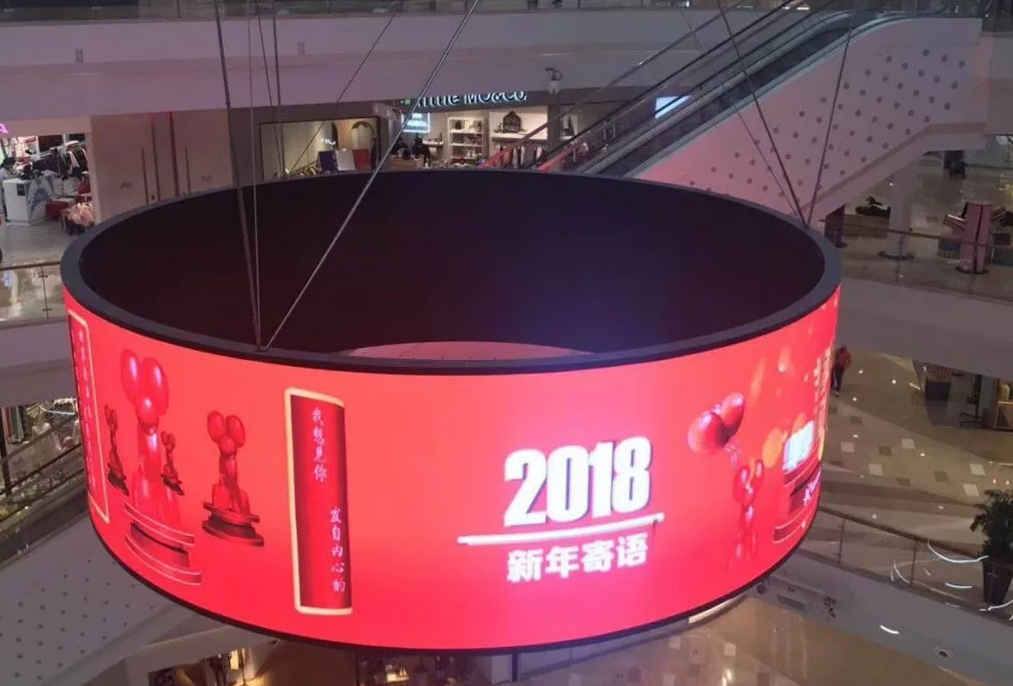
How Circular LED Screens Are Made
Understanding the production process helps you evaluate quality claims and spot shortcuts that affect long-term reliability.
From Flat Module to Circular Form
Standard LED modules are rectangular. Achieving a true circular display requires one of two approaches:
Approach 1 — Flexible PCB modules: The LED circuit board is manufactured on a flexible substrate (typically 240×120mm or 320×160mm panels) that can bend to conform to a curved surface. This method achieves smooth curves but has a higher per-module cost and requires careful thermal management.
Approach 2 — CNC-machined arc cabinets: Standard rigid LED modules are mounted in precision-cut arc-shaped aluminum or steel cabinets that approximate the circular form. The seams between modules must be minimized through tight manufacturing tolerances. This is the more common approach for large-diameter displays.
Key Production Steps
- Design and pixel mapping — The circular geometry requires custom pixel mapping software to ensure content displays without distortion. This is a step that flat-panel installations skip entirely.
- Substrate and LED chip fabrication — N-type and P-type semiconductor layers are deposited to form the LED chips, with the active light-emitting layer sandwiched between them.
- Module assembly — LED chips are soldered to the PCB, then encapsulated with silicone potting compound (for outdoor/IP65 models) or standard resin (indoor).
- Cabinet fabrication — Arc-shaped cabinets are CNC-machined to the specified radius. Tolerances of ±0.5mm are required for seamless module joins.
- System integration — Control cards, power supplies, and data receivers are installed. For circular displays, the control system must support non-rectangular canvas mapping (e.g., Novastar VX600 or equivalent).
- Quality testing — Full-white, full-red, full-green, and full-blue burn-in tests are run for 24–72 hours before shipping.
Circular vs. Flat LED Screen: Core Differences
Before committing to a circular form factor, understand what you’re trading off:
| Dimension | Circular LED Screen | Standard Flat LED Screen |
|---|---|---|
| Visual impact | High — unique focal point, 360° visibility option | Standard — familiar rectangular format |
| Display area efficiency | Lower — circular area = π×r² vs. full rectangle | Higher — full rectangular area utilized |
| Production complexity | High — custom cabinets, pixel mapping required | Low — standard modular assembly |
| Cost premium | +20–50% over equivalent flat panel | Baseline |
| Content creation | Requires circular-format templates | Standard 16:9 or custom aspect ratio |
| Maintenance | Modular replacement possible; cabinet access more complex | Straightforward front or rear access |
| Installation | Requires structural engineering for suspended types | Standard wall mount or floor stand |
| Best application | Brand activation, retail focal point, art installation | Information display, video wall, signage |
The circular format is not a universal upgrade — it’s a deliberate creative choice. If your primary goal is information density or video content area, a flat panel delivers more display per dollar. If your goal is visual differentiation and brand impact, the circular form justifies the premium.
Technical Specifications: What to Evaluate
Pixel Pitch and Viewing Distance
This is the most consequential spec decision. Overspending on fine pitch for a long-distance installation is the most common waste in circular LED procurement.
| Pixel Pitch | Min. Viewing Distance | Optimal Range | Typical Application |
|---|---|---|---|
| P1.5 – P1.8 | 1.5m | 1–3m | Luxury retail counter, close-range brand display |
| P2 – P2.5 | 2m | 3–6m | Shopping mall atrium, hotel lobby, conference room |
| P2.9 – P3.9 | 3m | 6–15m | Exhibition hall, stage backdrop, outdoor event |
| P4 – P6 | 4m | 10–30m | Outdoor billboard, stadium, large venue |
| P8 – P10 | 8m | 20m+ | Large outdoor installations, rooftop displays |
Practical rule: Measure the distance from the screen to your nearest regular viewer. That number in meters, multiplied by 0.8, gives you the maximum pixel pitch you should specify. For a retail window where customers stand 3m away: 3 × 0.8 = P2.4 → specify P2 or P2.5.
Brightness Requirements
| Environment | Recommended Brightness | Notes |
|---|---|---|
| Dim indoor (gallery, lounge) | 300–500 nits | Avoid glare; eye comfort priority |
| Standard indoor (retail, lobby) | 600–1,000 nits | Covers most commercial indoor conditions |
| Bright indoor (near windows) | 1,000–1,500 nits | Compensates for ambient daylight |
| Semi-outdoor / covered | 2,000–3,500 nits | Canopies, covered walkways |
| Full outdoor | 4,500–6,500 nits | Direct sun exposure; IP65 required |
Auto-brightness control (sensor-driven dimming) is strongly recommended for any installation that operates across day and night cycles. Running a 5,000-nit panel at full power overnight wastes 35–45% of electricity and accelerates LED degradation.
IP Rating by Installation Environment
| Location | Minimum IP Rating | Recommended |
|---|---|---|
| Fully indoor, climate-controlled | IP20 | IP30 |
| Indoor with humidity (pool, kitchen) | IP54 | IP65 |
| Covered outdoor (canopy, awning) | IP54 | IP65 |
| Direct outdoor exposure | IP65 | IP66 |
| Coastal / high-humidity outdoor | IP65 | IP66 + anti-corrosion coating |
2026 Pricing Guide: What Circular LED Screens Actually Cost
All prices are FOB China factory unless noted. Add 25–40% for shipping, import duties, and local installation.
Price Per Square Meter by Pixel Pitch
| Type | Pixel Pitch | Price per m² (USD, ex-factory) |
|---|---|---|
| Indoor fine pitch | P1.2 – P1.8 | 1,200–2,800 |
| Indoor standard | P2 – P3 | 700–1,400 |
| Indoor economy | P3 – P5 | 350–850 |
| Outdoor standard | P2.5 – P4 | 900–1,700 |
| Outdoor economy | P5 – P10 | 550–1,100 |
| Circular structure premium | All types | +20–50% on top of module cost |
Turnkey Budget by Display Size
| Diameter | Effective Area | Total Budget (USD, installed) | Typical Use Case |
|---|---|---|---|
| 0.5 – 1m | 0.2 – 0.8m² | 1,800–4,000 | Retail counter, reception desk |
| 1 – 2m | 0.8 – 3.1m² | 3,500–8,000 | Retail window, small lobby |
| 2 – 3m | 3.1 – 7.1m² | 8,000–18,000 | Shopping mall, hotel atrium |
| 3 – 5m | 7.1 – 19.6m² | 18,000–45,000 | Large venue, stage backdrop |
| 5m+ | 19.6m²+ | 45,000–100,000+ | Landmark installation, stadium |
Real Project Cost Breakdown (Reference Cases)
Case 1 — Wall-mounted retail display (1.8m diameter, P1.8 indoor)
- LED modules: $2,400
- Custom arc cabinet + mounting bracket: $700
- Video controller + circular pixel mapping: $400
- Air freight: $300
- Total hardware: ~$3,800 (local installation additional)
Case 2 — Suspended atrium ring (3.5m OD, P2.5 indoor, double-sided)
- LED modules, dual-sided: $11,200
- Steel rigging, motorized winch, safety cables: $2,800
- Control system (Novastar VX600): $900
- On-site installation supervision (5 days): $2,500
- Sea freight (DDP): $350
- Full turnkey: ~$17,750
Case 3 — Portable outdoor trade show (1.2m diameter, P3 outdoor IP65)
- LED modules + IP65 enclosure: $1,900
- ATA flight case + lift trolley: $600
- Novastar processor: $300
- Total: ~$2,800 (self-contained, no on-site engineer)
Scaling note: Going from a 3m to a 4m diameter circle increases display area by nearly 80% (from 7.1m² to 12.6m²). Budget increases are non-linear — plan accordingly when scaling up.
Five-Factor Selection Framework
Factor 1 — Viewing Distance Determines Pixel Pitch
Already covered above, but worth restating as the first decision: measure your minimum viewer distance before looking at any other spec. Everything else is secondary.
Factor 2 — Installation Type Determines Structure Cost
The four main installation types have very different structural requirements and cost implications:
- Wall-mounted (fixed): Lowest structural cost. Requires wall load capacity assessment for displays > 2m diameter.
- Suspended (atrium/ceiling): Requires structural engineering sign-off, rigging hardware, and safety cables. Add 2,000–5,000 for rigging on displays > 2m.
- Floor-standing (portable): Highest flexibility, lowest installation cost. Suitable for events and trade shows. Requires stable base for displays > 1.5m.
- Curved surface / column wrap: Uses flexible modules. Higher module cost but eliminates cabinet fabrication. Best for architectural integration.
Factor 3 — Content Strategy Affects Spec Requirements
Circular displays require content designed for the format. Before specifying hardware, confirm:
- Will you use static images or video? Video requires a higher-performance control system and media player.
- Will the display be filmed or live-streamed? If yes, specify ≥3,840 Hz refresh rate to avoid moiré patterns on camera.
- Who manages content updates? App-controlled systems (iOS/Android) are suitable for non-technical operators; PC-based systems offer more flexibility for complex content.
Factor 4 — Environment Determines IP Rating and Brightness
Use the tables above to match IP rating and brightness to your installation environment. The most common mistake: specifying indoor-grade panels (IP20–IP40) for semi-outdoor locations like covered walkways or building entrances, where condensation and dust ingress cause premature failure.
Factor 5 — Total Cost of Ownership, Not Just Purchase Price
The purchase price is typically 50–65% of the 5-year total cost of ownership. Factor in:
| Cost Component | Typical Range | Notes |
|---|---|---|
| Hardware (panel + structure + control) | 50–65% of TCO | One-time |
| Installation and commissioning | 10–25% of hardware cost | One-time |
| Annual maintenance | 3–8% of hardware cost/year | Preventive + reactive |
| Power consumption | Varies by size and brightness | Ongoing |
| Content management | 0–2,000/year | Depends on complexity |
| Spare parts (modules, power supplies) | Budget 5% of hardware/year | After warranty period |
Modular designs that support single-module replacement significantly reduce maintenance costs — a failed module in a non-modular display can require replacing an entire cabinet section.
Circular LED Screen Design Variants in 2026
The market has expanded beyond simple flat circular panels. Current variants include:
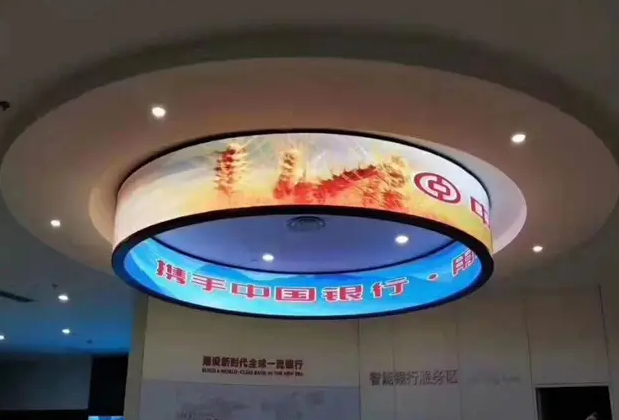
- Ring/donut displays: Hollow center with LED on the outer ring. Common in retail and hospitality for aesthetic integration with lighting fixtures.
- 3D naked-eye circular LED: Curved LED surfaces engineered to create depth illusions without glasses. Increasingly used in flagship retail and brand activations.
- Double-sided circular displays: LED on both faces of a suspended disc. Maximizes visibility in high-footfall atrium environments.
- Flexible column wraps: LED strips conforming to cylindrical columns. Technically circular but architecturally integrated rather than freestanding.
- Interactive circular displays: Touch or motion-sensor enabled. Used in museums, exhibitions, and high-end retail for visitor engagement.
Summary
Circular LED screens deliver visual impact that rectangular panels cannot match, but they carry a 20–50% structural premium and require custom pixel mapping, content design, and installation engineering. The right specification starts with viewing distance (which determines pixel pitch), then environment (which determines brightness and IP rating), then installation type (which determines structural cost). For a 2026 purchase, budget 3,500–8,000 for a small retail installation and 18,000–45,000 for a large venue display — fully installed. Always request an itemized quote that separates panel cost, structure, control system, freight, and installation labor.