Table of Contents
ToggleAn outdoor traffic LED display is a high-brightness outdoor LED system used to communicate traffic, road, public-service, or guidance information to drivers and other road users. In traffic-control applications, these systems are commonly implemented as Variable Message Signs (VMS), Dynamic Message Signs (DMS), or Changeable Message Signs (CMS) rather than as ordinary advertising billboards. NTCIP defines a DMS as a sign system capable of changing the message presented to motorists and identifies the sign face, housing, controller, and controller cabinet as major components.
For buyers, the most important decision is not simply choosing the brightest or highest-resolution LED screen. The right configuration depends on viewing distance, road speed, message size, daylight conditions, environmental exposure, maintenance access, control-system integration, local regulations, and total cost of ownership.
| Item | What Buyers Should Evaluate |
|---|---|
| Primary applications | Highways, urban roads, tunnels, traffic guidance, public information, selected transport applications |
| Common terminology | VMS, DMS, CMS, traffic guidance LED display |
| Key specifications | Pixel pitch, luminance, contrast, viewing angle, IP protection, thermal management |
| Control | Local controller, networked control, remote monitoring, traffic-management integration |
| Compliance | Local road authority requirements; U.S. projects may involve MUTCD and NTCIP requirements |
| Price | Project-specific; hardware is only one part of total project cost |
| Main advantage | Fast, highly visible, remotely changeable information |
| Main limitation | A traffic display is a system, not simply an outdoor LED billboard |
One important distinction should be made before procurement: a traffic LED display and an outdoor advertising LED billboard are not automatically interchangeable. In the United States, the current MUTCD is the 11th Edition with Revision 1, dated December 2025, effective March 5, 2026. Its Chapter 2L treats Changeable Message Signs as traffic control devices and establishes requirements for their message design and use.
What Is an Outdoor Traffic LED Display?
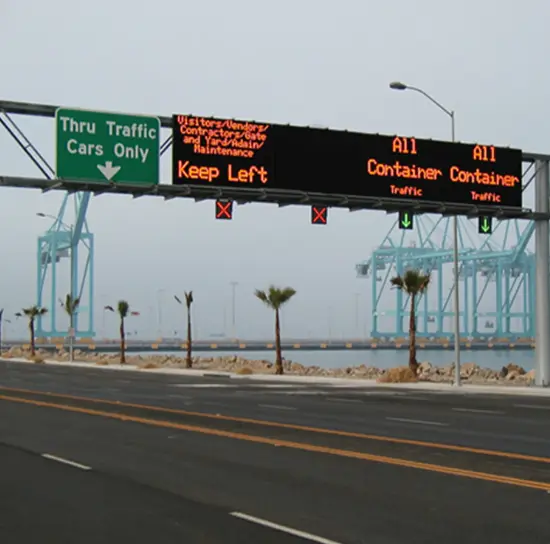
An outdoor traffic LED display is an electronic visual information device designed to communicate changing information in an outdoor road or transportation environment.
Unlike a conventional static traffic sign, an LED traffic display can change its message electronically. Depending on the application, it may show:
- Traffic conditions
- Road closures
- Detours
- Travel information
- Congestion warnings
- Weather-related information
- Emergency messages
- Lane or route guidance
- Public-service information
- Parking or transportation information
In formal traffic-management applications, terminology matters. VMS, DMS, and CMS are often used to describe variable or changeable traffic-message systems, although exact terminology varies by country and agency.
NTCIP’s current DMS documentation describes a Dynamic Message Sign as a system that can change the message presented to the viewer and includes the display face, environmentally protective housing, controller, and related control equipment.
This means the LED panel is only one part of the solution.
A complete traffic display may include:
- LED modules and cabinets
- Receiving and control cards
- A sign controller
- Communication equipment
- Power distribution
- Brightness-control equipment
- Environmental protection
- Mounting structure
- Remote monitoring
- Integration with a traffic-management system
That distinction is important when comparing supplier quotations. A quotation for LED cabinets alone is not necessarily a quotation for a complete traffic-display system.
What Is the Difference Between a Traffic LED Display and an Advertising LED Billboard?
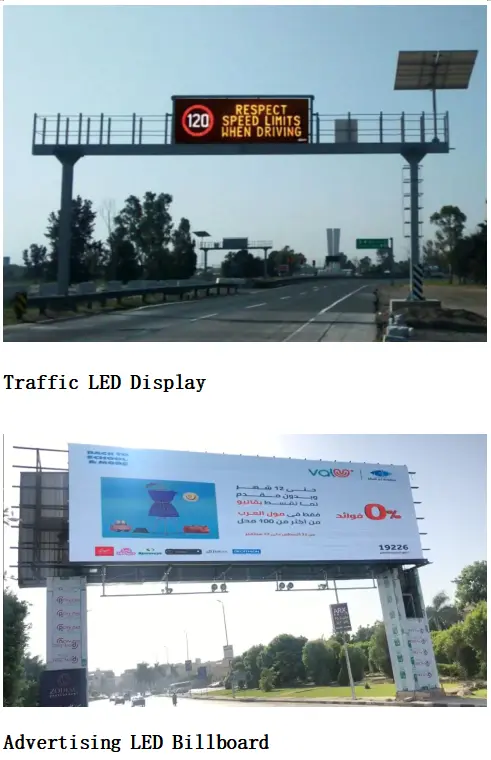
The hardware may look similar from a distance, but their design priorities can be very different.
| Factor | Traffic VMS / DMS / CMS | Outdoor Advertising LED Billboard |
|---|---|---|
| Primary purpose | Traffic information, warning, guidance or other permitted traffic messages | Commercial advertising and media |
| Message priority | Legibility, clarity and timely information | Visual impact and media presentation |
| Content | Usually controlled by transportation requirements | Commercial content managed through an advertising CMS |
| Integration | May require traffic-management-system integration | Usually connected to media/CMS infrastructure |
| Message design | Subject to applicable traffic rules and agency requirements | Subject to advertising and local display regulations |
| Maintenance priority | Availability and rapid fault recovery | Availability and advertising uptime |
| Procurement focus | Safety, compliance, readability and reliability | Image quality, brightness, commercial performance and operating cost |
This distinction is more than terminology.
The current U.S. MUTCD states that a CMS is a traffic control device and that messages displayed on CMS must follow the applicable traffic-control design principles.
Therefore, a buyer should not assume that installing a standard outdoor advertising LED billboard automatically creates a compliant traffic-message sign.
For projects controlled by a transportation authority, the specification issued by that authority should take precedence over a generic LED-display specification.
Where Are Outdoor Traffic LED Displays Used?
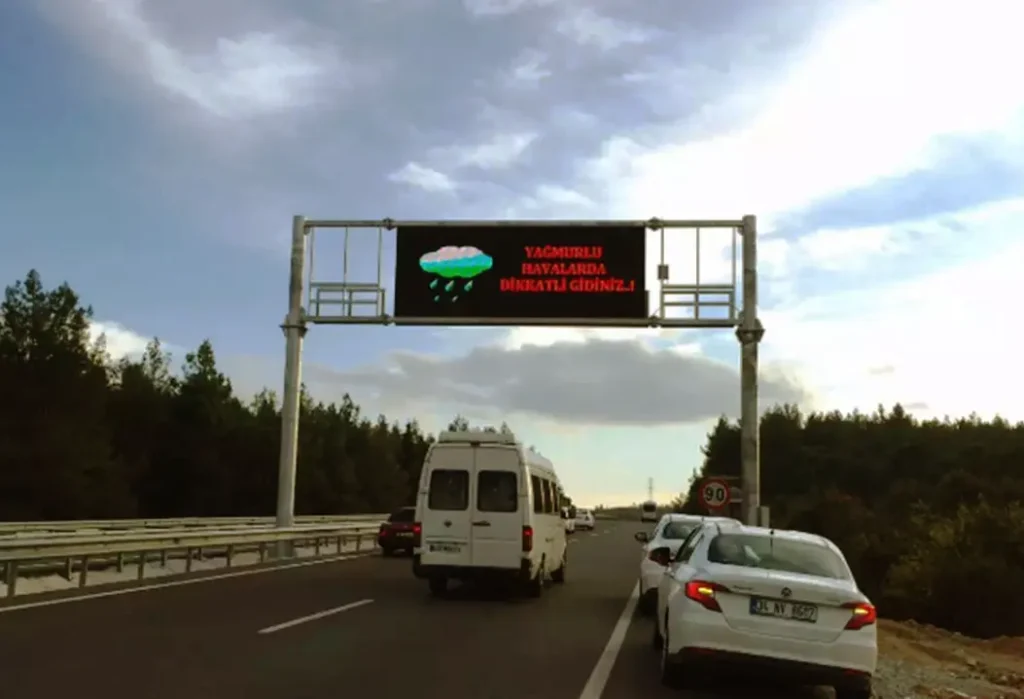
Traffic LED displays are used wherever information must reach road users quickly and visibly.
Highways and Freeways
Highway applications typically require long-distance readability, strong daylight performance, weather resistance, and reliable operation.
Typical information can include:
- Traffic congestion
- Road closures
- Accident warnings
- Detours
- Weather warnings
- Travel information
- Emergency instructions
The display should be designed around the driver’s actual decision-making distance rather than around a preferred LED pixel pitch.
A large display with the wrong message size is not necessarily more effective than a smaller, correctly configured sign.
Urban Roads and Intersections
Urban traffic environments introduce different challenges.
Drivers may be closer to the display, but the visual environment can be more complicated because of:
- Street lighting
- Buildings
- Vehicle headlights
- Other signs
- Pedestrian activity
- Advertising displays
- Shorter decision distances
In these situations, message organization, contrast, viewing angle and update speed can matter as much as raw brightness.
Tunnel Applications
Tunnel displays operate under a different environmental and visibility profile.
The engineering requirements may include:
- High humidity
- Vehicle exhaust
- Restricted maintenance access
- Limited natural ventilation
- Emergency operation
- Strong contrast
- Reliable communication
The appropriate configuration should therefore be determined from the tunnel’s actual environmental and traffic-management requirements rather than simply copying an outdoor highway configuration.
Transportation Hubs and Public Information
LED displays may also be used around:
- Bus stations
- Railway facilities
- Airports
- Parking facilities
- Transportation terminals
However, these should not automatically be classified as regulated traffic VMS installations. The required specifications depend on the information being displayed and the authority responsible for the site.
Which Specifications Matter Most for an Outdoor Traffic LED Display?
The most useful specification sheet is not necessarily the one with the longest list of numbers.
For traffic applications, buyers should prioritize the specifications that affect what a driver can actually see, understand and act upon.
Pixel Pitch and Viewing Distance
Pixel pitch is the center-to-center distance between adjacent pixels.
A smaller pitch provides higher pixel density, but smaller pixel pitch is not automatically better for a highway traffic sign.
For example:
- A close-viewing urban display may benefit from a finer pitch.
- A large highway sign viewed from a greater distance may prioritize character size, luminance, contrast and overall sign dimensions.
- A very fine pitch can increase hardware cost without producing a meaningful benefit if the viewing distance is large.
The correct selection should therefore start with:
Viewing distance → required character size → display dimensions → pixel pitch
rather than:
Pixel pitch → screen purchase
This is one of the most important differences between consumer-style LED selection and engineering-led procurement.
Brightness Is Important, but Maximum Brightness Is Not the Objective
Outdoor traffic displays must remain readable under changing ambient light.
A highway display may encounter:
- Direct sunlight
- Low-angle sunlight
- Cloudy conditions
- Nighttime darkness
- Headlight glare
- Wet-road reflections
The solution is therefore not simply to select the highest possible luminance.
Excessive brightness at night can create glare and reduce visual comfort. A properly designed system should consider brightness control and the relationship between luminance, contrast and ambient light.
The MUTCD also requires message displays on CMS to follow established traffic-control sign design principles, reinforcing the point that visibility should be evaluated as a complete sign-design problem rather than as a single brightness number.
Contrast Can Matter More Than Resolution
Resolution describes how many pixels the display contains.
Contrast determines how clearly the displayed information separates from its background.
For traffic information, especially text and symbols, insufficient contrast can make a high-resolution screen difficult to read.
Consider a driver approaching a sign at speed:
A technically high-resolution image is useless if the driver cannot distinguish the message quickly enough.
Therefore, procurement specifications should examine:
- Luminance
- Contrast
- Mask design
- LED optical characteristics
- Ambient-light conditions
- Viewing angle
- Message design
rather than treating pixel count as the only measure of quality.
Environmental Protection
Outdoor traffic displays may operate continuously while exposed to:
- Rain
- Dust
- UV radiation
- Wind
- Heat
- Cold
- Humidity
- Salt air
- Pollution
The enclosure and electronic components therefore need appropriate environmental protection.
IP rating is useful, but it should not be treated as the complete environmental specification.
Buyers should also ask about:
- Cabinet sealing
- Module protection
- Drainage
- Corrosion resistance
- Thermal management
- Cable entry
- Power protection
- Maintenance procedures
For coastal installations, for example, corrosion protection can be just as important as waterproofing.
Thermal Management
LED displays convert electrical energy into light and heat.
A traffic display operating for long periods in direct sunlight can experience substantially different internal conditions from a display operating indoors.
Good thermal design may involve:
- Aluminum cabinets
- Passive heat dissipation
- Airflow
- Temperature monitoring
- Controlled ventilation where required
- Automatic brightness adjustment
- Appropriate power-system design
The objective is not simply to advertise a low operating temperature.
The buyer should ask:
How does the supplier manage heat under the actual climate and operating schedule of the project?
That question is more useful than asking for a single laboratory temperature figure.
How Should You Choose Pixel Pitch for a Traffic LED Display?
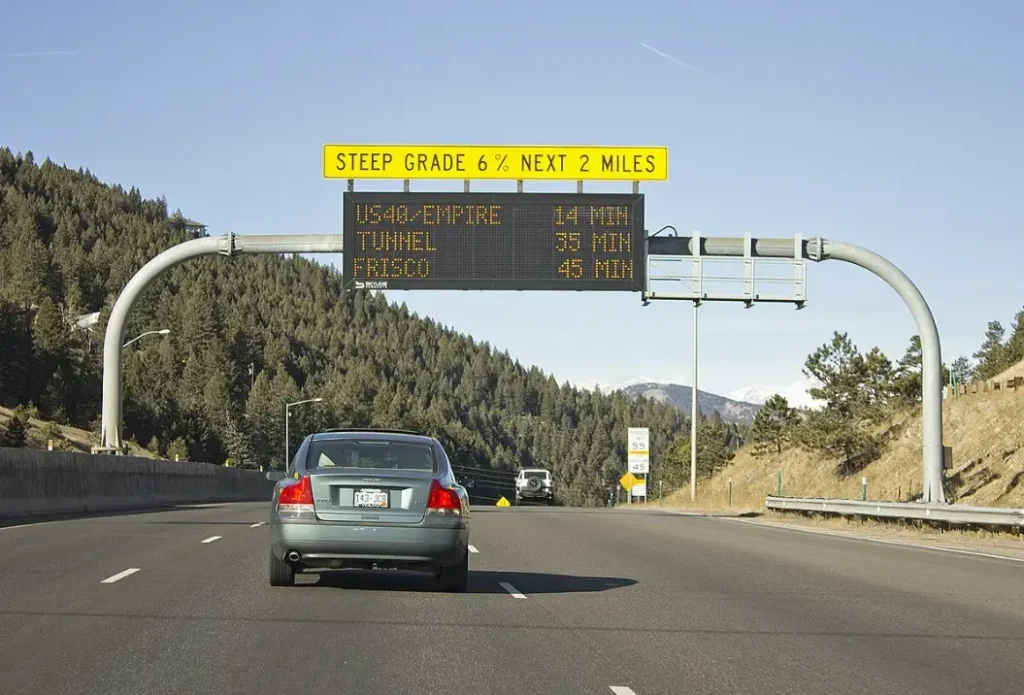
There is no universal “best” pixel pitch for every traffic application.
The choice should be based on the geometry of the sign and the driver’s viewing conditions.
A practical selection process is:
Step 1: Determine the Viewing Distance
Identify:
- Minimum reading distance
- Typical reading distance
- Maximum useful viewing distance
Step 2: Determine Road Speed
A display viewed by vehicles traveling at highway speed provides less time for message recognition than a display at a slow urban intersection.
Step 3: Define Message Content
Ask:
- How many characters are required?
- Are arrows needed?
- Are symbols needed?
- Is more than one message displayed?
- Is the display intended for text only or graphics as well?
Step 4: Determine Character Height
Character size must be appropriate to the driver’s distance and speed.
Step 5: Select Display Dimensions
Only after understanding the required information should the physical display size be finalized.
Step 6: Select Pixel Pitch
Pixel pitch is then selected to provide sufficient character and symbol definition at the intended viewing distance.
This process prevents a common procurement mistake:
Choosing the pixel pitch first and trying to make the traffic application fit afterward.
How Does a Traffic LED Display Connect to a Traffic Management System?
A modern traffic display may be part of a larger Intelligent Transportation System (ITS).
The architecture can include:
Traffic sensors → Traffic Management Center → Communication network → Sign controller → LED display
Depending on the project, data may come from:
- Traffic detectors
- Cameras
- Weather stations
- Incident-management systems
- Traffic-management software
- Operator input
The display controller then determines what information is presented.
What Is NTCIP?
For U.S. transportation projects, NTCIP can be relevant to how a management station communicates with and controls a Dynamic Message Sign. NTCIP 1203 v03 defines data elements for DMS applications and describes how a management station may interface with a field device to control and monitor the sign. Whether NTCIP is required, and which specific requirements apply, should be confirmed in the project’s procurement specification.
What Should Buyers Ask?
Before ordering, ask the supplier:
- Which communication interfaces are supported?
- Is NTCIP required by the project specification?
- Which NTCIP version is required?
- Can the display communicate with the existing traffic-management center?
- How are messages transferred?
- Is remote diagnostics available?
- What happens if communication is lost?
- Is local fallback control available?
- Can brightness and status be monitored remotely?
Do not accept “supports smart control” as a sufficient technical answer. Ask for the actual interface and compatibility documentation.
What Standards Apply to Outdoor Traffic LED Displays?
Standards depend heavily on the project location.
United States: MUTCD
For U.S. projects, the current MUTCD is the 11th Edition with Revision 1, dated December 2025, which became effective on March 5, 2026. Chapter 2L addresses Changeable Message Signs (CMS), including their use and message-display requirements. Always verify the applicable state and local transportation-agency requirements in addition to the National MUTCD.
Chapter 2L addresses Changeable Message Signs and specifies requirements relating to message characteristics and display principles.
NTCIP
NTCIP provides communication and object-definition standards used in intelligent transportation systems.
For DMS applications, NTCIP 1203 v03 is the published DMS object-definition standard currently listed by NTCIP.
Other Markets
Other countries and regions may have their own:
- Traffic-sign standards
- Road-authority specifications
- Electrical requirements
- EMC requirements
- Structural requirements
- Environmental requirements
- Communication standards
For example, China’s DB11/T 1273-2024 is a technical standard for LED traffic guidance displays used on urban roads and highways in Beijing. It defines the LED traffic guidance display as an outdoor LED device used to communicate traffic conditions, road conditions, route guidance, warnings, weather and environmental information.
The important procurement principle is:
Do not ask whether an LED display is “internationally compliant” in the abstract. Ask which exact standards, interface requirements, testing requirements, and local transportation-authority specifications apply to the project. Compliance is project- and jurisdiction-specific, and a supplier’s general statement of conformity should not replace review of the actual procurement specification.
How Much Does an Outdoor Traffic LED Display Cost?
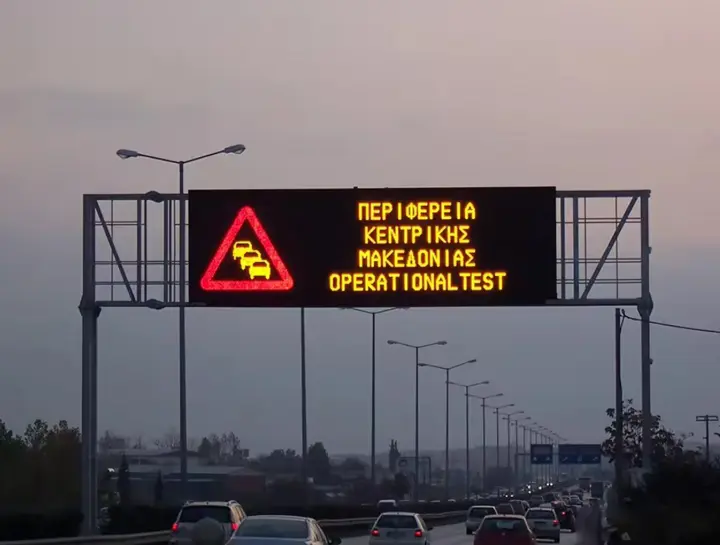
There is no reliable single 2026 price per square meter that applies to all outdoor traffic LED displays.
The previous version of this article listed prices such as $100–$600 per square meter for different pixel pitches. Those figures are not sufficiently documented to serve as current procurement benchmarks and should not be treated as 2026 market prices.
For traffic projects, the total quotation can include much more than LED cabinets.
| Cost Component | What It May Include |
|---|---|
| LED display | Modules, cabinets, power supplies, receiving cards |
| Controller | Sign controller and control hardware |
| Communication | Network equipment, fiber, cellular or other connectivity |
| Structure | Steel frame, gantry, poles, brackets |
| Foundation | Concrete and civil works |
| Electrical | Distribution, cables, protection and grounding |
| Installation | Labor, lifting equipment and commissioning |
| Logistics | Packaging, freight and local transportation |
| Customs | Duties, taxes and brokerage where applicable |
| Software | CMS or traffic-management integration |
| Maintenance | Spare modules, power supplies and control components |
| Monitoring | Remote diagnostics and network services |
Why Price per Square Meter Can Be Misleading
Two displays with the same physical area can have very different project costs.
For example, a simple roadside display may require only:
LED cabinets + controller + installation
while a highway VMS installation could additionally require:
LED cabinets + sign controller + communication + steel structure + foundation + electrical system + lightning protection + authority testing + integration + maintenance access
Therefore, $/m² should be treated as a component-level comparison, not a complete project price.
If a supplier provides a very low square-meter price, ask what has been excluded.
What Is the Total Cost of Ownership of a Traffic LED Display?
Initial purchase price is only one part of the economic decision.
A useful TCO model is:
TCO = Hardware + Control + Structure + Installation + Logistics + Infrastructure + Energy + Maintenance + Replacement Parts + Software/Network Costs
The exact values are project-specific.
Hardware
Includes:
- LED modules
- Cabinets
- Power supplies
- Receiving cards
- Controller
Structure
Large roadside displays may require engineered structures.
The structural design should consider:
- Screen dimensions
- Wind loading
- Mounting method
- Local building requirements
- Foundation conditions
- Maintenance access
Electricity
Electricity cost depends on:
- Screen area
- Maximum power
- Average operating power
- Operating hours
- Brightness settings
- Local electricity price
- Content characteristics
A supplier quoting only maximum power can therefore make two otherwise similar products difficult to compare.
Ask for both:
Maximum power consumption
and, where available:
Typical/average operating power under defined conditions.
Maintenance
Traffic displays should be evaluated for the cost and speed of service.
Ask:
- Is front maintenance possible?
- Is rear access required?
- How quickly can a module be replaced?
- Are spare parts available locally?
- Can the controller identify failed components?
- What happens if a power supply fails?
- What is the expected response process?
For a roadside installation, a five-minute module replacement and a five-hour structural-access procedure are not economically equivalent.
Can an Energy-Efficient Outdoor LED Display Reduce Operating Costs?
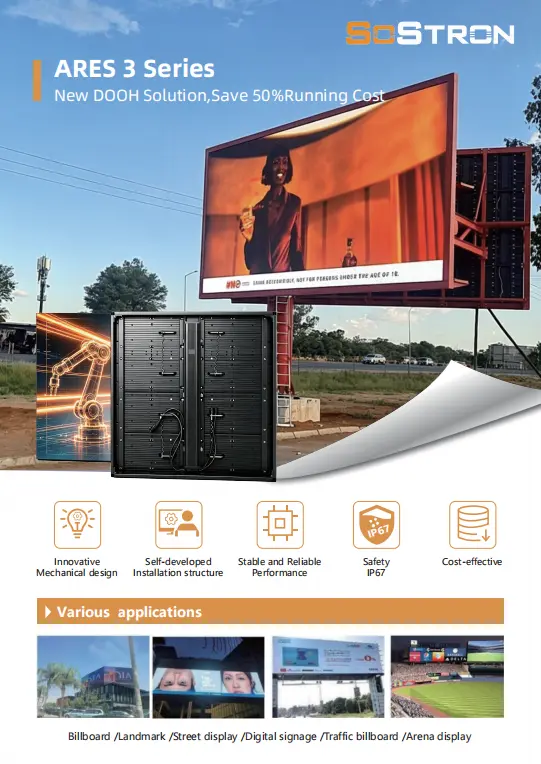
Potentially, yes—but the saving must be evaluated using actual project conditions.
Sostron’s Ares 3 product documentation currently specifies common-cathode technology, an aluminum cabinet design, front and rear maintenance, and published power-consumption figures for its listed configurations. The product page also states that brightness and power performance depend on configuration and operating conditions.
For a traffic application, the correct calculation should use:
Annual Energy Cost = Average Power × Operating Hours × Electricity Rate
For example, an energy-saving feature is more valuable for a display that operates continuously than for a screen that operates only a few hours per day.
The buyer should therefore compare:
- Initial equipment price
- Average operating power
- Expected operating hours
- Brightness-control strategy
- Maintenance cost
- Expected service conditions
rather than evaluating “energy saving” from a percentage alone.
What Should Buyers Ask About Installation?
Traffic LED displays often have more demanding installation requirements than ordinary indoor displays.
Before manufacturing begins, confirm:
Site Information
- Screen dimensions
- Mounting height
- Viewing distance
- Road orientation
- Wind conditions
- Ambient temperature
- Humidity
- Coastal exposure
- Access restrictions
Structural Requirements
- Pole or gantry design
- Steel structure
- Foundation
- Wind loading
- Maintenance walkway
- Service access
Electrical Requirements
- Input voltage
- Maximum load
- Distribution equipment
- Grounding
- Surge protection
- Cable routing
Communication Requirements
- Fiber
- Ethernet
- Cellular
- Other specified communication links
- Traffic-management-system interface
Sostron’s installation guidance similarly emphasizes location, mounting method, power supply, data connections, testing, security and maintenance as interconnected parts of successful LED deployment.
For a major roadside installation, these issues should be resolved before production—not after the cabinets arrive on site.
What Are the Hidden Risks in a Traffic LED Display Project?
The most expensive problems are not always caused by the LED modules themselves.
Risk 1: Wrong Viewing-Distance Assumption
A display can have excellent image quality but still fail the intended use if the message cannot be read from the required distance.
Risk 2: Treating Brightness as the Only Visibility Metric
High luminance without appropriate contrast and nighttime control can create a poor viewing experience.
Risk 3: Buying Hardware Before Defining Integration
If the transportation authority requires a particular communication architecture, compatibility should be confirmed before purchasing the display.
Risk 4: Ignoring Maintenance Access
A display installed over a highway is not easy to service.
Maintenance design should therefore be part of the original engineering package.
Risk 5: Comparing Quotations Only by $/m²
A low cabinet price may exclude:
- Controller
- Structure
- Installation
- Communication
- Power distribution
- Spare parts
- Software
- Integration
Risk 6: Treating an Advertising Display as a Traffic Sign
A display designed for commercial DOOH does not automatically satisfy traffic-control requirements.
This distinction should be established before the project specification is finalized.
Real Sostron Project Example: Brazil Highway Outdoor LED Display
Sostron has documented a highway outdoor LED project in Brazil that provides a useful example of the engineering considerations involved in roadside deployment.
According to Sostron’s published project information, the project is located along a major Brazilian highway corridor and uses a high-brightness outdoor LED advertising display system. The published configuration includes brightness of ≥6,500 nits, a steel pillar structure with wind-resistant reinforcement, and remote wireless/4G cloud-based control. The project has been operational since June 2025.
The project documentation also states that the display uses an IP65-rated structure and temperature-control system for the local climate.
However, this case should be interpreted accurately.
It is primarily documented by Sostron as an outdoor LED advertising display project that also supports traffic updates and public-service announcements. It should not automatically be represented as proof of a regulated government VMS deployment.
What Can a Roadside Outdoor LED Display Teach Buyers About Engineering?
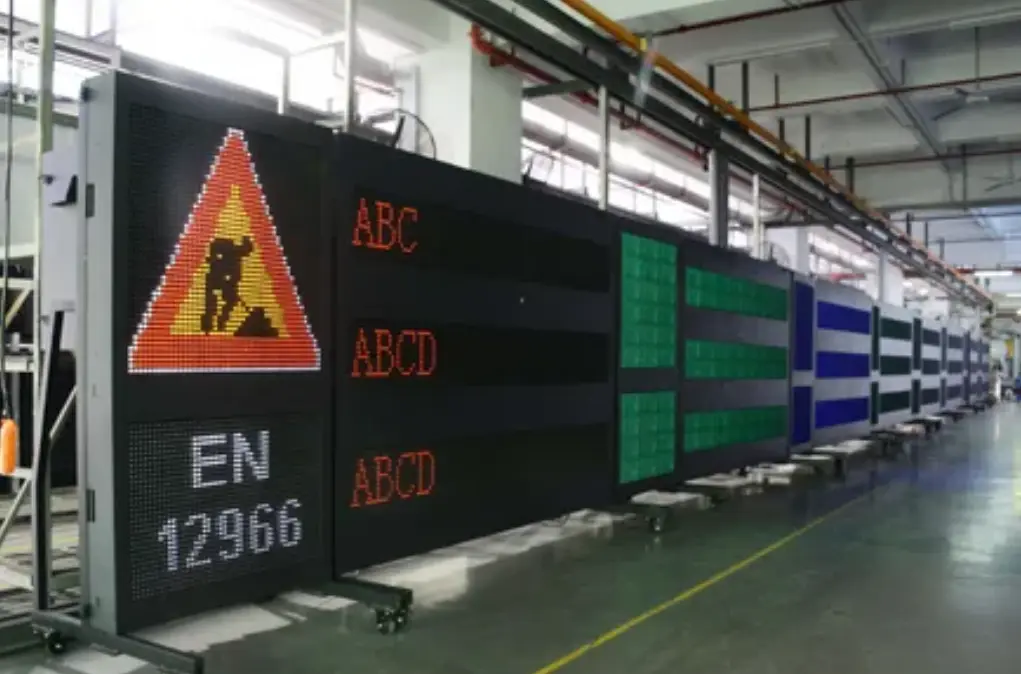
The Brazil project illustrates several practical points:
Brightness Must Match the Environment
The project uses ≥6,500 nits according to Sostron’s published documentation. That figure is project-specific and should not be copied as a universal requirement for every traffic display.
Structure Is Part of the Display System
The project uses reinforced steel pillars and accounts for local wind conditions.
This demonstrates why a screen quotation without structural engineering may not represent the final project cost.
Remote Control Has Practical Value
The project uses 4G/cloud-based control, allowing content updates without requiring personnel to physically access the screen.
For distributed roadside networks, remote monitoring and control can reduce unnecessary site visits and simplify content management.
Is a Standard Outdoor Advertising LED Screen Suitable for Traffic Guidance?
Not automatically.
A conventional outdoor LED billboard can have:
- High brightness
- Outdoor protection
- High refresh rate
- Remote CMS control
and still not meet the requirements of a traffic-control project.
The critical question is not:
“Can the screen display text?”
Almost every modern LED display can.
The real questions are:
Can it display the required traffic messages correctly, integrate with the required control architecture, meet the applicable standards, provide sufficient readability, and be maintained safely at the installation site?
For a transportation-authority project, the procurement specification should therefore be reviewed before selecting a commercial billboard platform.
When Is a More Expensive Traffic LED Configuration Justified?
A higher-priced configuration may be justified when it solves a real project constraint.
Higher Environmental Protection
Worth considering when the display is exposed to:
- Heavy rain
- Coastal salt
- Dust
- Extreme temperature
- High UV exposure
Better Maintenance Access
Worth considering when:
- The display is large
- The site is difficult to access
- Traffic disruption must be minimized
- Service time is expensive
More Advanced Control
Worth considering when:
- Multiple displays must be centrally managed
- The project uses a traffic-management center
- Remote fault monitoring is required
- Automatic message updates are required
Higher Energy Efficiency
Worth considering when:
- Displays operate 24/7
- Electricity is expensive
- The network contains many large displays
- Long-term operating cost matters more than lowest initial price
The principle is simple:
Pay more when the additional feature reduces a measurable project risk or recurring cost—not simply because the specification sheet looks more impressive.
What Should You Ask an Outdoor Traffic LED Display Supplier?
Before approving a purchase order, ask for written answers to the following.
Technical Questions
- What pixel pitches are available?
- What is the recommended viewing distance for the proposed configuration?
- What are the maximum and typical power-consumption figures?
- What luminance range is supported?
- How is automatic brightness adjustment implemented?
- What is the IP rating?
- How is thermal management handled?
- What are the operating-temperature limits?
- What maintenance access is required?
Control Questions
- What controller is included?
- Which communication interfaces are supported?
- Is NTCIP required or supported for the project?
- Can the display integrate with the existing traffic-management system?
- Is remote diagnostics available?
- What happens if network communication fails?
Installation Questions
- Is the steel structure included?
- Is structural engineering included?
- Is the foundation included?
- Who performs installation?
- Who performs commissioning?
- What electrical protection is required?
- What site information must be provided before manufacturing?
Maintenance Questions
- Are spare modules included?
- Are spare power supplies included?
- How quickly can failed modules be replaced?
- Is front or rear service available?
- Can individual faults be detected remotely?
- Where are replacement components stored?
Compliance Questions
- Which exact standards does the proposed configuration address?
- Which tests have been completed?
- Can test reports be provided?
- Does the configuration satisfy the local road authority’s project specification?
- If the project is in the United States, how does the proposed system align with the applicable MUTCD and NTCIP requirements?
A good supplier should be able to answer these questions with documentation rather than relying on phrases such as “international standard” or “high-quality LED.”
A Practical Buyer Checklist
Before selecting an outdoor traffic LED display, confirm these seven areas:
| Decision Area | Key Question |
|---|---|
| Application | Is this a traffic-control display, public-information display, or advertising display? |
| Readability | From what distance and at what vehicle speed must the message be understood? |
| Environment | What are the site’s sunlight, temperature, humidity, wind and corrosion conditions? |
| Hardware | Which pixel pitch, luminance, contrast and protection level are actually required? |
| Integration | How will the display communicate with the control system? |
| Compliance | Which standards and local authority requirements apply? |
| TCO | What will the project cost after installation, energy and maintenance are included? |
If these seven questions have not been answered, the project is probably not ready for a final hardware comparison.
Frequently Asked Questions
What is an outdoor traffic LED display?
An outdoor traffic LED display is an electronic LED information display designed for outdoor transportation environments. It can present changing traffic, road, warning, guidance or public-information messages. In formal traffic-management systems, the display may be classified as a VMS, DMS or CMS. The complete system can include LED modules, cabinets, controllers, communication equipment, power systems and remote monitoring rather than only the visible LED panel.
What is the difference between VMS, DMS and CMS?
The terminology varies by country and organization, but all three terms describe variable-message traffic-display concepts. NTCIP uses Dynamic Message Sign (DMS) for systems that can change the message presented to motorists. In U.S. MUTCD terminology, Changeable Message Sign (CMS) is a traffic-control device capable of displaying alternative messages. Always follow the terminology and definitions used in the project’s official specification.
What pixel pitch is best for a traffic LED display?
There is no universal best pixel pitch. It should be selected from the required viewing distance, road speed, character height, message density and display dimensions. Highway applications viewed from a long distance may not benefit from the same fine pixel pitch used for close-viewing urban displays. A supplier should therefore recommend pixel pitch after reviewing the site and message requirements rather than selecting it from screen resolution alone.
How bright should an outdoor traffic LED display be?
The required luminance depends on the environment, viewing conditions, display design and applicable project specification. A display must remain readable in strong daylight but should also provide appropriate nighttime brightness control. Sostron’s documented Brazil highway project uses ≥6,500 nits, but that is a project-specific configuration rather than a universal traffic-display requirement.
How much does an outdoor traffic LED display cost?
There is no reliable universal 2026 price per square meter. The final cost depends on display size and configuration as well as the controller, communication system, structural steel, foundation, electrical work, installation, transportation, taxes, software and maintenance requirements. Buyers should compare complete project quotations rather than relying only on the LED cabinet price per square meter.
Does a traffic LED display need NTCIP?
Not every traffic display in every country requires NTCIP. However, NTCIP can be an important requirement for U.S. intelligent transportation projects. NTCIP currently lists NTCIP 1203 v03 as its published standard for Dynamic Message Signs. The actual project specification and transportation authority requirements should determine whether and which NTCIP requirements apply.
Can an advertising LED billboard be used for traffic information?
It can potentially display traffic-related information, but that does not automatically make it a compliant traffic-control sign. A commercial billboard and a regulated VMS/DMS/CMS can have different requirements for message content, control, integration, readability and compliance. For transportation-authority projects, buyers should verify the complete system against the applicable local specification before procurement.
Final Takeaway
The best outdoor traffic LED display is not necessarily the screen with the smallest pixel pitch, highest brightness, or lowest price.
The better approach is to work backward from the transportation problem:
Road environment → viewing distance → vehicle speed → message requirements → readability → display configuration → control system → compliance → installation → maintenance → TCO
That approach also explains why traffic-display procurement is different from buying a conventional outdoor advertising billboard.
Sostron provides outdoor LED display manufacturing, product development, engineering support, customized display solutions, installation guidance and after-sales service for commercial LED projects. Its documented product portfolio includes outdoor fixed LED systems such as the Ares and Ares 2 series, while its project documentation includes highway and roadside deployments.
For a traffic project, however, the final configuration should always be developed from the actual site conditions, communication requirements, applicable standards and authority specifications rather than from a generic product configuration.
That is the difference between buying an outdoor LED screen and engineering an outdoor traffic information system.
References:
FHWA — MUTCD 11th Edition with Revision 1
NTCIP — NTCIP 1203 v03, Object Definitions for Dynamic Message Signs

About SoStron
Marketing Strategic Director at Sostron