An immersive exhibition is a spatial experience that surrounds visitors with coordinated visuals, sound, lighting, architecture, and interactive technology. An immersive LED display can form the visual core of this environment, using fine-pitch LED walls, curved screens, floor displays, ceiling displays, or multi-sided CAVE configurations. For buyers, the right solution depends on viewing distance, screen area, pixel pitch, content resolution, installation structure, and total project cost—not simply the LED price per square meter.
| Project Requirement | Recommended Direction |
|---|---|
| Close-range museum or showroom | Fine-pitch LED such as P1.2–P2.5 |
| Large immersive room | Multi-surface LED wall or CAVE configuration |
| Curved environment | Curved or flexible LED display |
| Interactive experience | LED floor + sensors + interactive content |
| Temporary exhibition or event | Rental LED display |
| Very large irregular surface | Consider LED, projection, or a hybrid system |
Modern immersive exhibitions are no longer limited to projection walls. Current projects increasingly combine LED walls, floors, ceilings, projection, interactive systems, spatial audio, and real-time digital content to create a continuous visual environment.
What Is an Immersive Exhibition?
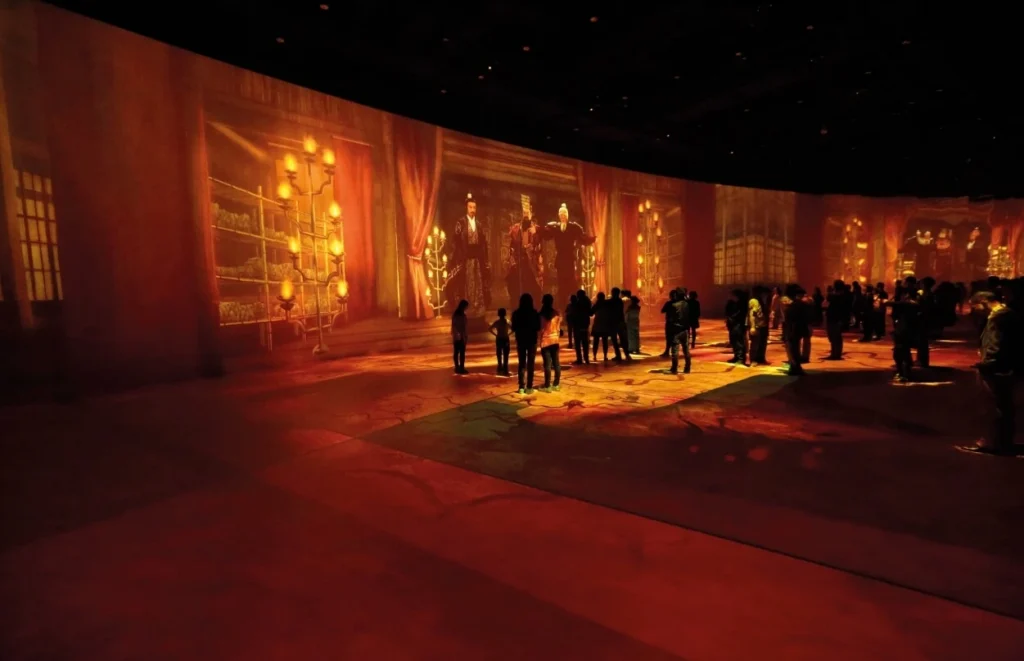
An immersive exhibition is an exhibition format in which visitors enter a digitally enhanced environment rather than simply standing in front of individual exhibits.
Instead of presenting information through isolated displays, an immersive exhibition uses space as part of the storytelling system. Images can extend across walls, floors, ceilings, curved surfaces, or multiple synchronized LED screens. Sound, lighting, motion, and interactive elements can then reinforce the visual content.
This distinction is important when planning an immersive exhibition hall. The objective is not simply to install the largest LED screen possible. The objective is to create a continuous relationship between content, display surface, physical space, and visitor movement.
A practical immersive exhibition can therefore use LED technology, projection mapping, interactive media, VR/AR/XR, spatial audio, or a combination of these technologies.
What Makes an Exhibition Truly Immersive?
A large screen alone does not automatically create an immersive experience.
A successful installation normally combines several layers:
- Visual coverage: LED walls, curved displays, floors, ceilings, or projection surfaces.
- Content: High-resolution video, 3D animation, digital art, data visualization, or branded storytelling.
- Spatial design: The physical room guides how visitors enter, move, view, and interact with the experience.
- Audio: Directional or spatial sound can reinforce the sense of location and depth.
- Interaction: Sensors, cameras, touch interfaces, motion tracking, or interactive floors can allow the environment to respond to visitors.
- Synchronization: Multiple display surfaces must maintain consistent timing, color, brightness, and geometry.
This is why an immersive LED display should be treated as part of a complete AV and content system rather than as a standalone video wall.
Common Types of Immersive Exhibitions
Dome and 360-Degree Environments
A dome surrounds the audience with a curved visual surface, creating a strong sense of spatial depth. Projection is frequently used in dome applications, although LED technology can also be incorporated into large-format immersive environments.
This format is particularly suitable for:
- Planetariums
- Science museums
- Cultural exhibitions
- Digital art
- Educational experiences
- Entertainment venues
Box or CAVE Immersive Rooms
A CAVE-style environment places display surfaces around the visitor.
A basic configuration may use three walls, while more advanced systems can add the ceiling and floor. A recent P1.25 exhibition project, for example, integrated left and right LED walls, a front wall, an LED ceiling, and an LED floor to create a continuous multi-surface visual environment.
This configuration is particularly effective when content needs to move naturally around the visitor rather than remain inside a single rectangular frame.
360-Degree and Curved LED Environments
Curved LED displays can reduce the visual interruption created by sharp corners and allow designers to build panoramic or cylindrical environments.
They are useful for:
- Brand experience centers
- Corporate showrooms
- Museums
- Exhibition booths
- Retail environments
- Entertainment spaces
For temporary events, rental LED systems with curved capability can also reduce installation time and provide more flexibility for changing venue layouts.
What LED Displays Are Used in Immersive Exhibitions?
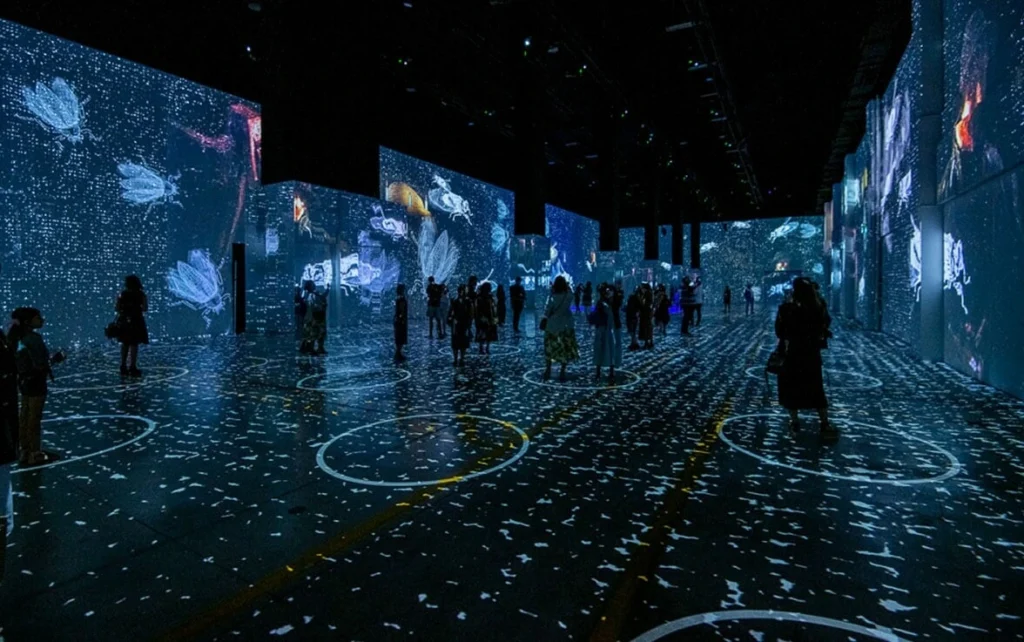
There is no single LED display type for every immersive exhibition. The correct choice depends on viewing distance, room dimensions, content requirements, geometry, and whether the installation is permanent or temporary.
Fine-Pitch LED Display
Fine-pitch LED is usually preferred when visitors stand relatively close to the screen.
A smaller pixel pitch produces a higher pixel density and allows the display to maintain greater image detail at shorter viewing distances. P1.2, P1.5, P1.8, P2.0, and P2.5-class products are commonly considered for high-resolution indoor applications.
For example, a recent immersive exhibition project used P1.25 LED across multiple display surfaces specifically to support high-definition close-range viewing.
The key point is that smaller pixel pitch is not automatically better. It should be selected according to viewing distance, screen size, content resolution, and budget.
Curved and Flexible LED Displays
Curved LED displays are useful when the visual surface needs to follow the architecture.
Flexible modules can be used for more complex curves, while rental cabinets with controlled curvature can create concave or convex configurations.
The engineering challenge is not simply making a screen curve. The system must maintain:
- Pixel alignment
- Cabinet flatness
- Color consistency
- Mechanical stability
- Signal continuity
- Seam consistency
For immersive applications, these details become particularly important because viewers may see the display from multiple angles.
LED Floor Screens
An LED floor screen extends the visual experience below eye level.
When combined with motion sensors or interactive software, the floor can respond to footsteps or visitor movement. This turns the floor from a passive surface into an interactive part of the exhibition.
For example, SoStron’s Hima series is designed for floor-screen applications and interactive installations, with configurations available for indoor and outdoor use.
LED Ceiling Displays
Ceiling LED can complete a room-scale immersive environment.
When content moves continuously from wall to ceiling, visitors no longer perceive the display as a conventional rectangular screen. Instead, the entire room becomes a digital canvas.
However, ceiling installations require additional attention to:
- Structural loading
- Rigging
- Maintenance access
- Heat dissipation
- Safety attachments
- Cable routing
These engineering requirements should be included in the initial design rather than added after the LED system has been selected.
LED vs Projection for Immersive Exhibitions

Projection remains an important technology for immersive exhibitions, and LED should not automatically be considered the universal solution.
Projection is particularly useful when designers need to cover very large or irregular architectural surfaces. It can also be effective for temporary artistic installations and projection mapping.
LED displays generally have advantages when the project requires:
- High brightness
- Strong contrast
- Close-range viewing
- Consistent image quality
- Physical durability
- Modular installation
- Interactive floor integration
- Long-term operation
Some modern exhibition projects combine both technologies. For example, Creative Expo Taiwan integrated high-brightness laser projection with a foldable LED display rather than relying on one display technology alone.
The best solution is therefore determined by the space and content, not by the technology label.
Immersive LED Display Price: What Does It Cost?
There is no universal immersive LED display price because an immersive installation is normally a complete system rather than a single LED wall.
A realistic project budget can include:
| Cost Component | What Influences the Cost |
|---|---|
| LED display | Pixel pitch, area, LED package, cabinet design |
| Video processor | Resolution, inputs, processing requirements |
| Media server | Content complexity and number of display surfaces |
| Structural system | Wall, ceiling, floor, curved or suspended installation |
| Content production | 2D/3D animation, interactive content, real-time rendering |
| Installation | Labor, calibration, rigging and site conditions |
| Transportation | Distance, packaging and project location |
| Interactive system | Sensors, cameras, tracking and software |
| Maintenance | Front/rear access, spare parts and service |
| Technical support | Commissioning and on-site operation |
Published exhibition and immersive-project cost guidance also shows why buyers should avoid evaluating a project solely by the quoted USD/m² figure. Installation, processors, rigging, transportation, technical labor, content and other services can materially change the total project cost.
For this reason, an immersive LED quotation should ideally be based on a complete project specification rather than only screen area.
How to Choose the Right Immersive LED Display
1. Start With Viewing Distance
Viewing distance should be one of the first technical parameters.
A visitor standing 1.5 meters from the wall has very different requirements from an audience standing 5 or 10 meters away.
The closer the audience, the more important pixel density becomes.
2. Calculate the Required Resolution
Do not select pixel pitch without considering the final screen dimensions and content resolution.
A very large display with a relatively coarse pixel pitch may create an unnecessary loss of detail when viewed from close range. Conversely, using an extremely fine pitch in a large room can increase the budget without providing a meaningful visual benefit.
3. Check Brightness for the Environment
Indoor immersive exhibitions generally require controlled brightness to prevent glare and viewer discomfort.
Outdoor or naturally lit environments require substantially higher brightness.
Brightness should therefore be specified according to ambient light, viewing conditions, content type, and camera requirements—not simply by selecting the highest available specification.
4. Consider Refresh Rate and Camera Performance
If an immersive installation will be filmed for social media, advertising, livestreaming, or broadcast production, refresh rate becomes especially important.
A high refresh-rate LED system can help reduce visible scanning and flicker on camera.
5. Plan Content Before Finalizing the LED Layout
This is one of the most overlooked parts of immersive LED design.
The content should be designed for the actual:
- Screen resolution
- Aspect ratio
- Corner geometry
- Viewing path
- Display surfaces
- Playback system
If the content is designed after the hardware is installed, the project may require unnecessary cropping, scaling, or reconstruction.
How to Build an Immersive Exhibition
Step 1: Define the Visitor Journey
Start with the experience rather than the screen.
Determine where visitors enter, where they stop, what they see first, how they move through the room, and where the main visual or interactive moment occurs.
Step 2: Map the Physical Space
Measure:
- Room width
- Room height
- Wall dimensions
- Ceiling height
- Floor area
- Viewing distances
- Entry and exit points
- Structural limitations
These measurements determine whether a flat wall, curved LED, CAVE, floor-to-ceiling system, or hybrid solution is appropriate.
Step 3: Select the Display Configuration
Choose between:
- Flat LED wall
- Curved LED wall
- Three-sided CAVE
- Five-sided CAVE
- LED floor
- LED ceiling
- Projection
- Hybrid LED + projection
Step 4: Design the Content and Control System
The LED display is only the output layer.
A professional immersive system may require a combination of media servers, processors, content management software, sensors, cameras, and synchronization systems.
For multi-surface installations, accurate calibration and synchronization are essential to prevent visible discontinuities between screens.
Step 5: Test the Complete System
Before opening the exhibition, test:
- Brightness uniformity
- Color consistency
- Pixel alignment
- Content synchronization
- Viewing angles
- Audio synchronization
- Interactive response
- Emergency procedures
- Maintenance access
A visually impressive screen is not enough if the content breaks at the corners or the interactive system responds with noticeable delay.
Why Choose an LED Display for an Immersive Exhibition?
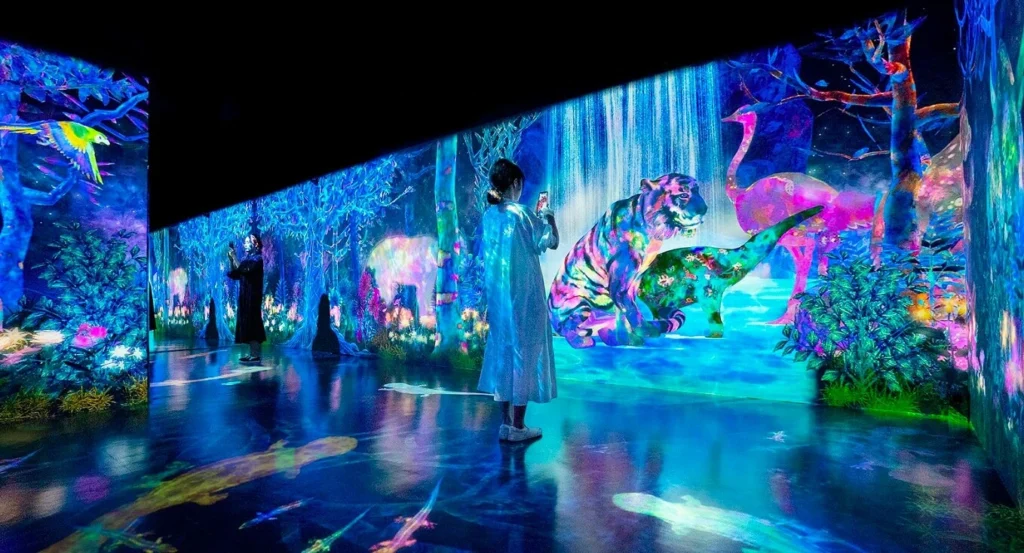
LED technology provides several advantages for professional immersive environments.
High brightness and contrast allow digital content to remain visually strong in controlled indoor environments and selected high-ambient-light applications.
Modular construction makes it possible to build large display surfaces and integrate multiple screens into architectural spaces.
Fine-pitch technology supports close-range viewing where conventional large-pitch displays may reveal visible pixel structure.
Creative geometry allows curved, floor, ceiling, and multi-surface configurations that are difficult to achieve with conventional flat displays.
Most importantly, an immersive LED display can become part of the architecture instead of remaining a separate piece of equipment.
What Should You Ask an Immersive LED Display Manufacturer?
Before placing an order, ask the supplier for more than a basic price quotation.
Request:
- Recommended pixel pitch and viewing distance
- Complete screen dimensions and resolution
- LED package and module specifications
- Brightness and refresh rate
- Cabinet dimensions and weight
- Power consumption
- Front/rear maintenance method
- Processor and control system
- Structural and installation requirements
- Content synchronization method
- Warranty and spare-parts policy
- Installation and commissioning scope
This approach makes it easier to compare suppliers on total project value, rather than choosing the lowest initial hardware quotation.
SoStron Immersive LED Display Solutions
SoStron is a Shenzhen-based LED display manufacturer providing LED display design, manufacturing, engineering support, installation guidance, and technical service for commercial display projects.
For immersive exhibitions, the solution can be configured around the project’s viewing distance, screen geometry, application environment, and content requirements. Rental products can also be considered for temporary exhibitions and events where rapid deployment and flexible configuration are important.
The key principle is simple: design the immersive experience first, then engineer the LED system around it. A successful immersive exhibition is not created by adding a large LED wall to a room; it is created when display technology, content, architecture, interaction, and visitor movement work as one system.
Related SoStron Products
For interactive immersive floors:
Hima Rental LED Floor Screen — suitable for exhibitions, events and interactive installations where the floor becomes part of the visual experience.
For curved immersive LED walls:
sPad Pro 2 Curved Rental LED Display — designed for curved configurations, stage environments and flexible rental applications.
For close-viewing exhibition environments:
Reta 2 Small-Pitch LED Display — a fine-pitch option for indoor applications where image detail and short viewing distance are important.
References:
Smithsonian Institution — Immersive Digital Art & Projection
Cooper Hewitt, Smithsonian Design Museum — Immersion Room