The Core Problem LED Cinema Screens Solve — and What It Costs
If you operate a cinema, you already know the brightness problem. Standard xenon projection delivers 14–48 foot-lamberts on screen. DCI specification requires 14 fL minimum. 3D projection cuts that by 60–70% through the polarization filter — dropping many screens below 5 fL, which is why long 3D sessions cause eye strain and why audiences increasingly avoid 3D formats. Laser projection improved the situation but did not eliminate it. The fundamental constraint is that projection always loses brightness between the light source and the screen surface.
LED cinema screens remove that constraint entirely. The screen surface is the light source. There is no projection path, no lens loss, no filter loss, no screen gain dependency. A well-specified LED cinema screen delivers 100–300 nits (approximately 29–87 fL) — three to six times the DCI minimum — consistently, across the full screen surface, for the operational life of the installation. For 3D content, HDR content, and any application where brightness is the limiting factor on image quality, LED cinema is not an incremental improvement over projection. It is a different category of display.
The cost is real and it is the reason LED cinema screens represent a small fraction of global cinema screens in 2026. This guide gives you the full picture on both sides of that equation.
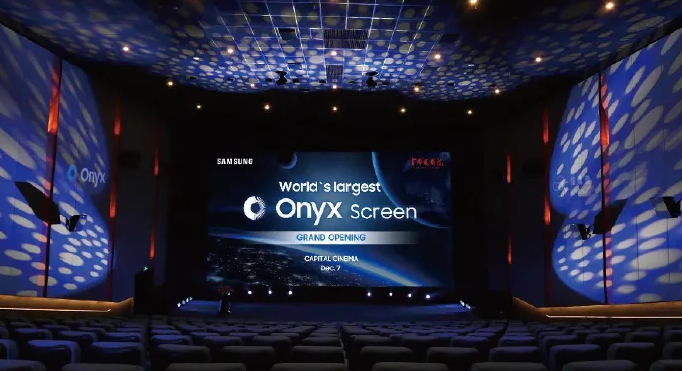
How LED Cinema Screens Work: The Technology Explained
A cinema LED screen is a large-format fine pitch LED display — typically using pixel pitches between P1.2 and P2.5 — assembled from modular cabinets to cover the full screen area of a cinema auditorium. Each pixel is a self-emissive RGB LED unit that generates its own light directly, with no backlight, no projection surface, and no optical path between light source and viewer.
The key technical distinction from standard LED displays is the optical treatment of the pixel surface. Standard LED displays have a pixel fill factor of approximately 15% — meaning 85% of the panel surface is non-emissive substrate visible between pixels. At cinema viewing distances, this creates visible pixel grain that degrades the image quality for film content. Cinema-grade LED screens use pixel surface optical processing technology to increase the effective fill factor to 70–80%, dramatically reducing pixel grain and producing a smooth, film-like image surface.
Additional cinema-specific engineering includes:
- Acoustic transparency: The screen surface must allow sound from behind-screen speakers to pass through without attenuation — a requirement that standard LED panels do not meet
- DCI color space compliance: Cinema content is mastered to DCI-P3 color space; cinema LED screens must cover this gamut accurately
- Uniformity calibration: Point-by-point brightness and color calibration across the full screen surface to meet cinema uniformity standards
- Viewing angle optimization: Wide horizontal viewing angles (≥160°) to serve all seats in the auditorium
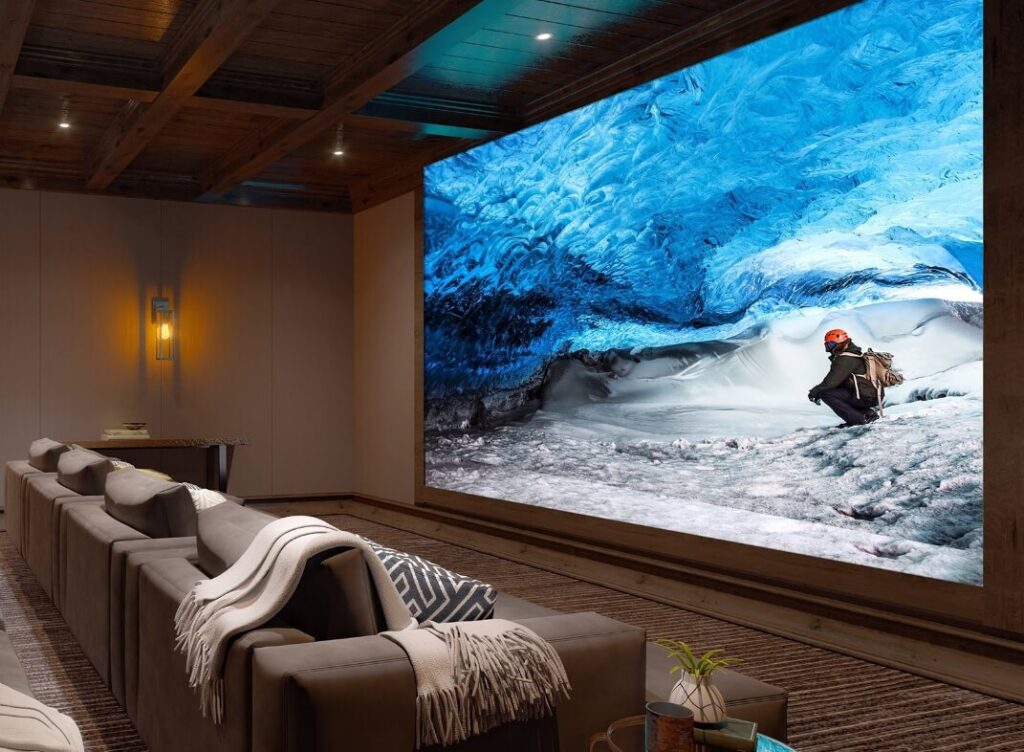
LED Cinema Screen vs. Laser Projection: Full Specification Comparison
| Specification | LED Cinema Screen | Laser Projection (Premium) | Advantage |
|---|---|---|---|
| Peak brightness | 100–300 nits (29–87 fL) | 14–48 fL (DCI range) | LED (3–6×) |
| 3D brightness | Full brightness maintained | 30–40% of 2D brightness | LED |
| HDR capability | True per-pixel HDR | Zone-based approximation | LED |
| Contrast ratio | 1,000,000:1 (true black) | 3,000:1–10,000:1 | LED |
| Color gamut | 100%+ DCI-P3 | 95–100% DCI-P3 | Comparable |
| Uniformity | Point-calibrated, stable | Degrades with lamp/laser age | LED |
| Projection booth | Not required | Required | LED |
| Screen replacement | Not required | Not required | Comparable |
| Light source lifespan | 100,000 hrs (LED) | 20,000–30,000 hrs (laser) | LED |
| Maintenance cost | Module replacement | Laser/lamp replacement | LED (long-term) |
| Installation cost | 300,000–1,000,000+ | 150,000–500,000 | Projection |
| Screen size sweet spot | 14m+ width | Any size | Projection (<14m) |
| Ambient light tolerance | High (self-emissive) | Low (requires dark room) | LED |
| DCI certification | Available (major brands) | Standard | Comparable |
Application Scenarios: Where LED Cinema Screens Make Sense in 2026
Commercial Multiplex Cinemas
The primary commercial case for LED cinema screens in multiplexes is the premium large-format (PLF) auditorium — the flagship screen that commands a ticket price premium and differentiates the venue from competitors. An LED cinema screen in a PLF auditorium delivers a genuinely differentiated experience: brighter 3D, true HDR, and a visual quality that projection cannot match. The premium ticket pricing (typically 30–60% above standard) can support the higher capital cost over a 7–10 year amortization period.
For standard auditoriums with screen widths below 12 meters, the economics favor laser projection in 2026. The crossover point — where LED cinema becomes cost-competitive on a total cost of ownership basis — is approximately 14 meters screen width.
Luxury and Boutique Cinemas
Small-format luxury cinemas — 50–150 seats, premium seating, food and beverage service — are a strong fit for LED cinema screens regardless of screen size. The differentiation value is high, the audience is less price-sensitive, and the ambient-light tolerance of LED screens enables lighting designs that projection cannot support (projection requires near-total darkness; LED screens perform in ambient light, enabling the lit, lounge-style environments that luxury cinema operators prefer).
Corporate and Event Screening Venues
Conference centers, hotel ballrooms, and corporate auditoriums that screen content as part of events — product launches, investor presentations, award ceremonies — benefit from LED cinema screens’ ambient-light performance and the elimination of the projection booth. These venues often operate in partially lit environments where projection quality degrades significantly.
Alternative Content and Immersive Experiences
LED cinema screens are not limited to film content. The same installation supports live sports broadcasts, esports events, concerts, corporate presentations, and immersive art experiences — all at full brightness, without the content restrictions that DCI projection systems impose. This content flexibility is a meaningful operational advantage for cinemas seeking to diversify revenue beyond traditional film exhibition.
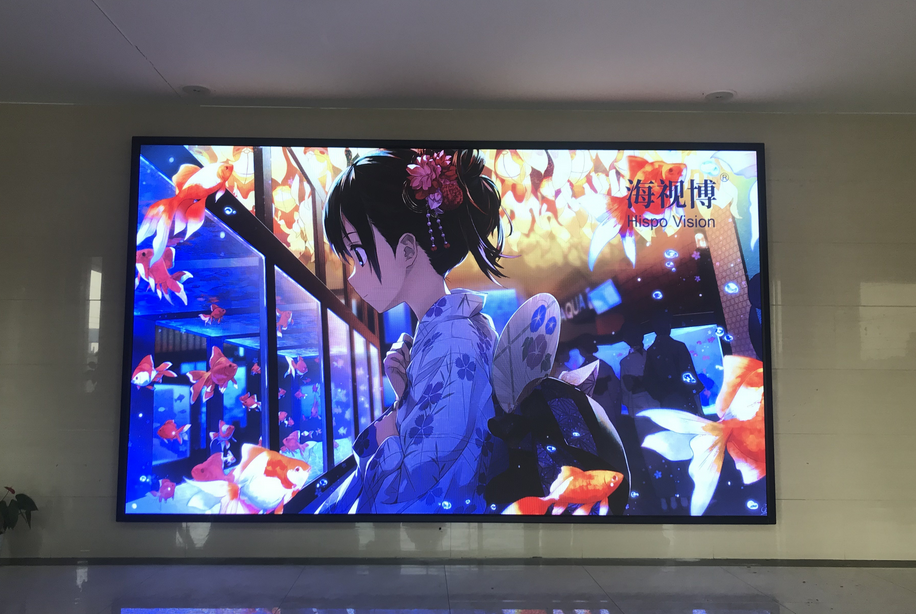
Real-World LED Cinema Installations: 2026 Reference Cases
| Installation | Location | Screen Size | Supplier | Notable Feature |
|---|---|---|---|---|
| Samsung Onyx flagship | CGV Starfield Hanam | 10.3m × 5.4m | Samsung | First commercial LED cinema screen globally (2017) |
| Sony Crystal LED cinema | Various (Japan, US) | Custom | Sony | Acoustic transparency panel design |
| Cinity LED | Multiple China locations | 14m–22m | Cinity / Leyard | DCI-certified, large-format focus |
| LUXE LED Cinema | Middle East, SE Asia | 12m–18m | Various | Premium PLF positioning |
| SoStron LED Cinema | Emerging markets | 10m–20m | SoStron | Mid-market pricing, full technical support |
Samsung’s Onyx system, launched in 2017 at CGV in South Korea, established the commercial viability of LED cinema. By 2026, over 200 LED cinema screens are operating globally — a small fraction of the approximately 200,000 commercial cinema screens worldwide, but growing at 25–30% annually as costs decline and DCI certification becomes standard.
DCI Certification: What It Means and Why It Matters
DCI (Digital Cinema Initiatives) is a consortium of major Hollywood studios — Disney, Warner Bros., Universal, Sony Pictures, Paramount, and others — that established the technical standards for digital cinema projection. DCI certification is technically a voluntary industry standard, but in practice it is the de facto access requirement for screening first-run Hollywood content in commercial cinemas globally.
For LED cinema screens, DCI certification requires:
- Color gamut: Full DCI-P3 coverage
- Brightness: Minimum 14 fL (48 nits), with uniformity within ±10% across the screen
- Contrast ratio: Minimum 2,000:1
- Resolution: 2K (2048×1080) or 4K (4096×2160)
- Security: Compliance with DCI content protection requirements
Before 2022, the absence of DCI certification for LED cinema screens was a significant barrier to commercial adoption — studios would not license first-run content to non-certified screens. Samsung Onyx received DCI certification in 2018; Leyard and Sony followed. As of 2026, DCI-certified LED cinema screens are available from multiple suppliers, removing this barrier for operators considering the transition.
Pricing and Total Cost of Ownership
Capital Cost Reference (2026)
| Screen Width | Auditorium Type | LED Cinema Screen Cost | Laser Projection Cost |
|---|---|---|---|
| 8–10m | Small auditorium / luxury | 180,000–350,000 | 80,000–150,000 |
| 10–14m | Standard multiplex | 300,000–600,000 | 120,000–250,000 |
| 14–18m | Large multiplex / PLF | 500,000–900,000 | 200,000–400,000 |
| 18m+ | Premium large format | 800,000–1,500,000+ | 350,000–600,000 |
10-Year Total Cost of Ownership Comparison (14m screen)
| Cost Component | LED Cinema Screen | Laser Projection |
|---|---|---|
| Initial hardware | $600,000 | $280,000 |
| Projection booth construction | $0 | 40,000–80,000 |
| Lamp/laser replacement (10yr) | $0 | 60,000–120,000 |
| Screen replacement | $0 | 15,000–30,000 |
| Maintenance (annual) | 15,000–25,000 | 20,000–35,000 |
| 10-year total | ~$800,000 | ~650,000–850,000 |
At 14 meters and above, the 10-year TCO of LED cinema and premium laser projection converges. The LED screen‘s higher capital cost is offset by the elimination of projection booth construction, lamp/laser replacement cycles, and screen replacement. Below 14 meters, projection maintains a clear TCO advantage.
Operational Advantages Beyond Image Quality
No Projection Booth Eliminating the projection booth recovers 15–30 square meters of floor space per auditorium — space that can be converted to premium seating, increasing per-show revenue. In new-build cinemas, the absence of a projection booth also simplifies the building design and reduces construction cost.
Ambient Light Compatibility LED cinema screens perform in partially lit environments. This enables lounge-style seating configurations, food and beverage service during screenings, and the kind of social viewing environments that attract audiences who find traditional dark-room cinema uncomfortable. This is a meaningful differentiator for operators targeting younger demographics.
Content Flexibility The same LED screen that shows DCI-certified film content can display live sports, esports, concerts, and corporate events at full quality without any hardware reconfiguration. Projection systems optimized for DCI content often perform poorly on non-DCI sources.
Independent Brightness Zones LED cinema screens support per-zone brightness control, enabling HDR content rendering that projection cannot match — bright highlights and deep shadows simultaneously, across the full screen, without the zone-dimming artifacts that affect projector-based HDR implementations.
Is an LED Cinema Screen Right for Your Project?
Answer these questions before committing:
- Screen width ≥14 meters? If yes, LED cinema is cost-competitive on TCO. If no, projection is more economical unless differentiation value justifies the premium.
- Premium or luxury positioning? LED cinema’s differentiation value is highest in premium-tier venues where the audience expects and will pay for superior image quality.
- Ambient light environment? If your venue operates with any ambient light during screenings, LED cinema is the only viable high-quality option.
- Content mix beyond film? If live events, esports, or corporate use are part of your revenue model, LED cinema’s content flexibility adds operational value.
- Capital budget available? LED cinema requires 2–3× the upfront investment of projection. Confirm financing before specifying.
Conclusion
LED cinema screens in 2026 are a proven, DCI-certified technology delivering image quality that projection cannot match — particularly for 3D, HDR, and ambient-light applications. The economics are compelling at 14 meters and above, and the operational advantages (no projection booth, no lamp replacement, content flexibility) add value that the capital cost comparison alone does not capture.
The technology is not yet the right answer for every auditorium. But for premium large-format screens, luxury cinema concepts, and venues with diverse content programming, LED cinema is the specification that defines the next decade of cinema exhibition.
SoStron designs and supplies LED cinema screen systems for commercial cinemas, luxury venues, and corporate screening facilities. Contact us with your auditorium dimensions and operational requirements for a specification recommendation and detailed cost analysis.