Key Takeaways
- Fine pitch LED display = an LED wall with a pixel pitch typically between 0.9mm and 2.5mm (some define the range as 0.6mm–3mm), engineered for close-range viewing without visible pixel grain.
- Ultra-fine pitch goes below 0.7mm, sometimes down to 0.4–0.9mm, for the closest viewing distances (under 2m).
- Two chip technologies dominate the market: SMD (cost-effective, widely available) and COB (better durability, contrast, and viewing angle for premium indoor use).
- Refresh rate matters as much as pixel pitch for any camera-facing application — 3,840Hz is the current baseline; 7,680Hz is recommended for broadcast and virtual production.
- The right pitch depends on viewing distance, not the smallest number available — over-specifying wastes 30–50% of budget with no visible benefit.
What Is a Fine Pitch LED Display?
A fine pitch LED display is a direct-view LED screen with a pixel pitch — the distance between the centers of two adjacent LED pixels — small enough to be viewed comfortably from a short distance, typically under 3 meters, without individual pixels becoming visible.
Fine pitch ≠ 4K. Fine pitch describes the physical hardware (how densely LEDs are packed); 4K/8K describes the content resolution being displayed. A fine pitch wall gives you the pixel density to display 4K content clearly at close range — but pixel pitch and content resolution are two separate specifications, and buyers often confuse them when comparing quotes.
Fine pitch + HDR = best real-world result. Pixel pitch alone determines sharpness; HDR (High Dynamic Range) determines color and contrast depth. For premium broadcast or command-center applications, the two specs are typically evaluated together, not interchangeably.
Industry pixel-pitch tiers generally break down as follows:
- Standard pitch: 3.0mm and larger — for viewing distances beyond 3–5m
- Fine pitch: roughly 0.9mm–2.5mm — the mainstream category for indoor commercial and corporate use
- Ultra-fine (micro) pitch: below 0.7mm, down to 0.4mm in premium products — for viewing distances under 1–2m
Because product pitch is quoted differently across manufacturers (P1.2, P1.25, P1.5, P1.8, P1.9, P2.0, P2.5 are the most common SKUs), always confirm the actual pitch in millimeters rather than relying on marketing labels alone — some vendors apply “fine pitch” loosely to displays as coarse as 3.9mm.
Technical Deep Dive: What Actually Determines Image Quality
A pixel pitch spec alone doesn’t tell you how a display will perform in your space. Three other specs matter just as much for a B2B purchase decision.
SMD vs. COB: Which Chip Technology?
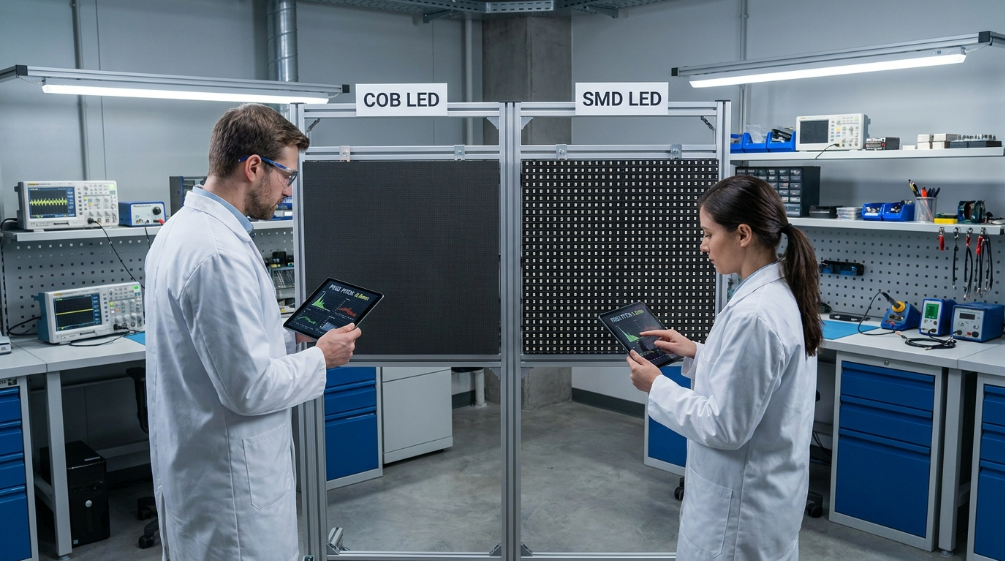
The single biggest technical fork in the fine-pitch category is packaging technology — Surface-Mount Device (SMD) vs. Chip-on-Board (COB).
- SMD uses individually pre-packaged LED components, each with its own visible casing. It’s the more mature, widely available technology, generally lighter, and more cost-effective — but individual diodes are more exposed to physical damage and dust.
- COB embeds the LED die directly onto the PCB under a protective coating, without individual lens packaging. This creates a “surface light source” rather than a “point light source,” which reduces moiré and glare, improves contrast and durability, and is increasingly the default choice for sub-1.5mm pitches. The trade-off is a roughly 10–20% cost premium at fine-pitch tiers, and module-level (not pixel-level) repair.
As a rule of thumb: SMD suits rental/staging and large-format commercial displays where budget and swappability matter; COB suits 24/7 control rooms, boardrooms, and camera-facing broadcast/virtual production walls where image consistency and longevity matter more than upfront cost.
Refresh Rate: The Spec Buyers Overlook
- Camera Flicker: Visible black bars (rolling shutter effect) when filmed.
- Content Loss: Fast-moving content may appear blurry or tearing.
- Not Broadcast Ready: Unsuitable for professional live streaming or TV.
- Flicker-Free: Crystal clear image on all cameras (1/2000s+ shutter speed).
- Smooth Motion: Perfect for fast video playback and sports.
- XR Ready (7680Hz): Essential for virtual production and XR studios.
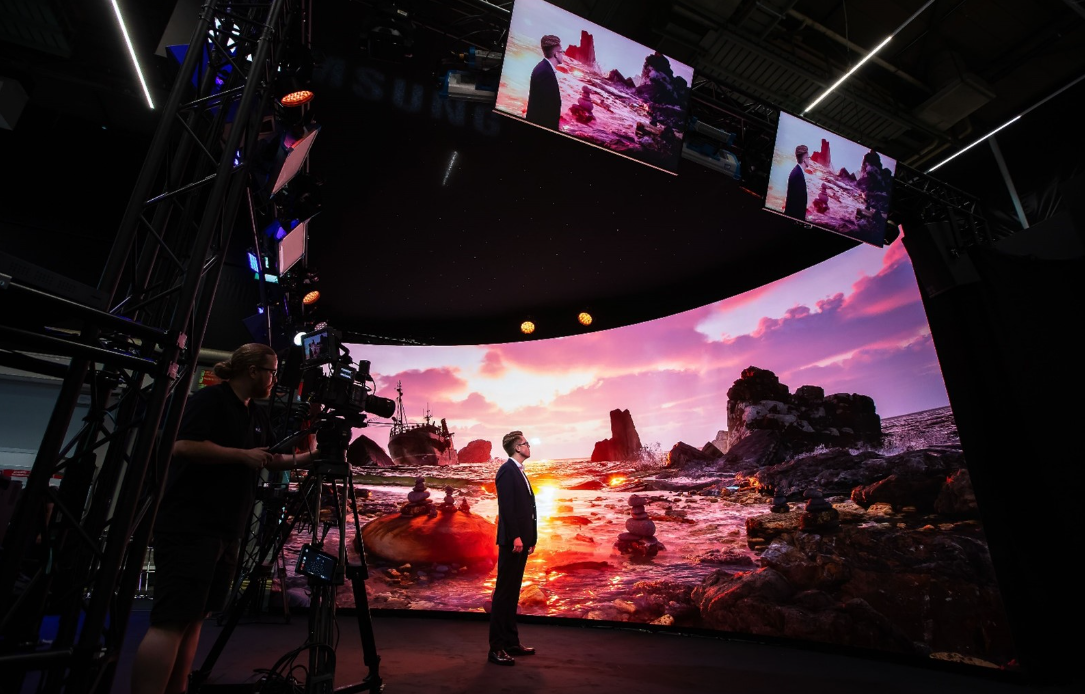
Refresh rate — how many times per second the display updates the image — directly determines whether a wall will flicker on camera.
- 3,840Hz is the current commercial-indoor baseline for flicker-free viewing by the human eye.
- 7,680Hz (or higher) is recommended for broadcast studios and virtual production/XR stages, where camera shutter speeds can otherwise pick up visible scan lines or moiré.
If the display will ever be filmed — livestreamed events, news broadcasts, or LED-wall virtual sets — confirm the refresh rate spec in writing, not just the pixel pitch. A fine pixel pitch with a low refresh rate will still flicker on camera.
Grayscale and Brightness
Higher grayscale processing (typically quoted as 16-bit to 22-bit) improves gradation in dark tones and reduces visible banding at low brightness — relevant for control rooms and boardrooms often run at reduced brightness. Brightness for indoor fine-pitch displays typically ranges 600–1,000 nits (up to 2,500+ nits for products designed to fight direct sunlight through glass, e.g. retail window displays); outdoor-rated products run considerably higher.
Choosing the Right Pixel Pitch: The Viewing Distance Formula
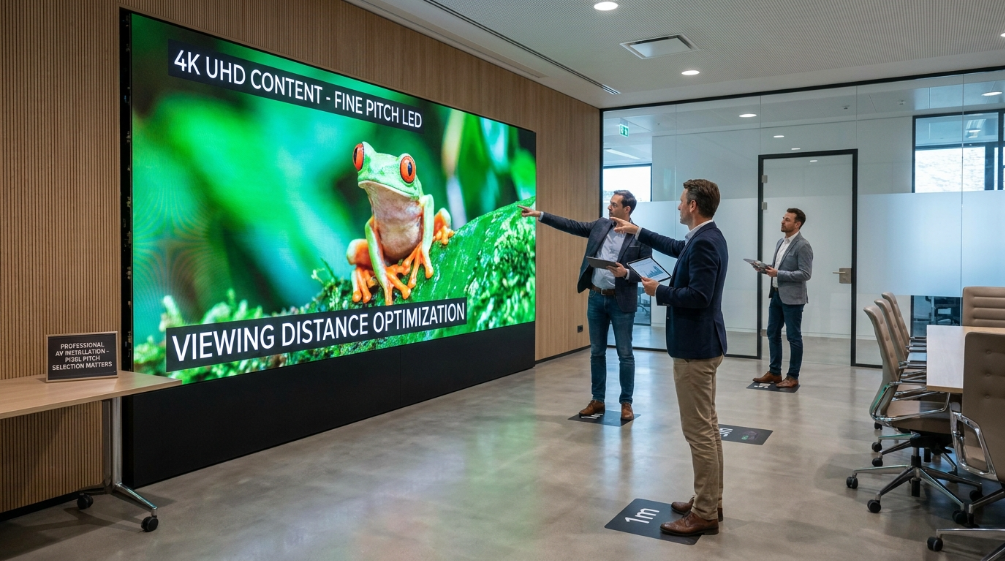
Viewing distance — not budget or trend — should be the first input into a pixel-pitch decision. Several formulas are used across the industry; they converge on similar practical ranges:
- 10x rule (quick estimate): minimum viewing distance (ft) ≈ pixel pitch (mm) × 10. A P2.5 display → ~25ft minimum.
- mm-to-meter rule (comfortable range): allow roughly 1 meter of viewing distance per 1mm of pixel pitch as a comfortable minimum.
- Resolution-based calculation: pixel pitch (mm) = screen width (mm) ÷ horizontal resolution (pixels) — useful when you already know the target resolution (e.g., native 4K) and physical wall size.
None of these is exact — “acceptable” viewing distance is ultimately about what looks sharp to the intended audience — but they’re useful for eliminating options before requesting quotes.
Selection Checklist
Before requesting a proposal, confirm:
- Closest viewer distance to the screen (in meters or feet)
- Environment: indoor/outdoor, ambient light level, glass/window exposure
- Camera use: will the display ever be filmed or livestreamed? (drives refresh-rate requirement)
- Operating hours: 24/7 (control room) vs. event-based (rental) — affects SMD vs. COB choice
- Physical constraints: wall depth for service access (front vs. rear maintenance), structural load
- Content type: text/data-heavy (needs finer pitch) vs. broad branding/video (tolerates coarser pitch)
- Budget ceiling per m² and total project area
Applications by Scenario
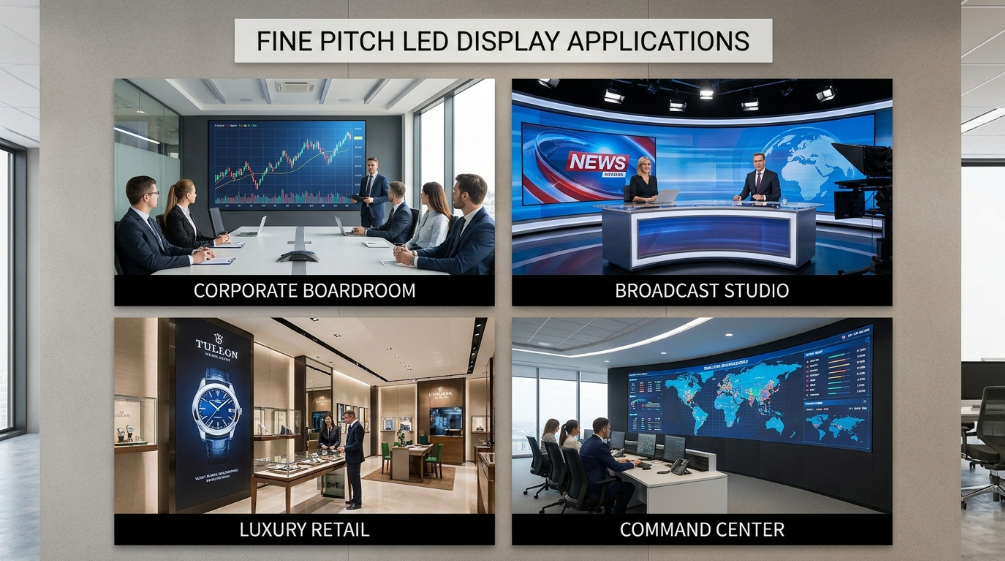
Control rooms & command centers — Typically P0.9–P1.5, COB preferred for 24/7 reliability, lower heat output, and reduced operator eye strain over long shifts; front-access maintenance is usually a hard requirement given restricted rear space.
Broadcast studios & virtual production (XR stages) — P0.9–P1.9, COB strongly preferred, refresh rate 7,680Hz minimum for moiré-free camera capture; color consistency across panels is critical for LED-wall virtual sets.
Corporate boardrooms & conference rooms — P1.2–P1.9, COB for glare-free close-range viewing by front-row attendees; front maintenance access saves significant install space in fitted-out rooms.
Retail & commercial advertising — P1.5–P2.5, SMD generally sufficient; higher brightness (1,000–2,500+ nits) needed for window/storefront installs facing daylight.
Rental & live events / stage backdrops — P2.5–P3.9 (edge of the fine-pitch range), SMD favored for lighter cabinets, faster rigging, and lower cost-per-swap if a panel is damaged.
Museums, education & public spaces — P1.5–P2.5, flexibility on chip type; content mix of static graphics and video usually tolerates mid-range fine pitch.
Fine Pitch LED Display: Comparison Table
| Dimension | Ultra-Fine (P0.9 & below) | Standard Fine Pitch (P1.2–P1.9) | Mid Fine Pitch (P2.0–P2.5) | Coarse End (P2.6–P3.9) |
|---|---|---|---|---|
| Typical viewing distance | Under 1.5m | 1.5–3m | 3–5m | 5–8m |
| Chip technology | COB dominant | COB or premium SMD | SMD typical | SMD standard |
| Refresh rate available | Up to 7,680Hz | 3,840–7,680Hz | 3,840Hz | 1,920–3,840Hz |
| Typical brightness | 600–1,000 nits | 600–1,200 nits | 800–1,500 nits | 1,000–2,000 nits |
| Best for | Control rooms, XR stages | Boardrooms, broadcast | Retail, corporate lobbies | Rental, stage backdrops |
| Relative cost/m² | Highest | High | Medium | Lower |
| Maintenance access | Front only (typical) | Front or rear | Front or rear | Front or rear |
| Indoor/outdoor | Indoor only | Indoor only | Indoor (some hybrid) | Indoor/outdoor variants |
Figures above are typical industry ranges, not fixed specifications — always confirm exact values against the specific product’s datasheet.
What Does a Fine Pitch LED Display Cost?
Pricing varies significantly by chip technology, brightness, refresh rate, and supplier — there is no single market price. As a general, non-binding reference, indoor fine-pitch LED walls typically run in the range of $600–$4,500+ per square meter, with COB and ultra-fine (sub-1mm) configurations at the top of that range and standard SMD fine-pitch products at the lower-to-mid range. Total cost of ownership over a 5-year period (power consumption, maintenance, downtime) can shift the economics meaningfully in favor of COB for 24/7 applications, even though its upfront cost is higher — worth modeling before comparing quotes on price-per-m² alone.
FAQ
What is the difference between fine pitch and standard LED displays?
Fine pitch displays have a pixel pitch under roughly 2.5–3mm, enabling clear close-range viewing (under 3–5m), while standard pitch displays (3mm+) are intended for greater viewing distances.
Is fine pitch LED the same as 4K?
No. Pixel pitch is a hardware spec describing LED density; 4K/8K describes content resolution. A fine-pitch wall provides the density needed to display 4K clearly, but the two are independent specifications.
What refresh rate do I need for a fine pitch LED wall?
3,840Hz is sufficient for most commercial and corporate applications. If the display will be filmed or livestreamed, specify 7,680Hz to avoid camera-visible flicker.
Should I choose SMD or COB for a fine pitch display?
COB generally suits 24/7 operation, camera-facing use, and premium close-range viewing; SMD suits rental, staging, and budget-sensitive large-format projects.
What is the minimum viewing distance for a fine pitch LED wall?
As a rough guide, allow about 1 meter of viewing distance per 1mm of pixel pitch, or use the 10x rule (pixel pitch × 10 = minimum distance in feet) for a conservative estimate.
How much does a fine pitch LED display cost per square meter?
Typically $600–$4,500+ per m² depending on chip technology, brightness, and refresh rate — always request a project-specific quote rather than relying on general pricing.
Choosing a Supplier
Beyond the spec sheet, ask any fine-pitch LED supplier for a pixel-by-pixel calibration report, documented refresh-rate testing under your target camera setup (if applicable), and a clear service plan for module-level repairs — these operational details affect long-term image quality and uptime as much as the headline pixel-pitch number.
Related reading: Indoor P2.5 LED Display Buying Guide · COB LED Video Wall Series · Rental LED Display Panels
Need help specifying the right pixel pitch for your project? Request a quote or download the Sostron Fine Pitch LED Display spec sheet for a side-by-side comparison of our full product range.
References:
Frontline Technology: Elemental Evolution of Displays
District Wide Signage Guidelines – LED Display Standards