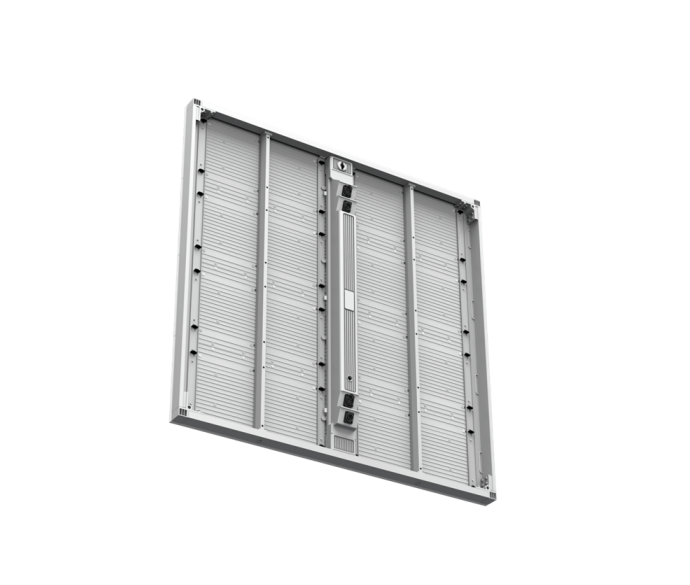
Quick-Reference Spec Guide: Bar LED Wall vs. Hotel Digital Signage
| Deployment Zone | Recommended Pixel Pitch | Minimum Refresh Rate | Brightness (Nits) | Key Protection Rating | Primary Buyer Pain Solved |
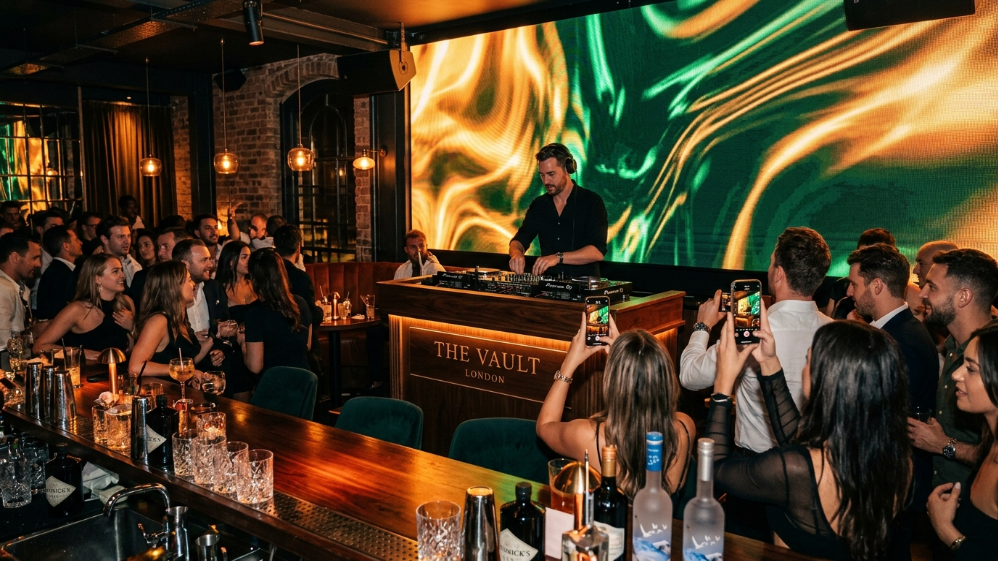
| Bar back wall / DJ booth | P2.5 | 3,840Hz | 800–1,200 | IK08+ | Flicker on guest cameras (TikTok / Instagram) |
| Hotel lobby feature wall | P1.86–P2.5 | 3,840Hz | 1,000–1,500 | IP54 | Seamless visual impact at variable viewing angles |
| Hotel conference corridor | P2.5–P3.91 | 1,920Hz | 600–1,000 | IP54 | Real-time PMS schedule integration |
| Sports bar / viewing area | P2.5–P3.91 | 3,840Hz | 1,200–1,800 | IK10 | Multi-feed simultaneous display without motion blur |
| Hotel exterior / porte cochère | P3.91–P6.67 | 3,840Hz | 5,000–10,000 | IP65 | Full sunlight visibility; weather resistance |
Walk into any bar or hotel that installed a direct-view LED (DVLED) wall in the last 18 months, and the ROI signal is immediate: guests stop, photograph, film, and share. That earned social media content—generated at zero marginal cost—is the business case nobody puts in the procurement spreadsheet, but every venue operator privately understands. The screen does not just display content. It is the experience.
The problem is that most B2B buyers arrive at the procurement stage with the wrong questions. They ask, “What size screen do I need?” when the spec that determines whether the investment succeeds or fails is refresh rate. They compare price per square meter from three suppliers when the variable that separates a 3-year display from an 8-year display is driver IC quality and LED packaging technology. And they treat “hotel digital signage” as a software category when the hardware foundation—pixel pitch, brightness calibration, front-service maintenance access—is what separates a lobby feature wall from an expensive liability.
Based on our experience engineering LED display systems across 6,000+ projects in over 70 countries, the specification errors that generate the most costly disputes are not random. They cluster around three decisions: wrong pixel pitch for the viewing distance, insufficient refresh rate for camera-facing environments, and inadequate protection ratings for high-traffic hospitality spaces. This guide corrects all three.
Why Bars and Hotels Are Replacing TV Arrays and Projectors With Direct-View LED
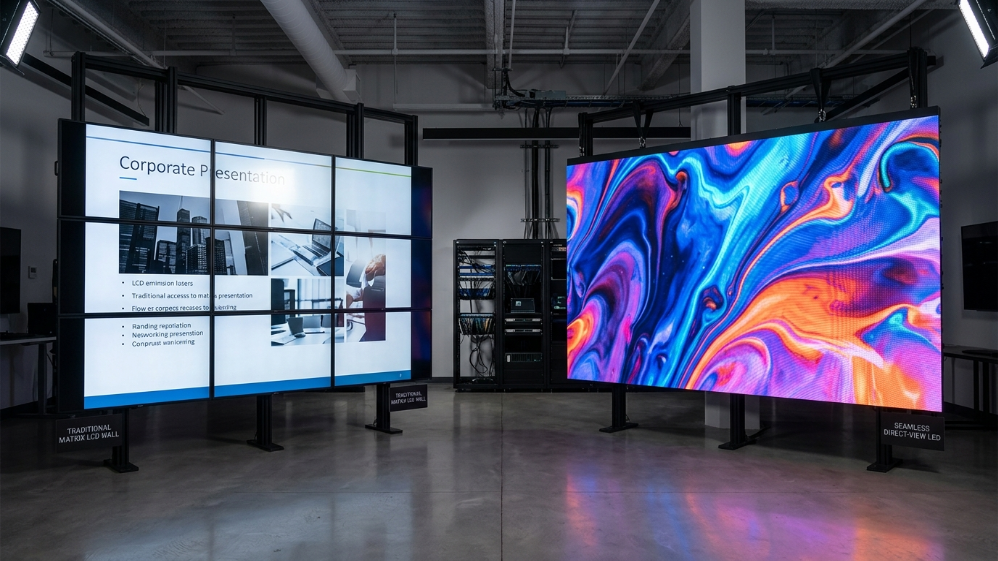
The comparison is not close, and the industry data reflects it. According to market research firm Mordor Intelligence, the global LED display market is projected to exceed $14.8 billion by 2029, with hospitality and entertainment venues representing the fastest-growing vertical outside of out-of-home advertising. The technical reasons for this shift are concrete.
A TV wall—even a premium commercial-grade array—introduces bezel gaps, fixed aspect ratios, brightness ceilings around 700–800 nits, and a replacement cycle that begins at year 5. A DVLED system is modular by design: cabinets tile seamlessly, the final resolution is determined by your physical wall dimensions (not a manufacturer’s product line), and a 100,000-hour operational lifespan means a correctly specified system amortizes over a decade without replacement.
For bars and nightlife venues, one factor dominates all others: visual performance under dynamic lighting conditions at 3,840Hz refresh rate or above. For hotels, the decisive advantage is content flexibility and multi-zone control—a single NovaStar or Colorlight processor can manage lobby welcome walls, conference room directories, F&B promotional displays, and exterior signage from one interface.
Bar LED Wall: Choosing the Right Spec Without Overpaying or Under-Delivering
Pixel Pitch Decoded: Which P-Value Actually Fits Your Venue?
Pixel pitch is the distance in millimeters between the center of two adjacent LED pixels. A P2.5 display has 160,000 pixels per square meter. A P3.91 display has 65,536. The practical consequence of that density difference is not abstract—at a viewing distance of 2.5 meters, a P3.91 screen shows visible pixelation on text and faces. At the same distance, a P2.5 screen renders broadcast-grade clarity.
The industry formula is simple: minimum comfortable viewing distance (meters) $\approx$ pixel pitch value $\times$ 1.0 to 1.5. A P2.5 screen delivers full-resolution perception from 2.5–3.75 meters. A P3.91 screen requires 4–6 meters before pixelation disappears. Apply this to your floor plan before issuing any RFQ.
Pixel Pitch Selection Guide for Bars and Hotels
| Venue Type | Typical Viewing Distance | Recommended Pitch | Pixel Density (px/m²) | Image Quality Verdict |
| Back-bar display (cocktail bar) | 1.5–3 m | P1.86–P2.5 | 160,000–289,000 | Premium: face & text razor sharp |
| Main wall (sports bar, DJ room) | 3–6 m | P2.5–P3.91 | 65,000–160,000 | Excellent for video, sport feeds |
| Hotel lobby feature wall | 2–5 m | P2.5 | 160,000 | Required for brand content fidelity |
| Hotel exterior / entrance canopy | 8–20 m | P3.91–P6.67 | 22,000–65,000 | Sunlight-readable at distance |
| Conference room / ballroom signage | 3–8 m | P2.5–P3 | 111,000–160,000 | Presentation-grade for text/charts |
Get the pixel pitch wrong by one step, and the result is either wasted capital on resolution your audience cannot perceive at their viewing distance, or a visible quality failure that damages the brand every night the venue operates.
The Specification That Most Buyers Ignore—And Why Refresh Rate $\ge$ 3,840Hz Is Non-Negotiable for Bars
Here is a scenario that plays out dozens of times each month in hospitality venues worldwide: a venue owner installs a new LED wall, guests start filming content, the social media clips go live—and the screen appears to flicker. Black horizontal scan lines pulse across every video. The display that cost $40,000 looks broken on camera, even though it looks fine to the naked eye.
The cause is not a defective product. It is a 1,920Hz refresh rate being recorded by a smartphone camera operating at a shutter speed that captures individual scan cycles. The result is a strobing artifact—visible on video, invisible in person.
This is not a fringe technical edge case. According to data published by UNIT LED based on installed-base analysis, the majority of bar and nightclub LED installations specified before 2023 used 1,920Hz panels. In an era when guests document every experience for TikTok, Instagram Reels, and YouTube Shorts, a flickering LED wall is not just an aesthetic problem—it is a marketing liability.
Feature: High-refresh panels rated at 3,840Hz or above use advanced driver ICs—such as the ICN2153 or MBI5124—that execute PWM dimming cycles fast enough to be invisible at any smartphone shutter speed.
Business benefit: Guest-generated video content becomes consistently shareable, high-quality earned media. A 3,840Hz bar LED wall generates social amplification with every event night. A 1,920Hz wall generates complaints and retakes.
At 7,680Hz—the specification used in broadcast studio and XR virtual production walls—the screen is camera-invisible even under professional cinema cameras operating at 1/2000 second shutter speeds. For hotel ballrooms hosting press events, award ceremonies, or televised conferences, 7,680Hz is the specification to write into the technical brief.
Our Recommended Solutions for Bar LED Walls and Hotel Digital Signage
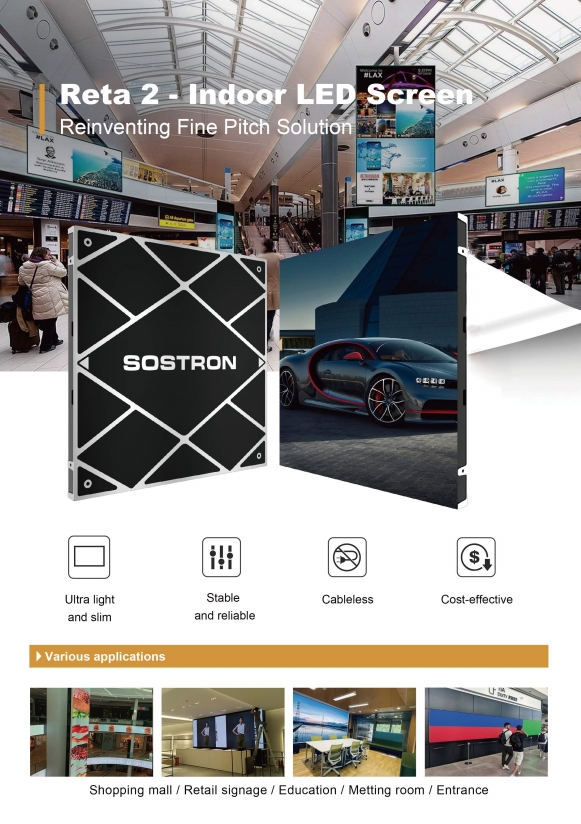
Sostron Reta 2 Series—Recommended for Bar Walls and Hotel Lobbies
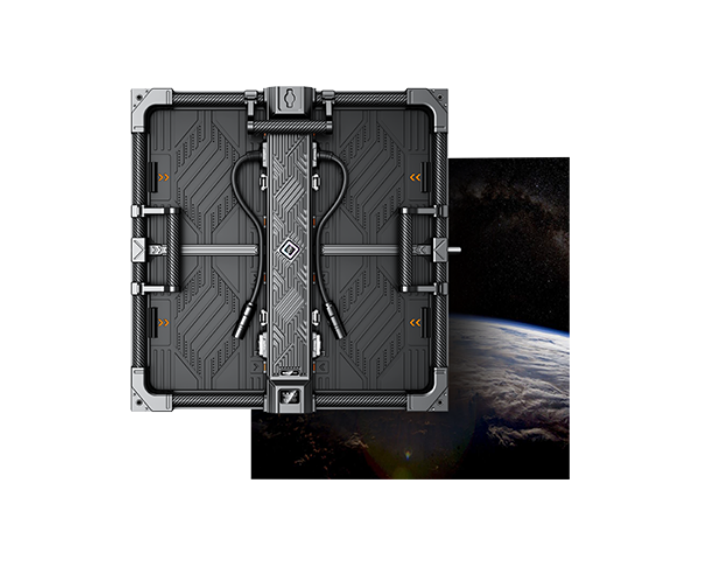
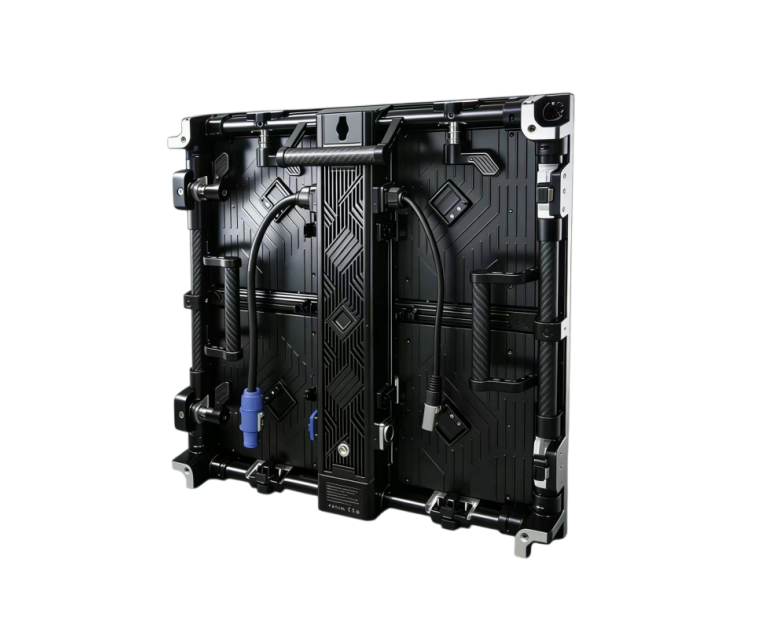
Based on our analysis of Sostron’s product portfolio against the hospitality deployment criteria above, the Reta 2 Series (P2.5, indoor fixed installation) is the most directly aligned product for bar LED wall and hotel lobby applications. Key specifications:
-
Pixel pitch: P2.5—suitable for viewing distances from 2.5 meters, covering the full range of bar and lobby environments
-
Cabinet depth: 30mm ultra-thin, cable-free design—integrates flush with architectural wall finishes without visible cable management
-
Refresh rate: 3,840Hz standard—eliminates camera flicker across all guest recording scenarios
-
Driver IC: Gold wire bonding for dead-pixel rate below 0.0001%—critical for high-visibility feature wall installations where a single dead cluster damages brand perception
-
Front-service maintenance: Full component access from the face of the wall—essential in bars where rear-wall access is blocked by structure or HVAC
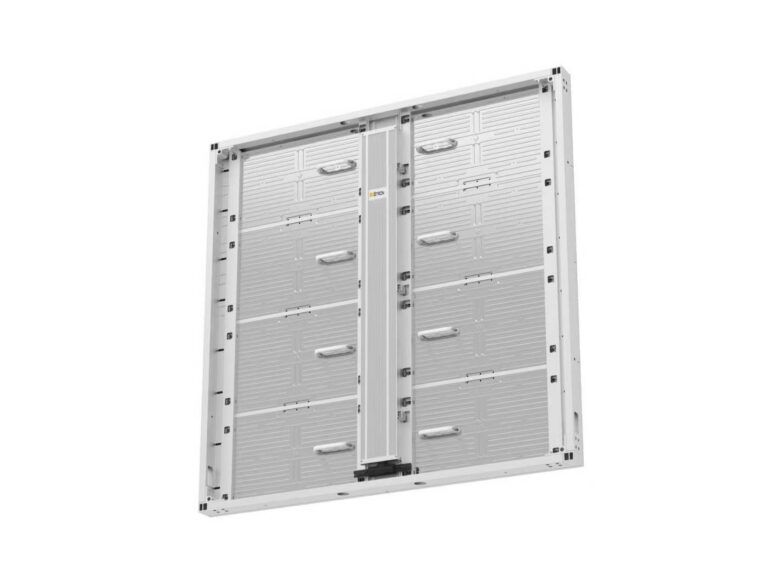
For venues requiring outdoor coverage—hotel porte cochère signage, exterior facade displays, or rooftop bar installations—the Sostron Ares 2 Series delivers Common Cathode technology with 7,680Hz refresh rate, IP65 waterproofing, and a 40% energy reduction versus equivalent Common Anode panels. At 20kg/m², it requires substantially less steel reinforcement than industry-standard outdoor cabinets, reducing installation cost alongside operational cost.
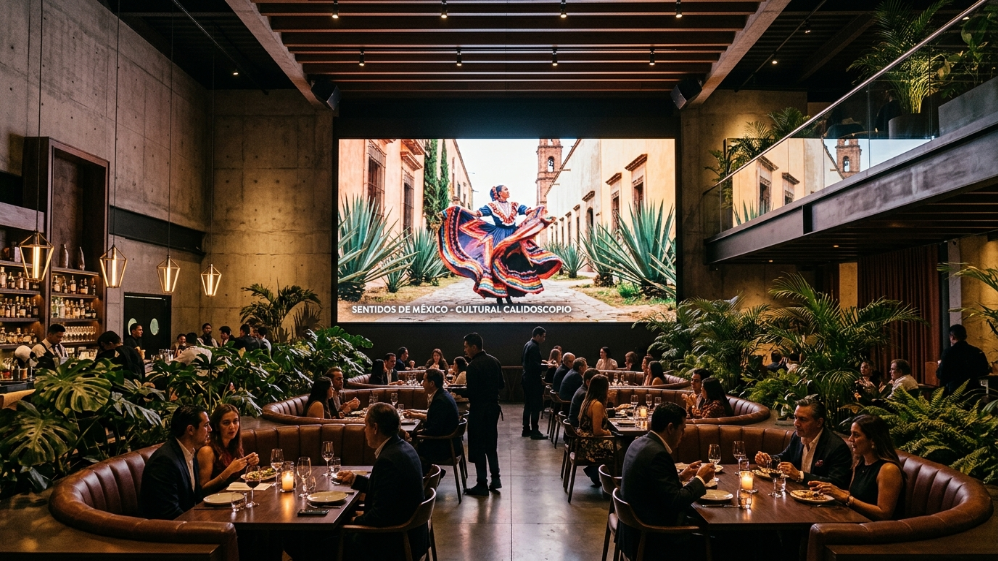
Global Case Study: 100sqm P2.5 Bar & Restaurant LED Wall—Mexico (Reta2 Project)
-
Client: High-footfall hospitality venue, Mexico City metropolitan area
-
Scope: 100 square meters of P2.5 indoor LED display integrated across the main dining and bar wall
-
Product deployed: Sostron Reta 2 Series, P2.5, cable-free 30mm cabinet
-
The brief: The operator needed a display that could transform the venue’s atmosphere in real time—shifting from ambient brand visuals during dinner service to high-energy dynamic content during late-night bar operations, all without a content operations team on-site.
-
The engineering decision: P2.5 was selected over P3 for a specific reason: at the primary bar viewing distance of 2–3 meters, P3 introduces visible pixelation on high-resolution cultural and brand content. P2.5 at 160,000 pixels/m² ensures that faces, typography, and motion graphics render without grain regardless of content type or time of day.
-
The operational outcome: The cable-free cabinet design reduced installation time compared to conventional racked LED systems. Content scheduling—handled via the integrated control system—allowed the venue to operate themed nights with zero manual intervention between transitions. According to the client, the wall became the primary reason cited by new guests for choosing the venue over nearby competitors.
-
The commercial lesson: A bar LED wall specified to the correct pixel pitch and refresh rate does not function as décor. It functions as the venue’s most powerful and lowest-marginal-cost marketing asset—running 365 nights per year.
Operating 365 nights a year in a high-energy hospitality environment exposes hardware to risks that corporate boardrooms never see. That 100-square-meter LED installation functioning as your venue’s primary marketing engine will encounter spilled champagne, rogue elbows, vibrating bass frequencies, and wildly fluctuating ambient temperatures.
If the procurement conversation stops at pixel pitch and refresh rate, you are leaving your most expensive AV asset vulnerable. For bar and hotel environments, surviving the operational realities of the venue requires an engineering-first approach to physical protection and backend control systems.
The Durability Mandate: SMD vs. GOB vs. COB in High-Traffic Venues
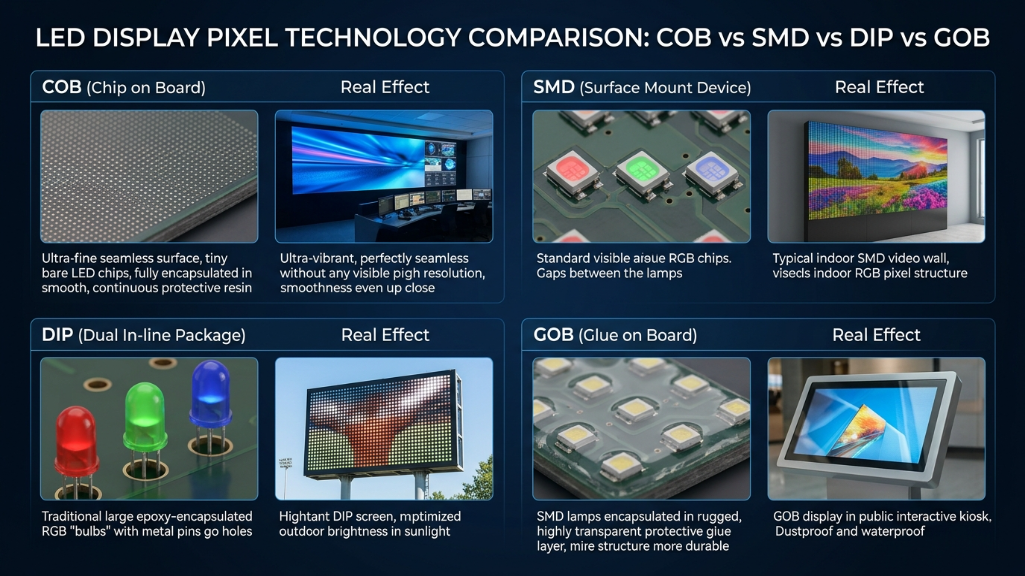
In standard LED manufacturing, the diodes are exposed. Surface-Mounted Device (SMD) encapsulation solders individual LED pixels directly onto the PCB. If a guest leans against an SMD wall or a flying bottle strikes it, those pixels shear off, resulting in dead black clusters that instantly degrade the premium feel of the venue.
For ground-level bar LED walls or high-traffic hotel elevator lobbies, you must specify advanced protection layers. The industry relies on two primary upgrades: GOB (Glue on Board) and COB (Chip on Board). GOB involves sealing the SMD modules in a transparent, impact-resistant epoxy resin. COB bonds the LED chips directly to the board and encapsulates the entire surface, resulting in a smooth, screen-like finish that is virtually indestructible under normal hospitality conditions.
Multi-Dimensional Specification Table: LED Protection Technologies for Hospitality
| Packaging Technology | Impact Resistance (IK Rating) | Moisture/Spill Protection | Heat Dissipation Efficiency | Repairability/Maintenance | Optimal Hospitality Deployment Zone |
| Standard SMD | Low (IK04) – Pixels easily dislodged by physical touch | Low – Vulnerable to high humidity and liquid splashes | Standard | High – Individual pixels can be re-soldered on-site | Suspended DJ booth screens, high-elevation hotel lobby walls (>3m above floor) |
| GOB (Glue on Board) | High (IK08) – Withstands blunt impact and heavy pressure | High (IP54 Front) – Easily wiped clean from spilled drinks | Good (Resin acts as a minor thermal blanket) | Medium – Module replacement required; resin removal is complex | Main bar back-walls, VIP booth surrounds, ground-level nightclub columns |
| COB (Chip on Board) | Maximum (IK10) – Extreme durability; completely smooth surface | Maximum (IP65 Front) – Waterproof face, dust-proof | Excellent – Direct chip-to-board bonding speeds heat transfer | Low – Must be sent to factory for diode-level repair | Luxury hotel check-in desks, interactive touch-walls, ultra-premium tight-pitch (P1.2) areas |
Engineering Note: If your bar wall is within an arm’s reach of the guests, GOB is the mandatory minimum specification. The slight premium in upfront capital expenditure (typically 10-15% over standard SMD) is recouped the first time a rogue champagne cork strikes the display without causing a $400 module failure.
The Brains of the Operation: Processing and AV Integration
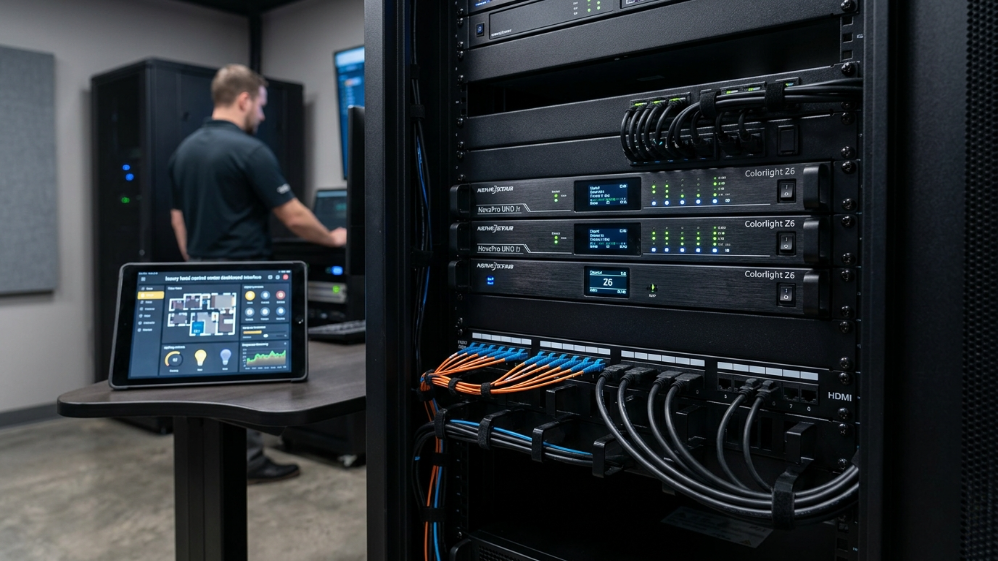
A high-performance LED display is useless if your venue staff cannot easily trigger content changes. Hotel and nightlife operators are not IT engineers; they require foolproof, latency-free control systems.
For Nightclubs and Sports Bars (Synchronous Control):
Venues relying on live sports feeds, live DJ visualizers, or real-time camera inputs require synchronous processors. We exclusively engineer systems around high-end NovaStar (e.g., the VX or H-Series) or Colorlight processors. These units accept direct HDMI/SDI inputs from your video matrix, processing 4K feeds with near-zero latency. When the DJ drops the beat, the visual transition is instantaneous.
For Hotel Digital Signage (Asynchronous Control):
A hotel lobby wall running branded lifestyle videos, real-time weather, and conference room wayfinding does not need a dedicated media PC running 24/7. Here, we specify asynchronous controllers (like the NovaStar Taurus series). These built-in media players store the content locally on the LED wall’s receiver cards and connect to cloud-based CMS (Content Management System) platforms. Your marketing team can push new promotional videos to the lobby wall from an iPad in another country.
Technical Guide: The Real-World Engineering FAQs for Venues
Before signing off on a PO, B2B buyers frequently raise the following operational concerns. Here is the unvarnished engineering reality.
1. How much heat will a large LED wall add to my bar, and will it overload my HVAC?
Heat is the enemy of LED lifespan. A standard P2.5 LED wall running high-brightness content draws an average of 200–250 watts per square meter, peaking at around 600 watts on full white. A 20sqm wall will output roughly 17,000 BTUs of heat per hour.
-
Solution: Specify die-cast aluminum cabinets (like the Sostron Reta 2 series) rather than plastic or iron chassis. Aluminum acts as a giant passive heatsink, drawing thermal loads away from the diodes without requiring noisy internal cooling fans. Your MEP (Mechanical, Electrical, and Plumbing) contractor must factor this thermal output into the room’s AC tonnage.
2. How do we clean the LED wall when it gets dirty from smoke machines or spilled drinks?
If you specified standard SMD panels, you cannot use liquids; you must use a specialized micro-vacuum and dry microfiber cloths to avoid snagging diodes. If you specified GOB or COB, the front face is sealed. Your cleaning staff can wipe it down with a lightly damp microfiber cloth and a mild, non-abrasive screen cleaner. Never use heavy solvents or spray liquid directly onto the seams between cabinets.
3. What happens when a section of the wall inevitably fails? Do we have a black hole in our display?
Not if the system was engineered for front-serviceability. Modern hospitality LED walls utilize magnetic module attachments. If a module fails at 10 PM on a Friday, the venue manager can use a specialized magnetic suction tool to pull the dead 320x160mm tile straight off the front of the wall and snap a pre-calibrated spare into place. The entire hot-swap process takes less than 30 seconds, and the wall never needs to be powered down. Always demand at least 3% spare modules from the exact same manufacturing batch to ensure perfect color macro-consistency.
4. Does the screen emit electromagnetic interference (EMI) that will mess with our wireless microphones?
Cheap, uncertified LED power supplies and poorly shielded receiving cards generate massive RF noise, which will absolutely interfere with UHF wireless microphones used by your DJs or hotel conference speakers. Ensure your procurement spec strictly requires EMC Class B certification for the entire cabinet, not just the power supply component.
The Expert Verdict: Stop Buying Screens, Start Architecting Visual Infrastructure
Treating a 50-square-meter LED installation like a massive television is the fastest route to a negative ROI. A television is a consumable commodity; a direct-view LED wall is integrated architectural infrastructure.
If you are outfitting a high-impact bar or a luxury hotel lobby for the 2025–2026 operational cycle, the procurement mandate is absolute. Do not compromise on a 3,840Hz refresh rate—your guests’ smartphone cameras will instantly expose anything less. Specify a P2.5 pixel pitch or tighter for any ground-level installation to guarantee broadcast-grade clarity. And above all, protect your capital investment by insisting on GOB encapsulation and front-service magnetic modules to neutralize the physical hazards of hospitality environments.
Align these hardware specifications with a robust, cloud-managed NovaStar processing ecosystem, and you cease being a venue with a screen. You become a dynamic, immersive environment where the architecture itself drives revenue, guest retention, and organic social amplification night after night.
References:
IEEE Standard for Semiconductor LED Displays and Driver IC Specifications