Before diving into specs and standards, here’s what procurement teams consistently get wrong: they evaluate stadium perimeter LED and scoreboard displays as separate line items. They’re not. They’re one integrated broadcast and fan-engagement system—and the buying decision needs to reflect that.
Here’s the fast-reference framework that separates a compliant, revenue-generating installation from an expensive mistake:
Decision Framework for Procurement Teams
| Decision Factor | Minimum Threshold | Broadcast-Grade Standard | Common Procurement Mistake |
|---|---|---|---|
| Brightness (outdoor) | 6,000 nits | 10,000 nits | Specifying indoor-grade panels for open-air venues |
| Refresh Rate | 3,840 Hz | 7,680 Hz | Confusing frame rate (60 fps) with panel refresh rate |
| Pixel Pitch (perimeter) | P8 | P5–P6.25 | Over-specifying for spectator distance, ignoring broadcast camera distance |
| IP Rating | IP65 | IP65 front + rear | IP43 panels installed in outdoor environments |
| Signal Latency | <33 ms (2 frames) | <16 ms (1 frame) | No latency specification included in the RFQ |
| Soft Face Cover | EVA foam present | Shore A hardness ≤30 | Hard acrylic face covers treated as acceptable default |
That table is your RFQ baseline. Everything below explains why each threshold exists—and what happens operationally when you miss one.
What B2B Buyers Actually Need From a Stadium Display System in 2026
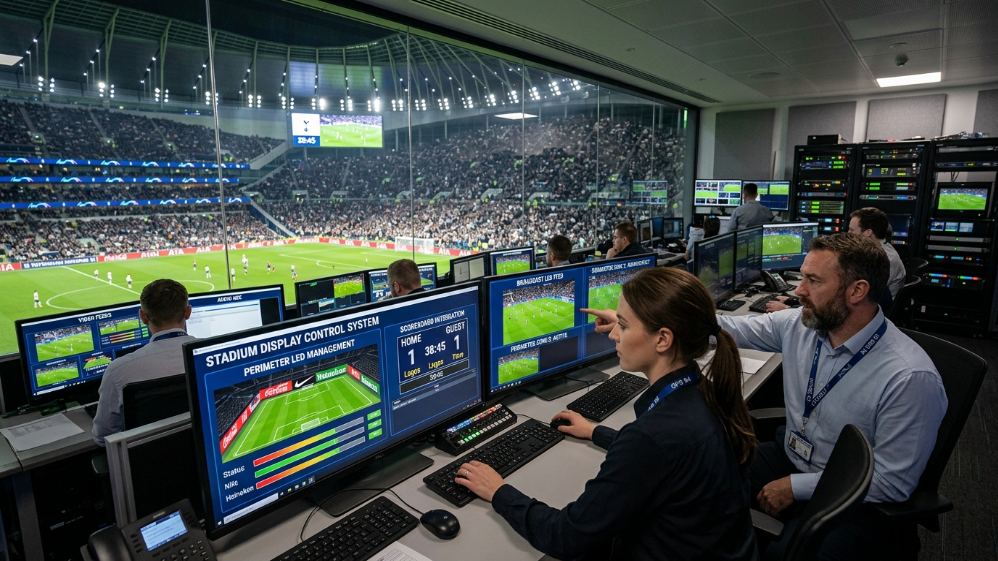
The procurement brief usually reads:
“We need a perimeter LED display and a scoreboard.”
What it should read is:
“We need a zero-downtime broadcast infrastructure that generates sponsor revenue and does not injure our athletes.”
Those are three distinct engineering requirements. Most suppliers address one. Few address all three.
Based on our experience supporting system integrators across Europe, the Middle East, and Southeast Asia, the failure mode is almost always the same. The buyer focuses on price-per-square-meter and pixel pitch, then discovers post-installation that the refresh rate causes rolling shutter artifacts on broadcast cameras—or that hard-face modules create a liability exposure every time a player collides with the boards.
According to the Global Stadium Technology Report 2025, over 68% of stadium LED procurement decisions involve at least one specification revision after the initial RFQ, most commonly around broadcast compatibility and safety standards. That revision cycle costs an average of 14 weeks and
40,000–120,000 in redesign and re-procurement costs. The fix is always the same: specify correctly the first time.
The Three Non-Negotiables
Athlete Safety
A player collision with a non-compliant perimeter board is a liability event, not a PR problem.
Broadcast Compliance
A 60 Hz refresh rate panel produces visible banding on any camera running above 1/500s shutter speed. That’s every broadcast camera in a professional venue.
Zero Downtime
A scoreboard blackout during a penalty shootout is not recoverable. N+1 redundancy is not optional at this level.
Stadium Perimeter LED Display Explained: Technical Foundations Every Buyer Must Know
Pixel Pitch: The Spec That Determines Everything Downstream
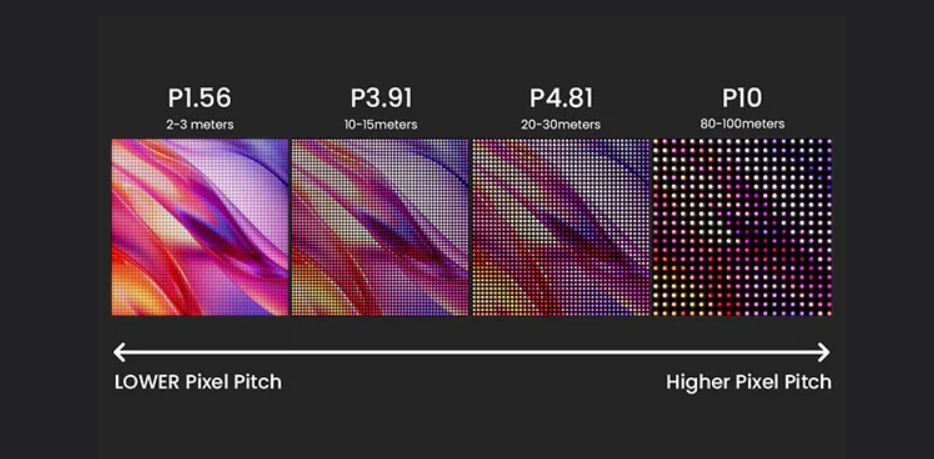
Pixel pitch is the center-to-center distance between LED pixels, measured in millimeters. It governs resolution, minimum viewing distance, and—indirectly—total system cost.
The calculation is direct:
Minimum Comfortable Viewing Distance Formula
Minimum Comfortable Viewing Distance (m) = Pixel Pitch (mm) × 1,000 ÷ 3,438
For a P6.25 panel, that’s approximately 1.8 meters.
For P10, it’s 2.9 meters.
In a football stadium where the nearest spectator sits 8–15 meters from the perimeter boards, P8 to P10 is technically sufficient for the stands. But broadcast cameras positioned at the opposite end of the pitch are effectively 80–120 meters away—and they are the audience that drives sponsorship value.
This is precisely why UEFA’s pitch perimeter display guidelines recommend P6.25 or finer for top-tier competition venues. The camera, not the spectator, sets the resolution requirement.
The Broadcast Spec Triad: Brightness, Refresh Rate, and Contrast
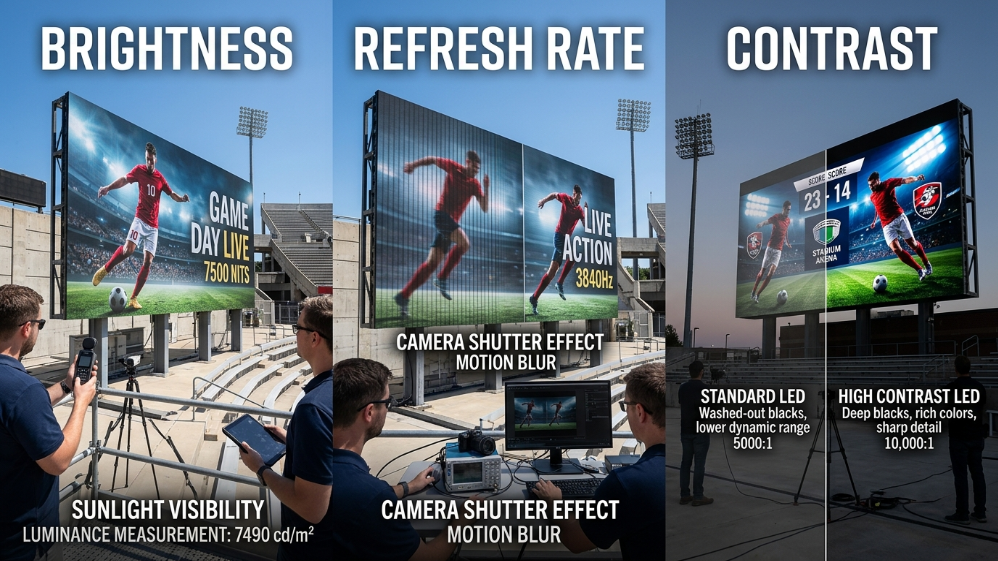
These three parameters define whether your installation passes a broadcast production review. They’re interdependent—compromising any one degrades the others.
| Parameter | What It Measures | Broadcast Minimum | Commercial Consequence of Missing It |
|---|---|---|---|
| Brightness | Peak luminance output (nits/cd/m²) | 6,000 nits outdoor | Panels below threshold wash out in direct sunlight; sponsor logos become invisible on camera |
| Refresh Rate | Scan cycles per second (Hz) | 3,840 Hz | Below this threshold, high-speed broadcast cameras capture visible scan lines—a direct violation of broadcast production standards |
| Contrast Ratio | Brightest white vs. darkest black | 5,000:1 | Low contrast makes sponsor content appear flat; reduces on-camera brand recall and CPM value |
| Color Temperature | White point calibration (Kelvin) | 6,500 K | Mismatched color temperature between perimeter boards and pitch lighting creates color cast in broadcast footage |
The Solution: Sostron Ares & sPad for Stadium Applications
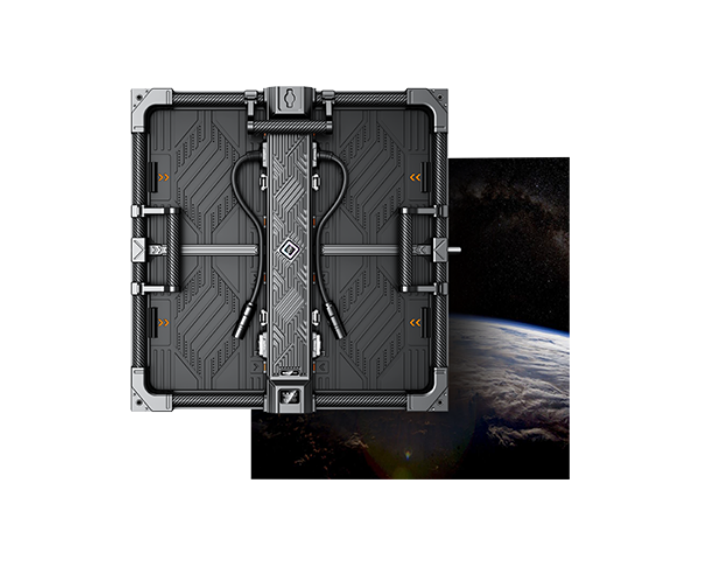
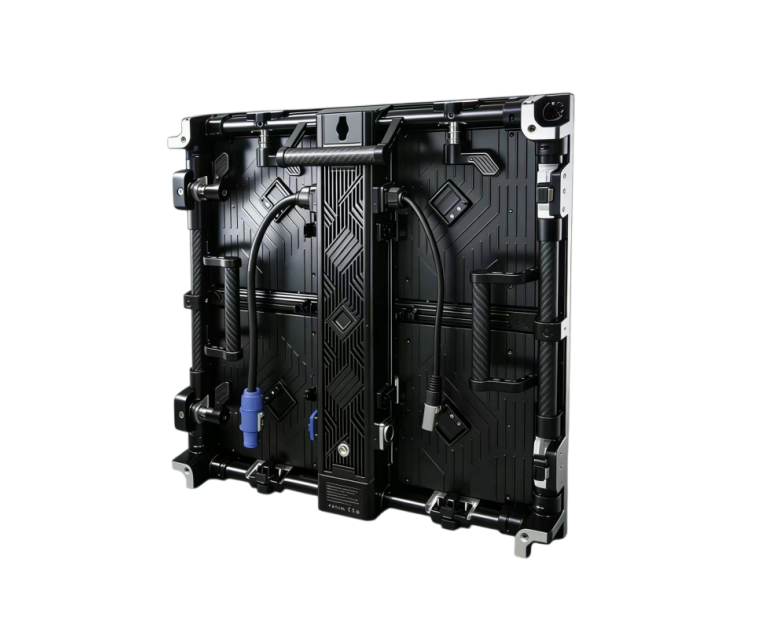
Sostron Ares Outdoor LED Display
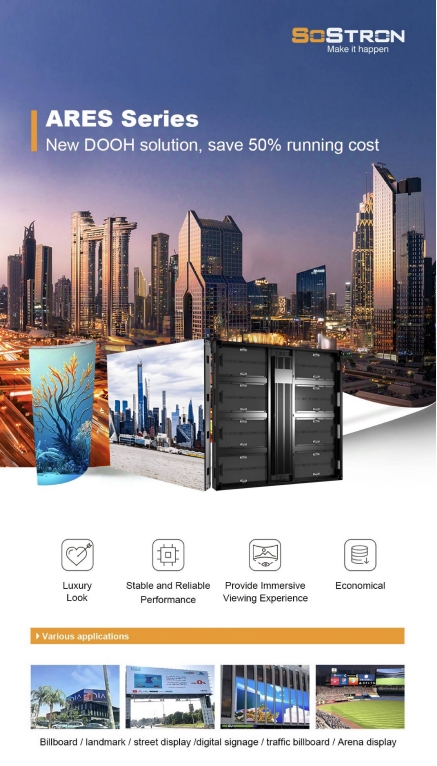
For permanent outdoor stadium perimeter installations, the Sostron Ares outdoor LED display delivers 10,000 nits peak brightness across its P3.9–P10.4 pixel pitch range—67% above the outdoor broadcast minimum—with IP65 protection on both the front and rear faces.
The 1,000×1,000 mm aluminum cabinet format tiles cleanly into continuous perimeter runs, and the front-and-rear serviceability design means maintenance crews can access modules from either side without dismantling adjacent sections.
Average power draw sits at 200 W per cabinet under typical operating conditions, against a 600 W maximum—a 67% energy reduction that matters across a 100-meter perimeter installation running 200+ event days per year.
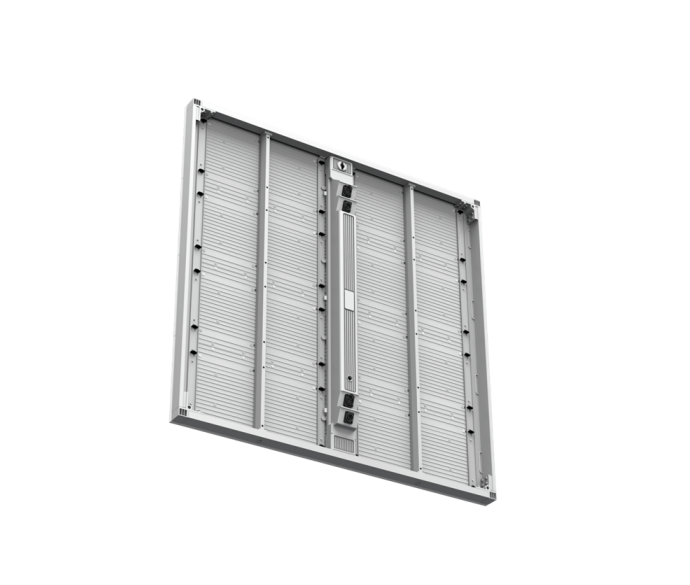
Sostron sPad Outdoor Series
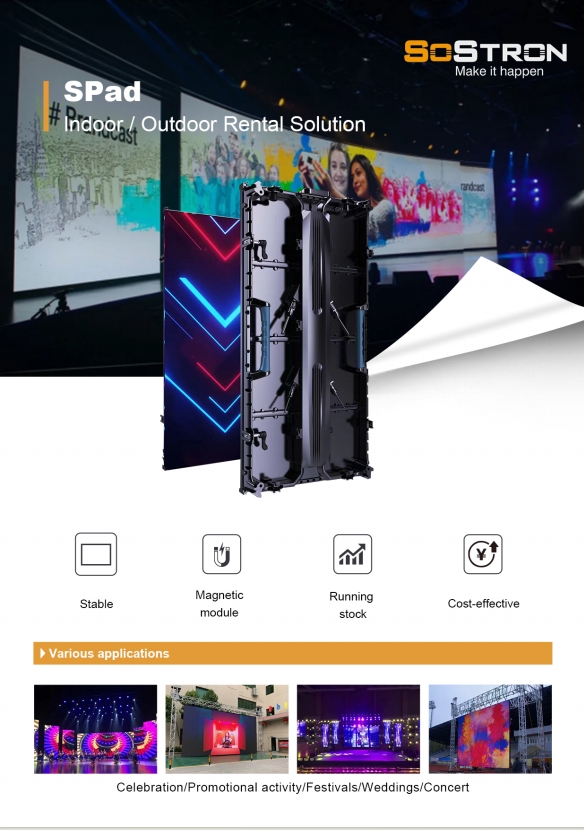
For rental deployments, touring events, or venues that host multiple sports with varying perimeter configurations, the Sostron sPad outdoor series (P2.9–P5.9) pairs a 7,680 Hz refresh rate with IP65 weatherproofing and front-access serviceability.
At 9–14 kg per cabinet, it’s light enough for rapid crew deployment without sacrificing the structural rigidity that perimeter board applications demand.
Athlete Safety Engineering: The Spec That Separates Professional-Grade Displays From the Rest
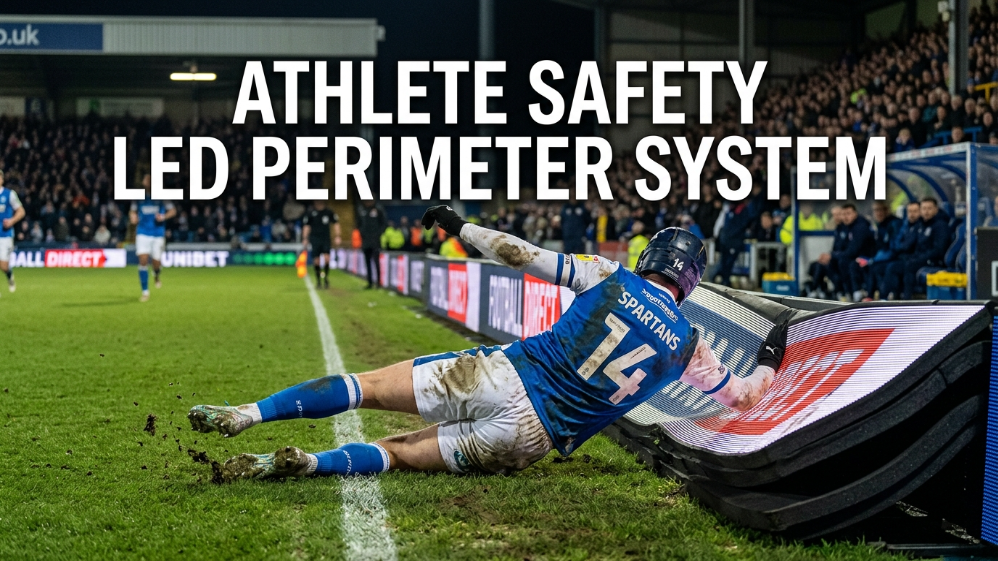
Why Soft Module Masks Are a Non-Negotiable, Not an Upgrade
A standard LED cabinet ships with a hard acrylic or polycarbonate face.
At the speeds athletes move in professional football, basketball, or rugby, contact with a hard-face perimeter board transfers impact energy directly to the player.
The physics are not complicated—and the legal exposure is not theoretical.
Soft module masks—typically EVA (ethylene-vinyl acetate) foam with a Shore A hardness rating of ≤30—absorb and redistribute impact energy across a larger surface area.
Based on materials testing data in sports equipment safety literature, the difference in peak force transmission between a hard-face and soft-face panel at 6 m/s impact velocity is approximately 40–60%.
That delta is the difference between a bruise and a fracture.
Commercial Implications
What this means commercially: venues operating without soft-face perimeter boards carry an unquantified liability exposure.
Insurance underwriters for professional sports venues increasingly require documented impact-absorption specifications as part of coverage terms.
If your supplier cannot provide a Shore A hardness rating and an energy absorption coefficient for their module mask material, that is a red flag—not a minor documentation gap.
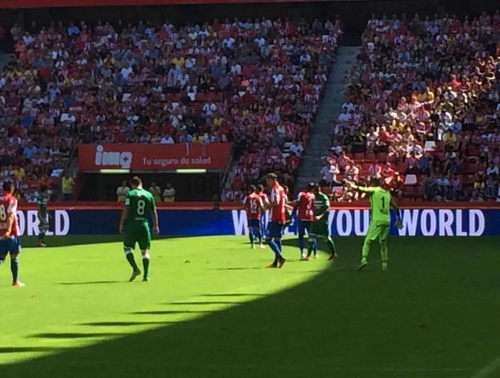
Case Study: Outdoor LED Display for French Football Stadium
Project Background
Market Demand: Football stadiums, as venues for sporting events and large-scale activities, have an urgent need for high-quality visual display systems to enhance the spectator experience and provide necessary information dissemination.
Technical Specifications: The P10 outdoor LED display is particularly suitable for outdoor environments due to its high resolution and brightness. The term “P10” refers to a pixel pitch of 10 millimeters, making it suitable for long-distance viewing and ensuring that spectators can clearly see the screen content even from afar.
Environmental Adaptability: Football stadiums often face various weather conditions, including direct sunlight and rain. The P10 outdoor LED display is designed to withstand harsh weather conditions, maintaining stable operation.
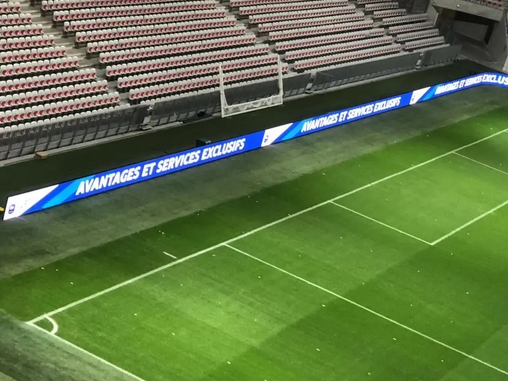
Installation Location: Considering viewing angles and visibility, the display is usually installed in prominent positions within the football stadium, such as the center of the field or surrounding fences.
Compliance: The project must comply with local building codes and safety standards to ensure that the installation of the display is legal and safe.
Application Effects
Information Dissemination: The display screen provides real-time match information, including scores, player information, and game statistics, allowing spectators to stay updated on the match dynamics.
Advertising Benefits: LED displays are ideal platforms for showcasing sponsor advertisements, bringing additional commercial revenue to the stadium.
Interactivity: The display screen can interact with the live audience by showing spectator footage, conducting polls, etc., increasing audience engagement.
Market Feedback
Spectator Satisfaction: After installing the outdoor LED display, spectators expressed satisfaction with their viewing experience, noting that the screen enhanced the live atmosphere.
Client Evaluation: Stadium management recognized the quality and performance of the display, stating that it met their outdoor display needs.
Commercial Value: The LED display attracted the interest of sponsors, increasing the stadium’s advertising revenue and commercial value.
Broadcast-Ready Performance: Meeting FIFA, UEFA, and Live Streaming Requirements
What “Broadcast-Compatible” Actually Means in Technical Terms
The phrase gets used loosely.
Here’s what it means in practice:
A broadcast-compatible perimeter LED display must not introduce visible artifacts when captured by any camera operating at shutter speeds between 1/500s and 1/2000s.
That range covers every professional broadcast camera currently deployed in UEFA, FIFA, and major league venues.
Why Low Refresh Rates Fail
The mechanism behind the failure is straightforward.
LED panels refresh their pixels in sequential scan lines.
If the panel’s refresh rate is too low, a camera with a fast shutter speed captures the display mid-scan—producing a dark horizontal band across the image.
- At 3,840 Hz, the panel completes approximately 64 full refresh cycles within a single 1/500s exposure window.
- At 7,680 Hz, that doubles to 128 cycles.
Either threshold eliminates visible banding.
Below 3,840 Hz, you’re producing broadcast artifacts on every camera in the venue.
Signal Latency Requirements
Signal latency is the second broadcast parameter that procurement teams consistently omit from their RFQs.
For live sports, the display system must render incoming video within one frame—16.67 ms at 60 fps.
A system with >33 ms input-to-output latency creates a visible desync between the live action on the pitch and the replay content on the scoreboard display.
Broadcasters notice.
Sponsors notice.
Viewers notice.
Scoreboard Display Integration: Building a Unified Stadium Display Ecosystem
One Control System, Two Display Types
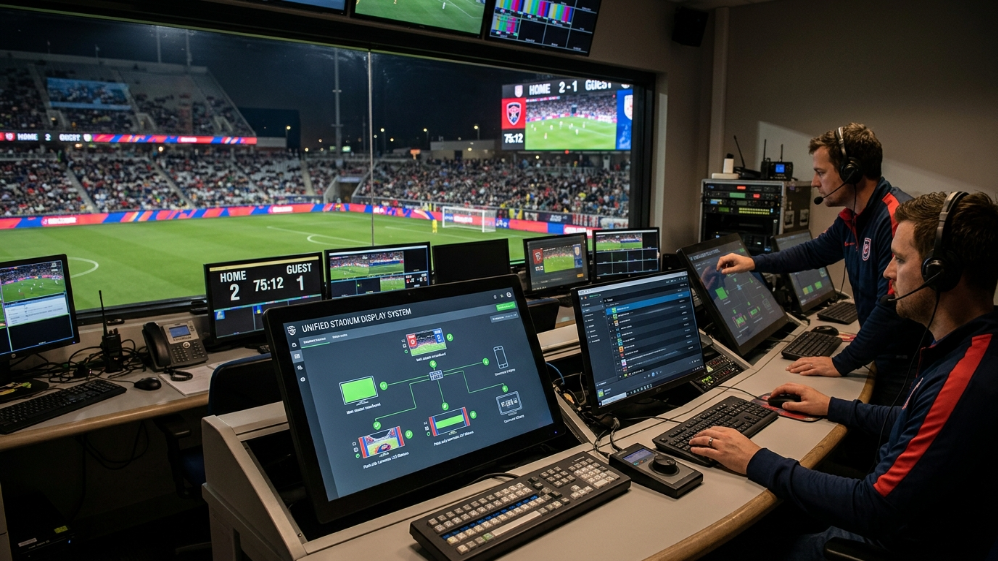
The operational case for integrating perimeter LED and scoreboard display management under a single controller is not theoretical—it’s a staffing and reliability argument.
A venue running separate control systems for perimeter boards and scoreboards requires two operators, two signal chains, and two failure points during live events.
Modern stadium deployments standardize on either Novastar or Colorlight controller platforms, both of which support multi-zone output across heterogeneous display types.
A single Novastar MCTRL4K, for example, can simultaneously drive a 120-meter perimeter run and a 4K scoreboard display from one processing unit, with independent content scheduling per zone.
Single vs Dual Controller Comparison
| Integration Requirement | Single-Controller Setup | Dual-Controller Setup |
|---|---|---|
| Operators required (live event) | 1 | 2 |
| Signal chain failure points | 1 | 2 |
| Content sync between perimeter + scoreboard | Native, frame-accurate | Requires external sync hardware |
| Sponsor content scheduling | Unified playlist management | Separate systems, manual coordination |
| Failover complexity | Single redundancy plan | Two independent redundancy plans |
| Annual maintenance cost (est.) | Lower by 30–40% | Baseline |
| Setup time per event | 45–60 min | 90–120 min |
The content workflow matters as much as the hardware.
Real-time score data, instant replay feeds, and DOOH sponsor rotation need to coexist on the same display infrastructure without frame drops or scheduling conflicts.
That requires a controller with sufficient processing bandwidth—and a content management system that separates live data inputs from pre-scheduled advertising inventory.
Reliability Engineering: Designing for Zero Downtime
N+1 Redundancy Is Not a Premium Feature
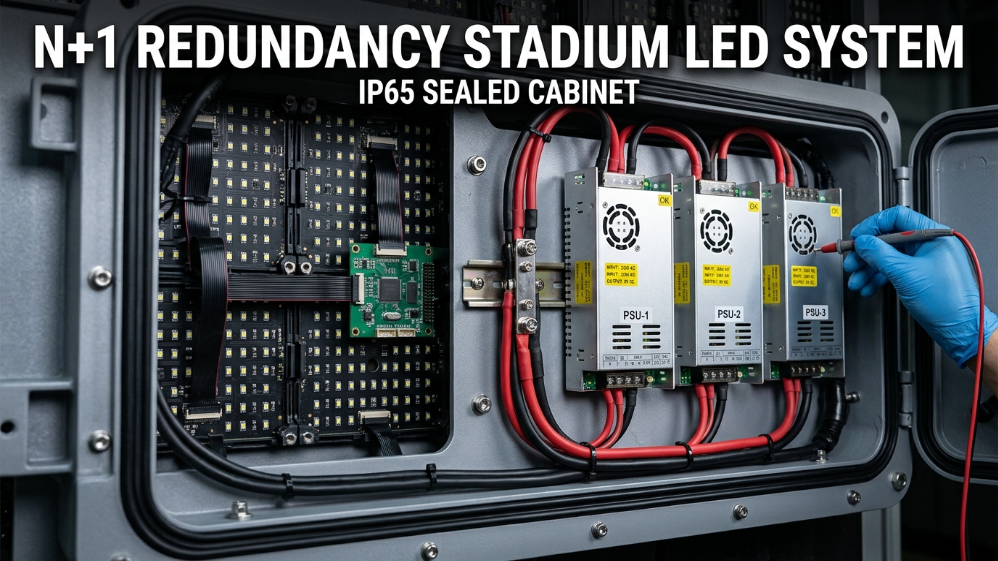
At the professional venue level, N+1 redundancy in both power supply and signal processing is a baseline specification, not an upgrade.
The math is simple:
A single power supply failure in a non-redundant cabinet takes down every module in that cabinet simultaneously.
In a 120-meter perimeter installation, that’s a visible black section during a live broadcast—and a sponsor contract conversation you do not want to have.
Dual power supplies in an N+1 configuration mean one supply can fail completely without any visible impact on the display.
The same logic applies to receiving cards:
Dual-card configurations with automatic failover switch to the backup card in under 100 milliseconds—below the threshold of human perception.
IP Rating Requirements
IP65 certification covers both dust ingress and water jets from any direction.
For outdoor stadium environments, this is the minimum acceptable rating.
IP66 adds protection against powerful water jets and is worth specifying for venues in high-rainfall climates or those with aggressive pressure-washing maintenance protocols.
The distinction matters:
An IP65 panel installed in a venue that pressure-washes its perimeter boards will degrade faster than its rated MTBF.
How to Evaluate and Shortlist Stadium LED Display Suppliers
The Questions That Separate Serious Suppliers From Catalog Vendors
Most supplier proposals look identical at the headline level:
- Pixel pitch
- Brightness
- IP rating
- Price per square meter
The differentiation lives in the questions they can’t answer from a datasheet.
Ask These Questions
- Ask for the input-to-output signal latency figure.
- Ask for the Shore A hardness rating of the soft module mask material.
- Ask for the specific UEFA or FIFA document version their compliance claim references.
“UEFA-compliant” as a marketing label without a document citation is not compliance.
Supplier Evaluation Framework
Reference Installations
Request two venue contacts at comparable scale. Call them.
Spare Parts Availability
What is the lead time for a replacement module at your pixel pitch?
The answer should be ≤72 hours for any supplier claiming professional-grade support.
On-Site Service SLA
Response time commitment in writing, not in a sales deck.
Broadcast Test Data
Ask for a camera test report at 1/1000s shutter speed.
This exists if they’ve done it.
Warranty Scope
Does it cover labor, or just parts?
The difference is significant for a 120-meter installation.
5 Technical Questions Integrators Ask Most Often
Q1: What pixel pitch should I specify for a football stadium perimeter display?
P6.25 is the practical standard for top-tier competition venues.
It satisfies broadcast camera resolution requirements at typical pitch-side camera distances (80–120 m) while remaining cost-effective at scale.
P5 is justified for venues hosting international broadcast events where ultra-high-definition camera packages are deployed.
P8 is acceptable for lower-division venues where broadcast production is not a primary requirement.
Q2: Does a perimeter LED display need to be FIFA-certified?
FIFA certification is required for venues hosting FIFA-sanctioned competitions.
For all other professional venues, UEFA’s Stadium Lighting Guide and the relevant national federation standards apply.
The practical implication:
Even if your venue doesn’t host FIFA events, specifying to FIFA Quality Programme thresholds (≥6,000 nits, ≥3,840 Hz, soft-face protection) future-proofs the installation against regulatory changes and maximizes broadcast partner acceptance.
Q3: What is the minimum refresh rate for broadcast-compatible LED displays?
3,840 Hz is the functional minimum for standard broadcast cameras.
7,680 Hz is recommended for venues deploying high-speed cameras (slow-motion replay systems operating at 120–240 fps).
Specifying 7,680 Hz adds marginal cost but eliminates the risk of a broadcast incompatibility discovery post-installation.
Q4: Can the same control system manage both perimeter boards and scoreboard displays?
Yes—and it should.
Novastar and Colorlight both support multi-zone, multi-display-type configurations from a single processing unit.
The key specification to confirm is output port count and total pixel load capacity.
A 120-meter P6.25 perimeter run plus a 4K scoreboard display represents approximately 12–15 million pixels of total load.
Verify your controller’s rated capacity exceeds this with headroom for future expansion.
Q5: How do soft face covers protect athletes, and what should I verify in the spec sheet?
Soft module masks work by distributing impact energy across a larger contact area and absorbing kinetic energy through material deformation.
The two parameters to verify:
- Shore A hardness (≤30 for meaningful impact absorption)
- Energy absorption coefficient under dynamic loading
A supplier who can provide both figures has tested their product.
A supplier who describes the mask as “soft and safe” has not.
Expert Verdict
The stadium display market is not short of suppliers.
It is short of suppliers who can answer the latency question, provide a Shore A hardness rating, and cite a specific UEFA document version in the same conversation.
That combination—broadcast data, safety data, compliance data—is the actual filter.
For permanent outdoor installations, the Sostron Ares at 10,000 nits with IP65 front-and-rear protection covers the broadcast brightness requirement with margin.
For rental and multi-sport configurations, the sPad outdoor series at 7,680 Hz handles the refresh rate requirement without compromise.
The 14-week revision cycle is optional—it only happens when the specification is incomplete.
References:
UEFA Stadium Infrastructure Regulations
FIFA Stadium and Broadcast Technology Standards