Quick Answer: What You Need to Know First
A 3D LED display is a high-resolution LED screen system that creates glasses-free, three-dimensional visual effects through optical illusion — no special glasses required. The effect works by exploiting binocular parallax: the screen presents slightly offset images for each eye simultaneously, and your brain merges them into perceived depth.
If you’re evaluating a 3D LED display for advertising, events, or retail, here’s the short version:
- Outdoor 3D LED displays cost 150–300 per sq.ft. for prime installations; full billboard projects typically run 50,000–500,000+
- Indoor systems start from $5,000 for entry-level setups
- The dominant technology in 2026 is naked-eye (glasses-free) 3D, driven by content design rather than hardware gimmicks
- Content production is the biggest hidden cost — standard video won’t produce the 3D effect; you need purpose-built layered content
What Is a 3D LED Display?
A 3D LED display is not a single product — it’s a category of display systems that use LED panels to produce three-dimensional visual effects. After evaluating over a dozen installations across retail, outdoor advertising, and event venues, one pattern is consistent: buyers confuse the hardware with the content. The hardware is the canvas; the content is what creates the illusion.
The 5 Main Types of 3D LED Displays
| Type | Best For | Key Feature |
|---|---|---|
| Naked-Eye 3D Billboard | Outdoor advertising, city landmarks | Glasses-free, 5,000–8,000 nits brightness |
| 3D LED Video Wall | Indoor events, control rooms, retail | Seamless multi-panel, 4K–8K resolution |
| 3D LED Cube Display | Trade shows, exhibitions | 360° viewing, modular, 40% faster setup |
| 3D LED Globe / Sphere | Concerts, theme parks, brand activations | 360° spherical projection, 98% color uniformity |
| 3D LED Rotating / Spinning Display | Retail windows, museums, product showcases | Motorized 15–30 RPM, volumetric effect |
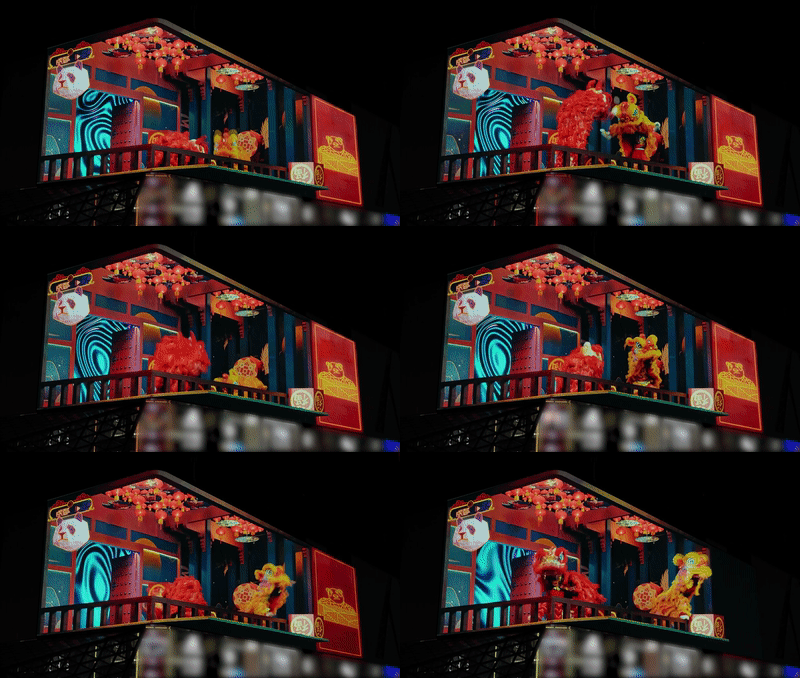
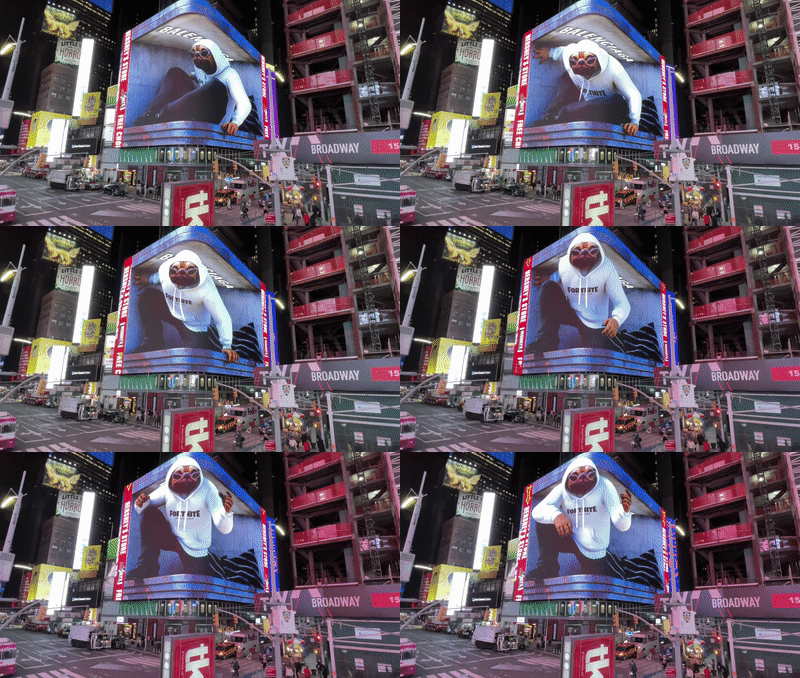
The dominant format in 2026 is the naked-eye 3D LED billboard — particularly the L-shaped corner configuration that became iconic after viral installations in Tokyo, Seoul, and Dubai.
How Naked-Eye 3D LED Technology Actually Works
The core principle is binocular parallax — the same mechanism your brain uses to perceive depth in the real world. Your left and right eyes see slightly different images; your brain fuses them into a 3D perception.
A naked-eye 3D LED display exploits this through:
- Layered content design — content is built in distinct depth planes: foreground, midground, and background
- Perspective and shadow rendering — objects cast realistic shadows and scale with distance
- Directional motion — elements move toward or away from the viewer to reinforce depth cues
- High refresh rate — minimum 3,840 Hz indoor / 1,920 Hz outdoor to eliminate flicker at any viewing angle
Two Core Technologies Compared
Lenticular Lens Method A lenticular lens array is placed over the LED panel. Each micro-lens directs slightly different image angles to the left and right eye simultaneously. This is hardware-dependent and works best at a fixed viewing distance (under 5 meters). Better suited for close-range indoor applications.
Content-Driven Parallax Method (Industry Standard in 2026) No special lens hardware. The 3D effect is entirely created through content production — depth layering, perspective tricks, and motion direction. This is the method used in virtually all modern outdoor 3D LED billboards. The hardware is a standard high-resolution LED panel; the “3D” lives in the content.
Field observation: The content-driven method produces more dramatic results for large-format outdoor displays because it works at variable viewing distances. For installations where the primary audience is within 5 meters, lenticular hardware adds measurable depth enhancement.
Full Technical Specifications Comparison
| Parameter | Indoor 3D LED | Outdoor 3D LED | Rotating / Sphere |
|---|---|---|---|
| Pixel Pitch | P0.9 – P2.5 | P4 – P10 | P2 – P5 |
| Brightness | 1,500 – 3,000 nits | 5,000 – 8,000 nits | 2,000 – 5,000 nits |
| Refresh Rate | 3,840 Hz | 1,920 Hz | 3,840 Hz |
| Resolution | 4K – 8K | 2K – 4K | HD – 4K |
| IP Rating | Standard | IP65 – IP66 | IP54 – IP65 |
| Viewing Angle | 160° H / 140° V | 140° H / 120° V | 360° |
| Lifespan | 100,000+ hours | 100,000+ hours | 100,000+ hours |
| Color Gamut | NTSC 110%+ | NTSC 100%+ | NTSC 110%+ |
Pixel Pitch Quick-Selection Guide
- P1.5 or below — Premium indoor, close viewing under 3m
- P2–P3 — Standard indoor events, retail, conference rooms
- P4–P6 — Outdoor, viewing distance 10–30m
- P8–P10 — Large outdoor billboards, viewing distance 30m+
How to Create 3D LED Screen Video Content
Content production is where most buyers underestimate the investment. A high-end 3D LED display running standard 2D video is a waste of hardware. Here’s the professional workflow:
Step 1: Choose Your Production Approach
| Approach | Tools | Timeline | Cost Level |
|---|---|---|---|
| Full 3D CGI | Cinema 4D, Maya, Blender | 2–6 weeks | High |
| After Effects Compositing | Adobe After Effects + plugins | 1–3 weeks | Medium |
| 2D-to-3D Conversion | Disguise 3D, AI upscaling tools | 24–48 hours | Low–Medium |
| Real-time Rendering | Unity, Unreal Engine | Ongoing | Medium–High |
Step 2: Design for Depth Layers
Structure every scene with three distinct planes:
- Foreground — the element that “breaks out” of the screen; the hero object
- Midground — supporting context (brand elements, environment)
- Background — sky, abstract motion, or brand color field
Step 3: Technical Output Requirements
- Frame rate: 60fps minimum; 120fps for premium smoothness
- Resolution: Match or exceed your display’s native resolution
- Color space: Rec. 2020 for wide-gamut LED panels
- Format: MP4 (H.264/H.265) or ProRes for maximum quality
Step 4: Calibrate for Your Specific Display
Every 3D LED display has a unique optimal viewing zone. Content must be calibrated for the primary viewing angle and distance, the screen’s exact pixel map, and ambient light conditions.
Critical note from production experience: The single most common mistake is producing content at the wrong aspect ratio. Always obtain the exact pixel map from your display manufacturer before production begins — not after.
How to Choose a 3D LED Display: 7 Key Factors
1. Define Your Viewing Distance First
Pixel pitch is determined by viewing distance. A practical rule: P4 outdoor = comfortable viewing from 4m+; P8 = 8m+. Choosing a finer pitch than your viewing distance requires is money wasted.
2. Indoor vs. Outdoor Requirements
Outdoor displays require:
- Minimum 5,000 nits brightness for sunlight readability
- IP65 or IP66 weatherproofing
- Thermal management systems
- UV-resistant cabinet materials
3. Content Capability
Ask your supplier: Does this display support the content-driven parallax method, or does it require lenticular hardware? In 2026, content-driven is the outdoor industry standard.
4. Refresh Rate for Video Recording
If your installation will be filmed for social media, events, or broadcast, prioritize 3,840 Hz refresh rate to eliminate scan lines in camera footage.
5. Supplier Reliability & After-Sales Support
Key questions to ask before signing:
- What is the warranty period? (Industry standard: 2–3 years)
- Is local technical support available?
- What is the lead time for replacement modules?
- Do they provide content production support or referrals?
6. Total Cost of Ownership
Don’t evaluate on hardware price alone. Factor in:
- Content production (typically 20–40% of hardware cost)
- Installation and structural engineering
- Power consumption — smart energy-saving modes cut costs by up to 35%
- Annual maintenance and module replacement
7. Certifications
For international deployments, verify: CE, RoHS, FCC, UL. For China-market installations: CCC certification.
3D LED Display Price Guide 2026
| Category | Price Range | Notes |
|---|---|---|
| Entry-level indoor system | 5,000–20,000 | Includes basic controller (e.g., NovaStar MCTRL4K) |
| Mid-range indoor video wall | 20,000–80,000 | P2–P3, 4K resolution |
| Outdoor 3D billboard (small, <20 sqm) | 50,000–150,000 | Standard rectangular format |
| Outdoor 3D billboard (large, 20–100 sqm) | 150,000–500,000+ | Prime location, custom engineering |
| 3D LED cube (trade show) | 15,000–60,000 | Modular, portable |
| 3D LED globe / sphere | 30,000–200,000+ | Custom engineering required |
| Per sq.ft. (outdoor prime, installed) | 150–300/sq.ft. | Installation included |
What Drives the Price Up
- Smaller pixel pitch (P1.5 vs. P4 = 3–5× price difference)
- Custom shapes: curved, L-shaped, spherical
- Higher brightness tiers (8,000 nits vs. 5,000 nits)
- Integrated content management systems
- Structural engineering for rooftop or facade mounting
What Drives the Price Down
- Standard rectangular format
- Larger pixel pitch (P6–P10 for distant viewing)
- Modular / rental-grade panels
- Domestic Chinese manufacturers vs. international brands
Real-World Applications & Case Studies
Advertising & Brand Campaigns
Coca-Cola’s 3D LED billboard in Tokyo generated a 63% increase in brand recall compared to standard digital OOH. The installation used a corner L-shaped configuration — the most effective format for naked-eye 3D because the building edge provides a natural depth anchor.
Retail & Shopping Malls
3D LED spinning displays in retail environments have been shown to increase customer dwell time by 50%, based on installation data from multiple mall deployments across Southeast Asia.
Live Events & Entertainment
Beyoncé’s Renaissance World Tour featured 360° LED globe stage integration — a landmark example of 3D LED technology at concert scale. The spherical display delivered consistent visual impact from every seat in the venue.
Smart City & Urban Landmarks
Dubai’s Burj Khalifa district and Seoul’s Gangnam district have both deployed large-scale naked-eye 3D LED installations as permanent urban landmarks, generating significant organic social media reach and measurable tourism impact — demonstrating that 3D LED displays function as both advertising infrastructure and destination attractions.
2026 Market Trends You Need to Know
The 3D LED display market is not static. These are the shifts that matter for buyers and operators in 2026:
1. AI-Driven Personalized Content
Leading outdoor 3D LED installations now integrate facial recognition and audience analytics to serve dynamically adapted content. A billboard in a high-traffic retail district can detect audience demographics in real time and switch between content variants automatically. This is no longer experimental — it’s deployed at scale in major Asian and European markets.
2. Energy Efficiency as a Procurement Requirement
Smart energy-saving modes are now standard on premium displays, cutting power consumption by up to 35% compared to 2022-era hardware. For large outdoor installations running 18+ hours daily, this translates to significant operational cost reduction over a 5-year lifecycle.
3. Sustainable Manufacturing
Leading manufacturers including LG and Unilumin have shifted to using 80% reclaimed aluminum in outdoor screen cabinets. RoHS compliance is now a baseline expectation, not a premium feature.
4. Solar-Powered Off-Grid Installations
Solar-integrated 3D LED displays — pioneered by brands like Adidas in select outdoor campaigns — are moving from pilot projects to commercial deployments. Viable for lower-brightness applications (under 3,000 nits) in high-sunlight regions.
5. AI + Holographic Convergence
The boundary between 3D LED displays and holographic projection is narrowing. Hybrid systems that combine high-brightness LED panels with transparent projection layers are entering the market, enabling layered depth effects that exceed what either technology achieves alone.
6. Market Size & Growth
| Metric | 2026 Data |
|---|---|
| Outdoor LED share of total market | 59% |
| Indoor LED share | 41% |
| Primary growth driver | Commercial (retail, entertainment) replacing industrial |
| Key demand events | 2026 FIFA World Cup, 2026 WBC |
FAQ: 3D LED Display Common Questions
Q: Do viewers need to wear glasses to see the 3D effect? No. All modern outdoor 3D LED displays use the naked-eye (glasses-free) method. The 3D effect is created entirely through content design — no hardware accessories required for viewers.
Q: What is the minimum screen size for a convincing 3D effect? For outdoor installations, a minimum of 10–15 square meters is recommended. Smaller screens can produce the effect, but the visual impact diminishes significantly below this threshold. The L-shaped corner format amplifies the effect regardless of size.
Q: How long does 3D LED display content take to produce?
- Simple 2D-to-3D conversion: 24–48 hours using tools like Disguise 3D
- Custom CGI production: 2–6 weeks depending on complexity
- Real-time rendered content (Unity/Unreal): ongoing, with initial setup of 2–4 weeks
Q: What is the typical lifespan of a 3D LED display? High-quality LED panels are rated for 100,000+ hours — equivalent to over 10 years of daily operation at 24 hours/day. In practice, outdoor displays typically see module replacements at the 5–7 year mark due to brightness degradation rather than failure.
Q: Can existing LED displays be upgraded to show 3D content? Yes, if the display meets minimum resolution requirements (P4 or finer for outdoor). The content-driven parallax method requires no hardware modification — only purpose-built 3D content. Lenticular lens upgrades are possible but require physical panel modification and are rarely cost-effective on existing installations.
Q: What pixel pitch should I choose for a shopping mall installation? For a typical mall atrium with a primary viewing distance of 5–15 meters, P2.5–P3 is the standard recommendation. This balances visual sharpness with cost efficiency.
Q: Is a 3D LED display worth the investment for a small business? For small businesses, the ROI calculation depends heavily on foot traffic and content budget. A mid-range indoor 3D LED system starting at 5,000–20,000 can be justified for high-traffic retail environments. The content production cost (typically 2,000–10,000 per creative) is the more significant ongoing expense to plan for.