Quick Answer
A flexible LED display is a digital screen built from LED modules designed to conform to specified curved or non-flat surfaces. Unlike conventional flat LED cabinets, flexible modules can accommodate certain concave, convex, cylindrical, or wave-shaped designs, depending on their construction and manufacturer-defined bending limits.
Flexible LED screens are commonly considered for retail interiors, architectural features, exhibition stands, stage backdrops, curved video walls, and cylindrical columns. However, flexibility does not mean unlimited bending. The minimum bending radius, permitted bending direction, module dimensions, mounting structure, and environmental protection must all be confirmed for the selected model.
There is no single reliable price for every flexible LED display. The total cost depends on pixel pitch, screen size, brightness, control equipment, structural fabrication, installation, shipping, and maintenance requirements. Buyers should compare quotations based on the same technical specification and delivery scope rather than price per square meter alone.
| Key consideration | What buyers should verify |
|---|---|
| Application | Indoor, outdoor, retail, stage, architectural, or exhibition use |
| Pixel pitch | Resolution and intended viewing distance |
| Bending capability | Minimum bending radius, direction, and permitted installation geometry |
| Image performance | Brightness, refresh rate, color reproduction, and viewing angle |
| Protection | Product-specific IP rating and environmental limitations |
| Installation | Frame design, fixing method, cable routing, and service access |
| Total cost | Display hardware, control system, structure, logistics, installation, and maintenance |
The most suitable flexible LED display is not necessarily the most flexible or highest-resolution model. It is the configuration that meets the required visual performance and physical geometry without introducing unnecessary installation, maintenance, or operating costs.
What Is a Flexible LED Display?
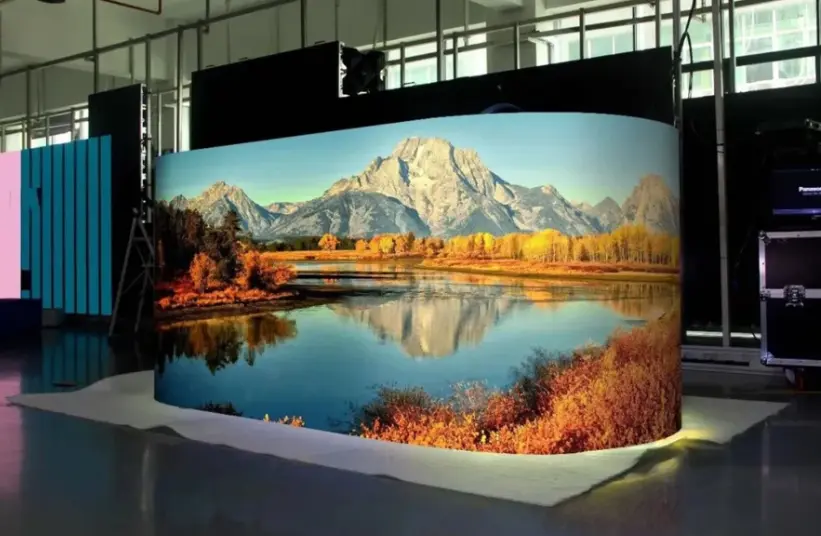
A flexible LED display is an LED-based visual system that uses specially designed modules or panels to create curved and other non-flat display surfaces.
A typical system includes LED pixels, a flexible or specially segmented circuit structure, driving electronics, module connections, a mounting system, power supplies, receiving cards, and a control system. The exact construction varies by product.
The term flexible LED display generally refers to the complete display application or system, while flexible LED module describes an individual building block used to assemble that screen.
How Do Flexible LED Modules Work?
Conventional LED cabinets are designed around relatively rigid frames. They are well suited to flat walls, standard video walls, and modular outdoor billboards.
Flexible LED modules use a different mechanical arrangement. Depending on the design, their circuit boards, substrates, component layout, connectors, and mounting interfaces allow controlled bending or adaptation to curved supports.
The flexibility comes from the module’s construction, not from an unrestricted ability to fold the screen in any direction.
When several modules are assembled, their combined geometry determines the final display shape. The mounting structure must maintain alignment, provide adequate support, and avoid applying excessive stress to the modules and their electrical connections.
Flexible LED Modules vs. Complete Flexible LED Screens
These terms are related but should not be treated as interchangeable in a quotation.
| Item | Definition | Buyer consideration |
|---|---|---|
| Flexible LED module | An individual display unit | Module dimensions, pixel pitch, bending limits, and compatibility |
| Flexible LED screen | The assembled display surface | Overall dimensions, resolution, geometry, and visual uniformity |
| Control system | Hardware and software that process and distribute display content | Compatibility, input requirements, resolution limits, and control functions |
| Mounting structure | The frame or support that holds the display in its intended shape | Structural strength, curvature, alignment, and service access |
| Complete project | The display and agreed delivery components | Installation, logistics, commissioning, warranty, and other contracted services |
A module-only purchase may be suitable for an experienced integrator with an existing compatible structure and control system. A buyer commissioning a complete curved display should confirm that the supplier’s proposal covers all components needed to make the system operational.
What Shapes Can a Flexible LED Display Create?
Flexible LED technology is useful when a standard flat display cannot follow the required surface economically or visually.
Cylindrical installations wrap the display around a column or another curved support.
Before selecting a module, establish the column diameter, display height, required viewing directions, and whether the screen needs to form a complete circle or only a partial arc.
A full cylindrical design also needs attention to the meeting point between the first and last modules. Poor alignment at this joint can create a visible seam or disrupt the image.
Concave and Convex Curved Screens
Concave screens curve inward toward the viewer, while convex screens curve outward.
The distinction matters because a module may have different restrictions for inward and outward bending. A product suitable for one geometry should not automatically be assumed suitable for the other.
For a large curved wall, the designer should confirm the radius at every section, the transition between curved and flat surfaces, and the required support arrangement.
Wave-Shaped and Complex Architectural Displays
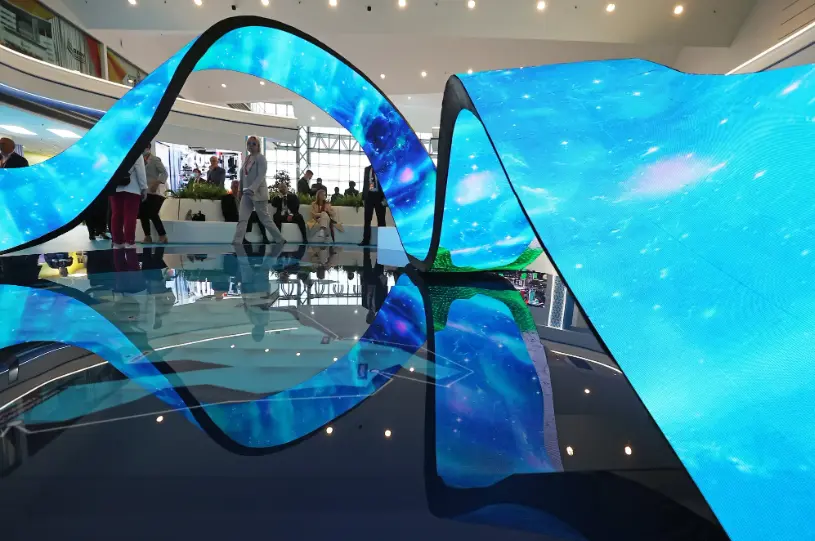
Wave-shaped screens can combine different radii or transitions between curved sections.
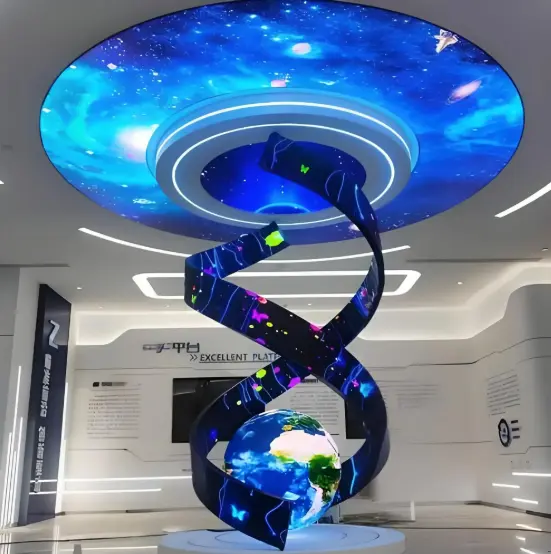
These projects usually require more detailed planning than a simple cylindrical installation. The designer should verify whether the proposed module can follow the entire surface without exceeding its bending limits or creating excessive mechanical stress.
For complex shapes, a full-size sample section or representative mock-up can help identify alignment, connection, and visual-uniformity problems before mass installation.
When Is a Flexible LED Display Not the Best Choice?
Flexibility alone is not a reason to choose a flexible display.
A conventional rigid LED cabinet may be more practical when the installation is flat, uses standard cabinet dimensions, requires frequent module handling, or benefits from a standardized structural system.
For outdoor advertising, large stadium displays, or installations exposed to substantial wind and weather, the decision must account for the complete system design. The module’s ability to bend does not establish its suitability for the environment.
Which Technical Specifications Should You Check Before Buying?
The correct specification depends on the display’s viewing distance, environment, geometry, and operating requirements. A specification sheet should be treated as a starting point for engineering review, not as proof that the product will work in every installation.
1. Pixel Pitch, Resolution, and Viewing Distance
Pixel pitch is the center-to-center distance between adjacent LED pixels, measured in millimeters. A smaller pitch provides more pixels within a given area, which can improve fine-detail reproduction when the content and viewing distance justify it.
For a screen with a physical width \(W\) in millimeters and a horizontal pixel pitch \(P\) in millimeters, the approximate horizontal pixel count is:
This is a planning approximation. The actual resolution depends on the module’s pixel matrix, module orientation, and the way the screen is assembled.
For example, a hypothetical flat display section measuring 3,200 mm across with a 2 mm pixel pitch would have approximately 1,600 horizontal pixels if the module layout supports that continuous pitch and width.
For curved screens, the visible surface width, projected width, and physical arc length may differ. A cylindrical display also needs to account for its circumference and the way modules fit around the column.
Do not select pixel pitch in isolation. First establish the typical viewing distance, the smallest text or detail to be displayed, the available budget, and the content’s intended resolution.
2. Brightness and Ambient Light
Brightness is generally specified in nits, equivalent to candela per square meter (cd/m²).
The appropriate level depends on ambient light, screen orientation, viewing distance, and whether the display is behind glass or exposed to direct sunlight.
A bright indoor retail window may require a different configuration from an indoor exhibition wall. Outdoor applications require a more detailed assessment of sunlight, weather exposure, thermal conditions, and the complete display system.
Ask the supplier for the specified brightness of the exact model and clarify whether the value represents a typical setting, a maximum setting, or a measured test result.
3. Refresh Rate and Camera Performance
Refresh rate describes how frequently the display updates its image, usually expressed in hertz (Hz). It should not be confused with video frame rate.
A higher refresh rate can help reduce visible artifacts in some camera-recording conditions, but it does not guarantee flicker-free footage. Camera shutter speed, scanning behavior, brightness settings, and the LED control system also affect the result.
If the display will be used for broadcast, filming, virtual production, or live events with cameras, request a test using the intended camera and recording settings.
4. Viewing Angle and Color Uniformity
Viewing angle affects how the image appears when people view the screen from different positions.
For cylindrical and curved displays, this matters because viewers may see the screen from multiple directions. However, a published viewing-angle figure alone does not guarantee consistent brightness or color across the entire viewing area.
Request the manufacturer’s viewing-angle specification and, where visual consistency is important, evaluate a representative sample or completed display section.
5. Protection Rating and Environmental Suitability
The International Electrotechnical Commission’s IEC 60529 standard defines the IP Code used to classify degrees of protection provided by electrical equipment enclosures.
Outdoor suitability depends on the complete display system, not only on whether the LED module is flexible or carries an IP rating. Check the documented protection level of the relevant components, connectors, power system, enclosure, and installation assembly. Also verify brightness, heat dissipation, structural support, and the environmental conditions specified by the manufacturer. IEC 60529 defines the IP Code classification for enclosure protection; it does not, by itself, certify a complete LED display for every outdoor application.
For an outdoor project, confirm:
-
Front and rear protection requirements.
-
Protection of power connections, signal connections, and cable entries.
-
Permitted operating temperature and humidity.
-
Drainage, ventilation, and condensation management.
-
Structural resistance to wind and other site-specific loads.
-
Maintenance requirements after installation.
An indoor flexible module should not be specified for outdoor use simply because its surface appears sealed or its seller describes it as weather-resistant.
6. Power Consumption and Electrical Design
Power consumption depends on the selected product, brightness setting, displayed content, and operating conditions.
Ask for both the maximum power requirement and a defensible average-power estimate. These figures serve different purposes: maximum power helps establish electrical capacity, while average power is more appropriate for estimating ongoing energy costs when based on representative operating conditions.
The electrical design should also consider power distribution, cable sizing, protective devices, circuit loading, and the manufacturer’s installation requirements.
7. Module Size, Thickness, and Service Access
Module dimensions influence more than the number of modules needed. They can affect how closely the screen follows a curve, where seams appear, and how easily a technician can access a damaged section.
Before finalizing the design, confirm:
-
Physical module dimensions and pixel matrix.
-
Thickness and mounting interface.
-
Required clearances behind the display.
-
Connector positions and cable routing.
-
Front or rear maintenance access.
-
Compatibility with the proposed frame.
-
Availability of replacement modules.
For more detailed module-specific considerations, see Sostron’s LED Display Soft Module: Specs, Uses & Buying Guide.
How Much Does a Flexible LED Display Cost?
There is no universal price for a flexible LED display. A meaningful quotation must identify the model, pixel pitch, screen dimensions, brightness, control equipment, structural requirements, delivery scope, and destination.
A module-only purchase and a fully installed curved display are different products from a budgeting perspective. Comparing them using a single price-per-square-meter figure can produce misleading conclusions.
What Determines the Price?
| Cost driver | Why it matters | What to request |
|---|---|---|
| Pixel pitch | Changes pixel density and the module configuration required | Exact pitch and module resolution |
| Module dimensions | Affects layout, seams, and curve compatibility | Module drawing and approved assembly geometry |
| Display area | Determines quantity, but does not fully define complexity | Screen dimensions and module count |
| Brightness and performance | May affect hardware selection and power requirements | Rated brightness and relevant test conditions |
| Curved structure | Complex geometry can require custom fabrication | Structural drawings and fabrication scope |
| Control system | Determines content inputs, processing, and compatibility | Equipment list and supported resolution |
| Installation | Depends on access, height, site conditions, and labor | Installation scope and exclusions |
| Logistics | Depends on dimensions, weight, packing, route, and destination | Packing details and freight quotation |
| Maintenance | Depends on service design, spare parts, and accessibility | Warranty, service plan, and spare-parts policy |
Module Price vs. Complete Screen Price
Buyers should request separate line items for the following:
-
Flexible LED modules.
-
Receiving cards, power supplies, and cabling.
-
Sending equipment or video processor, where required.
-
Mounting frame and structural fabrication.
-
Spare modules and other recommended spare parts.
-
Export packaging and shipping.
-
Customs duties, import taxes, and destination handling where applicable.
-
Installation, commissioning, and operator training, if included.
-
Content preparation or control software services, if applicable.
The exact list will vary with the supplier’s scope. Some projects use existing control equipment or locally fabricated structures, while others require a complete system from the manufacturer.
A lower module price does not necessarily mean a lower installed project cost. The relevant comparison is the cost of delivering the same technical result under the same scope and acceptance requirements.
How Should Buyers Compare Supplier Quotations?
Request at least two quotations using the same specification sheet and project drawing.
Check that each quotation identifies the product model, pixel pitch, module size, bending limits, brightness, control equipment, structural scope, warranty, delivery terms, and exclusions.
If one supplier quotes only the modules while another includes the structure and commissioning, the totals are not directly comparable. Normalize the scope before deciding which proposal offers better value.
For additional pricing and purchasing considerations, consult Sostron’s Flexible LED Panel Prices and Buying Guide.
How Can You Estimate the Total Cost of Ownership?
The initial purchase price is only one part of the cost of operating a display.
A useful project-level framework is:
Here, \(TCO\) represents the total cost of ownership over a defined evaluation period. Each cost category should be defined consistently to prevent double-counting.
Customs, content services, and other project-specific expenses should also be included where relevant. If they are already included in another line item, do not add them twice.
Electricity Cost Calculation
Annual electricity cost can be estimated using:
Where:
-
\(P_{\text{avg}}\) is average operating power in kilowatts.
-
\(H_{\text{daily}}\) is operating hours per day.
-
\(D_{\text{annual}}\) is operating days per year.
-
\(R_{\text{kWh}}\) is the electricity tariff per kilowatt-hour.
Example — calculation method only: Assume a display has a measured average operating power of 2 kW, operates for 10 hours per day, runs 365 days per year, and uses electricity priced at $0.15 per kWh.
The resulting annual electricity cost is $1,095 under those assumptions. This is an illustrative calculation, not a measured Sostron product result or a claim about typical flexible LED power consumption.
For an actual quotation, replace every assumed input with project-specific data.
Maintenance costs also deserve attention. Difficult access, specialized structural components, unavailable replacement modules, or extended downtime can make an initially inexpensive installation more expensive over its operating life.
Flexible LED Modules vs. Rigid LED Cabinets: Which Is Better?
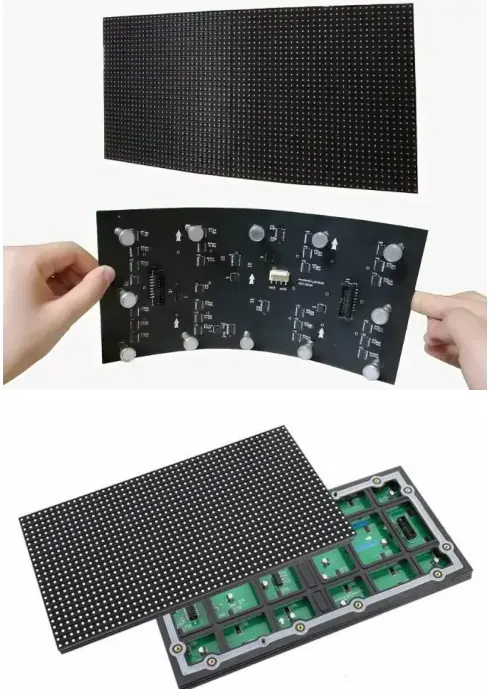
The best choice depends on the required screen geometry, installation conditions, maintenance plan, and total project cost.
| Decision factor | Flexible LED modules | Rigid LED cabinets |
|---|---|---|
| Surface geometry | Designed for specified curved and non-flat surfaces | Well suited to flat surfaces and standardized modular layouts |
| Curved installations | Can simplify certain curved designs when the module’s limits match the geometry | Curves may require specialized cabinets, connectors, or structural arrangements |
| Structural requirements | May require a custom curved frame or mounting surface | Often uses a standardized cabinet mounting system |
| Installation | Requires careful control of curvature, alignment, and module stress | Often more straightforward for standard flat video walls |
| Maintenance | Depends on module access, fixing method, and compatible spare parts | Depends on cabinet design and front or rear service access |
| Cost | May reduce complexity for some shapes but increase custom engineering costs | May be more economical for standard flat installations |
| Best-fit applications | Columns, curved walls, wave-shaped displays, and selected architectural designs | Flat video walls, standard outdoor billboards, and modular display systems |
Neither category is universally better. A flexible module may be the practical choice when a design requires a curve that standard cabinets cannot accommodate efficiently. A rigid cabinet may be preferable when the surface is flat and standardized installation, handling, and servicing are priorities.
When Should You Choose a Flexible LED Display?
Consider flexible LED modules when:
-
The display must follow a specific curved surface.
-
The required geometry is compatible with the manufacturer’s bending specification.
-
A custom architectural or exhibition design is central to the project.
-
The structure can support the module and provide adequate maintenance access.
-
The project budget accommodates any additional engineering and fabrication.
Consider a rigid LED solution when:
-
The display is predominantly flat.
-
Standard cabinet dimensions suit the design.
-
Frequent assembly and disassembly are important.
-
The project benefits from standardized structural and maintenance arrangements.
-
A custom curved frame would add cost without providing a meaningful benefit.
For cylindrical installations, compare the proposed module’s actual bending capability and assembly dimensions against the column geometry before selecting the product.
How Do You Install and Maintain a Flexible LED Screen?
Successful installation depends on the complete system, not just the flexibility of the modules.
1. Confirm the Geometry Before Ordering
Provide the supplier with a dimensioned drawing of the installation surface. Include the screen height and width, target radius or column diameter, curvature direction, and any transitions between flat and curved sections.
For cylindrical screens, verify the circumference and module layout. For more complex surfaces, provide drawings or a three-dimensional model when available.
The supplier should confirm that the proposed module dimensions and permitted curvature can achieve the intended design.
2. Design the Supporting Structure
A flexible module still needs appropriate support. The frame or mounting surface must maintain the required geometry and provide stable fixing points.
Check the structural design for:
-
Correct curvature and dimensional tolerances.
-
Secure fixing and adequate load-bearing capacity.
-
Consistent module alignment.
-
Suitable cable routing and power distribution.
-
Access for installation and future servicing.
-
Compatibility with the selected module and its mounting method.
For large, elevated, or outdoor displays, the supporting structure should be evaluated by a qualified professional against the relevant site conditions and applicable engineering requirements.
3. Plan Module Alignment and Cable Routing
Poor alignment can create visible seams, uneven surfaces, or inconsistent image geometry.
The installation plan should specify module orientation, connection points, sequence of assembly, and the location of the final seam where applicable.
Power and signal cables should follow the manufacturer’s routing requirements. Avoid twisting modules or placing unnecessary strain on connectors, circuit boards, and solder joints.
Do not assume that a module can be repeatedly bent or flattened during installation. Follow the model-specific handling instructions.
4. Test Before Final Commissioning
Where practical, assemble and test a representative section before completing the full installation.
The inspection should verify:
-
Mechanical fit and surface alignment.
-
Correct module connections.
-
Pixel operation and image uniformity.
-
Color consistency and brightness.
-
Content playback and control-system compatibility.
-
Operating temperature and other applicable manufacturer checks.
For camera-facing applications, test the display with the actual camera and recording settings.
5. Plan for Maintenance and Replacement
A flexible LED screen should be designed with future servicing in mind.
Confirm whether modules can be removed from the front or require rear access. Check whether replacement modules use compatible dimensions, connectors, control settings, and color calibration.
Keep a record of the model numbers, module layout, control-system configuration, and replacement parts used in the installation. These records can reduce troubleshooting time when a module fails.
Electrical repairs, soldering, and work inside powered equipment should be handled by appropriately qualified personnel following the manufacturer’s safety procedures.
What Are the Most Common Installation Risks?
| Risk | Possible consequence | Preventive action |
|---|---|---|
| Bending beyond the rated limit | Module damage, dead pixels, or intermittent connections | Verify the model-specific curvature specification |
| Incorrect frame geometry | Gaps, uneven surfaces, and visible seams | Confirm dimensions before fabrication |
| Excessive connector stress | Intermittent signals or electrical faults | Follow the approved routing and mounting design |
| Insufficient service access | Longer maintenance time and higher labor costs | Plan front or rear access before installation |
| Incompatible replacement modules | Fit, image, or calibration problems | Confirm model and control-system compatibility |
| Unverified outdoor suitability | Water ingress, thermal problems, or premature failure | Verify the complete system’s environmental requirements |
How Do You Choose a Reliable Flexible LED Display Manufacturer?
A reliable supplier should be able to explain how the proposed product meets the project’s technical requirements and provide documentation to support the claims.
Technical Documents to Request
Before placing an order, request:
-
A product specification sheet identifying the exact model.
-
Module dimensions, pixel pitch, and pixel resolution.
-
Minimum bending radius or diameter and permitted bending direction.
-
Brightness, refresh rate, and relevant electrical specifications.
-
Applicable protection ratings and supporting documentation.
-
Control-system compatibility and connection requirements.
-
Mounting drawings and installation instructions.
-
Warranty terms, spare-parts arrangements, and maintenance guidance.
-
Relevant test reports or certificates where required by the project.
-
A written quotation that clearly defines the delivery scope.
Check that documents apply to the model being quoted. A certificate for another product or a generic company brochure does not establish that the proposed configuration meets your requirements.
How Can You Evaluate a Supplier’s Engineering Capability?
Ask the supplier to review your drawing rather than immediately recommending a product based only on square-meter area.
A technically useful response should address whether the required curve is feasible, which module dimensions are appropriate, what support structure is needed, and what limitations or trade-offs apply.
For a complex project, request a representative sample or a technical review before committing to full production.
Where the project requires third-party certification or testing, verify the relevant document and its scope through the issuing organization. Do not assume that a general statement about compliance is equivalent to a valid product-specific certificate.
What Should the Purchase Contract Specify?
A clear contract should identify the exact product model, approved specifications, quantities, delivery schedule, acceptance criteria, warranty coverage, and responsibilities for installation and commissioning.
For custom curved screens, the approved drawings and agreed geometry should be part of the technical scope. Any deviation from the approved configuration should be reviewed before production or installation.
Also establish how defects, replacement modules, shipping damage, and after-sales support will be handled. These details can be as important as the initial hardware price.
Frequently Asked Questions About Flexible LED Displays
1. What is the difference between a flexible LED display and a flexible LED module?
A flexible LED module is an individual unit designed to form part of a curved or non-flat screen. A flexible LED display is the assembled system, which may include multiple modules, a supporting structure, power supplies, control equipment, and associated cabling.
When purchasing modules separately, confirm compatibility with the intended structure and control system.
2. What is the minimum bending radius of a flexible LED screen?
The minimum bending radius is the smallest permitted radius specified for a particular module under its manufacturer’s stated conditions. It varies by model and cannot be determined from pixel pitch alone.
Some manufacturers specify a minimum bending diameter or a permitted assembly geometry instead. These measurements are related but should not be treated as interchangeable without checking the technical definition.
Provide the required curve or column diameter to the supplier and request written confirmation that the proposed model can achieve it.
3. Can flexible LED displays be used outdoors?
Some flexible LED products are designed for outdoor applications, but indoor modules should not automatically be considered weather-resistant.
Verify the exact product’s IP rating, front and rear protection, operating temperature, humidity limits, electrical connections, and structural requirements. The complete installed system must meet the environmental conditions of the project.
4. How much does a flexible LED display cost per square meter?
There is no single price that applies to every flexible LED display. The quotation depends on pixel pitch, module construction, required curvature, control hardware, supporting structure, installation scope, shipping, and maintenance requirements. For a meaningful comparison, ask each supplier to separate the module price from the complete system cost and to list all included and excluded items. Any price benchmark should state its date, currency, market scope, and whether it covers modules only or a complete installed system.
For a meaningful comparison, request separate prices for display hardware, control equipment, supporting structure, installation, logistics, and other applicable costs. Compare suppliers using the same technical specification and delivery scope.
5. Which pixel pitch should I choose for a curved LED screen?
Choose pixel pitch based on the typical viewing distance, required image detail, screen dimensions, content, and budget.
A finer pitch may improve close-up image quality, but it increases pixel density and may increase hardware cost. A coarser pitch can be appropriate for more distant viewing.
For curved displays, also verify the module dimensions, available resolution, and bending limits. Pixel pitch alone does not establish whether a module can achieve the required curve.
6. Can flexible LED modules be bent repeatedly?
Do not assume that a flexible LED module is designed for repeated bending.
Some products are intended to conform to a specified curve during installation, while others may have different handling requirements. Repeated bending can place stress on circuit traces, solder joints, connectors, and other components.
Follow the manufacturer’s instructions and confirm whether repeated bending is explicitly permitted before using the modules in a reconfigurable installation.
7. Are flexible LED displays better than rigid LED screens?
Neither option is universally better.
Flexible LED modules can be advantageous when the display must follow a curved wall, column, or other non-flat surface. Rigid LED cabinets can be more practical for standard flat installations and may simplify structural design and maintenance.
The right choice depends on geometry, visual requirements, installation conditions, and total project cost.
Expert Verdict: When Should You Choose a Flexible LED Display?
A flexible LED display is worth considering when the shape of the installation is a central design requirement. It can enable curved walls, cylindrical columns, wave-shaped surfaces, and other applications that are difficult to achieve with standard flat LED cabinets.
However, the term flexible should never replace engineering verification. Before ordering, confirm the minimum bending radius or diameter, permitted bending direction, pixel pitch, module dimensions, brightness, environmental protection, and maintenance method.
For B2B buyers, the most important commercial decision is to evaluate the complete installation rather than the module price alone. Structural fabrication, control equipment, logistics, electrical requirements, maintenance access, and replacement parts can materially affect the final cost.
The most reliable procurement process starts with a dimensioned drawing, a clear performance specification, and a written technical review from the supplier. That approach helps establish whether the proposed display is feasible before money is committed to production.
About Sostron
Before requesting a quotation, prepare the display dimensions, required curve geometry, nearest viewing distance, installation environment, brightness requirements, maintenance constraints, and preferred control system. Sostron provides LED display manufacturing and commercial display solutions, with engineering support and installation guidance for project-specific requirements. The final module and system configuration should be confirmed against the applicable technical specifications, mechanical drawings, and agreed quotation scope.
For projects involving curved walls, cylindrical structures, or other non-standard display geometries, buyers should provide their project drawings, installation environment, viewing requirements, and target dimensions so the appropriate product configuration can be evaluated.
The objective is to select a display system that meets the project’s visual and mechanical requirements while remaining practical to install, operate, and maintain.
References:
IEC 62715-6-1 — Flexible Display Devices: Mechanical Test Methods
IEC 60529 — Degrees of Protection Provided by Enclosures (IP Code)