What Is an Indoor Flexible LED Column Module?
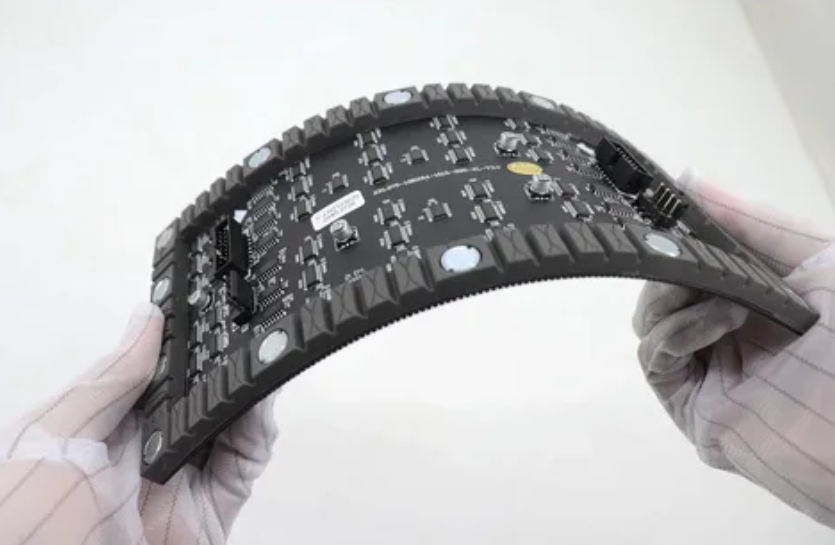
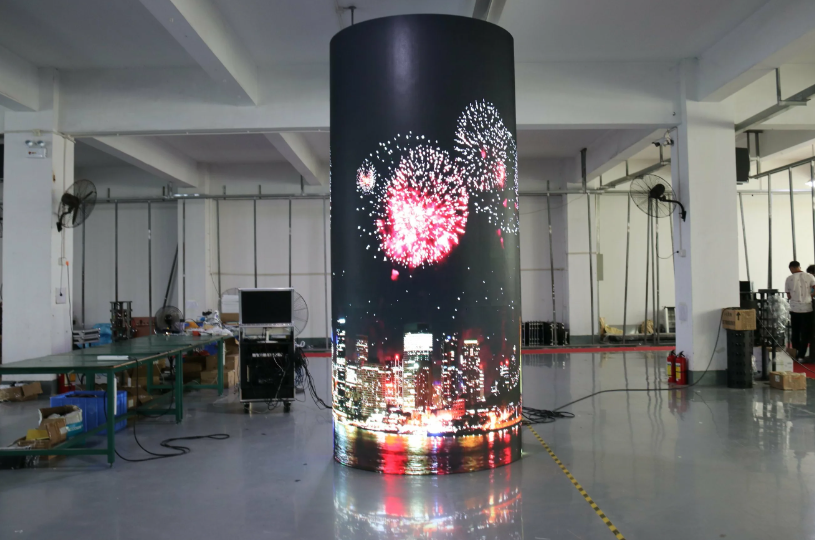
An indoor flexible LED column module is a customized display unit built on flexible PCB (FPC) technology combined with a high-elasticity silicone base. Unlike traditional rigid LED panels, it is specifically designed for cylindrical, S-shaped, and wave-like architectural structures. Using a magnetic front-maintenance system, these modules achieve seamless assembly on non-linear surfaces.
For event production companies, engineering teams, and international procurement managers, flexible LED column modules are not just display hardware—they are a core solution for digitizing irregular spaces and elevating visual value in high-end environments.
1. Core Logic: How Flexible Modules Define Spatial Premium
In B2B procurement, an indoor LED column screen is not simply a display—it is a digital extension of architectural design.
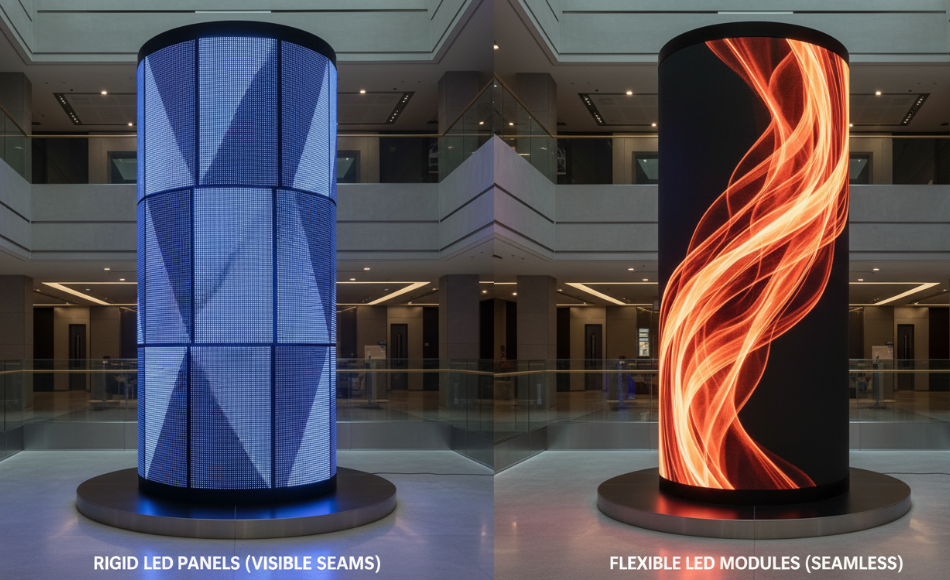
Traditional cabinet-based LED screens struggle with curved structures. Their rigid geometry inevitably creates visible edges and polygonal distortion when applied to columns, resulting in broken visual continuity.
The true value of flexible modules lies in their curvature tolerance.
High-quality flexible modules use high-density, multi-layer flexible circuit designs that achieve a minimum bending radius of approximately 150 mm. This level of curvature precision is critical in high-density commercial environments such as luxury retail columns or airport wayfinding pillars, where visual smoothness directly translates into perceived brand value.
2. Technical Breakdown: High-Density Specs and Scenario Matching
A common mistake among buyers is relying solely on pixel pitch. In reality, column display performance is
determined by the combined effect of pixel pitch, refresh rate, grayscale depth, and color consistency.
Table 1: Recommended Technical Specifications by Application Scenario
| Application Scenario | Recommended Pixel Pitch | Key Technical Requirements | Recommended Solution | Commercial Value |
|---|---|---|---|---|
| High-end broadcast / XR studios | P1.25 – P1.5 | 7680 Hz refresh rate / 16-bit grayscale | Reta 2 Series | Eliminates scan lines on cameras; supports virtual production |
| Shopping malls / art galleries (columns) | P1.8 – P2.5 | 3840 Hz refresh rate / strong magnetic adhesion | SPad Pro2 Creative Series | Ultra-smooth curvature; reduces front-maintenance cost by 70% |
| Large indoor exhibition halls | P2.5 – P3.0 | Energy-efficient drivers / low-temperature operation | Storm Plus Fixed Series | Long-term stability for large-scale irregular installations |
In-depth insight:
If your project resembles a commercial P2.5 indoor installation, such as those commonly seen in Southeast Asian shopping complexes, high-refresh driver IC support is non-negotiable.
Modern consumers constantly record and share content on social media. Displays with refresh rates below 1920 Hz produce black scan lines on camera, instantly destroying the premium feel of the brand presentation.
3. Supply Chain Reality: Hidden Costs and Lifespan Traps
As someone responsible for supply chain decisions, this must be stated clearly:
The real cost of a flexible LED module is not paid at purchase—it is paid in year three.
Table 2: 3-Year Cost Risk Comparison — Low-End vs. Professional-Grade Solutions
| Cost Factor | Low-End Solution (Low Initial Price) | Sostron Professional Solution | Root Cause |
|---|---|---|---|
| Initial purchase | 100% (baseline) | 120%–130% | Gold-wire LEDs, 4+ layer FPC, high-refresh ICs |
| Dead pixel maintenance | 5–10% module replacement per year | <0.01% failure rate | Inferior PCBs crack after repeated bending |
| Power consumption | High | ARES series common-cathode energy-saving design | Up to 50% lower power usage |
| Hidden risks | Warped seams, color shifts | Precise curvature, consistent color | Silicone base aging resistance determines long-term flatness |
Industry reality:
Many factories cut costs by using recycled LEDs or copper-wire LEDs. In dry, air-conditioned indoor environments, copper wire oxidizes far faster than gold wire, leading to widespread pixel failure within 12 months—often referred to in the industry as “mass blind pixels.”
4. Industry Shortcuts and How to Avoid Them: Three Ways to Identify Quality
Check the base material:
True high-quality flexible modules use medical-grade silicone. It remains soft, does not leak oil, and does not shrink under heat. Inferior rubber bases harden after 6 months of operation, causing modules to detach from magnetic frames—a common issue known as “edge lifting.”
Inspect the FPC routing:
Open the back and examine the flexible PCB thickness. Professional B2B-grade modules use rolled annealed copper, not electrolytic copper. The former tolerates repeated bending during installation without cracking.
Test grayscale performance:
Play low-brightness gradient content. Visible banding indicates insufficient driver IC processing capability. Such screens perform poorly in dark-toned advertising and premium visual applications.
5. The Sostron Solution: Stability and Aesthetics Built on 14 Years of Experience
Backed by a 15,000 m² intelligent manufacturing base, Sostron delivers more than products—we deliver end-to-end engineering reliability.
14 years of applied expertise:
We understand structural challenges in column displays. In a bowling center P2.5 project, our irregular-splicing technology ensured real-time score synchronization while maintaining perfect cylindrical geometry.
Full industry-chain coverage:
From the high-brightness ARES 2 energy-saving series to the ultra-fine Reta 2 indoor lineup, our 4,000 m² R&D center ensures every module undergoes a 72-hour white-balance aging cycle before shipment.
Key advantage:
To address after-sales concerns for export-focused clients, we deliver EMC Class B–certified products, paired with a cloud-based CMS that supports remote fault alerts—true turnkey delivery, not empty promises.
6. FAQ: Straight Answers to the Toughest Questions
Q: Is the installation structure complicated?
A: Not complicated—but experience matters. Modules are magnetically mounted onto pre-fabricated steel column frames. Sostron provides detailed CAD drawings to ensure millimeter-level alignment.
Q: Why are some P2.5 flexible modules priced at half the market rate?
A: They typically use 1920 Hz low refresh, copper-wire LEDs, and recycled plastic bases. Lifespan is usually 8–12 months. As a nationally certified high-tech enterprise, we do not compete in low-quality price wars.
Q: Do you provide global technical support?
A: Yes. With 14 years of export experience, we offer video-based technical guidance, cloud diagnostics, and on-site engineering supervision when required.
Conclusion: Don’t Let “Cheap” Destroy Your Creative Space
Indoor flexible LED column modules are a long-term investment. Choosing Sostron means choosing low maintenance costs, high visual premium, and the stability of a world-class supply chain.
Looking for a precise technical solution and pricing for your current project?
[Request a Customized Quote] or [Book a 1-on-1 Virtual Factory Tour]
See how our 72-hour aging process protects quality—without shortcuts.
Disclaimer:
The market reference prices mentioned in this article are estimates based on supply chain costs and exchange rates at the time of writing and are provided for budgeting purposes only. Actual transaction prices may vary due to fluctuations in raw material costs (such as LED chips, precious metals, and aluminum), changes in exchange rates, logistics expenses, and your specific customization requirements (including non-standard designs or special mounting structures).
The product images and case examples shown are for illustrative purposes only. Sostron reserves the right to upgrade or modify product appearance and technical specifications as part of ongoing product development. Final delivery standards shall be subject to the technical specifications and contractual terms mutually confirmed by both parties.
References: