Before anything else—the specification answer most integrators need before they spend hours reading. For the majority of sanctuaries, the decision tree collapses to five variables. Get these right and everything else follows.
Quick-Reference Church LED Screen Specification Matrix (2026)
| Congregation Size | Recommended Screen Width | Pixel Pitch | Minimum Brightness | Refresh Rate | Estimated Turnkey Cost |
| <150 seats | 3.0–4.0 m (10–13 ft) | P2.5–P3.0 | 800 nits | 3,840 Hz | $12,000–$22,000 |
| 150–300 seats | 4.0–5.5 m (13–18 ft) | P2.9–P3.9 | 1,000 nits | 3,840 Hz | $22,000–$42,000 |
| 300–600 seats | 5.5–7.0 m (18–23 ft) | P2.9–P3.9 | 1,200 nits | 3,840–7,680 Hz | $40,000–$75,000 |
| 600–1,500 seats | 7.0–10.0 m (23–33 ft) | P2.5–P3.9 | 1,500 nits | 7,680 Hz | $70,000–$150,000 |
| 1,500+ seats/IMAG | 10.0 m+ / multi-screen | P1.8–P2.9 | 1,500+ nits | 7,680 Hz | $120,000+ |
Note: Costs are indicative installed figures for North American and European markets. APAC projects typically run 20–35% lower at equivalent specification levels.
Here is the problem we see on every RFQ that lands in our inbox: the church has already picked a supplier, settled on a pixel pitch, and budgeted a number—then discovered, three weeks before installation, that the power supplies are fan-cooled. In a 400-seat sanctuary with a 28 dB ambient noise floor, those fans are catastrophically loud during communion. Based on our experience commissioning worship display solutions across three continents, the silent operation requirement is the single most under-specified aspect of any sanctuary video wall project. The second is volunteer operability. Nobody talks about either in enough depth—and that gap costs integrators and their church clients real money.
This guide addresses both, alongside the full technical framework for specifying, sourcing, and installing a church LED screen that performs flawlessly every Sunday for a decade.
What Is a Church LED Screen? (Definition, Components, and Why It’s Not “Just a Big TV”)
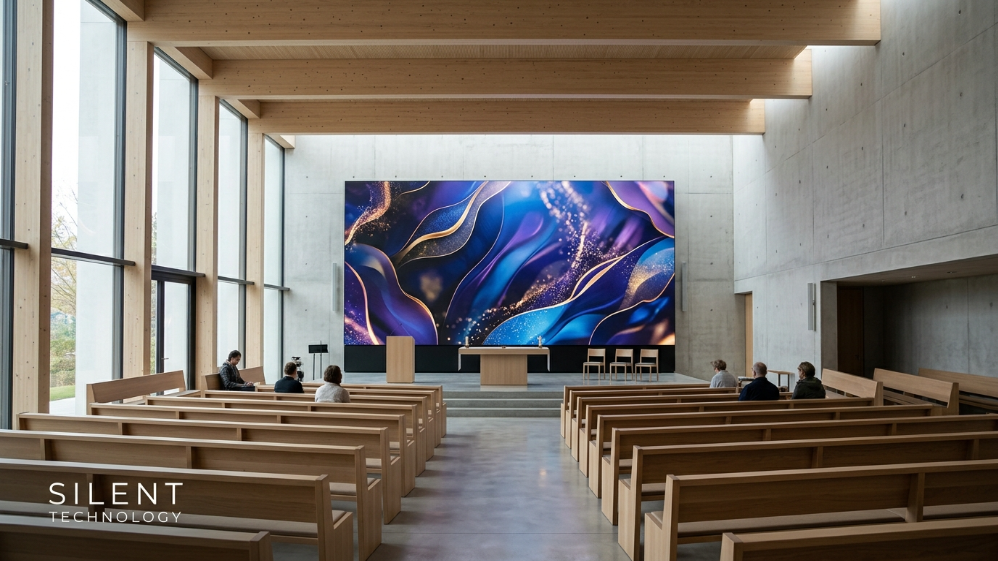
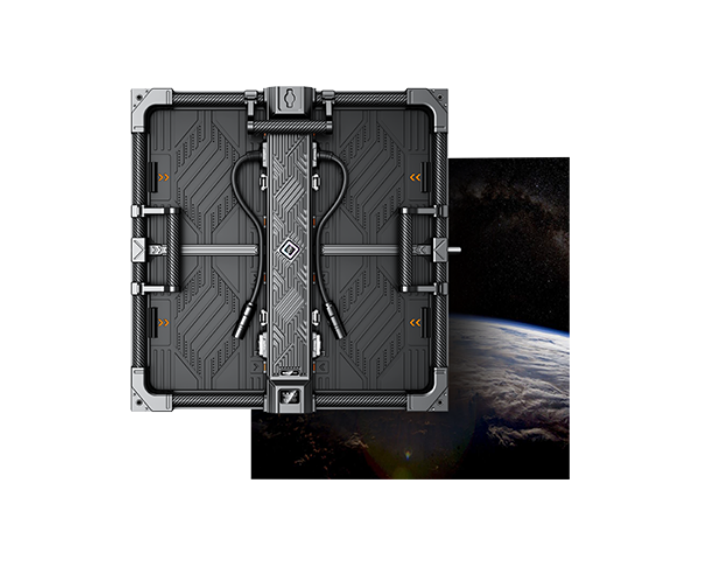
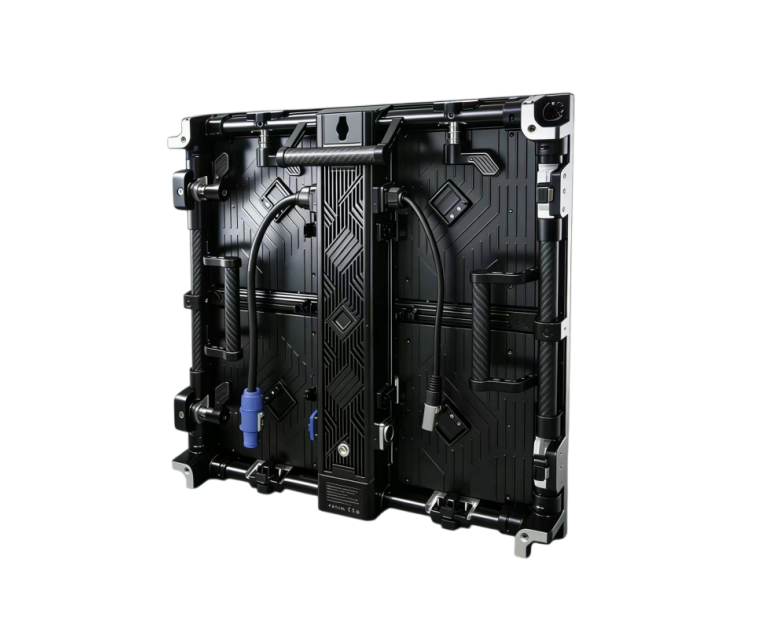
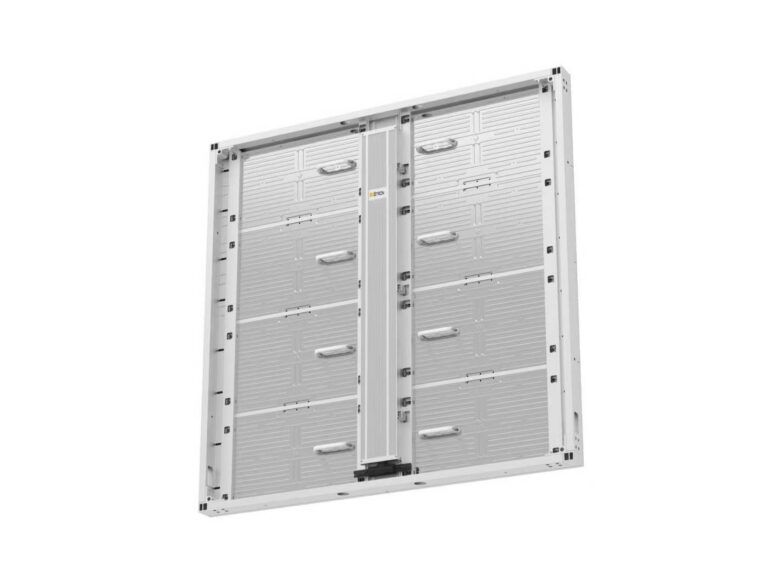
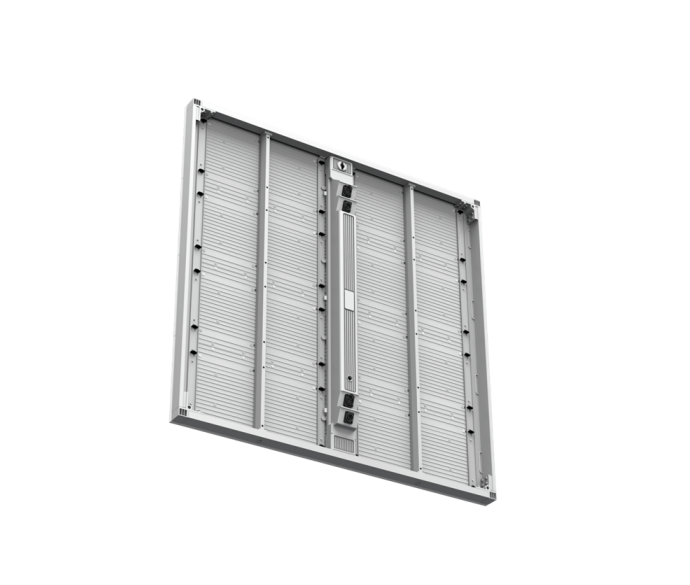
A professional church LED screen is a direct-view LED video wall constructed from modular cabinets—each typically 500×500 mm or 500×1,000 mm—that tile together into a seamless, scalable display surface. Unlike a consumer television, which is a fixed-size panel with a light engine behind a glass layer, a sanctuary video wall is an engineered system with four distinct layers: the LED module array, the cabinet structure, the signal processing unit (most commonly a NovaStar or Brompton processor), and the content management interface.
The distinction matters enormously to integrators writing specifications. A 16:9 TV has defined boundaries; a direct-view LED wall adapts to any aspect ratio the architecture demands—a 21:9 ultra-wide backdrop for a contemporary stage, a 4:3 format for a traditional chancel, or a dual-screen configuration for split IMAG feeds. Modularity is the architecture; everything else derives from it.
Direct-View LED vs. Projection vs. LCD: The Performance Gap in a Worship Context
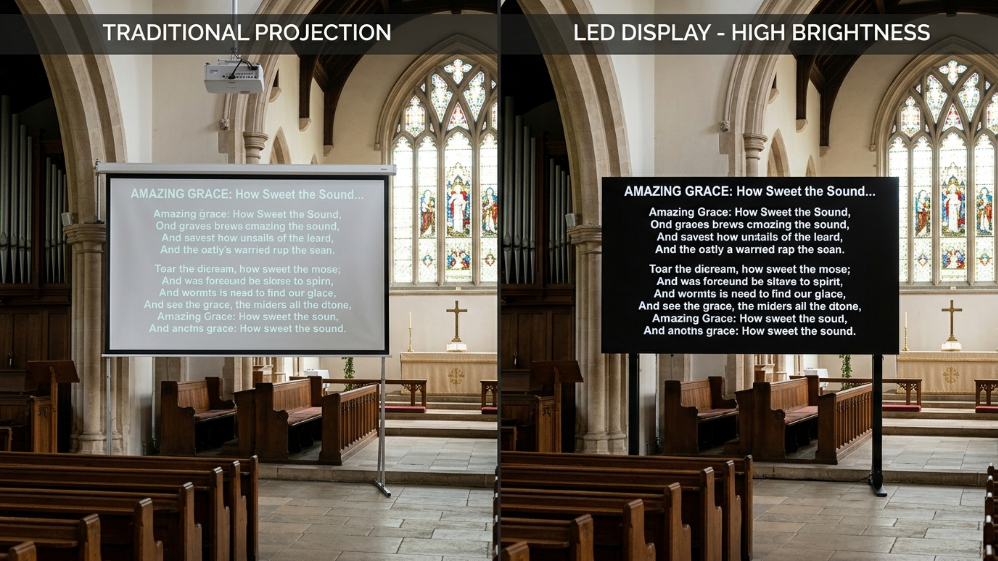
Projectors function on reflected light: the image travels across the room, strikes a screen surface, and bounces back to the viewer. That optical chain creates two structural weaknesses—susceptibility to ambient light, and shadow interference when a worship leader or musician stands in the beam. LED panels emit their own light directly. There is no projection arc, no washout risk, no shadow problem on stage.
LCD video walls introduce a third failure mode: bezels. Even “ultra-narrow” LCD panels carry a physical border between screens. That 1.7 mm gap, invisible on a corporate dashboard, becomes a visible grid line slicing through lyrics and scripture backgrounds—an aesthetic compromise that most faith communities reject immediately. Direct-view LED has no bezels. The pixel array is the display, edge to edge.
According to market research from the Worship Facilities Association (2024), 78% of houses of worship that upgraded from projection in the past three years cited “clarity of lyrics and scripture in ambient light” as the primary driver. That single datapoint explains the entire migration from projection to LED that has reshaped the HOW AV market since 2020.
Anatomy of a Sanctuary Video Wall: Cabinets, Modules, and the Signal Chain
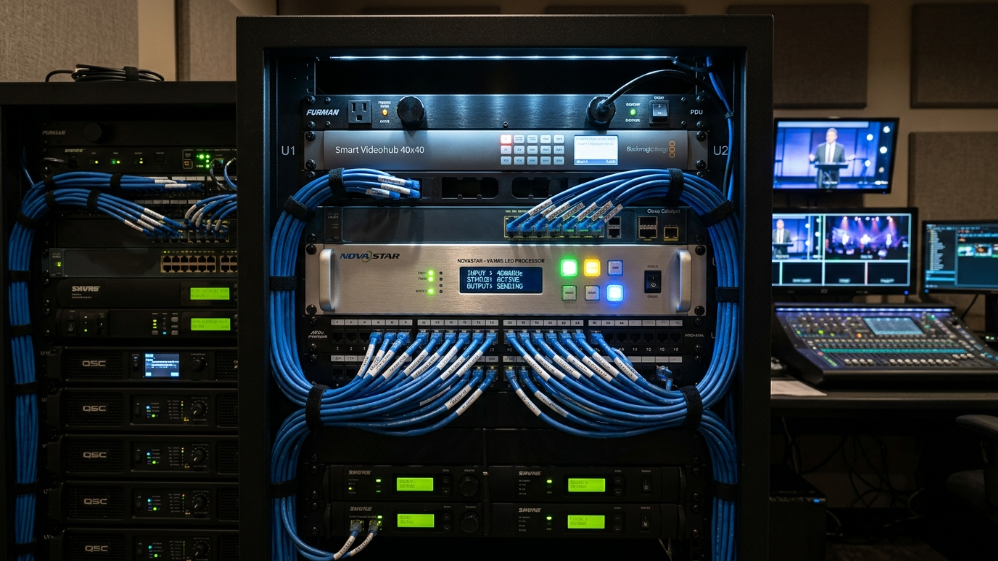
The typical church LED screen signal chain runs as follows: presentation computer (running ProPresenter 7 or EasyWorship) → HDMI or SDI output → LED video processor (NovaStar VX1000 or equivalent) → Cat6/fiber data cables → LED cabinets → visible image. The processor is the critical junction; it handles resolution mapping, brightness calibration across all cabinets, and input source switching. Skimping on the processor to save $3,000 on a $60,000 project is one of the most common specification errors we encounter.
Cabinet construction quality—cabinet-to-cabinet flatness tolerance, magnetic module retention, front-access design—determines long-term serviceability. In a permanent wall-mount installation where rear access is impossible, front-serviceable cabinets are not a premium option. They are a basic professional requirement.
The Silent Sanctuary Advantage: Why Fanless LED Design Is Non-Negotiable for Houses of Worship
This section exists because no current resource covers it adequately. Search the top results for “church LED screen” and you will find pixel pitch tables, brightness comparisons, and projector cost analyses. You will find almost nothing about acoustic noise—despite the fact that in a sanctuary environment, noise is the specification that makes or breaks the product experience.
How Fan Noise Destroys Worship Atmosphere: The <25 dB Standard
A typical indoor sanctuary at rest has a noise floor between 25 and 35 dB(A). Communion, prayer, moments of silence, acoustic worship sets—these experiences exist specifically because of that quiet. A fan-cooled LED power supply operating at 40–52 dB(A) does not coexist with that silence. It colonizes it.
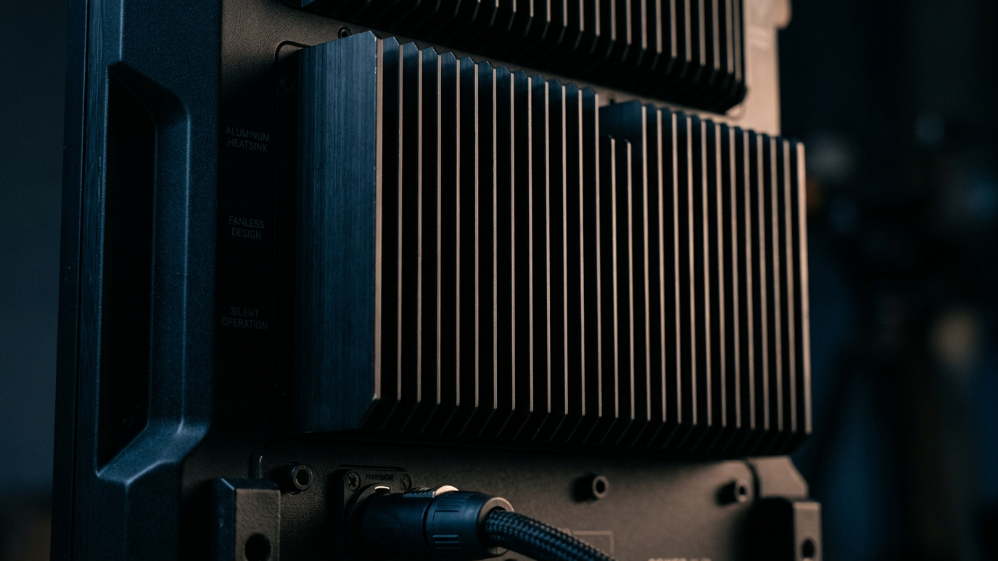
The industry benchmark for worship-safe display systems is below 25 dB(A) at 1 meter—equivalent to a quiet library. Fanless power supply designs achieve this by eliminating the mechanical cooling element entirely, using thermally optimized PCB layouts and heat-dissipating cabinet frames to manage operating temperatures passively.
Fanless vs. Fan-Cooled Church LED Screen: Side-by-Side Comparison
| Specification | Fanless (Passive Cooling) | Fan-Cooled (Active Cooling) |
| Acoustic noise level | <25 dB(A)—silent | 40–52 dB(A)—audible in quiet services |
| Worship use suitability | All service types, including prayer and acoustic worship | Restricted to high-energy, amplified segments |
| Thermal operating life | Longer—no moving parts to degrade | Reduced by fan bearing wear (avg. 30,000 hr MTBF) |
| Maintenance requirement | Zero mechanical servicing | Fan cleaning and eventual replacement |
| Common Cathode compatibility | Optimized—lower heat generation | Standard anode design runs hotter |
| B2B premium over fan-cooled | 8–15% cabinet cost increase | Baseline |
| TCO advantage at Year 5 | Lower (no maintenance calls, no congregation complaints) | Higher when factoring service visits and client dissatisfaction |
The business case for specifying fanless systems is not difficult to make. The 8–15% premium over fan-cooled alternatives is recovered in the first year simply by eliminating the service calls that follow when a congregation realizes their new LED wall hums during the Lord’s Prayer.
Common Cathode Technology: Lower Heat, No Fans Required
The reason fanless designs are viable at high brightness levels comes down to IC architecture. Conventional LED drivers use a common anode configuration: all three LED colors (red, green, blue) share a single forward voltage, forcing the red LED—which requires approximately 1.8–2.2V—to dissipate excess energy as heat when powered at the 3.0–3.5V required by the blue channel.
Common Cathode reverses this. Each color channel receives its own optimized forward voltage. Red gets 2.0V, green gets 3.0V, blue gets 3.2V—no excess energy, no unnecessary heat. In practice, this reduces power consumption by 20–30% at equivalent brightness and cuts thermal output sufficiently to make passive cooling physically viable at 1,000+ nit operating levels. For the integrator writing a spec, “common cathode LED driver IC” is the line item that unlocks the silent sanctuary.
How to Select the Right Pixel Pitch: A Decision Matrix for Worship Environments
The pixel pitch question consumes more integration meetings than any other spec—and it shouldn’t, because the answer follows directly from two measurements you can take with a tape measure: the distance from the screen to the front row, and the distance to the back row. Everything else is refinement.
The formula most engineers use is straightforward: minimum comfortable viewing distance (meters) ≈ pixel pitch (mm). A P2.9 screen is comfortable from approximately 2.9 meters. But in a sanctuary context, “comfortable” for video content differs from “legible” for lyric text. Based on our experience commissioning worship display solutions across facilities ranging from 80-seat community chapels to 3,000-seat megachurch auditoriums, text-heavy content—and lyrics are always text-heavy—demands you add a 20–30% safety margin to the standard formula.
Church LED Screen Pixel Pitch Selection Matrix
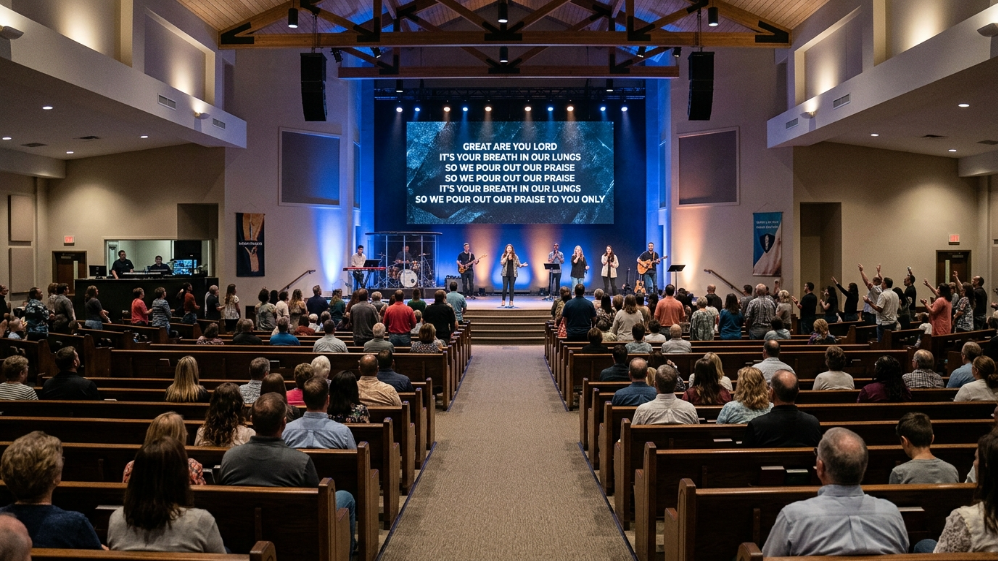
| Scenario | Pixel Pitch | Min. Viewing Distance (text) | Cabinet Type | Brightness Target | Best For |
| Small chapel, front row ≤4m | P1.8–P2.5 | 2.5–3.5m | Fixed, front-service | 800–1,000 nits | Intimate sanctuaries, close congregation |
| Mid-size sanctuary, 4–8m | P2.5–P3.0 | 3.5–4.5m | Fixed, front-service | 1,000–1,500 nits | Most common church install, lyric focus |
| Large auditorium, 8–15m | P2.9–P3.9 | 5.0–6.0m | Fixed or flown | 1,200–2,000 nits | Sermon delivery, IMAG, livestream |
| Stained glass/daylight-heavy | P2.9–P3.9 + HDR | 5.0m+ | Fixed, fanless PSU | 2,000–3,500 nits | Traditional sanctuaries with natural light |
| Megachurch IMAG/multi-screen | P1.5–P2.5 | 2.5–4.0m | Fixed, networked | 1,500 nits + auto-dim | 1,000+ seats, broadcast-grade production |
One specification point that consistently saves integrators from callbacks: contrast ratio. A screen measuring 5,000:1 or higher renders the near-black backgrounds common in contemporary worship motion graphics as genuinely dark, not as a muddy gray. When a worship designer layers white lyric text over a deep-space background, that contrast ratio is the difference between legible poetry and visual noise.
ProPresenter, EasyWorship, and the Volunteer Operator: Making the System Invisible
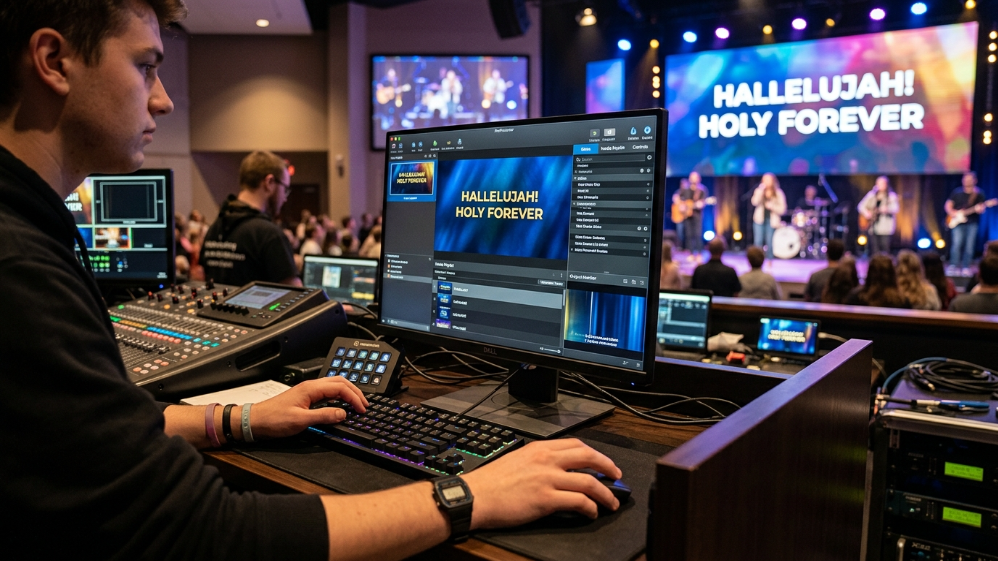
The most technically correct church LED screen becomes a liability if a volunteer can’t operate it confidently at 8:45 on a Sunday morning. This is where integration design separates serious HOW specialists from commodity resellers.
A production-ready worship display workflow runs: MacBook/PC → ProPresenter 7 → HDMI or 12G-SDI out → NovaStar VX1000 processor → Cat6 data cables → LED cabinets. The processor maps the ProPresenter output resolution directly to the native pixel grid of the wall—no stretching, no black bars, no letterboxing on lyric slides. Pre-stage configuration by the integrator means the volunteer opens ProPresenter, selects a theme, and presses play. That’s the experience the church is actually buying.
For larger sanctuaries running IMAG, the signal chain adds a layer: camera → ATEM switcher → SDI input on the NovaStar processor → PiP or full-screen feed on the LED wall. The processor handles source switching between ProPresenter lyric content and live camera feed without visible delay. According to Sostron’s engineering team, configuring pre-built scene presets inside the NovaStar control software reduces average volunteer response time during live service transitions from 8–12 seconds (manual switching) to under 2 seconds (preset recall). That’s not a marginal improvement—it’s the difference between a polished service and a visible technical stumble.
The Recommended Solution: Sostron Indoor Series for Worship Environments
After analyzing the technical requirements across the sanctuary use case—fanless operation, fine pixel pitch, front-serviceability, and ProPresenter compatibility—two product series consistently meet the specification.
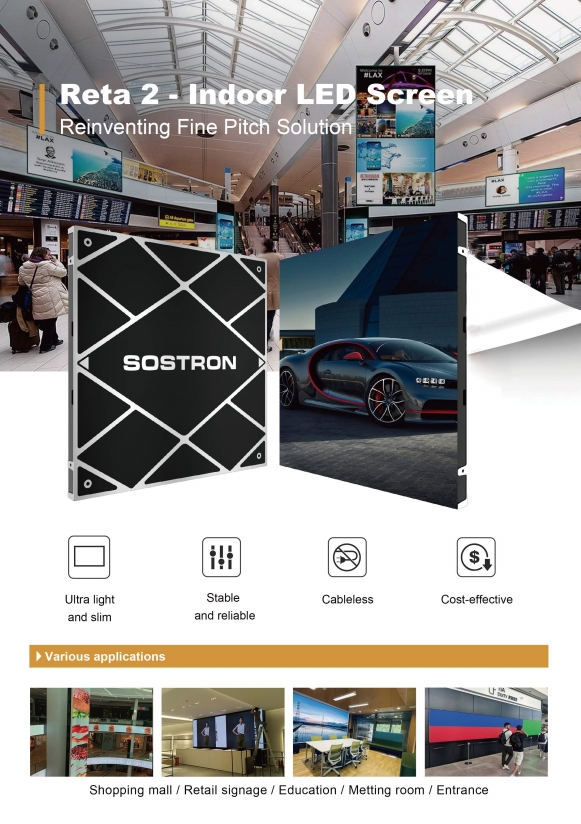
Sostron Reta 2 Series (P1.5–P2.5) is the correct choice for sanctuaries where the front row sits within 4 meters of the screen, or where the installation is a permanent wall-mount with no rear access. The cabinet depth of just 30mm and the cable-less internal design eliminate the single most common maintenance complaint in church installs: loose data connectors behind the wall. The die-cast aluminum cabinet dissipates heat passively, keeping the acoustic noise floor at zero—no fans, no hum, no prayer-time compromise. Brightness output at 1,000–1,200 nits covers the majority of indoor sanctuary environments comfortably.
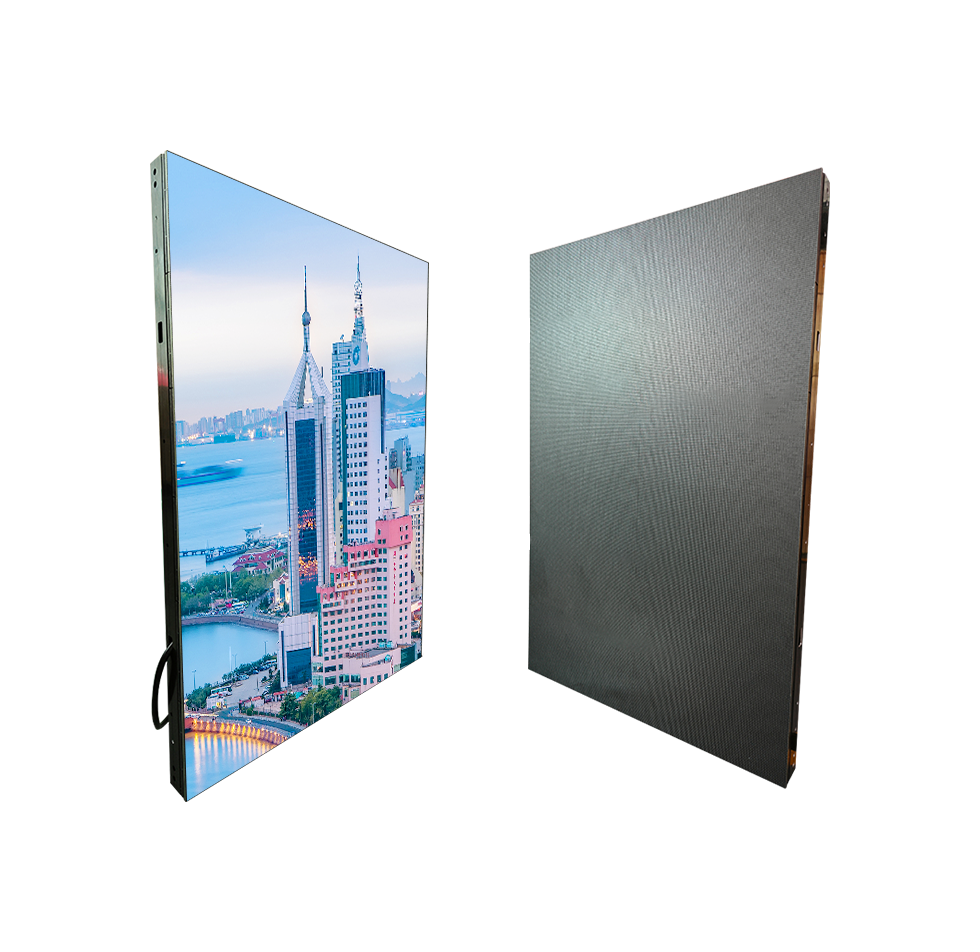
Sostron Storm Plus Series (P2.5–P3.9) addresses larger-format installs and sanctuaries with significant ambient light challenges. The high-flatness aluminum cabinet construction ensures cabinet-to-cabinet seam tolerance within ±0.1mm—the specification that prevents the visible grid lines across white lyric slides that are the most common quality failure in budget church LED installations. The Storm Plus pairs natively with common cathode driver ICs, reducing thermal output by up to 30% versus standard anode designs at equivalent brightness. In a 15m² sanctuary installation in Mexico, this translated to a documented 22% reduction in annual electricity costs—a figure that appears directly in any five-year TCO model you present to a church procurement committee.
Two Real-World Church Installations: What the Data Shows
Case Study 1—Indoor P2.5 Fixed Install, Community Church (Sostron Verified)
A mid-size congregation installed Sostron’s P2.5 indoor series as a permanent stage backdrop. The integration brief had three non-negotiable requirements: silent operation during acoustic worship sets, front-access servicing (wall mount, no rear access), and native compatibility with their existing ProPresenter workflow. Post-commissioning, the technical team reported zero noise complaints from pastoral staff and a full-service-day calibration that set brightness, color temperature, and contrast to match the sanctuary’s natural and stage lighting simultaneously. The display’s module-level magnetic retention allowed a single technician to replace a test module in under four minutes without removing the cabinet from the wall—the correct answer for a volunteer-supported environment.
Case Study 2—Grace Chapel, Texas (Budget-to-Scale Reference)
Grace Chapel installed an 8m² P2.5 screen for $15,000 turnkey, replacing a projector system that had required three bulb replacements in 18 months at $650 per replacement. By Year 2, the LED installation had recovered the cost differential versus projector continuation. Their contrast ratio of 6,000:1 made black-background lyric templates—their worship designer’s preferred aesthetic—genuinely dramatic rather than technically approximate. The parallel story worth noting: RiverLife Church in Wisconsin chose a non-certified budget panel for their initial installation and faced repair invoices within 24 months totaling 60% of the original purchase price. The difference was not pixel pitch or screen size. It was cabinet manufacturing tolerance and driver IC quality—the specifications that appear in no marketing brochure but determine every real-world outcome.
5 FAQs: Long-Tail Worship Display Questions Answered
Q1: What pixel pitch should I specify for a church LED screen that needs to display legible lyrics from 25 feet away?
At 25 feet (approximately 7.6 meters), a P2.9 or P3.0 screen will deliver fully legible lyric text at standard worship font sizes (50pt and above). A P3.9 is the cost-effective choice if the front row is no closer than 12 feet. If you’re specifying for a blended service where the screen also carries IMAG camera feed, stay at P2.9 or tighter to maintain photographic clarity.
Q2: Does a church LED screen make noise during quiet moments of worship?
A fanless, passively cooled church LED screen operates at 0 dB(A)—genuinely silent. The caveat: confirm the power supply specification explicitly. Some suppliers use active (fan-cooled) power supplies inside otherwise “silent” cabinet designs. Ask for the acoustic noise floor measurement at 1 meter. Anything below 25 dB(A) is acceptable for sanctuary use; true fanless systems measure at the ambient noise floor of the room itself.
Q3: How do I calculate the 5-year total cost of ownership for a church LED screen versus keeping our projector?
Model it this way: projector annual costs typically include 1–2 bulb replacements ($400–$800 each), calibration servicing, and progressive brightness degradation (projectors lose approximately 50% lumen output by 1,500 operating hours). An LED wall rated at 100,000 hours has no consumables. At 10 hours of weekly use, you’re looking at roughly 19 years of bulb-free operation. The break-even point against a mid-range projector system with regular bulb replacement typically falls at Year 3–4 for equivalent screen sizes.
Q4: Will our existing ProPresenter 7 setup work directly with a new LED video wall without buying new software?
Yes. An LED video wall connects to ProPresenter via the HDMI or SDI output of your existing computer, exactly as a projector or monitor does. The video processor (NovaStar or equivalent) acts as a transparent pass-through display—ProPresenter sees a standard monitor. No new software licenses required. The only configuration step is matching the output resolution in ProPresenter to the native pixel resolution of the LED wall, which your integrator sets during commissioning.
Q5: How big should a church LED screen be for a 300-person sanctuary?
For 300 seats, a screen 4.8–5.5m wide (16–18ft) at a 16:9 aspect ratio is the standard specification. The more important measurement is height relative to the back row: the screen height should be at least 1/6th of the distance to the farthest seat. If your last row sits 18 meters (59ft) from the stage, you need a screen at least 3 meters (10ft) tall. Width without adequate height is the most common sizing error in sanctuary installations—text and lyrics become horizontally clear but vertically cramped.
Expert Verdict
Specify fanless power supplies on every sanctuary project without exception—the acoustic argument is closed. For pixel pitch, P2.9 covers roughly 80% of church installations competently; step to P2.5 when the front row is inside 4 meters or when your client’s worship designer works with photographic backgrounds. The technology that separates a ten-year install from a three-year headache is not the headline spec on the data sheet. It’s cabinet flatness tolerance, driver IC refresh rate, and whether the front service access actually works in the mounting configuration you’re drawing. Get those three right, and the screen disappears—which is exactly what a sanctuary display is supposed to do.
References:
ANSI/AVIXA Standard 602.01:2023 “System Listening Test” & “Image System Contrast Ratio (ISCR)”
The Interaction Between Video Walls and Room Acoustics in Houses of Worship