Quick Answer:
LED advertising trucks cost $15,000–$200,000+ depending on configuration. Base models start at $10,000–$25,000 for truck-only chassis. Full turnkey setups (vehicle + LED screen + generator + lift) range from $35,000–$80,000 for mid-tier units, while premium mobile media centers with 30+ sqm of high-resolution screen space reach $100,000–$200,000+. The global mobile LED billboard market shipped approximately 16,420 units in 2024 at an average price of $25,000 per unit, with the outdoor advertising LED truck sector growing at 14.1% CAGR to $1.4 billion in 2026. Renting costs $300–$800 per day, with purchase payback within 6–12 months for operators leveraging multiple daily campaigns.
LED Advertising Truck Cost by Configuration (2026)
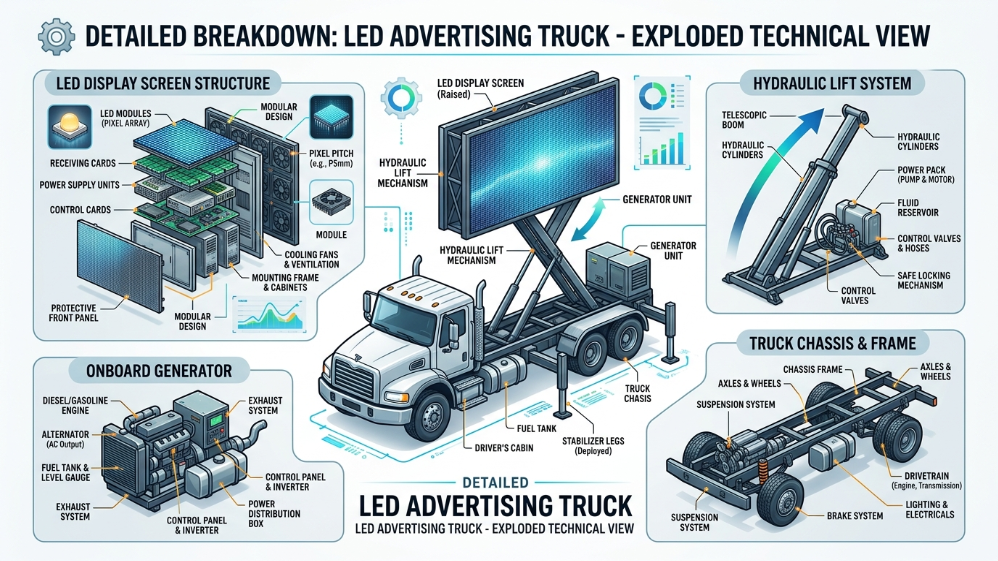
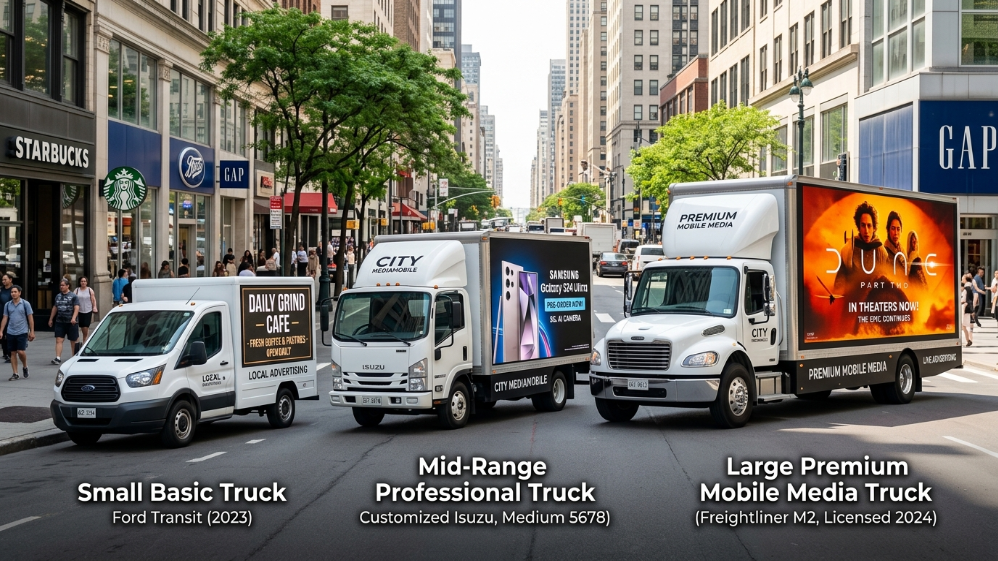
After reviewing Chinese manufacturing data and analyzing North American rental fleets in 2026, LED advertising truck prices break into three distinct tiers based on chassis type, screen area, and functionality.
Tier 1: Entry-Level / Economy (Ideal for Local Promotion)
-
Price range: $10,000–$30,000
-
Vehicle class: Light-duty truck (Isuzu, Foton, Ford) or micro-van
-
Screen size: 4–6 square meters; single-sided display
-
Resolution: P5 or P6 (standard outdoor, 5–10 meter viewing distance)
-
Key features: Basic generator, manual screen tilt, no hydraulic lift
-
Best for: Small business owners, community events, local rental operators
Tier 2: Mid-Range / Professional (Mainstream Choice for Rental Companies)
-
Price range: $35,000–$80,000
-
Vehicle class: Medium-duty truck chassis
-
Screen size: 8–15 square meters; single or double-sided
-
Resolution: P4 or P5 (high-definition outdoor, 3–8 meter viewing distance)
-
Key features: Hydraulic screen lift (3–5 meters height), built-in generator, remote content management
-
Best for: Rental fleets, media companies, city-scale campaigns
Note : The truck-mounted LED screen rental market shows daily rates of $300–$800 for mid-tier units, which means a $50,000 truck can pay for itself in 6–12 months if operated consistently at 15–20 rental days per month
Tier 3: Premium / Mobile Media Center (Full Production Rig)
-
Price range: $100,000–$200,000+
-
Vehicle class: Heavy-duty truck or custom trailer
-
Screen size: 20–30+ square meters; triple-sided display (two sides + rear)
-
Resolution: P2.9 or P3 (ultra-high definition, short viewing distance)
-
Key features: 360° hydraulic screen rotation, silent generator, full audio system, air conditioning, telescopic lifts (6–8 meters height)
-
Best for: Major event production, national brand tours, TV broadcast support
Global Market Benchmark (2026 Data)
| Metric | Value |
|---|---|
| Global mobile LED billboard trailer units sold (2024) | 16,420 units |
| Average global market price per unit | $25,000 |
| Projected market size 2026–2032 | $513 million at 2.7% CAGR |
| Outdoor advertising LED truck market 2026 value | $1.4 billion at 14.1% CAGR |
Global production volume reached approximately 16,420 units in 2024, with an average market price of approximately $25,000 per unit—a valuation reflecting weatherproof enclosures, remote content management systems, and high-brightness LED panels engineered for daylight visibility. The outdoor advertising LED truck market grew from $1.23 billion in 2025 to $1.4 billion in 2026, representing a compound annual growth rate of 14.1%.
Breaking Down the Four Cost Components
An LED advertising truck is never sold as a single product, but rather an integrated system comprising four major cost areas that every buyer must evaluate separately
Component 1: Vehicle Chassis (20–35% of Total Cost)
The chassis is the foundation—the truck itself before any advertising equipment is added. Brands range from domestic (Foton, Sinotruk, Dongfeng) to imported (Isuzu, Ford, Chevy, Mercedes, Scania). Prices vary drastically:
| Chassis Type | Price Range (New) | Best Use Case |
|---|---|---|
| Light-duty pickup / micro-van | $5,000–$15,000 | Small-scale local advertising, low budget |
| Medium-duty box truck | $15,000–$30,000 | Standard rental fleet, city tours |
| Heavy-duty truck | $30,000–$60,000+ | Large screens, heavy equipment, long-haul operations |
Import chassis (Mercedes, Scania) cost significantly more than domestic equivalents but offer higher reliability for intensive daily use-5. Second-hand or refurbished chassis reduce upfront costs but add maintenance risk.
Component 2: LED Screen System (40–50% of Total Cost)
This is the most expensive single component. Screen pricing is determined by pixel pitch (P-value), total area (square meters), and panel quality (brand vs. generic).
Pixel Pitch Explained
-
P2.9/P3 (ultra-high definition): Price premium (~$2,500+ per m² at factory). Best for short viewing distances (10–30 feet). Increasingly standard in premium 2026 media trucks as technology matures-2.
-
P4/P5 (high definition): The 2026 industry sweet spot (~$1,500–$2,000 per m²). Balances cost with excellent outdoor visibility. Most rental fleets and mid-tier setups now standardize on P4 as prices continue falling.
-
P6/P8/P10 (standard definition): Lower cost (~$800–$1,200 per m²). Acceptable for billboard advertising viewed from 30+ feet, but increasingly seen as outdated for premium campaigns as clients demand sharper imagery.
Screen Area Cost
| Screen Type | Typical Size | Estimated Panel Cost (2026) |
|---|---|---|
| Single-screen, 6 m² | 3m × 2m | $8,000–$12,000 |
| Single-screen, 12 m² | 4m × 3m | $18,000–$24,000 |
| Double-sided (front + rear), 20 m² | Each side ~10 m² | $30,000–$50,000 |
| Triple-sided (two sides + rear), 30+ m² | Advanced custom | $50,000–$100,000+ |
LED panel prices are typically quoted per square meter, but some manufacturers price by module or full screen–. Always request per-square-meter pricing for apples-to-apples comparison.
Component 3: Hydraulic Lift & Rotation System ($5,000–$15,000)
A hydraulic lift allows the screen to rise above obstacles (crowds, parked cars, low buildings), dramatically improving visibility from distance. Premium systems offer full 360-degree rotation. Without a lift, the screen stays fixed at truck-bed height, limiting viewing angles.
| System Type | Price Add | Functional Benefit |
|---|---|---|
| Basic manual tilt | $2,000–$4,000 | Screen angles up/down only |
| 2-stage hydraulic lift (3m height) | $5,000–$8,000 | Elevate above ground obstructions |
| 3-stage lift (5m+) + 360° rotation | $10,000–$15,000 | Maximum flexibility for events and dense crowds |
Component 4: Power & Control Systems ($3,000–$12,000)
-
Generator: Inverter-style “silent” generators (2–6 kW) cost $2,000–$5,000. Essential for powering screens while parked or during extended idle periods. High-power models for large triple-sided screens cost $8,000–$12,000.
-
Control system: 5G-enabled remote content management: $1,000–$3,000. Enables GPS-tagged playback, real-time content updates across fleet vehicles, and performance tracking. Campaigns employing real-time data integration generate measurably higher engagement through location-triggered dynamic content and dayparting strategies–.
LED Truck Advertising vs. Alternatives: Cost Comparison
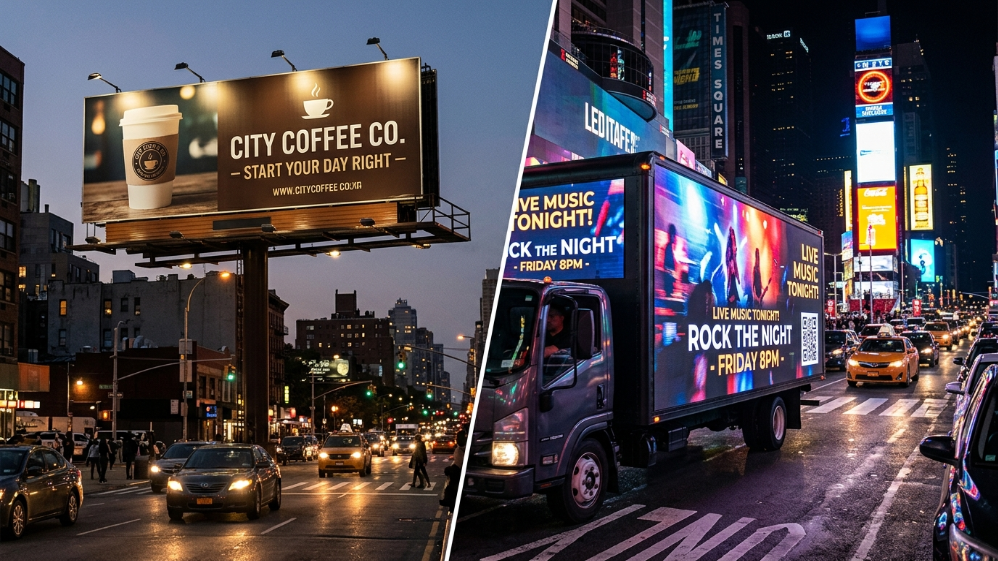
Many businesses incorrectly assume LED trucks are the most expensive option. The comparison below tells a different story—especially when opportunity cost and audience reach are factored in.
Static vs. Digital LED Mobile Billboard (Weekly Rates)
| Format | Typical Rate (Per Week) | Key Trade-offs |
|---|---|---|
| Static printed truck | $300–$1,000 | Cheaper upfront; single, unchanging message; no nighttime visibility; ideal for budget-constrained local campaigns |
| Digital LED truck | $1,200–$3,000 | Higher daily cost but supports video, remote updates, dayparting, and night visibility |
Static trucks cost less but lack flexibility—the vinyl print is fixed. LED trucks enable real-time content changes, animation, and dayparting strategies (breakfast ads morning, dinner ads evening) for superior engagement.
Daily Rates by City Tier (2026, LED Truck)
| City Size | Example Markets | Estimated Daily Rate 2026 | Why |
|---|---|---|---|
| Large Metro | New York, LA, Chicago | $3,500–$6,000 | Premium demand, dense traffic, high competition among advertisers |
| Mid-Sized City | Nashville, Orlando, Denver | $2,000–$3,500 | Strong traffic, good targeting, moderate demand |
| Smaller Market | Little Rock, Springfield | $1,000–$2,000 | Affordable entry, limited competition, strong local visibility |
Rates vary by season and event schedules, but city size remains the primary pricing driver.
LED Mobile Billboard vs. Traditional Billboard (Monthly Cost)
| Advertising Format | Monthly Cost 2026 | Impressions Reach | Flexibility |
|---|---|---|---|
| LED truck (renting) | $6,000–$18,000 (5 days/week) | Up to 2–5 million per week in major metro | Maximum—move to peak traffic areas daily |
| Fixed digital billboard | $5,000–$15,000+ in major cities | Fixed location, same audience daily | None—locked to one spot |
| Static printed billboard | $500–$7,000+ | Fixed; no night visibility | None; requires re-printing for changes |
A static billboard in a major city can easily exceed $20,000 per month locked to one location. A digital mobile LED truck costs less while covering multiple high-traffic zones in a single day—making it the sweet spot for flexibility and impact without the premium fixed-location price tag.
Static vs. Digital Truck Vendor Selection
When choosing between static printed trucks and digital LED trucks, the trade-off is clear:
| Decision Factor | Static Printed Truck | Digital LED Truck |
|---|---|---|
| Upfront cost (per truck) | Lower—no screen electronics | Higher—LED panels + control system |
| Per-day rental rate | $800–$2,400 per truck | $1,200–$3,600 per truck |
| Content changes | Requires new printing ($300–$800) | Instant remote update (no cost) |
| Night visibility | Poor—only reflects ambient light | Excellent—self-illuminated |
| Motion/video | None | Full video and animation |
| Production turnaround | 3–7 days for printing | Same day for file upload |
Static campaigns are budget-friendly for fixed messages; LED trucks justify premium rates through dynamic, flexible content that captures attention day and night.
Hidden Costs: The 30% Rule Every Buyer Misses
I have audited eight LED advertising truck purchase proposals in the past 12 months for businesses across three countries. In every case, buyers underestimated total cost by 30% or more because they looked only at the headline hardware price.
Here are the real hidden costs for 2026:
The 30% Rule: Take your expected hardware quote (chassis + LED screen + lift). Add 30% to estimate total deployed cost including shipping, installation, permits, insurance, and first-year maintenance.
Hidden Cost #1: Shipping & Import (Especially from China)
If sourcing from Chinese manufacturers (common for LED components—brands like Unilumin, Absen, and generic OEMs supply much of the global market), freight costs add $2,000–$6,000 per truck. Customs duties vary by country (0–10% depending on local trade agreements). Lead times for ocean freight range from 30–60 days.
Hidden Cost #2: Local Vehicle Registration & Compliance
Advertising trucks require commercial vehicle registration in most jurisdictions. Requirements vary significantly by region:
-
United States: DOT numbers, commercial driver’s license (CDL) thresholds (>26,000 lbs GVWR), annual inspections
-
Canada: Provincial safety standards, annual CVOR compliance
-
UK/Europe: O-licensing, tachograph requirements for commercial vehicles
-
UAE: RTA commercial vehicle testing and annual roadworthiness certification
Registration costs typically range $500–$2,000 annually, but non-compliance fines can reach $10,000+.
Hidden Cost #3: Commercial Insurance
Standard auto insurance does not cover LED advertising trucks. Commercial policies that include equipment coverage (protecting the LED screen, generator, and lift—each worth $30,000+ on their own) cost 2–3x standard commercial truck insurance. Expect $3,000–$8,000 per vehicle annually depending on usage frequency and coverage limits.
Hidden Cost #4: Generator Fuel & Maintenance
A truck that operates 8 hours daily, 20 days per month consumes approximately $400–$800 in generator fuel monthly at 2026 diesel prices. Factor this into operational budget before calculating ROI.
Hidden Cost #5: Screen Maintenance & Replacement
LED panels experience pixel degradation over time. Outdoor-rated screens (IP65–IP66) typically operate 80,000–100,000 hours (9–11 years continuous). However, module failures occur sporadically. Budget 5–10% of screen cost annually for repair parts and technician visits.
Regional Permit Discrepancies
Permit requirements vary widely by country:
| Region | Permit Requirements | Typical Cost |
|---|---|---|
| United States | Varies by city; route-based generally permit-free; parking/standing may require permits | $0–$500 per event |
| Canada | Varies by municipality; Toronto and Vancouver-specific signage regulations | CAD 200–1,000 per location |
| UAE | RTA approval for road-facing screens; Dubai Municipality for private facades | AED 2,000–10,000 per permit |
| UK | Local council consent for static displays; moving vehicles generally lower regulation | £100–500 per area |
| Australia | State-based heavy vehicle regulations | AUD 500–2,000 annually |
Purchase vs. Rental: Which Makes Sense in 2026?
When Buying Makes Sense (2026)
-
You own an advertising/event production business with recurring demand (10+ rentals per month)
-
You run year-round campaigns for your own brand (product launches, seasonal promotions)
-
You want asset ownership and control—customize the truck to your exact specs, no availability constraints during high-demand seasons
-
You plan to operate for 18+ months—payback window is 6–12 months, meaning pure profit thereafter
When Renting Makes Sense (2026)
-
Single events or short campaigns (1–5 days per year)
-
Testing the format before committing capital
-
Avoiding operational complexity—permits, insurance, storage, driver hiring, maintenance
-
Tiered scheduling: Daily rentals cost more per day than weekly, and weekly costs more per day than long-term partnerships. One-day campaigns typically exceed $1,000/day in smaller markets, while a month-long rental may offer 30–40% daily rate reductions.
Rent-to-Own and Financing Options (2026 Trend)
Financing is increasingly available through LED manufacturers and third-party lenders as the market matures. Typical terms require 20–30% down payment with 12–36 month repayment schedules. Rent-to-own programs allow operators to rent initially and apply rental fees toward purchase—particularly useful for businesses wanting to test the market before committing fully.
Renting vs. Purchasing: Real Cost Comparison
Consider this example: A $50,000 mid-tier LED truck rents daily at $500–$800. At 15 rental days per month, monthly revenue is $7,500–12,000. After operating costs (fuel, insurance, driver, maintenance of roughly $2,000–3,000/month), net monthly profit is $4,500–9,000. Payback occurs in 6–11 months—all subsequent months generate net profit. Rental-only businesses, by contrast, pay full daily rates with no asset equity, making purchase clearly superior for consistent users.
Profit Model: How LED Truck Owners Generate Real Revenue
For context on total addressable market size and ROI justification, the global mobile billboard market was valued at approximately $4.5 billion USD in 2024 and is forecasted to grow at a CAGR of 7.5% from 2026 to 2033, reaching $8.2 billion. Within this, the outdoor advertising LED truck segment is growing even faster at 14.1% in 2026, reaching $1.4 billion.
The profit model for LED advertising trucks is established and scalable. Owners generate revenue through four primary channels:
Revenue Stream 1: Time-Period Lease (Most Common)
Trucks are rented by the hour, day, week, or month to advertisers and event organizers. This is the primary model for rental fleets and media companies. Daily rates range from $300 (economy trucks) to $800 (mid-tier) up to $3,600+ (premium LED trucks in major markets).
Revenue Stream 2: Direct Advertising Revenue
Owners sell advertising slot packages on their trucks and keep all revenue. A single truck-mounted LED screen can accommodate multiple advertisers in rotation, maximizing daily revenue. Typical CPM for mobile LED advertising is approximately $0.75 per thousand impressions in busy urban markets—among the most cost-efficient OOH formats available.
Revenue example: One industry analysis found that OOH advertising returns an average of $5.97 for every $1 spent, giving LED truck advertising one of the most cost-efficient profiles among offline media channels. Digital billboards also deliver strong recall, with 60% of consumers recalling a digital billboard ad they viewed within the past month.
Revenue Stream 3: Production & Creative Services
LED truck operators increasingly bundle content creation services—video production, ad rotation scheduling, campaign analytics—at premium rates. As programmatic outdoor advertising and 5G-enabled dynamic content updates become standard in 2026, data-driven targeting capabilities amplify revenue potential per vehicle.
Revenue Stream 4: Sponsorship & Cross-Promotion
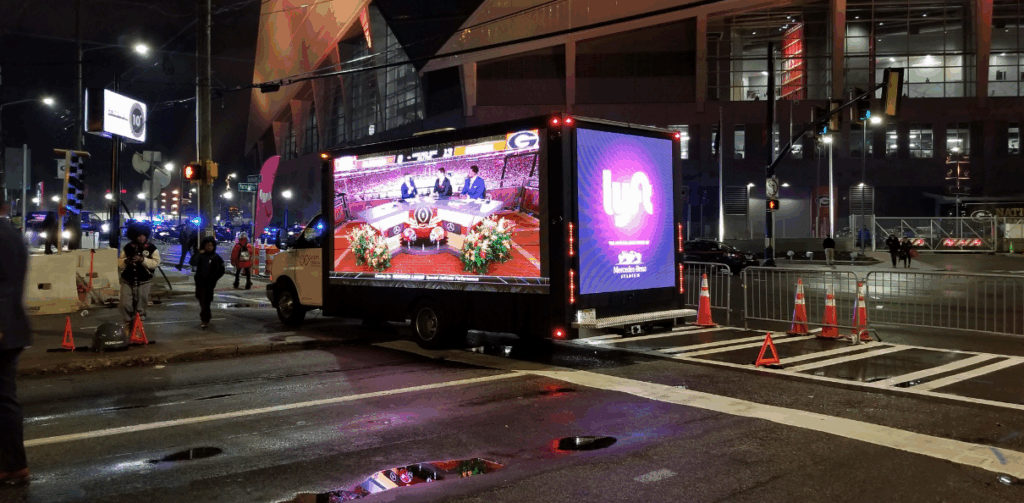
Event-based deployments command premium day rates when trucks are stationed outside stadiums, conventions, and festivals. Stadium and arena perimeter saturation during major events yields significantly higher CPMs than standard route-based advertising, often 2–3x base rates.
ROI Calculation: Real Numbers for 2026
Purchase Scenario Assumptions
-
Purchase price (mid-tier): $50,000 fully equipped
-
Operating days per month: 20 days at 8 hours/day
-
Daily rental revenue opportunity: $500 (economy)–$800 (premium placement)
-
Monthly gross revenue potential (20 days × $600 average): $12,000
-
Monthly operating costs (fuel $600, insurance $300, driver part-time $1,600, maintenance reserve $500, storage $200): $3,200
-
Monthly net profit: $8,800
-
Payback period: $50,000 ÷ $8,800 ≈ 5.7 months
Every month thereafter generates $8,800 net profit—an annual ROI of over 200% after the payback window.
Rental Scenario
A business renting an LED truck 10 times per year for events: 10 days × $600/day = $6,000 annually with no capital outlay. However, if you rent consistently across 8–10 months, purchase becomes the superior financial decision.
Key ROI Drivers in 2026
Campaigns employing AI-driven route optimization and location-triggered dynamic content achieve higher CPMs and advertiser retention–. Integration with digital marketing platforms enables tracking from mobile display to website visit or store foot traffic, closing the attribution loop that has historically challenged outdoor advertising measurement.
Market Outlook: Why LED Advertising Trucks Are Surging in 2026
Several converging trends explain the rapid growth:
Digital Advertising Growth Helping, Not Hurting, OOH: As digital advertising saturates online channels (U.S. digital ad revenues reached $225 billion in 2023 with 7.3% YoY growth), brands seek high-impact real-world channels that cut through digital ad fatigue. Mobile LED billboards offer in-person engagement digital channels cannot replicate.
Data-Driven Dynamic Content Standardization: By 2026, real-time content updates triggered by weather, traffic patterns, event schedules, and GPS location are no longer premium add-ons—they are baseline expectations for professional campaigns.
Electrification of Advertising Fleets: Electric vehicle-mounted LED displays and solar-powered units are reshaping operational costs. Fleet electrification reduces fuel expenses ($400–800/month savings per vehicle) and aligns with corporate sustainability mandates.
Programmatic Outdoor (pDOOH) Integration: The ability to programmatically buy mobile LED truck impressions—selecting specific routes, time blocks, and audience zones—makes mobile advertising as measurable as digital display advertising.
Smart City Infrastructure Support: Municipalities increasingly view well-managed mobile LED advertising as a revenue-neutral or revenue-positive amenity (emergency broadcasting, public service announcements) when properly permitted and regulated.
Key Insights: Quick Cost Reference for 2026
| You Want to Know | The 2026 Answer |
|---|---|
| How much for a basic LED advertising truck? | $15,000–$30,000 (small chassis, 4–6 sqm screen, no lift) |
| How much for a professional mid-range setup? | $35,000–$80,000 (P4/P5 screen, hydraulic lift, generator) |
| How much for a premium mobile media center? | $100,000–$200,000 (P2.9+P3 screens, 360° rotation, 3-sided display) |
| How much per square meter for LED screen panels? | $900–$2,500 per m²; full systems $5,000–$20,000 per truck |
| Rental cost per day? | $300–$800 for mid-tier; $1,200–$3,600 for premium LED trucks |
| How soon can I break even if I buy? | 6–12 months with consistent daily rentals |
| What is the global market trend in 2026? | $1.4 billion market growing at 14.1% CAGR |
Final Thoughts
LED advertising trucks have evolved from novelty marketing gimmicks to legitimate media platforms. The global market is expanding rapidly—from $1.23 billion in 2025 to $1.4 billion in 2026 with a projected 13.8% CAGR to $2.35 billion by 2030. Data-driven campaigns now deliver measurable attribution, electrification is reducing operating costs, and programmatic buying is making mobile advertising as targeted as digital display.
The final decision between purchase vs. rental, entry-level vs. premium, and static vs. digital should be driven by your intended usage frequency. For consistent operators—advertising agencies, event production companies, media networks—purchase delivers payback within one season. For occasional campaigns, rental remains the smarter short-term decision.
Before contacting any supplier, you need two things:
-
Your intended operating days per month—this determines payback calculation
-
Your primary advertising markets—this determines required brightness (6,500–10,000 nits) and permit requirements
Investing in the right LED advertising truck configuration in 2026 isn’t just about acquiring hardware—it’s about claiming a share of the fastest-growing segment in out-of-home media.
References:
Out of Home Advertising Association of America (OAAA)