The Confusion Most Buyers Have — Resolved Upfront
When someone searches for “3D LED display,” they are almost always looking for one of two completely different things — and most articles on this topic fail to distinguish between them.
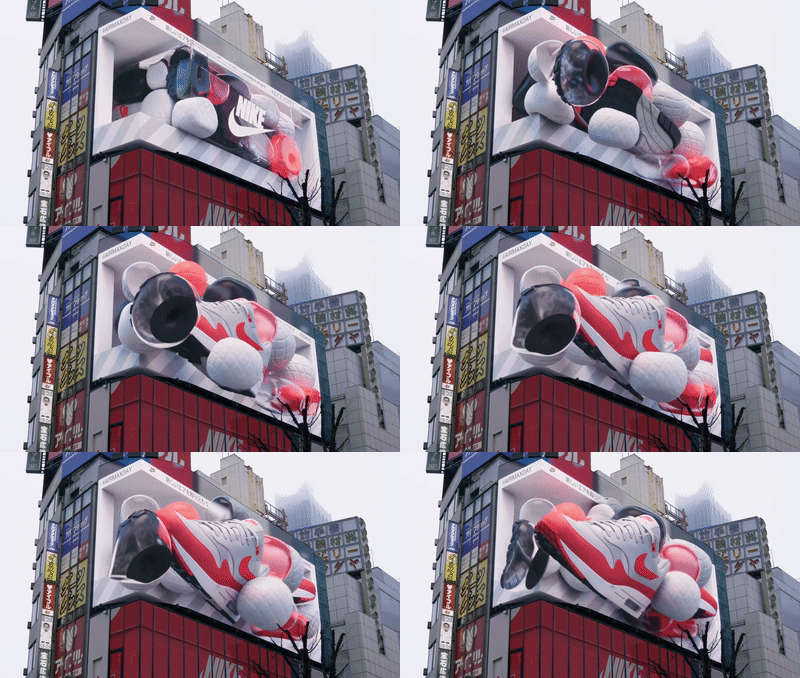
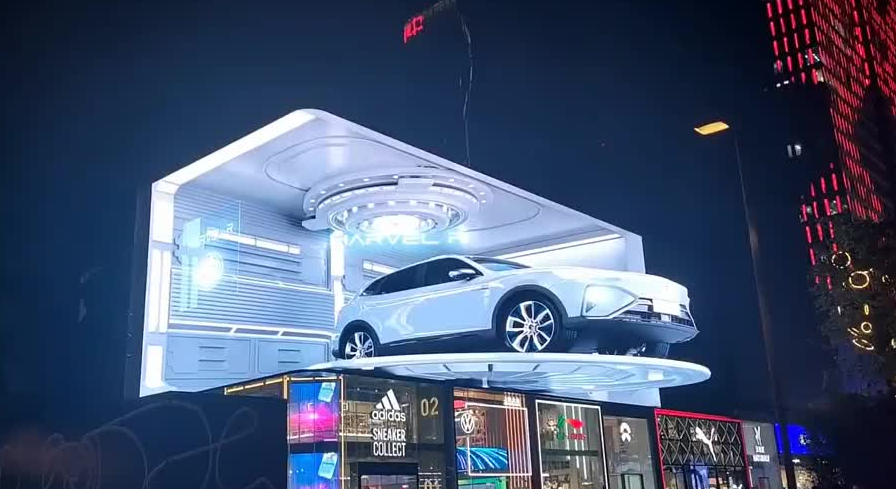
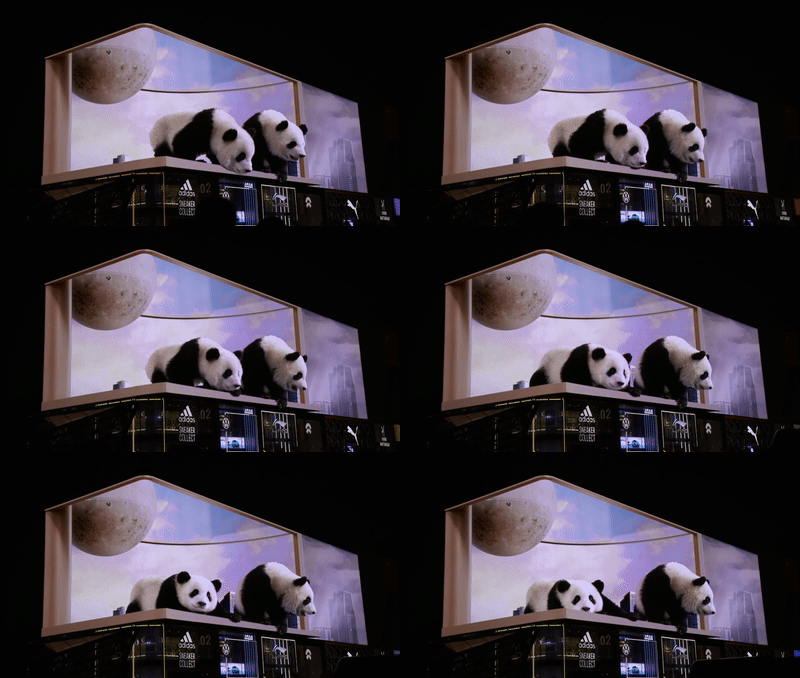
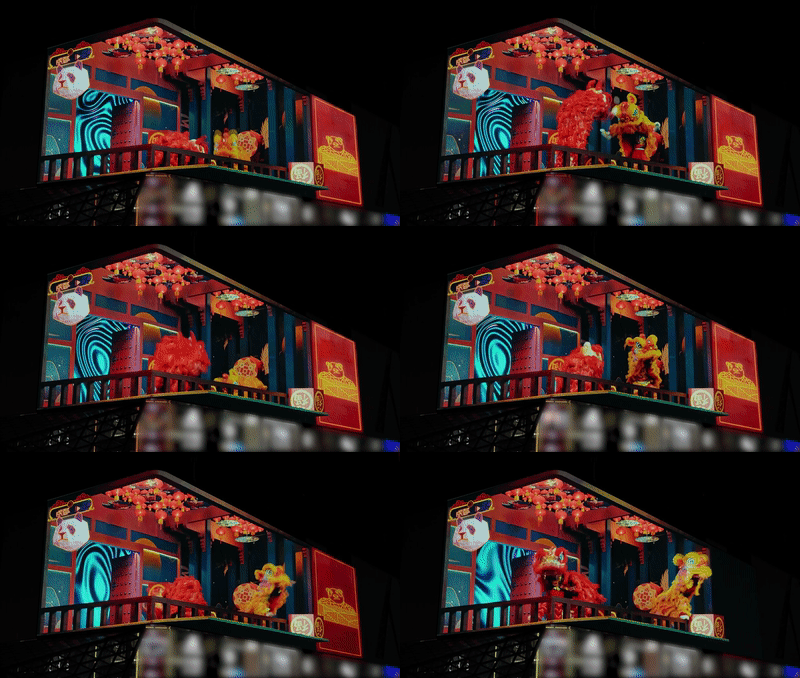
The first is naked-eye 3D LED: the L-shaped corner billboard or curved screen that makes a giant cat appear to leap out of a building, or a wave crash through a city block. No glasses required. The 3D effect is an optical illusion created by matching specially produced content to the physical geometry of the screen. This is the dominant commercial format in 2026 and what most buyers, brand managers, and venue operators are actually asking about.
The second is stereoscopic 3D LED: a display system that uses active shutter glasses or passive polarized glasses to deliver separate images to each eye, creating genuine binocular depth perception. This technology exists in cinema, simulation, and some specialized visualization applications — but it is not what you see on outdoor billboards or in retail environments.
This guide covers both, but prioritizes naked-eye 3D because that is where the commercial market is in 2026.
Type 1: Naked-Eye 3D LED — How It Actually Works
Naked-eye 3D LED does not use any depth-sensing technology, lenticular lenses, or eye-tracking. The effect is entirely content-driven, exploiting how the human brain interprets perspective, shadow, and motion cues to infer depth.
The Physical Setup
The most common configuration is an L-shaped corner installation: two flat LED panels meeting at a 90-degree angle at a building corner. One panel faces one street direction; the other faces the perpendicular direction. From the optimal viewing position — standing at roughly 45 degrees to the corner — both panels are visible simultaneously, and the brain reads them as a single three-dimensional surface.
Other configurations include:
- Curved LED arc — a single curved panel with sufficient curvature to create perspective depth
- Multi-panel volume — three or more panels forming a partial enclosure (used in immersive retail and entertainment installations)
- Flat screen with 3D content — a standard flat LED screen displaying content with strong forced-perspective animation; the weakest form of the effect but the lowest cost
The Content Requirement
The 3D illusion lives entirely in the content. A naked-eye 3D screen running standard 2D advertising looks like a normal LED screen. The content must be produced specifically for the physical dimensions and geometry of the installation:
- Objects that appear to “exit” the screen are animated to align with the corner geometry
- Shadows and reflections are rendered to match the physical screen surfaces
- Motion parallax is exaggerated to reinforce depth perception
- The optimal viewing zone (typically a 30–60 degree arc in front of the corner) is defined during content production
This is why content production cost is a significant and often underestimated line item in naked-eye 3D projects.
Type 2: Stereoscopic 3D LED — Technical Mechanism
Stereoscopic 3D LED creates genuine binocular depth by delivering different images to each eye simultaneously. Two primary technologies are used:
Active Shutter 3D
The display alternates between left-eye and right-eye frames at high speed (typically 120Hz total — 60Hz per eye). Active shutter glasses synchronize with the display via infrared or RF signal, blocking each lens in alternation so each eye sees only its corresponding frame. The brain fuses the two offset images into a single 3D perception.
Requirements: High refresh rate display (minimum 120Hz), synchronized glasses for every viewer, controlled viewing environment.
Passive Polarized 3D
The display outputs left and right images simultaneously using orthogonally polarized light (circular or linear polarization). Passive polarized glasses — inexpensive, no electronics — filter the appropriate image to each eye.
Requirements: Specialized polarized LED display or projection system, passive glasses for every viewer.
Why Stereoscopic 3D Is Rare in Commercial Signage
Requiring every viewer to wear glasses is a fundamental barrier for public advertising and retail applications. Stereoscopic 3D LED is primarily used in:
- Cinema (projection-based, not LED)
- Military and industrial simulation
- Medical visualization
- Theme park and immersive entertainment attractions
For outdoor advertising, retail, and events — the primary commercial LED market — naked-eye 3D is the practical and dominant format.
Technology Comparison: Naked-Eye 3D vs. Stereoscopic 3D vs. Standard LED
| Dimension | Naked-Eye 3D LED | Stereoscopic 3D LED | Standard LED |
|---|---|---|---|
| Glasses required | No | Yes | No |
| 3D mechanism | Forced perspective + content | Binocular disparity | N/A |
| Viewing zone | 30–60° arc (corner install) | Wide (glasses-dependent) | Wide |
| Content requirement | Custom 3D production required | Standard stereoscopic content | Standard 2D content |
| Pixel pitch (outdoor) | P2.6–P4 | P1.5–P2.6 | P3.9–P10 |
| Refresh rate requirement | 3,840Hz+ (motion smoothness) | 120Hz minimum | 1,920Hz+ |
| Installation complexity | Moderate–High (corner geometry) | High (sync system) | Low–Moderate |
| Primary application | Outdoor advertising, retail, events | Cinema, simulation, theme parks | General signage |
| Hardware cost premium vs. standard | 20–40% (corner structure) | 50–100% | Baseline |
| Content cost | High (custom per creative) | Moderate | Low |
Real-World Applications: Where 3D LED Is Deployed in 2026
Outdoor Advertising and OOH Media
The most commercially active segment. Landmark naked-eye 3D installations have become destination attractions in their own right — the Chengdu IFS giant panda, the Dubai Mall shark, and multiple Times Square corner installations have each generated tens of millions of social media impressions, delivering earned media value that dwarfs the installation cost.
In 2026, naked-eye 3D corner LED is a standard specification for premium OOH media owners in major Asian, Middle Eastern, and European cities. The format commands a 3–5× premium over standard LED billboard rates.
Retail and Brand Activation
Luxury brands, automotive manufacturers, and consumer electronics companies use naked-eye 3D LED for flagship store entrances, shopping mall activations, and product launch events. The format is particularly effective for product reveals — a car appearing to drive out of a screen, or a watch floating in three-dimensional space.
Stage and Event Production
Concert productions and live events use curved LED volumes and multi-panel 3D configurations for immersive stage design. Unlike outdoor installations, event 3D LED prioritizes visual impact from a defined audience position rather than street-level viewing.
Sports Venues
Perimeter LED and scoreboard systems increasingly incorporate 3D content segments — animated mascots, score celebrations, and sponsor activations that use forced-perspective techniques to create depth on flat screens.
Theme Parks and Immersive Entertainment
Stereoscopic 3D LED finds its strongest commercial application here, where controlled viewing environments and captive audiences make glasses-based systems practical.
Technical Specifications: What to Specify for a 3D LED Project
| Specification | Outdoor Naked-Eye 3D | Indoor Naked-Eye 3D | Stereoscopic 3D |
|---|---|---|---|
| Pixel pitch | P2.6–P4 | P1.5–P2.6 | P1.2–P1.9 |
| Refresh rate | 3,840Hz minimum | 3,840–7,680Hz | 120Hz minimum |
| Brightness | 4,000–8,000 nits | 800–1,500 nits | 800–1,200 nits |
| Contrast ratio | 5,000:1+ | 8,000:1+ | 5,000:1+ |
| Viewing angle | 140°+ horizontal | 160°+ horizontal | Per glasses spec |
| IP rating | IP65 (outdoor) | IP30–IP43 | IP30 |
| Color gamut | DCI-P3 90%+ | DCI-P3 95%+ | DCI-P3 90%+ |
| Cabinet design | Corner-compatible, lightweight | Flat or curved | Flat |
| Content input | HDMI 2.0 / SDI | HDMI 2.0 / SDI | HDMI 2.0 (120Hz) |
Viewing Distance and Pixel Pitch
The standard formula applies: minimum viewing distance (m) = pixel pitch (mm) × 1,000 ÷ 3,438
For naked-eye 3D, the optimal viewing distance is also the distance at which the corner geometry creates the strongest illusion — typically 8–20 meters for outdoor installations. Specify pixel pitch based on this distance, not the maximum viewing distance.
Price Guide: 2026 Cost Breakdown
Hardware Costs by Installation Type
| Installation Type | Screen Area | Pixel Pitch | Hardware Cost (USD) | Notes |
|---|---|---|---|---|
| Small indoor corner (retail) | 6–10 m² | P1.9 | 15,000–35,000 | Two-panel L-shape |
| Medium outdoor corner | 15–25 m² | P3.9 | 30,000–80,000 | Structural frame included |
| Large outdoor corner (landmark) | 30–60 m² | P2.6–P3.9 | 80,000–200,000 | Custom engineering required |
| Curved arc (indoor) | 10–20 m² | P1.5–P2.6 | 40,000–120,000 | Radius-dependent |
| Multi-panel volume (event) | 20–50 m² | P2.6–P3.9 | 60,000–180,000 | Modular, reconfigurable |
Content Production Costs
Content is the variable that most buyers underestimate:
- Single 3D creative (15–30 seconds): 3,000–15,000 depending on complexity
- Full campaign (4–6 creatives): 15,000–50,000
- Ongoing content subscription (monthly updates): 1,500–5,000/month
A naked-eye 3D screen with a single piece of content running on loop loses impact within weeks. Budget for content refresh as a recurring operational cost, not a one-time expense.
Total Project Cost Example
Medium outdoor corner installation, 20m², P3.9, city center location:
- LED hardware: $55,000
- Corner structural frame and installation: $12,000
- Control system and cabling: $5,000
- Content production (2 creatives): $12,000
- Commissioning and calibration: $3,000
- Total: approximately $87,000
How to Choose the Right 3D LED Display
Step 1: Define Your 3D Type
Naked-eye 3D for public advertising or retail? Or stereoscopic 3D for a controlled-environment application? This determines the entire specification path.
Step 2: Confirm the Physical Installation Geometry
For naked-eye 3D, the screen geometry is the foundation of the effect. A corner installation requires a true 90-degree meeting point between panels. A curved installation requires a defined radius. Measure and confirm the physical space before specifying any hardware.
Step 3: Specify Pixel Pitch Based on Viewing Distance
Use the formula above. For most outdoor naked-eye 3D installations, P3.9 is the cost-performance optimum. For indoor retail, P1.9–P2.6 is standard.
Step 4: Confirm Refresh Rate for Your Content
If the installation will be photographed or filmed (which all high-profile 3D installations will be), specify 3,840Hz minimum to eliminate banding in video recordings. 7,680Hz for productions where high-speed cameras are expected.
Step 5: Budget for Content Separately
Do not treat content as an afterthought. The hardware is the canvas; the content is the painting. Allocate a minimum of 15–20% of hardware cost for initial content production, and plan for quarterly content refreshes.
Step 6: Verify Structural and Permitting Requirements
Corner LED installations on building facades require structural engineering sign-off and, in most jurisdictions, planning or advertising permits. Confirm these requirements before finalizing the installation design.
Conclusion
3D LED display in 2026 is primarily a content and geometry story, not a technology mystery. Naked-eye 3D works because purpose-built content, matched to a specific screen geometry, exploits the brain’s depth perception mechanisms. The hardware is a high-refresh, high-brightness LED panel — the “3D” is in the production.
For buyers evaluating a 3D LED project: start with the physical space, define the viewing zone, specify pixel pitch and refresh rate accordingly, and budget seriously for content. The installations that generate viral attention and measurable ROI are the ones where content investment matches hardware investment.
SoStron manufactures corner-compatible and curved LED panels for naked-eye 3D installations, with P1.9–P4 configurations, 3,840–7,680Hz refresh rates, and DCI-P3 color coverage. Our team supports projects from panel specification through installation geometry planning and content partner referrals.