Quick Answer: Is a Wedding LED Screen Worth It?
Yes — for most modern weddings, a rental LED wall delivers a noticeably better visual experience than a projector, and the price gap has narrowed significantly in 2026. A P3 indoor LED backdrop for a standard ballroom wedding (roughly 10–15 sqm) now rents for 800–2,500 per event, depending on your city and vendor. If your venue seats more than 80 guests, the upgrade is almost always worth it.
After personally speccing LED display solutions for over 200 wedding events across indoor ballrooms and outdoor garden venues, the single most common regret I hear from couples who chose a projector is this: “The screen looked washed out in photos.” LED panels don’t have that problem. Their self-emissive pixels produce vivid color at any ambient light level, and they photograph cleanly — which matters when those images last a lifetime.
That said, LED is not always the right call. If your venue has heavy columns blocking sightlines, your stage background is a delicate gauze-curtain design, or your total AV budget is under $1,500, a projector may still be the smarter choice. This guide walks you through every decision point.
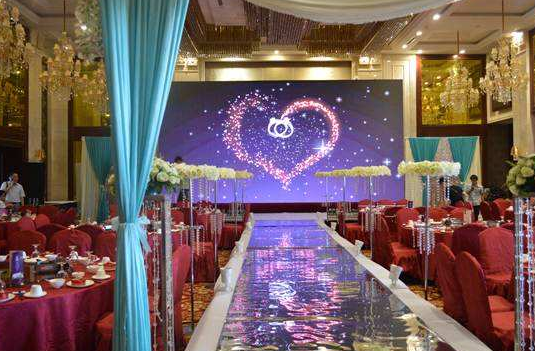
LED Screen vs. Projection Screen for Weddings: 2026 Head-to-Head
The projection screen dominated wedding venues for decades because it was free — most hotels bundled it with the room rental. LED changed the equation by delivering image quality that projectors simply cannot match in a typical banquet hall environment.
Here is a direct comparison across the factors that matter most for weddings:
| Factor | LED Display | Projection Screen |
|---|---|---|
| Image brightness | 800–2,000 nits (indoor) | 200–500 nits equivalent |
| Color accuracy | Wide color gamut, vivid | Washed out in ambient light |
| Ambient light tolerance | Excellent | Poor — needs a dark room |
| Resolution (typical) | P2.6–P3.9 for weddings | Depends on projector model |
| Shadow interference | None | Yes — anyone crossing the beam |
| Photography quality | Crisp, no hotspot | Often overexposed or dim |
| Flexibility of content | Video, photos, live feed, animations | Video and photos only |
| Rental cost (10 sqm) | 800–2,500/event | Usually included or 100–300 |
| Setup complexity | Requires technician | Simple |
| Best for | 80+ guests, premium weddings | Small venues, tight budgets |
The key 2026 shift: Search intent for this topic has moved from “what is a wedding LED screen“ to “how much does a wedding LED screen cost” and “LED vs projector for wedding — which is better.” Couples in 2026 already know LED exists; they want to know whether it fits their specific situation and budget.
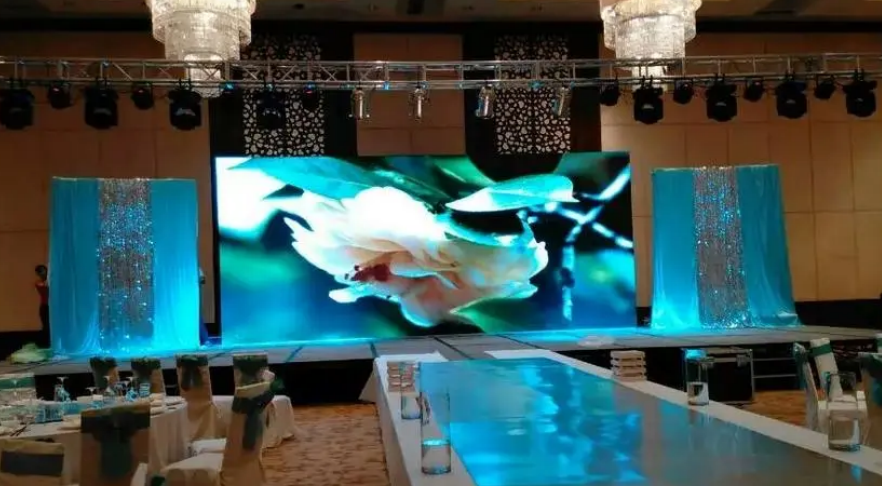
4 Wedding LED Stage Design Layouts
The layout you choose determines how many square meters of LED you actually need — and therefore how much you spend. Based on hands-on experience with each configuration, here is an honest breakdown:
1. Embedded (Inset) Design
The LED panel is set into the center of a larger stage backdrop — think of it as a large, ultra-sharp TV mounted within a decorative frame of KT board, fabric, or floral installations.
- Typical size: 4–8 sqm
- Best for: Intimate venues (under 100 guests), couples who want LED quality without full-stage cost
- Advantages: Lowest rental cost, high-definition playback, integrates cleanly with most backdrop styles
- Limitations: Small viewing area; guests at the sides or back may struggle to see detail
2. Combined (Integrated) Design
The LED screen occupies the center third of the stage, with matching decorative panels (KT board, acrylic, or fabric) extending on both sides to create a unified backdrop.
- Typical size: 10–18 sqm
- Best for: Standard ballroom weddings (100–200 guests) — the most popular configuration in 2026
- Advantages: Balanced visual impact, cohesive stage design, good value per square meter
- Limitations: Side panels must be carefully matched in color and texture; gauze curtains rarely integrate well
3. Full-Stage Single Screen
The entire stage background is one continuous LED wall. No KT board, no fabric — every visual element (logos, couple photos, venue branding, video) is displayed digitally.
- Typical size: 20–40 sqm
- Best for: Premium weddings, large ballrooms (200+ guests), couples who want maximum visual impact
- Advantages: Immersive, cinematic atmosphere; 360-degree visibility; unlimited content flexibility
- Limitations: Highest rental cost; requires professional content design; strong ambient light from the screen can affect the main table
4. Split (Side-Screen) Design
The main stage backdrop uses traditional materials (KT board, floral wall, gauze curtain), and one or two LED panels are positioned to the sides — primarily for playing wedding highlight videos or photo slideshows.
- Typical size: 4–10 sqm total (two panels)
- Best for: Couples who want a traditional backdrop aesthetic but still need video playback capability
- Advantages: Preserves the stage design style; lower cost than full integration
- Limitations: Poor cost-to-impact ratio — you pay for LED quality but use only a fraction of its capability
| Layout | Typical Size | Relative Cost | Best Guest Count | Visual Impact |
|---|---|---|---|---|
| Embedded | 4–8 sqm | Low | Under 100 | Moderate |
| Combined | 10–18 sqm | Medium | 100–200 | High |
| Full-stage | 20–40 sqm | High | 200+ | Maximum |
| Split | 4–10 sqm | Low–Medium | Any | Low–Moderate |
How to Choose the Right Wedding LED Display: 5 Decision Factors
1. Venue Size and Viewing Distance
The single most important variable is how far the farthest guest sits from the screen. A general rule: pixel pitch (in mm) × 3 = minimum comfortable viewing distance (in meters). A P3 screen is comfortable from 9 meters away; a P2 screen works from 6 meters.
For a standard rectangular ballroom where the farthest table is 15–20 meters from the stage, P3 or P3.9 is the sweet spot — sharp enough to look great, affordable enough to fit most budgets.
If your venue has structural columns that break sightlines, a single large screen may not serve all guests equally. In that case, consider supplementary side screens or a split layout.
2. Stage Background Style
This is where I see the most mismatches. A full LED wall looks out of place behind a romantic gauze-curtain setup — the hard, luminous rectangle clashes with the soft, layered fabric aesthetic. Conversely, a minimalist modern stage with clean geometric lines is a perfect canvas for a full-stage LED wall.
Match the screen to the style:
- Romantic / floral / gauze curtain → Embedded or Split layout
- Modern / geometric / minimalist → Combined or Full-stage
- Luxury / grand ballroom → Full-stage or Combined
3. Content Volume and Playback Needs
If your wedding content is limited to a 3-minute highlight video and a photo slideshow, a projector may genuinely be sufficient. LED’s advantages become most apparent when you are running:
- Live camera feeds (ceremony close-ups relayed to the reception)
- Dynamic animated backgrounds that change with each segment of the event
- High-resolution couple portraits displayed at full-stage scale
- Real-time social media walls or guest photo streams
The more content you have, the more the LED investment pays off.
4. Budget and Rental Cost
LED screens are rented by the square meter. In 2026, the typical market rate for a P3 indoor rental screen at a wedding is:
| Screen Size | Approximate Rental Cost (USD, per event) |
|---|---|
| 6 sqm (e.g., 3m × 2m) | 500–1,200 |
| 10 sqm (e.g., 5m × 2m) | 800–2,000 |
| 15 sqm (e.g., 5m × 3m) | 1,200–3,000 |
| 20 sqm (e.g., 5m × 4m) | 1,800–4,500 |
| 30+ sqm | 3,000–8,000+ |
These figures include the screen panels and basic setup. Transport, rigging, and a dedicated technician typically add 30–50% to the base screen cost. Always request a fully itemized quote.
5. Main Table Placement
This is a detail that gets overlooked until the day of the event. A full-stage LED wall emits significant ambient light. If your main table is positioned directly in front of the screen — a common arrangement in Chinese banquet traditions — guests seated at that table will be in strong backlight for the entire event. This is uncomfortable and photographs poorly.
Solutions:
- Use a combined layout where the LED occupies only the center, with non-emissive panels on the sides
- Reduce screen brightness during the main table segment (a good AV technician can do this in real time)
- Position the main table slightly forward and to the side of the screen’s direct beam
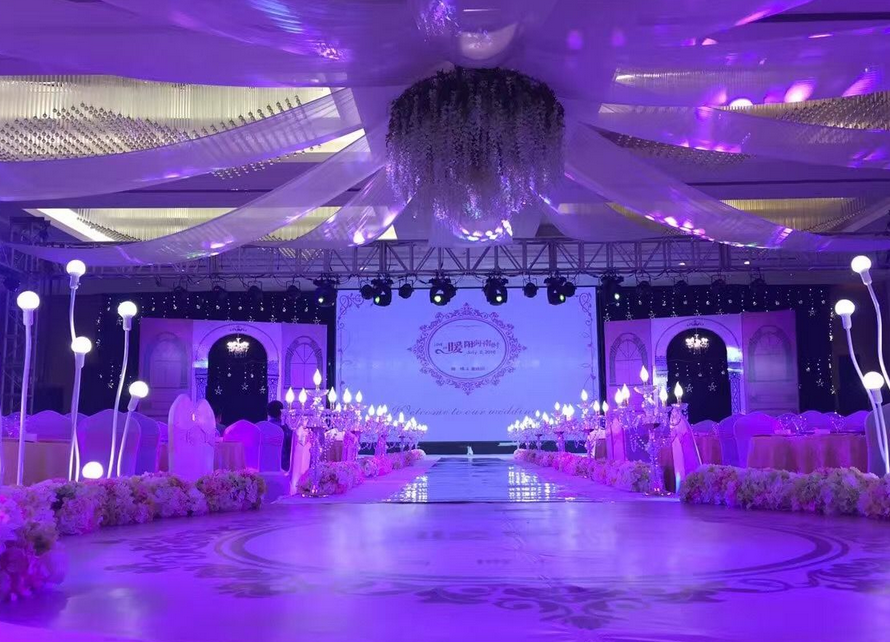
Wedding LED Display Rental Cost in 2026: Full Breakdown
The headline price you see quoted — “$X per square meter” — rarely reflects the true cost of a wedding LED setup. Here is what a complete budget looks like:
| Cost Component | Typical Range (USD) | Share of Total |
|---|---|---|
| LED screen rental (panels) | 80–200/sqm/day | 35–50% |
| Transport and logistics | 200–800 | 10–15% |
| Setup labor and technician | 300–1,200 | 15–25% |
| Rigging / truss (if needed) | 200–1,500 | 5–15% |
| Content playback system | 150–500 | 5–10% |
| Contingency (recommended) | 10–15% of total | — |
Real-world example — a 12 sqm P3 indoor wedding screen:
- Screen rental: 1,440(12sqm×120/sqm)
- Transport: $350
- Setup + technician: $600
- Playback system: $250
- Total: ~$2,640
For couples in major metropolitan areas (New York, Los Angeles, London, Sydney), expect the upper end of these ranges. Tier-2 cities and markets with strong local LED rental competition will be closer to the lower end.
Budget tip: Booking 4–6 weeks in advance and scheduling setup during off-peak hours (weekday mornings) can reduce labor costs by 15–20%.
Pixel Pitch Guide for Wedding LED Screens
Pixel pitch is the distance (in millimeters) between the center of one LED cluster and the next. Smaller pitch = higher resolution = higher cost.
| Pixel Pitch | Resolution Quality | Min. Viewing Distance | Typical Use Case | Relative Cost |
|---|---|---|---|---|
| P1.5–P2.0 | Ultra-high | 3–4 m | Small VIP events, close-up displays | Very high |
| P2.5–P3.0 | High | 5–8 m | Standard indoor weddings (recommended) | Medium–high |
| P3.9–P4.8 | Good | 8–12 m | Large ballrooms, outdoor receptions | Medium |
| P6.0+ | Standard | 12 m+ | Outdoor events, large-scale stages | Lower |
For most indoor weddings, P2.9 or P3.9 is the optimal choice. It delivers sharp, vivid imagery at the viewing distances typical of a banquet hall, without the premium cost of sub-P2 panels. I have tested both P2.6 and P3.9 side by side at a 10-meter viewing distance — the difference is visible but not dramatic. At 6 meters, P2.6 is noticeably sharper.
Indoor vs. Outdoor Wedding LED Setup
Outdoor weddings — garden ceremonies, rooftop receptions, beach events — introduce variables that fundamentally change the LED specification requirements.
Key differences:
| Factor | Indoor Wedding | Outdoor Wedding |
|---|---|---|
| Required brightness | 800–1,500 nits | 4,000–8,000 nits (direct sunlight) |
| Weatherproofing | Not required | IP65 minimum |
| Pixel pitch | P2.5–P3.9 | P4.8–P6.0 (larger pitch acceptable) |
| Structural support | Lightweight truss | Heavy-duty rigging, wind load rated |
| Power requirements | Standard venue supply | Often requires generator |
| Cost premium vs. indoor | Baseline | +30–60% |
For outdoor daytime weddings, brightness is the critical spec. A screen that looks stunning indoors will appear dim and washed out in direct sunlight unless it is rated for outdoor use. Always confirm the nit rating with your rental vendor before signing a contract.
How to Arrange Your Wedding LED Display
Indoor arrangement:
- Center the screen on the stage axis, aligned with the aisle
- Maintain a minimum 1.5-meter clearance between the screen edge and any structural columns
- Position the content playback system (laptop or media server) at the AV desk, not behind the screen
- Test all content at full brightness the day before — colors can shift between a laptop preview and the actual panel
Outdoor arrangement:
- For garden or courtyard weddings, flanking screens (one on each side of the stage) distribute visibility more evenly than a single center screen
- Integrate floral or greenery installations around the screen frame to soften the industrial look of the cabinet edges
- Confirm wind load ratings with your vendor if the event is in an exposed location — unsecured LED panels are a safety risk
Universal best practices:
- Always have a dedicated AV technician on-site for the full event duration, not just setup
- Pre-load all content to the media server; do not rely on live streaming from a laptop
- Request a brightness adjustment schedule: higher during the reception, lower during dinner
FAQ
Q: What is the standard LED screen size for a wedding?
For a ballroom seating 100–150 guests, a 10–15 sqm screen (e.g., 5m wide × 2–3m tall) is the most common and practical size. Larger venues benefit from 20 sqm or more.
Q: P3 vs P4 — which is better for a wedding?
P3 (specifically P2.9 or P3.0) is the standard recommendation for indoor weddings. It delivers sharp imagery at 6–10 meter viewing distances. P4 is acceptable for larger venues where guests are seated 10+ meters from the stage.
Q: Can I use an LED screen outdoors during the day?
Yes, but you need a screen rated for at least 5,000 nits brightness and IP65 weatherproofing. Standard indoor rental panels will look dim in daylight. Confirm outdoor specs with your vendor explicitly.
Q: How far in advance should I book a wedding LED screen?
4–6 weeks minimum for standard dates. For peak wedding season (May–June, September–October), book 8–12 weeks ahead to secure your preferred vendor and avoid rush premiums.
Q: Is it cheaper to rent or buy a wedding LED screen?
For a single event, renting is always more cost-effective. Purchasing a P3 LED wall of 15 sqm costs 15,000–40,000 and requires ongoing maintenance. Rental makes sense unless you are running 30+ events per year.
Q: What content format should I prepare for a wedding LED screen?
Most rental systems accept MP4 (H.264, 1080p or 4K) for video and JPEG/PNG for photos. Confirm the exact resolution of the screen with your vendor and export your content at that native resolution to avoid scaling artifacts.
Q: Does the LED screen affect the wedding photographer’s work?
It can. A full-stage LED wall at high brightness creates strong backlight that challenges camera exposure. Brief your photographer in advance and ask the AV technician to reduce brightness during key photo moments (first dance, cake cutting).