Table of Contents
ToggleIn the early planning stage of audiovisual (AV) engineering and commercial display projects, searching for “2×2 LED screen price” is a very common behavior. However, for frontline R&D and system engineers, this query is often highly ambiguous. If the physical unit and application scenario are not defined first, the resulting budget can easily deviate by more than ten times.
This article strips away all commercial marketing language and directly answers this budgeting problem from the objective perspectives of underlying hardware architecture, manufacturing standards, and engineering delivery.
Core Answer: What Does “2×2” Actually Mean? (Quick Price Overview)
In engineering terminology, “2×2” usually refers to three completely different physical forms. To directly address your budget confusion, here are the industry baseline average costs in the global market for 2026:
- 2 meters x 2 meters (approx. 6.5 x 6.5 ft) LED direct-view display: The most common commercial specification, with total system prices typically ranging from $4,000 to $12,000 (depending on pixel density).
- 2 feet x 2 feet (approx. 0.6 x 0.6 m) mini signage screen: Commonly used for standalone signage or wayfinding, with prices typically ranging from $500 to $1,500.
- 2×2 matrix (Video Wall Configuration): Refers to a matrix composed of 4 independent panels (e.g., 2 rows x 2 columns). The total price depends entirely on the physical size of each panel (such as 500mm or 1000mm), with a very wide range.
Objective Data Source Statement
The above price ranges are not rough estimates. These baseline data points are extracted from statistical averages of over 6,000 real AV projects implemented across nearly 100 countries over the past decade. By aggregating hardware and engineering costs from large-scale multinational retail, stage, and commercial display projects, this data model accurately reflects the current industrial delivery reality.
Scenario 1: Cost Logic Behind a 2m x 2m LED Display
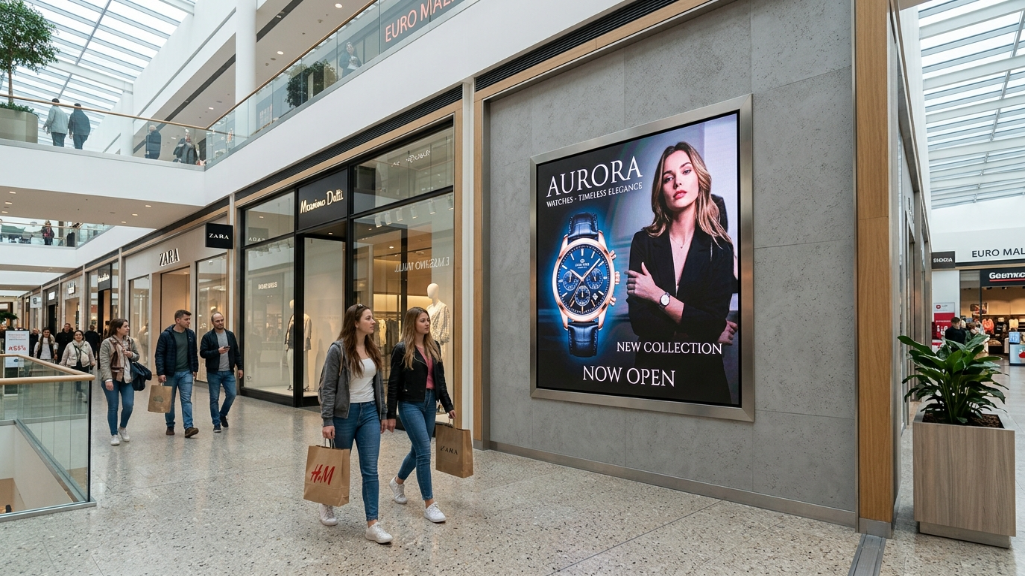
When most users (such as small-to-medium retail store owners, church AV teams, or studio managers) search for this term, they typically envision a square screen that is 2 meters wide and 2 meters tall. This size achieves an ideal balance between visual impact and space utilization.
Natural Cost Advantage from Industrial Standardization
From the perspective of manufacturing economics, 2×2 meters is a highly cost-effective size. Why? The answer lies in the physical laws of industrial standardized production.
From the production line perspective of a modern 15,000㎡ LED intelligent manufacturing facility, to ensure global supply chain compatibility and consistent quality control, the fundamental physical structure of LED displays (die-cast aluminum cabinets) is typically strictly standardized into two core specifications: 500mm × 500mm or 1000mm × 1000mm.
This means that to build a 2×2 meter screen:
- Using large cabinets: Exactly 4 units (2 rows × 2 columns) of 1000mm × 1000mm cabinets are required.
- Using small cabinets: Exactly 16 units (4 rows × 4 columns) of 500mm × 500mm cabinets are required.
This perfect multiple relationship means zero material waste at the factory, zero non-standard mold customization costs, and zero additional CNC cutting time. Standardization significantly reduces the marginal manufacturing cost, making it one of the most budget-efficient sizes in commercial procurement.
Decisive Impact of Pixel Pitch on Total Cost
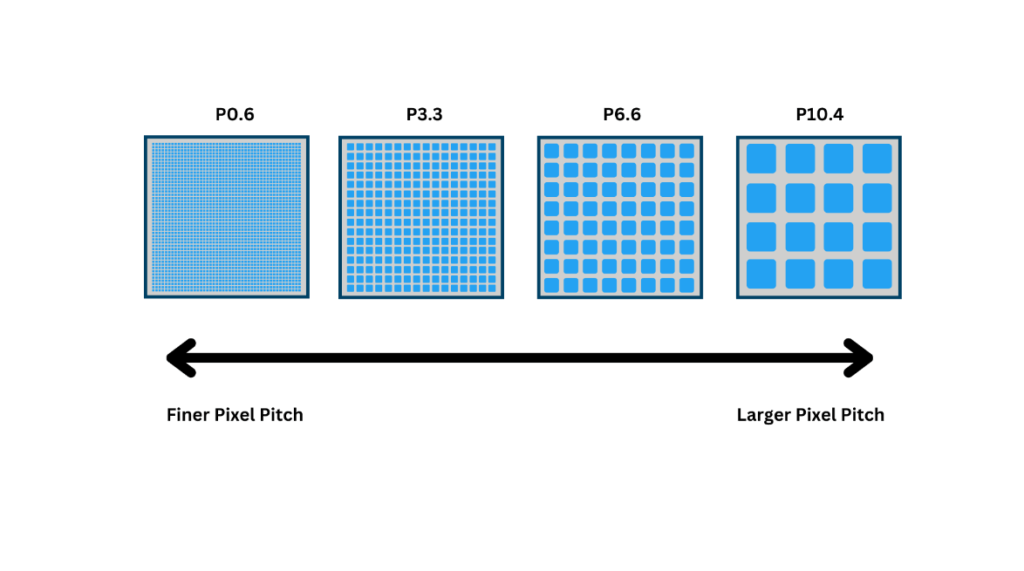
Once the physical size is fixed at 2×2 meters (total area of 4㎡), the only core hardware variable determining the final price is pixel pitch (P value). The smaller the pixel pitch, the exponentially higher the number of LED beads embedded within the 4㎡ area—and the cost rises accordingly.
To clearly illustrate this engineering principle, refer to the following multi-dimensional technical comparison matrix for a standard 2×2 meter display:
| Pixel Pitch (P) | Total Resolution (2x2m) | Estimated LED Count | Optimal Viewing Distance | 2026 Price Range ($) | Typical Applications |
|---|---|---|---|---|---|
| P1.8 (Ultra Fine Pitch) | 1111 × 1111 | ~1,230,000 LEDs | ≥1.8m | $12,000–$18,000 | High-end studio backgrounds, luxury retail windows (close viewing) |
| P2.5 (Indoor HD Standard) | 800 × 800 | ~640,000 LEDs | ≥2.5m | $6,000–$9,000 | Corporate lobbies, premium meeting rooms, mall main corridors |
| P3.9 (Stage/Display Standard) | 512 × 512 | ~260,000 LEDs | ≥4.0m | $4,000–$6,000 | Retail storefronts, mid-sized churches, live event backdrops |
Engineering Note
For a 2×2 meter square screen, aggressively pursuing extremely small pixel pitches (such as P1.2) will result in significant budget overflow and exceed the resolution limit of the human eye at normal social viewing distances—making it an ineffective investment.
Scenario 2: 2×2 Matrix (4 Panels) — Correcting LCD vs. LED Misconceptions
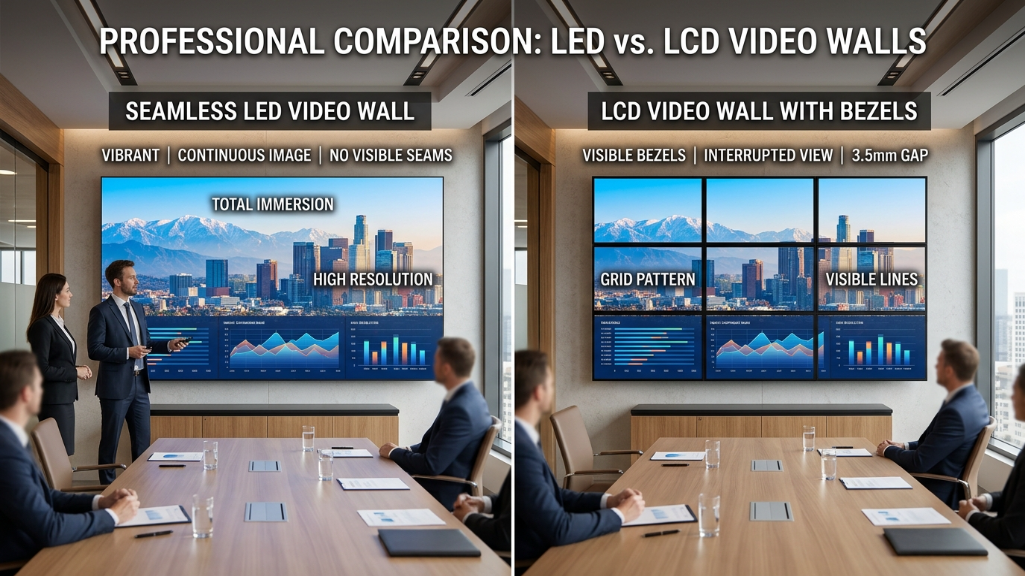
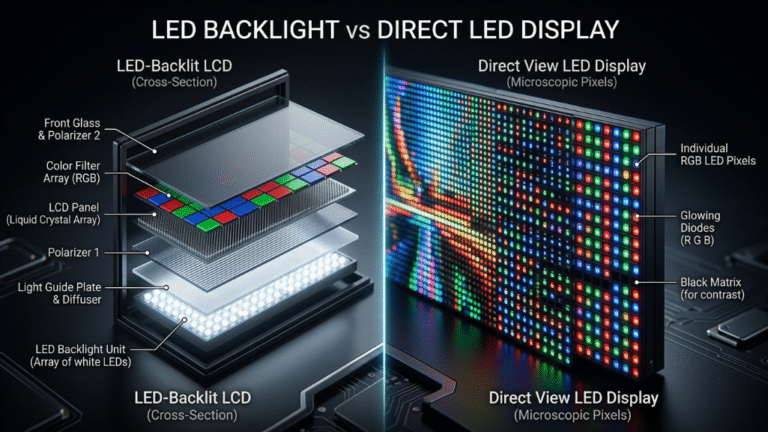
Many users searching for “2×2 screen” are actually thinking of mounting four TVs (2 above, 2 below) on a conference room wall. This is referred to in the industry as a 2×2 Video Wall Configuration. In this scenario, it is critical to distinguish between LCD and LED, which have completely different light-emitting and mechanical structures.
LCD 2×2 Video Wall vs. LED 2×2 Seamless Wall
LCD 2×2 Matrix (Liquid Crystal Splicing)
- Physical Structure: Composed of 4 specialized commercial LCD panels (e.g., 55-inch) mounted together with brackets.
- Visual Limitation: Regardless of technological advancements, LCD panels must have physical bezels. Therefore, a visible black “cross seam” will always appear at the center of a 2×2 wall.
- Cost Evaluation: Lower initial hardware investment, typically achievable within a few thousand dollars.
LED 2×2 Matrix (Direct-View Seamless Splicing)
- Physical Structure: (Technical example) Uses high-precision die-cast aluminum cabinets such as 500×500mm as basic units, connected via precision side locks for rigid assembly.
- Visual Advantage: LED pixels extend directly to the cabinet edges. Whether 4 or 400 cabinets are connected, the image remains 100% seamless with zero physical gaps.
- Cost Evaluation: Each cabinet requires extremely high machining precision and contains high-density LEDs, independent receiving cards, and power supplies. Therefore, the total cost is significantly higher than LCD walls. However, for high-end applications requiring uninterrupted visuals, this is the only viable engineering solution.
For any commercial project that requires a complete, uninterrupted image, understanding the fundamental difference between LCD “with seams” and LED “seamless” is critical to avoid costly project rework. Let’s take you through the seven major differences between LED and LCD panels.
The “Fixed Cost Trap” in Small LED Displays
When comparing a 2×2 meter (4㎡) system with a large 10×10 meter (100㎡) system, planners often find that the average cost per square meter is higher for smaller screens.
This seemingly counterintuitive phenomenon is known in AV engineering as the “fixed cost trap.” A complete commercial display system includes not only the display panels but also essential infrastructure costs. For smaller projects like 2×2 meters, these fixed costs account for a much larger proportion.
Essential Video Control System
Whether it is a 2×2 meter stage screen or a stadium-scale display, it cannot directly connect to a standard computer. The system must include at least one independent video processor and sending card (the “brain” of the display system).
- Rigid Hardware Cost: Industrial-grade video processors cost from hundreds to thousands of dollars, regardless of screen size.
- Long-Term Value of Turnkey Systems: In real engineering practice, fragmented procurement of generic control cards may reduce upfront cost but significantly increases debugging labor. In contrast, turnkey solutions from manufacturers with integrated hardware, software, and engineering teams can reduce calibration and signal debugging time by 70%, greatly lowering hidden labor costs.
Mandatory Electrical Compliance and Safety Certifications
If the 2×2 meter display is installed in malls, churches, or corporate lobbies, international certifications such as CE, RoHS, FCC, and UL are non-negotiable.
- EMI Compliance: In dense commercial environments, uncertified screens can cause electromagnetic interference, disrupting Wi-Fi or security systems.
- Fire Safety Premium: Certifications like UL require flame-retardant multi-layer PCBs and redundant wide-voltage power supplies.
- Compliance Cost Impact: Based on export experience across nearly 100 countries, compliant components increase material costs by approximately 15%–20% per square meter, but are essential for safety and regulatory approval.
Real Case Study: 2x2m Retail Window Display in Europe
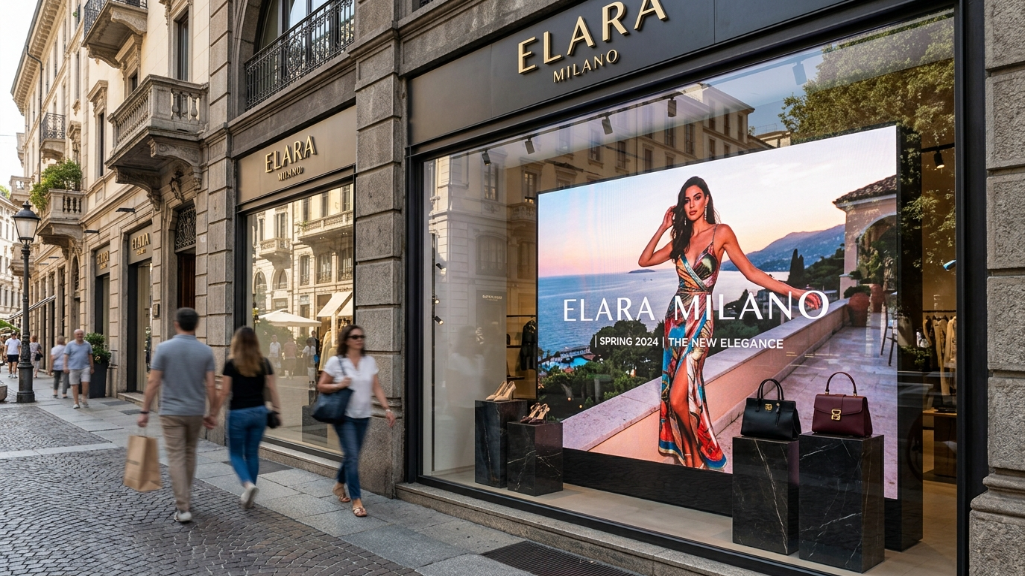
To make the abstract budget model concrete, we analyze a representative real-world project from a database of over 6,000 completed global deployments.
Project Overview
- Application: Luxury retail storefront window in Europe, exposed to strong natural sunlight
- Size: 2m × 2m square display
- Configuration: P2.5 indoor high-brightness series (1000 nits custom SMD LEDs)
- Cabinets: 16 units of 500mm × 500mm precision die-cast aluminum
Cost Structure & Engineering Decision Matrix
| System Module | Budget Share | Core Technical Considerations |
|---|---|---|
| LED Panels & Cabinets | 65% | Core expense. Automated SMT lines in a 15,000㎡ facility ensure cabinet tolerance below 0.1mm, achieving true seamless visuals at close viewing distances. |
| Video Control System | 15% | Fixed cost. Includes proprietary system with ambient light sensing for automatic brightness adjustment and energy savings. |
| Steel Structure & Mounting | 10% | Hidden cost. Lightweight custom wall-mount design developed due to load-bearing constraints. |
| Logistics & On-site Calibration | 10% | Includes shockproof packaging and professional cross-border color calibration labor. |
Engineering Conclusion
For 2×2 meter retail applications, the investment focus should not be solely on reducing panel cost. Instead, budgets should prioritize high-brightness LEDs, precision cabinets, and stable control systems to ensure perfect presentation of brand visual assets.
FAQ
Q1: Can a 2×2 meter LED screen be installed outdoors? How much does it increase the budget?
Answer:
Yes, but the physical architecture must be fully upgraded to outdoor standards.
Outdoor screens require extremely high brightness (typically above 5000 nits) and strict protection ratings (at least IP65). Additional requirements include potting glue processes and enhanced heat dissipation design. Therefore, under the same size, outdoor systems typically cost 30%–50% more than indoor versions.
Q2: Can a 2×2 meter LED screen be plugged into a standard wall outlet?
Answer:
Strongly not recommended. This is a common electrical planning mistake.
Although 2×2 meters sounds small, a high-brightness P2.5 screen can reach 1500W to 2500W peak power consumption under full white display. Standard 10A or 15A outlets may overheat or trip under sustained load.
The correct engineering approach is to install a dedicated 20A power circuit with an independent breaker by a certified electrician.
Q3: Will a 2×2 (1:1 ratio) screen distort 16:9 video?
Answer:
This is a critical display logic issue.
A 2×2 meter screen has a 1:1 aspect ratio. Forcing a 16:9 video into full screen will cause severe vertical stretching.
- Solution A (Content Adaptation): Create custom 1:1 square video content.
- Solution B (Hardware Scaling): Use a high-quality video processor to scale the 16:9 video proportionally and display it centered with black bars (letterboxing), preserving the original aspect ratio.
Extended Technical Reading & Resource Assurance
Planning a professional commercial LED display is a rigorous system engineering task involving electrical calculations, structural load analysis, and optical evaluation. To ensure your early-stage budget aligns perfectly with real-world deployment requirements, it is recommended to further study industry technical standards.
References:

About Dylan Lian
Marketing Strategic Director at Sostron