Quick answer: SMD and COB are two different LED packaging methods, not two different display “brands.” SMD mounts pre-packaged LED bulbs onto a PCB, giving you flexibility, lower upfront cost, and easy on-site repair — ideal for outdoor, large-format, and standard-viewing-distance projects. COB mounts bare chips directly onto the board under a sealed resin layer, giving you a smoother surface image, higher contrast, and better protection — ideal for close-viewing, fine-pitch, high-end indoor installations. Neither is universally “better”; the right choice depends on your viewing distance, environment, and budget.
Article at a Glance
- SMD ≠ COB ≠ DIP ≠ GOB. All four are LED packaging methods, not competing product lines — and increasingly, a single project may combine more than one.
- COB typically supports finer pixel pitches (down to P0.4–P0.9) than mainstream SMD (P0.9–P10), because chips sit closer together with no bracket in between.
- COB generally delivers higher contrast (commonly cited above 20,000:1) and a wider viewing angle (up to ~175–180°) than SMD (typically under 10,000:1 contrast, up to ~160° viewing angle), though figures vary by manufacturer and should be confirmed on the datasheet.
- SMD remains the more field-repairable technology; COB modules are usually swapped, not spot-repaired, when a chip fails.
- SMD generally wins on upfront cost and outdoor brightness; COB generally wins on total cost of ownership in fine-pitch, close-viewing indoor use because of lower failure rates and lower maintenance frequency.
SMD vs COB: Clearing Up the Confusion

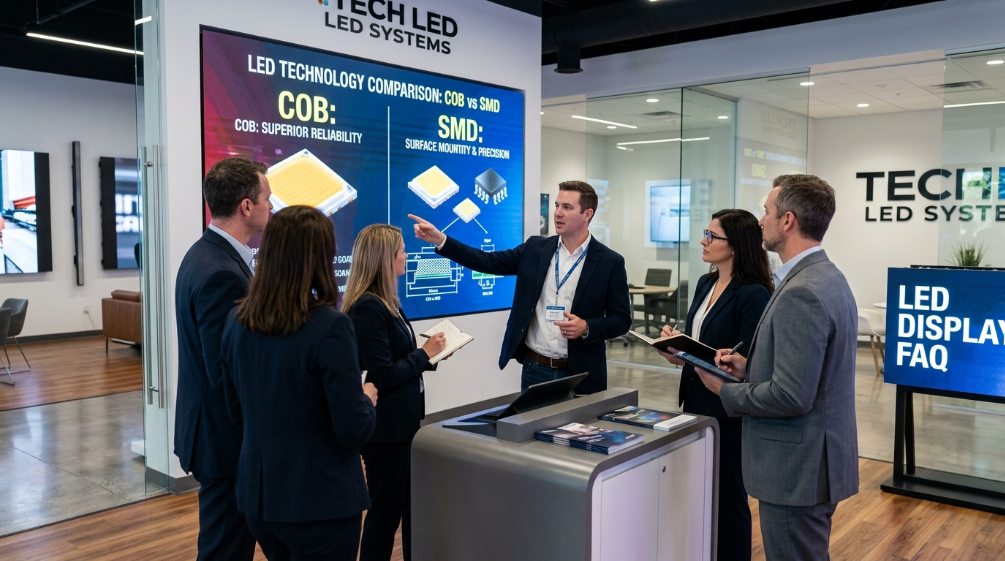
SMD (Surface-Mounted Device) ≠ COB (Chip-on-Board). They differ at the packaging step — the process that turns a raw LED chip into something that can be soldered onto a display’s PCB.
- SMD: individual red, green, and blue chips are packaged into a small plastic-encased “lamp bead,” then that bead is soldered onto the PCB using reflow soldering. Each pixel is a distinct, raised component — a point light source.
- COB: bare chips are bonded directly onto the PCB (no individual casing), then the entire chip array is covered by one continuous layer of epoxy or resin. The result is a flat, surface light source with no visible gaps between pixels.
It’s also worth placing two related technologies on the same map, since they show up constantly in RFQs and spec sheets:
- DIP (Dual In-line Package): an older through-hole packaging method, largely retired for new indoor/fine-pitch projects but still found in some rugged outdoor and legacy signage.
- GOB (Glue-on-Board): not a separate chip technology — it’s a protective glue layer applied over a finished SMD module. Think of it as “SMD + a COB-like protective shell”: it keeps SMD’s point-light-source optics but gains much of COB’s ruggedness and moisture resistance, which is why some integrators treat GOB as a middle ground between SMD and COB rather than a wholesale COB replacement.
SMD + COB = trade-off, not hierarchy. Neither packaging method is objectively superior; each optimizes for a different combination of image quality, durability, and cost.
For close-viewing, high-density installations, see our [fine-pitch COB LED display series].
Technical Deep Dive: What Actually Happens Inside the Package
SMD packaging process
Red, green, and blue chips are assembled into a single lamp bead (common package sizes include 8520, 7020, 5733, and finer variants such as SMD1010 used in sub-P1.5 modules), according to <cite index=”23-1″>SMD LED module specifications compiled on Wikipedia</cite>. That bead is placed by automated pick-and-place equipment and fixed via reflow soldering — a mature, highly automated process that keeps SMD’s unit cost low and its global supply chain deep.
COB packaging process — and its two sub-types
COB skips the individual-bead step entirely. Bare chips are bonded straight onto the substrate, then encapsulated. Two bonding methods matter for procurement, because they affect cost and repair strategy differently:
- Wire-bonding COB: chips connect to the PCB via fine gold wires before encapsulation. It’s the more established COB method but adds a fragile connection point under the resin layer.
- Flip-chip COB: chips bond face-down directly onto the substrate with no wires, improving reliability and heat transfer, and increasingly used in premium fine-pitch COB products.
Why COB tends to run cooler and last longer
COB’s direct-mount structure — often paired with a copper foil layer under the chip array — conducts heat away from the diode more efficiently than SMD’s individually-packaged beads, which each need their own thermal path. Better heat dissipation is a major reason COB modules are frequently rated for lower failure rates over a multi-year deployment.
Pixel pitch and resolution
Because COB eliminates the bracket and gap between individually packaged bulbs, chips can be placed closer together. Mainstream SMD commonly spans roughly P0.9–P10 pixel pitch (finer packages like SMD1010 push toward the lower end), while COB regularly reaches sub-P1.0 pitches — some premium COB lines cite P0.4–P0.9 — which is what makes COB the default choice once a project requires viewing distances under roughly 2 meters. These figures are typical values; always confirm exact pitch and tolerances on the specific model’s datasheet, since manufacturers vary.
Controllers and driving hardware
Both technologies are driven by the same class of LED receiving cards and sending systems (e.g., Novastar-compatible controllers are common across both SMD and COB modules), so switching packaging technology generally does not require a different control ecosystem — a useful point for integrators standardizing on one control platform across a mixed SMD/COB fleet.
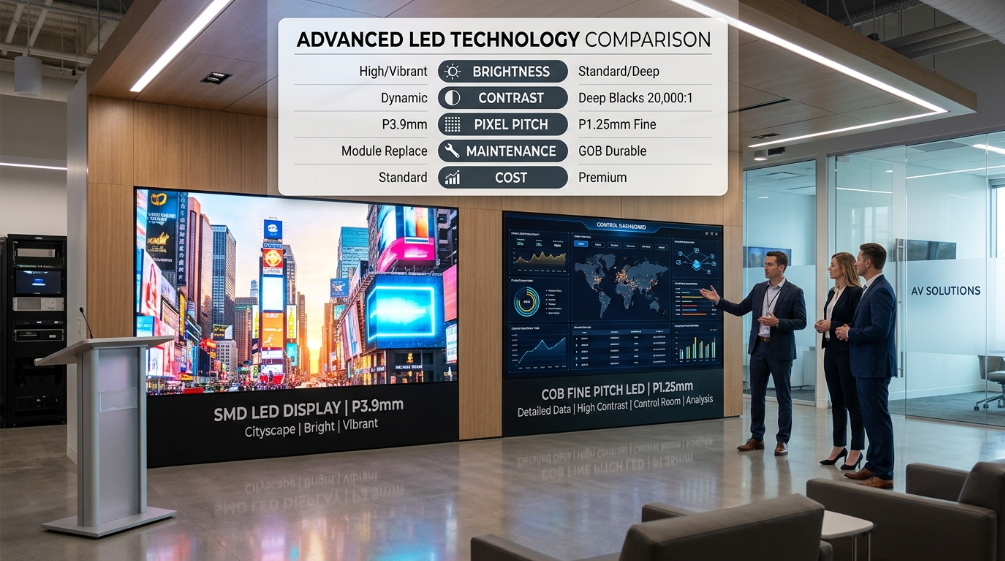
SMD vs COB LED Display: Full Comparison Table
| Dimension | SMD LED Display | COB LED Display |
|---|---|---|
| Light source type | Point light source (individually packaged beads) | Surface light source (chips + continuous resin layer) |
| Typical pixel pitch | ~P0.9 – P10 | ~P0.4 – P1.6 (fine-pitch focus) |
| Contrast ratio (typical) | Commonly under 10,000:1 | Commonly above 20,000:1 |
| Viewing angle (typical) | Up to ~160° | Up to ~175–180° |
| Brightness range (typical) | ~2,000–5,000 nits (outdoor-capable) | ~600–2,400 nits (indoor-optimized) |
| IP rating (front) | Often lower unless separately gasketed | Commonly IP65-class, wipeable surface |
| On-site repair | Yes — individual bead/module swap in the field | Usually no — factory or module-level repair only |
| Reported failure rate | Higher, varies by binning quality | Lower, often cited near 0.5%/year on quality product |
| Upfront cost | Lower | Higher |
| Best viewing distance | Medium–long range (>2–3 m) | Close range (<2 m) |
| Typical lifespan (to half-brightness) | ~100,000 hours industry standard, environment-dependent | ~100,000 hours industry standard, environment-dependent |
*Figures above are typical/representative values compiled from manufacturer specifications and industry sources, not guaranteed performance for any single product. Actual specs vary by model, chip binning, and driver IC — always confirm against the datasheet before purchasing.
Application Scenarios: Which Technology Fits Which Project

Outdoor advertising and stadium displays (SMD) Large-format, sunlight-viewable, high-brightness screens where viewing distance is measured in meters, not centimeters. SMD’s cost efficiency and outdoor-brightness headroom make it the default here; this is the technology behind most large outdoor billboard and stadium installations.
Stage and event rental (SMD, sometimes GOB) Rental LED needs to be light, quickly serviceable between events, and tolerant of frequent rigging and transport — SMD’s on-site repairability is a practical advantage. Where productions want extra ruggedness without switching to full COB, GOB-treated SMD panels are an increasingly common middle-ground choice.
Command centers and control rooms (COB) Operators sit close to the wall for extended shifts. COB’s lower minimum brightness, reduced glare, and smoother surface reduce eye strain over long viewing sessions, which is why COB has become common in mission-critical monitoring environments.
Broadcast studios and virtual production / XR volumes (COB) Camera-facing LED walls need high refresh rates to avoid flicker on camera, minimal moiré, and a dark, low-reflection surface for consistent on-air color — all COB strengths. Fine-pitch COB is increasingly the specified technology for in-camera VFX and virtual production stages.
Premium conference rooms and boardrooms (COB, fine-pitch SMD) Close viewing distance (2–5 m) with mixed content (video calls, presentations, data). Either technology can work; COB gives a more premium, seamless look, while fine-pitch SMD offers better value for standard corporate use.
Museums and digital cinema (COB) Artwork-quality reproduction, no visible pixel structure, and immersive close viewing favor COB’s surface light source and deep-black performance.
For large-format outdoor projects, browse our [outdoor SMD LED display screens].
Not sure which protection level your site needs? See our [LED display IP rating guide].
How to Choose: A Practical Decision Checklist

Work through these four questions in order — they’ll usually converge on the right technology before you look at price.
- What’s your minimum viewing distance?
- Under ~2 m → lean COB (or fine-pitch SMD as a lower-cost alternative)
- Over ~3 m → SMD is almost always sufficient and more economical
- What’s the installation environment?
- Outdoor / semi-outdoor with rain, dust, or direct sun exposure → SMD with an appropriate IP rating (IP65+ front protection is the common outdoor benchmark), or GOB-treated SMD
- Climate-controlled indoor space → either technology; COB if the surface needs to look seamless under close inspection
- Who will maintain it, and how accessible is the install?
- Hard-to-reach mounting (high ceiling, façade) or a team that needs fast on-site fixes → SMD’s field-repairability reduces downtime
- Staffed venue with scheduled maintenance windows and budget for factory-level repair → COB’s lower failure rate offsets less convenient repairs
- What’s the budget lens — upfront cost or 5–10 year total cost of ownership?
- Capex-constrained, large-area project → SMD
- Long-term installation where failure rate, energy use, and image quality compound over years → COB often wins on total cost of ownership despite higher upfront price
FAQ
What does SMD stand for in LED displays?
Surface-Mounted Device — LED chips packaged into individual beads and soldered onto a PCB using standard surface-mount technology.
What does COB stand for in LED displays?
Chip-on-Board — bare LED chips bonded directly onto the PCB and sealed under one continuous resin layer, with no individual bead casing.
Is COB always better than SMD?
No. COB generally wins on image smoothness, contrast, and close-range viewing; SMD generally wins on upfront cost, outdoor brightness, and field repairability. The better choice depends on viewing distance, environment, and maintenance plans.
Can a COB LED display be repaired on-site?
Usually not at the chip level — the sealed resin layer means most COB repairs happen at the module or factory level. On-site work is typically limited to swapping a whole module.
What is GOB LED technology, and how does it relate to SMD and COB?
GOB (Glue-on-Board) is a protective glue coating applied over a finished SMD module — not a separate chip technology. It keeps SMD’s point-light-source characteristics while adding ruggedness and moisture resistance closer to COB, making it a middle option rather than a COB substitute.
Which lasts longer, SMD or COB?
Both commonly cite the industry-standard ~100,000-hour rating to half-brightness, but real-world lifespan depends heavily on heat, driving current, and environment. COB’s typically lower reported failure rate often translates into fewer field issues over a multi-year deployment.
What pixel pitch should I choose for a 2-meter viewing distance?
As a general rule of thumb, pixel pitch (in mm) should be roughly proportional to minimum viewing distance — for viewing under 2 m, fine-pitch COB (P0.9 or finer) or fine-pitch SMD is typically recommended. Confirm the specific pitch-to-distance guidance with your supplier for the exact content type.
Does SMD or COB cost more?
SMD is generally cheaper upfront due to mature, automated manufacturing. COB carries a higher initial price because of its more complex, precision-dependent process — but may cost less over the display’s lifetime in close-viewing indoor applications due to lower failure and maintenance rates.
Customer Scenario
A control room integrator initially specified SMD at P1.5 to control upfront cost, but after evaluating actual operator viewing distance (under 1.5 m for shift staff), switched to fine-pitch COB at P1.2 — trading a higher unit price for reduced eye strain complaints and a lower service call rate over the following year. This kind of mid-project reassessment is common once real viewing distance is measured rather than assumed.
Bottom Line
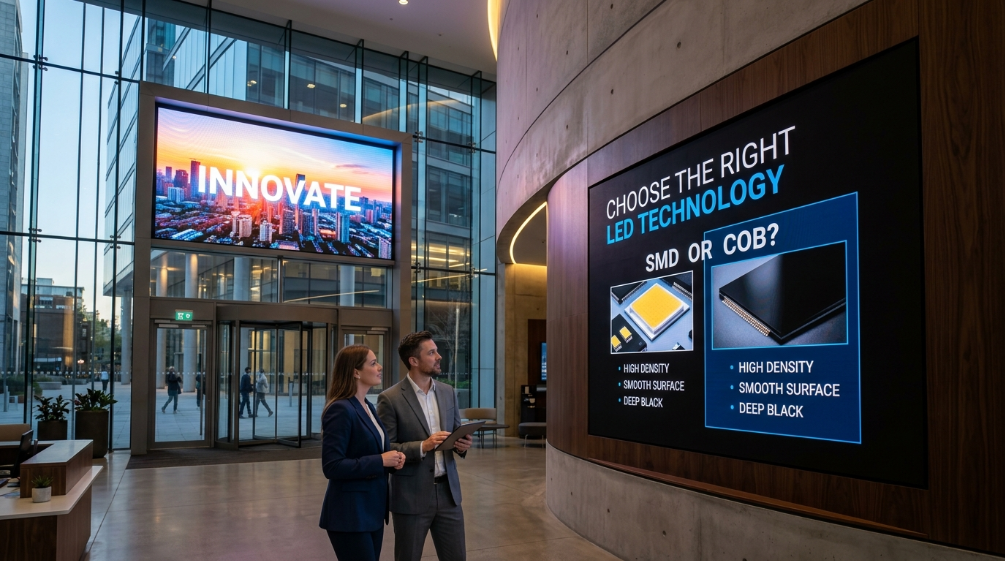
SMD and COB are not competing “brands” — they’re two packaging philosophies solving different problems. If your project is large-format, outdoor, cost-sensitive, or needs fast field repair, SMD remains the practical default. If it’s close-viewing, indoor, and image quality or long-term reliability matters more than upfront price, COB is usually worth the premium. Many integrators now spec both technologies across different rooms or applications within the same building rather than standardizing on one.
Need help specifying the right technology for your project? Share your viewing distance, environment, and budget with our engineering team, and we’ll recommend a pixel pitch and packaging technology — [request a quote].
Written by [Dylan], LED Display Product Specialist with 10+ years in commercial and rental LED display procurement and specification.
Sources referenced: SMD LED packaging specifications (Wikipedia), industry-published LED display comparison data (LEDMAN, ChipShow, UNIT LED, PTC LED, TW LED, ViboLED, Rigard), and LED IP rating standards guidance (Unilumin, ViboLED). Figures are typical/representative values; confirm exact specifications against individual manufacturer datasheets before purchasing.