If you are comparing COB LED displays, SMD LED screens, and fine-pitch LED video walls, the most important point is simple: COB is not a different type of light from LED. It is an LED packaging and integration technology. COB, or Chip on Board, places LED chips directly onto a PCB substrate and encapsulates them as part of the display module.
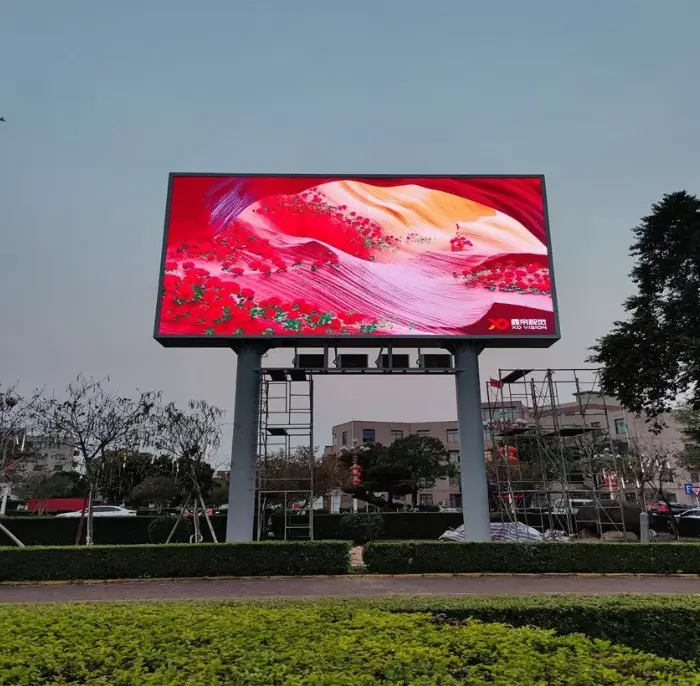
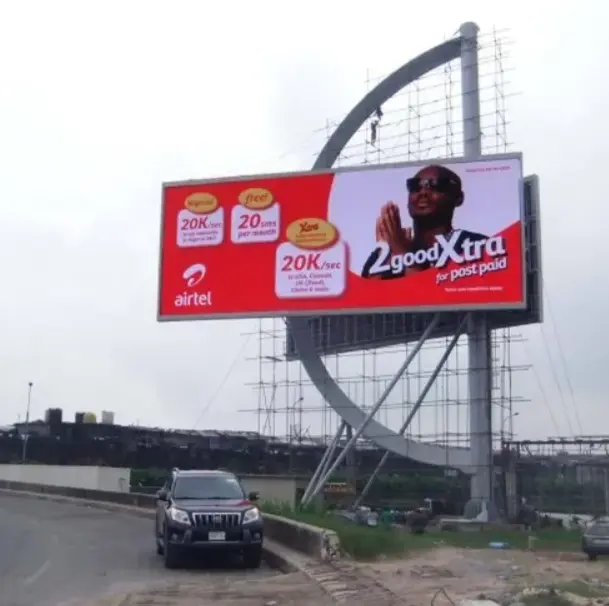
For commercial projects, COB is particularly attractive when you need fine pixel pitch, high contrast, a protected display surface, close viewing distances, and a premium indoor installation. However, COB is not automatically the best choice for every LED project. Outdoor billboards, large-format DOOH, and rental applications may still benefit from the cost and serviceability of SMD technology.
What Is a COB LED Screen?
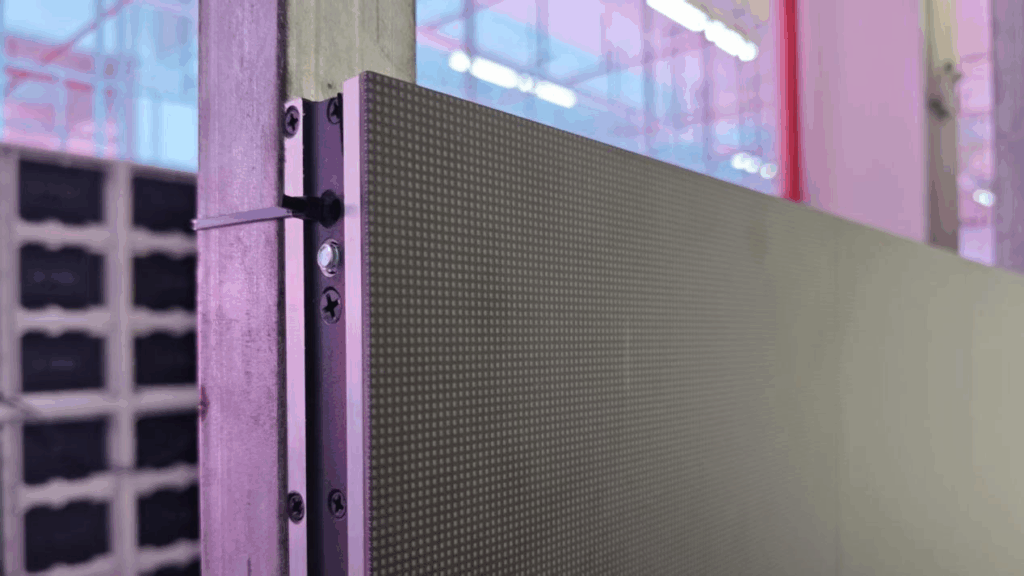
A COB LED screen is a direct-view LED display that uses Chip on Board (COB) packaging.
In a conventional SMD LED display, LED chips are first packaged into individual LED components. These packaged components are then mounted onto the PCB to form pixels.
COB takes a different approach. Bare LED chips are directly mounted onto the PCB substrate and then protected with an encapsulation layer. Analyze 6 differences between SMD LED display and COB LED display for you.
The simplified structure is:
SMD LED:
LED chip → individual package → soldering → PCB → LED module

COB LED:
LED chip → direct bonding to PCB → encapsulation → LED module
The result is a more integrated LED module with a relatively flat and protected surface.
This structural difference is especially useful for fine-pitch commercial LED displays, where very small pixels have to be placed at high density.
Is COB the Same as LED?
No. This distinction is important.
LED describes the light-emitting diode technology itself.
COB describes how multiple LED chips are mounted and packaged on a substrate.
Therefore, a COB LED screen is still an LED display. The difference is primarily in the chip packaging architecture, not in the fundamental principle of electroluminescence.
This is why comparing “LED vs COB LED” can be misleading. A more technically accurate comparison is:
- COB vs SMD
- COB vs GOB
- COB vs other LED packaging technologies
For commercial display procurement, this distinction helps avoid confusion when suppliers use terms such as “COB LED,” “fine-pitch LED,” “Mini LED,” or “Micro LED.”
How Does COB LED Technology Work?
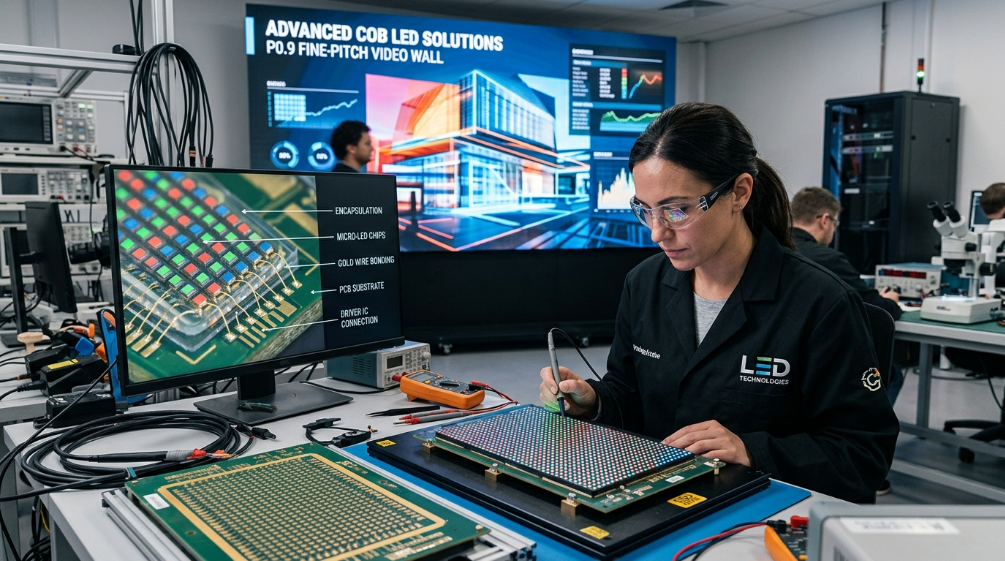
The manufacturing process varies by supplier, but the basic concept is consistent.
LED chips are placed directly on a PCB substrate and electrically connected to the circuit. The chips are then protected by an encapsulation material.
This removes several components associated with conventional packaged SMD LEDs.
The display therefore has fewer exposed elements on its light-emitting surface.
For fine-pitch applications, this has several practical consequences:
- Higher pixel density can be achieved.
- The surface is more resistant to physical contact.
- The individual LED packages are no longer exposed.
- The optical surface can appear more uniform.
- The module can be designed for very small pixel pitches.
- Heat can be managed through the PCB and module structure.
However, the actual performance of a COB LED display still depends on much more than the packaging method. LED chip efficiency, driver ICs, PCB design, calibration, optical design, scan architecture, and thermal management all affect the final result.
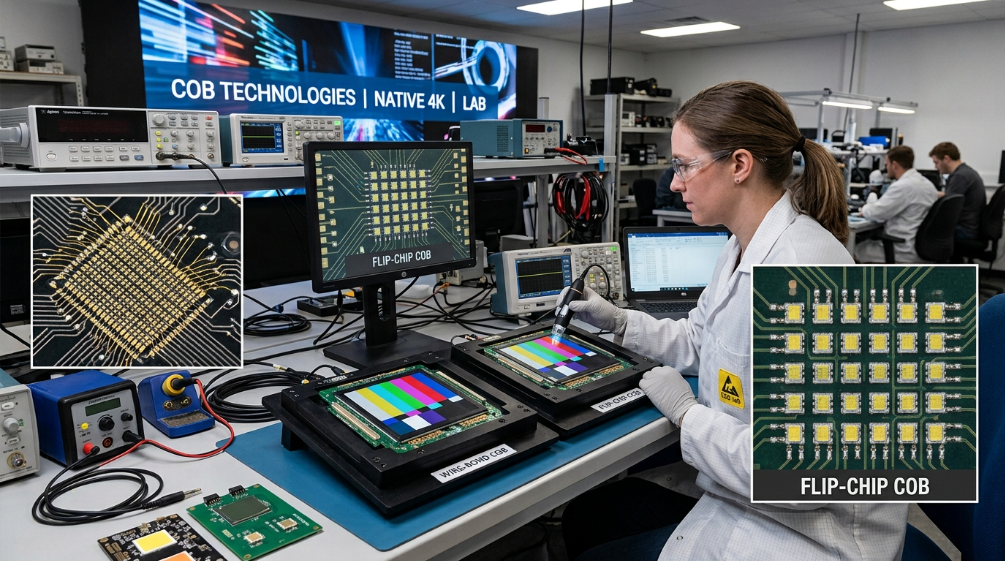
Wire-Bond COB vs Flip-Chip COB
Not every COB LED display is built exactly the same way.
Two common approaches are wire-bond COB and flip-chip COB.
Wire-Bond COB
In wire-bond COB, the LED chip is mounted on the substrate and connected electrically using fine bonding wires.
It is a mature manufacturing approach and can provide the benefits associated with COB packaging.
However, the bonding wire remains part of the electrical and optical structure.
Flip-Chip COB
In flip-chip COB, the LED chip is flipped so that its electrical connections are bonded directly toward the substrate.
This can shorten the electrical path and improve thermal transfer while eliminating conventional bonding wires.
For premium fine-pitch commercial displays, flip-chip COB is particularly interesting because the technology is aligned with the industry’s move toward smaller pixel pitches and higher integration.
When evaluating a supplier, therefore, do not stop at the words “COB LED.”
Ask:
- Is the product wire-bond COB or flip-chip COB?
- What LED chip is being used?
- What driver IC is installed?
- What is the actual pixel pitch?
- What are the measured power consumption figures?
- How is calibration performed?
- How are failed modules replaced?
These questions provide much more useful information than the word “COB” alone.
What Is the Difference Between LED and COB LED?
The simplest explanation is:
LED is the underlying light-emitting technology; COB is one way of packaging and integrating LED chips.
A conventional commercial LED screen may use SMD LED packages.
A COB LED screen uses bare LED chips directly mounted onto the PCB and encapsulated as part of the module.
Therefore, COB does not replace LED. It changes the architecture used to build an LED display.
This distinction is especially important for B2B buyers because a quotation that says “LED display” does not tell you enough about the actual product.
A professional RFQ should specify at least:
- LED packaging technology
- Pixel pitch
- LED chip specification
- Driver IC
- Refresh rate
- Brightness
- Cabinet dimensions
- Front/rear maintenance
- Average and maximum power
- Calibration specification
- Warranty
- Spare module policy
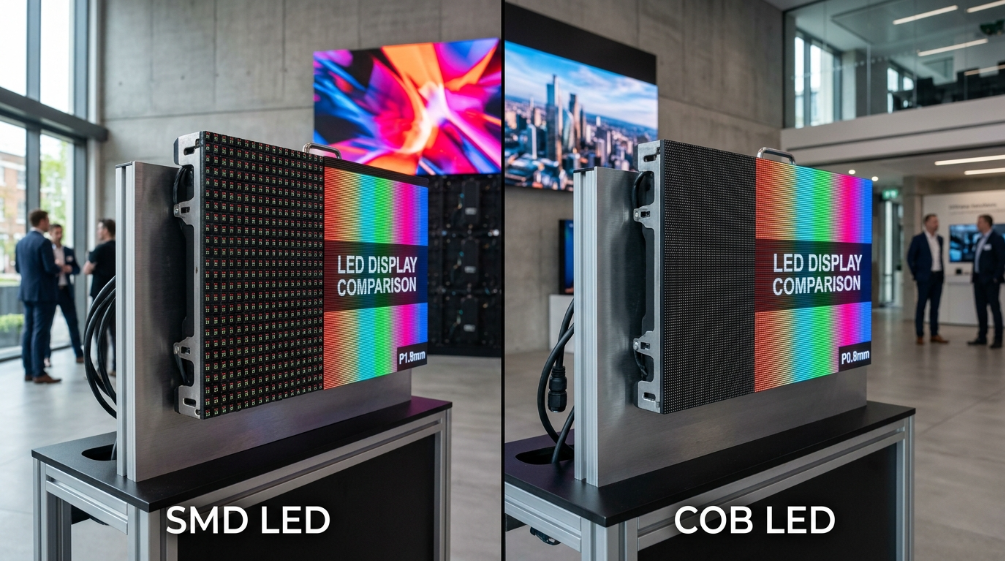
COB vs SMD LED Display: What Is the Difference?
COB and SMD are currently two important packaging approaches for commercial direct-view LED displays.
| Factor | COB LED Display | SMD LED Display |
|---|---|---|
| Chip packaging | Chips directly mounted on PCB | Packaged LED components mounted on PCB |
| Surface | Flat, encapsulated | Individual LED packages exposed |
| Fine-pitch capability | Excellent | Excellent, but generally less advantageous at extreme fine pitches |
| Physical protection | High | Depends heavily on module design and protection |
| Pixel repair | Usually module-level | Can offer more granular repair options |
| Manufacturing maturity | Rapidly expanding | Highly mature |
| Initial cost | Often higher in premium configurations | Generally more economical |
| Typical applications | Fine-pitch indoor, control rooms, boardrooms | Indoor, outdoor, rental, DOOH |
| Close viewing | Excellent | Good to excellent depending on pitch |
| Large-format outdoor | Usually less economical | Often preferred |
There is no universal winner.
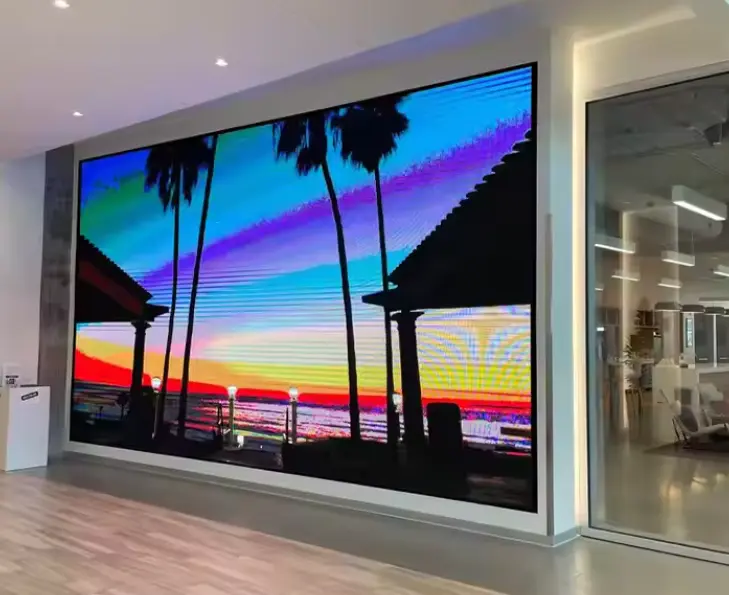
For a P0.9 or P1.25 indoor video wall, COB can make strong technical and economic sense.
For a large P4, P6, or P8 outdoor billboard, SMD may be the more rational choice because the viewing distance is greater and the economics of large-area deployment matter more.
What Are the Advantages of COB LED Displays?
1. Fine Pixel Pitch
One of the strongest reasons to specify COB is fine-pitch performance.
Commercial COB displays are available in pixel pitches below 1.0 mm, depending on the manufacturer and product generation.
Smaller pixel pitch means more pixels can be placed into the same physical area.
This matters when viewers are close to the screen.
Typical applications include:
- Executive boardrooms
- Command centers
- Control rooms
- Broadcast studios
- High-end retail
- Museums
- Corporate experience centers
- XR and virtual production
However, smaller is not automatically better. A P0.7 display can be technically impressive but economically unnecessary if the nearest viewer is 5 or 6 meters away.
2. Improved Physical Protection
A COB module has an encapsulated light-emitting surface rather than thousands of exposed SMD packages.
This can improve resistance to:
- Accidental contact
- Scratches
- Dust
- Moisture
- Cleaning operations
- Light impact
That makes COB attractive for high-traffic commercial spaces.
However, buyers should distinguish between COB packaging and a certified IP rating.
A COB screen should not be advertised as waterproof simply because it uses encapsulation.
If IP protection matters, ask the supplier for the actual IP test documentation.
3. High Contrast and Deep Black Appearance
COB displays can provide a very dark, visually uniform surface when the module and encapsulation are properly designed.
This is particularly valuable in:
- Control rooms
- Corporate presentation environments
- Museums
- Premium retail
- Broadcast studios
However, contrast ratio should be evaluated alongside calibration, optical structure, brightness and black-level uniformity.
A high number on a specification sheet does not automatically guarantee superior real-world image quality.
4. Wide Viewing Angles
Fine-pitch commercial LED displays are often installed in spaces where viewers are not directly in front of the screen.
COB modules can provide wide viewing angles and good image consistency across a broad viewing area.
This is useful for:
- Boardrooms
- Exhibition spaces
- Retail stores
- Command centers
- Large conference venues
The important procurement metric is not simply the maximum viewing-angle number. Ask for brightness and color consistency at different viewing angles.
5. Reduced Risk of Physical Pixel Damage
Because the LED chips are integrated and protected within the COB structure, the light-emitting surface is generally less vulnerable to physical damage than exposed SMD packages.
This can be valuable in high-touch commercial environments.
But there is a trade-off.
When a COB module does fail, repair is normally performed at the module level, rather than replacing one individual packaged LED in the field.
That means spare-module planning is essential.
What Are the Disadvantages of COB LED Screens?
COB is not a perfect technology.
Higher Initial Investment
COB fine-pitch displays can cost more than comparable SMD products, particularly when premium LED chips, flip-chip packaging, high-performance driver ICs and advanced cabinets are specified.
The premium can be justified when the application benefits from fine pitch and durability.
But paying for COB at a large pixel pitch simply because it is a newer technology may not make financial sense.
Module-Level Maintenance
SMD can sometimes allow more granular component-level repair.
COB generally requires replacing the affected module.
For large mission-critical projects, buyers should therefore budget for spare modules.
A lower initial spare inventory can reduce the purchase price but increase operational risk later.
More Complex Manufacturing
COB requires precise chip placement, bonding, encapsulation and calibration.
Yield and manufacturing consistency are important.
When comparing suppliers, ask about:
- Factory quality control
- Calibration process
- Module consistency
- Pixel failure criteria
- Aging tests
- Warranty terms
- Spare-part availability
Not Automatically Better for Outdoor LED Billboards
COB is often associated with premium image quality and physical protection, but outdoor LED billboards have different priorities.
Outdoor applications may require:
- Very high brightness
- Weather resistance
- Thermal management
- Large cabinet sizes
- Easy maintenance
- Competitive cost per square meter
For many P2.5+ outdoor advertising projects, SMD remains highly competitive.
Where Are COB LED Screens Used?

COB is particularly suitable for applications where image detail and surface durability matter.
Corporate Boardrooms
For viewers sitting approximately 1.5–3 meters from a screen, fine-pitch COB can provide a clean, high-resolution presentation surface.
P1.25, P1.5 and similar pitches are commonly considered depending on room geometry and content.
Command and Control Centers
Control rooms often operate continuously and display detailed information, maps, dashboards and multiple video sources.
Reliability, pixel density, calibration and front maintenance are more important than simply maximizing brightness.
High-End Retail
Retail environments benefit from:
- Premium image quality
- High contrast
- Close viewing
- Attractive cabinet integration
- Surface durability
COB can therefore be a strong choice for flagship stores and luxury commercial environments.
Museums and Exhibition Spaces
COB’s fine pitch and smooth surface can work well where visitors stand close to the screen.
The specification should also consider color accuracy, brightness control and low-reflection requirements.
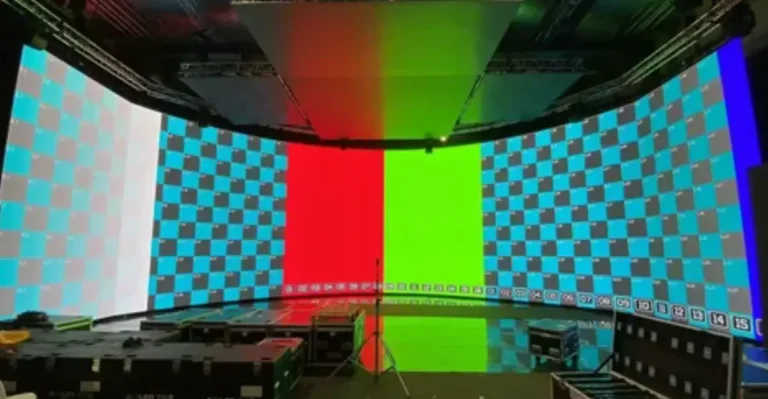
Broadcast and XR
Camera-facing LED displays have additional requirements.
A high refresh rate is important, but it is not the only consideration.
Buyers should evaluate:
- Refresh rate
- Scan architecture
- Grayscale
- Genlock compatibility
- Camera testing
- Calibration
- Moiré performance
- Color consistency
A display should be tested with the actual camera system whenever possible.
How Do You Choose the Right COB Pixel Pitch?
Pixel pitch is the distance between the centers of adjacent pixels.
The smaller the pitch, the higher the pixel density.
But the correct pitch depends on viewing distance.
As a general commercial planning principle:
| Application | Typical Pitch Range to Evaluate | Primary Consideration |
| Executive boardroom | P0.9–P1.5 | Close viewing and text |
| Control room | P0.9–P1.5 | Detail and 24/7 operation |
| Corporate lobby | P1.5–P2.5 | Viewing distance and budget |
| High-end retail | P1.2–P2.0 | Image quality and aesthetics |
| Exhibition | P0.9–P1.5 | Close viewing |
| Broadcast/XR | P0.7–P1.5 | Camera performance |
| Large outdoor billboard | Usually P2.5+ | Brightness and cost efficiency |
These are starting points rather than universal rules.
The correct specification should be calculated from:
screen size + nearest viewing distance + content type + ambient light + resolution target + budget.
COB LED Display Specifications Buyers Should Compare
Do not compare quotations based on pixel pitch alone.
At minimum, evaluate:
Pixel Pitch
Lower pitch provides greater pixel density but increases the amount of LED hardware required per square meter.
Brightness
Indoor commercial displays commonly require much less brightness than direct-sunlight outdoor billboards.
Excessive brightness indoors can reduce viewing comfort and waste energy.
Refresh Rate
For camera-facing applications, specify a high refresh rate and test the actual display with the intended camera and shutter settings.
Contrast
Contrast influences perceived depth and black-level quality.
However, contrast should be evaluated using comparable measurement conditions.
Power Consumption
Ask for both:
- Maximum power consumption
- Average power consumption
Compare them at the same brightness and operating conditions.
Cabinet Size
Cabinet dimensions affect:
- Installation
- Transportation
- Structural loading
- Maintenance
- Screen aspect ratio
- Pixel mapping
Maintenance Method
For commercial projects, front maintenance can significantly simplify installation and servicing.
Calibration
Ask whether the supplier provides:
- Factory calibration
- Brightness calibration
- Color calibration
- Module-to-module uniformity data
- Replacement-module calibration procedures
How Much Does a COB LED Display Cost?
There is no single global COB LED display price.
The correct way to estimate a commercial project is to calculate the screen area and then add the system-level costs.
COB LED Display Price per Square Meter
As a broad 2026 planning reference, premium indoor COB displays can range from roughly $1,000 to more than $5,000 per square meter, depending heavily on pixel pitch, LED chip quality, COB architecture, cabinet design, refresh rate, calibration and order volume.
At the very fine-pitch end, prices can be substantially higher.
Published industry pricing examples show major differences between P0.78, P0.9375, P1.25, P1.5625 and P1.875 configurations. The figures should be treated as budgeting references rather than universal market prices because suppliers quote different configurations and inclusions.
A Simple COB LED Cost Formula
For preliminary budgeting:
Display Hardware Cost = Screen Area × Price per m²
For example:
If the required display is:
4.8 m × 2.7 m = 12.96 m²
and the selected configuration is budgeted at:
$3,000/m²
then:
12.96 × $3,000 = $38,880
But that is not necessarily the final project cost.
You may also need:
- Video processor
- Sending and receiving cards
- Power distribution
- Mounting structure
- Cables
- Spare modules
- Flight cases or wooden packaging
- Shipping
- Installation
- Commissioning
- Local electrical work
Therefore:
Total Project Cost ≠ COB Panel Price
This distinction is critical when comparing B2B quotations.
Why Can Two COB LED Quotes Differ So Much?
Two displays can both be advertised as “P1.25 COB” while having very different prices.
The main cost variables include:
- LED chip brand and efficiency
- Wire-bond vs flip-chip COB
- Driver IC
- PCB quality
- Encapsulation process
- Calibration
- Refresh rate
- Cabinet material
- Cabinet depth
- Front or rear maintenance
- Power supply
- Controller
- Warranty
- Spare module package
- Factory testing and aging
This is why a professional buyer should never compare COB quotations using price per square meter alone.
COB LED Display Price vs SMD: Which Offers Better Value?
The answer depends on the application.
For a close-viewing indoor P1.25 control-room project, paying more for COB may provide meaningful value because the buyer is purchasing more than resolution.
They are also purchasing:
- Surface protection
- Fine-pitch capability
- High-density integration
- Premium visual quality
- Potentially lower physical damage risk
For a large outdoor P6 advertising screen, those advantages may have little financial value.
In that case, a mature SMD product can provide better project economics.
The correct question is therefore not:
“Is COB more expensive than SMD?”
It is:
“Does the additional COB investment solve a problem that matters to this project?”
COB vs SMD: Total Cost of Ownership
A B2B buyer should evaluate Total Cost of Ownership (TCO) rather than purchase price alone.
A simple five-year model can include:
TCO = Initial Hardware + Installation + Energy + Maintenance + Spare Parts + Downtime Risk
For high-value indoor installations, maintenance and downtime can become more important than the initial price difference.
For large outdoor advertising networks, however, cost per square meter, brightness, reliability and serviceability can dominate the equation.
This is why technology selection must be application-specific.
COB vs GOB: Are They the Same?
No.
COB means Chip on Board.
GOB means Glue on Board.
With COB, LED chips are directly integrated onto the PCB and encapsulated.
With GOB, conventional LED packages—often SMD LEDs—are already mounted on the module, and a protective layer is then applied over the surface.
Therefore:
COB changes the LED packaging architecture, while GOB primarily adds surface protection to an existing LED module.
Both technologies can improve physical protection, but they are not interchangeable technologies.
Is COB Better Than SMD for Every Commercial LED Project?
No.
A professional recommendation should be conditional.
Choose COB when:
- The pixel pitch is around P1.5 or finer.
- Viewers are relatively close.
- The project is indoors.
- High-end visual quality is important.
- The screen surface needs additional physical protection.
- The project has a long operating lifecycle.
- Fine text and detailed graphics are important.
- The buyer accepts module-level maintenance.
Consider SMD when:
- The display is a large outdoor billboard.
- The viewing distance is long.
- P2.5 or larger pitch is sufficient.
- The lowest initial cost is important.
- Rapid field repair is critical.
- The project involves large-scale DOOH deployment.
- The application requires very high outdoor brightness.
In other words, COB is a solution for a particular set of engineering requirements—not a universal replacement for SMD.
8 Questions to Ask a COB LED Display Manufacturer
Before approving a quotation, ask the supplier:
- What COB architecture is used—wire-bond or flip-chip?
- What LED chip brand and specification are used?
- What are the average and maximum power consumption figures?
- What is the actual measured brightness at calibrated settings?
- What refresh rate and driver IC are included?
- How are failed modules repaired or replaced?
- Are replacement modules calibrated to the original batch?
- What exactly is included in the quoted price per square meter?
For a large commercial project, these questions can reveal more than a glossy product brochure.
Actionable Advice for B2B Buyers
If you are purchasing a COB LED display for a commercial project, use this five-step process:
Step 1: Start with viewing distance
Do not start with the cheapest pixel pitch.
Measure the nearest and average viewing distances first.
Step 2: Define the application
A boardroom, control room, retail store and outdoor billboard have very different requirements.
Step 3: Compare equivalent configurations
When requesting quotations, make sure every supplier quotes the same:
- Pixel pitch
- LED chip
- Driver IC
- Refresh rate
- Brightness
- Cabinet size
- Maintenance method
- Controller
- Warranty
Step 4: Request a complete project price
Do not compare only the panel price.
Ask for a complete BOM and project quotation including accessories, control system, spare modules, shipping and installation assumptions.
Step 5: Evaluate TCO
If COB costs more initially, calculate whether its technical advantages justify the premium over the expected operating period.
For a premium indoor fine-pitch installation, COB can be an excellent investment.
For a large outdoor advertising project, SMD may still be the more economical engineering choice.
Frequently Asked Questions About COB LED Screens
Is COB LED better than SMD LED?
Not universally. COB generally becomes more attractive as pixel pitch gets finer and viewing distance gets shorter. SMD remains highly competitive for many large-format and outdoor applications.
What does COB stand for in LED displays?
COB stands for Chip on Board. It describes a packaging method in which LED chips are directly mounted onto a PCB substrate.
What is the difference between LED and COB LED?
LED refers to the light-emitting diode technology. COB describes how LED chips are packaged and integrated. A COB LED display is still a direct-view LED display.
Is COB more expensive than SMD?
Often, especially in premium fine-pitch configurations, but the price difference varies by specification, supplier, volume and manufacturing process.
What is flip-chip COB?
Flip-chip COB mounts the LED chip in an inverted orientation so that its electrical connections can be directly bonded toward the substrate. It is increasingly important for high-density fine-pitch LED applications.
How long does a COB LED display last?
Manufacturers commonly specify long operating lifetimes for commercial LED systems, but actual service life depends on LED chip quality, operating brightness, thermal conditions, driver electronics, operating hours and maintenance. Buyers should evaluate the manufacturer’s rated lifetime together with warranty and failure-rate data rather than relying on a single “100,000-hour” claim.
Can a COB LED screen be used outdoors?
Some COB technologies can be engineered for outdoor environments, but COB should not automatically be treated as an outdoor technology. Outdoor LED displays require sufficient brightness, thermal design, weather protection and appropriate cabinet construction. For many conventional outdoor billboard projects, SMD remains the more established option.
Is COB the same as Micro LED?
No.
COB describes a packaging and integration method.
Micro LED describes extremely small LED chips.
Some advanced COB architectures can use very small LED chips, but the two terms should not be treated as synonyms.
Final Verdict: Is a COB LED Screen Worth It?
For fine-pitch indoor commercial LED displays, COB is one of the most compelling technologies available because it combines high pixel density with a protected display surface and a highly integrated module structure.
But the best buying decision is not based on technology labels alone.
If your project requires P0.9–P1.5-class fine pitch, close viewing, premium image quality and high physical durability, COB deserves serious consideration.
If your project is a large outdoor billboard, long-distance advertising display or cost-sensitive large-area installation, SMD may provide a better balance of price, brightness and serviceability.
The most reliable approach is to compare equivalent specifications, complete project cost and five-year TCO rather than simply asking which technology is “better.”
For a commercial LED project, the right COB display is the one that solves the project’s actual viewing, reliability, maintenance and budget requirements—not simply the one with the most advanced specification sheet.
Related SoStron Resources
For buyers evaluating a COB LED project, the following pages can be used as supporting product and pricing resources:
- [COB LED Display — Cobra] — suitable anchor text: COB LED Display
- [P1.25 Fine-Pitch LED Display Price Guide] — suitable anchor text: P1.25 LED Display Price Guide
Sources Used for Technical and Market Cross-Checking
The technical comparison and pricing discussion above were cross-checked against current industry material from LEDMAN, LEDChina, Linstar, UNIT LED, LEDu, LedInCloud, Colorlit, SightLED and SoStron.
References:
LED Basics — U.S. Department of Energy
About the Solid-State Lighting Program — U.S. Department of Energy