Quick-Reference:LED Screen Specifications by Restaurant Zone
The right spec depends entirely on where the screen lives and who is looking at it.Here is the baseline before anything else.
Restaurant Zone Specification Table
| Restaurant Zone | Pixel Pitch | Brightness | IP Rating | Duty Cycle | Technology |
|---|---|---|---|---|---|
| QSR indoor menu board | P2.5–P4 | 800–1,500 nits | IP54 | 16/7–24/7 | SMD |
| Fine dining ambient wall | P1.5–P2 | 800–1,500 nits | IP54 | 12/7 | COB |
| Sports bar video wall | P2–P3 | 1,000–2,000 nits | IP54 | 18/7 | SMD |
| Window/storefront display | P4–P6 | 2,500–4,000 nits | IP65 | 24/7 | SMD |
| Drive-thru confirmation screen | P4–P6 | 2,500–3,500 nits | IP56 | 24/7 | SMD |
| Kitchen display system(KDS) | P3–P5 | 300–600 nits | IP54 | 24/7 | COB/SMD |
| Queue/pickup status screen | P2.5–P4 | 600–1,000 nits | IP54 | 16/7 | SMD |
If a supplier quotes you a single product for all of these zones,walk away.That is not a specification—it is a catalog page.
The most expensive mistake in restaurant LED procurement is not buying the wrong brightness or the wrong pixel pitch.It is treating every screen in a restaurant as the same category of product.Based on our experience deploying electronic LED screens across QSR chains,sports bars,and fine dining venues,the failure rate on projects that start with a generic”restaurant LED screen”brief is significantly higher than those that begin with a zone-by-zone specification.The hardware is only part of the problem.The deeper issue is that a P4 SMD panel optimized for a drive-thru confirmation screen will look washed out and pixelated when repurposed as a fine dining ambient wall—and a COB P1.5 panel designed for close-range visual refinement is dramatically over-specified(and over-priced)for a highway-facing QSR exterior sign.
This guide is written for system integrators,AV consultants,and multi-location restaurant operators who need to make defensible procurement decisions—not for someone buying a single screen for a cafécounter.
Why the Restaurant You’re Equipping Determines Every Spec Decision
The Four Restaurant Categories and Their Fundamentally Different LED Requirements
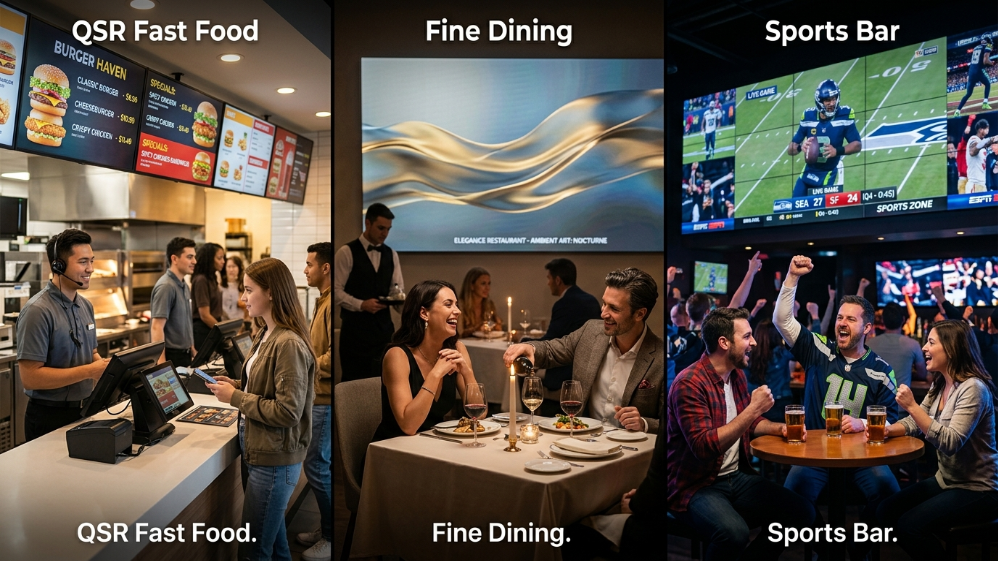
The restaurant industry is not a monolith,and neither is its LED display infrastructure.Four distinct categories drive four distinct technical briefs.
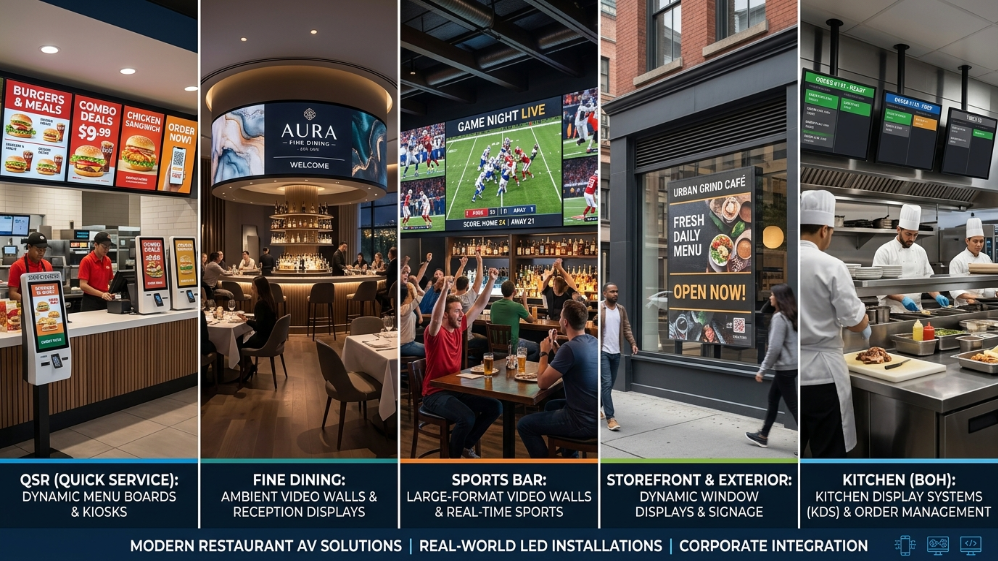
QSR and fast-food chains are the highest-volume segment.The primary display surfaces are indoor menu boards(typically 3–5 panels behind the counter),drive-thru order-point screens,drive-thru confirmation screens,and kitchen display systems.The defining technical requirement is not resolution—it is system integration.A QSR menu board that cannot sync with the POS in under 60 seconds is an operational liability.Dayparting—the automatic switching between breakfast,lunch,and dinner menus on a time-based schedule—is not a feature;it is a baseline expectation.According to DisplayDetails’2026 restaurant signage analysis,QSR operators who implement automated dayparting eliminate an average of 4–6 manual content interventions per day per location.Across a 50-store chain,that is a meaningful labor saving.
Fine dining and upscale casual venues use LED screens differently.The display is not a menu delivery mechanism—it is an architectural element.A poorly calibrated ambient video wall in a fine dining room that runs at 3,000 nits will destroy the atmosphere that the lighting designer spent months building.The correct specification for this category is P1.5–P2 COB technology at 800–1,500 nits,with content that uses slow gradients,natural textures,and zero high-contrast cuts.The screen should be felt,not noticed.
Sports bars and social dining venues represent the most technically demanding category for a different reason:multi-source signal management.A 40-screen sports bar running simultaneous NFL,NBA,and Premier League feeds requires a video processor architecture that can handle independent audio zones,real-time source switching,and—critically—a refresh rate of≥3,840 Hz on every panel.That last specification is not about what the human eye perceives.It is about what a smartphone camera captures.A sports bar where every guest’s social media video shows rolling scan lines across the screens is a brand problem,not just a technical one.
Fast-casual and caféchains sit between QSR and fine dining in both budget and complexity.The defining challenge is the window-facing display:a storefront LED panel that must remain readable in direct sunlight(requiring 2,500–4,000 nits)while not appearing aggressively bright to seated indoor guests.Auto-brightness control(ABC)solves this—the panel reads ambient light levels and adjusts output automatically,reducing power consumption by 30–40%during low-light hours and extending LED lifespan by reducing thermal stress.
The One Mistake That Costs System Integrators the Most:Consumer Displays in Commercial Environments
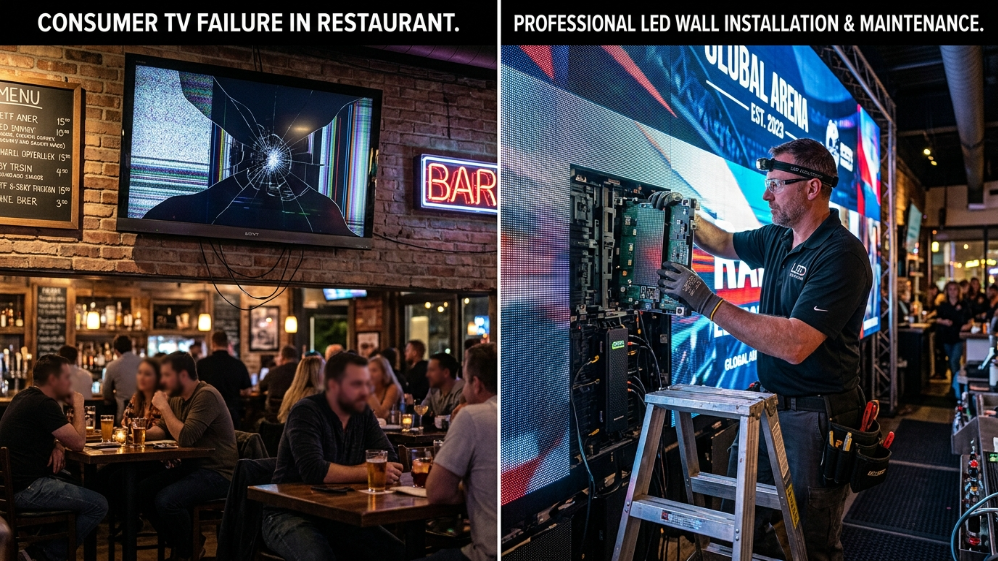
Consumer televisions are not commercial displays.This distinction is not marketing language—it is an engineering reality with a predictable failure timeline.
A consumer TV is designed for approximately 4–6 hours of daily use.A restaurant menu board runs 16–24 hours per day,365 days per year.Based on our experience with restaurant retrofit projects,consumer displays deployed in QSR environments typically fail within 8–14 months of installation.The failure mode is usually backlight degradation first(brightness drops 30–40%),followed by panel failure.The replacement cost—hardware,labor,content reconfiguration,and operational downtime—consistently exceeds the original savings from choosing consumer over commercial hardware.
Commercial-grade electronic LED screens carry MTBF ratings of 50,000 hours or more,tested at sustained operating temperatures.They are rated for 24/7 duty cycles.They support modular repair—when a section of the display fails,you replace the module,not the entire panel.That modularity is not a minor convenience;for a 20 m²video wall in a sports bar,the difference between module-level repair and full-panel replacement is the difference between a 2-hour fix and a 3-day closure.
Pixel Pitch&Brightness Selection Matrix—Matched to Every Restaurant Zone
Indoor Menu Boards:Why P2.5–P4 SMD Delivers the Best ROI for QSR and Fast-Casual
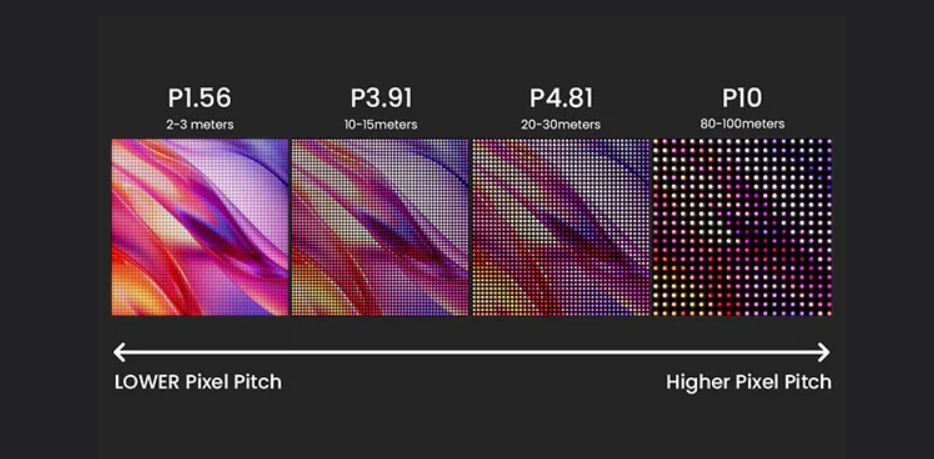
Pixel pitch is the distance in millimeters between the centers of adjacent LED clusters.The practical implication:multiply the pixel pitch by 1,000 and you get the approximate minimum comfortable viewing distance in meters.A P3 panel is optimized for viewing distances of 3 meters and beyond.
In a standard QSR counter configuration,the distance between a customer at the register and the menu board is 1.5–3 meters.That puts P2.5–P3 in the optimal range for sharp,readable content at typical counter distances.P4 is acceptable for larger formats where the board is mounted higher and the effective viewing distance increases.Going finer than P2.5 for a standard menu board is over-engineering—the resolution improvement is imperceptible at counter distance,and the cost premium is substantial.
Brightness for indoor menu boards sits at 800–1,500 nits under standard ambient lighting.The exception is south-facing windows or open-plan restaurants with significant natural light ingress,where 2,500 nits becomes the practical floor.A panel running at 800 nits in a sun-drenched space will appear washed out and unreadable—not because the content is wrong,but because the hardware was specified for the wrong environment.
Fine Dining Ambient Walls:How COB Technology at P1.5–P2 Changes the Guest Experience
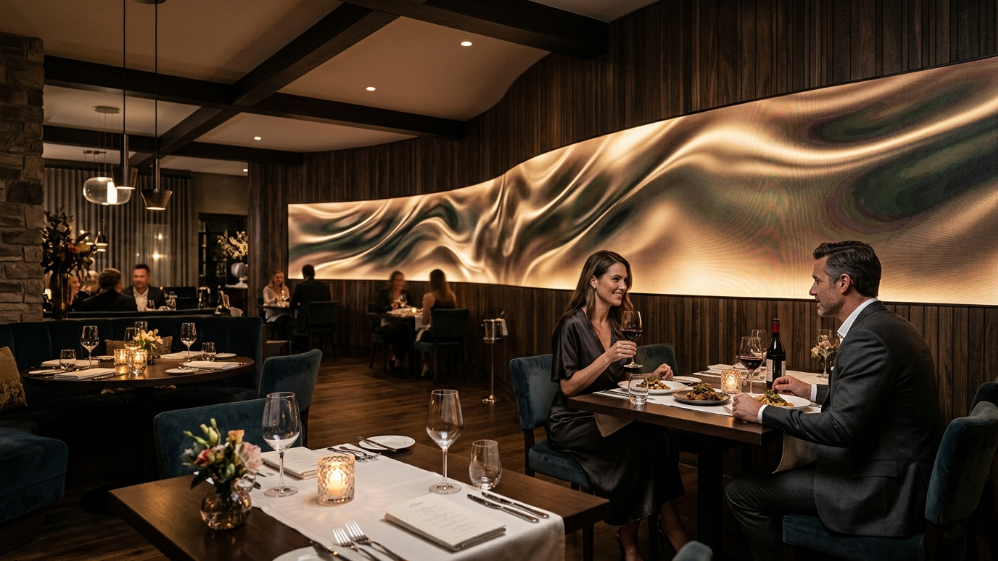
COB technology is a fundamentally different LED packaging architecture from the SMD(Surface-Mounted Device)technology that dominates most commercial display applications.In SMD,individual LED components are soldered onto a PCB substrate,leaving microscopic solder joints exposed at the surface.In COB,the LED chips are bonded directly to the substrate and encapsulated in a single protective layer.The result is a surface with no exposed solder points,higher physical durability,superior color uniformity across the panel,and—critically for restaurant environments—a surface that is easier to clean without risk of damaging individual components.
For fine dining ambient walls,COB at P1.5–P2 delivers three commercial benefits that SMD cannot match at equivalent pitch.First,color uniformity:COB panels maintain consistent color temperature across the entire display surface,which matters when the screen is functioning as a background element in a carefully lit dining room.Second,surface finish:the flat,seamless COB surface reads as architectural rather than technological—it integrates into the space rather than announcing itself.Third,longevity under low-brightness operation:COB panels driven at 20–30%of rated brightness(the typical operating point for ambient dining applications)experience significantly less thermal stress than SMD panels,translating to longer operational life in this specific use case.
The brightness ceiling for fine dining applications is as important as the floor.Running an ambient wall above 1,500 nits in a candlelit dining room is a design failure.Specify panels with granular dimming control—0.1%increments rather than the 1%increments common on lower-tier hardware—and verify that the control system supports scheduled brightness profiles that track the restaurant’s service periods.
Sports Bar Video Walls:P2–P3 SMD with≥3,840 Hz Refresh Rate for Broadcast-Ready Displays
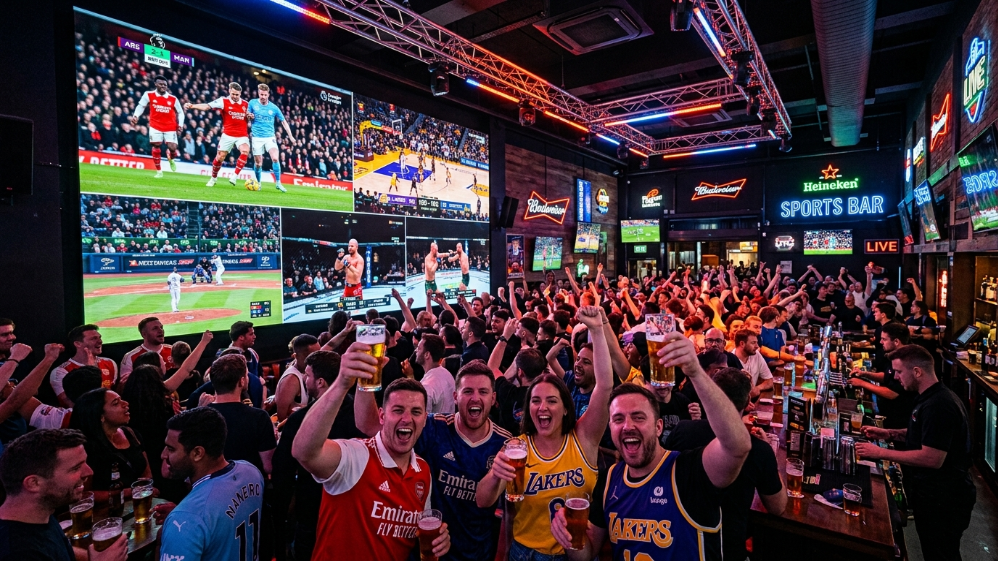
The sports bar category has a specification requirement that most buyers miss entirely until it becomes a problem:refresh rate.At 1,920 Hz—the standard for most commercial LED panels—a smartphone camera filming the screen at 60fps will capture visible horizontal scan lines in the footage.In a venue where every guest is a potential content creator,that is not a technical footnote.It is a brand liability that shows up in every Instagram story and TikTok posted from your client’s bar on game day.
Specify≥3,840 Hz as a non-negotiable floor for any sports bar deployment.The commercial benefit is straightforward:every piece of user-generated content filmed in the venue becomes free advertising rather than a visual complaint.
The second specification that separates a functional sports bar video wall from a great one is the video processor architecture.A 40-screen installation running simultaneous feeds from four different sports requires a processor that can handle independent signal routing,audio zone management,and real-time source switching without latency.Novastar’s MCTRL series and equivalent processors from Brompton Technology handle this at the hardware level.The control interface matters as much as the processing power—bar staff operating under service pressure will not navigate a multi-menu software interface.The system needs single-touch scene switching,pre-programmed for the venue’s most common configurations.
RGBW lighting integration is the final layer.Standard RGB lighting produces artificial-looking whites—acceptable for a nightclub,wrong for a dining environment where food appearance matters.The dedicated white channel in RGBW systems produces accurate,natural illumination that complements rather than competes with the LED wall.For sports bars,synchronized lighting cues during scoring moments—a brief intensity surge across the room—create the kind of visceral atmosphere that drives repeat visits and longer dwell times.
POS Integration and CMS Architecture—The Decision That Determines Your Entire System
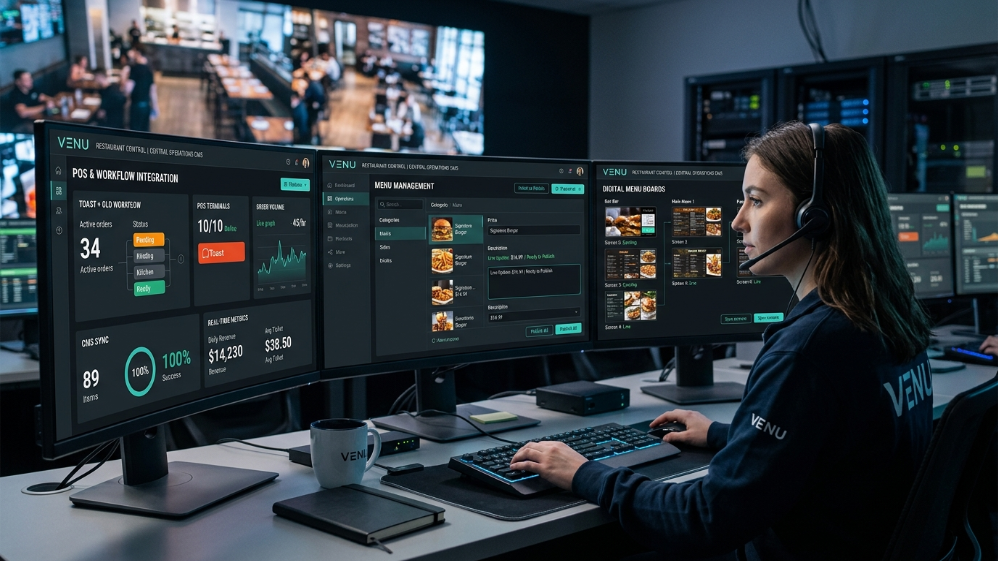
How Real-Time POS Integration Works:Toast,Square,and Olo
The content management system is the architectural decision in any restaurant LED deployment.Hardware is replaceable.A CMS that is incompatible with the restaurant’s POS creates a workflow problem that no amount of hardware quality can solve.
The integration chain works as follows:a price change or menu item update is entered in the POS(Toast,Square,Olo,or Revel)→the CMS receives the update via API→the change propagates to all connected screens.The target latency for this chain is under 60 seconds.Systems that cannot meet this threshold create the operational scenario where a customer is looking at a price on the menu board that no longer matches what the register is charging—a compliance and trust problem simultaneously.
Based on our experience with multi-location rollouts,the CMS selection should happen before hardware procurement,not after.The CMS determines which media players are compatible,which screen resolutions are supported,and whether the system can scale to 50 or 500 locations without a platform migration.Samsung MagicINFO,built into the Tizen SoC on Samsung commercial displays,handles this natively for Samsung hardware.For mixed-hardware environments,platform-agnostic CMS options like Scala or Signagelive provide the flexibility that single-vendor solutions cannot.
The FDA Compliance Risk Nobody Talks About
One specific risk that system integrators must flag to restaurant clients:FDA menu labeling regulations require that calorie counts be displayed whenever a menu item is shown.In a promotional content loop—where a limited-time offer takes over the full screen for 15 seconds—the calorie information for that item must remain visible throughout.A promotional template that pushes nutritional data off-screen during the animation sequence is an active compliance citation risk.The solution is a fixed display zone for nutritional information that sits outside the promotional content layer,persistent regardless of what the promotional content is doing.Build this into the content template architecture from day one.
Kitchen Display System Specifications—The Most Overlooked LED Screen in Any Restaurant
The KDS is the screen that nobody photographs for the case study but that has the most direct impact on operational efficiency.It lives in the harshest environment in the building:sustained temperatures of 60–80°C near cooking surfaces,relative humidity above 80%,and airborne oil particulates that will infiltrate any enclosure that is not properly sealed.
Minimum specification for a kitchen-adjacent KDS:IP54 ingress protection,operating temperature rated to 60°C,and conformal coating on the PCB to resist oil vapor penetration.COB technology has a practical advantage here—the absence of exposed solder joints means the surface can be wiped down with commercial kitchen cleaning agents without risk of component damage.SMD panels in kitchen environments require more careful cleaning protocols to avoid dislodging individual LED components.
Screen size follows kitchen layout logic.A 22–27 inch panel is the standard for single-station KDS applications.Open-plan kitchens with multiple preparation zones benefit from 32–43 inch panels mounted at 1.5–1.7 meters—standing eye level for kitchen staff—positioned to avoid direct steam exposure from cooking surfaces.
Total Cost of Ownership
Deployment Cost Table
| Deployment Type | Hardware Cost | Installation | Year-1 CMS+Content | Drive-Thru(per lane)5-Year TCO Estimate |
|---|---|---|---|---|
| Single QSR(3-panel menu board) | 2,400–4,500 | 500–1,200 | 580–2,100 | 6,500–12,000 |
| Drive-thru system(order+confirm) | 8,000–14,000 | 2,000–4,000 | 580–2,100 | 14,000–22,000 |
| Fine dining ambient wall(20 m²) | 18,000–40,000 | 3,000–8,000 | 1,200–3,000 | 30,000–65,000 |
| Sports bar video wall(40 screens) | 35,000–80,000 | 8,000–15,000 | 2,400–6,000 | 60,000–120,000 |
| 50-location QSR chain rollout | 120,000–225,000 | 25,000–60,000 | 29,000–105,000 | 220,000–450,000 |
The year-2 and beyond operating cost benchmark is 12–18%of year-1 hardware cost annually—covering CMS licensing,content production,and maintenance.For a 50-location chain,that is a recurring line item that belongs in the business case from the start,not a surprise in year two.
FAQ:What Restaurant LED Buyers Are Actually Searching For
Q1:What pixel pitch is best for a restaurant menu board?
For a standard QSR counter with 1.5–3 meter viewing distance,P2.5–P3 delivers optimal sharpness at a justifiable cost.P4 works well for larger-format boards mounted higher,where the effective viewing distance increases.Going finer than P2.5 for a standard menu board adds cost without a perceptible visual improvement at counter distance.
Q2:How much does it cost to install LED screens in a restaurant?
A 3-panel indoor menu board installation runs 4,800–8,500 fully installed,including hardware,media players,mounts,cabling,and a year of CMS licensing.A drive-thru system adds 14,000–22,000 per lane.A fine dining ambient video wall at 20 m²typically lands between 30,000–65,000 over five years including content production.The number that most operators miss is the ongoing CMS and content cost—budget 12–18%of hardware cost annually.
Q3:Do restaurant LED screens need special IP ratings for kitchen environments?
Yes.Any screen installed within 2 meters of a cooking surface needs a minimum IP54 rating,which protects against dust ingress and splashing water from any direction.Screens in direct steam exposure zones should be IP65.Standard commercial displays without IP ratings will fail in kitchen environments—not immediately,but predictably within 12–18 months as oil vapor and moisture penetrate the enclosure.
Q4:Can restaurant LED menu boards integrate with Toast or Square POS?
Yes,but the integration is CMS-dependent,not hardware-dependent.Samsung MagicINFO,Scala,and Signagelive all support API connections to Toast,Square,Olo,and Revel.The critical specification is update latency—the chain from POS price change to on-screen update should complete in under 60 seconds.Verify this with a live test before deployment,not after.
Q5:What is the difference between COB and SMD LED for restaurant use?
SMD(Surface-Mounted Device) is the dominant technology for large-format video walls and menu boards—lower cost per square meter,proven at scale,and available in a wide pitch range.COB(Chip-on-Board) encapsulates LED chips directly onto the substrate with no exposed solder joints,producing better color uniformity,a more durable surface,and easier cleaning.For fine dining ambient walls and kitchen KDS applications,COB’s advantages justify the 20–35%cost premium.For a QSR menu board or sports bar video wall,SMD is the rational choice.
Expert Verdict
The restaurant LED market in 2026 is not short of hardware options.It is short of buyers who know how to specify correctly before the purchase order is signed.
Start with the zone,not the product.Define the viewing distance,the ambient light conditions,the duty cycle,and the integration requirements for each screen location before you open a single supplier catalog.A P2 COB panel in a fine dining room and a P4 SMD panel on a drive-thru confirmation screen are both”restaurant LED screens”—they share almost nothing else in common.
The CMS is the decision that locks in your architecture for the next five years.Get that right first.The hardware follows.
Price Summary
Restaurant LED screen pricing in 2026 varies significantly by application and system complexity. Entry-level QSR menu board systems typically range from $4,800 to $8,500 per installation, while drive-thru configurations can reach $14,000 to $22,000 per lane. Fine dining ambient LED walls (around 20 m²) generally fall between $30,000 and $65,000 over a 5-year total cost cycle, depending on COB or SMD technology and CMS integration. Large sports bar video walls may exceed $60,000 to $120,000 when including control systems and high refresh-rate requirements. Overall, buyers should expect ongoing annual operating costs of 12–18% of initial hardware investment, making total lifecycle cost a more accurate planning metric than upfront price alone.
References:
Audiovisual and Integrated Experience Association
Penn State University – School of Hospitality Management