If you’re sourcing an outdoor advertising LED screen for a Bogota installation, the number that matters most isn’t pixel pitch—it’s brightness measured under real solar load, not factory-rated nits.
Here’s the quick-reference spec floor we give every client before they issue a PO:
| Bogota Deployment Factor | Standard Sea-Level Spec | Bogota-Adjusted Spec | Why It Changes |
|---|---|---|---|
| Peak brightness | 5,500 nits | 7,000–8,000 nits | 2,600m altitude + thinner air = weaker convective cooling |
| Pixel pitch (highway, 15m+ viewing) | P10 | P10, verified IP65 | UV exposure accelerates lens yellowing at this elevation |
| Pixel pitch (street-level, mixed traffic) | P6–P8 | P6–P8 with ambient light sensor | Bogotá’s overcast-to-bright swings within a single day |
| Structural certification | CE only | CE + ONAC-recognized load stamp | Municipal permitting rejects CE-only documentation |
Get any one of these four wrong, and you’re not looking at a suboptimal purchase—you’re looking at a screen that washes out during the 10:00–15:00 window when Carrera Séptima or the Autopista Norte carry peak foot and vehicle traffic, or a structure that gets flagged during a routine curaduría urbana inspection.
Based on our experience with over a dozen large-format outdoor LED installations across Bogotá and the broader Andean corridor, the buyers who get burned aren’t the ones who chose a cheap manufacturer.
They’re the ones who applied a Miami or Dubai spec sheet to a Bogotá site without adjusting for altitude, UV load, and a permitting system that treats digital signage structurally, not decoratively.
This isn’t a market where you can copy-paste a generic outdoor LED datasheet and expect it to survive first contact with a municipal inspector—or with a July thunderstorm that hits three hours after a cloudless morning.
We’ve seen 48m² installs pulled down within six weeks of going live, not because the LED modules failed, but because the mounting structure lacked ONAC-recognized certification.
The panel was fine. The paperwork wasn’t.
Why Bogota’s Altitude and Climate Change Everything About Your LED Screen Spec
Most outdoor LED procurement guides treat brightness as a single global number—5,000 nits here, 6,500 there—as if a screen bolted to a building in Barranquilla and one bolted to a building on Avenida El Dorado face the same environment.
They don’t.
How 2,600m Elevation and UV Intensity Push Your Nit Requirement Above Sea-Level Standards
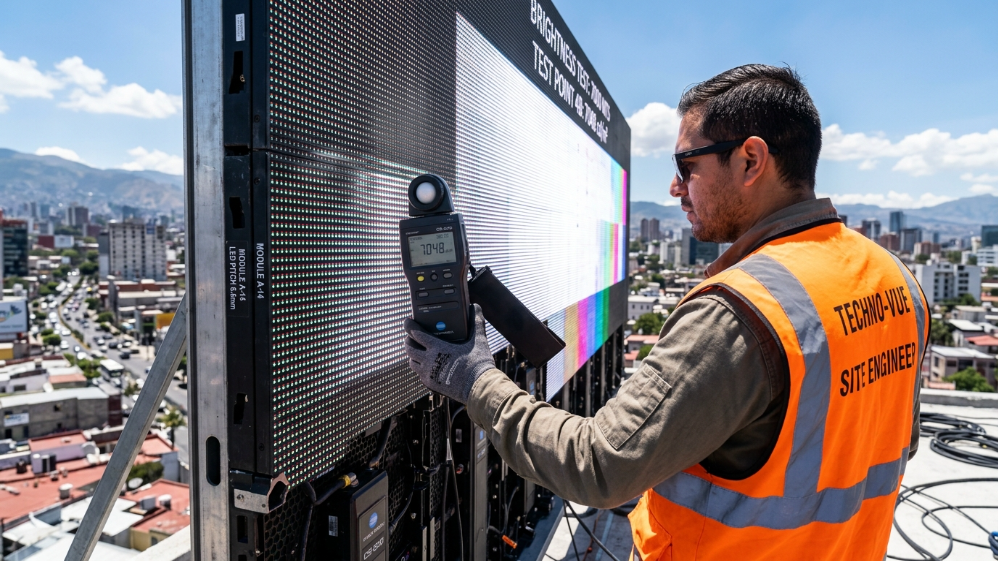
At Bogotá’s elevation, the atmosphere filters roughly 20–25% less UV radiation than sea level would, and the air itself is thinner—which sounds like it should make cooling easier, but does the opposite for LED modules.
Thinner air carries less heat away through convection, meaning the same driver IC and LED package that stays comfortably within thermal spec in Cartagena will run hotter in Bogotá under identical ambient temperature readings.
The feature here is a driver board rated for high-altitude thermal derating.
The benefit to you as a buyer is a screen that doesn’t silently lose 15–20% of its rated brightness after 18 months of accelerated LED degradation—which is the single biggest driver of “my screen looks dimmer than it did on installation day” complaints we field from Andean-region clients.
Why a 5,500-Nit Screen Turns Gray-White by Noon on Carrera 7
Specify anything below 6,500 nits for a street-facing installation on a high-traffic Bogotá corridor, and you will watch your content wash out precisely during the hours when foot traffic—and therefore advertising value—peaks.
According to field luminance data from comparable Andean-altitude deployments, ambient illuminance on a clear Bogotá midday can exceed 100,000 lux, a figure most manufacturer datasheets quietly assume you’ll never hit because they’re benchmarked for temperate-latitude cities.
The practical spec floor:
7,000–8,000 nits peak output with automatic ambient-light-sensor dimming
—not a static brightness setting.
The dimming sensor is the feature; the benefit is that your screen doesn’t blast 8,000 nits at 9pm and blind drivers, while still punching through Bogotá’s harsh midday glare.
Rainy Season Reality Check: IP65 Ratings You Can Trust vs. Marketing Claims
Bogotá runs on a bimodal rainfall pattern—heavy rains April–May and October–November—and IP65 on paper does not always mean IP65 in practice.
The rating only holds if the module’s waterproof rubber gasket, the cabinet’s double waterproof barrier, and the cable-entry sealing ring are all installed correctly on-site, not just present in the spec sheet.
We recommend requesting the manufacturer’s actual water-ingress test video, not just the certificate, before signing off—a five-minute ask that has saved more than one client from a screen that fails eight months into a rainy season.
Matching Pixel Pitch to Your Bogota Installation Scenario
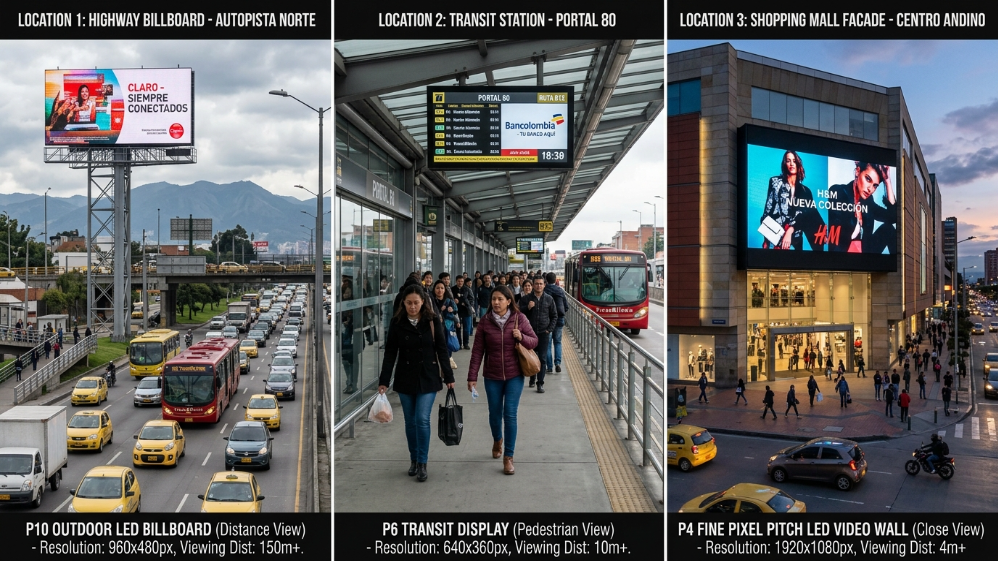
There is no single “correct” pixel pitch for Bogotá—there’s a correct pitch for each of the city’s three dominant deployment contexts, and conflating them is where most first-time buyers overspend or underspend.
| Installation Scenario | Recommended Pixel Pitch | Minimum Viewing Distance | Key Consideration |
|---|---|---|---|
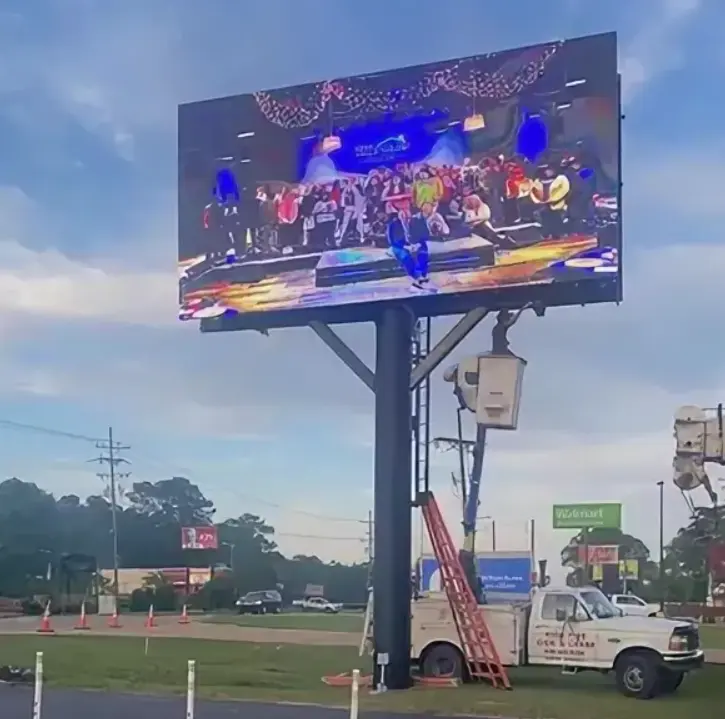
| Highway/toll corridor (e.g., Autopista Norte) | P8–P10 | 15m+ | Prioritize brightness and structural wind load over resolution |
| TransMilenio & transit stations | P4–P6 | 3–6m | Pedestrian proximity demands finer pitch; vandalism-resistant front maintenance |
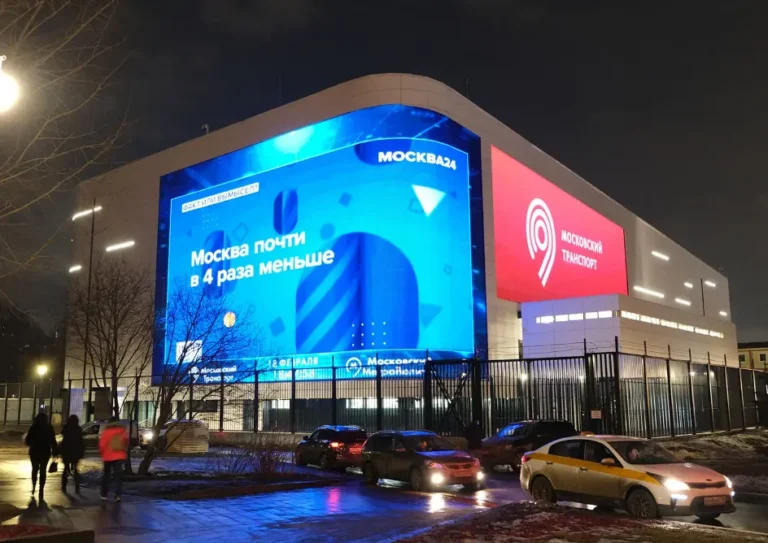
| Shopping mall & building facade | P6–P8 | 6–10m | Balance resolution with cost; often visible from both close and distant angles |
Highway & Toll Corridor Billboards—Lessons from the 210m² Andes Toll Project
The largest outdoor LED installation in Colombia to date sits at the Andes toll on Bogotá’s North Highway—four independent 42m² screens plus a connecting banner, running at 6mm pixel pitch and roughly 5,500 nits, reaching an estimated 3.5 million people monthly along a corridor carrying 38,000 vehicles and 5,000 motorcycles daily.
It’s a useful benchmark, but also an instructive one:
That 6mm pitch and 5,500-nit spec reflects 2020-era deployment assumptions.
A comparable highway project speced today, following the altitude-adjusted brightness logic above, would push closer to 7,000 nits to maintain the same effective visibility a driver experiences at 38,000-vehicle-per-day traffic speeds.
TransMilenio & Transit Screens—Balancing Pedestrian Clarity with Budget
Transit-adjacent screens face viewers from 3–6 meters, not 15, which is precisely why a P10 highway spec fails at a bus station—the pixel structure becomes visibly grainy at that range.
Colombian DOOH operators running transit networks have converged on P4–P6 for exactly this reason, prioritizing image clarity for a captive, close-range audience over the raw brightness that highway applications demand.
Shopping Mall Facades vs. Building-Mounted Spectaculars—Which Pitch Wins?
Facade installations occupy the middle ground:
Viewers approach from a parking lot at 30–40 meters but also pass directly beneath at 5 meters.
P6–P8 with a modular cabinet design tends to be the commercially sensible compromise here, since over-specifying to P4 buys resolution most viewers physically cannot perceive from typical mall approach distances—a cost premium with no corresponding brand-impact return.
The Hidden Compliance Trap: ONAC, ICONTEC, and Municipal Permits Explained
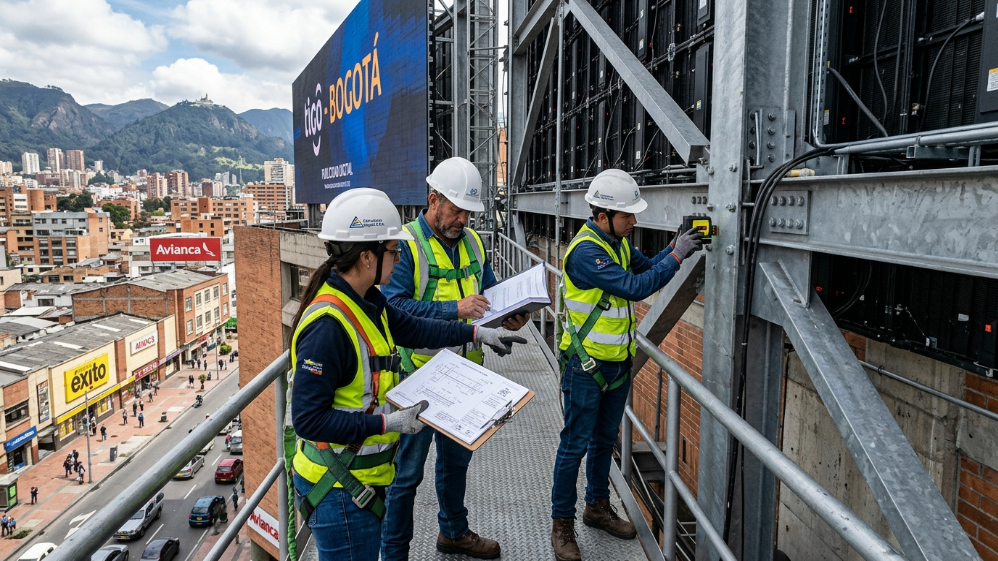
None of the brightness or pixel-pitch decisions above matter if your screen gets flagged during a routine structural inspection—and this is the section most manufacturer-side content simply skips, because it isn’t a technical spec, it’s a paperwork trail most Chinese suppliers have never had to navigate.
What ICONTEC Actually Regulates (and What It Doesn’t)
ICONTEC’s role is widely misunderstood, and the confusion costs buyers real money.
ICONTEC doesn’t test or certify individual LED screens—it publishes the technical standards framework that testing labs must follow.
ONAC, the national accreditation body, is the one that accredits the labs actually qualified to sign off on your installation.
The practical takeaway for a B2B buyer:
Your screen’s international CE mark clears customs, but it does nothing to satisfy a Bogotá curaduría urbana reviewing your mounting structure.
Those are two entirely separate approval tracks, and treating them as one is the single most common compliance mistake we see.
Why CE Certification Alone Isn’t Enough for Bogota Installation Approval
CE tells an inspector the electronics are safe.
It says nothing about whether your steel frame can withstand Bogotá’s wind-load requirements or whether the anchoring meets local seismic-zone building code.
For that, you need a local, ONAC-recognized structural engineer to stamp the installation drawings—a step that typically adds 1–2 weeks and a few thousand dollars to your project, but is non-negotiable for any structure exceeding a few square meters in a public right-of-way.
Case Study: How a 48m² Screen Got Torn Down Six Weeks After Installation
A Medellín-based integrator we spoke with installed a 48m² P8 billboard on a major commercial avenue, sourced from a reputable manufacturer with full CE documentation.
Six weeks later, local authorities pulled it down—not because of a wiring fault or a dead pixel, but because the mounting structure lacked an ONAC-recognized load certification.
The LED modules themselves were never the problem.
The lesson generalizes cleanly to Bogotá:
Budget for local certification before you budget for the screen itself, not after.
From Factory to Carrera Séptima: The Realistic Supply Chain Timeline
| Supply Chain Stage | Typical Duration | Buyer Action Required |
|---|---|---|
| Manufacturing (post-deposit) | 15–25 days | Confirm module aging test reports (48hr + 72hr) before shipment |
| Ocean freight, Shenzhen → Buenaventura | 28–35 days | Build this into any hard event-date deadline with buffer |
| DIAN customs clearance | 7–14 days | Prepare CE docs, commercial invoice, and packing list in advance |
| Local structural certification | 7–14 days (parallel-track) | Engage ONAC-recognized engineer before container arrives |
| Total door-to-site | 45–55 days | Air freight ($8–12/kg) only for time-critical rental units |
Ocean Freight vs. Air Freight—Cost and Time Tradeoffs
For a permanent installation with a flexible timeline, ocean freight is the economically obvious choice.
For event-driven deployments—a product launch, a sponsored activation with a fixed date—air freight at $8–12/kg is expensive but predictable.
And predictability is what you’re actually paying for when a client’s launch date isn’t moving regardless of your logistics.
DIAN Customs Clearance: What Documents Prevent Delays
The single biggest clearance delay we see traces back to incomplete or mismatched commercial documentation—invoice values that don’t align with the packing list, or missing CE certificates in the shipment paperwork.
Have your supplier confirm document sets before the container leaves port, not after it’s sitting in a Buenaventura bonded warehouse accruing demurrage fees.
Choosing a Local Installation Partner: Questions to Ask Before You Sign
Ask any prospective local partner directly:
Have they handled ONAC structural sign-off before, and can they produce a reference project?
Do they carry their own liability insurance for public-right-of-way installations?
A partner who hesitates on either question is a partner who will hand you the Medellín case study as your own.
How System Integrators, Event Planners, and DOOH Operators Should Each Approach This Differently

A system integrator, an event activation agency, and a programmatic DOOH operator are buying the same physical product for entirely different commercial reasons, and a one-size-fits-all checklist underserves all three.
For System Integrators: Structural Load and Warranty Due Diligence Checklist
Your liability exposure runs longest—you’re the name on the installation contract.
Prioritize the manufacturer’s warranty terms on driver ICs and power supplies specifically, since these fail before the LED chips themselves in high-altitude, thermally stressed environments.
The key areas to verify include:
| Evaluation Area | Buyer Focus |
|---|---|
| Manufacturer warranty | Confirm coverage period and replacement conditions |
| Driver IC reliability | Check long-term stability under high-altitude thermal stress |
| Power supply quality | Verify industrial-grade components and failure rate data |
| Structural documentation | Confirm compatibility with local certification requirements |
For Event & Activation Companies: Rental vs. Permanent Screen Decision Framework
If the engagement runs under 90 days, rental-spec screens with quick-release cabinet designs will out-economize a purchase every time.
Beyond that threshold, the math flips, and a purchased asset amortized across multiple campaigns becomes the better commercial argument.
| Project Duration | Recommended Option | Reason |
|---|---|---|
| Under 90 days | Rental screen | Lower upfront investment and faster deployment |
| More than 90 days | Purchase LED screen | Asset value spreads across multiple campaigns |
| Recurring events | Own equipment | Better long-term ROI and availability control |
For DOOH Advertisers: Programmatic-Ready Screens and SSP/DSP Integration Requirements
If your business model depends on programmatic revenue, confirm SSP/DSP compatibility—Broadsign, Vistar, or Hivestack integration—before you commit to hardware, not after.
A beautifully bright screen that can’t plug into your existing ad server is a stranded asset, not inventory.
Frequently Asked Questions
What brightness (nits) do I need for an outdoor LED screen in Bogota?
Specify a minimum of 7,000–8,000 nits peak output for street-level and highway installations, given Bogotá’s altitude-reduced UV filtering and the resulting midday glare on major corridors.
Is CE certification sufficient to install an LED billboard in Bogota?
No.
CE clears customs and confirms electrical safety, but municipal permitting requires a separate ONAC-recognized structural engineer’s stamp on the mounting design.
How long does it take to import and install a large LED screen in Bogota?
Budget 45–55 days door-to-site via ocean freight, factoring manufacturing time, transit to Buenaventura, and DIAN clearance—longer if structural certification isn’t run in parallel.
What pixel pitch is best for a Bogota highway billboard?
P8–P10 is standard for viewing distances beyond 15 meters, prioritizing brightness and structural wind-load integrity over the finer resolution needed at street level.
Does an outdoor LED screen need special waterproofing for Bogota’s rainy season?
Yes.
Confirm a genuine IP65 rating with correctly installed gasket sealing and double waterproof barriers, not just a certificate, given the city’s bimodal April–May and October–November rainfall pattern.
Expert Verdict
A Bogotá outdoor LED project succeeds or fails on three decisions made before the container ever leaves the factory:
- Brightness specification adjusted for altitude, not copied from a sea-level datasheet.
- Structural certification budgeted as a line item, not treated as an afterthought.
- A local partner who can prove—not promise—ONAC compliance experience.
Get those three right, and the pixel pitch, the freight timeline, and the SSP integration all fall into place behind them.
Outdoor LED Screen Price Summary for Bogota Projects
The final investment for a Bogotá outdoor advertising LED screen depends on several factors, including screen size, pixel pitch, brightness level, structural requirements, certification costs, installation complexity, and international shipping method.
For high-altitude outdoor deployments, buyers should expect additional costs compared with standard sea-level projects because 7,000–8,000 nits brightness requirements, high-altitude thermal considerations, and local structural certification can increase the total project budget.
A complete B2B quotation should include not only the LED modules but also cabinets, control systems, steel structures, engineering certification, freight, customs clearance, installation, and after-sales support.
Choosing the lowest upfront screen price may lead to higher long-term expenses if brightness performance, structural compliance, or waterproof reliability are insufficient.
For a professional Bogotá outdoor LED billboard project, the most cost-effective approach is to balance initial investment with long-term visibility, regulatory approval, and operational reliability.
References:
Visual Outdoor Advertising Regulations and Registration Requirements in Bogotá
Registration Process for Visual Outdoor Advertising Elements in Bogotá