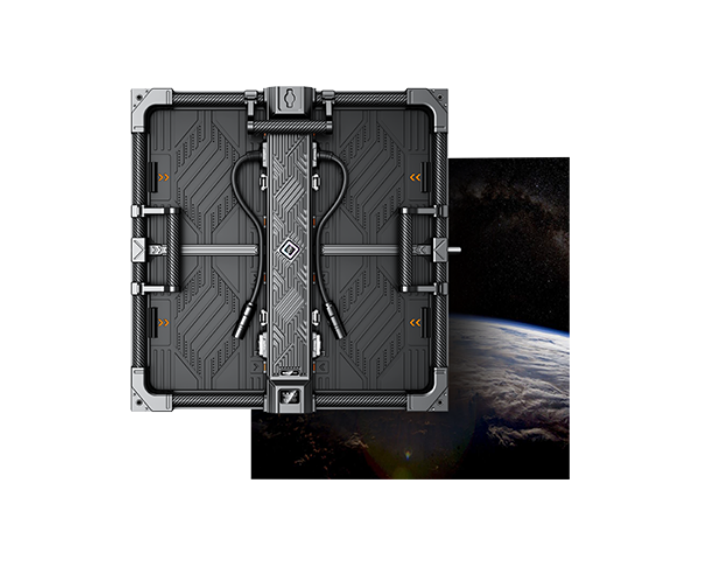
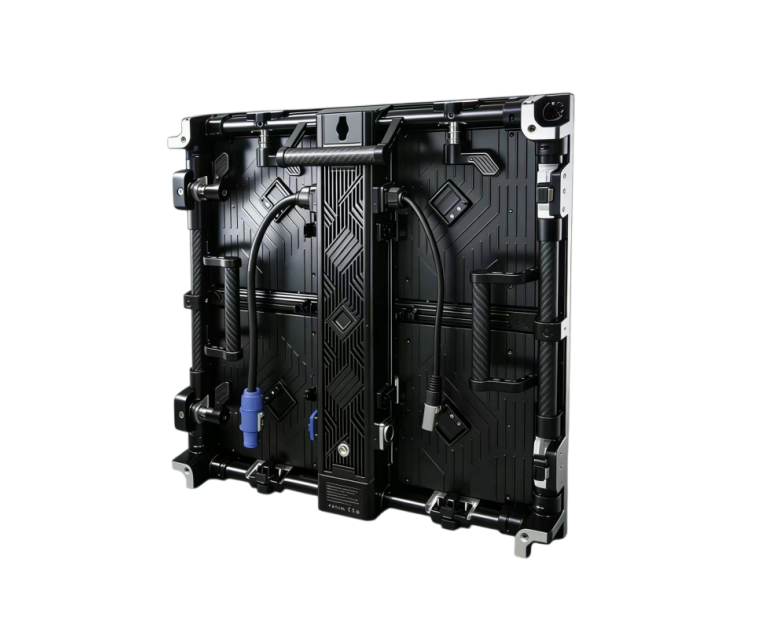
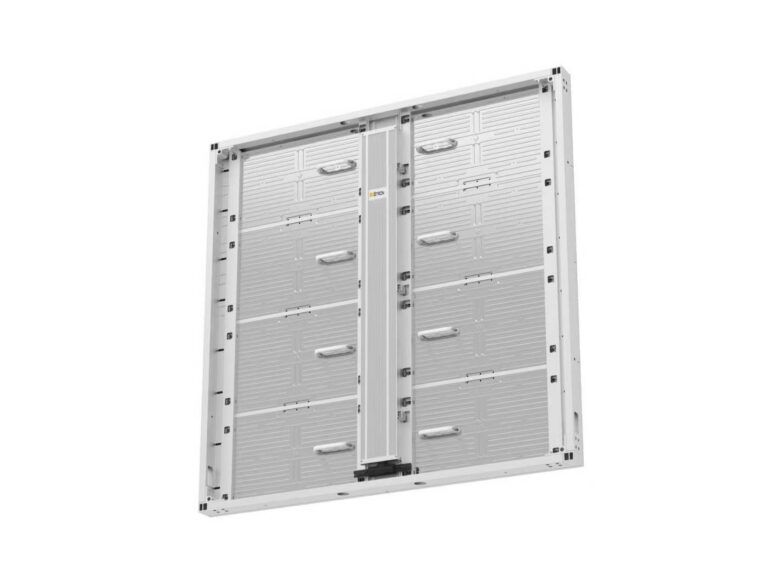
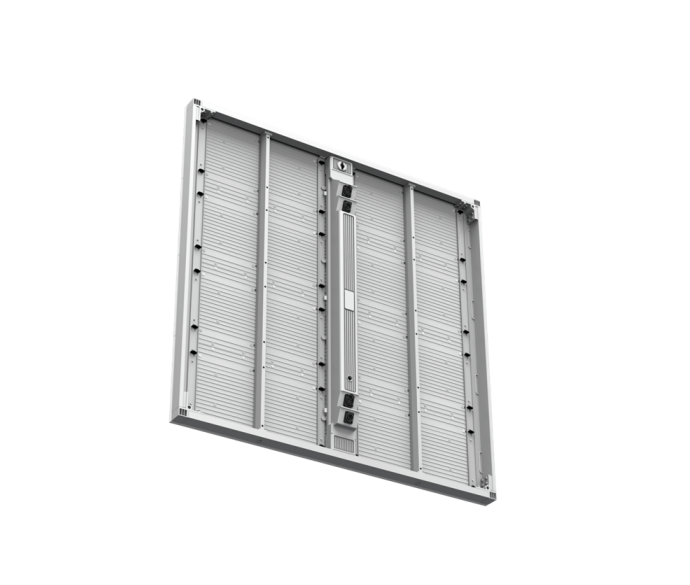
If you are specifying a museum LED display or scoping an immersive LED room for a cultural institution,exhibition center,or experiential brand space,this table is where the decision starts.The four most common project types,their minimum viable specs,and the commercial consequence of getting each one wrong:
Project Specification Overview
| Project Type | Recommended Pixel Pitch | Minimum Refresh Rate | Color Standard | Critical Failure Point |
|---|---|---|---|---|
| Fine art museum video wall | P1.2–P1.5 | 3,840 Hz | ≥97%DCI-P3 | Color banding on oil/watercolor reproductions |
| Immersive LED room(360°) | P1.5–P2.5 | 3,840 Hz | ≥95%DCI-P3 | Visible cabinet seam at corner transitions |
| Exhibition video wall(trade shows) | P1.8–P2.5 | 1,920 Hz min | NTSC 100% | Moirépatterns under professional photography |
| DOOH creative LED screen(shaped/cylindrical) | P2.5–P3.9 | 1,920 Hz | NTSC 100% | Content distortion from uncalibrated curved mapping |
Wrong pixel pitch selection alone can add 15–25%to a project’s total cost when retrofit corrections are needed post-installation.
Get the spec right before the RFQ leaves your desk.
Why Cultural Institutions and Experience Designers Are Moving Beyond Flat Screens
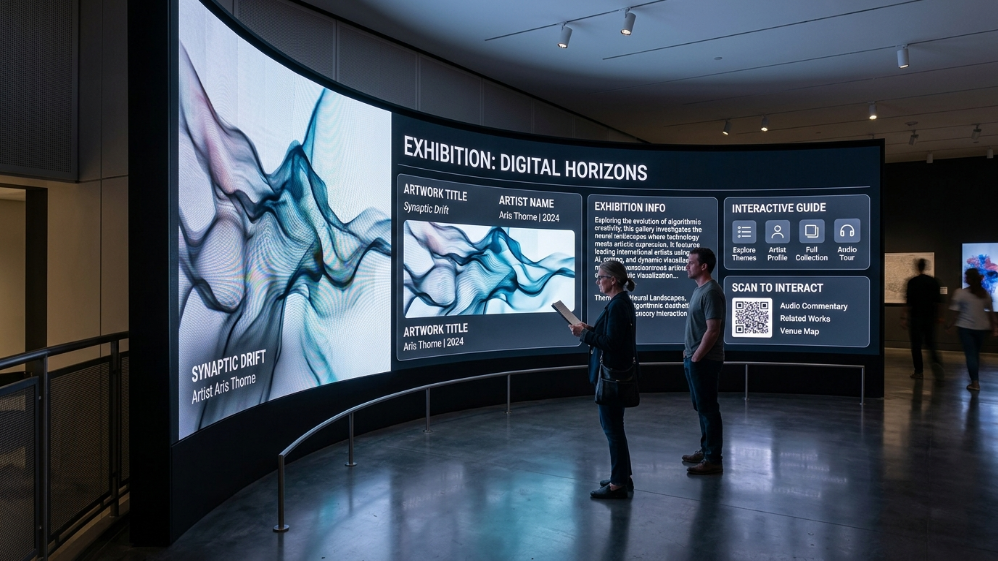
Walk into any of the world’s top 10 most-visited museums today and you will find LED surfaces where glass cases used to stand.This is not aesthetic preference—it is a response to a measurable behavioral shift.Visitors,particularly those under 35,no longer distinguish between a physical artifact and a digital experience in terms of emotional weight.What they do distinguish is engagement quality.A pixelated,color-inaccurate exhibition video wall does more reputational damage to a cultural institution than no screen at all.
Based on our experience deploying LED display solutions across cultural,retail,and experiential environments in over 70 countries,the single most common procurement mistake is not budget—it is treating museum LED displays as commodity AV hardware.They are not.The color science,seamless splicing tolerances,and long-term serviceability requirements for a permanent cultural installation are categorically different from a corporate boardroom or a retail flagship.
The global immersive experience market is accelerating.System integrators,event production companies,and DOOH operators are fielding briefs for 360°LED environments,curved gallery walls,and cylindrical creative LED screens that would have required custom fabrication at prohibitive cost five years ago.Flexible LED module technology,GOB(Glue-on-Board)encapsulation,and fine-pitch COB packaging have fundamentally changed what is achievable within a commercial project budget in 2026.The specification knowledge to take advantage of that shift,however,remains poorly documented—which is exactly the gap this guide closes.
Understanding the Core Technology Behind Museum LED Displays
Pixel Pitch Selection for Cultural Spaces—A Viewing Distance Decision Matrix
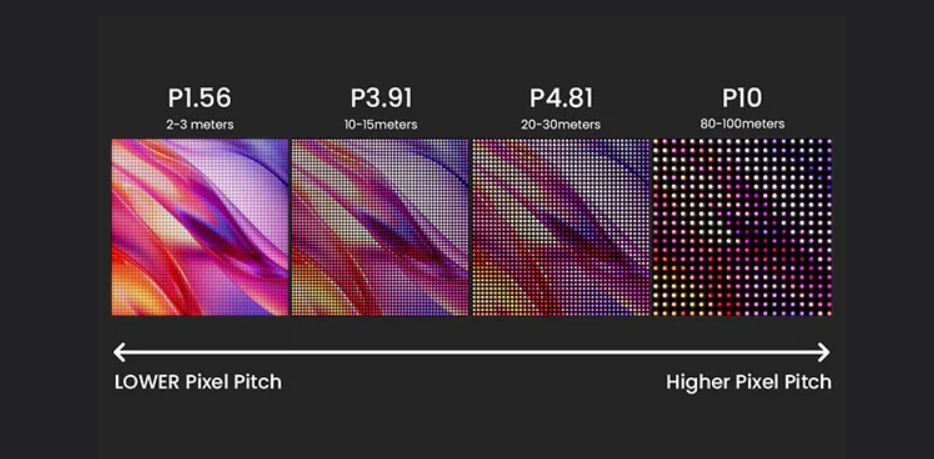
The”P”value in any LED display specification is a physical measurement:the center-to-center distance between adjacent pixels in millimeters.It governs resolution density,minimum viewing distance,and,directly,price.The widely cited rule of thumb—1 mm of pitch per 1 meter of viewing distance—is a floor,not a target.For content-rich museum environments where a visitor may stop 1.5 meters from a large-format surface to read interpretive text or examine fine art detail,that ratio needs to be tightened.
A more conservative and commercially defensible planning ratio for cultural spaces is P(mm)×1.2 to 1.5=minimum viewing distance(meters).This accounts for close-inspection behavior that museums actively encourage.
| Pixel Pitch | Min.Viewing Distance | Pixels per m² | Ideal Museum Application | Relative Cost Index |
|---|---|---|---|---|
| P1.2 | 1.4–1.8 m | 694,444 | Fine art reproduction walls,curatorial close-reading displays | 1.0(baseline) |
| P1.5 | 1.8–2.2 m | 444,444 | Immersive room primary surfaces,high-definition narrative walls | 0.75 |
| P1.875 | 2.2–2.8 m | 284,444 | Exhibition hall main video walls,visitor information centers | 0.60 |
| P2.5 | 3.0–3.75 m | 160,000 | Large-format exhibition video walls,perimeter displays in tall gallery spaces | 0.45 |
| P3.9 | 4.7–5.8 m | 65,746 | Architectural façades,DOOH creative LED screens,high-ceiling atrium installs | 0.30 |
One specification decision that most articles never address:pixel pitch selection is also a photography specification.Museums host press launches,content shoots,and social media documentation constantly.Any display with a refresh rate below 3,840 Hz will produce visible rolling bands in professional camera footage.That is not a post-production problem—it is a permanent limitation baked into the hardware purchase.
Why DCI-P3 Color Gamut Is Non-Negotiable for Art and Cultural Installations
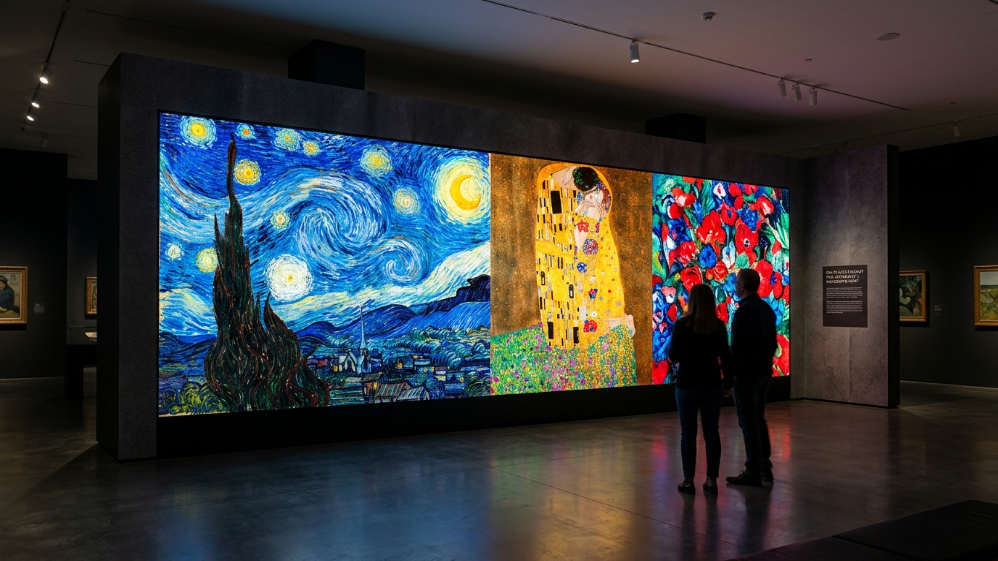
This is where most exhibition LED display purchases fail silently.A system integrator delivers a technically compliant installation.The pixel pitch is correct,the brightness adequate,the cabinets flush.Then the museum director views a Vermeer oil reproduction on the new wall and notices the gold tones look slightly orange and the lapis lazuli shadows read flat.The display is performing exactly to its sRGB specification.The problem is that sRGB was never designed for art reproduction.
DCI-P3 ,originally developed for digital cinema distribution,covers approximately 45% of the CIE 1931 color space—a 25%wider gamut than sRGB.In practical terms for museum LED displays,this translates to richer saturation in the red-orange spectrum(critical for warm-toned oil paintings),deeper and more differentiated greens(botanical and landscape content),and—most significantly—accurate reproduction of blue-violet pigments that are genuinely impossible to render within the sRGB boundary.
The specification to demand in any museum LED display RFQ is≥97%DCI-P3 coverage,verified by factory color calibration certificates,not marketing datasheets.Leading exhibition-grade panels now achieve this threshold alongside contrast ratios of 20,000:1 and peak brightness of 1,200 nits for HDR10 content delivery.
Creative LED Screen Formats—Matching Display Geometry to Architectural Reality
Flexible vs Rigid LED Modules—Which Fabrication Approach Suits Your Project?
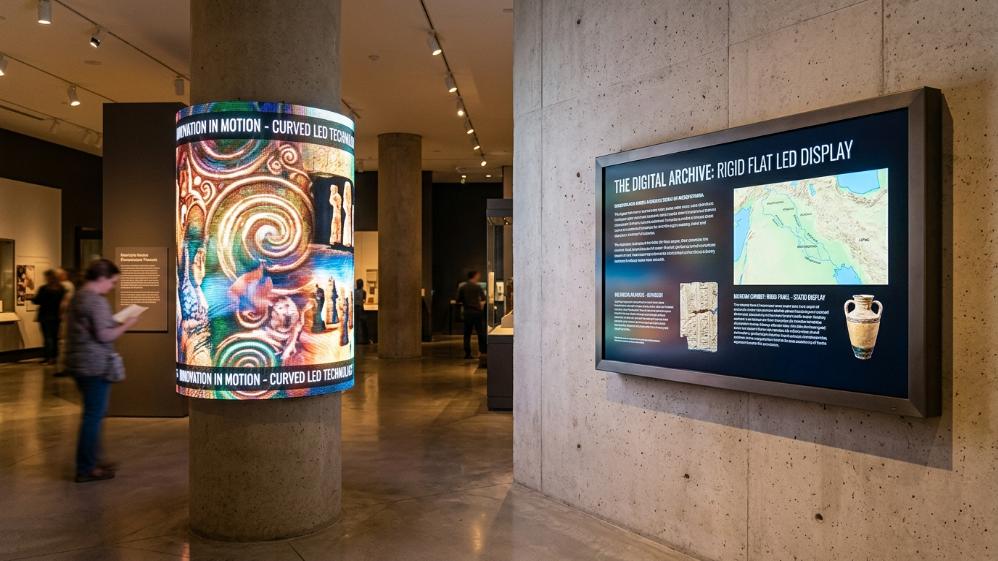
Flat cabinet systems remain the right answer for most exhibition video wall installations.They offer lower cost per square meter,simpler content mapping,and—when specified correctly—sub-0.1mm cabinet-to-cabinet gap tolerances that deliver the seamless splicing visual continuity that immersive spaces require.
Flexible LED modules—built on FPC(flexible printed circuit)substrates with silicone or rubber backing—become the correct answer the moment your installation geometry departs from planar.Cylindrical columns,wave-form architectural features,concave dome surfaces,and—critically—the corner transitions that define a true immersive LED room all require materials that can accept curvature without mechanical stress on the LED substrate.
The engineering constraint most project managers discover too late:rigid cabinet systems have a practical convex bending limit of approximately 5–15°per cabinet,depending on manufacturer.Attempting tighter radii with rigid panels introduces stress fractures at the PCB level,creates visible gaps at corner edges,and produces the seam-break effect that destroys immersive spatial coherence.A flexible module rated for a minimum bend radius of 500mm,by contrast,can achieve smooth corner wraps,cylindrical screen construction,and continuous wall-ceiling-floor transitions without geometric compromise.
The Solution—Recommended Sostron Products for Museum&Exhibition Environments
Based on our analysis of Sostron’s current product lineup,two series address this specification landscape directly:
Sostron Reta 2 Series(Fine-Pitch Indoor LED)
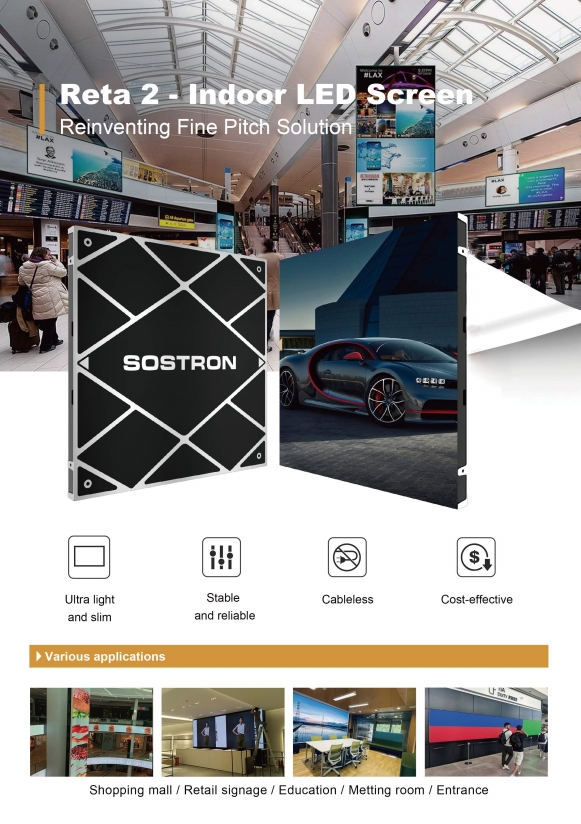
Available in P1.25 to P2.5,with a 30mm ultra-slim cabinet depth,cable-free modular connection,and a 3,840Hz refresh rate that eliminates camera flicker for press and content documentation.At 220W/m²average power consumption,it is also the most energy-efficient option for permanent museum installations with 24/7 operational requirements.The precision die-cast cabinet engineering ensures seamless splicing with sub-millimeter flatness tolerance—the parameter that determines whether a 50m²gallery wall reads as a single canvas or a grid of panels.Brightness range of 800–1,000 nits is calibrated for indoor ambient light conditions,avoiding the eye fatigue that over-bright museum displays consistently produce.
Sostron sPad Pro 2(Flexible Arc Rental/Permanent)
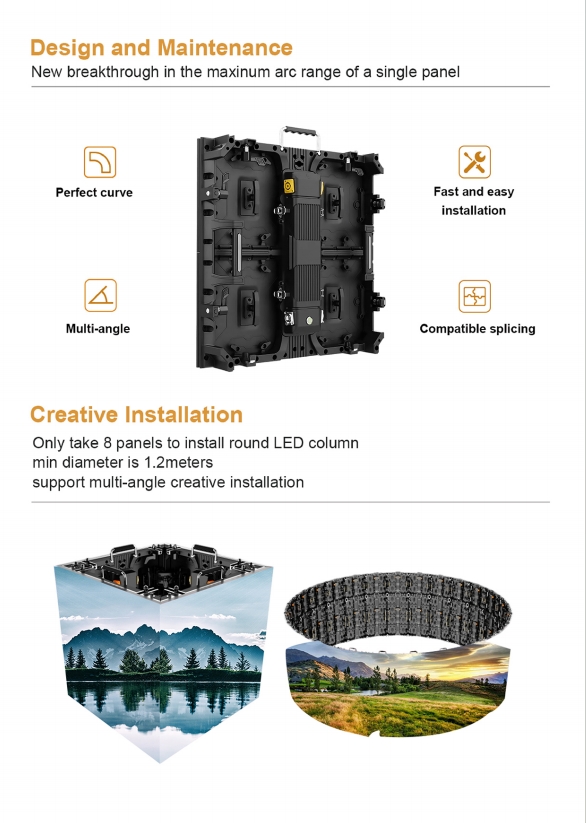
The flexible arc series addresses the creative LED screen and immersive LED room geometry requirements that the Reta 2’s rigid cabinet cannot satisfy.Built for both rental deployment and permanent installation,this series handles concave and convex surface configurations and cylindrical column wrapping.For integrators building 360°immersive rooms with floor-to-wall-to-ceiling content continuity,the sPad Pro 2’s flexible module architecture is the fabrication solution for the corner transition problem—the seam point where most immersive room builds visually fail.
Global Case Reference:Malaysia Exhibition Hall—P2.5 Indoor LED Display
One real-world deployment that maps closely to the museum and cultural venue specification brief is Sostron’s completed project at an exhibition hall in Malaysia.The installation used an indoor P2.5 LED display to deliver high-definition multimedia content including exhibition information,interactive presentations,and artwork—with the primary goal of transforming a static display environment into a visually dynamic,updatable digital venue.The P2.5 pixel density was selected to balance close-viewer image quality with total installation budget,while the modular system architecture enabled the venue to update and rotate content independently—without any additional hardware investment.Post-installation,the exhibition hall reported measurable improvements in visitor engagement,audience dwell time at featured exhibits,and overall venue modernity perception from both attendees and institutional partners.
Designing the Immersive LED Room—Technical Considerations for 360°Environments
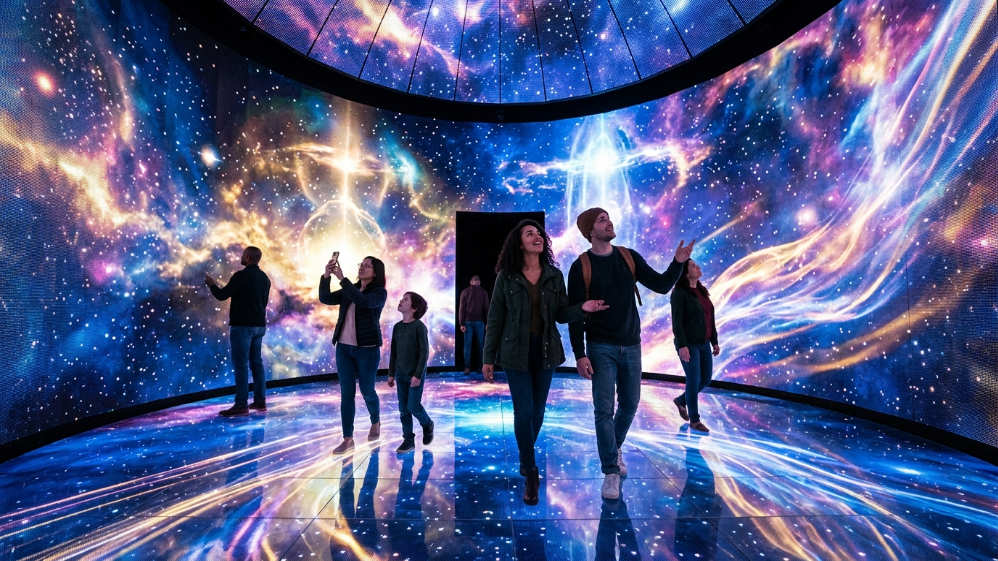
Floor,Wall,and Ceiling Integration—Solving the Transition Seam Problem
The hardest engineering challenge in any immersive LED room build is not the display surface itself.It is the junction.Floor-to-wall,wall-to-ceiling,and concave corner transitions are where spatial coherence either holds or collapses—and where the majority of immersive installations quietly fail.
The physics are unforgiving.Rigid cabinet systems meet at corners with a gap that,even at 0.5mm,reads as a visible break line when the ambient light drops and content spans the transition.At a 2-meter viewing distance,the human eye resolves gap widths below 0.3mm with surprising accuracy.This is why corner-wrap flexible modules,purpose-engineered for 90°and obtuse angle transitions,are not a premium option for immersive builds—they are a structural requirement.
Three engineering decisions determine whether a 360°LED environment achieves genuine immersion or simply delivers a large-format video wall with curved edges:
1.Corner cabinet specification.Dedicated corner modules with pre-angled aluminum extrusion frames allow wall-to-wall transitions at pixel-level continuity.The content bleed zone—typically 20–40mm of active pixel area extending past the geometric corner—must be accounted for in the content mapping stage,not corrected afterward.
2.Video processor architecture.Multi-surface synchronization requires a sending card capable of driving non-planar geometries without latency drift between outputs.For immersive rooms exceeding 100m²of total active surface,a distributed Novastar or Brompton processing architecture with frame synchronization locked to≤1ms variance is the commercial standard.Any deviation above that threshold produces a visible”shutter”artifact at the seam between processor outputs—invisible in specification documents,immediately apparent to a visitor.
3.Content resolution planning.A 360°immersive LED room is not a display—it is a coordinate system.Content must be authored to a unified pixel map that accounts for the physical geometry of every surface,including the angular distortion introduced by cylindrical and concave transitions.Integrators who treat this as a post-production problem rather than a pre-production specification invariably deliver a second site visit at their own cost.
Exhibition Video Wall Procurement—The RFQ Specification Framework
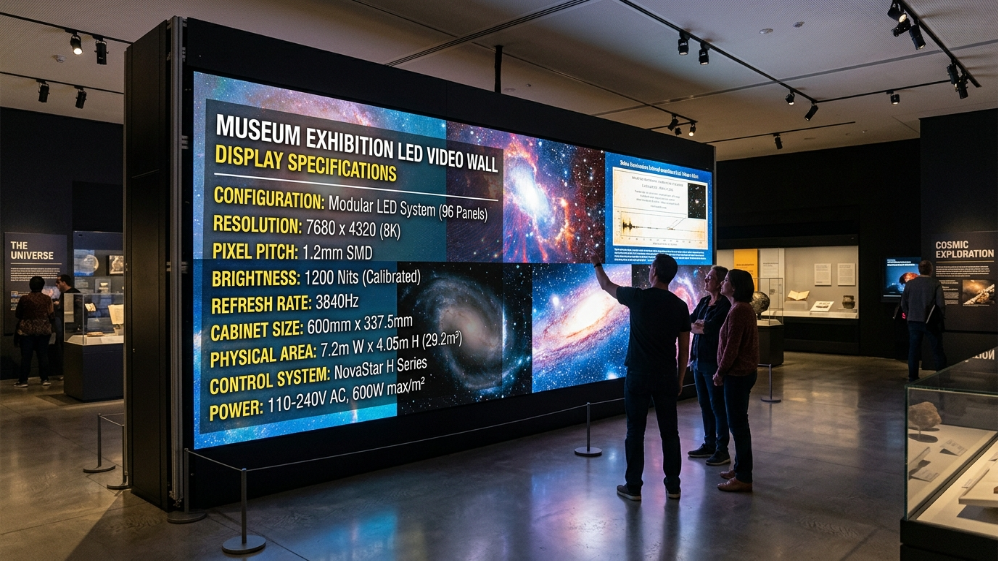
The 7-Point Technical Checklist for Your Exhibition Video Wall RFQ
Before any vendor proposal reaches your desk,these seven parameters should appear as mandatory specifications,not optional features.Any supplier unable to provide factory-certified data against each one is not a serious candidate for a permanent cultural or exhibition installation.
| Specification Parameter | Minimum Standard(Museum/Exhibition Grade) | Why It Matters Commercially |
|---|---|---|
| Pixel Pitch | P1.5 or below for close-view(≤3m);P2.5 for large-format | Determines perceived image quality at actual visitor viewing distances |
| Color Gamut | ≥97%DCI-P3,factory calibration certificate required | Art reproduction accuracy;color consistency across multi-panel arrays |
| Refresh Rate | ≥3,840Hz | Eliminates flicker in press photography and video documentation |
| Contrast Ratio | ≥5,000:1(target 10,000:1+) | Shadow detail in dark gallery environments;HDR content delivery |
| Cabinet-to-Cabinet Gap | ≤0.1mm(flatness tolerance±0.2mm) | Seamless splicing visual continuity across large video walls |
| Grayscale Depth | 16-bit processing | Prevents color banding in low-brightness,gradient-rich art content |
| IP Rating(Permanent Install) | IP30 minimum indoor;IP54 for floor surfaces | Protection against cleaning agents,accidental contact,floor moisture |
One parameter consistently absent from low-quality RFQ responses:grayscale depth.A 16-bit grayscale display processes 65,536 discrete luminance levels per channel versus 256 for standard 8-bit panels.In a museum environment where the content frequently includes dark oil paintings,low-key photography,or atmospheric immersive video,the difference between 8-bit and 16-bit grayscale is the difference between banding artifacts and faithful tonal reproduction.Specify it explicitly.
How to Choose the Right Museum LED Display Partner—5 Critical Questions
The hardware specification is only half the procurement decision.The other half is the supplier’s ability to support a permanent installation across a 5–10 year operational lifecycle.These are the five questions that separate vendors from genuine technology partners:
Q1:Can you provide factory color calibration certificates tied to specific cabinet serial numbers?
Q2:What is your spare module replacement commitment and stock policy for permanent installations?
Q3:Does your content management system support multi-surface synchronization and remote fault monitoring?
Q4:What certifications apply to your products for permanent indoor installation?
Q5:Can you provide references from comparable cultural or exhibition installations?
Frequently Asked Questions—Museum LED Display and Immersive Exhibition Installations
What pixel pitch is best for a museum LED display?
For permanent museum installations where visitors approach within 2–3 meters,P1.5 is the practical optimum—it delivers 444,444 pixels per square meter,sufficient for fine art reproduction and interpretive text legibility,at a cost point roughly 25%below P1.2 without a perceptible quality compromise at normal gallery viewing distances.
How much does an immersive LED room cost?
A full 360°immersive LED room with floor,wall,and ceiling integration at P2.5 typically ranges from$1,800 to$3,500 per square meter of active surface,inclusive of structure,processing,and calibration.Custom flexible modules and corner-wrap engineering add 20–35%above flat-panel baseline costs.Content production—consistently underbudgeted—should represent 10–20%of total project spend.
Can LED displays handle the cleaning protocols used in museums?
Standard SMD indoor LED modules are not designed for direct liquid exposure.For floor surfaces and lower-wall installations subject to regular cleaning,specify GOB-encapsulated modules with a nano-layer protective coating.This addresses both moisture ingress and the physical abrasion from cleaning tools that destroys exposed LED chips over time.
What is the difference between a flexible LED screen and a rigid cabinet for an immersive room?
Rigid cabinets deliver superior flatness tolerance and lower cost for planar surfaces.Flexible modules handle curvature,corner wraps,and cylindrical geometries that rigid systems physically cannot achieve without seam breaks.Most large immersive LED room projects deploy both:rigid fine-pitch panels for flat wall surfaces,flexible modules for corner transitions and any non-planar architectural feature.
What refresh rate should I specify to avoid camera flicker at press events?
3,840Hz is the professional minimum.Some broadcast and virtual production environments now specify 7,680Hz.Below 1,920Hz,rolling-shutter artifacts are visible in standard smartphone video—a press-event liability that no calibration adjustment can correct after the hardware is installed.
Expert Verdict
Most exhibition LED display failures are specification failures—not hardware failures.The museum director who commissioned a$200,000 installation and is now unhappy with it almost always received exactly what the RFQ asked for.The problem was the RFQ.
Demand DCI-P3≥97%in writing,with certificates.Specify 3,840Hz refresh as a hard requirement.Require factory-calibrated cabinet gap tolerances below 0.1mm.For any immersive LED room with corner transitions,flexible modules are not optional—they are the structural answer to the seam problem that flat-panel systems cannot solve.
The technology to build a genuinely immersive,color-accurate,press-ready museum LED environment exists today,at accessible commercial price points.The gap is not in the hardware.It is in the specification language that gets you there.
References:
Society for Information Display (SID) – Display Standards & Color Science
SMPTE (Society of Motion Picture and Television Engineers) – Color & Display Standards