Quick answer: A DJ display screen typically costs $600–$5,000+ per square meter, mainly driven by pixel pitch (P1.25–P3.91), refresh rate (3840Hz–7680Hz for flicker-free camera work), and cabinet form factor (flat facade, curved/wraparound, or transparent). A standard 4m × 3m rental-grade P3.9 unit lands around $18,000–$24,000 installed. Below, we break down every variable so you can match a screen to your venue, budget, and content plan — not just the sticker price.
Key Takeaways
- Pixel pitch determines clarity at viewing distance — P1.25–P2.5 for close-up booths, P3.91 for larger backdrops viewed from 10ft+
- Refresh rate of 3840Hz or higher is non-negotiable if the booth will be filmed or livestreamed — lower rates cause visible flicker on camera
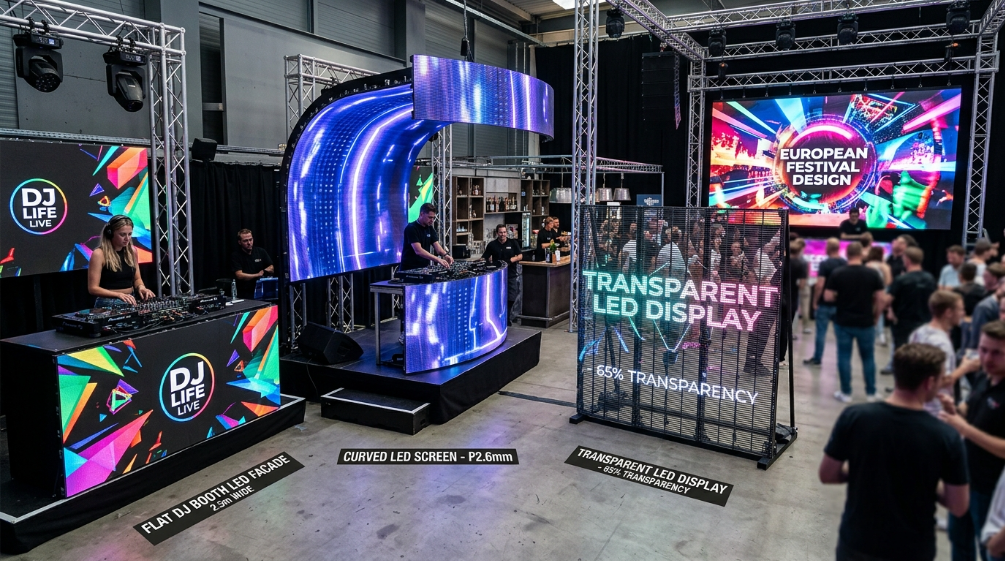
- DJ screens come in four form factors: front-facing booth facade, curved/wraparound booth, transparent screen, and full stage backdrop wall
- Sticker price is only part of the cost — installation, flight cases, controller hardware, and maintenance typically add 15–30% to the initial quote
- IP65-rated, GOB-sealed panels are required for any outdoor or high-splash-risk venue
Understanding What “DJ Display Screen” Actually Means
The term covers a broader family of products than most buyers expect. Before comparing prices, it helps to separate pixel pitch from refresh rate — the two specs buyers most often confuse:
- Pixel Pitch ≠ Refresh Rate. Pixel pitch (measured in mm, e.g. P2.5) controls image sharpness at a given distance. Refresh rate (measured in Hz) controls motion smoothness and whether the screen flickers on camera. A screen can have a very fine pixel pitch and still look terrible on a livestream if its refresh rate is too low.
- Pixel Pitch + Refresh Rate = Real-World Performance. For a DJ booth that will be photographed or streamed under stage lighting, both numbers matter together: a fine pitch (P1.9–P2.5) paired with a high refresh rate (3840Hz+) gives you the sharp, flicker-free look audiences expect from a professional setup.
Technical Specifications That Actually Drive Price
Pixel Pitch
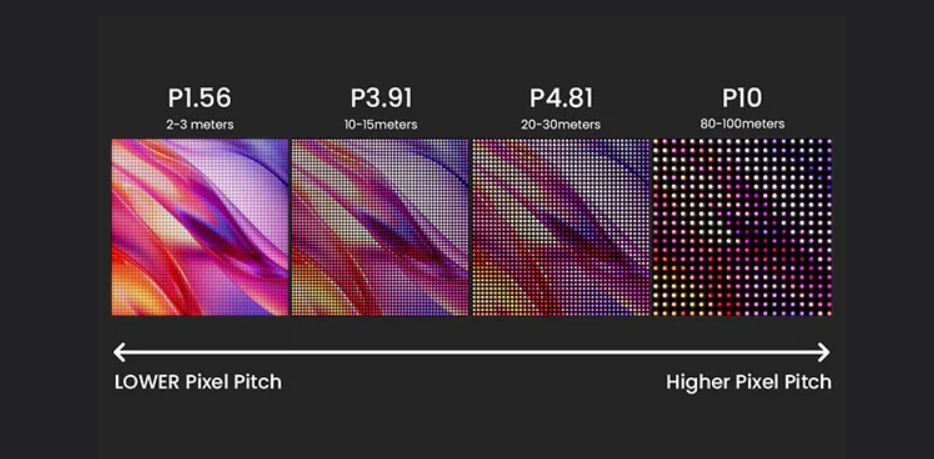
Pixel pitch is the distance between adjacent LED clusters, and it’s the single biggest driver of both image quality and cost. As a rule of thumb, allow roughly 1 meter of minimum viewing distance per millimeter of pitch. For DJ booths, where the audience or camera often sits within 6–15 feet:
- P1.25–P1.9 — ultra-fine, used for close-range booth facades and livestream-heavy setups where cameras zoom in
- P2.5–P2.97 — the most common range for standard DJ booths and nightclub installations
- P3.91–P4.8 — used for larger stage backdrops viewed from 15ft or more, where per-square-meter cost needs to stay controlled
Refresh Rate
Standard commercial LED panels often run at 1920Hz, which is adequate for the naked eye but can produce visible banding or flicker on camera sensors. Because DJ screens are filmed constantly — for social content, livestreams, and professional photography — the industry has moved toward much higher rates. This mirrors the same physics behind flicker perception on any impulsed display: the higher the refresh rate relative to a camera’s shutter speed, the less banding appears in captured footage. Most reputable DJ booth suppliers now spec 3840Hz to 7680Hz as standard, not a premium add-on.
Controller & Media Player
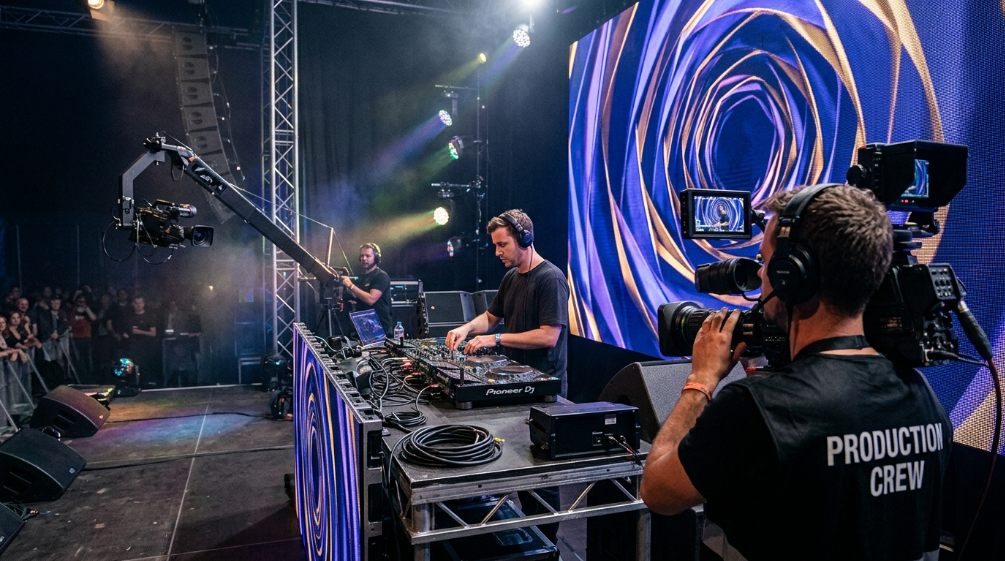
The screen panels are only half the system — a sending/receiving controller drives content and syncs it to audio. Common hardware in this category includes NovaStar’s VX400, VX4S, and TB-40 series, which support phone-app control, PC/HDMI sync, and music-reactive playback. When comparing quotes, confirm which controller is included, since some listings price the LED tiles alone and quote the controller separately.
Cabinet Build & Weatherproofing
- Aluminum alloy cabinets are standard for touring and rental use — lightweight, road-case friendly, and durable across frequent load-in/load-out cycles.
- GOB (Glue on Board) encapsulation seals the LED surface against dust, moisture, and impact — worth specifying for outdoor festivals, poolside events, or high-traffic nightclub environments where drinks and crowd contact are a real risk.
- IP rating: for any screen used outdoors or in a semi-exposed area, look for IP65 or higher. Indoor-only booths can use a lower-rated, lighter panel.
- Brightness: indoor booths typically run 1,500–2,000 nits; outdoor festival stages need 3,500–6,000+ nits to stay visible against daylight or competing stage lighting.
Application Scenarios: Which Booth Type Fits Your Event
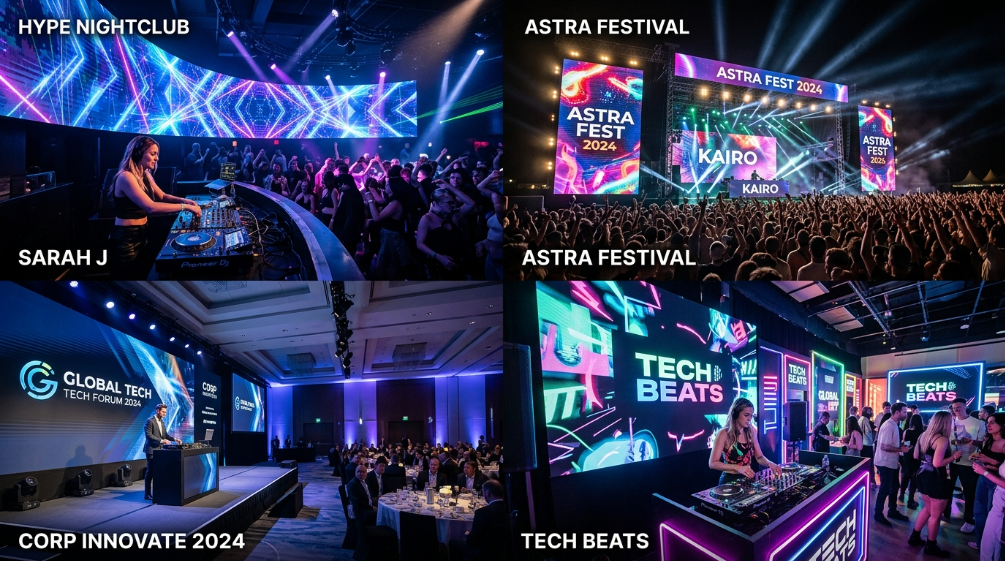
- Front-facing booth facade — the flat panel mounted on the front of a DJ table, the most common and most affordable configuration. Best for club residencies, weddings, and corporate events with a fixed setup.
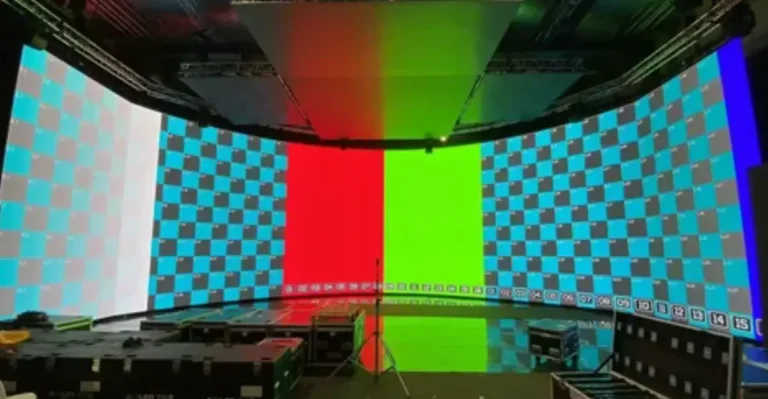
- Curved / wraparound booth (180°–270°) — panels wrap around the sides of the booth for an immersive look from multiple angles, popular for festival main stages and brand activations where the booth itself is part of the visual identity.
- Transparent LED screen — 60–90% see-through mesh panels that let stage lighting pass through while still displaying content, increasingly used for modern club and virtual-production-style stages where a fully opaque wall would feel heavy.
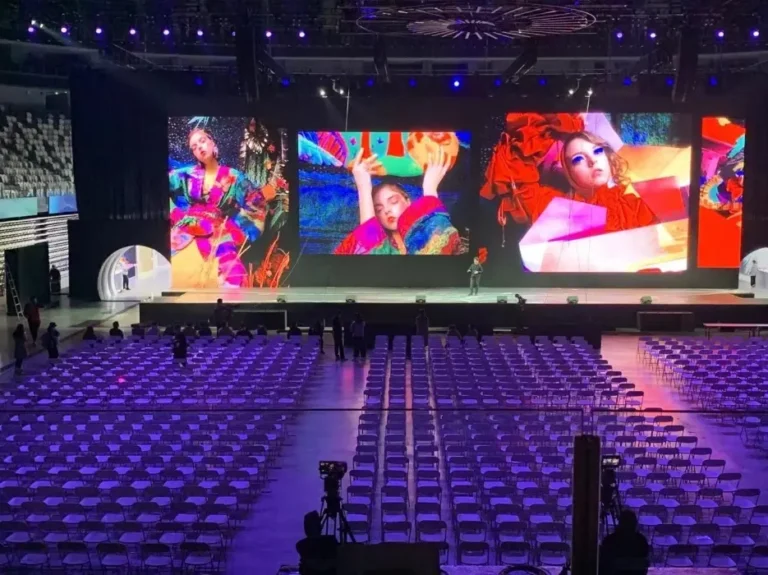
- Full stage backdrop wall — a larger-format screen behind the entire stage rather than just the booth, used for major festivals and touring productions where the DJ booth is one element within a bigger visual set.
Comparison Table: Entry, Mid-Range & High-End DJ Display Screens
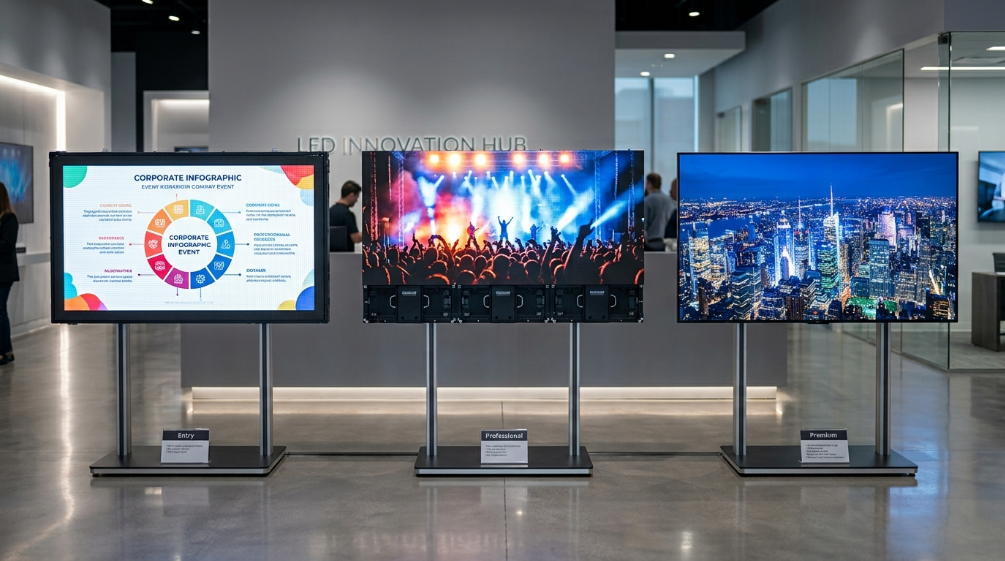
| Dimension | Entry-Level | Mid-Range | High-End |
|---|---|---|---|
| Price per m² | $600–$1,200 | $1,200–$3,000 | $3,000–$8,000+ |
| Pixel Pitch | P3.91–P4.8 | P2.5–P2.97 | P1.25–P1.9 |
| Refresh Rate | 1920Hz–3840Hz | 3840Hz | 3840Hz–7680Hz |
| Brightness (indoor) | 800–1,500 nits | 1,500–2,000 nits | 1,800–2,500 nits |
| IP Rating | IP20 (indoor only) | IP20–IP54 | IP54–IP65 |
| Cabinet Build | Steel/plastic frame | Aluminum alloy | Aluminum alloy + GOB |
| Form Factor | Flat facade only | Flat or curved | Flat, curved, transparent, wraparound |
| Setup Time | 30–60 min | 20–30 min, modular | 10–20 min, tool-free |
| Best For | Small bars, budget-first buyers | Regular touring DJs, mid-size clubs | Festivals, livestream-heavy residencies, brand activations |
Typical values based on 2026 market listings across multiple suppliers; actual pricing varies by order volume, region, and included controller hardware. Request an itemized quote to confirm what’s included.
What a Quote Actually Includes (Beyond Panel Price)
A per-square-meter number is only the starting point. A full DJ display project typically also includes:
- Controller/sending card (often $500–$2,000 depending on model)
- Installation labor and mounting hardware if not self-assembled
- Flight cases for touring setups — a meaningful line item for frequent load-in/out
- Spare modules for quick field replacement
- Ongoing maintenance and software updates
For a deeper breakdown of total cost of ownership — including how storage, obsolescence, and touring frequency affect the real cost over 2–3 years — see our DJ LED Screen: 2026 Price & Hidden TCO Guide, which walks through a full ROI example for a nightclub-scale installation.
Selection Checklist
Use this checklist to narrow your options before requesting quotes:
- Viewing distance: Under 10ft → P1.25–P1.9. 10–20ft → P2.5–P2.97. Over 20ft → P3.91+
- Camera/livestream use: If yes, require 3840Hz+ refresh rate — don’t accept standard 1920Hz panels
- Environment: Indoor-only can use IP20; outdoor or splash-risk venues need IP54–IP65 and GOB sealing
- Setup frequency: Touring/rental use favors lightweight aluminum, modular, tool-free designs; fixed installs can use heavier, cheaper builds
- Form factor: Match the shape (flat, curved, transparent, backdrop) to how the booth will be seen from the crowd
- Controller compatibility: Confirm the included controller supports your content workflow (phone app, PC/HDMI, or DMX/lighting-console sync)
- Total budget: Add 15–30% to the panel price for controller, cases, and installation before comparing supplier quotes
For a real client scenario, one Los Angeles nightclub client we worked with initially budgeted only for panel cost and had to revise their budget upward by roughly 20% once controller hardware and flight cases were added — a common first-time-buyer gap.
Frequently Asked Questions
How much does a DJ LED display cost per square meter?
Most projects fall between $600 and $5,000 per m², depending on pixel pitch, refresh rate, and cabinet build. Entry-level fixed installs sit at the low end; touring-grade high-refresh-rate screens sit at the high end.
What pixel pitch is best for a DJ booth?
For booths viewed from under 15 feet, P1.9–P2.97 balances clarity and cost well. Larger backdrops viewed from further away can use P3.91 or coarser without a visible quality loss.
Do I need a high refresh rate if I’m not livestreaming?
It’s still recommended. Even phone cameras from the crowd can pick up flicker on low-refresh panels, and most venues end up being filmed informally regardless of the original plan.
Can DJ LED screens be used outdoors?
Yes, but they need an IP65-rated, GOB-sealed panel and higher brightness (3,500+ nits) to remain visible and weatherproof. Standard indoor panels are not rated for outdoor exposure.
What’s the difference between a booth facade and a stage backdrop screen?
A facade covers just the front of the DJ table; a backdrop wall covers the stage behind the performer and is typically much larger and priced as a separate line item.
Is the panel price the total cost of the project?
No. Controller hardware, installation, flight cases, and ongoing maintenance typically add 15–30% on top of the panel price — budget for the full system, not just the tiles.
Author
This guide was reviewed by the Sostron LED technical content team, drawing on product specifications and installation data from active DJ booth and rental LED projects. For a project-specific quote, our engineering team can review your venue’s viewing distance, lighting environment, and budget to recommend the right pixel pitch and cabinet build.
Get a Custom Quote
Every venue’s viewing distance, lighting, and budget are different — the ranges above are a starting point, not a final number. [Talk to our engineering team] for a free, itemized quote based on your specific booth dimensions and use case, or explore our [DJ Booth LED Screen product line] and [Rental-Grade LED Display Series] for ready-to-configure options.
References:
Information Display Measurements Standard (IDMS) – International Committee for Display Metrology
LED Displays: Pixel Pitch, Viewing Distance and Image Quality Considerations