By the Sostron Display Engineering Team — 10+ years designing and specifying fine pitch LED walls for control rooms, retail, and broadcast clients across 60+ countries.
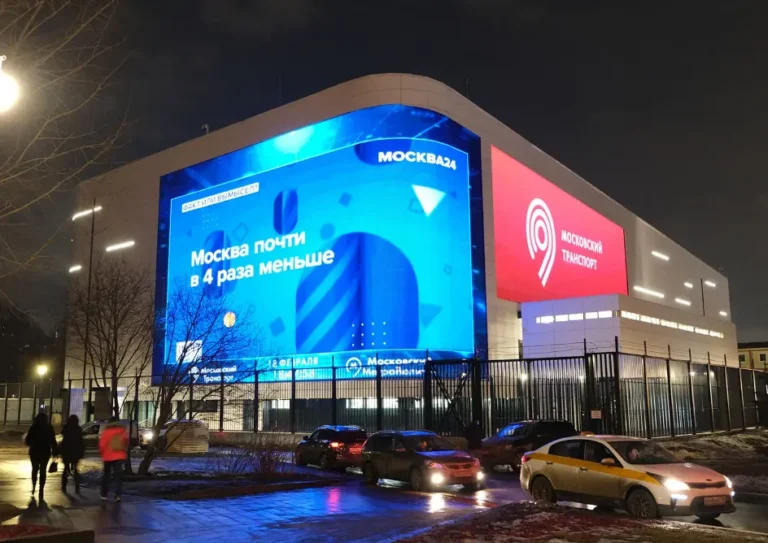
A fine pitch LED screen — typically P0.9 to P2.5mm — is the right choice when your audience sits within about 1–5 meters and needs to read fine detail, whether that’s data on a control-room wall or product texture on a retail display. Expect a typical 2026 hardware price of $900–$4,500 per square meter depending on pixel pitch and packaging technology (SMD, COB, or MIP), with a fully installed system running 35–60% higher once controllers, structure, and installation are included.
Key takeaways:
- Pixel pitch sets your minimum viewing distance — the rule of thumb is roughly 1mm of pitch per 1m of comfortable viewing distance.
- Below P1.5mm, COB (chip-on-board) packaging is now the 2026 default for durability and contrast; SMD remains cost-effective at P1.8mm and above.
- Screen price is only part of the budget — control systems, steel structure, and installation typically add 35–60% on top of panel cost.
- The cheapest quote at a given pixel pitch is rarely the cheapest system once total cost of ownership is factored in.
What “Fine Pitch” Actually Means (and What It Doesn’t)
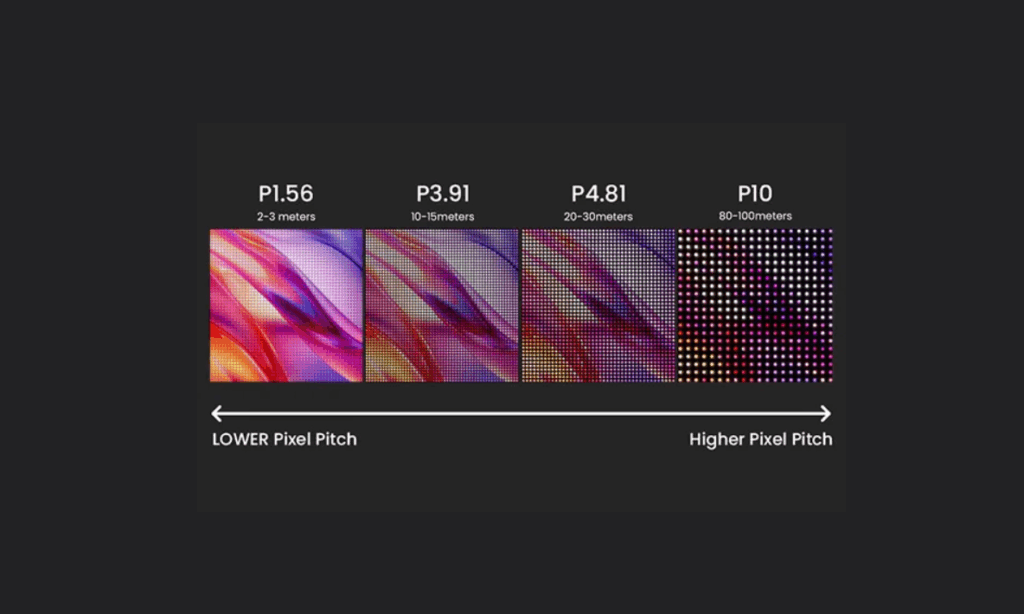
Fine pitch LED ≠ any small LED screen. It specifically refers to displays with a pixel pitch below roughly 2.5mm — P2.5, P2.0, P1.86, P1.56, P1.25, P0.9, down to ultra-fine sub-0.7mm models. Fine pitch + the right packaging technology (COB or high-grade SMD) is what delivers the seamless, close-viewing image quality that control rooms and premium retail installs need. A P2.5 fine pitch panel and a P2.5 “standard” outdoor panel can share a pixel pitch number and still perform very differently in contrast, uniformity, and lifespan — pitch alone doesn’t tell you the whole story.
Pixel Pitch and Viewing Distance
Pixel pitch determines how close a viewer can stand before individual pixels become visible. A commonly used industry shorthand from AVIXA-aligned guidance is: multiply the pixel pitch in millimeters by roughly 1 for the minimum comfortable distance in meters (or by ~3.3 for feet using the older “10x” rule). For example:
- P1.2 → comfortable viewing from about 1.8–2.4m — suited to control rooms and near-field data walls
- P1.8 → comfortable from about 2.5–3.5m — meeting rooms, lobbies
- P2.5 → comfortable from about 3.5–5m — retail, broadcast backgrounds
Use this as a starting point, not a final spec — content type matters too. Text-heavy dashboards and SCADA data need a finer pitch than concert backdrops or ambient brand loops viewed from the same distance.
SMD vs. COB vs. MIP: Which Packaging Technology Do You Need?
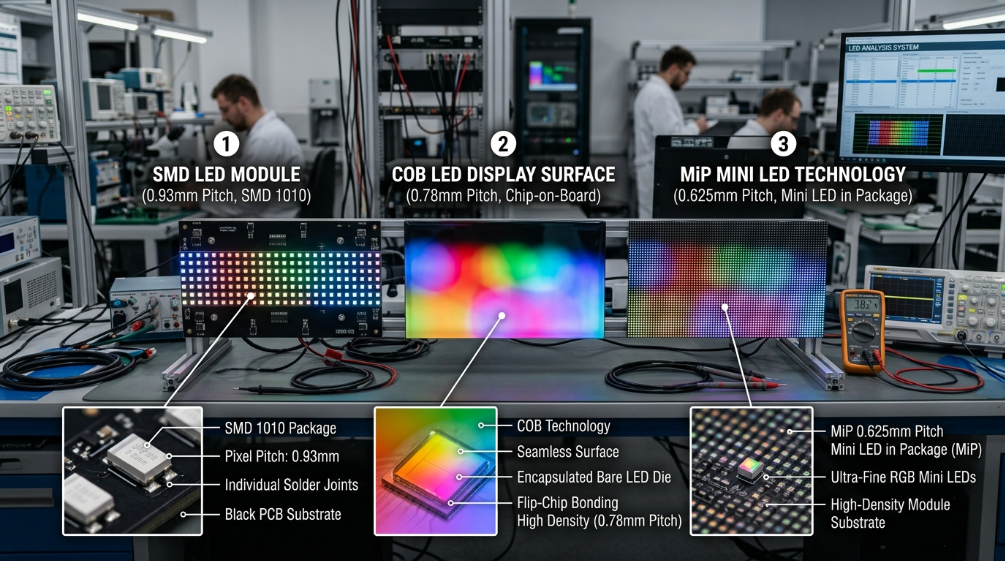
This is the single biggest technical decision buyers skip — and it affects both price and long-term reliability more than pixel pitch alone.
- SMD (Surface-Mount Device): The mature, mainstream technology. Individual RGB LEDs are mounted on the PCB surface. SMD remains the practical, cost-effective choice for pitches from about P1.8mm up to standard and outdoor panels, offering wide viewing angles and solid lumen efficiency. Below P1.5mm, SMD becomes more fragile and harder to manufacture reliably.
- COB (Chip-on-Board): LED chips are bonded directly to the board and sealed under an epoxy layer. This gives COB better durability, higher contrast (often 10,000:1+), better dust/impact resistance, and superior heat dissipation — which is why it has become the 2026 baseline for indoor fine pitch below P1.5mm, especially in control rooms and broadcast studios that run 24/7.
- MIP (Mini-LED In-Package): The newest of the three, gaining traction at P0.9mm and below for improved color uniformity and manufacturing yield versus conventional fine-pitch SMD. It’s positioned for premium video walls and virtual production/XR stages where color consistency across a huge panel array is critical.
Practical rule: if your project specs sub-P1.5mm for a 24/7 environment, ask any supplier quoting SMD at that pitch to justify it — most 2026 projects at that density specify COB or MIP.
Application Scenarios: Match Pitch and Technology to the Room
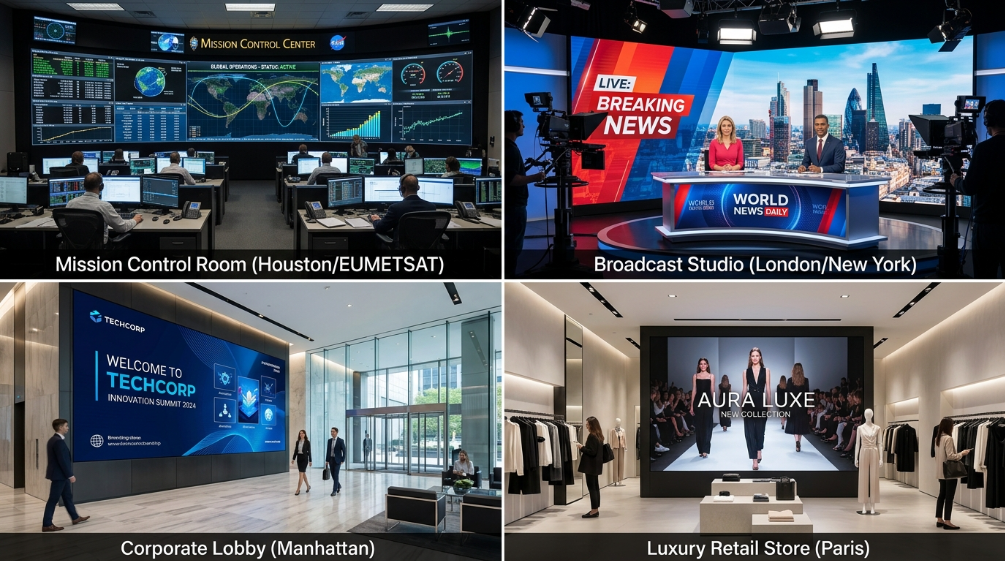
| Scenario | Recommended pitch | Technology | Why |
|---|---|---|---|
| Control rooms / command centers | P0.9–P1.5 | COB or MIP | Viewers sit close and read fine data continuously; needs high contrast and low maintenance |
| Broadcast studios / virtual production | P1.2–P1.8 | COB | Color accuracy and refresh rate must hold up under camera capture |
| Corporate lobbies / boardrooms | P1.5–P2.0 | COB or premium SMD | Balance of image quality and budget for shorter, less-continuous viewing sessions |
| High-end retail / product displays | P1.8–P2.5 | SMD or COB | Close-up product detail matters, but 24/7 uptime demands are lower than control rooms |
| Rental & staging / event backdrops | P2.6–P3.9 | SMD | Viewing distance is longer; lightweight, quick-lock panels matter more than ultra-fine pitch |
| Transparent / creative installations | Varies (mesh or bar) | SMD | Different structural requirements — see transparent LED display options for spec guidance |
For control rooms and broadcast environments specifically, Sostron’s Cobra COB LED display line is built around this exact use case — chip-on-board packaging with a 10,000:1 contrast ratio and 170° viewing angle for close, continuous viewing. For boardrooms and lobbies where a slim profile matters more than sub-P1.5 density, the Reta 2 indoor LED display is designed for a 30mm cabinet depth with an 800–1000 nit range suited to indoor ambient light.
What’s Actually in the Price: Hardware Is Not the Whole Budget
The original cost breakdown — screen body, control system, external equipment, steel structure, installation, freight/tax — is directionally right, but buyers consistently underestimate how much the non-panel costs add up to. As a rough 2026 rule of thumb: budget 35–60% on top of panel hardware cost for signal processing, structure, and installation to get a realistic total project number, not just a per-square-meter panel quote.
Screen body (LED chips, modules, power supplies, cabinets): This is the line item pixel pitch and technology (SMD/COB/MIP) most directly affect. Control system (sending cards, receiving cards, software): Determines refresh rate, color depth, and how many screens you can manage centrally. External equipment (processors, computers, amplifiers, climate control): Often overlooked in early budgeting, but necessary for the system to actually run. Structure, installation, freight, tax: Highly variable by region and installation complexity — get a line-item quote rather than a single blended number.
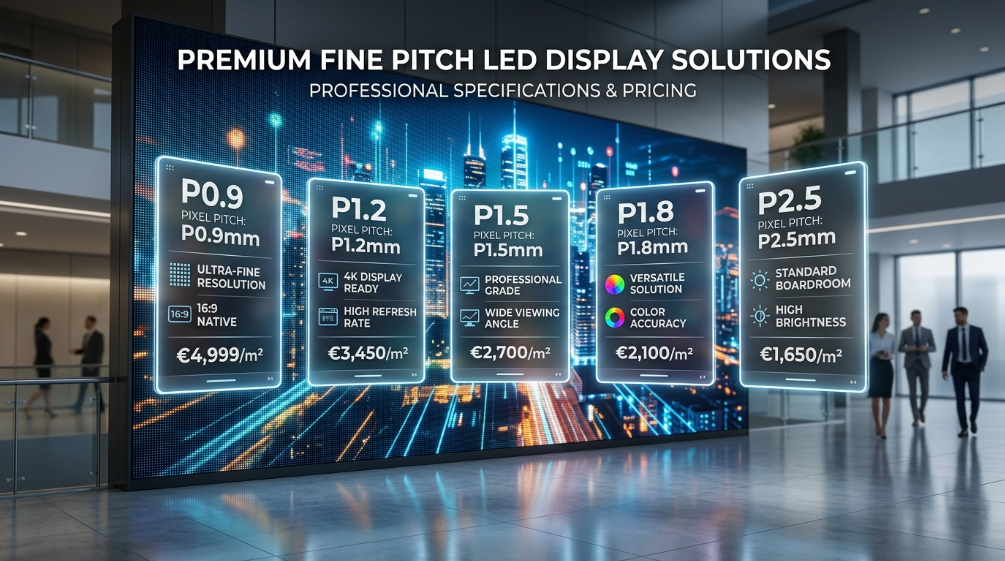
Fine Pitch LED Screen Price by Pixel Pitch and Technology (Typical 2026 Ranges, Hardware Only)
| Pixel Pitch | Typical Technology | Price (USD/m², hardware only) | Best For |
|---|---|---|---|
| P0.9 and below | COB / MIP | $2,500–$4,500 | Ultra-close control rooms, premium broadcast |
| P1.2 | COB | $2,000–$3,500 | Control rooms, mission-critical data walls |
| P1.5 | COB or premium SMD | $1,800–$3,200 | Boardrooms, broadcast studios |
| P1.8 | SMD or COB | $1,200–$2,500 | Corporate lobbies, high-end retail |
| P2.0 | SMD | $1,000–$1,800 | Meeting rooms, showrooms |
| P2.5 | SMD | $800–$1,600 | Retail, broadcast backgrounds |
These are typical hardware-only reference ranges based on current 2026 industry pricing guidance; actual quotes vary by brand, chip supplier, brightness spec, and order volume. Always request a line-item quote that separates panel, control system, structure, and installation costs.
Buyer’s Checklist: How to Choose Before You Request a Quote
- Measure your actual minimum viewing distance. Don’t guess — this single number determines your realistic pitch range and prevents overspending on resolution no one will perceive.
- Identify your content type. Text/data-heavy content (SCADA, dashboards) needs a finer pitch than video or ambient brand loops at the same distance.
- Decide indoor vs. outdoor and check ambient light. Indoor panels typically run 800–2,000 nits; outdoor needs 5,000–8,000+ nits for daylight readability, which changes both technology and price.
- Match technology to duty cycle. 24/7 control rooms lean COB/MIP for durability; retail and event use can often use well-specified SMD.
- Set a total budget, not a panel budget. Add 35–60% to your panel price estimate to account for control systems, structure, and installation before you compare quotes.
- Ask for a line-item quote. A single blended number hides where you’re overpaying — request panel, control system, structure/install, and freight as separate lines.
- Verify after-sales terms. Confirm maintenance cycle, spare-parts availability, and warranty length before signing — this affects total cost of ownership more than the sticker price.
Frequently Asked Questions
What pixel pitch is best for a conference room?
Most conference rooms with viewers 2–4m away do well with P1.5–P1.8. Going finer (P1.2 or below) only makes sense if viewers sit within 1.5m or the content is detailed data.
Is COB always better than SMD?
Not universally. COB wins below P1.5mm on durability, contrast, and dust resistance. For P1.8–P2.5 with viewing distances over 3m, a well-specified SMD panel is often the more cost-effective choice.
How much does a fine pitch LED screen really cost installed?
Panel hardware runs roughly $800–$4,500/m² depending on pitch and technology. A fully installed system — including control system, structure, and labor — typically adds 35–60% on top of the panel price.
What’s the difference between fine pitch and Micro LED?
Fine pitch LED (roughly P0.9–P2.5mm) uses sub-millimeter LED packages on a PCB. Micro LED uses far smaller LED crystals to push pixel pitch below 0.3–0.5mm, offering even higher density at a currently much higher price point.
Do I need a fine pitch screen if viewers are always 6m+ away?
Usually not. At that distance, a standard P2.5–P3 pitch will look effectively seamless to most viewers, and the extra cost of finer pitch buys little visible benefit — that budget is often better spent on brightness or a better control system.
How often do fine pitch LED panels need maintenance?
This varies significantly by brand and packaging technology; COB panels generally require less frequent servicing than SMD at the same pitch due to better dust/impact resistance. Always ask suppliers for documented MTBF (mean time between failures) data and spare-parts lead times rather than a general claim.
Conclusion
Choosing a fine pitch LED screen comes down to three decisions in order: viewing distance (which sets your pitch range), duty cycle and environment (which sets SMD vs. COB vs. MIP), and total system budget (which should include control systems and installation, not just panel price). Buyers who request line-item quotes and match technology to their actual use case — rather than defaulting to the smallest pitch available — consistently get better long-term value than those who shop on a single per-square-meter number.
If you’re specifying a control room, broadcast studio, or premium indoor wall, our engineering team can review your viewing distance and environment and recommend a pitch and technology before you request pricing from multiple suppliers.
Note on data sourcing: All price ranges above are framed as “typical 2026 reference ranges” rather than fixed figures, consistent with how they’re presented across current industry pricing guides — actual project quotes should always be verified directly with suppliers, since real quotes vary by brand, order volume, and exact spec.
References:
How To Choose The Right Pixel Pitch — Recommended Viewing Distance & Direct View LED
Measurement of LEDs — CIE 127:2007