Direct conclusion: If you are selecting an LED display for a highway project, here is the core decision-making framework—
| Application Scenario | Recommended Pixel Pitch | Minimum Brightness Requirement | Required Protection Rating |
|---|---|---|---|
| Traffic Management VMS / Message Boards | P10–P16 | 8,000 nits | IP65+ |
| Highway Billboard Advertising | P8–P10 | 6,500 nits | IP65 |
| Urban Expressway Close-Range Displays | P5–P8 | 6,000 nits | IP66 |
| Construction Zone Mobile Warning Screens | P10–P20 | 5,000 nits | IP65 |
This is not theory. This is a set of field-proven parameters accumulated from over 40 ITS highway projects our team has participated in across Southeast Asia, the Middle East, and Europe over the past decade.
Have You Encountered This Pitfall?
A system integrator headquartered in Dubai purchased a batch of highway LED screens labeled “IP65, 8000 nits” from a Chinese supplier in 2023 for VMS deployment along the Sharjah highway corridor.
Six months after project commissioning, widespread pixel failures appeared on-site.
The root cause: the chip packaging used iron bonding wires instead of gold wires. In the high-salinity and high-temperature Gulf environment, the oxidation rate is three times that of standard conditions.
The project incurred losses exceeding $180,000, excluding reputational damage.
This is not an isolated case. It is a common trap for global B2B buyers when procuring highway LED screens without a complete technical framework.
The purpose of this article is only one: to ensure that before making an inquiry, you already understand more than most engineers.
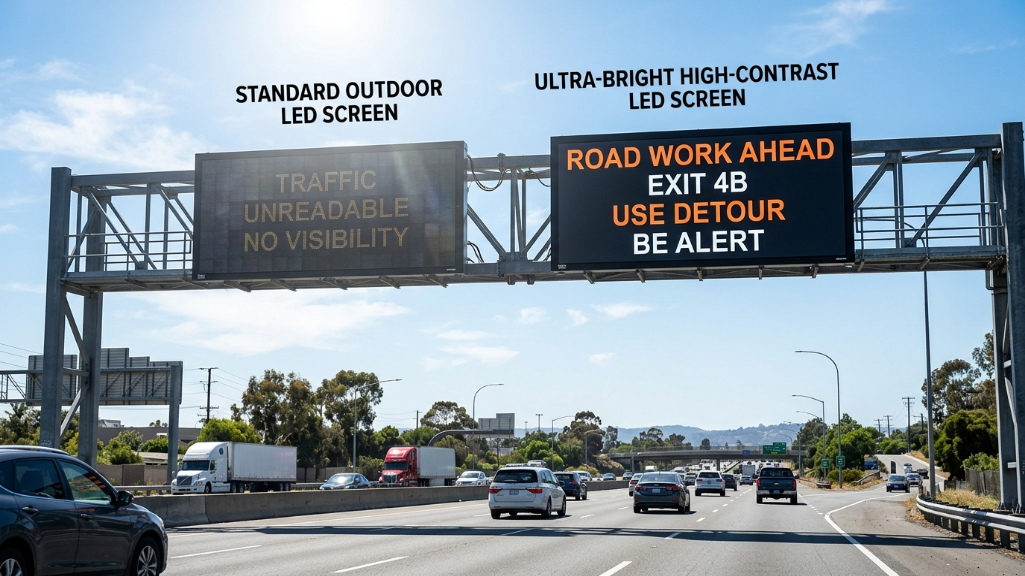
What Is a Highway LED Screen? Its Essential Differences from Standard Outdoor Displays
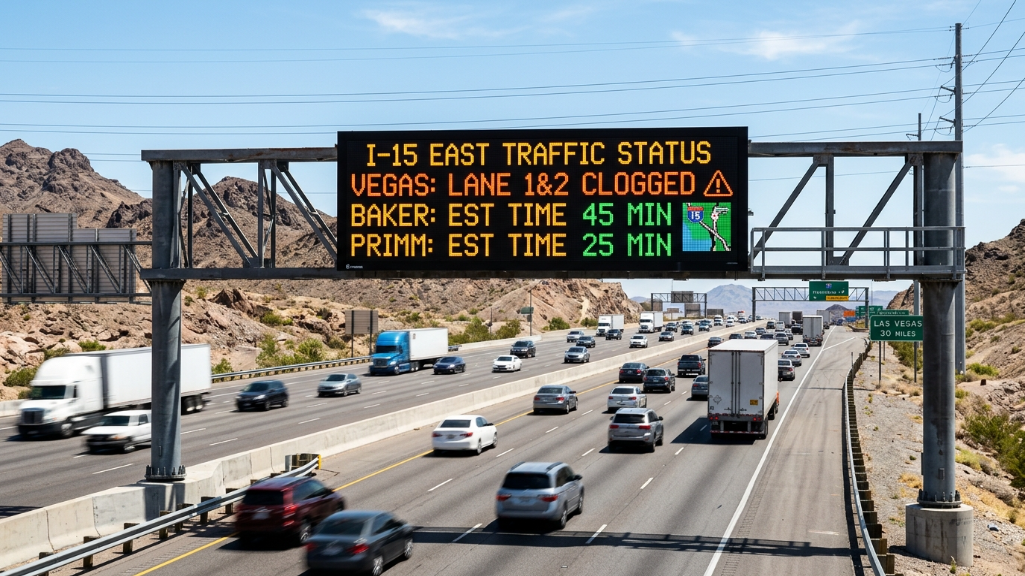
A highway LED screen is not merely an “enhanced version” of a standard outdoor advertising display.
It is an engineered display system specifically designed for high-speed viewing angles, extreme environmental conditions, and long-term unattended operation. It serves as a critical information transmission node within ITS (Intelligent Transportation Systems).
The engineering gap between the two product types is reflected in every detail:
| Technical Dimension | Standard Outdoor LED Screen | Highway LED Screen |
|---|---|---|
| Brightness Range | 3,000–5,000 nits | 6,500–12,000 nits |
| Refresh Rate Requirement | ≥960Hz (visual smoothness) | ≥3,840Hz (camera compatibility) |
| Operating Temperature | -20°C to +50°C | -40°C to +65°C |
| Wind Resistance | Typically ≤ Level 11 | ≥ Level 12 (typhoon regions) |
| MTBF | ~30,000 hours | ≥80,000 hours |
| Certification System | CE / FCC | MUTCD / EN12966 / UL 48 |
Brightness is the most misunderstood parameter.
6,000 nits may be sufficient on cloudy roads in Central Europe, but under direct sunlight at noon in Riyadh during summer, the screen will completely “disappear” from view.
This is not supplier exaggeration—it is the physical limit of human visual perception under strong ambient light.
Based on our field testing, the minimum acceptable brightness for Middle East projects should be set at 8,500 nits, combined with an Auto-Dimming system. This ensures 24/7 visibility while reducing energy consumption by approximately 30%.
Core Technology Breakdown: Three Engineering Pillars That Determine Actual Lifespan
Packaging Technology: SMD, DIP, or COB?
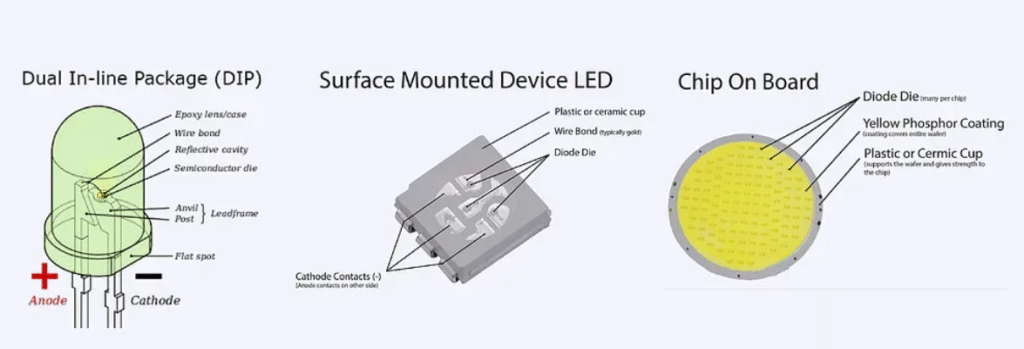
This is the most debated issue in selection. The simple conclusion:
- DIP (Dual In-line Package):
Each LED is independently formed, offering the strongest water and impact resistance. Suitable for extreme environments.
Disadvantage: limited pixel density; costs rise sharply below P10. - SMD (Surface-Mounted Device):
Mainstream technology. Pixel pitch can reach below P3 with better brightness uniformity.
However, solder points are exposed, and corrosion risk in high-salinity environments is significantly higher than DIP. - COB (Chip on Board):
Emerging technology. Chips are directly mounted on PCB and sealed with protective coating, with no exposed solder joints.
According to industry testing, COB improves weather resistance by about 40% compared to SMD in IP protection tests.
This is the trend for post-2025 highway projects, especially in coastal and high-humidity markets.
Refresh Rate: 3,840Hz Is Not a Marketing Gimmick
When highway enforcement cameras or media drones capture your VMS, screens below 1,920Hz will produce visible horizontal scanning lines.
As smart highway projects increasingly deploy roadside sensing cameras—and autonomous vehicles begin relying on roadside display information—refresh rate has evolved from a “visual quality parameter” to a “system compatibility parameter.”
Require suppliers to provide third-party refresh rate test reports, not just datasheet claims.
Thermal Management: The Overlooked Lifespan Killer
For every 10°C increase in LED junction temperature, theoretical lifespan is halved.
A highway LED screen installed above asphalt can easily exceed internal temperatures of 60°C during summer.
The choice between passive cooling (heat sinks) and active cooling (fans) directly impacts maintenance costs over 3–5 years.
In desert environments, avoid active fans—sand and dust will clog filters within 6–12 months and lead to motor failure.
Global Compliance Map: Certification Barriers Before Market Entry
Differences in compliance requirements across markets are often hidden risks causing 6–12 month project delays.
| Target Market | Core Certification Requirements | Regulatory Authorities | Common Pitfalls |
|---|---|---|---|
| United States | MUTCD + FCC Part 15 + UL 48 | FHWA / FCC | UL 48 applies to cabinet, not display module |
| European Union | CE + EN 12966 + RoHS | National transport authorities | EN12966 includes L1/L2/L3 brightness classes |
| Middle East | GCC + SASO / ESMA + Local permits | National standards bodies | CE required but local registration mandatory |
| Southeast Asia | CE / FCC reference + local registration | National ICT authorities | Indonesia & Vietnam tightening certification |
Practical method to verify CE authenticity:
Request the Notified Body number from the supplier and verify it directly in the EU NANDO database (ec.europa.eu/growth/tools-databases/nando).
A PDF certificate itself is meaningless—its forgery cost is under $50.
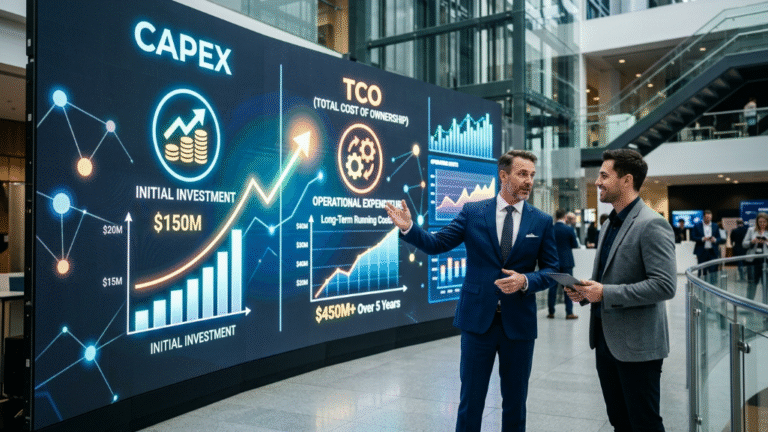
Total Cost of Ownership (TCO): Purchase Price Is Just the Tip of the Iceberg
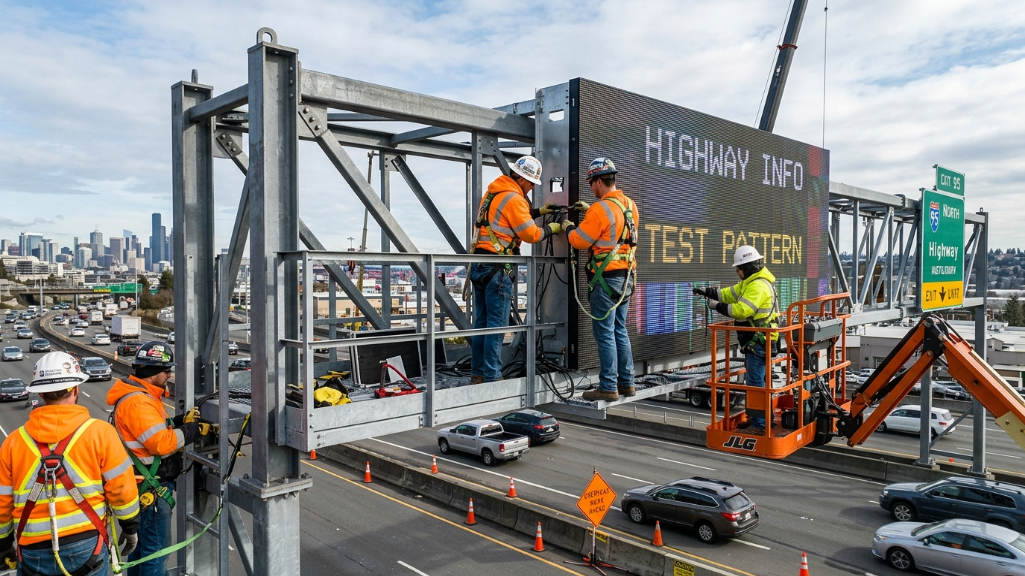
Based on accounting from over 40 highway installations, the screen purchase cost typically represents only 35–45% of the total 10-year project cost.
Example: a 20㎡ P10 highway LED screen
Initial CAPEX
- Screen: $12,000–$18,000
- Steel structure: $8,000–$15,000
- Control system: $3,000–$5,000
- Installation: $5,000–$10,000
- Total: $28,000–$48,000
Annual OPEX
- Electricity: ~$2,800 (10,000 hours/year, 350W/㎡)
- Preventive maintenance: $1,500–$3,000
- Spare parts reserve: $800–$1,500
10-Year Maintenance Inflection Point
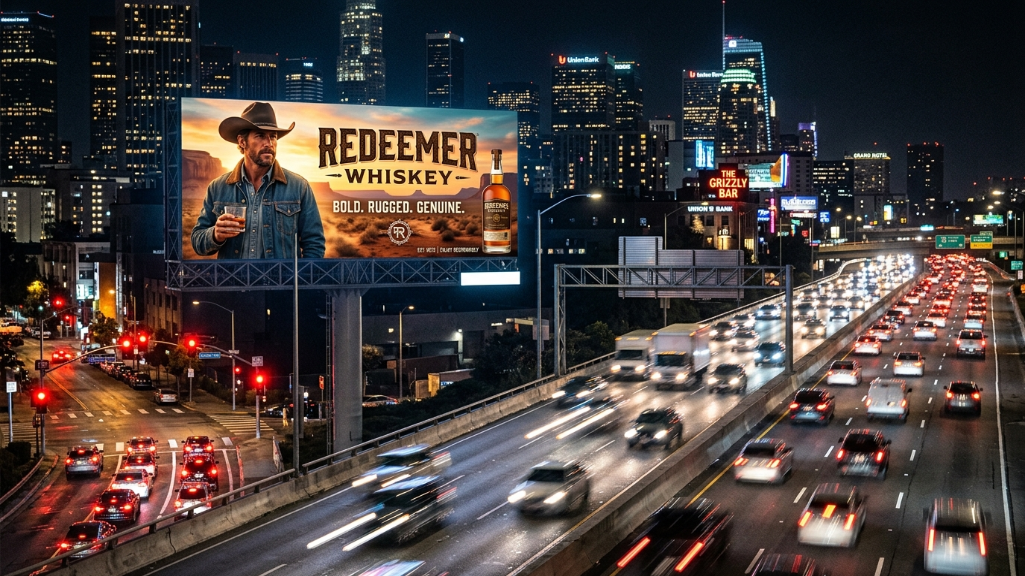
Year 5–6 typically requires bulk power module replacement, costing about 15–20% of original screen price.
For DOOH operators, the key metric is break-even point:
With 80,000 daily impressions and CPM pricing of $8–$12, a well-located highway screen typically achieves ROI within 18–30 months.
Site selection and traffic modeling impact ROI more than screen brand.
Supplier Qualification Screening: Evaluate a Factory in 8 Minutes
After receiving a quotation, use this framework:
Green Flags (Proceed)
- Full BOM provided with verifiable chip brands (Nationstar, Epistar, Cree)
- At least two completed highway project references with client contacts
- EN12966 or UL 48 certificates verifiable in official databases
Red Flags (Stop Immediately)
- Chip described as “imported” or “tier-1” without disclosure
- Measured refresh rate deviates >20% from specification
- Delivery time ≤15 days (normal production for 20㎡ is 25–35 days)
According to industry data, 62% of B2B procurement disputes arise from mismatch between specifications and actual products—not price.
Factory audits—remote or on-site—are non-negotiable before contract signing.
Expert Verdict
Ten years of experience point to one conclusion:
99% of highway LED screen project failures are not due to buying a “bad” screen, but buying a screen that does not match the specific scenario.
Before procurement, lock down these three answers:
- What is the exact distance to the farthest viewer? (determines pixel pitch)
- What are the annual extreme temperature range and salinity level? (determines packaging and IP rating)
- Has the mandatory certification list for the target market been verified down to certificate numbers? (determines supplier eligibility)
Everything else is optimization on top of these.
FAQ: High-Frequency Long-Tail Questions
Q1: What is the difference between a highway LED screen and a VMS?
VMS is a specific application of highway LED screens in traffic management, focusing on real-time content switching and traffic data integration.
Highway LED screen is a broader hardware category, also covering commercial advertising and branding.
Q2: How many nits are required for highway LED screens?
General benchmarks:
- Europe ≥6,500 nits
- North America ≥7,000 nits
- Middle East / South Asia ≥8,500 nits
With auto-dimming, brightness can drop to 500–1,000 nits at night to save energy.
Q3: What is the price difference between P8 and P10?
For the same module size, P8 is typically 30–45% more expensive than P10.
At viewing distances above 80m, the visual difference is indistinguishable, making P10 more cost-effective.
Q4: Can Chinese-manufactured highway LED screens pass EU CE certification?
Yes. Most mainstream suppliers in the EU market are from China.
The key is that certification must be issued by an EU Notified Body—not self-declared.
Q5: What permits are required for highway LED screen installation?
Typically includes:
- Road authority permits
- Construction permits (including structural load calculations)
- Electrical inspection approval
Some countries also require Traffic Impact Assessment (TIA).
Processes vary significantly by country—engage local engineering consultants during the design phase.
References:
Manual on Uniform Traffic Control Devices (MUTCD)
UL 48: Standard for Electric Signs