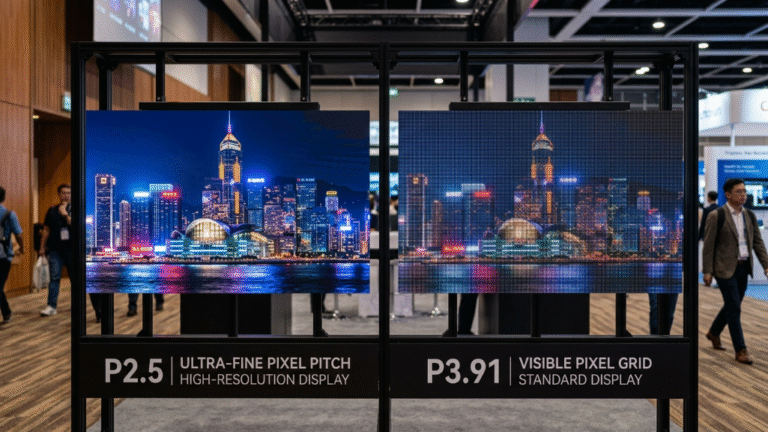
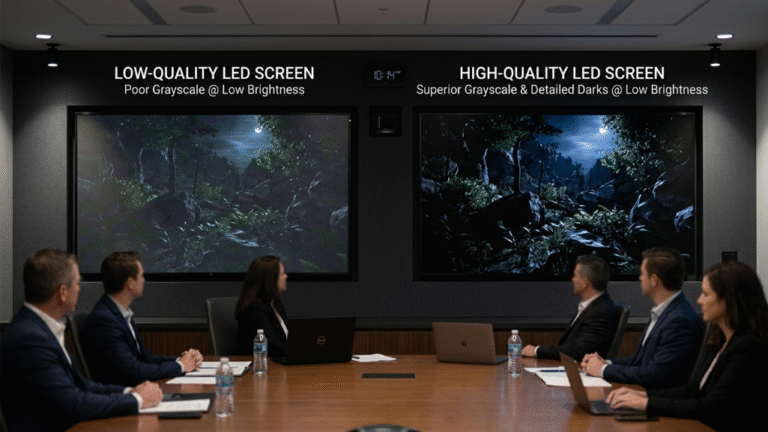
When calculating the Return on Investment (ROI) for LED displays, many businesses focus solely on the initial procurement cost (CAPEX) while overlooking long-term operating expenses (OPEX). According to industry-standard evaluation models, the average annual maintenance cost of an LED display typically ranges from 3% to 8% of the initial equipment cost. If you opt for low-cost products lacking redundancy design or superior heat dissipation, this figure can surge to over 15% after the third year.
Annual Estimated LED Maintenance Cost Breakdown
| Cost Dimension | Proportion (Annual Avg.) | Core Drivers | Business Impact |
| Preventive Maintenance | 20% – 30% | Regular cleaning, calibration, securing connections | Extends lifespan; reduces sudden lamp failure rates |
| Spare Parts & Replacement | 40% – 50% | PSU aging, receiving card failures, dead pixels | Maintains consistency of display effects |
| On-site Labor & Logistics | 20% – 30% | High-altitude work, logistics, technician travel | Determines the response speed of repairs |
For system integrators and DOOH (Digital Out-of-Home) advertisers, the true “cost killer” is not a single broken lamp bead, but Downtime Revenue Loss. Based on extensive experience serving large stadiums and commercial centers, the advertising loss from one day of downtime for a landmark screen often exceeds the material cost of replacing a driver IC by several times.
Core Principles and Failure Triggers: Why Does Your LED Screen Get Expensive?
An LED display is not a static box; it is a complex electronic ecosystem. Understanding its working principles is the first step in controlling maintenance costs.
Impact of Packaging Technology: SMD vs. COB
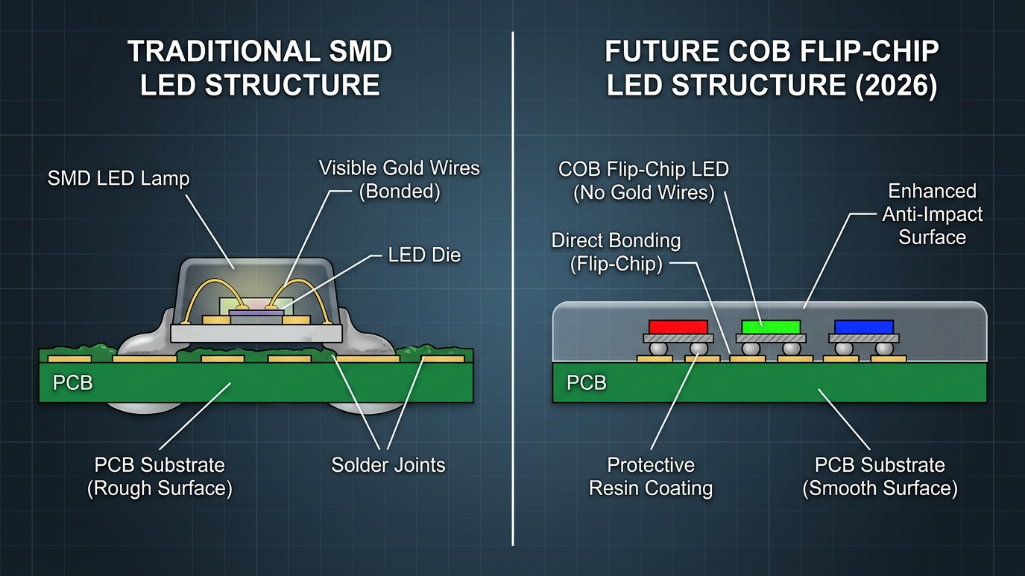
Mainstream SMD (Surface-Mounted Device) technology involves welding lamp beads onto a PCB. While color consistency is easy to adjust, the pins are exposed, making them vulnerable to moisture, static, or physical impact. Let you know the 6 differences between SMD LED display and COB LED display.
In contrast, COB (Chip-on-Board) technology fixes chips directly onto the circuit board with integrated packaging.
-
Feature: Fully enclosed surface with no exposed pins.
-
Benefit: Dramately reduces the Dead Pixel Rate. Although initial procurement for COB is higher, the maintenance cost for lamp drops caused by impact is approximately 60% lower than SMD in the long run.
Power Supply Units (PSU) vs. Redundant Design
Nearly 50% of failures in LED displays stem from the power supply rather than the LEDs themselves. High-brightness operation creates massive current loads.
-
Engineering Insight: PSUs running at high loads in high-temperature environments lead to drying out internal capacitors.
-
Solution: We recommend B2B buyers consider Power Redundancy. If one power supply fails, a backup takes over instantly. While this increases initial hardware investment, it can bring annual “corrective maintenance” costs close to zero.
Thermal Management and Heat Dissipation Logic
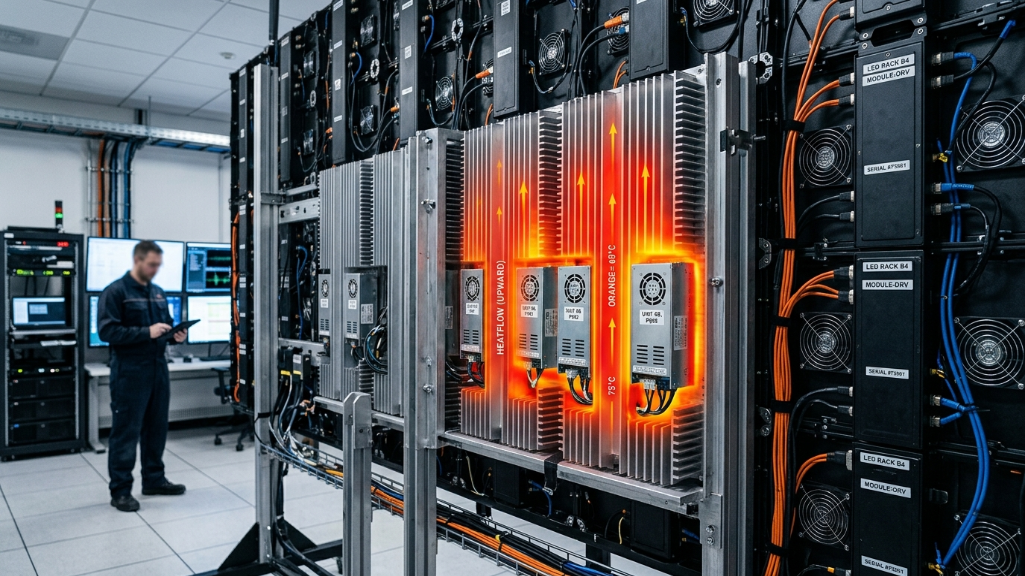
LED light decay is proportional to temperature. Poor internal heat dissipation leads to rapid brightness degradation and PCB deformation.
-
Professional Advice: Verify if the display uses a die-cast aluminum cabinet rather than cheap iron. Aluminum’s thermal conductivity is significantly higher, protecting precision components from systemic failure due to thermal runaway.
Deep Dive: Specific Components of Annual Maintenance
To set an accurate annual budget, you must distinguish between “visible hardware” and “invisible services.”
Strategic Spare Parts Inventory
It is highly recommended to procure 3%–5% in spare parts at the time of the initial order. This is not just for dead pixels, but for Color Calibration consistency.
-
Technical Detail: Even beads from the same manufacturer can have color differences between batches. Finding replacement parts two years later often results in a “patchwork” look that destroys the visual value of the screen.
Preventive Maintenance: Spend $1 to Save $10
Screens undergoing professional inspections twice a year generally last 2–3 years longer than those repaired only after a failure occurs.
-
Cleaning: Dust blocks cooling vents and can cause short circuits in humid weather.
-
Structural Checks: Outdoor screens affected by wind loads need regular inspection of support structures and cables to prevent expensive total system burnouts.
High-Altitude Work and On-site Labor
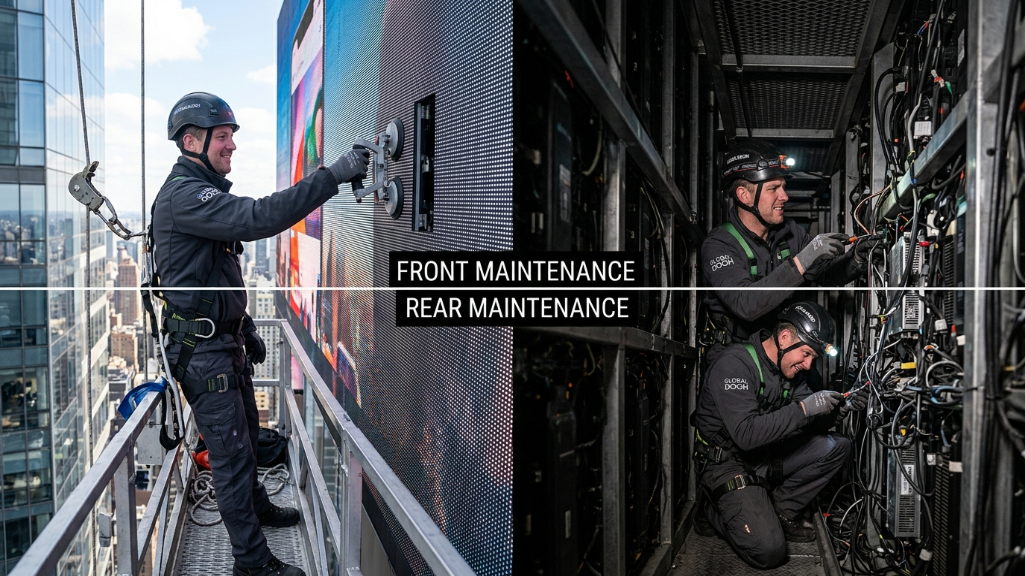
For DOOH screens on skyscrapers or highways, labor costs often exceed parts costs.
-
Logical Recommendation: Confirm whether the product supports Front/Rear Serviceability. If a screen only supports rear maintenance, repairs may require dismantling large structures or using heavy lifting equipment, which can consume an entire year’s maintenance budget in a single session.
Application Scenarios: Maintenance Logic by Business Type
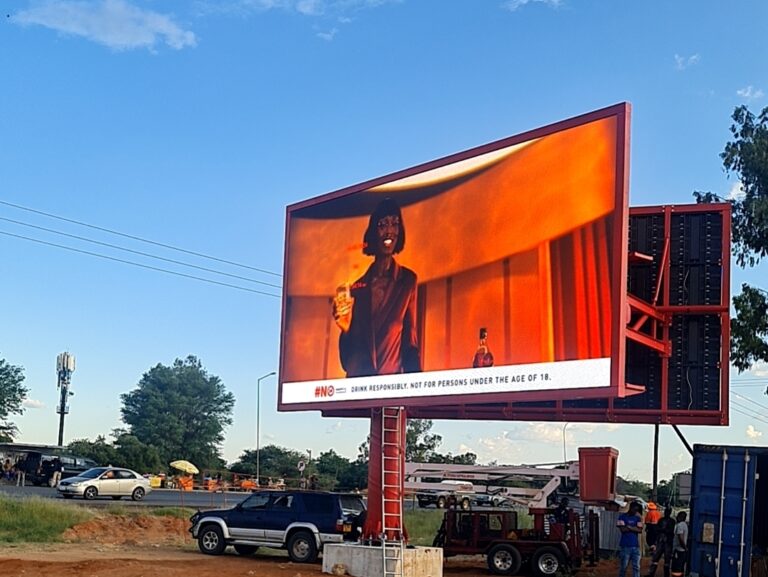
DOOH Outdoor Digital Advertising
-
Core Pain Point: Black screens result in immediate advertising revenue loss.
-
Strategy: Install intelligent monitoring systems to lock onto abnormal modules before failure. Prioritize aluminum bottom shell modules with independent waterproof grooves.
-
Annual Budget: 5% – 7% of initial cost.
Rental & Staging
-
Core Pain Point: Frequent handling leads to corner lamp damage; frequent plugging leads to connector failure.
-
Strategy: Ensure cabinets have Corner Protection. Maintain module universality across inventory for quick “transplants” during tours.
-
Annual Budget: 8% – 10% (due to high labor frequency).
Control Rooms & Fine Pitch LED
-
Core Pain Point: Visual “patchwork” effects after partial module replacement.
-
Strategy: Perform Pixel-level Calibration every 1.5–2 years. Use professional vacuum suction tools for maintenance on screens below P1.5 to prevent static damage.
-
Annual Budget: 2% – 3%.
Buyer’s Guide: Filtering Products via Technical Parameters
Over 60% of high maintenance bills result from unprofessional initial procurement decisions. Watch for these “cost-saving” parameters in datasheets:
-
Driver IC: Choose constant current driver ICs with “blanking” functions and high refresh rates (≥3840Hz) to protect lamps and reduce heat.
-
PCB Layers: 4-layer or 6-layer PCBs dissipate heat much better than 2-layer boards. Every 10°C improvement in cooling can double component lifespan.
-
Wire Material: Power cables must be pure copper. Cheap copper-clad aluminum wires have high resistance and are major fire hazards.
-
Gold Wire vs. Copper Wire Packaging:
-
Gold Wire: Excellent ductility and oxidation resistance for long-term use.
-
Copper Wire: Lower cost, but prone to breakage in high-humidity environments, leading to high dead lamp rates.
-
FAQ: High-Frequency Questions on LED Maintenance
Q1: How many “dead pixels” are normal for a new installation?
A: Industry standards suggest the dead pixel rate should be within 3 per million (≤3/1,000,000). Concentrated dead pixels indicate poor SMT welding or packaging, signaling high future maintenance costs.
Q2: Are repair fees for Fine Pitch (e.g., P1.2) much higher?
A: Yes. As pixel pitch decreases, repair difficulty increases exponentially. While P4+ screens can be fixed with a soldering iron, Fine Pitch requires professional rework stations and microscopes, leading to higher technician fees.
Q3: How often should outdoor screens be deep cleaned?
A: Every 12 months for urban areas and every 6 months for industrial or dusty zones. This prevents heat buildup caused by dust covering cooling fins.
Q4: Why shouldn’t I wait two years to buy spare modules?
A: LED wafers vary by batch. Even identical models from a different batch will show obvious “color blocks” when installed on an older screen. Buying all spares upfront is the most cost-effective solution.
Expert Verdict
The final advice for global B2B buyers is: “Do not save money in places that cannot be seen.”
A low-priced LED display often cuts corners in power redundancy, PCB heat dissipation, and gold wire packaging. Every dollar saved on the procurement contract will eventually flow out of your financial statements multiplied as “emergency repair fees” and “downtime penalties.” A mature B2B procurement mindset utilizes an evaluation model of 70% initial cost + 30% five-year maintenance budget.
References:
IES RP-7-20: Recommended Practice for Lighting Industrial Facilities
IPC-A-610: Acceptability of Electronic Assemblies