Stop Guessing: Here’s How to Pick the Right Type in 60 Seconds
The most common mistake buyers make is defaulting to full-color because it sounds more capable. Sometimes it is the right call. But if you are displaying a departure board, a sports scoreboard, or a stock price ticker, you are paying 3–5× more than necessary for color capability you will never use.
The decision comes down to three questions: What content are you displaying? How far away is your audience? What is your budget per square meter? Answer those three, and the right display type becomes obvious. This guide walks through each category with the specs, costs, and use cases that actually matter in 2026 — including where two-color fits (spoiler: almost nowhere anymore) and what the shift to COB and mini-LED means for buyers today.
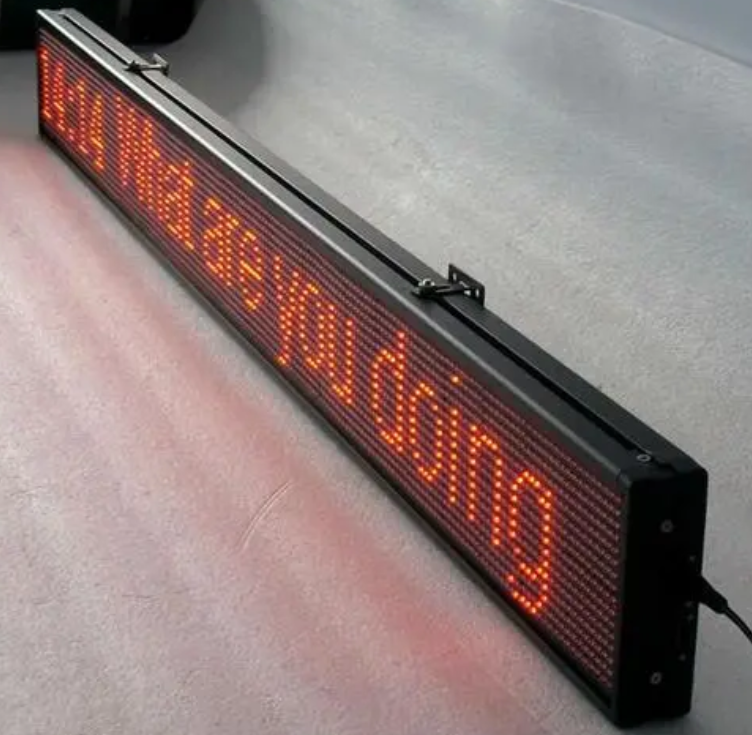
Monochrome LED Displays: Maximum Brightness, Minimum Cost
A monochrome LED display uses a single color of LED bead — most commonly red, amber, green, or white. There is no color mixing, no RGB driver complexity, and no multi-chip module cost. That simplicity translates directly into price and performance advantages that full-color panels cannot match at the same budget.
Where monochrome wins:
- Sports scoreboards and timing displays
- Stock market tickers and financial data boards
- Highway variable message signs (VMS)
- Factory floor production counters
- Simple outdoor text advertising (promotions, announcements)
- Religious and community message boards
2026 technical specs for monochrome:
| Spec | Typical Range |
|---|---|
| Pixel pitch | P6–P20 (outdoor); P3–P10 (indoor) |
| Brightness | 4,000–12,000 nits (outdoor) |
| Viewing distance | 6m–100m+ depending on pitch |
| Grayscale | 256–4,096 levels |
| Price | 50–150/m² |
| Lifespan | 80,000–100,000 hours |
The brightness advantage is real. A monochrome red or amber panel at the same power budget as a full-color panel will be significantly brighter, because all the energy goes into one color channel rather than being split across three. For highway VMS applications where readability at 200m+ matters, this is not a minor detail.
Limitation: Content is restricted to one color. You cannot display images, video, or multi-color graphics. If your use case ever expands beyond text and simple graphics, you will need to replace the hardware.
Two-Color LED Displays: A Shrinking Niche
Two-color displays combine two LED chip colors — typically red and green, or red and amber — to produce a limited palette. By varying the relative brightness of each color, they can simulate yellow and a handful of intermediate shades.
In 2023, two-color panels had a meaningful cost advantage over full-color. That gap has largely closed. By 2026, entry-level full-color SMD panels are available at 250–350/m², which is only marginally more expensive than a quality two-color panel. The performance difference is enormous.
Where two-color still makes sense (narrowly):
- Legacy system replacements where the controller infrastructure is already two-color
- Specific traffic management applications with regulatory color requirements
- Ultra-budget indoor text boards where even entry-level full-color is over budget
Where two-color does not make sense:
- Any new installation where content may evolve
- Any application where brand colors matter
- Any screen that will display photography, video, or gradient graphics
The honest assessment: unless you have a specific legacy or regulatory reason, two-color is not worth specifying in 2026. The incremental cost of full-color is too small to justify the permanent content limitation.
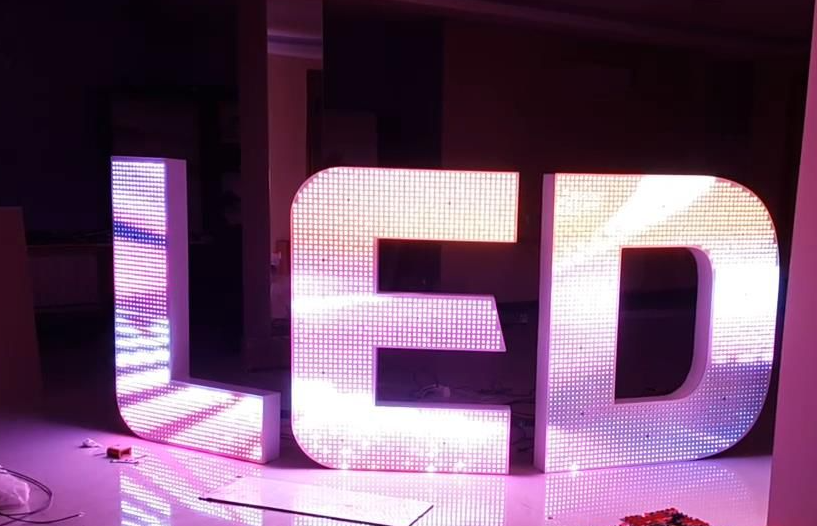
Full-Color LED Displays: The Default for Modern Installations
Full-color LED displays combine red, green, and blue LED chips — either in separate discrete packages (DIP, older technology) or integrated into a single surface-mount device (SMD, current standard) or embedded directly into a substrate (COB, emerging premium standard). The RGB combination produces 16.7 million colors and supports video, photography, animation, and live broadcast content.
This is the category where spec decisions get complex. Pixel pitch, brightness, refresh rate, grayscale depth, and cabinet technology all interact — and getting any one of them wrong produces a screen that looks bad or fails prematurely.
Pixel Pitch: The Resolution Variable
Pixel pitch is the distance in millimeters between the centers of adjacent pixels. Smaller pitch = higher pixel density = sharper image at close range = higher cost.
| Pixel Pitch | Minimum Viewing Distance | Typical Application |
|---|---|---|
| P1.2–P1.9 | 1–2m | Control rooms, broadcast studios, luxury retail |
| P2.0–P2.9 | 2–3m | Corporate lobbies, conference rooms, indoor events |
| P3.0–P4.0 | 3–5m | Shopping mall video walls, indoor advertising |
| P4.0–P6.0 | 4–8m | Outdoor street retail, building facades |
| P6.0–P8.0 | 6–12m | Outdoor billboards, sports venues |
| P8.0–P10.0+ | 8–20m+ | Highway billboards, large outdoor advertising |
Refresh Rate: The Spec Most Buyers Ignore
Refresh rate determines how many times per second the display redraws its image. At low refresh rates, cameras and smartphones capture a rolling scan line — the screen looks fine to the naked eye but produces unwatchable footage.
- Below 960 Hz: Visible flicker in video recordings. Unacceptable for any media-facing installation.
- 1,920 Hz: Minimum for social media content. Acceptable for most indoor applications.
- 3,840 Hz: 2026 standard for outdoor advertising, events, and broadcast-adjacent screens.
- 7,680 Hz: Premium tier for broadcast studios and high-speed camera environments.
Grayscale Depth: The Gradient Quality Variable
Grayscale depth determines how smoothly the display transitions between brightness levels. 8-bit panels (256 levels per channel) produce visible banding in dark gradients and skin tones. 14–16 bit processing (16,384–65,536 levels) is the current standard for quality full-color installations.
SMD vs. COB Technology
SMD (Surface Mount Device) is the dominant technology for full-color displays. Individual R, G, B chips are mounted in a small package and soldered to the PCB. Mature, cost-effective, widely available.
COB (Chip on Board) embeds the LED chips directly into the substrate without individual packaging. The result is a flat, smooth surface with no exposed solder joints. Benefits:
- Better impact resistance (no individual chips to knock off)
- Wider viewing angle (typically 160°+ vs. 120° for SMD)
- Better contrast in ambient light (flat black surface vs. reflective SMD packages)
- Better moisture and dust resistance
COB is now the preferred technology for fine-pitch indoor displays (P1.2–P2.5) and is expanding into mid-pitch applications. It carries a 20–40% price premium over equivalent SMD panels.
2026 Full-Color Pricing Benchmarks
| Screen Type | Pixel Pitch | Price (USD/m²) |
|---|---|---|
| Indoor SMD standard | P2.5–P3.0 | 300–600 |
| Indoor SMD fine pitch | P1.5–P2.0 | 600–1,200 |
| Indoor COB fine pitch | P1.2–P1.9 | 900–2,000 |
| Outdoor standard | P4.0–P6.0 | 400–700 |
| Outdoor premium (IP68) | P4.0–P6.0 | 700–1,200 |
| Outdoor highway | P8.0–P10.0 | 250–450 |
Side-by-Side Comparison: Which Type Is Right for You?
| Dimension | Monochrome | Two-Color | Full-Color |
|---|---|---|---|
| Color range | 1 color | 2–3 colors | 16.7 million colors |
| Content types | Text, simple graphics | Text, basic animation | Video, images, animation, live feed |
| Brightness (outdoor) | Up to 12,000 nits | Up to 8,000 nits | Up to 10,000 nits |
| Price range (USD/m²) | 50–150 | 100–250 | 250–2,000+ |
| Best use case | Scoreboards, tickers, VMS | Legacy replacements only | Most modern applications |
| 2026 relevance | High (niche) | Declining | Dominant |
| Lifespan | 80,000–100,000 hrs | 60,000–80,000 hrs | 50,000–100,000 hrs |
2026 Technology Trends Affecting All Three Categories
Mini-LED clarification: Mini-LED is a backlight technology for LCD panels — not a direct-view LED display type. It improves local dimming and contrast in LCD TVs and monitors. It is not a fourth category of direct-view LED display, despite frequent confusion in marketing materials.
Micro-LED is a direct-view technology using microscopic LED chips. It is currently in commercial deployment for premium large-format displays (Samsung The Wall, Sony Crystal LED) and is expected to reach broader market availability in the 2027–2029 timeframe. It is not yet a practical option for most buyers.
Transparent LED is an emerging full-color variant using low-density pixel arrays on transparent substrates. Transparency rates of 50–80% allow installation on glass facades without blocking natural light. Primarily used in retail storefronts, automotive showrooms, and architectural applications.
AI-driven content management is becoming standard on full-color installations — dynamic scheduling, audience analytics, and automated brightness adjustment based on ambient light sensors are now baseline features on mid-tier CMS platforms.
How to Make the Final Decision
Run through this checklist before specifying a display type:
- Content type — Text only → monochrome. Text + simple color → consider two-color only if budget is extremely tight. Images, video, brand color → full-color.
- Viewing distance — Determine minimum and maximum. Use this to select pixel pitch within the full-color category.
- Ambient light — Outdoor direct sun requires 8,000+ nits. Indoor controlled light can use 800–2,000 nits.
- Recording requirement — Will the screen be filmed for social media or broadcast? Specify 3,840 Hz refresh rate minimum.
- Budget — Calculate total cost of ownership over 5 years, not just hardware. A 150/m2monochromescreenthatlasts10yearsbeatsa300/m² full-color screen that needs replacement in 4.
- Future content needs — If there is any chance the content will evolve to include color or video, start with full-color. Replacing hardware is always more expensive than upgrading content.
FAQ
Q: Is two-color LED still worth buying in 2026?
Rarely. The price gap between two-color and entry-level full-color SMD has narrowed to the point where the content flexibility of full-color almost always justifies the small premium. The main exception is legacy system replacement where existing controllers are two-color.
Q: What is the difference between SMD and DIP LED displays?
DIP (Dual In-line Package) uses separate R, G, B LED lamps inserted through holes in the PCB. It was the standard for outdoor full-color displays before 2015. SMD integrates all three chips into a single surface-mount package. SMD offers better color mixing, smaller pixel pitch capability, and lighter weight. DIP is largely obsolete for new installations.
Q: Can a monochrome display show multiple shades of its color?
Yes. Monochrome displays use grayscale control to vary LED brightness, producing multiple shades of the single color. A red monochrome display can show light pink through deep red. This enables smooth text animations and simple gradient effects.
Q: What does “pixel pitch” actually mean for image quality?
Pixel pitch is the distance between pixel centers in millimeters. A P2.5 display has pixels 2.5mm apart; a P10 display has pixels 10mm apart. Closer pixels = higher resolution = sharper image at close range. The practical rule: minimum comfortable viewing distance in meters ≈ pixel pitch in mm.
Q: Is COB worth the premium over SMD for indoor displays?
For fine-pitch applications (P1.2–P2.5) in high-traffic environments — retail, museums, control rooms — yes. The impact resistance and contrast improvement are meaningful. For standard-pitch indoor displays (P3.0+) in controlled environments, SMD remains the better value.