Quick Answer
An LED display soft module is a flexible LED module built around a flexible circuit board and a soft protective structure, allowing an LED display to form curves and other non-flat geometries that conventional rigid LED modules cannot easily achieve. Depending on the product design, soft modules can be used for cylindrical columns, concave or convex walls, wave-shaped displays, stage designs, retail installations, exhibitions, and other creative LED applications.
The most important point for buyers is that flexible does not mean unlimited bending. The usable curvature, pixel pitch, module construction, mounting method, brightness, refresh rate, and maintenance design all depend on the specific module. For procurement, the minimum bending radius or permitted bending geometry should be confirmed from the manufacturer’s technical specification rather than assumed.
| Item | What Buyers Should Know |
|---|---|
| Core technology | Flexible PCB/FPC combined with LED components and a flexible protective structure |
| Main purpose | Creating curved, cylindrical, wave-shaped, or other non-flat LED displays |
| Key specification | Pixel pitch, module size, brightness, refresh rate, flexibility/curvature, and maintenance method |
| Typical applications | Columns, curved walls, retail, exhibitions, stages, museums, architectural displays |
| Main advantage | Greater freedom in display geometry |
| Main limitation | Higher engineering complexity and potentially higher project cost than a standard rigid LED display |
| Most important buying check | Confirm the manufacturer’s actual bending/curvature specification and mounting requirements |
A soft module is therefore best understood as an engineering solution for difficult display geometries, not simply a softer version of a conventional LED panel.
What Is an LED Display Soft Module?
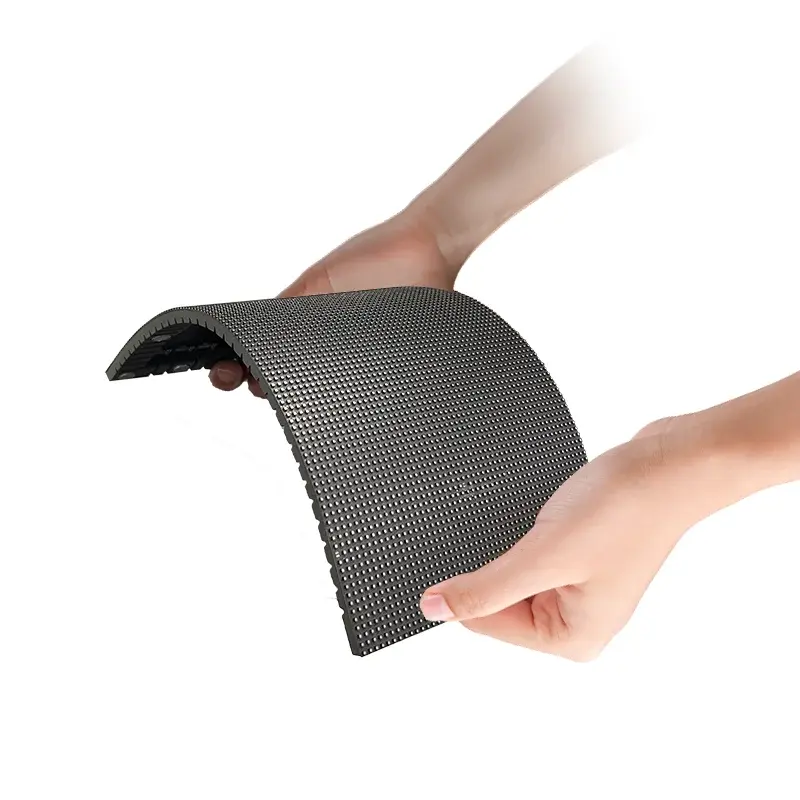
An LED display soft module, also called a flexible soft LED display module, is an LED module designed with a flexible substrate and mechanical structure that allows the module to conform to curved surfaces.
A conventional LED module normally relies on a rigid PCB and rigid supporting structure. That construction is well suited to flat LED cabinets, but it becomes difficult to use when the display must follow a column, arch, wave, circular wall, or other irregular surface.
A soft module changes the mechanical architecture. Flexible PCB technology, LED packages, driver electronics, protective materials, connectors, and mounting components are integrated into a module that can be shaped within its specified mechanical limits.
The display principle itself remains similar to a conventional LED display: LED pixels are controlled electronically to reproduce images and video. The major difference is how the LED components are mechanically supported and how the module can be shaped.
This distinction matters because the flexibility of the module does not eliminate the engineering requirements of the complete display. The supporting frame, magnetic system, power distribution, signal connections, cabinet or backing structure, and maintenance access still have to be designed for the intended geometry.
Why Is It Called a Soft LED Module?
The term “soft” describes the physical construction rather than the image quality.
A soft LED module generally uses flexible materials instead of the rigid board-and-cabinet architecture found in conventional LED displays. Manufacturers use different combinations of flexible PCB, silicone or polymer materials, magnets, masks, and supporting structures.
For example, Hikvision’s current soft-module products describe a flexible multi-layer PCB, a silicone soft panel, and a magnetic mounting structure. Its product range includes P1.25, P1.538, P1.86, and P2.0 examples with 320 × 160 mm modules and 3840 Hz refresh rates. These are manufacturer-specific specifications, not universal industry standards.
The important purchasing lesson is simple:
Do not evaluate a soft LED module only by asking whether it bends. Evaluate how it bends, how it is supported, and how the complete display behaves after installation.
How Does a Flexible Soft LED Display Module Work?
The electronic operating principle is broadly similar to other LED displays, but the mechanical construction is different.
A typical system includes:
- LED packages that produce the red, green, and blue light
- A flexible PCB or similar flexible circuit structure
- Driver ICs
- Power and signal connections
- A protective mask or flexible surface structure
- A mounting system, often involving magnetic attachment
- A supporting frame or shaped cabinet
The exact construction varies by manufacturer and product series.
Flexible PCB
The flexible PCB is one of the most important components because it allows the electronic circuit to conform to a curved structure.
However, flexibility must be considered together with the rest of the assembly. The PCB is not the only component subjected to mechanical stress. LED packages, solder joints, connectors, cables, magnets, masks, and the supporting frame all need to accommodate the intended geometry.
LED Packages and Pixel Pitch
The LED package determines how individual pixels are physically arranged on the module.
Soft modules are available in a range of pixel pitches. Current manufacturer offerings include examples from fine-pitch products around P1.25–P1.9 through larger pitches such as P2, P2.5, P3, P4, and beyond.
A smaller pixel pitch means more pixels are packed into the same physical area. That can improve image detail at short viewing distances, but it generally increases LED density and therefore can increase hardware cost.
Pixel pitch should therefore be selected from the viewing distance and content requirements, not simply because a smaller number sounds better.
Magnetic Installation
Many flexible LED modules use magnetic attachment to simplify installation and module replacement.
This is particularly useful when a display has a complex shape because technicians may need to remove individual modules without dismantling the entire structure.
But magnetic mounting is not a substitute for proper structural design. The supplier should provide a suitable supporting frame, magnetic arrangement, power distribution design, and installation method for the actual screen geometry.
How Flexible Is an LED Soft Module?
This is one of the most important questions to answer before purchasing.
A flexible LED module is not infinitely flexible.
Manufacturers may specify flexibility using different mechanical measurements, including bending angle, minimum bending radius, minimum bending diameter, or a defined assembly diameter. These measurements are not interchangeable. Always use the mechanical specification provided for the exact module model and confirm whether it applies to convex bending, concave bending, or both.
For example, manufacturer documentation may describe flexibility using a bending angle, while other products specify a minimum bending radius or assembly diameter. These specifications should not be converted into one universal “flexibility” number. For a project with a defined curve, provide the supplier with the required radius or diameter and confirm that the proposed module is mechanically compatible.
Therefore, avoid comparing products based only on statements such as “high flexibility” or “can bend freely.”
What Is the Minimum Bending Radius?
The minimum bending radius is the smallest radius through which a flexible component can safely bend under the manufacturer’s specified conditions.
For an LED soft module, the correct value depends on the specific product.
The smaller the required radius, the more demanding the mechanical design becomes. A column with a large diameter is a different engineering problem from a tightly curved ring.
Before ordering, ask the supplier for:
- Minimum bending radius or diameter
- Whether the value applies to convex or concave bending
- Whether continuous curvature is supported
- Whether repeated bending is permitted
- Recommended supporting frame
- Module orientation during installation
- Any restrictions on bending near connectors
- Installation drawings showing the permitted geometry
Do not use a bending specification from one manufacturer’s P2 module to design another manufacturer’s P2 module. Pixel pitch alone does not define mechanical flexibility.
Convex vs. Concave Bending
The direction of curvature matters.
A display may need to bend:
- outward around a column,
- inward around a concave wall,
- repeatedly into a wave,
- around an architectural curve,
- or into a closed cylindrical form.
These configurations can place different mechanical stresses on the module and its connections.
A professional supplier should therefore evaluate the actual geometry, not just the screen’s square-meter area.
What Specifications Matter Most When Buying a Soft LED Module?
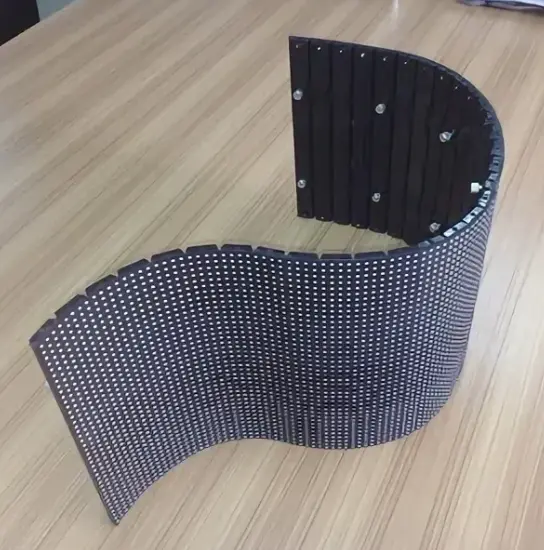
A soft LED module should be evaluated using both display specifications and mechanical specifications.
| Specification | Why It Matters |
|---|---|
| Pixel pitch | Determines pixel density and affects viewing-distance suitability |
| Module size | Affects screen resolution, installation layout, and replacement logistics |
| Brightness | Determines suitability for the intended ambient-light environment |
| Refresh rate | Important for camera capture, events, and professional video applications |
| Viewing angle | Important where audiences view the display from multiple directions |
| Scan mode | Influences electrical architecture and display performance |
| Flexible PCB construction | Directly affects mechanical flexibility |
| Bending specification | Determines whether the module can achieve the required geometry |
| Mounting method | Affects installation speed, stability, and maintenance |
| Maintenance method | Determines how quickly defective modules can be replaced |
| Protection level | Important when environmental exposure requires specific protection |
| Power consumption | Influences operating cost and electrical infrastructure |
| Controller compatibility | Determines system integration requirements |
Pixel Pitch
Pixel pitch is the distance between the centers of adjacent pixels.
A smaller pitch generally provides higher pixel density and can support closer viewing distances.
For example, a P1.5 display has a smaller pixel pitch than P2.5. That does not automatically make P1.5 the better choice.
If the audience is several meters away and the display is mainly used for large graphics or branding, moving to an unnecessarily fine pitch may increase cost without delivering a proportional benefit.
For close-viewing applications such as premium retail interiors, museums, corporate environments, or immersive installations, a finer pitch may be justified.
The correct question is:
What pixel pitch provides the required visual quality at the actual viewing distance?
Brightness
Brightness should be matched to the installation environment.
Indoor creative displays generally have different brightness requirements from outdoor displays exposed to direct sunlight.
Do not select brightness solely by choosing the highest available number. Excessive brightness can increase power consumption and may be visually uncomfortable in dark indoor environments.
The correct specification depends on:
- ambient light
- indoor or outdoor installation
- direct sunlight exposure
- viewing distance
- content
- camera requirements
- local display regulations
Refresh Rate
Refresh rate becomes particularly important when the screen will be photographed or recorded by professional cameras.
Many current soft LED modules advertise refresh rates around 3840 Hz, but buyers should confirm the complete display system rather than assuming the module’s advertised refresh rate alone guarantees camera performance.
Controller, receiving card, scan mode, signal chain, and camera settings can all affect the final result.
Soft LED Module vs. Rigid LED Module: Which Is Better?
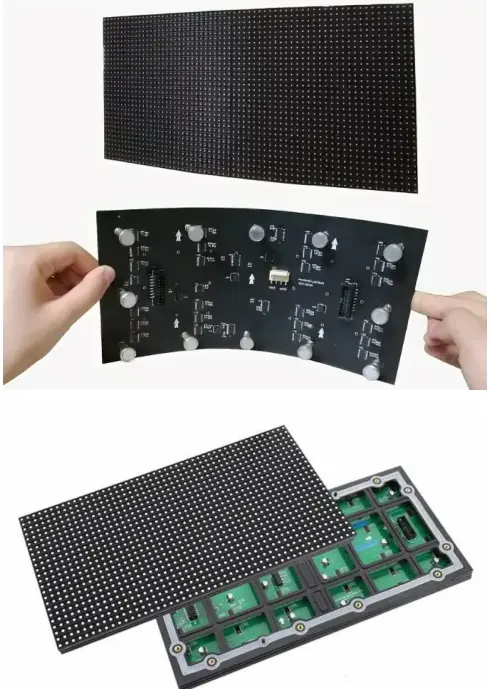
Neither technology is universally better.
The correct choice depends primarily on the geometry and project requirements.
| Factor | Soft LED Module | Rigid LED Module |
|---|---|---|
| Flat screen | Possible | Excellent |
| Curved surface | Excellent | Requires specialized cabinet/structure |
| Cylindrical display | Well suited | More complex |
| Irregular shapes | Excellent | Limited or requires custom fabrication |
| Structural simplicity | Can become complex for custom shapes | Often simpler for flat screens |
| Installation | Flexible but geometry-dependent | Usually straightforward for standard cabinets |
| Maintenance | Often module-level | Module/cabinet dependent |
| Customization | High | Moderate to high |
| Cost | Can be higher for custom projects | Often more economical for standard flat displays |
| Best use | Creative and non-flat geometry | Standard flat LED walls and conventional installations |
When Should You Choose a Soft Module?
A soft LED module makes sense when the shape itself is part of the display requirement.
Good candidates include:
- cylindrical columns
- curved architectural surfaces
- wave-shaped displays
- creative retail installations
- exhibition structures
- stage backgrounds
- museum displays
- immersive environments
- irregular architectural features
When Is a Soft Module Unnecessary?
If the required display is simply a large flat rectangle, a standard rigid LED solution may be more practical.
There is little commercial value in paying for flexibility that the project will never use.
This is an important B2B purchasing principle:
Buy the mechanical capability your project needs—not the most technically impressive specification available.
Where Are LED Soft Modules Used?
Cylindrical LED Columns
Columns are one of the clearest applications for flexible modules.
A rigid rectangular cabinet cannot naturally wrap around a column without additional mechanical solutions. A soft module can conform to the cylindrical surface when its bending specification is appropriate.
Typical applications include:
- shopping malls
- hotels
- corporate lobbies
- exhibitions
- entertainment venues
- architectural branding
Curved Walls
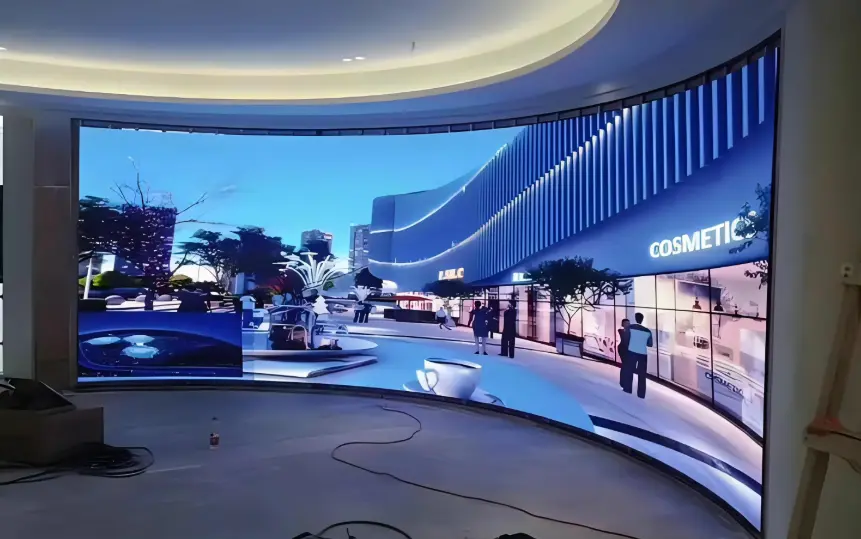
Flexible modules can follow concave or convex architectural surfaces, creating a continuous visual surface where conventional flat cabinets would require segmented construction.
The important consideration is not merely whether the wall is curved, but how tightly it curves and how accurately the support structure follows the intended profile.
Retail and Brand Environments
Retail environments often use unusual display geometry to make a visual statement.
A flexible LED display can be integrated around:
- pillars
- curved counters
- feature walls
- product zones
- entrances
- branded architectural structures
Stage and Entertainment
Flexible LED modules can be used where stage designers require curved, wave-shaped, or other creative forms.
For live events, however, refresh rate, processing, installation time, weight, structural safety, and maintenance access become especially important.
Museums and Exhibitions
Museums and exhibitions often require displays to integrate with unusual architecture rather than occupy a simple rectangular wall.
In these situations, flexibility can be a practical installation advantage rather than simply a visual feature.
How Much Does a Flexible LED Display Cost?
There is no reliable universal price for an LED soft module because the final cost depends on the configuration and project geometry.
The most important cost variables include:
- pixel pitch
- LED package
- module size
- LED density
- brightness
- refresh rate
- control system
- supporting structure
- magnetic system
- custom cabinet design
- installation complexity
- shipping
- spare parts
- maintenance requirements
A finer pixel pitch generally increases LED density and can increase the module cost. But the screen’s geometry can be just as important.
A simple flat flexible display and a custom cylindrical installation may use similar LED modules but have very different total project costs.
Why Module Price Is Not the Same as Project Price
For B2B procurement, the budget should be considered as a system rather than a box of modules.
A practical project budget may include:
| Cost Category | What to Consider |
|---|---|
| LED modules | Pixel pitch, LED package, quantity |
| Cabinet/frame | Custom geometry and supporting structure |
| Control system | Sending cards, receiving cards, processor and related hardware |
| Power distribution | Power supplies, distribution units and cabling |
| Installation | Labor, access equipment and commissioning |
| Shipping | Packaging, freight and delivery |
| Customs | Duties, taxes and local import costs where applicable |
| Spare parts | Recommended replacement modules and components |
| Maintenance | Technician access and replacement procedures |
| Content/control | Media player, content system or CMS where required |
| Structural engineering | Custom support for complex architectural shapes |
Note: Technical specifications such as pixel pitch, module dimensions, brightness, refresh rate, power consumption, and bending capability are model-specific. Manufacturer examples are useful for comparison, but they should not be treated as universal specifications for all soft LED modules. Request the latest datasheet for the exact product being quoted.This is why a supplier quotation should clearly distinguish LED hardware cost from the complete installed project scope.
What Are the Hidden Costs of a Soft LED Display?
The most frequently overlooked cost is often the supporting structure.
A flexible module can bend, but the final screen still needs a structure that holds the modules at the correct geometry.
For complex installations, buyers should also consider:
Structural Engineering
The frame must match the intended curvature and provide sufficient support.
Installation Labor
A complex cylindrical or irregular display can require more installation time than a standard flat wall.
Power and Signal Distribution
The electrical design must accommodate the final module arrangement rather than simply the total screen area.
Maintenance Access
A beautiful curved display is not commercially successful if technicians cannot reach defective modules efficiently.
Spare Modules
A reasonable spare-parts strategy can reduce downtime, especially for permanent commercial installations.
Shipping and Packaging
Soft modules may be lightweight, but project-specific frames, cabinets, power equipment, and protective packaging can significantly affect logistics costs.
How Do You Choose the Right Flexible Soft LED Display Module?
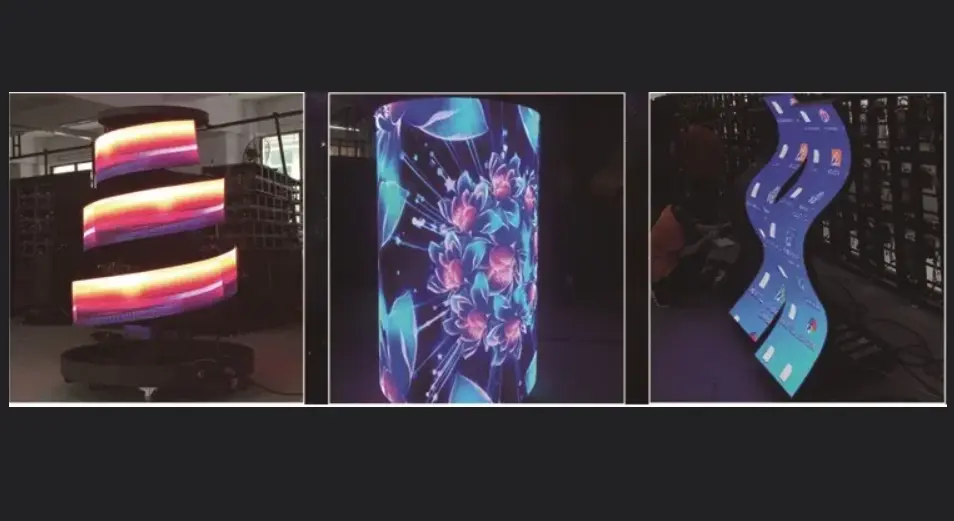
Use the following decision sequence instead of starting with the lowest price.
1. Define the Display Geometry
Draw or provide:
- width
- height
- radius
- circumference
- curve direction
- number of curves
- installation orientation
For a cylindrical display, provide the column diameter or circumference.
2. Determine the Viewing Distance
Estimate the nearest, normal, and farthest viewing positions.
Then select an appropriate pixel pitch.
Do not choose pixel pitch independently from viewing distance.
3. Define the Environment
Identify whether the display is:
- indoor
- semi-outdoor
- outdoor
- directly exposed to sunlight
- exposed to moisture
- exposed to dust
- exposed to physical contact
The environmental requirement can change the appropriate product architecture.
4. Confirm the Required Curvature
This is critical.
Ask for the manufacturer’s permitted:
- minimum radius
- minimum diameter
- convex curvature
- concave curvature
- installation orientation
If the supplier cannot provide a clear mechanical specification, treat that as a procurement risk.
5. Decide How the Screen Will Be Maintained
For permanent installations, ask:
Can a technician replace one defective module without removing a large section of the display?
Front-access magnetic designs can be valuable where rear access is limited.
6. Confirm Display Performance
Check:
- brightness
- refresh rate
- grayscale
- viewing angle
- color consistency
- controller compatibility
7. Calculate the Complete Project Cost
Do not compare suppliers using only:
USD/m²
Compare the complete BOM and scope.
What Should You Ask an LED Soft Module Supplier?
Before placing an order, request written answers to the following questions:
- What is the exact pixel pitch?
- What is the module size?
- What is the module resolution?
- What LED package is used?
- What brightness is guaranteed?
- What refresh rate is guaranteed for the complete system?
- What is the minimum bending radius or diameter?
- Does the specification apply to convex, concave, or both?
- What supporting frame is required?
- How are the modules mounted?
- Is front maintenance available?
- What is the recommended spare-parts ratio?
- What controller and receiving cards are compatible?
- What are the maximum and typical power requirements?
- What environmental protection is provided?
- What installation drawings are included?
- What is included in the quotation?
- Which costs are excluded?
- What warranty terms apply?
- What after-sales and technical support is available?
For a custom curved project, also provide the supplier with a drawing or 3D geometry whenever possible. A square-meter quotation alone is not enough to validate a complex installation.
Common Buyer Mistakes With Soft LED Modules
Mistake 1: Assuming All Soft Modules Have the Same Flexibility
They do not.
Different products can use different flexible PCBs, masks, magnets, connectors, and mechanical structures.
Mistake 2: Choosing the Smallest Pixel Pitch Automatically
A finer pixel pitch can improve image detail, but it also increases pixel density and cost.
The correct selection starts with viewing distance and content.
Mistake 3: Comparing Only the LED Module Price
A low module price does not necessarily mean a low project cost.
Structure, controller, installation, shipping, maintenance, and spare parts can materially affect the total budget.
Mistake 4: Ignoring Maintenance
A screen that is difficult to service can become expensive over its operating life.
Maintenance access should be part of the design before production.
Mistake 5: Treating “Flexible” as “Unlimited”
This is perhaps the most important technical mistake.
Always request the manufacturer’s mechanical limits.
Mistake 6: Using a Standard Flat-Screen Design for a Complex Curve
The module is only one component.
For irregular geometry, the frame, mounting system, power distribution, signal routing, and cabinet architecture should be engineered as one system.
Is an LED Soft Module Suitable for Outdoor Use?
Some flexible LED products are designed for outdoor applications, while many soft modules are primarily intended for indoor creative displays.
Therefore, “soft module” alone does not establish outdoor suitability.
For outdoor projects, verify the specific product’s:
- protection rating
- brightness
- temperature range
- moisture resistance
- UV resistance
- connector protection
- power-system design
- structural requirements
- wind-load considerations
Do not take an indoor flexible module and assume that its flexible construction makes it suitable for permanent outdoor use.
The environmental specification must come from the actual product.
What Is the Difference Between a Soft LED Module and a Flexible LED Display?
The terms are often used interchangeably, but they can describe different levels of the system.
A soft LED module is generally an individual modular component.
A flexible LED display usually refers to the complete display assembled from flexible modules, supporting structures, control hardware, power systems, and other components.
This distinction is useful when discussing procurement.
If you need replacement modules, you may be buying only the module.
If you are developing a complete cylindrical LED installation, you need a display solution, not simply a box of flexible modules.
When Is the Higher-Cost Flexible Configuration Justified?
A more expensive configuration can be justified when its technical capability solves a real project constraint.
Examples include:
- very close viewing distance requiring finer pixel pitch
- demanding camera environments requiring high refresh performance
- tight curvature requiring specialized flexible construction
- limited rear access requiring front maintenance
- unusual geometry requiring custom mounting
- high ambient light requiring higher brightness
- permanent commercial operation where serviceability matters
The key is to connect the additional specification to a measurable project requirement.
If a feature does not solve a real problem, it may simply increase the purchase price.
A Practical Buyer Checklist
Before approving a flexible LED display project, confirm these five areas:
Geometry
- Screen dimensions confirmed
- Radius/diameter confirmed
- Convex or concave direction confirmed
- Supporting structure designed
Display
- Pixel pitch selected from viewing distance
- Brightness matched to environment
- Refresh rate confirmed
- Viewing angle checked
Mechanical
- Minimum bending radius confirmed
- Mounting method confirmed
- Module replacement method confirmed
- Connector locations reviewed
Electrical
- Power requirements calculated
- Power distribution designed
- Signal architecture confirmed
- Controller compatibility verified
Commercial
- Hardware scope confirmed
- Structure included/excluded clearly
- Installation scope confirmed
- Shipping and customs identified
- Spare parts discussed
- Warranty terms documented
- After-sales support confirmed
FAQ
What is an LED display soft module?
An LED display soft module is a flexible LED display component designed to bend or conform to non-flat surfaces. It typically combines LED components with a flexible PCB and a soft protective structure. The exact flexibility, dimensions, brightness, pixel pitch, and mounting method vary by manufacturer and model.
What is the difference between a soft LED module and a rigid LED module?
A soft LED module is designed for curved or irregular display geometry, while a rigid module is optimized for flat or structurally fixed LED displays. Soft modules provide greater shape flexibility, but they can require more specialized structural and installation planning.
Can soft LED modules make a cylindrical LED display?
Yes, flexible modules can be used for cylindrical displays when the module’s specified bending capability is compatible with the cylinder diameter. Buyers should provide the required diameter or radius and confirm the manufacturer’s mechanical specification before ordering.
What is the minimum bending radius of a soft LED module?
There is no single industry-wide minimum bending radius for all soft LED modules. It depends on the product design. Some manufacturers specify bending angles, while others specify a minimum radius or diameter. Always use the technical specification for the exact module being purchased.
Are flexible soft LED modules suitable for outdoor use?
Some are, but not all. Outdoor suitability depends on the specific product’s protection, brightness, environmental resistance, connectors, electrical design, and structural system. Never assume that a flexible module is outdoor-rated simply because it can bend.
Is a smaller pixel pitch always better?
No. A smaller pixel pitch increases pixel density and can improve detail at short viewing distances, but it generally increases cost. Pixel pitch should be selected according to viewing distance, content requirements, display size, and budget.
Are soft LED modules more expensive than rigid modules?
They can be, particularly when the project requires custom geometry, specialized structures, or higher-performance components. However, there is no universal price premium because total cost depends on pixel pitch, configuration, quantity, structure, installation, and project requirements.
Choosing a Soft LED Module for a Real Project
The best soft LED module is not necessarily the most flexible, finest-pitch, brightest, or most expensive option.
It is the one whose mechanical flexibility, image performance, installation method, maintenance access, and total cost match the actual project requirements.
For a simple flat LED wall, a rigid solution may be the more efficient choice. For a cylindrical column, architectural curve, wave-shaped installation, or other irregular surface, a flexible soft module can reduce some of the mechanical constraints associated with conventional rigid cabinets and may simplify certain curved or irregular display designs. The supporting structure and installation system still require project-specific engineering.
For procurement, start with the geometry and viewing distance. Then define pixel pitch, brightness, refresh rate, mechanical limits, maintenance method, and environmental requirements. Finally, compare suppliers using the complete project scope rather than module price alone.
Sostron provides LED display manufacturing, product development, engineering support, customized display solutions, installation guidance, and after-sales support for commercial LED projects. For projects involving curved, cylindrical, or other creative LED geometries, the supplier should be involved early enough to review the display shape, module configuration, supporting structure, control system, and maintenance requirements before production.
The right soft LED module is ultimately a system-design decision, not just a component purchase.
References:
NIST — Fundamentals of Display Metrology
U.S. Department of Energy — LED Basics