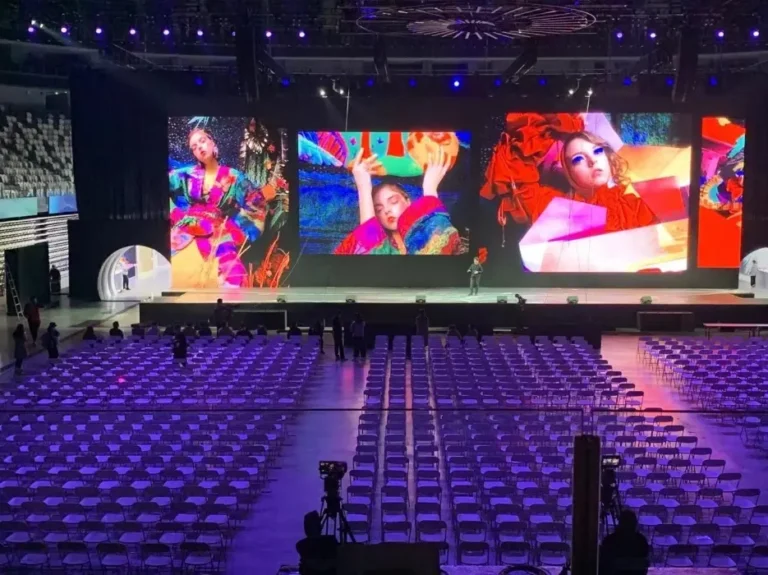
Quick answer: SMD (Surface Mount Device) and DIP (Dual In-line Package) are two different ways of packaging the red, green, and blue LED chips that make up a display pixel. DIP LEDs are larger, brighter, and more weather-resistant — the traditional choice for large outdoor billboards. SMD LEDs are smaller, more energy-efficient, and support much finer pixel pitches — the standard choice for indoor video walls and most modern outdoor displays under fine-pitch requirements.
Key takeaways
- DIP = three (or four) separate colored LED bulbs soldered through holes in the PCB; larger pixel pitch (P4 and up), highest raw brightness (5,000–10,000+ nits), best for large-format outdoor signage viewed from a distance.
- SMD = red, green, blue chips packaged into one compact surface-mounted unit; finer pixel pitch (down to P0.9 and below), wider viewing angle, better color uniformity, dominant technology for indoor displays and most outdoor DOOH today.
- Neither is universally “better” — the right choice depends on viewing distance, ambient brightness, budget, and installation environment.
- SMD ≠ higher brightness. DIP ≠ higher resolution. Don’t confuse packaging type with performance tier — see the comparison table below.
SMD vs DIP: The Core Difference in Packaging Technology
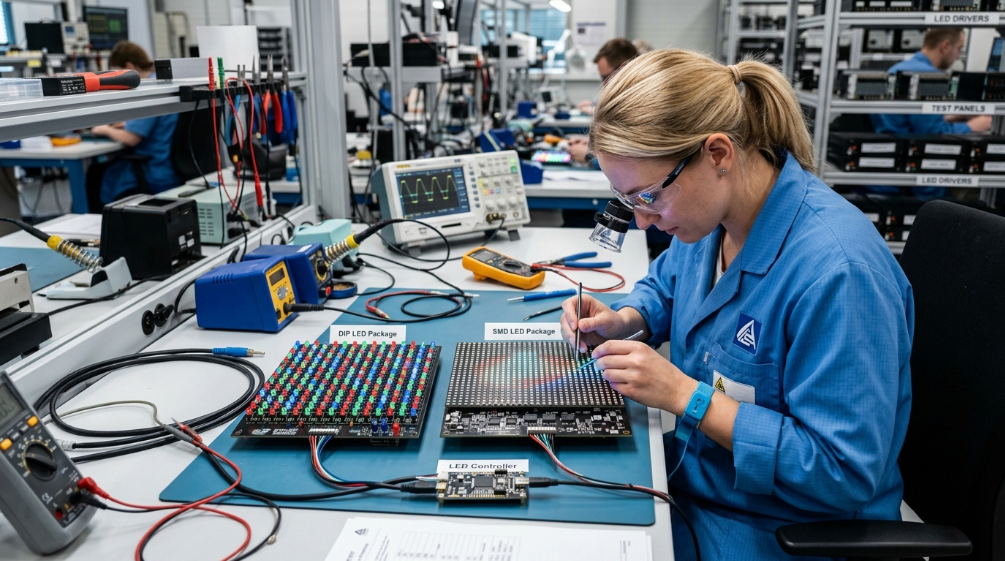
The difference between SMD and DIP LED comes down to how the LED chip is mounted onto the circuit board — and that single manufacturing choice cascades into every other spec that matters to a buyer.
DIP (Dual In-line Package) LEDs are built like a miniature version of a traditional incandescent bulb: each red, green, and blue diode is individually encased in an epoxy lens with two long metal leads. Those leads are inserted through drilled holes in the PCB and wave-soldered from the back — a manufacturing method called through-hole technology. Because each color is a physically separate bulb, DIP pixels are visibly “dotted” up close and cannot be packed closer than roughly 4mm apart (P4) without the leads interfering with each other.
SMD (Surface Mount Device) LEDs take a different approach: the red, green, and blue chips are packaged together inside a single compact plastic housing with short stub leads, then placed and reflow-soldered directly onto the surface of the PCB by automated pick-and-place machines. Because there’s no need for drilled through-holes, SMD packages can be made dramatically smaller — from around 5mm down to under 1mm — which is what allows fine-pitch displays (P0.9, P1.2, P1.5) to exist at all.
In short: DIP ≠ SMD in brightness alone — DIP is a mounting method optimized for raw output and ruggedness; SMD is a mounting method optimized for density and uniformity. DIP + long viewing distance = best fit. SMD + close viewing = best fit.
Technical Deep Dive: Brightness, Pixel Pitch, and Power
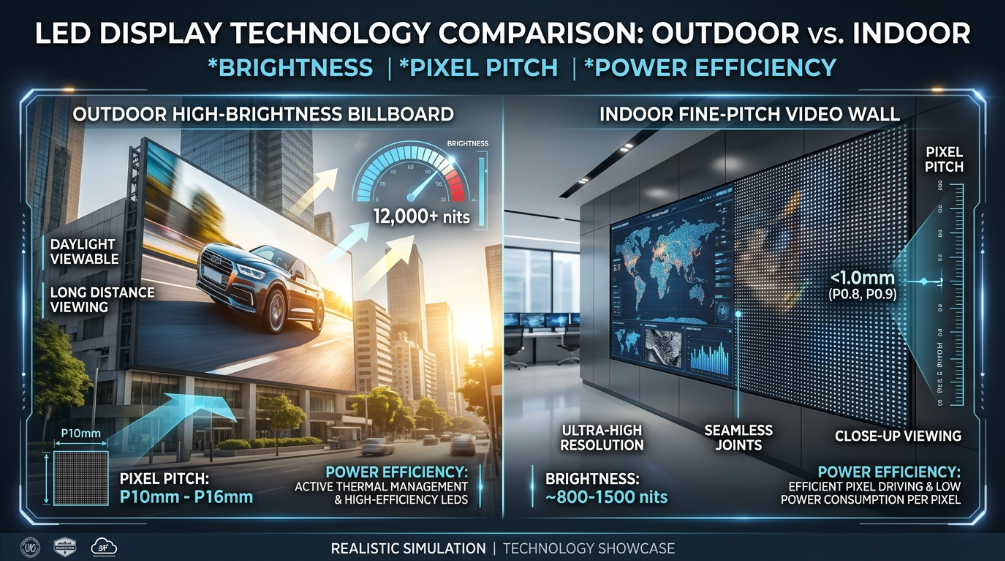
These are the three specs that most directly separate the two technologies in real installations:
Brightness. DIP’s larger physical LED size lets it push more raw light output per pixel. Typical DIP outdoor displays run 5,000–10,000 nits, with some heavy-duty billboard configurations exceeding that for direct sunlight readability at 100+ meters. SMD displays are more efficient per watt but, because each surface-mounted chip is smaller, they typically cap out lower for outdoor use — commonly 5,000–6,000 nits outdoors and 600–1,500 nits indoors, where that level of brightness would be uncomfortably intense anyway.
Pixel pitch and resolution. Pixel pitch is the distance between the centers of two adjacent pixels, and it’s the number that determines minimum comfortable viewing distance. DIP’s through-hole construction sets a practical floor around P4 (4mm); below that, the leads physically don’t fit. SMD has no such constraint — pitches from P10 down to below P0.9 are commercially available, which is why virtually all fine-pitch indoor video walls (control rooms, broadcast studios, retail) use SMD or its more advanced cousin, COB. A widely used rule of thumb is minimum viewing distance (meters) ≈ pixel pitch (mm) × 1, with optimal viewing distance closer to pitch × 2–3.
Power consumption and lifespan. DIP LEDs are generally reported to draw roughly one-third less power than an SMD display of equivalent brightness, largely because they aren’t driving as many densely packed chips. However, SMD’s higher luminous efficacy (typically 50–100 lumens per watt vs. DIP’s lower output per LED) means SMD often delivers more usable brightness per watt in indoor, lower-brightness applications. Both technologies, when properly driven and thermally managed, are commonly rated for 60,000–100,000 hours to 50% brightness — actual field lifespan depends heavily on driver quality, binning, and operating temperature, so treat any single-number lifespan claim as a typical value, not a guarantee, and always ask a supplier for their specific test conditions.
Reliability and maintenance. DIP’s through-hole leads give it a mechanical durability advantage — the display can generally withstand more physical shock and thermal cycling, and cold-solder-joint failures are relatively rare with wave soldering. SMD’s surface-mount joints are more prone to cold soldering defects during manufacturing and can be more fragile in transport or extreme weather, though this is largely mitigated by modern reflow processes and protective conformal coating. On the maintenance side, SMD generally wins for field serviceability: individual lamp beads or entire modules can often be swapped on-site with a hot-air rework tool, while a failed DIP bulb typically requires more involved desoldering and resoldering work.
Application Scenarios: Which Technology Fits Your Project
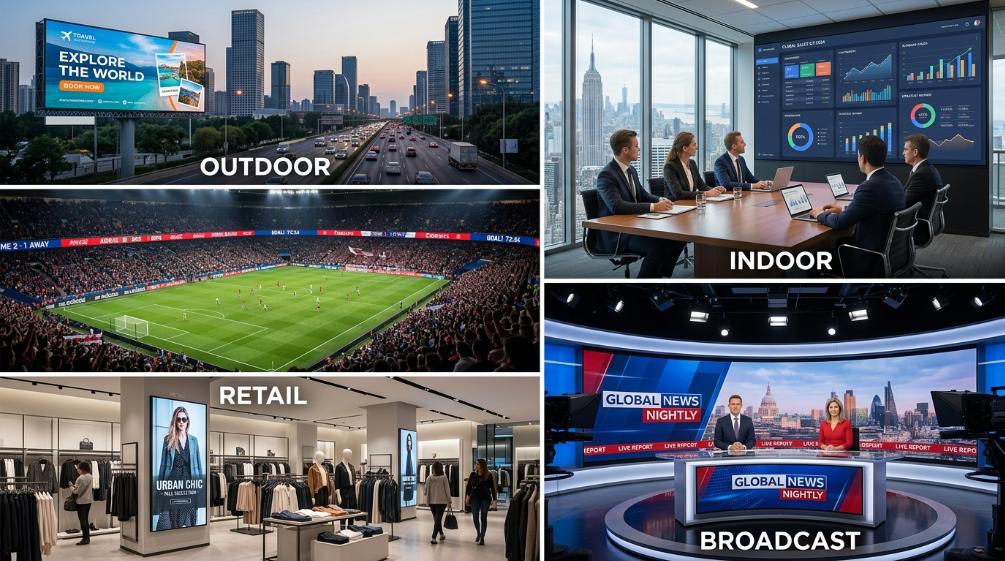
| Scenario | Recommended Technology | Why |
|---|---|---|
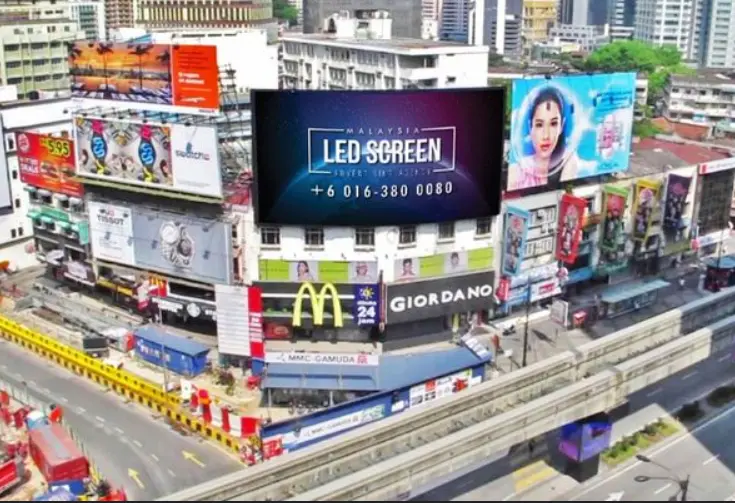
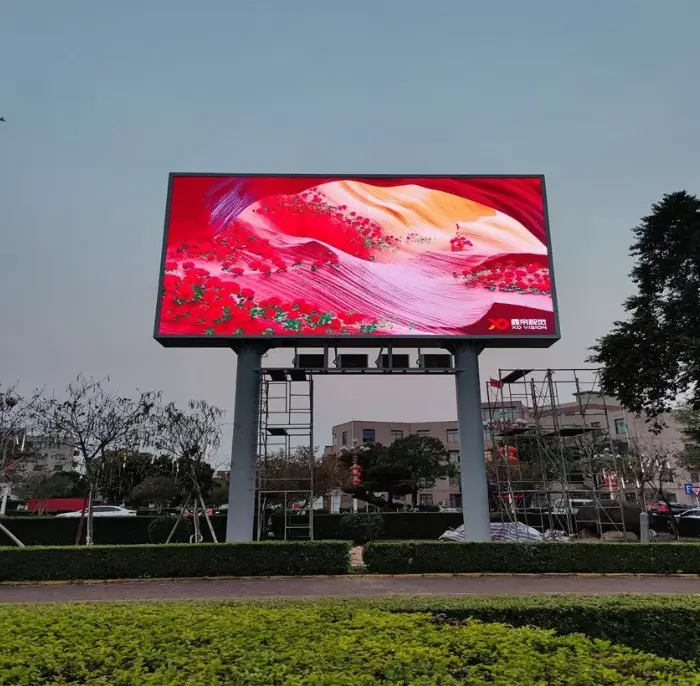
| Outdoor billboards & DOOH (viewed 15m+) | DIP or coarse-pitch SMD (P6–P10) | Highest raw brightness for direct sunlight readability; cost-efficient at large sizes |
| Retail storefront signage (viewed 5–15m) | Fine-pitch SMD (P2.5–P4) | Balances brightness with legible text/graphics at moderate distance |
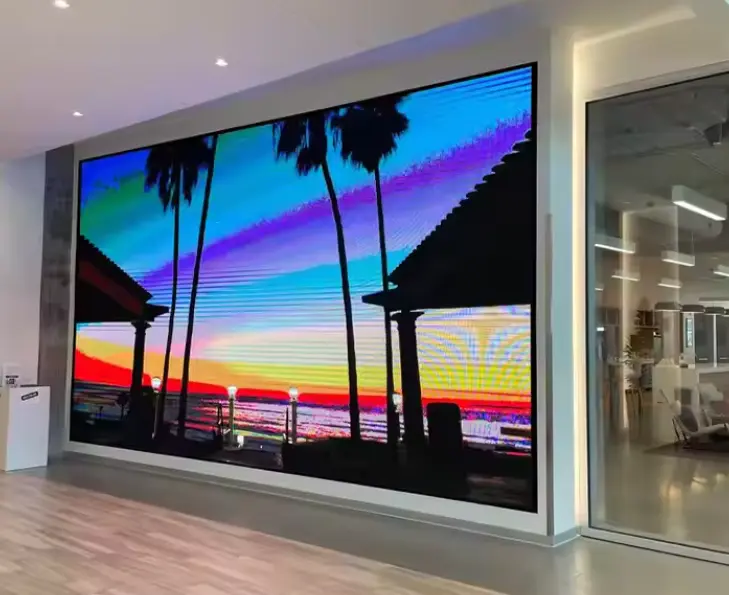
| Indoor video walls / boardrooms (viewed 2–5m) | SMD (P1.2–P1.9) | Fine detail, wide viewing angle, comfortable indoor brightness |
| Broadcast studios & control rooms (viewed <2m) | Fine-pitch SMD or COB (P0.9–P1.5) | Highest resolution, minimal moiré on camera, tight color uniformity |
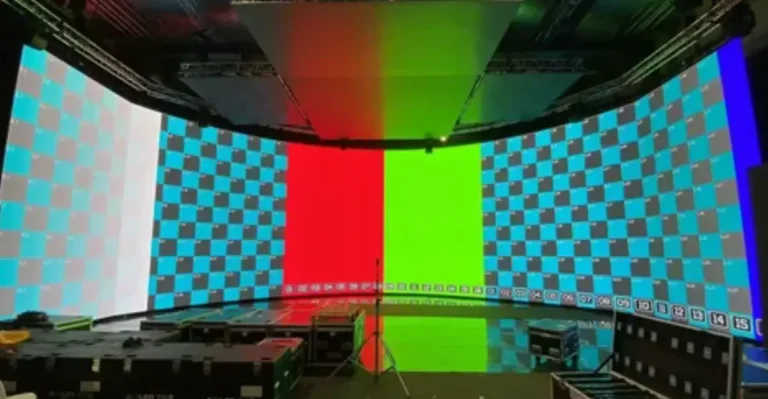
| Stage & rental LED walls | Lightweight SMD cabinets | Needs to be modular, quick-rig, and color-consistent under stage lighting |
| Harsh outdoor / long-term unattended installs | DIP | Superior mechanical ruggedness and weather resistance over a long service life |
If you’re specifying a control room video wall specifically, our Fine-Pitch Indoor LED Display line is built around SMD packaging optimized for close-range color accuracy. For outdoor billboard or DOOH projects, see our Outdoor LED Display Series.
SMD vs DIP LED: Full Comparison Table
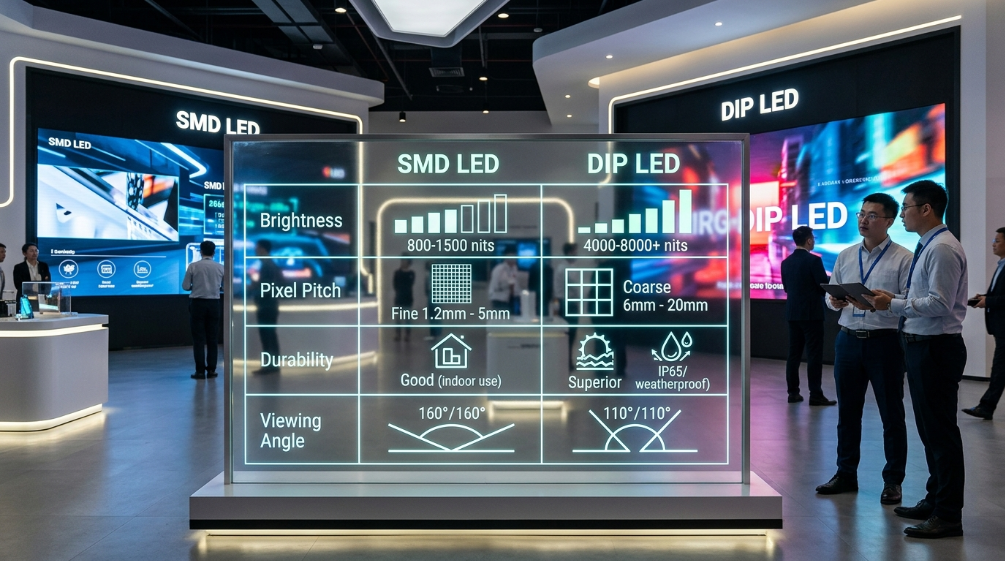
| Dimension | DIP LED | SMD LED |
|---|---|---|
| Packaging method | Through-hole, individually leaded bulbs | Surface-mounted, integrated RGB chip |
| Minimum pixel pitch | ~P4 (practical floor) | Down to <P0.9 |
| Typical outdoor brightness | 5,000–10,000+ nits | 5,000–6,000 nits |
| Typical indoor brightness | Rarely used indoors | 600–1,500 nits |
| Viewing angle | ~100–120° | ~140–160°+ |
| Power consumption (equivalent size) | Lower (~1/3 less, typical) | Higher, but more lumens/watt |
| Weather / impact durability | Higher (rugged, sealed leads) | Moderate (needs conformal coating for harsh use) |
| On-site repairability | Harder (requires desoldering) | Easier (bead/module swap) |
| Best viewing distance | 15m and beyond | Under 15m (down to <1m for fine pitch) |
| Typical use case | Large outdoor billboards, stadium scoreboards | Indoor walls, retail, studios, most modern DOOH |
Figures are typical industry values compiled from manufacturer datasheets and are meant for initial comparison — always confirm exact specifications with your supplier’s test report for the specific model you’re evaluating.
How to Choose: A Buyer’s Decision Checklist
Work through these four questions in order — each one narrows the field:
- What’s the minimum viewing distance? Under 5m → SMD (fine pitch). 5–15m → SMD (mid pitch) or coarse SMD. 15m+ → DIP or coarse SMD/DIP hybrid.
- Is the display indoor or outdoor, and how much ambient light will it face? Indoor / controlled lighting → SMD. Outdoor / direct sunlight, long-term unattended → DIP or high-brightness SMD.
- How important is on-site serviceability vs. raw ruggedness? Frequent access for maintenance → SMD. Remote/unattended, extreme weather exposure → DIP.
- What’s the budget per square meter at your required pitch? DIP is typically more cost-efficient at coarse pitches (P6+) and large sizes; SMD is the only realistic option once you need pitches finer than P4.
Rule of thumb: if your viewers will ever stand closer than about 10 times the pixel pitch (in meters, pitch in mm), SMD is very likely the right call. If the display is large-format, outdoor, and viewed from well beyond that distance, DIP remains a durable, cost-effective option.
Frequently Asked Questions
Is SMD or DIP more expensive?
Per square meter, coarse-pitch DIP is often cheaper for large outdoor displays. Fine-pitch SMD costs more per module but is the only option once you need pixel pitches below P4.
Which lasts longer, SMD or DIP LED?
Both are typically rated 60,000–100,000+ hours to 50% brightness under proper driving conditions. DIP tends to have a mechanical durability edge; actual lifespan depends more on driver quality and thermal design than packaging type alone.
Can SMD and DIP displays be mixed in one installation?
Not within a single seamless panel — the two use different module and cabinet designs. Some venues use DIP for a large outdoor screen and SMD for adjacent indoor displays as separate systems.
Is SMD LED brighter than DIP LED?
Not necessarily. DIP typically achieves higher peak brightness per pixel; SMD is more efficient per watt but usually caps lower in raw nits for outdoor use.
What pixel pitch do I need for a control room video wall?
For viewing distances under 2m, look at P0.9–P1.5 SMD or COB. For 2–5m, P1.5–P2.5 SMD is typically sufficient.
Does DIP LED display still get manufactured in 2026?
Yes, primarily for large-format outdoor billboards, scoreboards, and applications where raw brightness and weather ruggedness outweigh the need for fine detail.
Talk to an LED Display Specialist
Choosing between SMD and DIP — and the right pixel pitch within each — depends on your specific viewing distance, environment, and budget. Get a free consultation and quote from Sostron’s engineering team, or download our full LED display product catalog to compare specs across our indoor and outdoor lines.
References:
IEEE Xplore – Light-Emitting Diodes and Semiconductor Packaging Technology Research
ENERGY STAR – LED Lighting Facts & Technology Information