Quick Summary
- Transparent LED display prices in 2026 range from $1,500 to $5,800+ per square meter, with three distinct tiers based on pixel pitch, brightness, and structural engineering.
- Pixel pitch is the dominant cost driver: halving the pitch (e.g., P7.8 → P3.9) approximately quadruples the LED count per square meter, directly multiplying panel cost.
- Non-panel costs — steel structure, control systems, logistics, and 5-year maintenance — typically add 20–35% on top of the panel price. Quotes that omit these are structurally incomplete.
- For the majority of commercial glass façade and retail window applications, P3.9–P7.8 with 40–60% transparency delivers the best performance-to-cost ratio in 2026.
- A transparent LED display must deliver ≥1,200 nits for indoor use and ≥5,000 nits for outdoor or direct-sunlight glass façades to remain readable during daylight hours.
- True cost evaluation requires calculating Total Cost of Ownership (TCO) over 5 years — energy consumption, maintenance frequency, and spare parts availability routinely determine whether a low-priced panel is actually the cheaper option.
- Driver IC refresh rate should be ≥3,840Hz (ideally 7,680Hz) to prevent scan-line artifacts in smartphone video capture — critical for any installation with a social media or broadcast component.
The Direct Answer: 2026 Transparent LED Pricing by Tier
If you’ve received two quotes with nearly identical specifications where the unit prices differ by 30% or more — that discrepancy is real, and it matters. It reflects differences in LED packaging quality, driver IC specification, structural material grade, and post-sale support that don’t appear in a one-line spec sheet.
Here is the honest 2026 market structure:
| Specification Tier | Pixel Pitch | Transparency | Recommended Applications | Estimated Price (USD/m²) |
|---|---|---|---|---|
| Entry Level | P7.8 – P10.4 | 60 – 80% | Large building façades, high-altitude installs, highway displays | $1,500 – $2,200 |
| Standard Commercial | P3.9 – P7.8 | 40 – 65% | Retail windows, auto showrooms, shopping center atriums | $2,500 – $3,800 |
| High-End Fine Pitch | P1.9 – P2.8 | 30 – 45% | Luxury retail, XR stages, museum interiors, close-range interaction | $4,000 – $5,800+ |
The single most important insight from working with commercial display specifications: in approximately 70% of glass façade and retail window installations, a well-engineered P3.9 solution delivers image quality that is visually indistinguishable from P2.8 at the viewer’s actual distance. Pursuing finer pixel pitch than the installation geometry requires is the most common source of transparent LED budget overruns.
pixel pitch
What Is a Transparent LED Display? Key Specs Explained
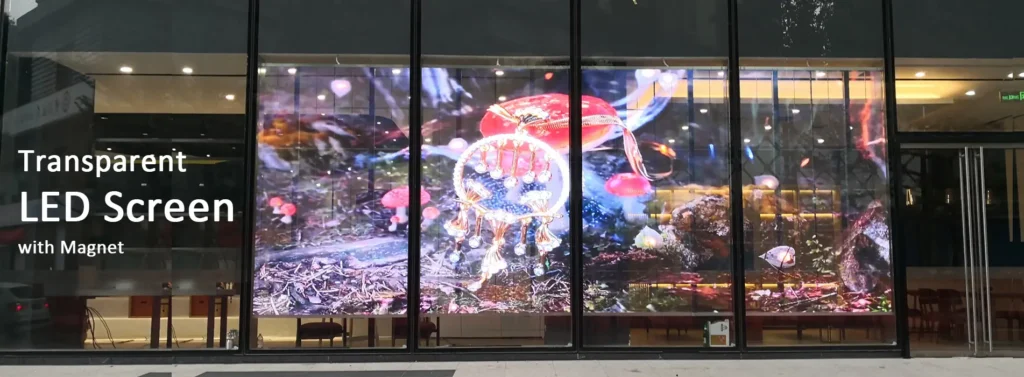
Transparent LED displays differ from conventional direct-view LED panels in one fundamental structural respect: the LED strips are mounted on a sparse grid — either on transparent film substrate or on widely-spaced aluminum bars — rather than a solid backing panel. This allows light to pass through the structure, achieving transparency rates of 30–80% while still displaying content.
The Three Specifications That Define a Transparent LED Panel
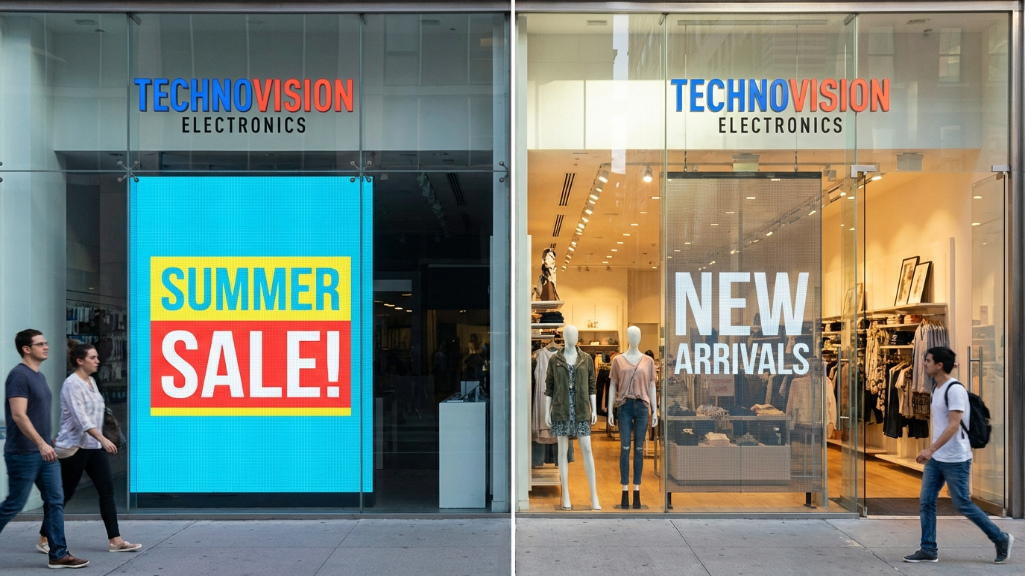
Transparency Rate The percentage of light passing through the display when the screen is off (or displaying black). Higher transparency preserves natural daylight and the visual connection between a retail interior and street-facing pedestrians. Standard commercial installations target 40–60%. Transparency above 70% is achievable but comes at the cost of pixel density and brightness.
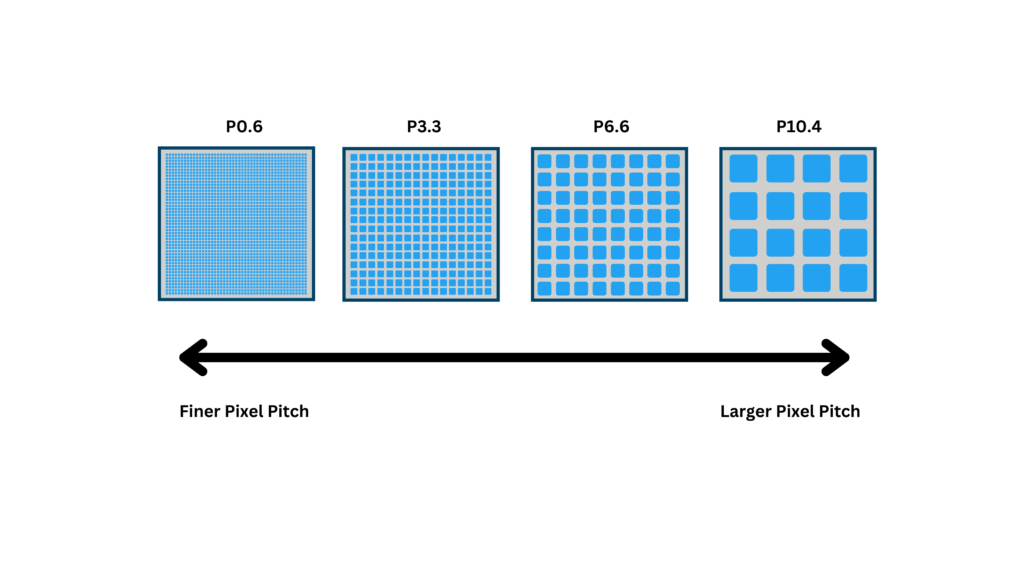
Pixel Pitch The distance in millimeters between adjacent LED pixels. In transparent displays, pitch is constrained by the physical width of the LED strip — narrower strips enable finer pitch but require more precise manufacturing and stronger structural materials. The relationship between pitch and minimum viewing distance follows the same rule as conventional LED: minimum viewing distance (meters) × ~1,000 = appropriate pixel pitch (mm).
Brightness Transparent displays are typically installed in glass-forward environments where they compete with ambient daylight. Minimum effective brightness thresholds:
- Indoor atrium or mall (indirect daylight): ≥1,200 nits
- Retail window facing indirect street light: ≥2,500 nits
- Outdoor glass façade with direct sun exposure: ≥5,000 nits
- Landmark outdoor installations: 6,500+ nits
Five Technical Factors That Drive Price Per Square Meter
Understanding what creates price differences between suppliers is the most practical knowledge a procurement manager can have. In 2026, transparent LED panel pricing is driven primarily by engineering quality rather than by raw LED costs — which have commoditized significantly.
Factor 1: Pixel Pitch and the Quadrupling Effect
Cutting pixel pitch in half multiplies the LED count per square meter by approximately four. This is the single largest price multiplier in transparent LED.
- P7.8 panel: approximately 16,400 LEDs per m²
- P3.9 panel: approximately 65,600 LEDs per m²
- P1.9 panel: approximately 277,000 LEDs per m²
Each LED requires individual soldering, testing, and calibration. At very fine pitches, yield rates during manufacturing decrease, adding further cost. The exponential cost curve at pitches below P2.8 is the reason fine-pitch transparent LED specifications should be justified by actual viewing distance requirements, not aesthetics.
Factor 2: LED Packaging Material — Gold Wire vs. Copper Wire
This is the most commonly invisible quality differentiator in competing quotes.
| LED Packaging | Pros | Cons | Impact on Lifespan |
|---|---|---|---|
| Gold wire bonding | Higher conductivity, slower brightness decay, better heat resistance | 15–25% higher unit cost | Maintains ≥70% brightness at 50,000 hours |
| Copper wire bonding | Lower unit cost | Higher resistance, faster oxidation, increased failure rate in humid environments | May fall below 70% brightness at 25,000–30,000 hours |
For any installation expected to operate for 5+ years in coastal, high-humidity, or outdoor environments, gold wire packaging is not a premium — it is a maintenance cost avoidance measure.
Factor 3: Brightness Engineering and Power Consumption
High brightness in a transparent display is structurally challenging: the LED strips must deliver strong luminance while the overall structure remains lightweight and minimizes heat buildup.
Conventional approach: Higher driving current to achieve brightness targets → increased heat → heavier heat dissipation structures → higher weight and power consumption.
Advanced approach (common cathode technology): Separates power supply circuits for red, green, and blue LEDs, supplying each color at its optimal voltage. This reduces excess heat generation and cuts operational power consumption by up to 40–50% compared to conventional common anode designs — at an initial hardware premium of approximately 5–8%.
For a 100m² installation operating 12 hours/day, the energy cost difference between common anode and common cathode technology at local commercial electricity rates can recover the price premium within 12–18 months.
Factor 4: Structural Engineering and Weight
Transparent LED installations are almost always mounted on glass, suspended in atriums, or integrated into building façades — environments where structural load is a genuine constraint.
| Structural Material | Weight per m² | Cost Impact | Best Application |
|---|---|---|---|
| Standard steel frame | 25–40 kg/m² | Lower upfront | Ground-level, load-tolerant installations |
| Aluminum alloy cabinet | 12–18 kg/m² | +15% material cost | Glass façades, suspended atriums |
| Carbon fiber composite | 4–7 kg/m² | +40–60% material cost | Touring concert rental, high-altitude installs |
Lightweight construction is not cosmetic — it directly determines whether a specific installation requires structural reinforcement of the host building, which can add $5,000–$50,000 in civil engineering costs to a project that selected a heavier panel to save on hardware.
Factor 5: Control System and CMS Integration
In 2026, the control system is as consequential to total cost as the panel hardware for multi-site or long-duration commercial installations.
A complete transparent LED control system includes:
- Sending card (PC or media server side)
- Receiving cards (per cabinet)
- Fiber optic or Cat6 data transmission
- Content management software (CMS) with scheduling and remote monitoring
What separates premium from budget control systems in 2026:
- Real-time fault detection and pixel-level error reporting
- Cloud-based remote management (eliminates physical on-site inspection for routine monitoring)
- Automatic brightness adjustment via ambient light sensor integration
- Hardware-software integration warranty — single-vendor accountability for the full signal chain
For multi-city or international installations, remote cloud management has been shown to reduce on-site maintenance visits by 50–60%, which directly impacts the 5-year TCO calculation.
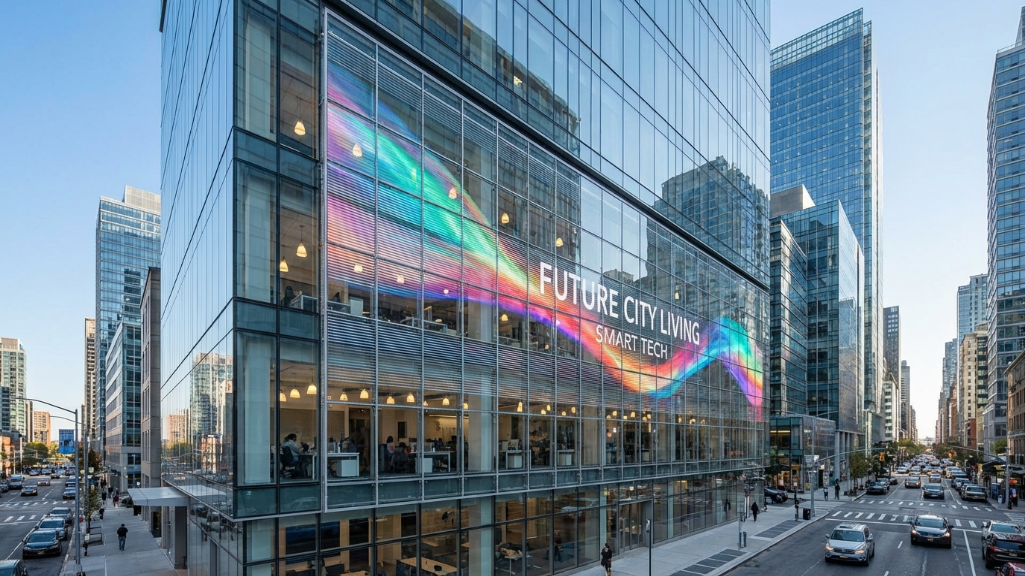
Full Specification and Price Comparison Table
| Specification | P10.4 Entry | P7.8 Standard | P3.9 Commercial | P2.8 High-End | P1.9 Premium |
|---|---|---|---|---|---|
| Price (USD/m²) | $1,500–$1,800 | $1,900–$2,500 | $2,500–$3,800 | $3,800–$5,000 | $5,000–$5,800+ |
| Transparency | 72–80% | 60–72% | 45–65% | 35–50% | 30–40% |
| Min. viewing distance | 8–12m | 6–9m | 3–5m | 2–3m | 1.5–2m |
| Recommended brightness | 1,500–3,000 nits | 2,000–4,000 nits | 2,500–6,500 nits | 3,000–6,500 nits | 3,500–6,500 nits |
| Weight (typical) | 10–14 kg/m² | 12–16 kg/m² | 14–20 kg/m² | 16–22 kg/m² | 20–28 kg/m² |
| Best application | Highway façades, large-area coverage | Retail atriums, mid-range showrooms | Glass façades, auto showrooms | Luxury retail, XR stages | Museum interiors, broadcast studios |
| TCO risk level | Low | Low–Medium | Medium | Medium–High | High |
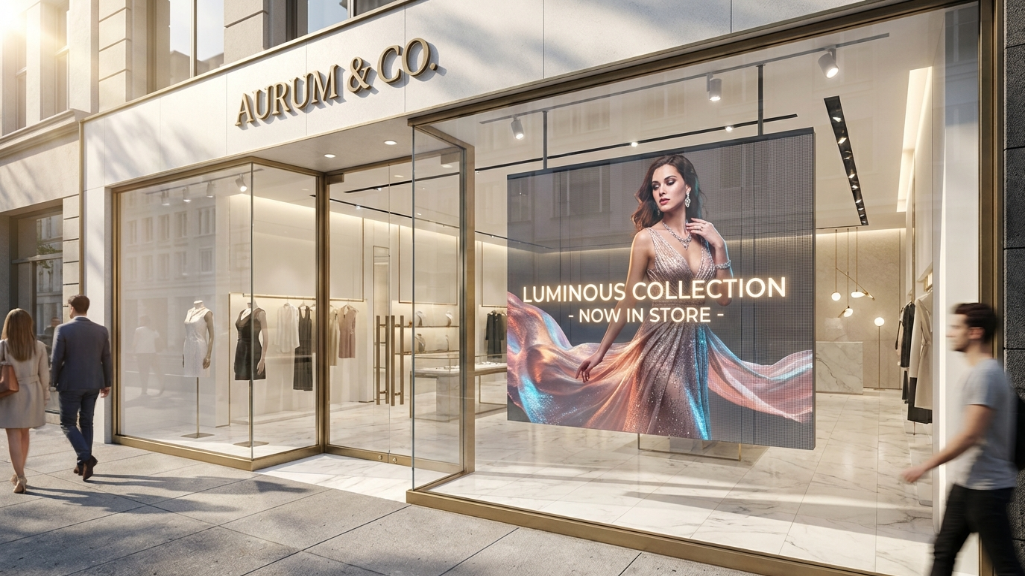
Hidden Costs That Most Quotes Don’t Include
Based on analysis of commercial transparent LED project budgets, non-panel costs account for 20–35% of total project expenditure in the majority of installations. Yet most initial supplier quotes cover only the panel hardware.
Steel Structure and Mounting System
Transparent LED displays require custom mounting structures engineered to the specific host architecture. This is not a commodity item — it requires structural drawings, material specification, fabrication, and on-site installation by certified teams.
- Aluminum substructure for standard glass façade (per m²): $150–$400
- Custom atrium suspension system: $300–$800/m²
- Structural engineering assessment (if required by building code): $2,000–$8,000 flat fee
Sending Cards, Receiving Cards, and Data Infrastructure
A complete signal chain for a 100m² transparent LED installation typically requires:
- 1–2 sending cards/servers: $800–$3,000
- 15–25 receiving cards (one per 4–6 cabinets): $40–$120 each
- Fiber optic or Cat6 cabling and routing: $500–$2,000 depending on installation complexity
Freight, Customs Clearance, and Logistics
Transparent LED panels are precision electronics requiring climate-controlled shipping and custom packaging.
| Shipping Method | Best For | Cost Impact |
|---|---|---|
| Flight cases (foam-padded) | Rental panels, frequent transport | Higher per-shipment cost; reusable |
| Wooden export crates | Fixed permanent installations | Lower per-shipment cost; not reusable |
| Sea freight (FCL) | Large-volume orders (50m²+) | Lowest per-unit freight; 25–45 day transit |
| Air freight | Urgent delivery or small volume | 3–5× sea freight cost per kg |
Import duty rates for LED display equipment vary significantly by destination country — from 0% (Singapore, Hong Kong) to 5–12% (EU, UK) to 15–30% (Brazil, India, some African markets). For international projects, customs duty should be calculated explicitly before signing a supply contract.
Spare Parts Reserve and 5-Year Maintenance Budget
Industry practice recommends reserving 3–5% of the total panel value in spare parts at installation:
- LED strips (primary failure component): 2–3% reserve
- Driver ICs and power supplies: 1–2% reserve
- Receiving cards: 1 spare per 10 active units
A panel that develops color shift, brightness inconsistency, or dead zones after two years — due to mismatched LED binning batches in the original supply or copper-wire bonding degradation — typically costs more to remediate than the initial savings from choosing a lower-priced supplier.
How to Calculate True Total Cost of Ownership (TCO)
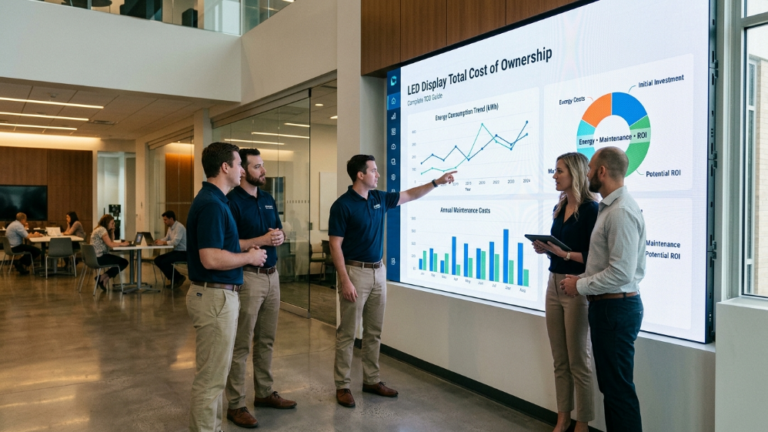
The TCO formula for transparent LED displays over a 5-year operating horizon:
5-Year TCO = Panel Cost + Installation + Control Systems + Freight/Customs + (Annual Energy Cost × 5) + (Annual Maintenance × 5) + Spare Parts Reserve
TCO Comparison Example: 100m² Glass Façade, 12hr/day Operation
| Cost Component | Budget Supplier (P3.9, copper wire) | Premium Supplier (P3.9, gold wire, common cathode) |
|---|---|---|
| Panel hardware | $220,000 | $280,000 |
| Installation and structure | $35,000 | $38,000 |
| Control system | $8,000 | $12,000 |
| Freight and customs | $15,000 | $15,000 |
| Annual energy (12hr/day) | $18,000/yr → $90,000 | $10,800/yr → $54,000 |
| Annual maintenance | $12,000/yr → $60,000 | $6,000/yr → $30,000 |
| Spare parts (Year 2–4 color shift remediation) | $25,000 | $8,000 |
| 5-Year TCO | $453,000 | $437,000 |
The premium panel costs $60,000 more upfront and delivers $16,000 in 5-year savings — while also delivering measurably better image consistency throughout the operating period. The crossover point in this scenario occurs at approximately 18 months.
For installations with longer operating horizons (7–10 years, common in permanent retail and architectural contexts), the TCO advantage of premium panels and energy-efficient driving technology becomes substantially larger.
Case Study: Luxury Mall Glass Façade Installation
Project Requirements
- Installation type: External glass façade, luxury flagship retail store
- Screen area: 80m²
- Key constraint: Maintain visible interior store environment through the display during daylight hours
- Viewing distance: Primary audience at 5–15 meters (street-level pedestrians)
The Core Technical Challenge
A south-facing glass façade in a warm climate receives peak ambient illuminance of 80,000–100,000 lux in the afternoon. A display that cannot maintain readability at these ambient levels fails its primary purpose during peak foot traffic hours.
Technology Comparison at This Installation
| Metric | Conventional Opaque LED | Transparent LED (P3.9) |
|---|---|---|
| Transparency | 0% — interior completely obscured | 55% — store merchandise visible from street |
| Peak brightness | 1,000 nits | 5,500 nits |
| Structural weight | 32–38 kg/m² | 14.5 kg/m² |
| Building load impact | Significant structural reinforcement required | Minimal — standard glass façade anchoring |
| Store ambient light impact | Interior requires 100% artificial lighting | Natural daylight maintained — HVAC/lighting savings |
Outcomes
- Store entry rate increased by approximately 28% in the 90 days following installation, attributed to improved window visibility and content engagement
- Interior daylighting costs remained stable — the 55% transparency allowed sufficient natural light penetration to avoid increased artificial lighting load
- Structural installation completed without building permit modifications due to lightweight aluminum cabinet design
2026 Transparent LED Product Tiers: Which Is Right for Your Project
Rather than reviewing specific branded products, the following framework describes the four functional product categories that represent the 2026 transparent LED market and their appropriate applications.
Category 1: Outdoor High-Brightness (IP65, Common Cathode)
- Specs: P3.9–P7.8, 5,000–6,500 nits, IP65 dual-sided encapsulation, common cathode power
- Best for: Landmark outdoor glass façades, building-integrated advertising, stadium perimeter glass
- Price range: $3,200–$4,500/m²
- Key selection criteria: Verify IP65 certification is dual-sided (both front and rear encapsulated); single-sided IP ratings are inadequate for exposed outdoor glass
Category 2: Standard Commercial Glass Façade (Crystal / Slim Series)
- Specs: P3.9–P5.2, 1,200–5,500 nits, 40–60% transparency, lightweight aluminum cabinet
- Best for: Retail windows, auto showrooms, shopping center atriums, hotel lobbies
- Price range: $2,500–$3,800/m²
- Key selection criteria: Weight per m² (target ≤16 kg/m²) and structural flatness for large seamless installations
Category 3: Lightweight Rental/Touring (Carbon Fiber or Ultra-Slim Aluminum)
- Specs: P3.9–P5.9, 3,000–5,000 nits, 4–8 kg per cabinet, tool-free fast-lock assembly
- Best for: Concert touring, temporary brand activations, exhibition installations
- Price range: $3,500–$5,500/m² (purchase); $80–$150/m²/day (rental)
- Key selection criteria: Cabinet weight and lock-in assembly time are the critical operational specs; verify load-in and strike time with full crew
Category 4: Fine-Pitch Close-Viewing (P1.9–P2.8)
- Specs: P1.9–P2.8, 30–45% transparency, 3,500–6,500 nits
- Best for: Luxury retail interiors, XR virtual production stages, museum installations, broadcast environments
- Price range: $4,000–$5,800+/m²
- Key selection criteria: LED binning batch consistency guarantee (all modules must be from same binning lot to prevent color patching); refresh rate ≥7,680Hz for broadcast camera compatibility
How to Write an RFQ That Protects Your Budget
A well-constructed Request for Quotation forces suppliers to specify the components that determine real-world performance — and creates accountability for the claims that appear in their commercial proposals.
The Three Non-Negotiable Technical Clauses
Clause 1: Driver IC Refresh Rate Specification
“All LED driver ICs must support a minimum refresh rate of 7,680Hz, verified by third-party test report. Refresh rate below this threshold causes visible scan-line artifacts in smartphone video capture at 60fps, which is unacceptable for any installation with social media visibility.”
This single clause eliminates the majority of low-cost driver IC substitutions that reduce panel cost by $80–$150/m² while creating a visible image quality problem the client only discovers after installation.
Clause 2: Power Consumption Documentation
“Quote must specify both maximum power consumption (all LEDs at full white, 100% brightness) and average power consumption (standard content mix at 50% brightness). Energy-saving certification documentation must be provided if common cathode technology is claimed.”
Without this clause, energy consumption claims are unverifiable. The gap between a common anode and common cathode design at 100m², 12 hours/day, over five years is typically $30,000–$50,000 in electricity costs.
Clause 3: LED Binning Batch Consistency Guarantee
“All LED modules supplied for this project must be manufactured from LEDs within the same color coordinate binning batch (ANSI/CTA-861 bin tolerance ±3-step MacAdam ellipse or tighter). Supplier must warrant against visible color non-uniformity for a minimum of 36 months post-installation.”
Color inconsistency between panels sourced from different manufacturing runs is the most common visible quality failure in large transparent LED installations — and one of the most expensive to remediate after installation.
Additional RFQ Clauses Worth Including
- Specify gold wire vs. copper wire LED bonding explicitly — do not accept “LED packaging per specification” without naming the wire material
- Request a sample module from the same production batch as your order for pre-shipment color and brightness verification
- Define IP rating test standard (IEC 60529) and request third-party certification, not self-certification
- Specify warranty coverage territory — confirm whether warranty service requires shipping panels back to the factory or includes on-site response
FAQ
Q: Can a transparent LED display really last 100,000 hours? The 100,000-hour figure is a theoretical LED lamp lifespan under laboratory conditions (25°C, rated current). In real-world operation, lifespan depends heavily on operating temperature, driving current, and environmental conditions. A well-engineered panel with aluminum heat dissipation, operated at 70–80% of maximum brightness in a temperature-controlled environment, realistically achieves 70,000–90,000 hours before falling below 70% of initial brightness. Outdoor installations in hot climates or coastal environments typically see 50,000–70,000 effective hours. These are still substantial operating periods — 12 hours/day at 60,000 hours equals approximately 13 years.
Q: Why do two P3.9 transparent LED quotes differ by 30–40% in price? The visible specification (pixel pitch) is the same; the invisible materials differ significantly. Key differentiators include: gold wire vs. copper wire LED bonding, driver IC refresh rate capability, aluminum vs. steel structural components, common cathode vs. common anode power design, and post-sale support infrastructure. A P3.9 panel with copper wire LEDs, 1,920Hz refresh rate driver ICs, and steel frame genuinely costs 30–40% less to manufacture than a P3.9 panel with gold wire, 7,680Hz ICs, and aluminum construction — and will show measurable performance differences within 2–3 years of operation.
Q: How much does custom shaping or curved installation add to the cost? Standard curved installations (single-axis curve, radius ≥1,000mm) using flexible module designs typically add 15–25% to the panel cost. Complex double-curve or compound geometry configurations add 30–50%. Completely custom shapes (cylindrical columns, spherical installations, irregular architectural integration) require custom tooling and typically add 40–70%. Where rental-format flexible panels can accommodate the required curvature, using standard rental hardware on a custom rigging structure is often more cost-effective than fully custom panel fabrication.
Q: What transparency rate should I specify for a retail window display? For a retail window where the primary goal is displaying dynamic advertising content while maintaining interior merchandise visibility: 45–60% transparency is the optimal range. Below 40%, natural light transmission becomes limiting and interior visibility is significantly reduced. Above 65%, pixel density decreases to the point where text readability at close viewing distances (2–5 meters) degrades. For north-facing windows with lower ambient light, 55–65% transparency is appropriate. For south-facing high-brightness exposure, 40–55% with brightness capability of ≥5,000 nits is the practical specification.
Q: Is a transparent LED display suitable for outdoor installation without a glass substrate? Yes — freestanding transparent LED mesh panels are used in outdoor environments without glass backing, particularly for stage backdrops, building perimeter decorative installations, and temporary structures. In this configuration, the display is mounted on a structural frame and wind load engineering becomes critical. Freestanding outdoor transparent LED typically requires wind load certification for the specific installation geography and may need additional structural bracing for installations above 5 meters in height.
Q: What content looks best on a transparent LED display? Content with high contrast and bold visual elements performs best — large typography, graphic brand elements, and video with high-contrast subjects. Fine detail, small text, and photorealistic images at fine pixel pitches are readable at close range but degrade at the viewing distances typical of glass façade installations. The most effective transparent LED content strategy uses the transparency itself as a design element — content that compositionally integrates with the visible background (store interior, urban streetscape) creates more visual impact than content that treats the screen as an opaque canvas.
Conclusion
Transparent LED display pricing in 2026 is structured and predictable once you understand that the price per square meter is a composite of panel engineering quality, structural materials, and the service infrastructure behind it — not a single commodity rate. The three-tier structure ($1,500–$2,200 for entry, $2,500–$3,800 for standard commercial, $4,000–$5,800+ for fine-pitch) reflects genuine manufacturing cost differences, not arbitrary margin decisions.
The most consequential buying decision is not which tier to choose — it is ensuring that within your chosen tier, you are comparing panels on equivalent invisible specifications: LED bonding material, driver IC refresh rate, structural weight, and IP certification standard. The RFQ clauses in Section 9 give you the specific language to enforce this.
For the majority of glass façade and retail window projects in 2026, a well-specified P3.9 standard commercial panel delivers the optimal balance of image quality, daylight readability, structural weight, and 5-year total cost. Reserve fine-pitch specifications for the installations where viewing distance and broadcast camera requirements genuinely justify the premium.
References:
- ASME/TMS — Aluminum Structural and Heat Dissipation Engineering Standards
- Society for Information Display (SID) — Display Measurement Standard, 2025 Edition