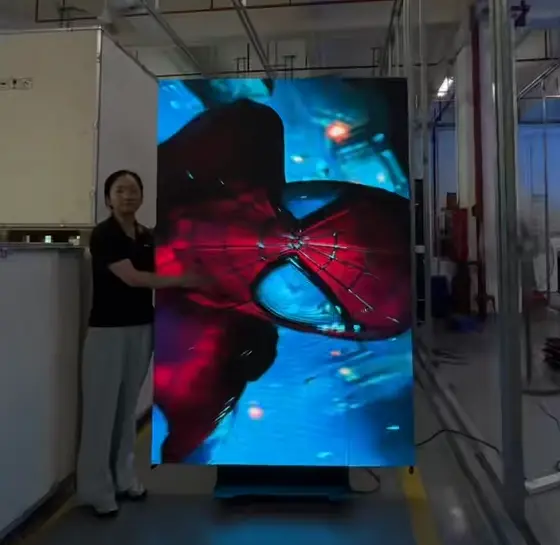
alue cause a nonlinear surge in pixel density. According to [Industry Data], the latest 2026 commercial display shipment report shows that when upgrading a project from P2.5 to P1.25, the physical spacing is only halved, but pixel density per square meter increases fourfold (from 160,000 pixels/㎡ to 640,000 pixels/㎡).
Technical Feature: A smaller P value results in a higher fill factor and a denser light-emitting matrix.
Business Value: This high density enables true 4K or even 8K native display quality in space-constrained environments such as high-end studios or medical imaging centers. The ultra-smooth visual experience directly enhances perceived brand luxury, becoming a key advantage in high-value project bids.
Viewing Distance Golden Rule: Accurately Identifying Your ROI Sweet Spot
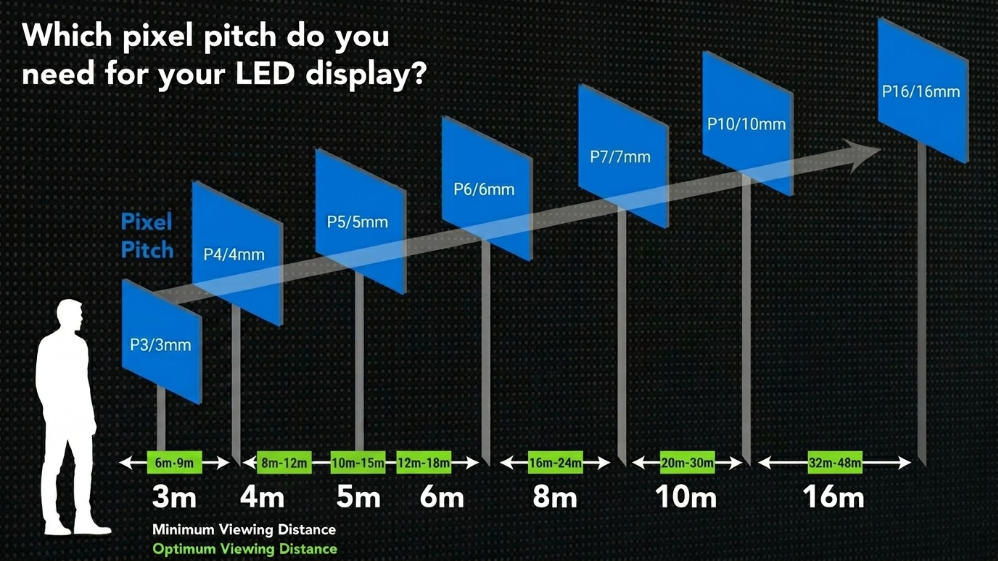
Never evaluate pixel pitch without considering physical space. The core principle of selecting P value lies in matching the viewer’s visual acuity. If you pursue extremely small pixel pitch beyond what the human eye can resolve, you are essentially throwing money into a shredder.
Calculating Optimal Viewing Distance (OVD) and Minimum Viewing Distance (MVD)
Experienced engineers typically rely on the following empirical formulas during site surveys:
- Minimum Viewing Distance (MVD) ≈ P value (mm) × 1 (meter)
Below this distance, viewers will clearly see the “black grid” and individual pixels. - Optimal Viewing Distance (OVD) ≈ P value (mm) × 2.5 (meters)
At and beyond this distance, the human eye can no longer distinguish individual pixels, and the image appears perfectly continuous.
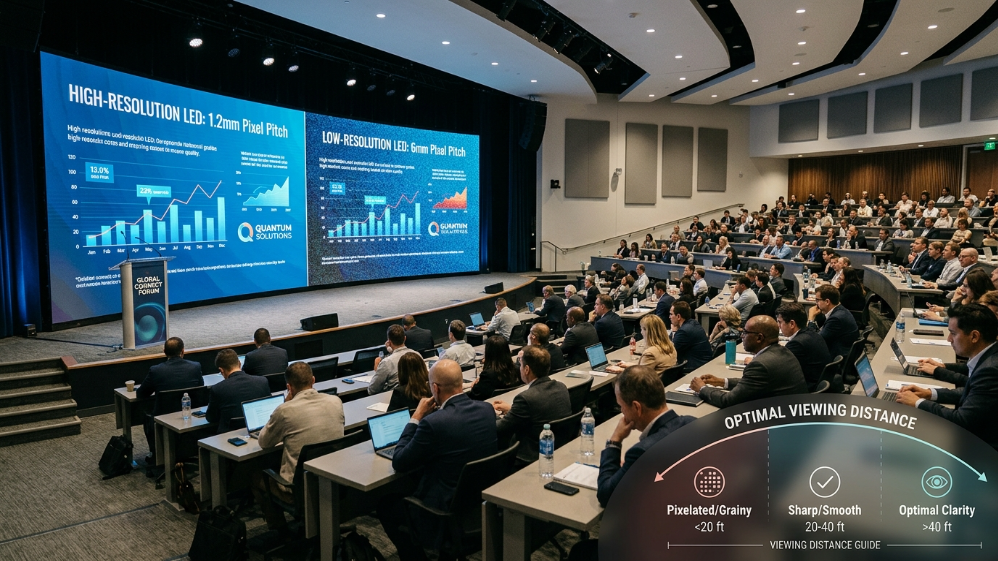
Understanding this logic allows instant filtering of wrong choices during on-site evaluation. For example, if the first row of an audience is 4 meters from the stage, pushing P1.5 offers no visual advantage, while P3.91 becomes the optimal ROI balance between performance and cost.
Table 1: 2026 Mainstream LED Pixel Pitch Viewing Distance & ROI Reference
| LED P Value | Minimum Viewing Distance (MVD) | Optimal Viewing Distance (OVD) | Core Application & Audience Distance | Budget Index |
|---|---|---|---|---|
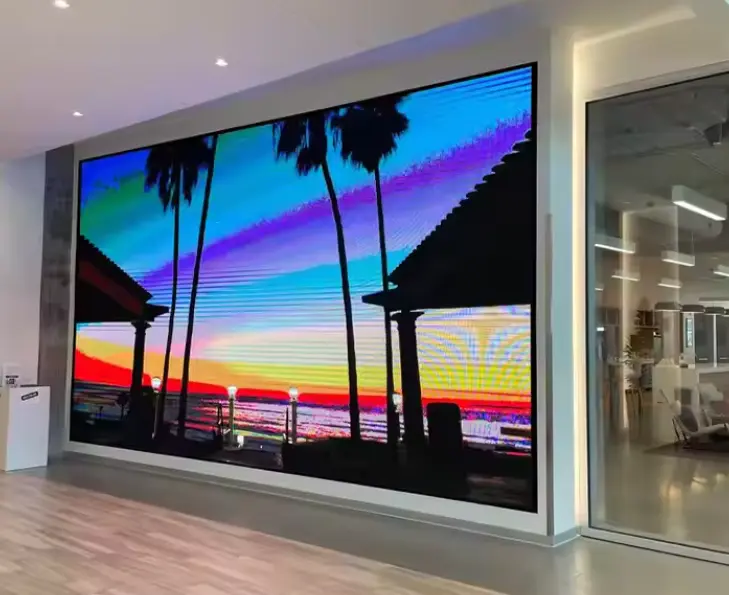
| P1.2 (Fine Pitch) | 1.2m (4 ft) | 3.0m (10 ft) | Boardrooms, security centers, broadcast studios | Very High ($$$$) |
| P2.5 (Standard Indoor) | 2.5m (8 ft) | 6.2m (20 ft) | Retail flagship stores, churches, shopping malls | Medium ($$$) |
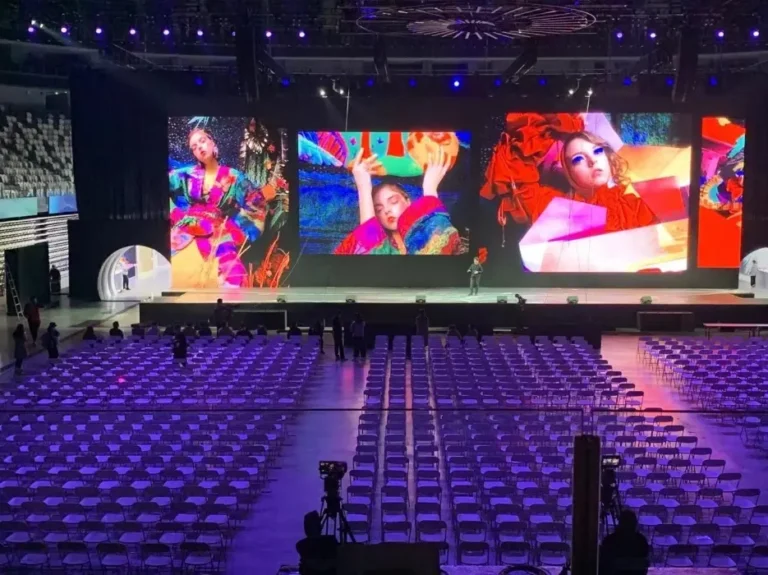
| P3.91 (Rental/Stage) | 3.9m (13 ft) | 9.8m (32 ft) | Concert stages, exhibitions, event screens | Lower ($$) |
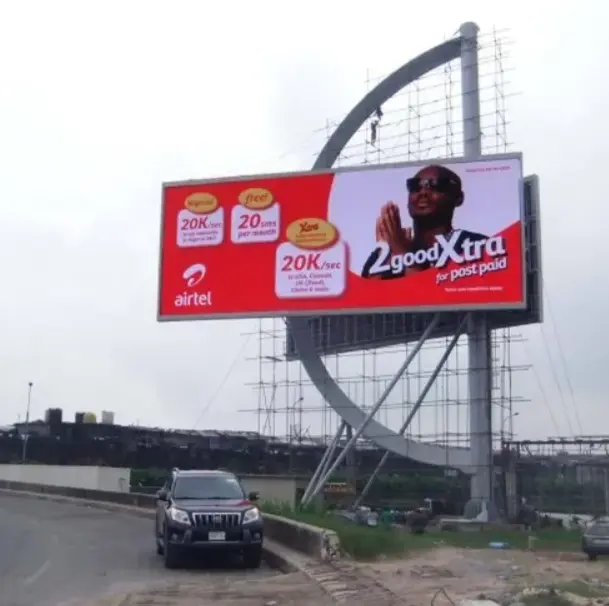
| P8.0 (Outdoor DOOH) | 8.0m (26 ft) | 20.0m (65 ft) | Highway billboards, stadium exteriors | Very Low ($) |
Reverse Engineering: How to Derive Screen Size and Pitch from Target Resolution
Most buyers think in a linear way: define screen size first, then determine resolution. Top-tier system integrators use reverse engineering instead—starting from the resolution matrix and deriving the required physical display area.
Technical Feature: Pixel-level calculation (Target resolution pixels = screen physical size / pixel pitch) is used to determine panel configuration.
Business Value: Ensures perfect matching between display wall and video processor output, eliminating stretching, compression, or cropping artifacts that create a “cheap” visual impression.
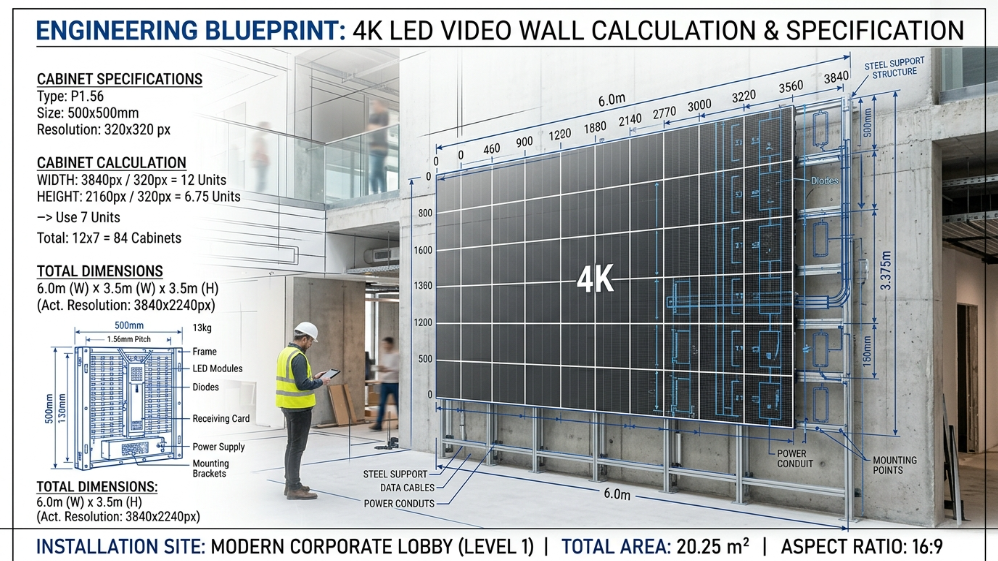
For example, achieving a true lossless 4K display (3840 × 2160) fully depends on pixel pitch.
Table 2: Absolute Physical Size Requirements for Native 4K Resolution (3840 × 2160)
| Pixel Pitch | 4K Width | 4K Height | Engineering Assessment |
|---|---|---|---|
| P0.9 (COB) | 3.45m (11.3 ft) | 1.94m (6.4 ft) | Ideal for low-ceiling indoor environments, extremely expensive |
| P1.5 (SMD) | 5.76m (18.9 ft) | 3.24m (10.6 ft) | Mainstream choice for large conference halls |
| P2.5 (SMD) | 9.60m (31.5 ft) | 5.40m (17.7 ft) | Too large for typical indoor walls |
As shown above, if your wall is only around 4 meters wide but you promise “true 4K experience,” you are forced into expensive P1.2 or even P0.9 solutions. This is why understanding pixel pitch early is the last defense for protecting engineering profit margins. Take you through the 4K LED video wall cost guide: pricing and purchasing tips.
2026 Technical Turning Point: How Packaging Technology Redefines “Visual Pixel Pitch”
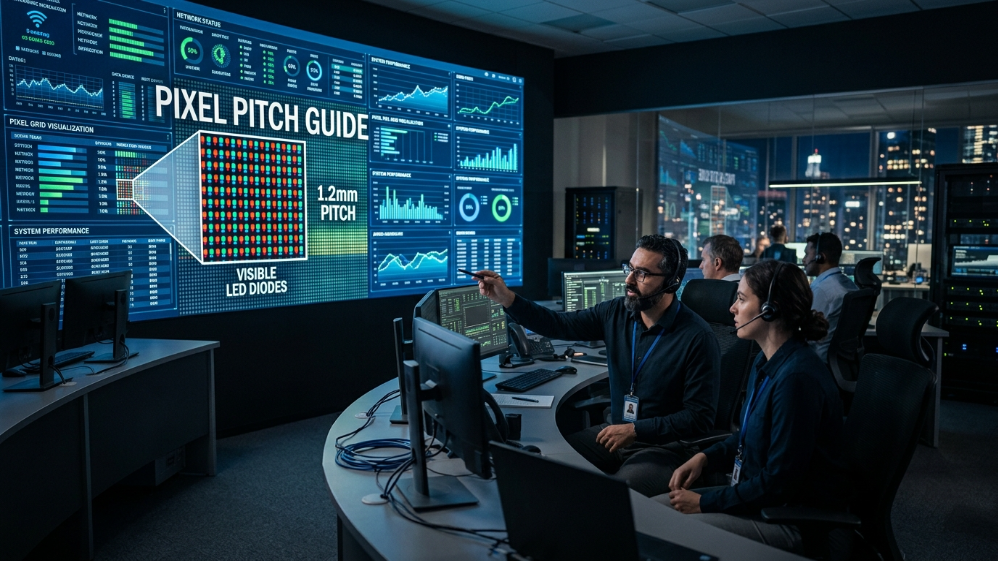
Today, buyers can no longer rely solely on P value. The same P1.5 screen can look drastically different depending on packaging technology. The key difference lies in the battle between COB (Chip on Board) and traditional SMD.
Fill Factor Transformation
Feature: Traditional SMD leaves visible black gaps between LEDs, while COB integrates chips directly onto the PCB and seals them with epoxy resin.
Benefit: This significantly improves fill factor and eliminates pixel graininess. Even at close viewing distances, COB screens avoid visible grid effects. For immersive corporate showrooms and XR virtual production, COB delivers far superior visual continuity compared to SMD of the same pitch.
Eliminating Moiré Effects
In 2026 broadcast studio projects, high contrast and surface uniformity technologies like GOB and COB are preferred. These treatments diffuse light and reduce moiré interference under camera lenses.
Industry Customization Strategy: Pixel Pitch Selection by Application
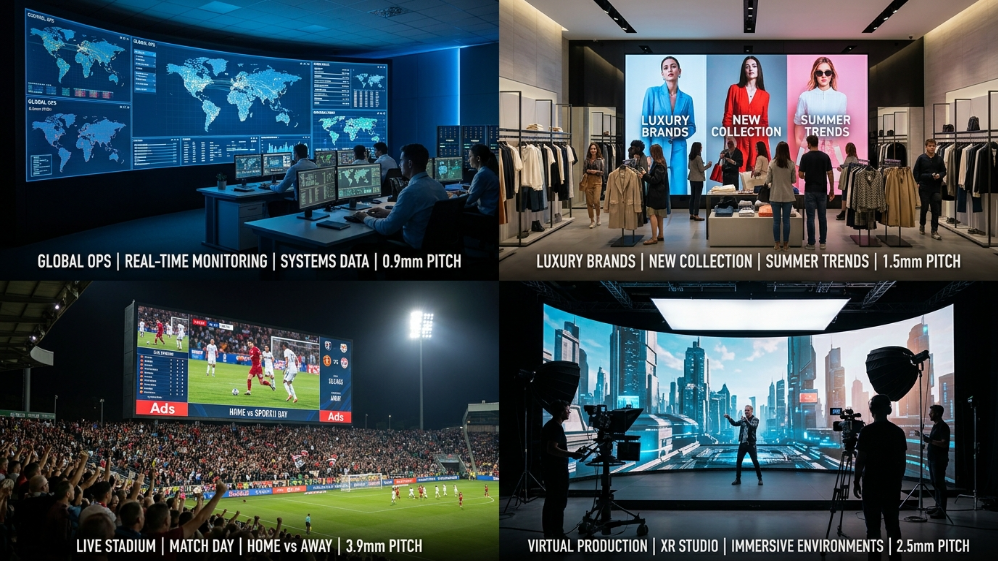
There is no “best” pixel pitch—only the most ROI-efficient configuration for each scenario.
Table 3: 2026 B2B Pixel Pitch Recommendation Matrix
| Industry | Core Requirement | Recommended Pitch | Key Reason |
|---|---|---|---|
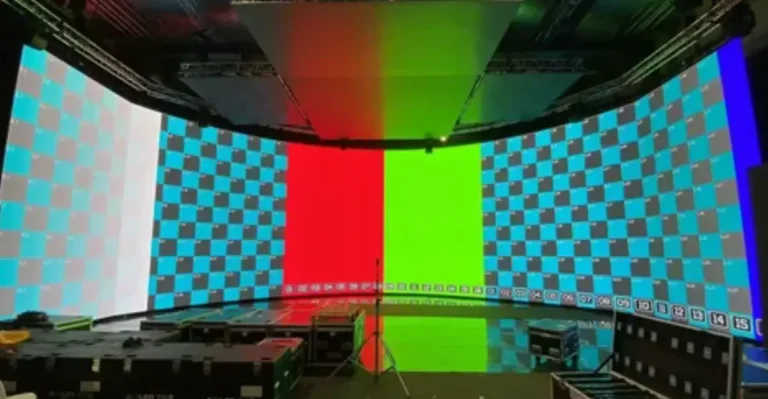
| XR Virtual Production | High sampling rate & no moiré | P1.5–P2.6 | Must sync with camera shutter |
| Control Centers | 24/7 operation & text clarity | P0.9–P1.2 | High density for small text |
| Retail Flagship Stores | Visual impact & durability | P1.9–P2.5 | Balance viewing and protection |
| Stadium Displays | High brightness & long-distance visibility | P6–P10 | Cost-efficient for long viewing distances |
Expert Deep FAQ
Q1: Does smaller pixel pitch mean higher power consumption?
Yes in theory. Halving pitch increases pixel density fourfold, meaning more driver ICs operate. However, 2026 common cathode technology can reduce 20–30% of this increase.
Q2: Can I upgrade modules without replacing the frame?
In most cases, no. Different pixel pitches require different module sizes and mounting structures. Standardized cabinets are recommended for future upgrades.
Q3: Why is P3.91 so popular in rental markets?
It is a “golden compromise.” It performs excellently beyond 10 meters, is easy to assemble, and offers flexible brightness between 500–3000 nits.
Q4: Does pixel pitch affect lifespan?
Smaller pitch increases thermal challenges. Without proper cooling, micro-pitch displays may degrade faster.
Q5: Can virtual pixel technology replace physical pixel pitch?
No. While it improves perceived sharpness through algorithmic processing, it cannot replace true physical pixel density.
Engineering Final Verdict
Never sacrifice minimum viewing distance to save cost.
If your audience is 2 meters away and you choose P3.91 instead of P1.9 to save 30% budget, the project is effectively compromised the moment it powers on—the visible pixel structure will destroy image quality. Conversely, using P6 instead of P10 on a 50-meter building facade wastes budget with no visible gain.
The 2026 best practice is simple: define viewing distance first, then reverse-engineer pixel pitch based on required resolution (4K/8K).
References:
SID – Display Technology and Pixel Density Research
AVIXA Knowledge Center – LED Display Fundamentals