If you’re sourcing an LED screen rental in California for a trade show, DOOH campaign, or corporate event, here’s the bottom line upfront:
| Use Case | Recommended Pixel Pitch | Typical Day Rate (Installed) | Min. Brightness Required |
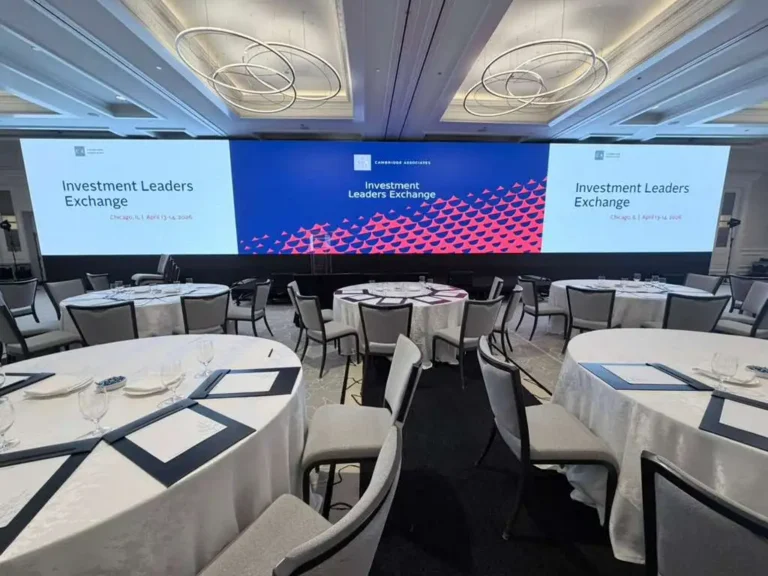
| Indoor conference/trade show booth | P1.9–P2.6 | $2,500–$5,500 | 800–1,200 nits |
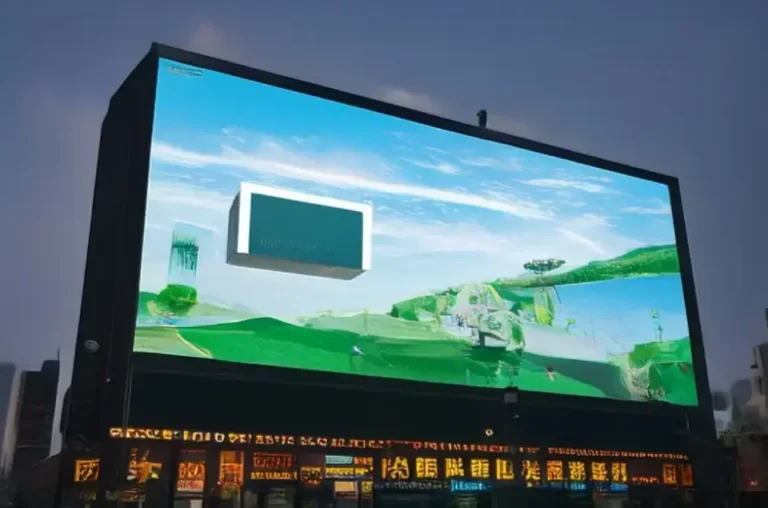
| Outdoor brand activation/festival | P3.91 | $5,000–$10,000 | 5,000–8,000 nits (IP65) |
| DOOH mobile trailer campaign | P3.91–P4.81 | $3,500–$7,000 | 5,500+ nits |
| Broadcast/XR virtual production | P1.5–P1.9 | $8,000–$20,000+ | 600–1,000 nits (controlled) |
| Multi-day convention (e.g., Moscone, LACC) | P2.6–P3.9 | $4,000–$9,000/day | 1,200–4,000 nits |
These are not list prices—they reflect all-in rates including delivery, rigging, a dedicated on-site LED engineer, and teardown. Any quote that doesn’t include those line items is not a comparable number.
Why California Is the Most Demanding Market for LED Screen Rentals in the U.S.
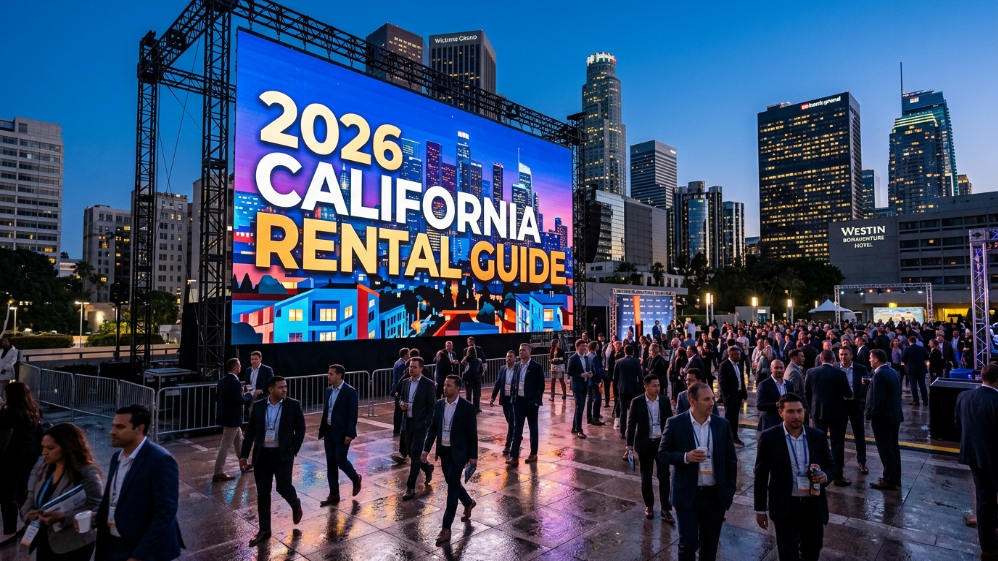
Most of our clients come to us after one bad experience with a vendor who treated a 3,000-person Los Angeles product launch the same way they’d handle a suburban movie night. The difference isn’t just scale. California’s B2B event and media landscape operates under a specific set of pressures that fundamentally change how LED rental decisions should be made.
The Regulatory Layer
Los Angeles and San Francisco both require temporary structure permits for any ground-stacked or rigged LED installation above a certain weight threshold—a modular video wall exceeding 500 lbs on a truss system in a public venue will need a stamped engineering load calculation before the first panel goes up. Add the California Energy Commission’s Title 20 compliance requirements for commercial display equipment, and you’re looking at a procurement environment where technical spec sheets carry real legal weight, not just marketing value.
The Labor Reality
The LACC, Moscone Center, and Anaheim Convention Center all operate under IATSE jurisdictional agreements. Your rental vendor must have a clear protocol for working alongside union crews—who can and cannot touch the LED cabling, who operates the NovaStar or Brompton processor during the show, and how load-in windows integrate with venue scheduling. Based on our experience managing deployments across California’s major convention venues, union coordination failures account for roughly 40% of event-day technical delays—not equipment failure.
Geographical Complexity
Finally, California’s geography creates logistical complexity that flat-state markets simply don’t face. A statewide DOOH campaign hitting San Francisco, Sacramento, Los Angeles, and San Diego in a single week requires cross-region transport logistics, multiple venue permits, and ideally a vendor with field engineers stationed in Northern and Southern California rather than driving a trailer six hours each way.
The B2B scale of this market is significant. California hosts more than 1.2 million business events annually, and the DOOH advertising sector in the greater LA market alone is projected to exceed $890 million in 2026. For system integrators, event production companies, and media buyers operating in this environment, choosing the wrong LED rental partner is a direct business risk—not an inconvenience.
What Exactly Is an LED Video Wall Rental—and How Does It Differ from What Most Vendors Are Selling?
This distinction matters more than most buyers realize before their first large-format deployment.
Modular LED Video Walls
A modular LED video wall is built from individual SMD (Surface Mount Device) panels—typically 500×500mm or 500×1000mm cabinets—that lock together mechanically and connect via daisy-chained signal and power routing. The wall has no fixed size. A skilled crew can configure it as a flat backdrop, a curved stage wrap (using panels with ±5° arc adjustment), an L-shaped corner display, or a floor-to-ceiling installation hung from a fly system. That configurability is the commercial value—it’s the reason a single LED rental inventory can serve a 40-person executive briefing room and a 15,000-person outdoor concert stage in the same week.
LED Trailers
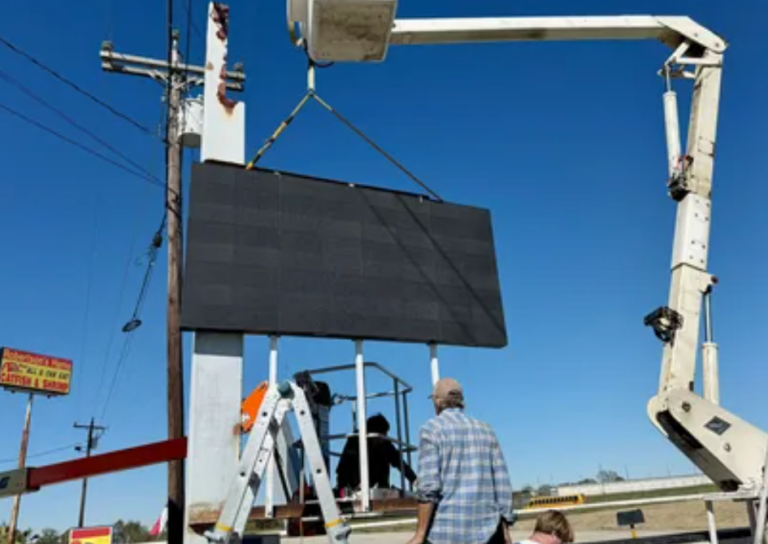
Contrast this with what many lower-tier vendors in California are actually renting: LED trailers. These are truck-mounted or trailer-mounted self-contained units with fixed screen dimensions—typically 12’×7′, 15’×8′, or 17’×10′. They have genuine utility for certain applications: rapid deployment, self-contained power, and mobility for DOOH campaigns in parking lots or roadside activations. But for trade show booths, stage backdrops, or venue-integrated corporate events, the fixed form factor is a hard constraint that limits creative execution.
Fine-Pitch LED for XR
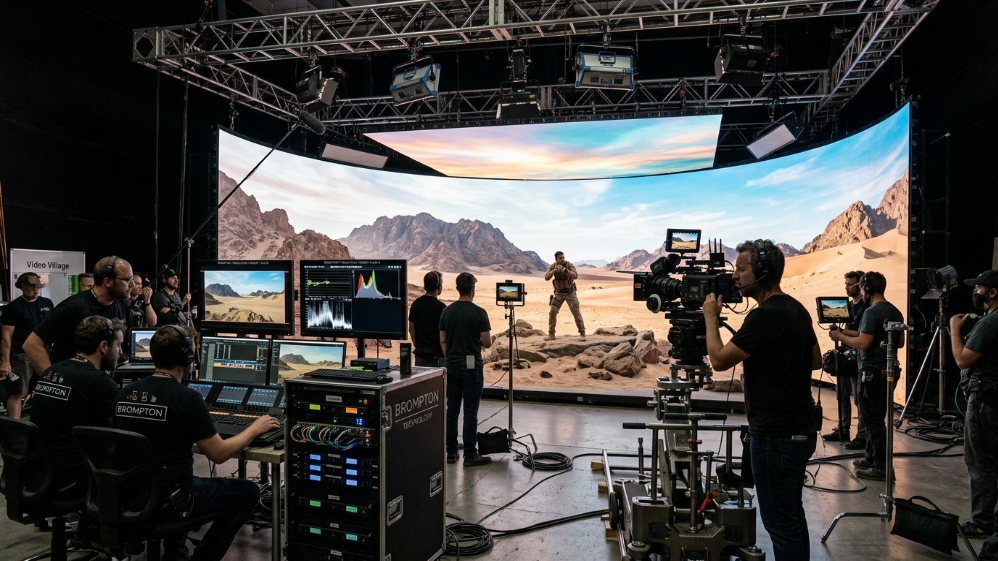
The third category—and the one growing fastest in California’s entertainment and tech sectors—is fine-pitch LED used in XR and virtual production environments. These P1.5 to P1.9 systems require controlled ambient lighting, specialized LED processing with high refresh rates (3,840Hz minimum to eliminate banding on camera), and 16-bit grayscale depth for accurate color grading integration. The Brompton Technology Tessera SX40 processor has become the de facto standard on LA studio stages. If a vendor doesn’t know what a Brompton does, they’re not the right partner for broadcast-facing deployments.
Key Technical Specs B2B Buyers Must Evaluate—and What They Mean for Your Event
| Specification | What It Is | B2B Commercial Impact |
| Pixel Pitch (P-value) | Distance in mm between pixel centers | Determines minimum viewing distance; drives cost-per-sqm significantly |
| Brightness (nits/cd/m²) | Light output per square meter | Must exceed ambient light; outdoor California sun requires 5,000+ nits |
| IP Rating (IP65) | Ingress protection against dust & water | Non-negotiable for any outdoor California deployment—coastal fog counts |
| Refresh Rate (Hz) | Screen redraws per second | <1,920Hz causes banding on video cameras; critical for broadcast or social content capture |
| Grayscale Depth (bit) | Color gradation range | 16-bit enables smooth gradients; 8-bit shows visible banding in dark scenes |
| GOB (Glue-on-Board) | Protective resin coating over LED diodes | Extends outdoor panel lifespan by ~30%; reduces moisture damage on touring or multi-city campaigns |
| Cabinet Weight (kg) | Per-panel mass | Lighter panels (6–7 kg) reduce rigging costs and expand venue eligibility; critical for fly systems |
| Scan Rate | Portion of pixels driven simultaneously | 1/32 scan = smoother rendering; affects visual quality in high-motion content |
Every one of these specs has a direct downstream consequence on your event budget, your venue eligibility, and your post-event content value. A P3.91 panel running at 1,920Hz is entirely adequate for a live audience. The same panel captured on a phone camera during a product launch—the clips your marketing team will use for six months of social content—may show visible flicker bands depending on shutter speed. These are the details that separate a technically competent LED rental partner from one with a nice website.
The Definitive Pixel Pitch Selection Guide for California B2B Events & DOOH Campaigns
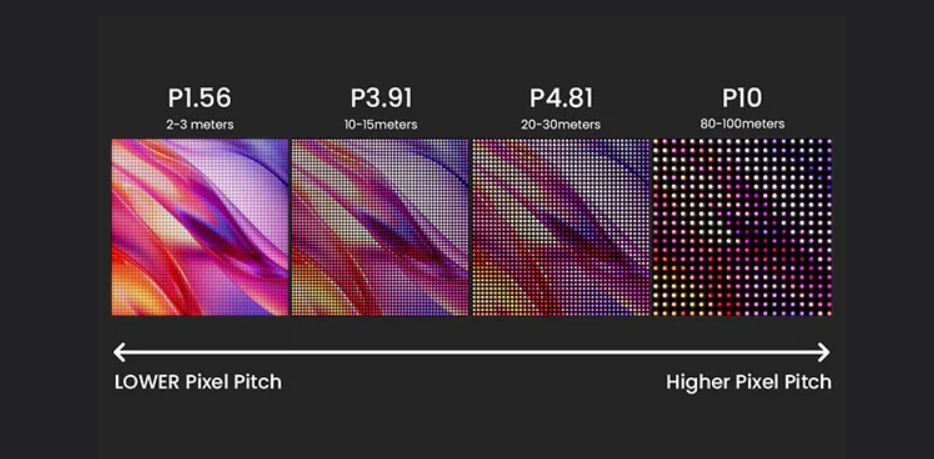
Pixel pitch is the single most consequential spec decision in any California LED screen rental, and it’s routinely misunderstood—or deliberately obscured by vendors who want to upsell or commoditize.
The rule is not complicated: pixel pitch in millimeters ≈ minimum comfortable viewing distance in meters, multiplied by roughly 8–10. A P2.6 panel delivers optimal resolution at viewing distances starting around 2.5–3 meters. A P3.91 becomes the right choice when your nearest audience member is 4+ meters away. Where buyers go wrong is applying indoor logic to outdoor deployments, or vice versa.
P1.9mm—When Premium Resolution Justifies the Cost
Fine-pitch P1.9 panels cost approximately 2.5× more per square meter than P3.91 for a one-day rental. That premium is justified in exactly three scenarios: a conference or keynote where front-row executives are seated 2–4 meters from the screen; a virtual production or XR stage where the LED wall appears on camera; or a high-end brand activation where the display is the product, not a backdrop. For a 500-person California tech conference where the keynote stage sits 6 meters from the front row, P1.9 is spending money the audience won’t perceive.
P2.6mm—The Intelligent Choice for Most California Corporate Deployments
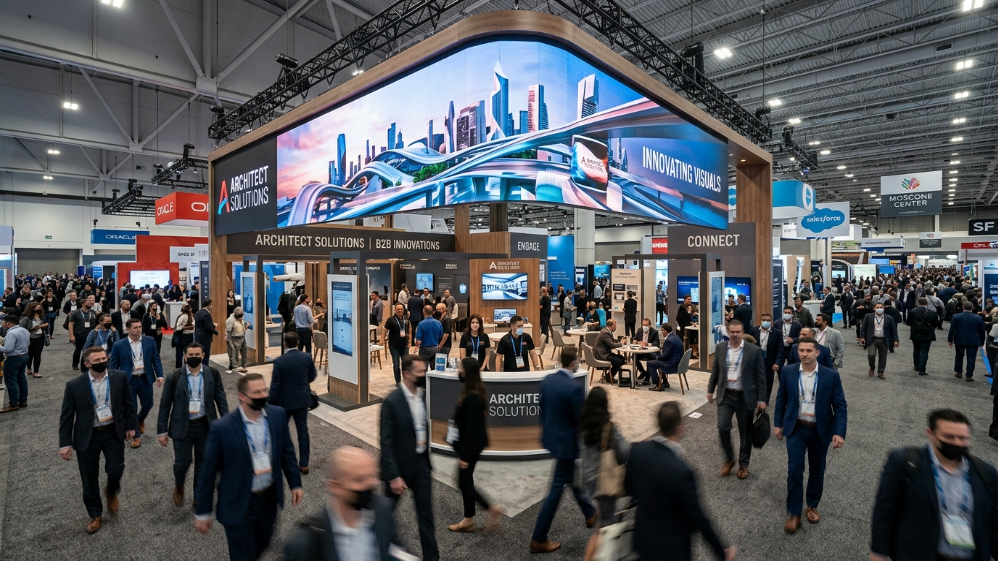
This is where most of our repeat B2B clients land for indoor events—trade show booths at Moscone or LACC, corporate general sessions, award ceremonies. The resolution at 4–8 meter viewing distances is indistinguishable from P1.9 to a live audience, the panels are lighter (improving fly-system economics), and the rental rate is meaningfully lower. For a typical 5m×3m (roughly 16’×10′) conference main screen, moving from P1.9 to P2.6 saves approximately $1,200–$2,000 in a single-day rental without any perceptible quality tradeoff.
P3.91mm—The Outdoor Workhorse That Dominates California Events
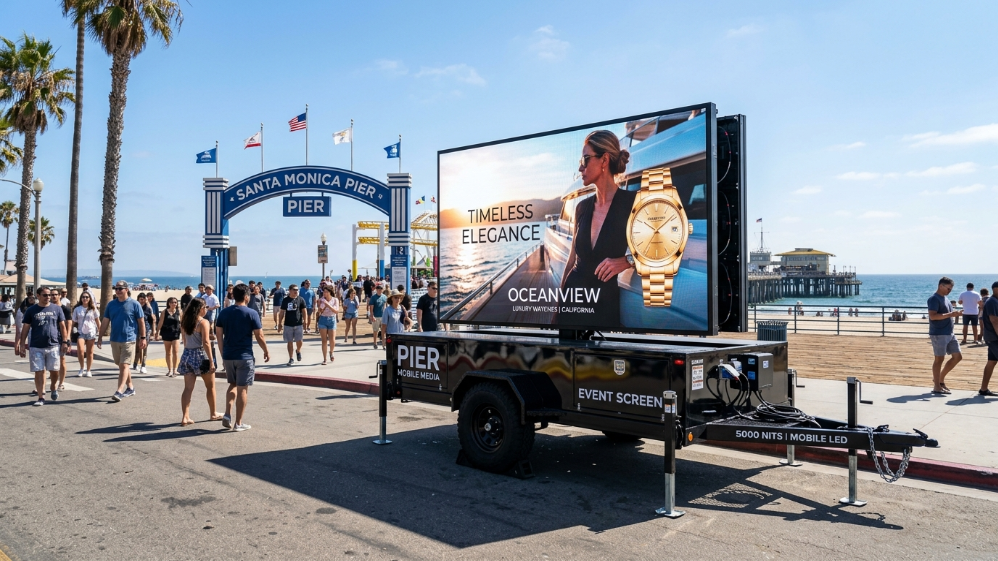
P3.91 is the industry standard for outdoor California deployments, and for good reason. The 5,500–8,000 nit brightness capability of quality outdoor P3.91 panels—combined with IP65 weatherproofing and GOB protective coating on premium units—makes them the only viable option for daytime outdoor events under California’s intense sun. A standard 500×500mm P3.91 cabinet weighs approximately 8–10 kg and can be configured into walls exceeding 20m×8m for festival-scale deployments.
For DOOH mobile trailer campaigns across high-traffic California locations—the Santa Monica Pier corridor, Union Square in San Francisco, the Gaslamp Quarter in San Diego—P3.91 offers the best balance of visual impact at typical pedestrian viewing distances (5–15 meters) and operational durability across a multi-city campaign schedule.
P4.81mm and Beyond—When Larger Pitch Is the Smarter Budget Call
For stadium-scale outdoor events, motorsport activations, or large-venue concert side-screens where the nearest viewer sits 8+ meters away, P4.81 delivers everything a live audience needs at a cost roughly 35–40% lower than P3.91 per square meter. California’s major outdoor amphitheaters—the Hollywood Bowl, the Greek, the Shoreline Amphitheatre—use P4.81 to P6 for their side-IMAG screens for exactly this reason. Don’t let a vendor sell you finer pitch than your geometry demands.
2026 California LED Screen Rental Pricing: What Transparent Cost Benchmarks Actually Look Like
The reason pricing opacity persists in this market is simple: it benefits the vendor. Vague “call for a quote” positioning lets rental companies adjust margins based on perceived budget rather than actual cost inputs. Here’s what the math actually looks like.
| Configuration | Screen Size | Pixel Pitch | Day Rate (All-In) | Includes |
| Small corporate presentation | 8′×5′ (~4 sqm) | P2.6 indoor | $2,200–$3,500 | Delivery, setup, 1 tech, teardown |
| Mid-size conference main screen | 16′×10′ (~14 sqm) | P2.6 indoor | $4,500–$7,000 | Delivery, truss, LED processor, 1 tech |
| Trade show booth wall | 12′×8′ (~9 sqm) | P1.9 indoor | $5,000–$8,500 | Rigging, signal chain, content support |
| Outdoor festival stage | 24′×14′ (~31 sqm) | P3.91 outdoor | $8,000–$14,000 | IP65 panels, fly system, 2 techs |
| Mobile DOOH trailer (single unit) | 17′×10′ fixed | P3.91 | $3,500–$6,500 | Self-contained power, operator |
| Multi-city DOOH fleet (5 units, 7 days) | Various | P3.91–P4.81 | $28,000–$55,000 | Fleet logistics, regional tech support |
| XR/virtual production stage | Custom | P1.5–P1.9 | $12,000–$25,000+ | Brompton processor, color calibration, gaffer integration |
Hidden Cost Drivers
Two cost drivers that vendors routinely bury in fine print: rigging and union labor. A fly-system installation at the LACC or Moscone adds $3,000–$8,000 in certified rigger fees on top of the LED rental rate—and that’s before IATSE crew jurisdictional requirements apply. For outdoor events requiring a generator (most do), add $800–$2,500 per day. Get these itemized before comparing quotes.
Multi-day events are where negotiation leverage lives. Most California LED rental vendors price day one at full rate, then drop to 30–50% of that rate for days two through five. For a four-day convention deployment, the effective per-day cost often falls to 50–60% of the day-one rate. Vendors don’t advertise this—you have to ask.
Rent vs. Buy: The ROI Framework California Integrators Need to Run Before Their Next Contract
This is the question that separates strategic procurement from reactive budgeting. The inflection point is roughly 8–12 rental deployments per year. Below that threshold, renting almost always wins on a total-cost-of-ownership basis when you factor in storage, maintenance, calibration, and component replacement. Above it, owning a P3.91 inventory starts to generate real margin.
Based on current factory-direct pricing for a 32 sqm P3.91 outdoor rental system—panels, processors, rigging hardware, flight cases—a complete system runs approximately $65,000–$90,000. If your average rental charge to clients is $500/sqm/day and you deploy that system 15 times per year at an average configuration of 24 sqm, gross revenue is $180,000 annually. The system pays for itself inside two years. Every subsequent deployment beyond break-even is margin, minus operational costs.
The hybrid model is what California’s most sophisticated production houses actually run: own your P3.91 outdoor inventory for high-frequency anchor deployments, and rent P1.9 or P2.6 fine-pitch panels for indoor events where demand doesn’t justify the capital commitment. This keeps capital allocation efficient without leaving revenue on the table.
The Technical Checklist: What to Verify Before Signing Any California LED Rental Contract
These are the questions that separate a vendor audit from a sales conversation. Ask all of them before any contract is signed:
-
What LED processor brand is included? NovaStar and Brompton Technology are the professional benchmarks. If a vendor is running generic or unbranded processing, signal integrity is unverified.
-
What is the panel refresh rate? Minimum 1,920Hz for live events; 3,840Hz if any camera capture is planned.
-
Are the outdoor panels GOB-protected? For multi-day California outdoor deployments—especially in coastal markets—GOB-coated diodes are not optional.
-
Who is the on-site engineer, and what is their escalation path? A dedicated LED technician, not a generalist AV operator, should be assigned. Confirm there is a 24/7 technical support line for the duration of the event.
-
Can you provide venue-stamped load calculations for fly systems? Non-negotiable for any rigged installation in a regulated California venue.
-
What is the panel replacement SLA? Professional vendors carry 10–15% spare panel inventory on-site. Any answer lower than that is a risk.
-
Does your insurance cover third-party property damage and public liability in California? Get the certificate of insurance before the contract, not the day before load-in.
California LED Screen Rental by Region: Where Deployment Complexity Varies Most
Los Angeles & Southern California
Remains the highest-volume B2B market, driven by entertainment, tech, and CPG brand activations. The density of union-jurisdictional venues—Staples Center, SoFi Stadium, the LA Convention Center—means vendor IATSE familiarity is a non-negotiable qualifier for any deployment of consequence. LED video wall rental demand here spikes in Q1 (awards season) and Q4 (brand campaign launches).
San Francisco Bay Area
Skews heavily toward fine-pitch indoor deployments—Moscone West and South host some of the country’s highest-profile B2B tech conferences, where a P2.6 main screen and P1.9 breakout displays are standard specification. The Bay’s coastal fog and temperature swings make IP-rated panels relevant even for ostensibly “indoor” tent installations at outdoor Bay Area venues.
San Diego
Driven by convention center volume (Comic-Con, the annual healthcare conference circuit) and a growing DOOH market along Harbor Drive and the Gaslamp Quarter. P3.91 mobile trailer rentals see strong demand here for roving outdoor brand campaigns.
Sacramento and the Central Valley
Represent the fastest-growing market for government, agricultural expo, and state association events—less brand-driven complexity, more emphasis on reliable statewide logistics and straightforward setup at mid-size venues.
5 FAQs: Long-Tail Questions California B2B Buyers Are Actually Searching
Q: How much does it cost to rent an LED screen in California for a one-day corporate event?
For a mid-size indoor conference setup—a 16′×10′ P2.6 modular video wall, fully installed with processor and on-site tech—expect $4,500–$7,000 all-in for a single day in a major California metro. Smaller setups (8′×5′) start around $2,200. Any quote below $1,800 for a professionally installed modular LED wall warrants scrutiny.
Q: Do I need a permit to run an outdoor LED screen at a California event?
Yes, in most jurisdictions. Los Angeles requires a Temporary Sign Permit for any LED display visible from a public right-of-way. San Francisco mandates a Special Event Permit covering temporary structures above a certain height. Vendors who don’t proactively raise permitting as part of their site survey are not equipped to manage large-scale California outdoor deployments.
Q: What pixel pitch is best for a trade show booth at Moscone Center or the LACC?
P2.6 is the professional standard for most trade show applications at California convention venues, where typical viewer distances range from 3–8 meters. P1.9 is worth the premium for booths where close-proximity product demos or on-camera capture is central to the activation. P3.91 is too coarse for close viewing in a convention hall context.
Q: Can I rent an LED video wall for a multi-city California DOOH campaign on a weekly basis?
Yes—and this is where negotiating fleet rates matters. Vendors with statewide logistics infrastructure (Northern and Southern California field teams) can manage rolling deployments across LA, the Bay Area, and San Diego without per-city mobilization surcharges. Weekly fleet contracts on P3.91 mobile trailer inventory typically fall 20–35% below the equivalent day-rate total.
Q: What is the difference between a modular LED video wall rental and an LED trailer rental in California?
A modular LED video wall is a configurable system of individual SMD panels assembled on-site into any shape or dimension—it integrates into stage designs, truss systems, and architectural installations. An LED trailer is a self-contained fixed-screen unit mounted on a towable chassis, offering rapid deployment and onboard power but no configurability. For professional B2B events—conferences, brand activations, trade show booths—modular walls are the standard. Trailers are the right tool for roadside DOOH, mobile campaigns, and rapid outdoor event setups.
Expert Verdict
California’s LED rental market is overserved by consumer-grade vendors and underserved by technically rigorous B2B partners. The gap shows up where it matters: permitting knowledge, processor quality, union-jurisdiction competence, and the willingness to put transparent pricing in writing.
The buyers who consistently get the best outcomes run the same process: define pixel pitch by viewing geometry first, establish a total-cost budget that includes rigging and labor, and shortlist vendors by asking the seven technical questions above—not by comparing day rates on websites that don’t publish them.
One last point worth saying plainly: the most expensive mistake in California LED rental is not overpaying for a screen. It’s underpaying for the engineer who runs it.
References:
Appliance Efficiency Regulations for Digital Signage and Displays.
Standard for Image System Contrast and Display Pixel Pitch.