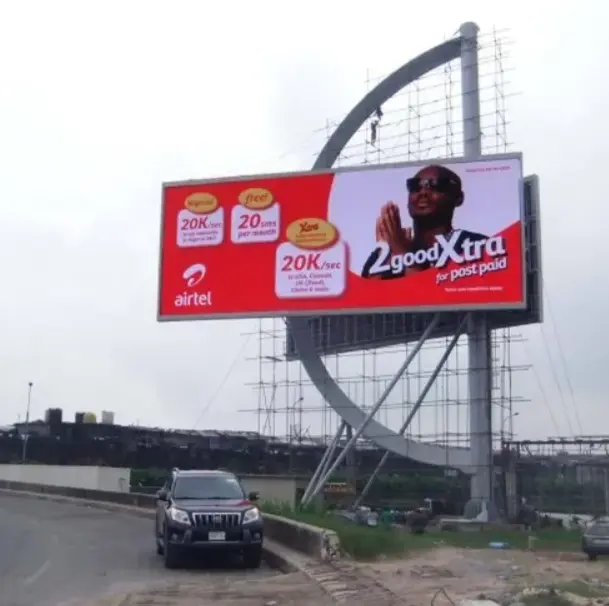
If you are a system integrator or a facility manager caught between choosing an LED or LCD video wall, the decision shouldn’t be based on abstract specs, but on the environment of your deployment.
Quick Decision Matrix: At a Glance
| Feature | LED Video Wall (DV-LED) | LCD Video Wall |
| Primary Advantage | Seamless, High Brightness | High Pixel Density (PPI) |
| Best For | Large venues, DOOH, Stage | Control rooms, close-range monitoring |
| Bezel Impact | Zero (Truly Seamless) | Visible (0.88mm – 3.5mm) |
| 5-Year TCO | Low (Low maintenance / Long life) | Moderate (Higher panel failure rate) |
| Environmental | Excellent in ambient light | Recommended for controlled light |
For most B2B applications in 2026, the question is no longer “which looks better,” but “which provides a higher ROI while minimizing downtime.” You are likely juggling stakeholders who demand 4K clarity but worry about budget spikes caused by hidden maintenance costs. As engineers who have managed over 500+ installations, we have seen too many companies commit to LCDs for large lobbies, only to regret the distracting black-grid lines as the screen scales, or invest in premium LEDs for tiny rooms where the resolution is “over-engineered.” This guide cuts through the marketing fluff to help you choose the right display architecture for your specific project.
Understanding the Fundamental Technical Divide
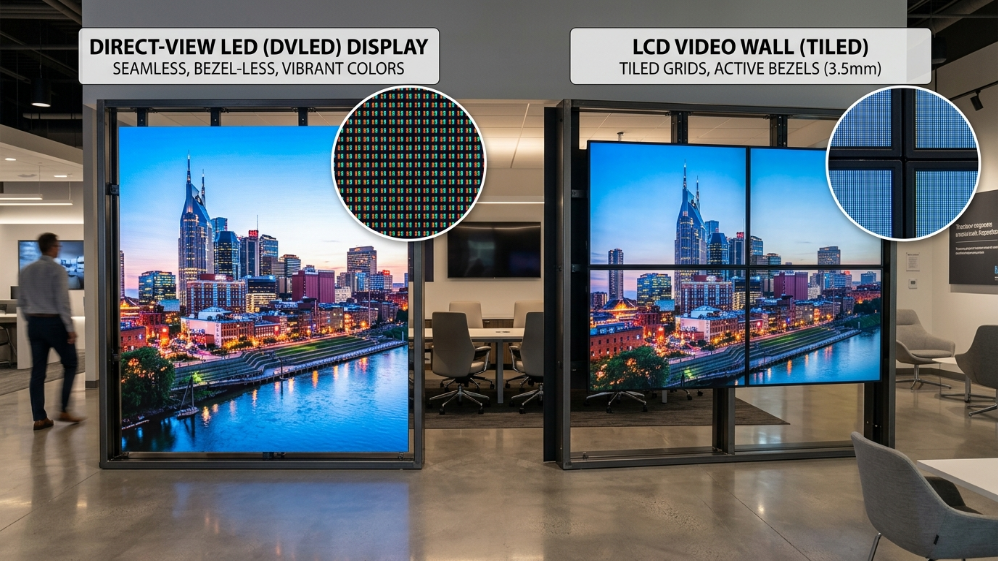
The core conflict between LED and LCD stems from their display architecture. LCD video walls rely on a backlight and liquid crystal panel; they are essentially thin-bezel television units tiled together. LED video walls, or Direct-view LED (DV-LED), consist of individual modular cabinets housing thousands of tiny, light-emitting diodes that form the image directly.
Based on our field experience with high-end command centers and flagship retail stores, this architectural difference dictates three non-negotiable performance pillars:
The Bezel “Dead Zone” and Visual Continuity
The most significant pain point for LCD video walls remains the bezel-to-bezel (BTB) measurement. Even with the thinnest 0.88mm seams, the human brain registers these lines during high-motion content or text-heavy data visualization.
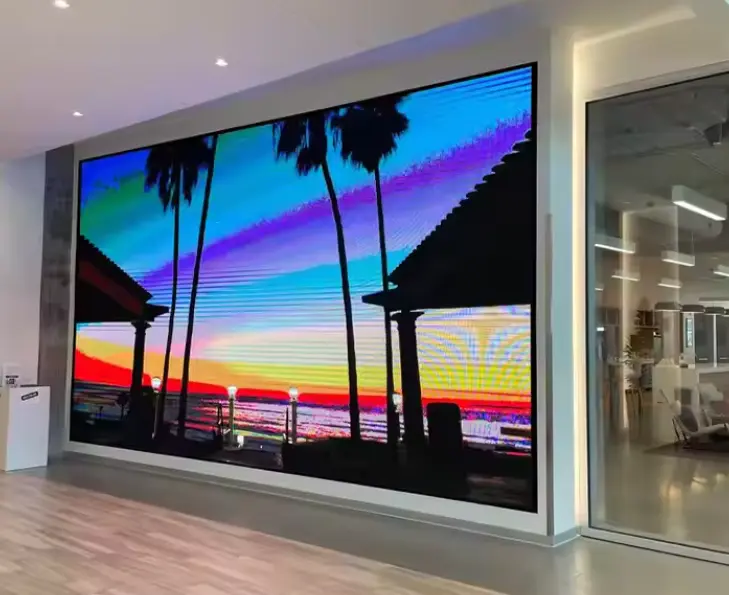
Engineering Perspective: If you are deploying for digital signage or architectural impact, the visual disruption of an LCD grid can sabotage your brand message. DV-LED eliminates this entirely. By mounting modules edge-to-edge, the surface becomes a singular, canvas-like display.
Business Benefit: A seamless LED wall creates a “wow factor” that significantly increases engagement in retail and lobby environments, whereas LCD grids often feel like “pasted televisions”—a perception that can cheapen the professional look of a high-end corporate space.
Luminance and Nits: Performance in Ambient Light
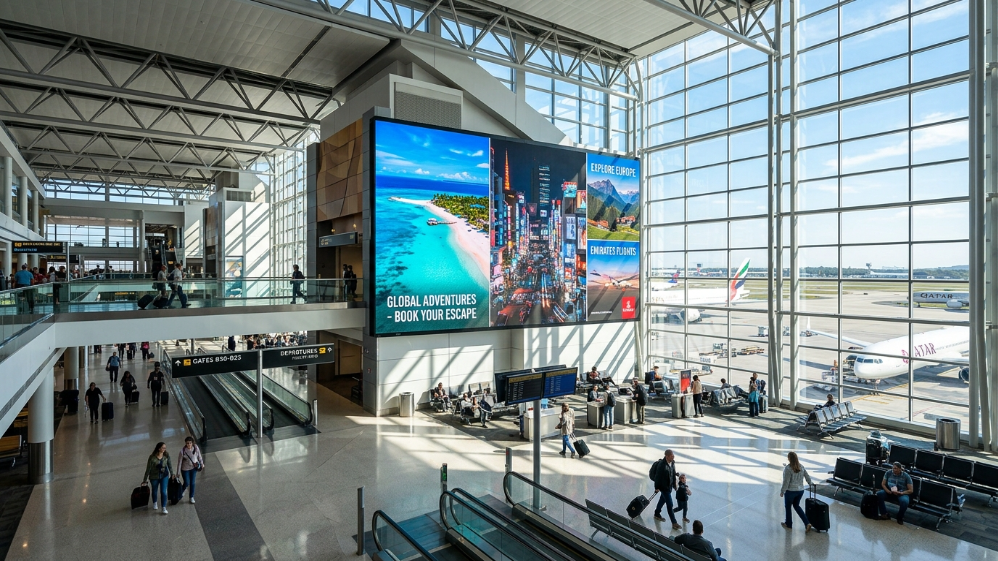
Brightness is measured in nits (cd/m²). LCD panels typically peak at 500–700 nits, which is perfectly adequate for office environments with managed lighting. However, in environments with strong natural sunlight, such as airport terminals or atrium-style lobbies, LCDs often struggle with washout.
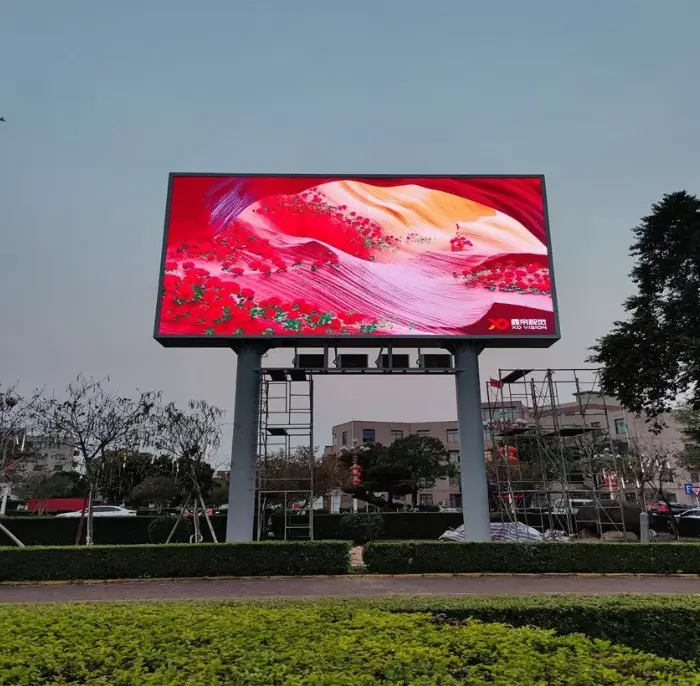
DV-LED systems regularly push 1,500 to 4,000+ nits. This high-luminance output is not just about brightness; it is about contrast preservation. In a bright environment, a high-nits LED wall maintains deep blacks and vibrant color saturation, ensuring your content doesn’t look washed out or grey. If your project involves DOOH (Digital Out-of-Home) advertising, an LED solution is the only viable choice to ensure 24/7 visibility regardless of daylight intensity.
The Financial Reality: 5-Year TCO Analysis
When procurement teams analyze hardware, they often look only at the MSRP. In the world of B2B display deployment, the Total Cost of Ownership (TCO) over a 5-year cycle is a much more accurate metric of investment health.
According to recent industry benchmarking, while LCDs offer a lower upfront capital expenditure (CAPEX), their operational expenditure (OPEX) often creeps up after the 30-month mark.
Why TCO Often Favors DV-LED
-
Modular Maintenance: When an LCD panel fails, it is often a “forklift” situation—replacing an entire unit, which may involve recalibrating the entire wall to match the color temperature of the remaining old screens. In contrast, DV-LED systems are fully modular. If a few pixels or a module board fail, you simply replace a small module (often taking less than 5 minutes) and let the controller handle the color calibration automatically.
-
Longevity and MTBF: Modern DV-LED systems boast an impressive MTBF (Mean Time Between Failures) rating. Because they run cooler and have less complex internal electronics compared to high-duty-cycle LCDs, they retain their color accuracy longer. A professional-grade LED wall, when maintained correctly, will often outlive the architectural layout of the room it occupies.
Table: Comparative Lifecycle Costs (5-Year Projection)
| Cost Factor | LCD Video Wall | DV-LED Wall |
| Initial Purchase | Lower | Higher |
| Calibration Labor | Frequent (Manual) | Rare (Auto-calibration) |
| Component Repair | Expensive (Whole panel) | Low (Individual modules) |
| Energy Consumption | Moderate | Efficient (per nit) |
| 5-Year Total Spend | Higher | Lower |
For projects expecting 12–24 hours of daily operation, the “higher” initial cost of LED is essentially a pre-payment for future reliability. If you are building a mission-critical control room or a high-traffic display, the reduced downtime offered by LED modularity is a massive hedge against operational risk.
Next, we will explore the specific constraints of pixel pitch and how to decide which resolution actually matters for your audience’s viewing distance.
Choosing Your Pixel Pitch: The Distance-to-Resolution Equation
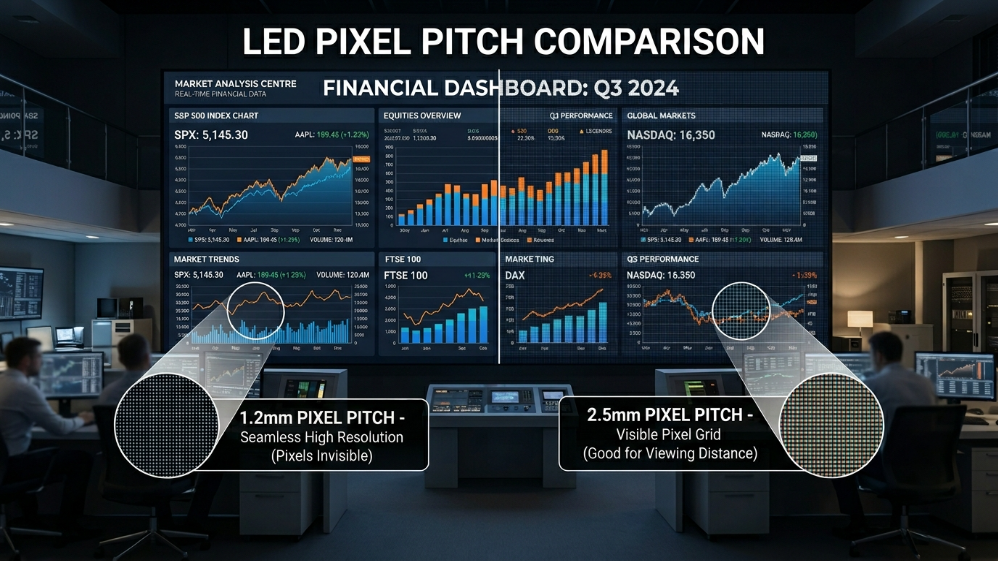
While the LED vs. LCD debate often centers on technology type, the most common pitfall we encounter in B2B procurement is the mismatch between pixel pitch and viewing distance. Pixel pitch—the distance in millimeters from the center of one LED cluster to the center of the next—determines your resolution density.
If you are upgrading from an LCD wall, you are likely accustomed to “Retina-like” sharpness. To replicate or improve upon this with an LED wall, you must apply the 10x Rule: a viewing distance of 10 feet typically requires a pixel pitch of roughly 1.0mm to 1.5mm to ensure individual diodes are invisible to the naked eye.
The “Over-Engineering” Trap: We frequently see clients overspending on a 0.9mm fine-pitch LED for a lobby where the closest audience member stands 15 feet away. At that distance, the human eye cannot discern the difference between a 0.9mm and a 2.5mm pixel pitch.
Engineering Insight: For data-intensive environments like security operation centers (SOC), choose a pitch below 1.5mm to ensure text and numbers remain crisp. For retail or event spaces where content is largely video or graphic-based, a 2.5mm or 3.0mm pitch offers significantly better ROI.
Table: Pixel Pitch Selection Guide for B2B Environments
| Use Case | Ideal Pixel Pitch | Typical Viewing Distance |
| Boardroom (Text/Charts) | 0.9mm–1.5mm | 2m–4m |
| Retail/Flagship Store | 1.8mm–2.5mm | 3m–6m |
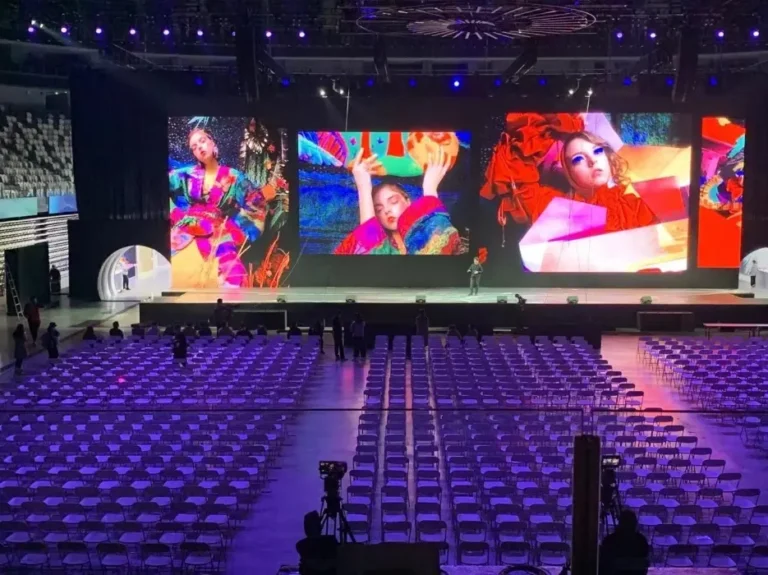
| Large Venue/DOOH | 3.0mm–5.0mm | 6m+ |
| Command/Control Room | 0.7mm–1.2mm | 1.5m–3m |
The Decision Tree: Your Deployment Strategy
When you stand at the crossroads of a procurement decision, move beyond the datasheet and look at your operational profile. Use this logic to finalize your decision:
-
Is your content primarily high-resolution text or fine-line data? If yes, and the audience is within 2 meters, LCD is a strong contender due to cost-effective 4K/8K density.
-
Is your space prone to high ambient light or direct sun? If yes, LED is your only viable path to avoid visibility issues.
-
Is this a mission-critical environment (e.g., 24/7 Monitoring)? If yes, the modular, front-serviceable nature of LED ensures that a single module failure does not take down the entire wall during critical operations.
-
Is the “Sensation” of the wall part of your branding? If yes, the zero-bezel nature of LED provides the premium, architectural aesthetic that LCD can never replicate.
Critical FAQ for B2B Buyers
Does a high refresh rate really matter for my video wall?
Absolutely. If your display is being captured on camera (e.g., during live webinars or broadcast interviews), a low refresh rate will cause visible “scan lines” or flickering. Look for a minimum of 3840Hz refresh rate to ensure professional camera compatibility.
Can an LED wall be curved?
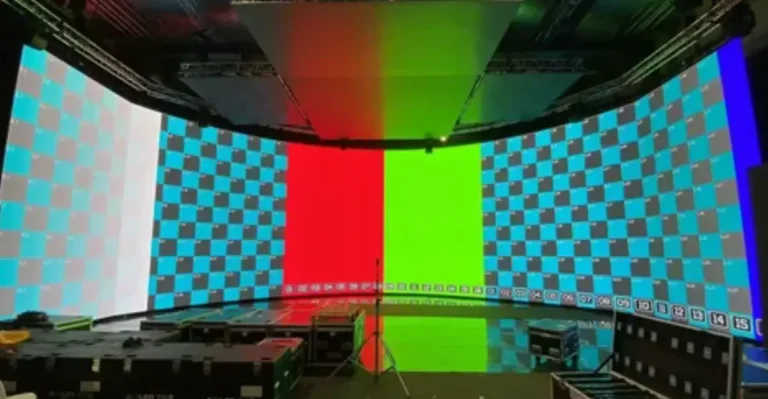
Yes. Unlike rigid LCD panels, many modern LED cabinets are designed with concave or convex mounting frames. This allows for seamless, curved installations that wrap around corners—a core differentiator for high-end architectural design.
What is the biggest risk with LED installation?
Calibration drift. Over time, individual modules can lose color consistency. Ensure your vendor provides a “batch-matched” spare kit—a small percentage of extra modules from the exact same production run as your wall to ensure perfect color matching for future replacements.
How does humidity affect these displays?
LCDs are generally more resilient to humidity due to their sealed nature. If you are installing in a high-humidity environment (e.g., near the coast or in an unconditioned warehouse), you must specify “conformal coated” LED modules to prevent moisture-induced corrosion on the PCB.
Which is more energy efficient?
LED technology is significantly more efficient at high brightness levels. LCDs consume power regardless of the content being displayed (due to the backlight). Modern LED controllers use “dynamic power saving,” adjusting the power draw based on the brightness of the specific content on screen.
The Expert Verdict
Stop treating the video wall as a simple commodity purchase. If your priority is absolute pixel density at a lower price point and your environment is a controlled indoor office, LCD remains a pragmatic, reliable choice. However, if your project demands a “wow factor,” 24/7 reliability, or seamless integration into a large-scale architectural space, Direct-view LED is the only future-proof solution.
Don’t let the spec sheets dictate your budget—let your viewing distance and environment drive the hardware choice. If you’re ready to scope your project, our engineering team can audit your floor plan to determine the optimal pixel pitch and brightness levels required to hit your KPI targets without overspending on unnecessary tech. Reach out to our integration desk to review your current site specifications today.
References:
DS01-2020 Display Image Size and Relative Resolution (DISCAS)
Solid-State Lighting Research and Development Opportunities