Table of Contents
ToggleA nightclub LED screen is a modular, high-refresh-rate direct-view display system built specifically to operate in high-vibration, smoke-filled, low-light entertainment environments. For B2B buyers — system integrators, AV rental operators, and venue developers — the core specifications that drive purchase decisions are: pixel pitch (P2.5–P3.91 for most indoor applications), refresh rate ≥3840 Hz (for camera-compatible venues), brightness (1,000–1,500 nits for nightclub ambient conditions), and front serviceability for permanent installs. Fully installed systems — panels, steel structure, cabling, control processor, and commissioning — typically land between $12,000 and $65,000 depending on screen area, configuration, and site complexity.
Spec ParameterRecommended RangeWhy It Matters for B2B BuyersPixel PitchP2.5 – P3.91Covers 85%+ of nightclub viewing distances (2–6 m); P2.5 for DJ booth close-up, P3.91 for stage wallsRefresh Rate≥ 3840 HzEliminates moiré banding in livestreams and camera recordings — non-negotiable for content-producing venuesBrightness1,000 – 1,500 nitsMaintains image contrast under high-power strobe and wash lighting without overexposing the roomPanel ProtectionGOB or IP54+Epoxy-encapsulated LEDs survive smoke machine particles, humidity spikes, and sub-bass vibrationPrice (fully installed)$12,000 – $65,000Dependent on screen area, pixel pitch tier, mounting complexity, and control system specification
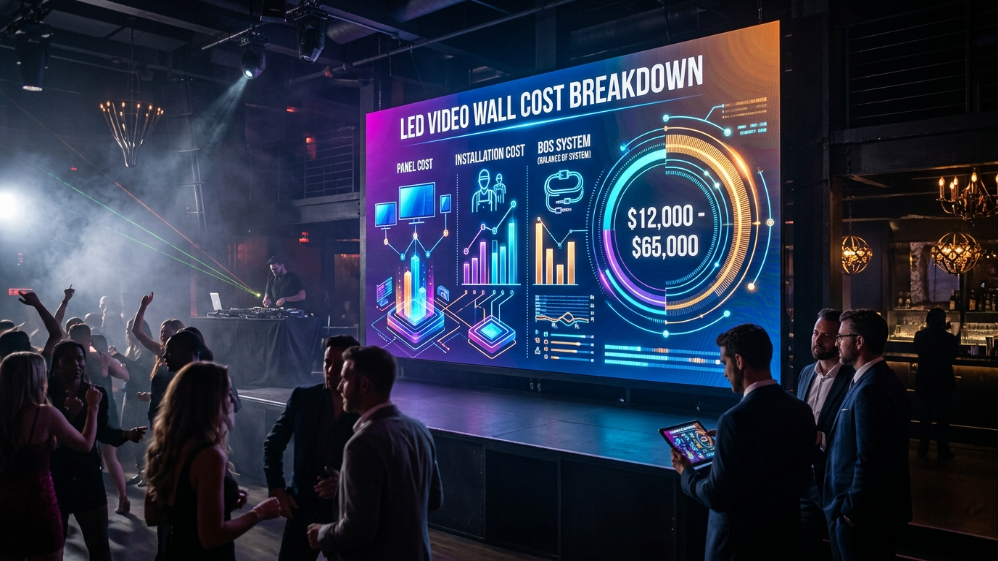
Most buyers who end up with the wrong system didn’t fail at the selection stage. They failed at the scoping stage — because nobody told them the panel price is only 40–60% of the real project cost. Based on our experience managing LED procurement across nightlife venues, hotel ballrooms, and event complexes in North America and Southeast Asia, the single most common outcome is this: an integrator quotes a client $15,000 for an LED wall, sources panels at $800/m², and then discovers the steel rigging structure, Novastar control processor, fiber signal runs, and two-day commissioning labor add another $11,000 to the job. Margin disappears. The client is unhappy. The integrator doesn’t get the referral.
This guide is written to close that gap — giving procurement teams, AV integrators, and venue technical directors the engineering-level framework to spec, source, and install nightclub LED screens correctly the first time.
Why Nightclub LED Screens Are Now a Revenue Asset, Not Just a Visual Upgrade
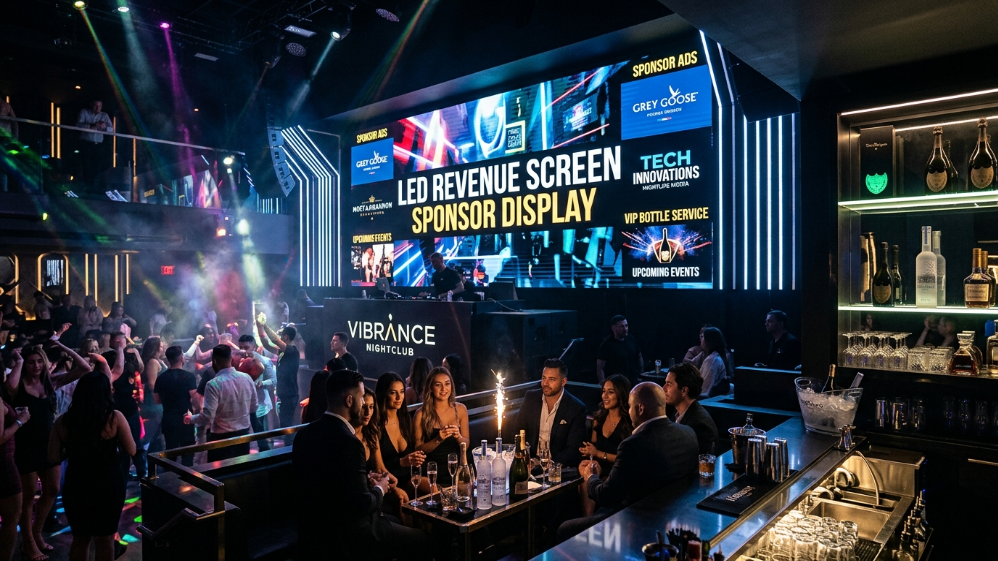
There’s a version of this conversation that treats a nightclub LED screen purely as an atmosphere tool. That’s a 2015 conversation. In 2026, venues that are extracting real commercial value from their LED installations are treating the screen as a dynamic revenue surface — one that pays for itself through parallel revenue channels that have nothing to do with looking impressive.
How Sponsor Display, Event Promos & DOOH Advertising Turn Your Screen Into a Payback Machine
According to industry analysis from Look Digital Signage, venues that integrate digital signage into their operational stack are treating screens as “active revenue channels” — selling display inventory to spirits brands, rideshare partners, and local advertisers on a per-night or per-event basis. For a nightclub running 200 nights per year, a single 8m² LED wall at the DJ booth can generate $500–$1,500 per evening in sponsored content display, depending on market and venue tier. At a conservative $600/night across 150 operating nights, that’s $90,000 in annual incremental revenue against a one-time installation cost in the $18,000–$28,000 range — a payback period under one year.
The mechanism is straightforward. LED video walls support real-time content switching through any cloud-based CMS, meaning a promoter’s branding can run during the first two sets, a spirits sponsor logo can take over at peak hours, and the venue’s own event calendar can close the night. This isn’t hypothetical — DVS LED Systems documents this exact workflow for venues running A-list acts, noting that LED walls directly enable “premium event booking” and sponsor integration that static or projection-based systems cannot support.
What the Data Says: Venue Booking Uplift & Dwell Time After LED Installation
The commercial case doesn’t rest entirely on ad revenue. Event venues that upgraded to LED visual infrastructure have reported measurable booking rate increases — one Los Angeles Convention Center installation cited a 45% uplift in corporate event bookings after deploying a 35m² LED system. For nightclub operators, the parallel metric is average spend per head and repeat visit frequency, both of which correlate with perceived production value of the space.
The strategic point for integrators making the ROI case to clients is this: the LED screen is not a cost line. Positioned correctly, it’s a capital asset with a defensible payback model. Any integrator who can walk into a client meeting with a structured revenue scenario — factoring in sponsorship yield, booking premium, and reduced printing/collateral costs — closes deals that competitors who lead with spec sheets never will.
Nightclub LED Screen Types: Matching the Right Format to Each Zone in the Venue
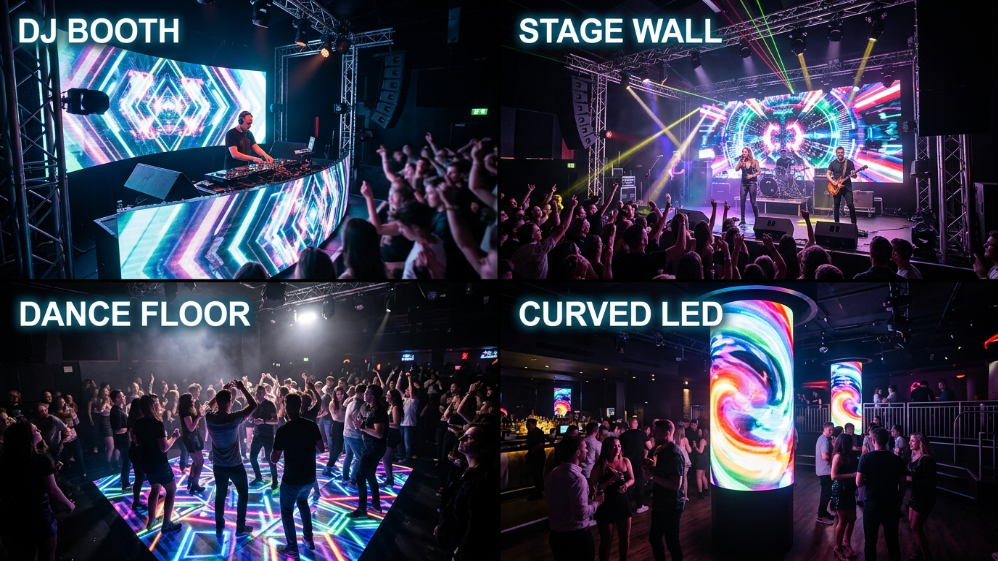
One of the most consistent mistakes in nightclub LED procurement is treating “LED screen” as a single product category. It isn’t. The display requirements for a DJ booth backdrop, a main stage video wall, an overhead ceiling installation, and an LED dance floor are fundamentally different in terms of pixel pitch, structural loading, IP rating, and content system requirements. Getting this mapping wrong — even on one zone — creates either chronic overspend or a system that underperforms and generates service calls.
DJ Booth Backdrop Screens: When P2.5 vs. P3.91 Actually Matters for Close Viewing
The DJ booth is the highest-resolution zone in any nightclub installation, for one reason: viewing distance is short. Dancers and patrons stand 1.5–4 meters from the screen. At that distance, the human eye can resolve individual pixel clusters on a P3.91 panel, resulting in visible pixelation on any content finer than full-motion video — logo animations, typography overlays, and album artwork all suffer.
The rule from display engineering is unambiguous: minimum comfortable viewing distance in meters ≈ pixel pitch in millimeters × 1.5 to 2.5 (conservative). For a P3.91 panel, that floor is roughly 5.9 meters at the conservative end. Most DJ booths don’t have it. P2.5 extends the minimum down to 3.75 meters — which covers the vast majority of real-world booth configurations.
The commercial implication: P2.5 panels cost approximately 60–80% more per square meter than P3.91. For a 6m² DJ booth backdrop, that delta is roughly $2,800–$4,200. For a venue positioning itself in the premium tier — or one that produces regular video content of DJ sets — that’s not an extravagance. It’s a technical requirement.
Stage LED Video Walls: Size Calculation Formula for Any Room Capacity
For main stage walls, the viewing distance problem inverts: most of the audience is far away, and resolution becomes less critical than sheer luminance and angular coverage. P3.91 is the workhorse specification at this zone, offering the best balance of image quality, panel cost, and cabinet weight per square meter.
Calculating the right screen size for a given room is not guesswork. Use this formula:
Minimum screen height (m) = Maximum viewing distance (m) ÷ 20
Minimum screen width (m) = Screen height × content aspect ratio
For a venue where the farthest audience member is 18 meters from the stage, the minimum screen height is 0.9 meters — but that’s the floor. A screen at that size reads as a screen, not an experience. For genuine visual impact, the practical multiplier is 1/12 to 1/15 of maximum viewing distance for the screen height. At 18 meters, that puts you at 1.2–1.5 meters tall, or a 4m × 2.25m wall minimum for a 16:9 aspect ratio. Most premium nightclub stage installations run 6m × 3.375m to 10m × 5.625m for meaningful presence.
LED Dance Floors & Overhead Ceiling Displays: Load Ratings, IP Ratings & Safety Standards
Dance floor and ceiling-mounted LED systems introduce structural and safety variables that don’t exist in standard wall installations, and they are significantly under-documented in the existing purchasing literature.
For LED dance floors, the critical specification is load rating — typically expressed in kilograms per square meter. Commercial-grade LED dance floor panels are engineered to 500–750 kg/m² static load with a 3:1 safety factor for dynamic loading (crowd jumping, concentrated heel loads). Panels below this threshold — which includes many “event” or “rental” tier products — should not be permitted in fixed venue installations. The secondary requirement is IP rating: a minimum of IP54 for dance floor surface applications, with IP65 preferred in venues that permit drink service near the floor.
Overhead installations introduce ceiling suspension load requirements. A 10m² LED ceiling array using standard 6 kg/m² panels weighs 60 kg — but the mounting structure, cabling, and power supplies in the plenum typically add another 30–40%. Engineers speccing overhead LED must coordinate with the venue’s structural drawings, not estimate from memory.
Installation ZoneRecommended Pixel PitchKey Technical RequirementMinimum IP RatingDJ Booth BackdropP2.5≤4m viewing distance, high resolution for close-up contentIP33 (indoor permanent)Main Stage WallP3.91High brightness (≥1,200 nits), wide viewing angle (≥140°)IP33 (indoor permanent)LED Dance FloorP3.91 – P4.81500+ kg/m² load rating, tempered glass or polycarbonate surfaceIP54 minimumCeiling / OverheadP3.91Structural load cert required; front-serviceable not applicableIP33 with sealed backRental / TouringP3.91 – P4.81GOB encapsulation, tool-free panel locking, <30 min setupIP54 recommendedCurved / ArchitecturalP2.976 – P3.91Flexible module radius ≥ 500mm convex / 1,000mm concaveIP33 (venue-dependent)
Curved & Flexible LED Panels: When Custom Shapes Justify the 30–40% Cost Premium
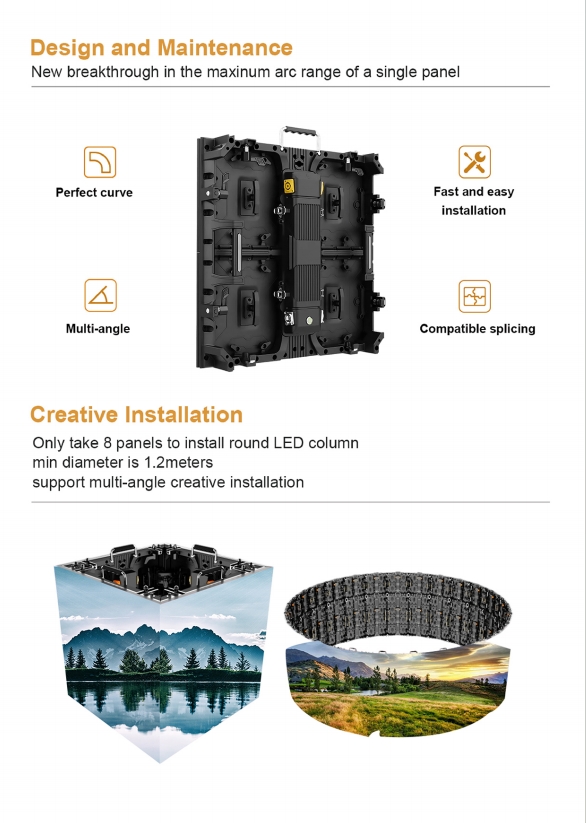
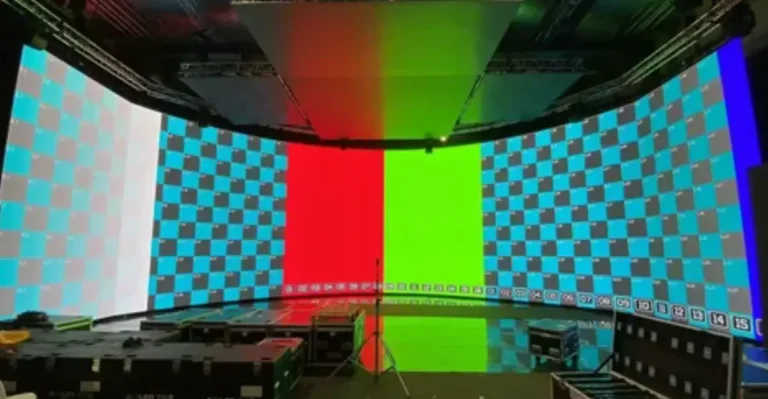
Curved LED installations — cylindrical columns, convex DJ booth surrounds, concave stage backdrops — represent the fastest-growing configuration in premium nightlife design. The visual logic is compelling: a curved display eliminates the flat-panel “TV on a wall” perception and turns the screen into an architectural element.
The engineering reality is more nuanced. True flexible LED modules (with a bending radius of 500mm or tighter) use a different substrate than rigid panels — a PCB-and-resin composite rather than standard aluminum-backed cabinets — which raises unit cost by 30–40% per square meter and complicates the signal routing design. For curves with a radius above 1,000mm, a standard rigid panel array built with angled connectors is almost always the more cost-effective solution, and the visual result at normal nightclub viewing distances is indistinguishable.
The procurement rule: specify flexible panels only where the design radius is genuinely tight. For everything above 1 meter radius, use a rigid panel system with appropriate bracket geometry and save the budget for a better pixel pitch or control system.
Rental Fleet vs. Permanent Install: How the Use Case Determines Every Spec Decision
The spec sheet for a rental fleet LED system and a permanent nightclub install share almost no priorities. Rental fleet buyers need GOB-encapsulated panels (impact and moisture resistant), tool-free cabinet locking mechanisms (single-person 20–30 minute setup), the lightest possible cabinet weight per square meter, and a modular signal architecture that can be reconfigured show to show. Durability under repeated transport, rigging, and breakdown is the primary value driver.
Permanent install buyers, by contrast, should prioritize front serviceability (the ability to replace a failed module from the audience side without dismounting the structure), a higher-tier control processor with remote diagnostics capability, and cabinet engineering optimized for thermal management in a continuously operating environment.
The most expensive mistake in this category: a rental company that buys permanent-install panels for fleet use. The panels lack GOB protection, the cabinets have rear-service designs that require disassembly, and the first time a roadie drops a cabinet on load-in, the repair bill is three times what GOB-grade panels would have cost at purchase.
The Technical Spec Sheet Every B2B Buyer Must Demand Before Signing a Purchase Order
Spec sheets from LED manufacturers are not standardized documents. Two suppliers can both claim “P3.91, 3840 Hz, 1000 nits” and deliver systems that perform completely differently under nightclub operating conditions — because those three numbers don’t tell you how the system behaves after 2,000 hours of continuous operation at 35°C, or whether the refresh rate figure was measured at full brightness or throttled output.
Why Refresh Rate Above 3840 Hz Is Non-Negotiable for Venues That Livestream or Shoot Content
Here’s the engineering reality: a camera sensor capturing at 1/500s shutter speed will image only a fraction of one refresh cycle on a 1920 Hz panel, producing a visible dark band across the recorded frame — the moiré effect that makes LED walls look broken on broadcast footage. At 3840 Hz, the exposure-to-refresh ratio is high enough to eliminate the artifact across virtually all cinematographic and live-streaming scenarios. At 7680 Hz — increasingly standard on premium-tier panels — it disappears completely even on high-speed cameras.
For any nightclub that produces content — DJ set recordings, Instagram Reels, brand activations, or ticketed livestreams — this specification is a hard technical floor, not an upgrade option. It should appear in every RFQ as a minimum, not a preference.
GOB Encapsulation vs. Standard SMD: Which Survives a Nightclub Environment
Standard SMD (Surface-Mounted Device) LED modules sit exposed on the PCB surface. They’re fine for broadcast studios and corporate lobbies. A nightclub is a different environment: smoke machine particles settle into the gaps between diodes and create conductive bridges; alcohol vapor accelerates corrosion on unprotected solder joints; sub-bass at 110 dB SPL generates vibration that slowly loosens module adhesion over months.
GOB encapsulation floods the entire module surface with a clear epoxy resin, sealing the diodes against moisture, particulate ingress, and impact. The practical result: GOB panels in nightclub environments report substantially lower field failure rates than standard SMD over a 36-month operating window. The cost premium is typically 15–25% per square meter. For any permanent nightclub installation — not just rental fleets — GOB specification is defensible engineering, not overspecification.
Full Cost Breakdown: What a Nightclub LED Installation Actually Costs in 2026
The table below represents realistic 2026 cost ranges for a fully installed nightclub LED system at common configurations, based on current factory-direct pricing plus contractor labor rates in tier-1 North American and European markets. These figures assume direct manufacturer sourcing and professional AV installation; distributor-sourced projects add 20–35% across the panel line.
System ConfigurationPanel AreaPixel PitchPanel Cost (ex-factory)Installation & BOS*Total Installed CostDJ Booth Backdrop6 m²P2.5$7,200 – $9,600$5,500 – $9,000$12,700 – $18,600Mid-Size Stage Wall16 m²P3.91$12,800 – $19,200$9,000 – $16,000$21,800 – $35,200Premium Stage Wall30 m²P3.91$24,000 – $36,000$14,000 – $24,000$38,000 – $60,000LED Dance Floor12 m²P4.81$14,400 – $20,400$8,000 – $14,000$22,400 – $34,400Full Venue Multi-Zone60 m²+Mixed$48,000 – $90,000$22,000 – $40,000$70,000 – $130,000
BOS = Balance of System: steel structure, cabling, control processor (Novastar or Colorlight), power distribution, and commissioning labor.
The single number that surprises buyers most is BOS cost — it represents 40–60% of total project value and scales non-linearly with site complexity. A clean flat wall at 3.5 meters height costs far less to rig than a ceiling-suspended curved array with conduit runs through an existing mechanical plenum. Get a site survey done before issuing an RFQ. Every hour spent on pre-project site work saves three hours of margin erosion post-contract.
B2B Procurement Workflow: 4 Steps That Protect Your Margin and Your Reputation
Step 1 — Write an RFQ That Prevents Supplier Substitution
The bait-and-switch in Chinese LED manufacturing follows a predictable pattern: the sample arrives with premium Nationstar or Cree diodes, the production run ships with a tier-3 equivalent. Prevent it by specifying the diode brand and bin tier explicitly in your purchase order — not just the finished panel specs. Require the supplier to provide factory test reports (aging data, uniformity scans) for each production batch, not just for the pre-shipment sample.
Your RFQ minimum specification block should include: pixel pitch, refresh rate minimum, brightness at 50% power load (the operational set point, not peak), viewing angle (H × V), diode brand and bin designation, GOB or standard SMD, IP rating, cabinet weight, and power consumption per cabinet at operational load. Any supplier who pushes back on specifying diode brand is telling you something important.
Step 2 — Vet the Supplier Before the Deposit Clears
CE marking (for EU markets) and UL certification (for US/Canada) are not optional for commercial installations — they’re liability protection for the integrator. A CE-marked LED panel that fails and causes a venue fire is a covered insurance event. An uncertified panel is an exposure.
Beyond certification, request two references from projects of similar scope in your target market. Not testimonials on their website — actual contact names at actual venues. Any manufacturer with legitimate tier-1 commercial experience will provide them without hesitation.
Step 3 — Budget Logistics as a Line Item, Not an Afterthought
Sea freight from Shenzhen to Los Angeles runs 18–24 days at current transit times, with full-container-load (FCL) rates varying seasonally. Add 7–14 days for customs clearance if you’re importing panels over $800 USD unit value (HS Code 8528.52 for direct-view LED displays). Air freight eliminates the timeline risk but adds roughly $8–$12/kg — meaningful on a 30m² system that weighs 600 kg with packaging.
Insurance against transit damage is non-negotiable. LED panels are fragile in ways that aren’t visible externally — a cabinet that looks intact after a drop can have shifted diode bonds that manifest as dead pixels three months into operation. Require the supplier to pack each cabinet in foam-lined individual cartons, not stacked bulk pallets. This specification belongs in the contract, not a verbal understanding.
5 FAQs B2B Buyers Ask Before Signing Off on a Nightclub LED Project
What pixel pitch is best for a nightclub DJ booth?
P2.5 for booths where audiences stand within 4 meters. P3.91 is acceptable at 5 meters or beyond, but will show visible pixelation on fine-detail content at close range. When in doubt, calculate: minimum viewing distance (m) = pixel pitch (mm) × 1.5.
How much does a nightclub LED screen cost fully installed?
Budget $12,700–$18,600 for a 6m² DJ booth system and $38,000–$60,000 for a 30m² stage wall, fully installed. Panel-only prices ($800–$2,500/m²) exclude structure, cabling, control systems, and labor — which collectively add 40–120% to panel cost depending on site complexity.
What refresh rate do I need if the venue shoots content or livestreams?
3840 Hz minimum. This eliminates moiré banding on standard broadcast and streaming cameras. For venues with dedicated video production setups or slow-motion capture, 7680 Hz is worth the modest premium.
Can LED panels handle smoke machines, humidity, and nightclub vibration?
Standard SMD panels degrade measurably in these conditions over 18–36 months. GOB-encapsulated panels — where the diode array is sealed in clear epoxy — are specifically engineered for this environment. Specify GOB for any permanent nightclub installation; the 15–25% cost premium is recovered in reduced maintenance spend within two years.
What controller system should I specify — Novastar or Colorlight?
Both are tier-1 controllers with strong global support networks. Novastar has a marginal edge in software ecosystem depth and is better integrated with common VJ platforms like Resolume Arena. Colorlight has stronger field-support coverage in Asia-Pacific markets. For North American and European projects, Novastar is the more common integrator choice; either will perform correctly when spec’d with matching receiving cards.
Expert Verdict
The gap between a nightclub LED installation that performs flawlessly for five years and one that generates service calls within six months almost always comes down to three decisions made before a single panel is ordered: GOB vs. standard SMD protection, front vs. rear serviceability for the mounting configuration, and whether the RFQ locked in diode brand and bin tier. Get those three right, and the rest of the project — pixel pitch, controller, content system — is manageable engineering. Get them wrong, and no amount of after-the-fact troubleshooting fixes a structural specification error.
The buyers who consistently win in this market are the ones who treat supplier vetting as a technical discipline, not a price exercise. The $800/m² panel that arrives certified, GOB-sealed, and backed by a 3-year warranty with spare module availability is a better procurement decision than the $650/m² panel that isn’t — every single time.
Price Summary
Nightclub LED screen projects in 2026 typically range from $12,000 to $130,000 fully installed, depending on size, pixel pitch, structural complexity, and control system requirements. Entry DJ booth setups start around $12K–$18K, mid-size stage walls fall between $20K–$60K, and full-venue multi-zone systems can exceed $70K–$130K. Importantly, panel cost usually represents only 40–60% of total project expenditure, with structural engineering, control systems, and installation labor making up the remainder.

About SoStron
Marketing Strategic Director at Sostron