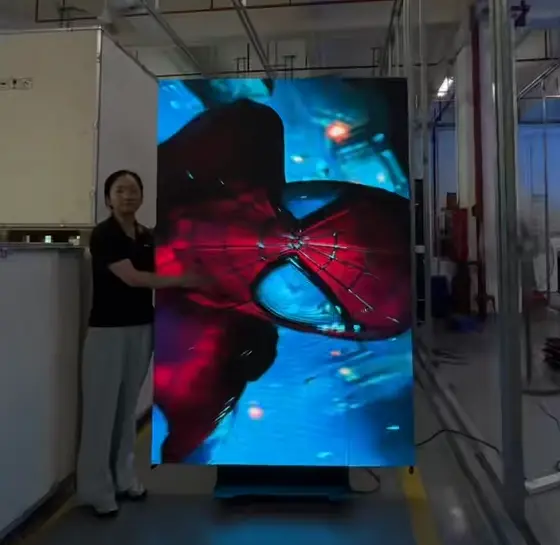
The short answer: Live concerts use LED video walls—modular, high-brightness display systems built from interlocking LED panels. A modern stadium show typically deploys a main backdrop screen (P2.6–P3.91 pixel pitch, 5,000–8,000 nits for outdoor), paired with flanking IMAG screens and, increasingly, LED floor tiles. Projection and LCD alternatives have been functionally obsolete in professional touring since the mid-2010s. If you’re speccing a display system for a concert, music festival, or large-scale live event, the decision tree starts and ends with rental LED video wall technology.
That said, “LED screen” is not one product. It’s a category spanning dozens of configurations—and choosing the wrong one will cost your client visibility, credibility, and real money. Based on our team’s experience across more than 200 live event installations on four continents, the most expensive mistakes AV integrators and event production companies make aren’t budget errors. They’re specification errors made too early in the project lifecycle, before the venue geometry, audience sightlines, and broadcast requirements are fully mapped.
This guide cuts through manufacturer marketing to give you the technical framework you need to specify confidently.
What Type of Screen Is Actually Used at Concerts—and Why LED Won
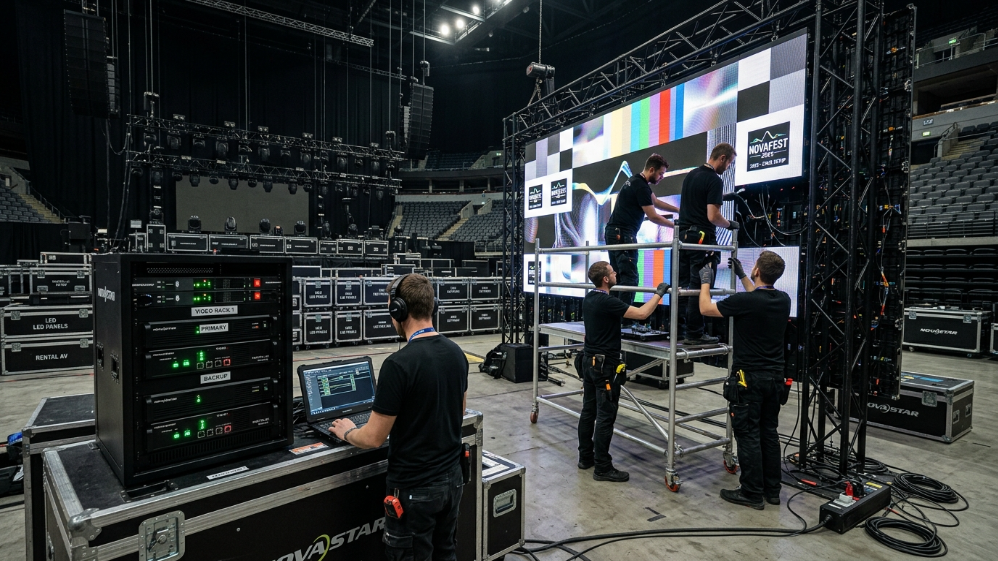
Walk backstage at any major touring production today and you’ll find the same core technology: SMD (Surface-Mounted Device) LED panels assembled into a video wall, driven by a Novastar or Brompton video processor, hanging from a ground-supported or flown truss structure. This wasn’t always the case.
Through the 1990s and early 2000s, large-format CRT-based Jumbotrons and front-projection systems dominated. The original Sony JumboTron—which debuted at the 1985 World’s Fair—used arrays of small cathode-ray tubes, not LEDs, because blue-wavelength LEDs capable of RGB display didn’t exist commercially at that time. The transition to full LED was enabled by the maturation of blue LED technology (for which Nakamura, Akasaki, and Amano received the 2014 Nobel Prize in Physics) and the parallel development of scalable die-cast aluminum cabinet systems.
Today, rental LED video walls dominate concert production for three compounding reasons that matter commercially to B2B buyers:
Brightness That Competes with Stage Lighting
Professional stage lighting rigs—moving heads, beam fixtures, follow spots—can output tens of thousands of lumens. An LCD display or projection screen simply cannot hold an image against that wash. A quality rental LED panel delivers 4,500–6,000 nits indoors and 5,000–8,000 nits for outdoor festivals, ensuring the visual content reads clearly even when a follow spot is pointed directly at the screen surface.
Modular Scalability
Standard cabinet sizes (500×500 mm and 500×1,000 mm are the industry norm) mean any screen size can be assembled from the same panel inventory. A 40 m² main backdrop and a 12 m² side IMAG screen use identical hardware—you scale the quantity, not the product. This is critical for touring productions where the screen footprint changes with every venue.
Setup Speed Under Event Pressure
Tool-less quick-lock mechanisms, integrated power and data cabling, and die-cast aluminum frames (weighing 7–9 kg per panel) allow experienced crews to assemble a 100 m² video wall in under four hours. A comparable projection system—requiring throw distance calculations, keystoning correction, ambient light management, and projector alignment—cannot match that timeline in a festival’s compressed load-in window.
Why Projectors and LCDs Can’t Compete on a Concert Stage
This question comes up frequently in early-stage client conversations. The table below resolves it technically:
| Specification | Rental LED Video Wall | Large-Format Projection | LCD/Direct-View |
|---|---|---|---|
| Peak brightness | 5,000–8,000 nits | 500–1,500 nits (screen gain dependent) | 700–1,200 nits |
| Ambient light performance | Excellent (high contrast ratio in sunlight) | Poor (washout in lit environments) | Moderate |
| Minimum viewing distance | 2–4 m (P2.6–P3.9) | Unlimited (projection) | 1–3 m |
| Modular scalability | Unlimited (panel-based) | Limited by projector output & throw | Limited by panel size |
| Setup time (100 m²) | 3–5 hours | 6–12 hours | Not practical at scale |
| IP rating (outdoor) | IP65 (standard rental) | Not rated | IP54 maximum |
| Lifespan | 80,000–100,000 hours | 10,000–20,000 (lamp) | 50,000 hours |
Projection retains a niche in theatrical productions where seamless curved surfaces are required and ambient light is fully controlled. For anything operating under daylight, with stage lighting, or at outdoor festivals, LED is the only viable specification.
The 5 Types of Concert LED Screens—and Where Each One Goes
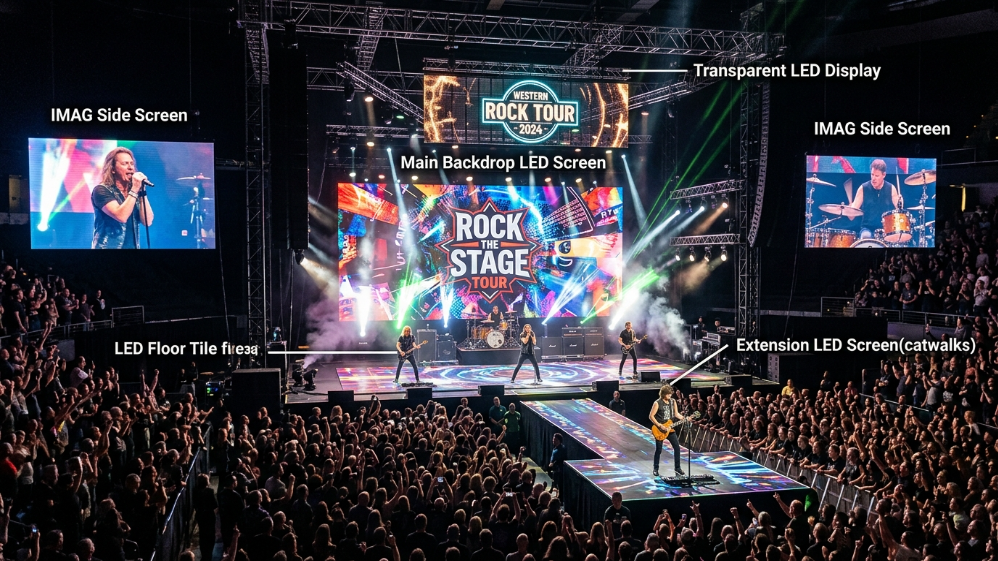
Understanding screen positioning is fundamental to any event production spec sheet. Concert LED display systems are not a single screen; they’re a multi-surface visual architecture. Here’s how professional productions structure that architecture.
Main Backdrop Screen
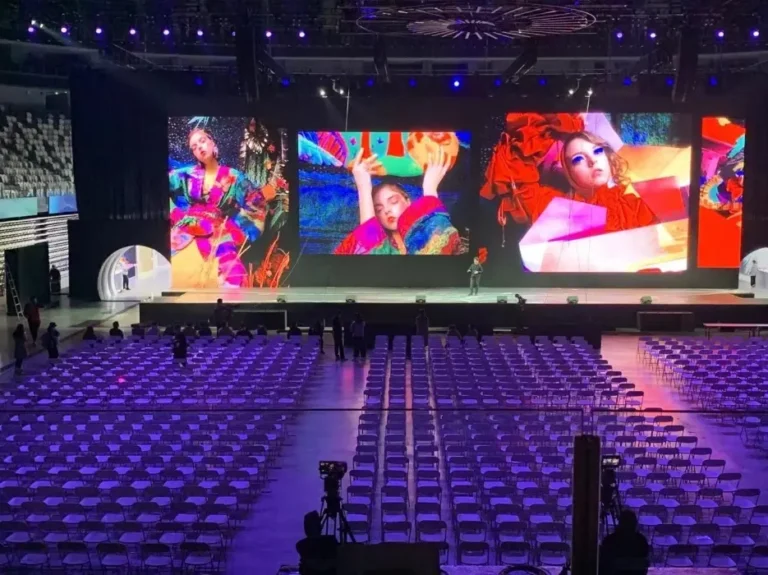
The primary visual surface, mounted upstage center behind the performers. This is the screen audiences focus on and the one most visible in broadcast footage. Pixel pitch selection here is driven by the minimum viewing distance from the front row—typically P2.6 or P2.976 for indoor arenas (minimum viewing distance: 2.5–3 m), scaling to P3.91 or P4.81 for larger outdoor stages where the front-of-house mix position sits 40–60 m from the stage.
Side IMAG (Image Magnification) Screens
Positioned left and right of the main stage, these screens carry live camera feeds of the performers—close-up shots that allow audiences in lateral seating sections to maintain connection with the artist. IMAG screens are what separate a concert from a stadium show: without them, anyone seated beyond 30° of the center axis loses the intimacy that defines live performance.
Based on our installations at 20,000+ capacity venues, IMAG screen width should be a minimum of 1/15th of the maximum viewing distance from that screen.
LED Floor Tiles
Increasingly standard in premium concert productions, floor LED creates interactive stage surfaces where performers’ movements trigger real-time visual responses. Structural load ratings (typically 1,000–1,500 kg/m²) and surface anti-slip coatings distinguish floor-rated panels from standard wall products—a specification detail that matters for insurance and venue compliance.
Extension Screens
Deployed at large outdoor festivals and stadium shows where venue geometry creates obstructed sightlines. These screens display a clean ISO feed from the production’s video director and are positioned on delay towers or temporary structures within the audience area itself.
Flexible and Transparent LED
Increasingly common in high-budget touring productions seeking creative differentiation. Flexible LED strips can be formed into cylinders, curves, or abstract sculptural forms. Transparent LED mesh panels allow performers to appear “inside” the screen—a visual effect now strongly associated with EDM and K-pop productions.
Concert LED Screen Types Comparison
| Screen Type | Typical Pixel Pitch | Key Spec Priority | Common Use Case |
|---|---|---|---|
| Main backdrop (indoor) | P2.6–P3.91 | Resolution, refresh rate ≥3840 Hz | Arena concerts, theater |
| Main backdrop (outdoor) | P3.91–P6 | Brightness ≥5,000 nits, IP65 | Festivals, stadium shows |
| IMAG side screens | P3.91–P4.81 | Wide viewing angle, low latency | Arenas, amphitheaters |
| LED floor tiles | P3.9–P6 | Load rating ≥1,000 kg/m², anti-slip | Premium touring, TV productions |
| Extension/delay screens | P4.81–P8 | High brightness, weather resistance | Outdoor festivals |
| Flexible/transparent LED | P3–P10 | Bending radius, transparency rate | Creative/immersive touring |
How to Choose the Right Pixel Pitch—The Specification Decision That Makes or Breaks Your Budget
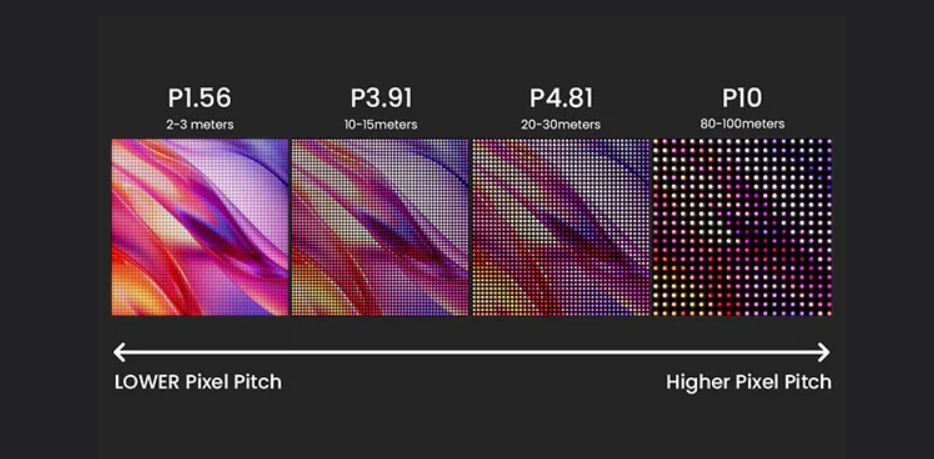
Pixel pitch is the single most consequential technical decision in any concert LED display project.
Get it wrong in either direction and you’ve either overspent on resolution nobody can perceive, or delivered a screen that looks pixelated at normal viewing distances—both outcomes that damage client relationships.
Pixel pitch (measured in millimeters, center-to-center between adjacent LED clusters) determines two things simultaneously: image resolution at a given screen size, and the minimum comfortable viewing distance. The relationship is direct. A P2.976 panel has 2.976 mm between pixels; a P6 panel has 6 mm. Halve the pitch, roughly quadruple the cost per square meter.
The industry rule of thumb—minimum viewing distance (meters) ≈ pixel pitch (mm) × 1.0—is a starting point, not a specification. For broadcast-quality output where camera close-ups will be displayed on the screen itself (a common IMAG application), tighten that multiplier to 0.8. For outdoor screens where the audience is uniformly distant, you can stretch it to 1.5 without visible quality degradation.
Pixel Pitch Selection Guide
| Pixel Pitch | Min. Viewing Distance | Typical Application | Indicative Price (USD/m²) | Brightness Ceiling |
|---|---|---|---|---|
| P1.5–P2.0 | 1.5–2.0 m | TV studios, XR virtual production walls | $1,800–$2,800 | 800–1,200 nits |
| P2.6–P2.976 | 2.5–3.0 m | Indoor arenas, theater backdrops | $1,100–$1,800 | 1,500–2,500 nits |
| P3.91 | 3.5–4.0 m | Multipurpose indoor/outdoor rental | $900–$1,400 | 3,000–5,000 nits |
| P4.81 | 4.5–5.0 m | Mid-size outdoor stages, IMAG screens | $700–$1,100 | 4,500–6,500 nits |
| P6–P8 | 6.0–10 m | Large outdoor festivals, delay screens | $450–$750 | 5,500–8,000 nits |
One point the manufacturer spec sheets won’t highlight: for outdoor festival applications, brightness matters more than pixel density beyond a certain threshold. At 50 meters viewing distance, the difference between P4.81 and P6 is imperceptible to the human eye. The difference between 5,000 nits and 8,000 nits in direct afternoon sunlight is not. Prioritize nits over pitch on outdoor builds.
Rental vs. Purchase: The ROI Framework Event Companies Actually Need
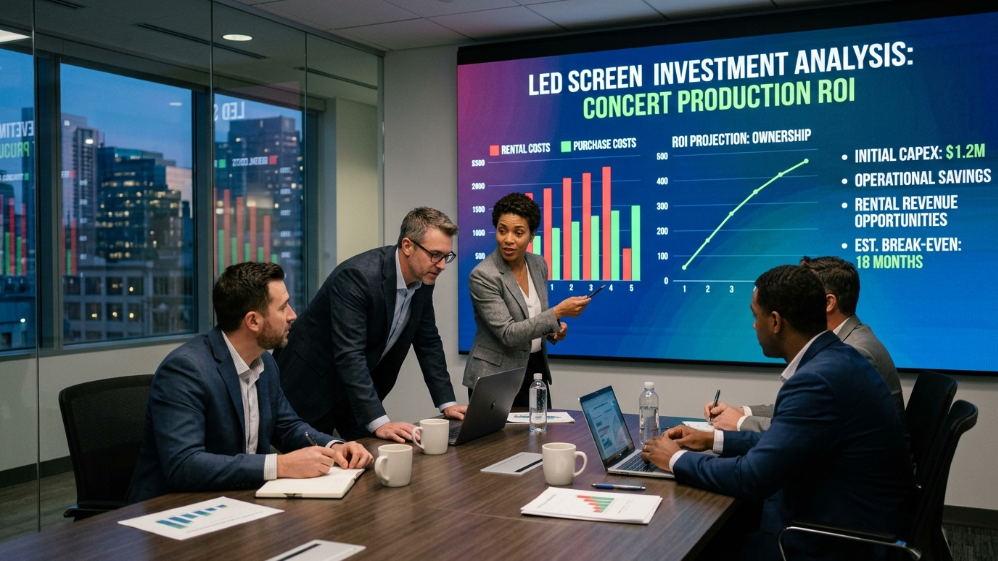
This is the conversation that happens in every serious B2B procurement process and almost never gets addressed honestly in vendor content. The answer isn’t “it depends”—it’s a calculable threshold.
The break-even analysis is straightforward. A professional-grade P3.91 outdoor rental LED system covering 60 m² (a workable mid-size festival stage) costs approximately $55,000–$80,000 to purchase outright, including cabinets, processors, power distribution, and cabling. Professional rental rates for equivalent equipment run $4,000–$8,000 per event day depending on market and logistics.
At $6,000/day average rental cost, break-even on ownership sits at roughly 10–14 events. Factor in maintenance reserves (budget 8–12% of equipment value annually), storage, transportation infrastructure, and technician training, and the true ownership break-even for most event companies is closer to 18–24 events per year to justify the capital outlay.
ROI Decision Framework
| Deployment Frequency | Recommended Strategy |
|---|---|
| Fewer than 15 deployments/year | Rental |
| 15–20 deployments/year | Hybrid Model |
| More than 20 deployments/year | Ownership |
The verdict: if your company runs fewer than 15 LED screen deployments per year, rental delivers better capital efficiency. Above 20 consistent annual deployments at similar specifications, ownership builds long-term margin. Hybrid strategies—owning core inventory (main backdrop panels) and renting supplementary screens (side IMAG, floor tiles)—are what most mid-scale production companies actually run.
The Signal Chain: What Every AV Integrator Needs to Understand Before Spec’ing a Screen
The LED panels get all the attention in sales conversations. The video processing chain is where concert productions actually succeed or fail.
A concert LED display system is only as reliable as its weakest signal link. From content source (media server or live camera feed) to the panel surface, the signal passes through a video processor—the brain of the entire display system. In professional touring, Novastar (NovaPro UHD Jr, MCTRL4K) and Brompton Technology (Tessera SX40, Hydra) are the two dominant processor families. They are not interchangeable, and they are not equivalent.
Brompton Processors

Brompton processors are the industry standard for broadcast-quality output and high-speed camera compatibility. Their proprietary Brompton Processing technology manages per-pixel calibration and enables the extreme refresh rates (up to 7,680 Hz) required when filming LED walls with modern cinema cameras—an increasingly critical requirement as concert livestreaming and IMAG broadcast become standard deliverables.
Novastar Processors
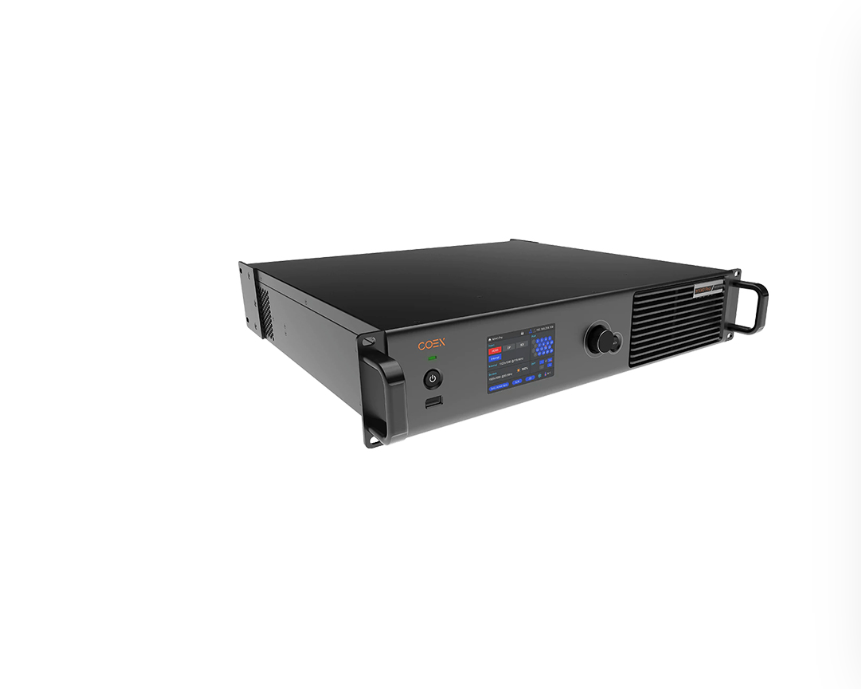
Novastar hardware delivers excellent performance at lower price points and dominates the mid-tier event market.
For any installation where live broadcast or streaming is part of the deliverable, specify Brompton. For events where broadcast is not a requirement, Novastar provides outstanding reliability at 30–40% lower processing cost.
Redundancy Is Non-Negotiable
Dual-redundancy signal backup is non-negotiable for concerts above 5,000-person capacity. This means dual fiber runs, hot-standby processor failover, and dual power feeds to every cabinet.
The cost delta is approximately 15–20% of total system cost. The cost of a screen going dark mid-show—in client relationship damage, social media exposure, and potential contractual penalties—makes that 20% the highest-ROI line item in any concert display budget.
Frequently Asked Questions
Q1: What size LED screen does a 5,000-capacity indoor arena typically require for the main backdrop?
For a 5,000-seat arena with a stage width of 15–20 m, a main backdrop screen in the range of 12 m wide × 6 m tall (72 m²) is a functional starting point.
The key calibration is that screen width should approximate stage width, and screen height should scale to maintain a 16:9 or 2.35:1 aspect ratio for video content compatibility.
Always validate the screen height against the maximum rigging point available in the venue—this is the constraint that most commonly forces a redesign late in the project.
Q2: Can outdoor concert LED screens operate in rain?
Professional outdoor rental LED panels are rated IP65 as standard—meaning complete dust protection and water jet resistance from any direction.
This covers rain, light hose-down cleaning, and morning condensation without operational impact.
What IP65 does not cover is prolonged submersion or high-pressure water ingress at seal joints after repeated assembly cycles.
Inspect cabinet seal integrity before every outdoor deployment; compressed foam gaskets degrade with heavy touring use.
Q3: What refresh rate is required if the concert will be live-streamed or filmed?
A minimum of 3,840 Hz refresh rate is required to eliminate the rolling shutter banding effect visible when LED screens are filmed with CMOS cameras at normal shutter speeds.
For productions using high-frame-rate cameras (120 fps+) or cinematic capture, specify 7,680 Hz or higher—currently the domain of Brompton-driven systems with compatible LED panels.
This is not a marketing spec; it’s a physics constraint. A 1,920 Hz panel will produce visible scan lines on broadcast footage regardless of camera settings.
Q4: What’s the difference between SMD and COB LED packaging for concert screens?
SMD (Surface-Mounted Device) packages individual red, green, and blue diodes separately on the panel surface—the industry standard for rental LED above P2.5.
COB (Chip-on-Board) encapsulates multiple diodes together under a single lens, producing better contrast ratios, improved color uniformity at fine pitches, and significantly greater physical robustness (the diodes are protected by the encapsulant rather than exposed).
COB is increasingly specified for fine-pitch indoor stages (P1.5–P2.5) and XR virtual production environments where surface durability and optical performance under camera are priorities.
COB panels typically cost 20–35% more than comparable SMD products.
Q5: How long does a professional concert LED display system last, and what does maintenance cost?
High-quality rental LED cabinets with SMD or COB packaging carry rated lifespans of 80,000–100,000 hours (roughly 9–11 years of continuous operation).
In touring conditions—frequent assembly, transport vibration, temperature cycling—practical service life before significant pixel failure rates emerge is typically 5–8 years with proper maintenance.
Budget 8–12% of equipment purchase value annually for maintenance: pixel replacement, power supply servicing, cabinet latch replacement, and calibration.
The highest-failure components in touring conditions are power supplies and receiving cards, not the LED diodes themselves.
Expert Verdict
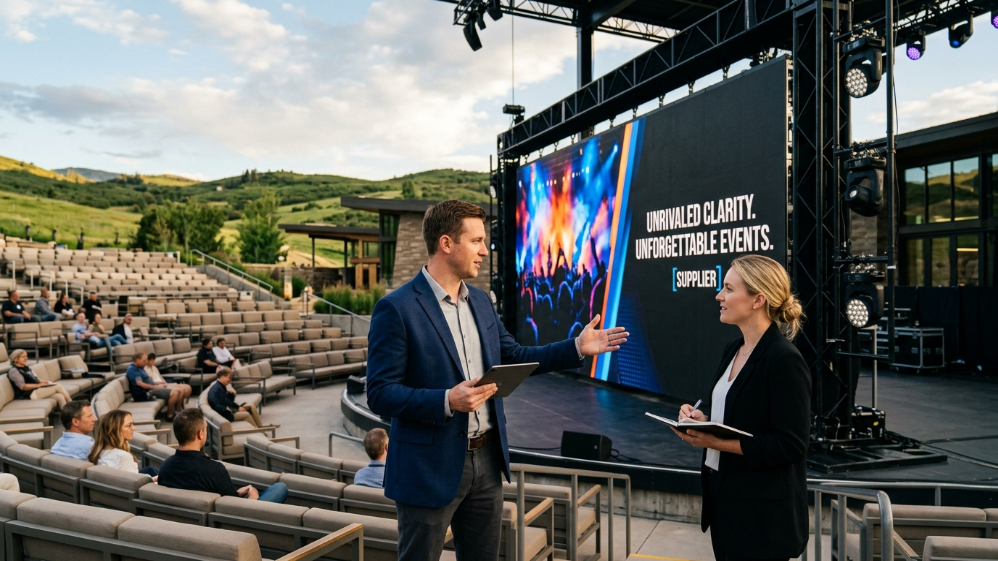
After speccing and commissioning LED display systems across arena tours, outdoor festivals, and hybrid broadcast productions, the pattern is consistent: the projects that go wrong almost never fail on panel quality.
They fail on incomplete signal chain design, mismatched pixel pitch to viewing geometry, or a rental-vs-purchase decision made on gut feel rather than utilization math.
For B2B buyers entering procurement: lock down your minimum viewing distance and broadcast requirements before any vendor conversation. Those two parameters will eliminate 70% of the product options and anchor every other specification that follows.
The screen you need is almost certainly a P3.91 rental panel for outdoor or a P2.976 for indoor—the market has converged on these formats for good reason—but the processing, rigging, and redundancy architecture around that panel is where your production’s reputation actually lives.
Price Summary Notice
Concert LED display pricing varies significantly based on pixel pitch, screen size, brightness requirements, processor configuration, and rental versus ownership models. As a general benchmark, rental LED screens range from approximately $4,000–$8,000 per event day for professional mid-size systems, while purchasing a complete P3.91 outdoor rental LED solution typically requires an investment of $55,000–$80,000 or more. For accurate budgeting, buyers should request project-specific quotations based on venue dimensions, viewing distance, installation method, and broadcast requirements.
References:
Fundamentals of LED Display Technology for Professional Video Applications
Digital Signage and LED Display Systems Resource Library