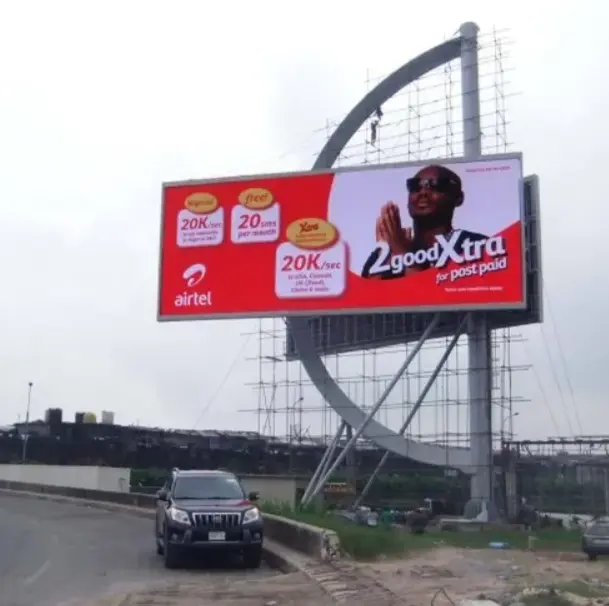
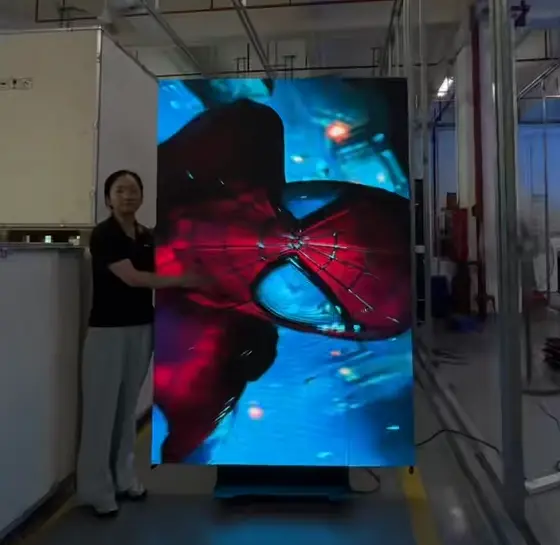
If you need a fast answer before diving deep: for most outdoor applications in South Africa, a P6 or P8 SMD LED screen with ≥5,000 nits brightness, IP65 protection, and a dedicated UPS or solar-hybrid power backup is the baseline specification that protects your investment. Anything below that threshold, and you are engineering failure into your project from day one. Here is a quick reference to get your shortlist started:
Quick Reference Specification Matrix
| Application | Recommended Pixel Pitch | Min. Brightness | IP Rating | Typical Cabinet Size |
| Highway / Freeway Billboard | P8 – P10 | 6,000–8,000 nits | IP65 | 960×960mm |
| Urban Road / Retail Facade | P5 – P6 | 5,000–6,000 nits | IP65 | 500×1000mm |
| Event Stage / Festival | P3.9 – P4.8 | 4,500–5,500 nits | IP54 | 500×500mm |
| Stadium Perimeter / Scoreboard | P6 – P8 | 5,500–7,000 nits | IP65 | 960×960mm |
| Shopping Centre Exterior | P4 – P5 | 5,000 nits | IP65 | 500×1000mm |
Why Buying an Outdoor LED Screen in South Africa Is Not Like Buying One Anywhere Else
Let’s be direct. Most online guides about outdoor LED screens are written for European or North American markets, where the two hardest engineering problems are cold-weather condensation and occasional rainfall. South Africa hands you an entirely different set of challenges — and if your supplier has not addressed them specifically, that is your first warning sign.
Based on our experience deploying outdoor LED screens across Gauteng’s high-plateau UV environment, KwaZulu-Natal’s coastal salt-spray corridors, and the Western Cape’s winter rain season, the variables that kill LED investments here are not the ones buyers typically research. They are: sustained direct solar irradiance exceeding 1,000 W/m² on the Highveld that accelerates enclosure degradation; Eskom’s chronic load shedding cycles that can darken a R2-million DOOH asset for up to 8–12 hours per day during Stage 6 outages; and municipal compliance requirements that vary dramatically between metros, turning a straightforward installation into a 6-month approval process.
These are not edge cases. They are the defining commercial realities of this market.
The Unique Engineering Challenges of South Africa’s Climate Zones
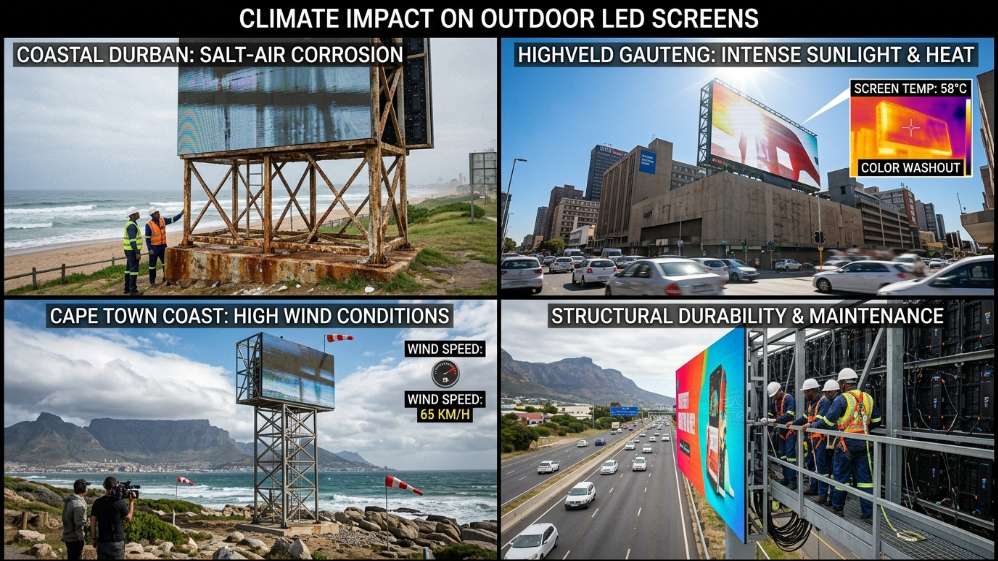
South Africa is not a monolithic climate. It is four distinct operating environments for outdoor LED hardware, and specifying a single product across all of them is a mistake.
Gauteng and Mpumalanga (Highveld)
Altitude around 1,700m, intense UV radiation, afternoon thunderstorms with lightning strike exposure, and temperature swings of 25°C between day and night. The thermal cycling alone stresses solder joints inside LED modules over time. Screens deployed here need cabinets with active thermal management — front-access service panels are non-negotiable given the frequency of maintenance calls. The brightness requirement is unforgiving: at 1,000+ W/m² of direct sunlight, a 4,000-nit screen simply disappears. 5,500 nits is the practical minimum; 7,000+ nits is preferred for east-facing highway installations.
KwaZulu-Natal Coastal (Durban corridor)
Salt-laden air corrodes unprotected circuit boards within 12–18 months. Standard IP65 cabinets use seals rated for fresh-water ingress. For coastal deployments, the relevant specification is IP67 with conformal-coated PCBs — a detail most entry-level quotations deliberately omit. The cost difference between a standard and a conformal-coated module is roughly 8–12%. The cost of replacing a corroded LED cabinet after 18 months is 100% of your original capital.
Western Cape (Cape Town Metro)
The Southeaster wind produces sand abrasion loads that erode cabinet seals. Structural wind-load ratings — SANS 10160 compliance — are actively enforced by the City of Cape Town’s building inspectors. A structure designed for the Johannesburg wind zone will not pass inspection here.
How Load Shedding Is Reshaping DOOH — And What Smart B2B Buyers Do About It
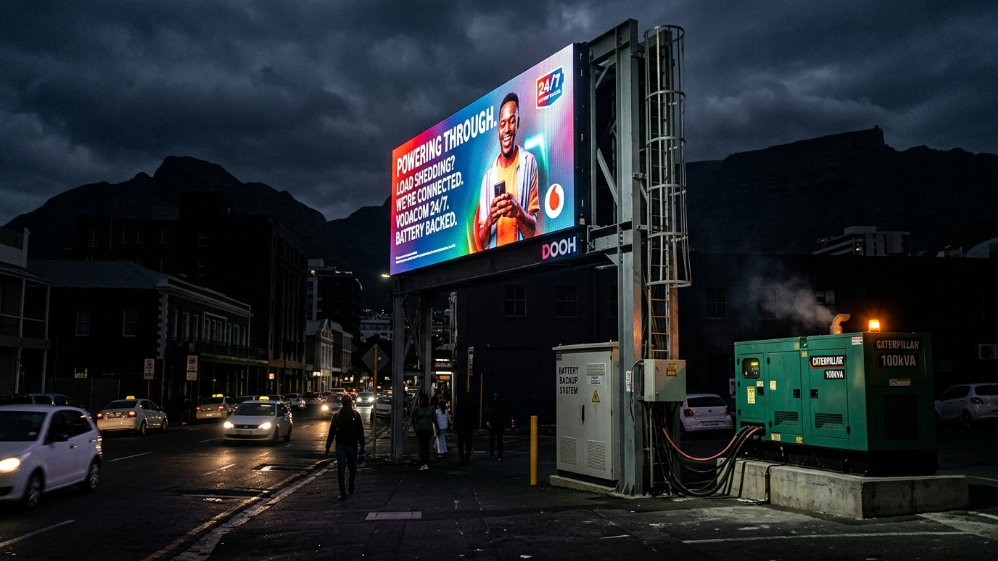
This is the conversation that separates serious operators from casual investors.
South Africa’s load shedding crisis, driven by Eskom’s sustained generation deficit, has introduced a risk category that does not exist in any other LED screen market globally. During the peak 2022–2023 period, the country experienced over 200 days of rolling blackouts. Even with recent grid stabilisation improvements, Stage 2–4 outages remain a structural feature of the energy landscape through at least 2027 according to Eskom’s own capacity projections.
For DOOH operators, the commercial consequence is precise and measurable: every hour a screen is dark is an hour of sold advertising inventory that cannot be delivered. For a premium highway billboard generating R80,000 per month in advertising revenue, an average of 4 hours of daily downtime across a month represents over R40,000 in non-deliverable impressions — roughly 50% of gross revenue.
There are three viable power resilience architectures for outdoor LED screens in South Africa today:
Power Resilience Options
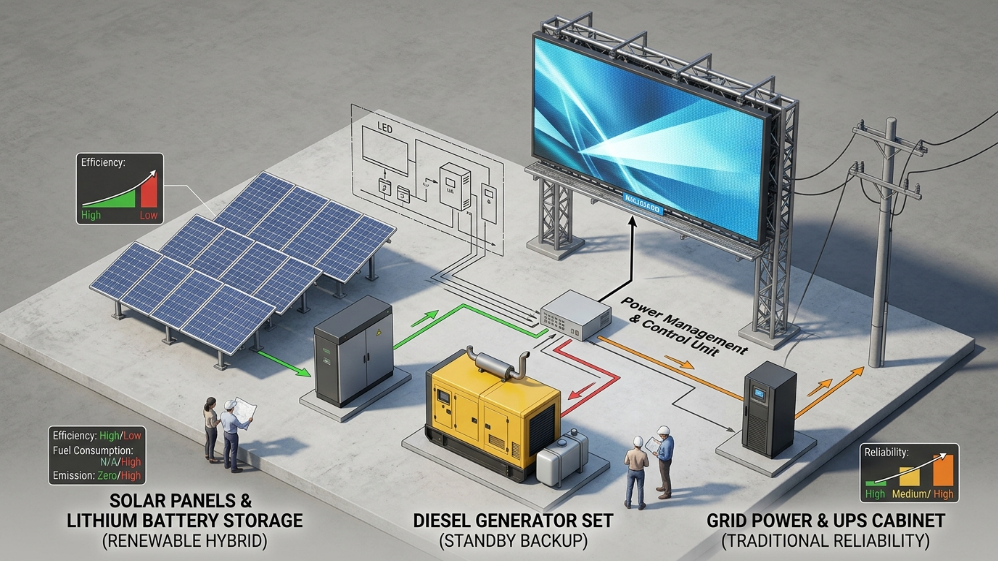
| Power Solution | Upfront Cost Premium | Coverage Duration | Best For |
| Industrial UPS (Li-ion) | +15–25% of screen cost | 4–6 hrs (Stage 4) | Urban single-screen sites |
| Diesel Generator Backup | +R80,000–R200,000 installed | Unlimited (fuel dependent) | High-revenue highway billboards |
| Solar PV + Battery Hybrid | +R150,000–R500,000 installed | 18–24 hrs autonomous | Remote sites, ESG-conscious operators |
| Solar Farm (large-scale) | Project-specific | 95%+ off-grid | Premium mega-format DOOH |
The solar-hybrid model is gaining significant momentum. South Africa’s irradiation levels — averaging 4.5–6.5 peak sun hours per day depending on region — make the economics compelling at scale. Based on publicly available project data, a 6m × 3m outdoor LED billboard drawing approximately 2.5–3.5 kWh per operational hour can be adequately served by a 10–15 kWp solar array with 20–30 kWh of lithium battery storage. The capital payback on eliminating downtime-related revenue loss typically runs 18–30 months for high-traffic sites.
The engineering implication for buyers: When issuing an RFQ, do not treat power infrastructure as a separate line item to be figured out later. Specify your power resilience requirement alongside the screen specification. Suppliers who do not address this proactively — and there are many — are selling you hardware without acknowledging the operating environment it will be placed in.
How to Choose the Right Pixel Pitch for Your South Africa Outdoor LED Screen Project
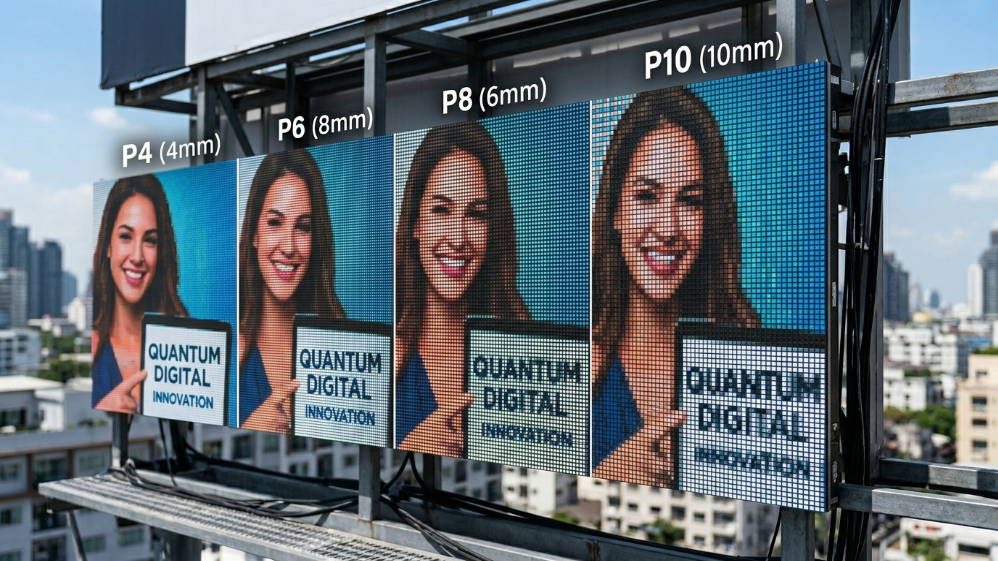
Pixel pitch is the single most misunderstood specification in the LED procurement process, and it is where both overspending and under-speccing happen most often.
Pixel pitch refers to the centre-to-centre distance between individual LED pixels, measured in millimetres. A P6 screen has 6mm between pixels; a P10 screen has 10mm. The practical consequence is straightforward: the larger the pixel pitch, the greater the minimum viewing distance required to perceive a clean, continuous image rather than a visible pixel grid.
The rule of thumb used by experienced integrators is: minimum viewing distance (in metres) ≈ pixel pitch (in mm) × 0.8 to 1.2, depending on content type. A P8 screen is optimally viewed from 6.4–9.6 metres or further. For a highway billboard where the nearest viewer in a vehicle is travelling at 120 km/h and is 15–25 metres away when they first register the creative, P8 or P10 is not a compromise — it is the correct engineering choice. Specifying a P5 screen for that application wastes approximately 30–40% of the capital budget on resolution the human eye cannot perceive at that distance.
The inverse mistake is equally costly. Specifying P10 for a shopping centre exterior where pedestrians approach within 5–8 metres produces a visibly pixelated image that degrades brand perception — the exact opposite of the intended commercial outcome.
The True Total Cost of Ownership: What Your Supplier’s Quote Is Hiding
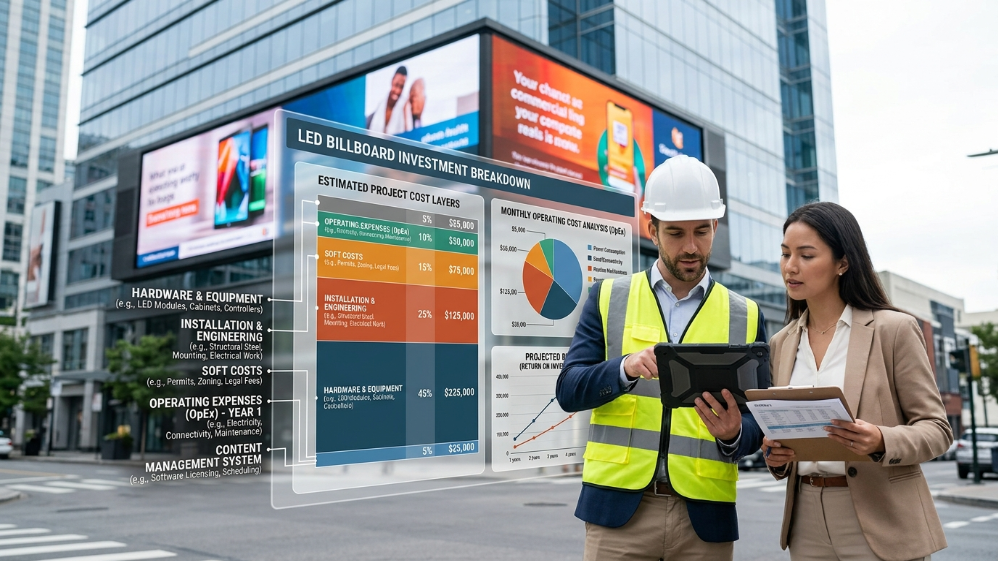
A quotation for an outdoor LED screen in South Africa that looks competitive at first glance is almost never the full picture. Based on our experience auditing procurement decisions post-installation, the initial hardware quote typically represents only 55–70% of the actual 3-year cost of ownership. The remainder surfaces as surprise line items after the contract is signed.
Here is the complete TCO framework that experienced B2B buyers use before approving any capital expenditure:
Total Cost of Ownership (TCO) Breakdown
| Cost Category | Typical % of Total 3-Year TCO | Notes for South Africa |
| LED screen hardware (cabinets, modules, power supplies) | 40–50% | Get itemised module count, not just total sqm price |
| Steel structure & civil engineering | 12–18% | SANS 10160 wind-load compliance mandatory; varies sharply by metro |
| Electrical installation & power backup | 8–15% | UPS or solar-hybrid adds significant capex but protects revenue |
| Content Management System (CMS) licensing | 3–6% annually | Cloud-based CMS often has recurring SaaS fees not in hardware quote |
| Preventive maintenance contract | 4–8% annually | Local spare parts availability is the critical variable |
| Municipal permits & structural certification | 2–5% (one-off) | Cape Town and Johannesburg Metro have different fee structures |
| Import duties & freight (for China-sourced screens) | 8–14% | Factor in ZAR/USD exchange rate risk on payment timeline |
The structural engineering cost deserves specific attention. Many buyers receive a quote that lists “installation included” without specifying whether the steel monopole or gantry structure is engineered to SANS standards. A structure that fails a city inspector’s review means a stop-work order, re-engineering fees, and delays that can run 8–14 weeks. For a DOOH operator with signed advertiser commitments, that is a commercial catastrophe.
On the import duty question: South Africa applies a 20% ad valorem customs duty on LED video walls (HS Code 8528.52), plus 15% VAT on the CIF value. A screen quoted at USD 18,000 ex-factory in Shenzhen can land at a landed ZAR cost equivalent of USD 26,000–28,000 after duties, freight, clearing, and currency conversion. Any supplier that presents you with a USD factory price without explicitly walking through the landed cost calculation is either uninformed or deliberately obscuring the comparison.
Top Use Cases: Matching the Right Spec to the Right Application
South Africa’s outdoor LED market is not homogeneous. The dominant B2B use cases each carry distinct technical requirements, and conflating them is how integrators end up with screens that underperform commercially.
DOOH Highway Billboards (Johannesburg N1/N3, Cape Town N2)
The primary KPI is maximum visibility at vehicle speed. Brightness above 6,000 nits, pixel pitch P8–P10, and a refresh rate above 1,920 Hz to eliminate scan lines in social media video content captured by passing motorists (who increasingly film and share billboards). The structural wind-load certification is particularly demanding along the N1 Highveld corridor. Power resilience is non-negotiable here — a dark billboard on a premium highway site generates contractual penalty clauses with advertisers.
Outdoor Events & Festival Screens
The rental market is the fastest-growing segment in South Africa’s LED industry, driven by the country’s active outdoor events calendar. Rental screens operate differently from permanent installations: they prioritise modular fast-assembly cabinet design (magnetic front service, tool-free locking), lightweight aluminium die-cast cabinets under 9 kg per module, and wide viewing angles above 140° horizontal to serve large spread audiences. Pixel pitch P3.9–P4.8 hits the sweet spot between visual quality and rental economics for stages viewed from 8–30 metres.
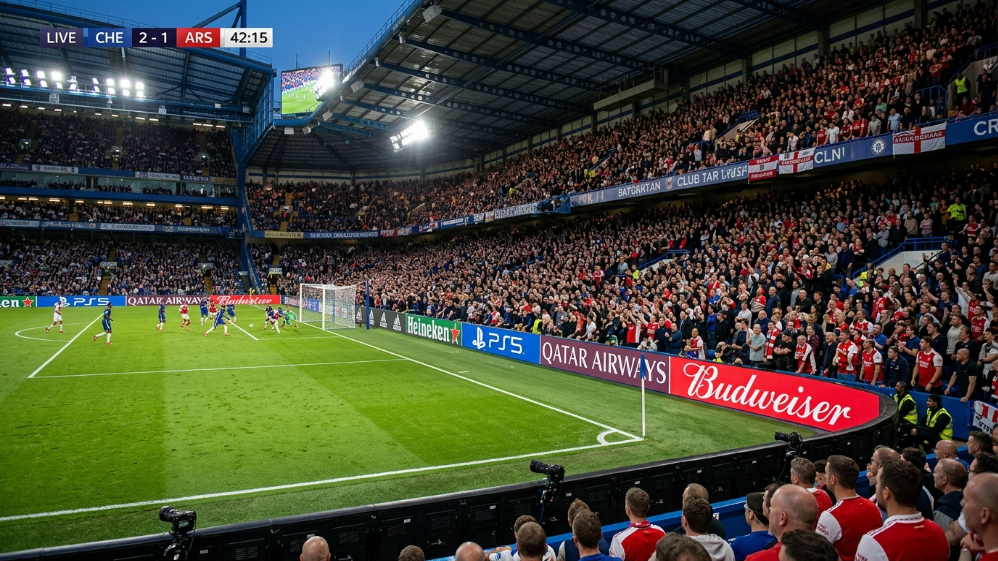
Sports Stadiums & Perimeter Boards
South Africa’s Premier Soccer League and domestic rugby fixtures have driven significant investment in stadium LED. The defining technical requirement is refresh rate — the screen must reproduce motion without flicker artefacts when captured by broadcast cameras operating at 50fps or 60fps. A refresh rate below 3,840 Hz produces visible banding in broadcast footage. This is a specification that most purchasing committees overlook until they see their stadium screen flickering on national television.
Outdoor LED Double-Sided Screen Next to the African Road (Case Study)
Project Overview
The project aims to install a series of outdoor LED double-sided screens along the highways of Africa for advertising and public service information display. With its outstanding performance and user-friendly operation, the Ares outdoor LED display screen has been chosen as the ideal solution for this project.
Advantages of Ares Outdoor LED Display Screen
High Brightness
With a brightness of 10,000 nits, ensuring clear visibility even in bright outdoor environments, attracting the attention of passing pedestrians. Knowledge about nit brightness.
Multiple Color Options
Silver, white, and black color options available, meeting various design and environmental requirements, seamlessly blending with the surrounding environment.
Lightweight and Easy Installation
Each aluminum panel weighs only 23 kilograms, lightweight and easy to install, saving up to 50% of installation costs. Here are some installation methods for installing LEDs.
Low Maintenance Cost
1-meter by 1-meter aluminum cabinet, no air conditioning required for maintenance, reducing maintenance costs. What should you consider when customizing LED digital screens?
Customizable
Aluminum panels are customizable to meet the personalized needs of customers.
Plug and Play
Easy operation, no need for professional maintenance personnel.
Benefits Brought by Ares Outdoor LED Display Screen to Customers
- Enhanced Advertising Effectiveness: High brightness and clear images effectively attract the attention of target audiences, enhancing advertising effectiveness.
- Beautification of Environment: Multiple color options and customizable aluminum panels enable the display screen to seamlessly blend with the surrounding environment, enhancing the city’s image.
- Cost Reduction: Lightweight and easy installation, low maintenance costs, saving operational costs.
- Simple Operation: Plug and play, no need for professional maintenance personnel, reducing management costs.
Case Evidence
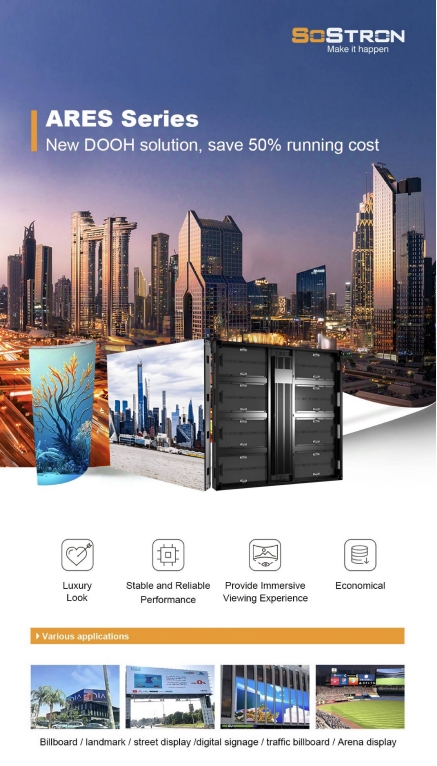
In this project, the Ares outdoor LED display screen has been highly recognized by customers. The high brightness images remain clear even under sunlight, attracting the attention of numerous passing pedestrians. The display screen with multiple color options seamlessly blends with the surrounding environment, enhancing the city’s image. Additionally, the lightweight and easy installation characteristics significantly reduce installation costs. Do you want to know the difference between indoor LED display and outdoor LED display?
Conclusion
As an excellent product, the Ares outdoor LED double-sided screen has brought outstanding performance and convenience to this project. Its outstanding features and numerous benefits have laid a solid foundation for the successful promotion and implementation of this project, while also providing a powerful reference for the success of similar projects in the future. In the future development, Ares outdoor LED double-sided screens will continue to play an important role, providing higher quality and more professional solutions for various outdoor advertising displays, helping customers achieve greater commercial value and social benefits.
How to Evaluate a Supplier: The 7-Point Vetting Framework
The South African market currently has over 35 identifiable LED screen suppliers, ranging from established local integrators with a decade of installations to new import-and-resell operations with no engineering capacity. The price variance between them can reach 40% for ostensibly equivalent specifications. Here is how to differentiate quality from risk:
-
Local spare parts inventory. Ask specifically: do you hold driver ICs, power supply units, and receiving cards for this cabinet model in South Africa? A supplier airfreighting replacement modules from Shenzhen on a 10–14 day lead time during a screen failure is not providing after-sales support — they are providing a 2-week revenue blackout.
-
Reference installations with verifiable uptime data. Request two or three reference sites that have been operational for 18+ months. Visit them. Inspect for dead pixels, colour uniformity drift, and cabinet seal condition.
-
SANS-compliant structural engineering capability. The supplier should have a registered professional engineer (or a formal relationship with one) who signs off on structural calculations. If they cannot name the engineer, that is a disqualifying answer.
-
Specific load-shedding mitigation proposal. Any supplier who does not proactively address power resilience in their proposal is not thinking about your operating environment.
-
CMS demo with local support. The content management software should be demonstrable, with South African-based technical support available during business hours. A CMS that requires a Shenzhen support ticket at 2am is not fit for commercial DOOH operations.
-
Warranty terms in ZAR, not USD. Warranty replacements priced in USD expose you to exchange rate risk on every claim. Negotiate ZAR-denominated warranty obligations.
-
Itemised bill of materials. A professional supplier can tell you the LED chip brand (Nationstar, Nichia, Cree), the driver IC (MBI, ICN), and the power supply manufacturer (Mean Well, Mingwei) in their proposed cabinet. A supplier who cannot or will not provide this information is selling you an unknown-quality bill of materials.
Frequently Asked Questions
How much does an outdoor LED screen cost in South Africa in 2026?
For a fully installed, SANS-compliant P8 outdoor LED billboard (6m × 3m), the realistic all-in investment ranges from R850,000 to R1.8 million depending on structural requirements, power backup specification, and site location. Factory-only hardware pricing from China (before duties, freight, and installation) typically runs USD 700–1,200 per square metre for commercial-grade outdoor product. Budget separately for structure, power, and permits — these are not optional line items.
What pixel pitch is best for a highway billboard in South Africa?
P8 or P10 for freeway applications where minimum viewing distance exceeds 10 metres. P6 is the right choice for urban arterials and retail-facing installations where pedestrian and slow-traffic viewing distances fall between 6–12 metres. Do not let a salesperson upsell you to P5 or lower for highway applications — the resolution improvement is invisible at speed and the cost premium is pure waste.
How do I protect my outdoor LED screen from load shedding?
The practical minimum for most commercial sites is an industrial lithium-ion UPS sized to cover Stage 4 outage duration (4–6 hours). For high-revenue DOOH sites, a solar PV hybrid system with battery storage provides 18–24 hours of autonomous operation and typically achieves positive ROI within 24–30 months through recovered advertising inventory. Specify the power resilience requirement in your RFQ — do not treat it as an afterthought.
Do I need a permit to install an LED billboard in South Africa?
Yes, without exception. Every metro requires a combination of building plan approval, outdoor advertising bylaw consent, and electrical compliance certification (CoC). Johannesburg Metropolitan Municipality, the City of Cape Town, and eThekwini all operate different application portals with different processing timelines — typically 8–20 weeks. Factor this into your project schedule. Unauthorised installations are actively removed by metro enforcement teams, and the fines do not recover your hardware costs.
What IP rating do I need for a coastal outdoor LED screen installation?
IP65 is the industry standard minimum for outdoor LED screens and is adequate for inland installations. For coastal deployments within 5km of the ocean — Durban beachfront, Cape Town waterfront, Port Elizabeth — specify IP67 with conformal-coated PCBs. The incremental cost is 8–15% of module pricing and the protection it provides against salt-spray corrosion is the difference between a 7-year asset life and an 18-month replacement cycle.
Expert Verdict
South Africa’s outdoor LED screen market rewards buyers who do their engineering homework and penalises those who shop on headline price alone. The three decisions that determine whether your investment succeeds or fails are: getting the pixel pitch right for your actual viewing distance, specifying a power resilience solution before the screen goes up rather than after the first Stage 4 outage, and choosing a supplier with demonstrable local technical infrastructure — not just a local sales address.
The screens that are still generating returns five years from now will be the ones spec’d at 5,500+ nits with SANS-certified structures, hardened against salt and UV for their specific climate zone, and backed by power systems that keep them on when the grid goes down. Everything else is a cost centre waiting to happen.
Price Summary (Final Note)
In 2026 South Africa market conditions, outdoor LED screens typically land in a R850,000 to R1.8 million range for mid-size highway installations, but total project cost can rise significantly once steel structures, power backup systems, import duties, and municipal compliance are included. In practice, buyers should plan for 30–45% additional cost beyond factory quotation to reflect real deployment conditions — anything lower is optimistic accounting, not engineering reality.
References:
Eskom Holdings SOC Ltd – Load Shedding & Grid Information
South African Bureau of Standards (SABS) – SANS 10160 Structural Design Standards