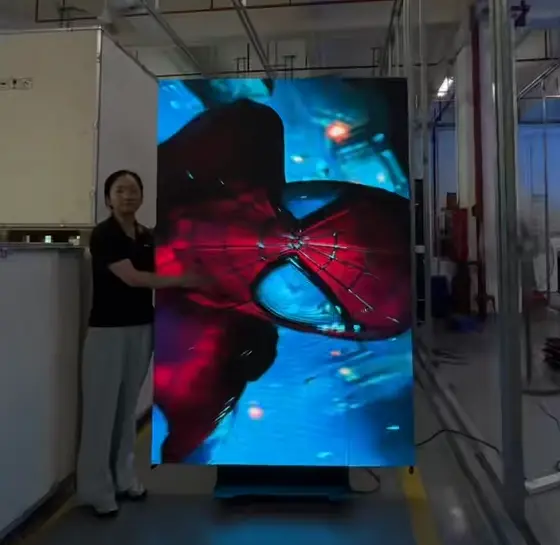
A B2B Buyer’s Guide for Commercial Deployments (2026)
Short answer for commercial buyers: For any deployment above 65 inches, in high-ambient-light environments, or requiring seamless large-format scaling, Direct View LED outperforms IPS LCD on every metric that drives commercial ROI—brightness, durability, scalability, and 5-year total cost of ownership. IPS panels retain a legitimate role in small-format, close-range indoor applications where color precision is paramount and budget is constrained.
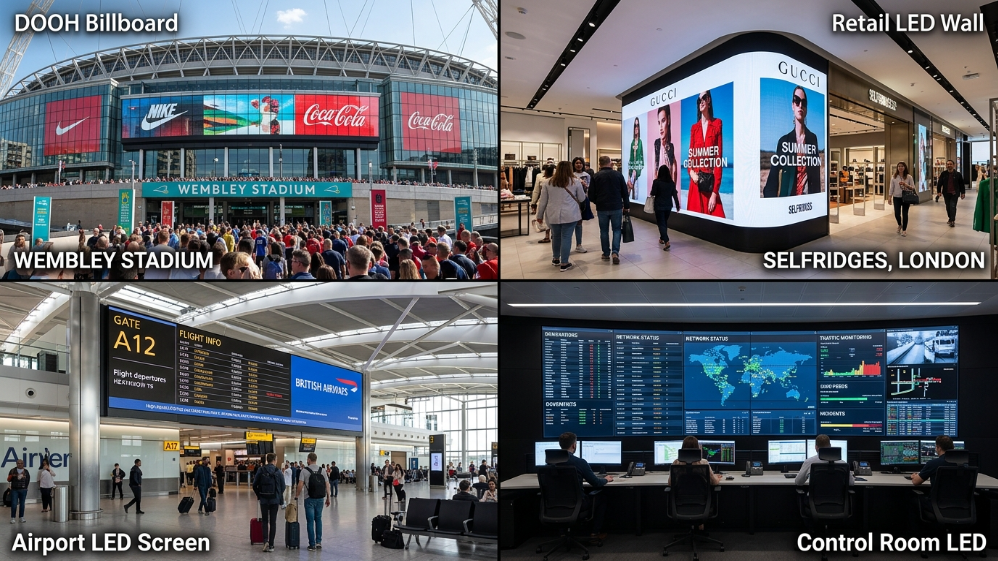
| Deployment Scenario | Recommended Technology | Decisive Factor |
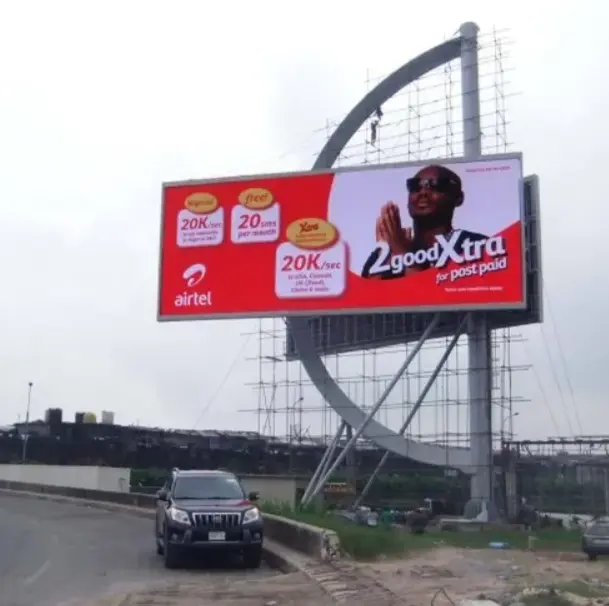
| Outdoor DOOH billboard | Direct View LED (P6–P10) | 5,000–10,000 nits vs. IPS ceiling of ~500 nits |
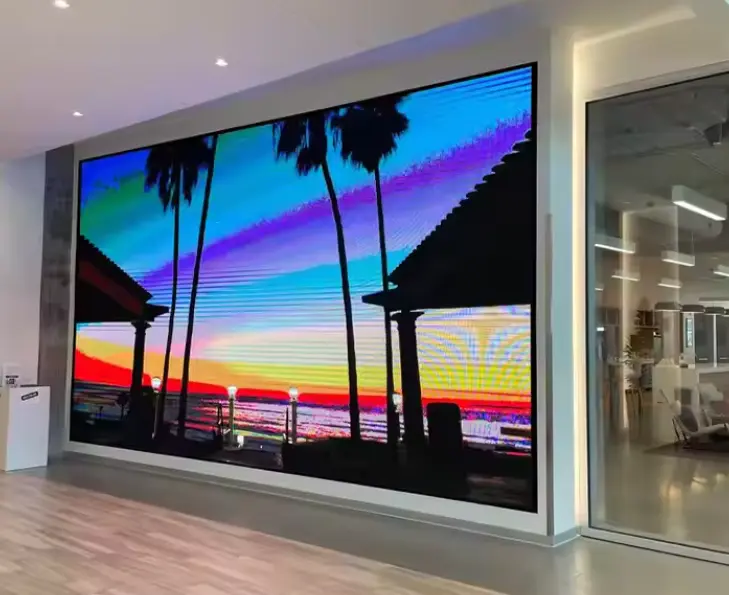
| Indoor retail video wall (>3m viewing) | Direct View LED (P1.9–P2.5) | Seamless tiling, no bezels, modular serviceability |
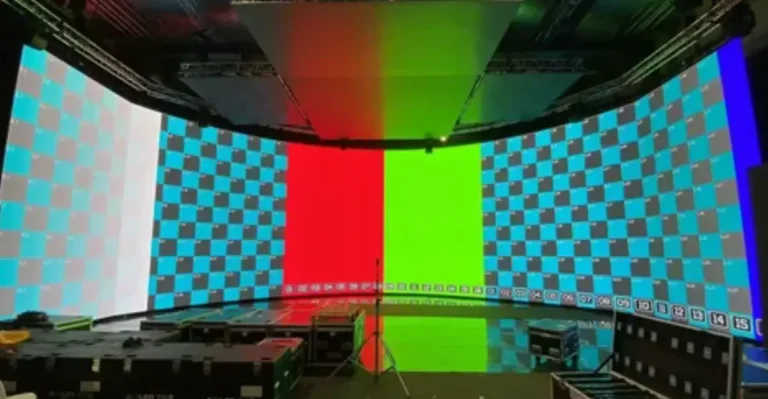
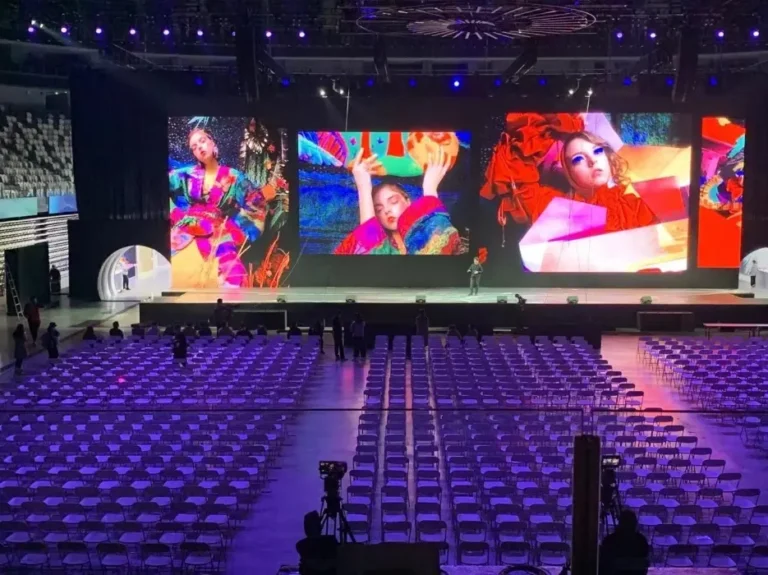
| Live event stage/rental | Rental dvLED with GOB encapsulation | IP54 transport durability, 7,680Hz refresh rate |
| Corporate boardroom (<55″, fixed) | Large-format IPS LCD | Superior ΔE color accuracy at close range |
| Control room/command center | Fine-pitch dvLED COB (P0.9–P1.5) | 24/7 operational rating, front-access serviceability |
Why Most LED vs IPS Articles Give You the Wrong Answer
Here is what you will find if you search this question right now: ten consumer-focused articles comparing gaming monitors and laptop screens, debating whether IPS panels have better viewing angles than the LED-backlit display on a MacBook. None of them will help you spec a 200m² stadium perimeter board, evaluate rental inventory ROI for a touring production company, or determine whether your DOOH billboard network will wash out at 3pm on a south-facing wall.
Based on our experience working with system integrators and DOOH operators across North America, Europe, and Southeast Asia, the most expensive display procurement mistakes we see share a common root cause: buyers applied consumer display logic to a commercial engineering problem. The result is hardware misspecified for the environment, panels failing inside 18 months, and re-procurement costs that dwarf the original savings.
The commercial display market exceeded USD 167 billion in 2024. The decisions happening inside that market deserve purpose-built guidance—not a comparison framework designed to help someone pick a gaming monitor.
The Technology Distinction Every B2B Buyer Must Understand First
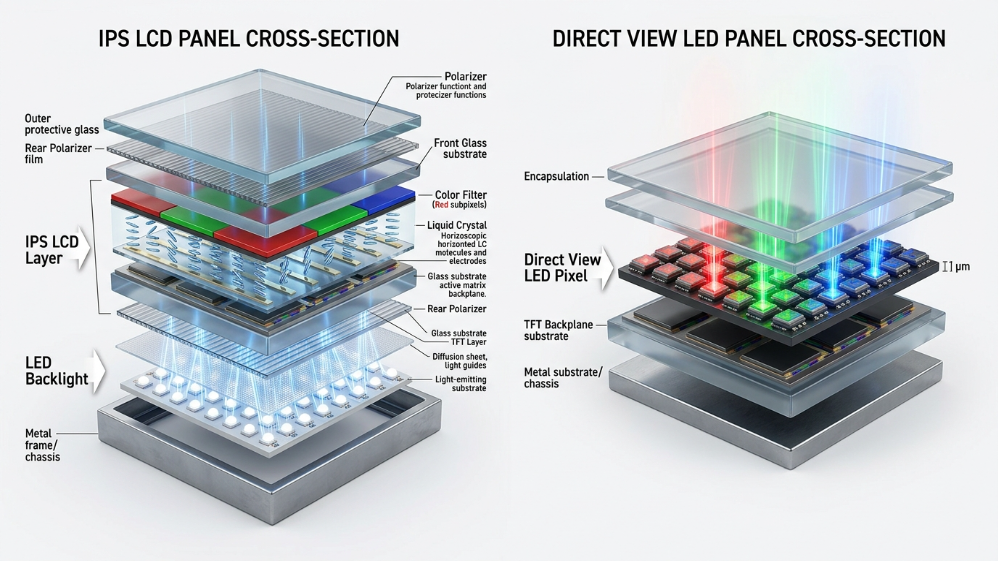
Is LED display better than IPS? The question contains a hidden assumption that LED and IPS are competing technologies of the same type. They are not. Resolving that confusion is the foundation of every correct commercial display decision.
IPS (In-Plane Switching) is a panel manufacturing technology. It defines how liquid crystal molecules are oriented within an LCD layer to produce wide viewing angles and accurate color reproduction. IPS is not a complete display system. It is a panel type—one that still requires a backlight source (almost always LED) to produce any visible image at all. When a spec sheet says “IPS display,” it means an LCD screen with IPS panel technology and LED backlighting.
Direct View LED (dvLED), by contrast, eliminates the LCD layer entirely. Individual light-emitting diodes act as the pixels themselves. There is no backlight to diffuse through polarizers, color filters, and glass substrates. The diode fires directly at the viewer. This is the technology powering commercial video walls, outdoor DOOH installations, stadium scoreboards, and rental event screens. When an AV specification calls for an “LED display” in a commercial context, this is what it means.
The market confusion stems from consumer electronics branding. Television manufacturers began labeling their LCD TVs as “LED TVs” around 2009 when they switched from CCFL fluorescent backlights to LED backlights—a meaningful efficiency upgrade, but not a display technology change. That nomenclature stuck, and it has been muddying B2B procurement conversations ever since.
The practical implication: an IPS panel with LED backlighting will never exceed approximately 500 nits of sustained brightness. A commercial outdoor dvLED installation routinely operates at 5,000 to 10,000 nits. That is not a marginal performance gap. It is the difference between a display that is legible in direct sunlight and one that becomes a mirror.
Head-to-Head: What Actually Matters for Commercial Deployments
Brightness and Outdoor Viability—Why 5,000 Nits Is the Non-Negotiable DOOH Threshold
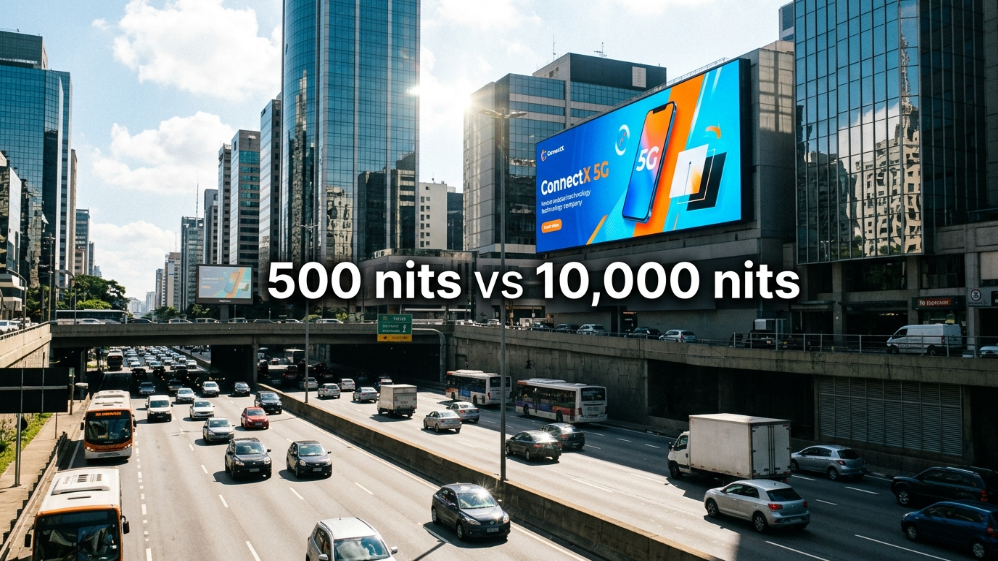
Brightness in display technology is measured in nits (candelas per square meter). This number carries more commercial weight than almost any other specification on your shortlist, and it is where the gap between IPS LCD and Direct View LED is most decisive.
A high-quality commercial IPS panel operates at 300 to 500 nits. That is adequate for a controlled indoor environment—a meeting room with diffused lighting, a retail kiosk in a shaded mall corridor, a reception desk display. Move that panel outdoors, face it south, and let natural sunlight hit the surface at peak afternoon: the image effectively disappears. The display does not fail. It simply cannot compete with ambient light conditions it was never engineered to address.
According to DOOH industry operating standards, outdoor digital signage requires a minimum of 5,000 nits to maintain legibility under direct sunlight. Premium installations in high-sunlight regions—stadium perimeters, highway corridors, transit hub facades—specify 8,000 to 10,000 nits. Outdoor dvLED modules deliver this as standard. It is not an upgrade tier; it is baseline product design.
Indoor LED panels typically operate comfortably at 800 to 1,500 nits, but an outdoor LED billboard facing afternoon sun needs a minimum of 5,000 nits to remain legible, with premium installations pushing 8,000 to 10,000 nits for stadiums in high-sunlight regions. A display that performs brilliantly at night but becomes unreadable during a 3pm event activation is not fit for commercial purpose—regardless of its color accuracy spec.
The commercial implication is straightforward. If your deployment is outdoors, in a high-ambient-light retail environment, or in a venue where natural light is uncontrolled, IPS LCD is not a cost-effective alternative to dvLED. It is not a viable alternative at all.
Scalability and Custom Dimensions—Where dvLED Has No Rival
IPS panels are manufactured in discrete, fixed sizes. Building a large-format display from IPS panels means assembling a video wall—a grid of individual screens with visible bezels between them. Modern narrow-bezel commercial LCD panels have reduced this gap to sub-2mm, which is acceptable for some applications. It remains a physical seam across your content. For brand-critical applications—a luxury retail flagship, a concert IMAG screen, an airport terminal installation—visible panel joints are a design compromise that undermines the entire investment.
Direct View LED modules tile to any dimension without bezels. A 4m × 2m boardroom display, a 12m × 3m curved outdoor fascia, an L-shaped lobby installation wrapping a column: all are achievable with standard dvLED cabinet systems. The display size is determined by your space and your content requirements, not by what the LCD manufacturer happens to produce in volume.
Individual diodes form the actual pixels—no backlight, no bezel, theoretically unlimited panel size. This is not a marketing claim. It is the mechanical consequence of building a display from modular LED cabinets rather than glass LCD panels.
Pixel pitch—the center-to-center distance between adjacent LED pixels, expressed as a P-value in millimeters—is the primary resolution variable in dvLED system design. This is the specification that governs image sharpness at your specific viewing distances, and it is the variable most commonly misspecified by first-time commercial LED buyers.
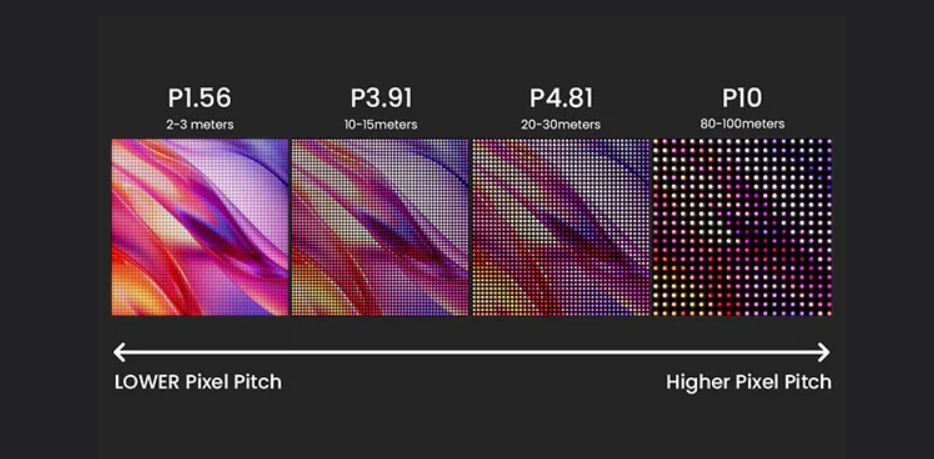
| Pixel Pitch | Minimum Viewing Distance | Primary Application |
| P0.9–P1.5 | 0.9–1.5 m | Control rooms, broadcast studios, premium boardrooms |
| P1.9–P2.5 | 2–5 m | Indoor retail, corporate lobbies, conference centers |
| P3–P3.9 | 3–8 m | Rental events, exhibition halls, large auditoriums |
| P4–P6 | 6–15 m | Indoor arenas, large venue staging |
| P6–P10 | 10–30 m | Outdoor DOOH, building facades, transit hubs |
| P10+ | 30 m+ | Highway billboards, stadiums, large outdoor venues |
Over-specifying pixel pitch is a common budget error. A P1.2 fine-pitch installation in a space with a minimum viewing distance of 8 meters delivers resolution the human eye cannot perceive from that distance—while adding significant cost per square meter. Under-specifying is worse: visible pixelation at standard viewing distances undermines content quality and, for DOOH operators, directly affects advertiser confidence in your network.
Image Quality,Color Accuracy,and Refresh Rate—Where IPS Still Has a Legitimate Argument
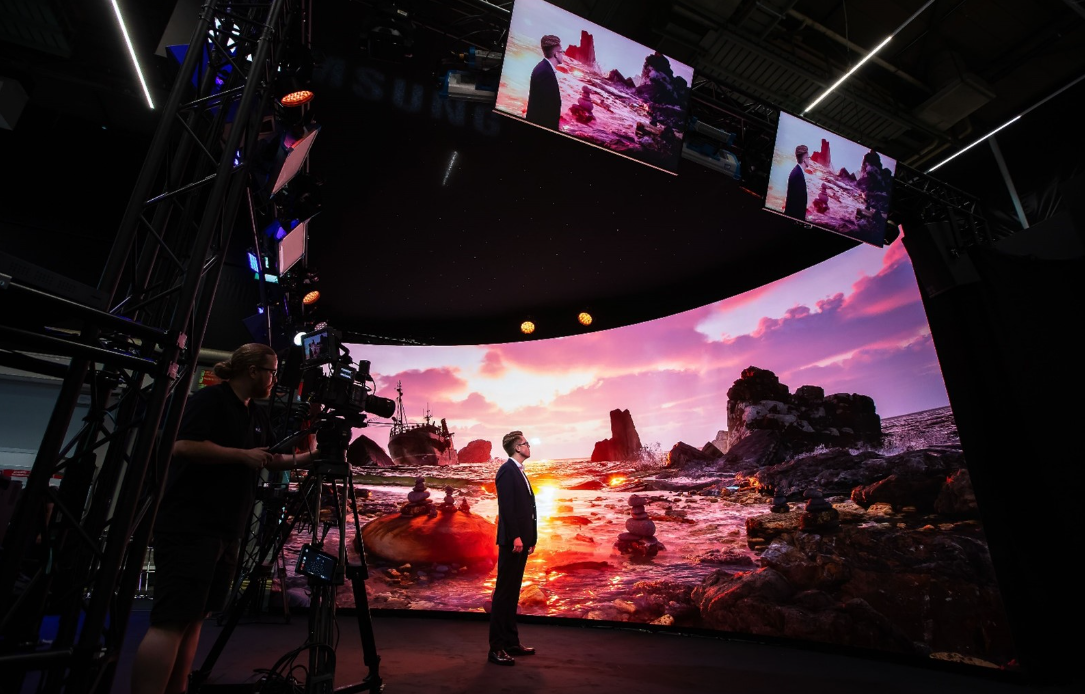
- Camera Flicker: Visible black bars (rolling shutter effect) when filmed.
- Content Loss: Fast-moving content may appear blurry or tearing.
- Not Broadcast Ready: Unsuitable for professional live streaming or TV.
- Flicker-Free: Crystal clear image on all cameras (1/2000s+ shutter speed).
- Smooth Motion: Perfect for fast video playback and sports.
- XR Ready (7680Hz): Essential for virtual production and XR studios.
Let’s be precise here, because this is where the consumer comparison articles get closest to something useful—then fail to translate it into commercial context.
IPS panels genuinely do produce superior per-pixel color accuracy at close range. The horizontal switching technology delivers a Delta-E (Delta E) color variance consistently below 2—the threshold at which color deviation becomes imperceptible to the human eye. For a graphic design studio monitoring station, a medical imaging workstation, or a broadcast color grading suite where the viewer sits 60cm from a 27-inch screen, IPS is not just competitive. It is the correct specification.
Direct View LED at standard commercial pixel pitches (P1.9 and above) does not match that per-pixel precision at close range. Individual LED emitters have inherent brightness variance, and at sub-2 meter viewing distances, that variance can produce subtle uniformity inconsistencies across large panels. Reputable manufacturers address this through factory calibration and binning—sorting LEDs by precise wavelength and luminance before assembly—but the physics of the underlying technology means that fine-pitch dvLED at close range requires more aggressive calibration protocols than IPS LCD.
Where dvLED decisively reclaims the image quality argument at commercial scale: contrast ratio, HDR performance, and refresh rate for live production.
dvLED delivers an effectively infinite contrast ratio. Each pixel turns fully off when no signal is applied. There is no backlight bleeding through an LCD layer creating the gray-black characteristic of even the best IPS panels. For DOOH content at night, for event staging with dark ambient conditions, for broadcast backdrop applications where deep blacks anchor the visual composition—this matters commercially. HDR10 content on a calibrated dvLED wall in an airport terminal creates a brand impression that a 500-nit IPS panel cannot replicate.
For live event and concert production, refresh rate is a non-negotiable specification. Audience smartphones recording at 60fps will produce visible moiré artifacts on LED displays running at standard 1,920Hz refresh rates. A dvLED system running at 3,840Hz to 7,680Hz eliminates this entirely. The commercial consequence is direct: zero moiré on audience footage means more shareable content, higher organic reach for the event, and measurably better ROI on the display investment itself.
Durability,GOB Protection,and the Real Cost of Deployment Stress
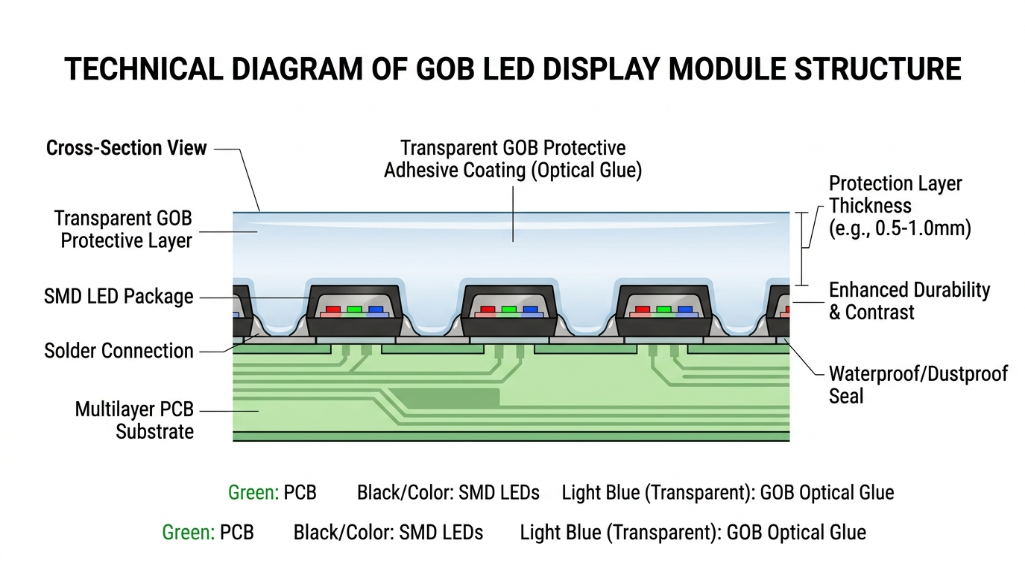
Physical durability is where the comparison becomes commercially decisive for rental and outdoor operators, and where most IPS panel specifications simply end the conversation.
IPS LCD panels are precision optical instruments built for stable indoor environments. They are not designed to be loaded into flight cases, transported across 10 venues in a touring season, assembled and disassembled under time pressure by event crews, or mounted on a coastal highway billboard exposed to salt air, UV radiation, and temperature cycling. Using IPS panels in these conditions does not produce a cost saving. It produces accelerated failure rates, warranty voids, and replacement costs that typically exceed the original procurement budget within 24 months.
Direct View LED cabinets built for rental and outdoor deployment carry GOB (Glue-on-Board) encapsulation as standard. GOB applies an epoxy resin layer directly over the LED module surface, mechanically bonding the individual diodes and protecting them against moisture ingress, dust penetration, and physical impact from handling. GOB-protected rental panels routinely achieve IP54 front and rear protection ratings; outdoor fixed installations specify IP65 or IP66, meaning the display enclosure is fully sealed against dust and withstands sustained high-pressure water exposure.
Based on our engineering experience with touring production deployments, GOB-protected P3.91 rental panels endure transport cycle stress that destroys standard LED modules within a single season. The protection is not a premium add-on. For any deployment involving repeated installation, outdoor exposure, or high-humidity environments, it is a minimum specification requirement.
5-Year Total Cost of Ownership—The Framework B2B Buyers Actually Need
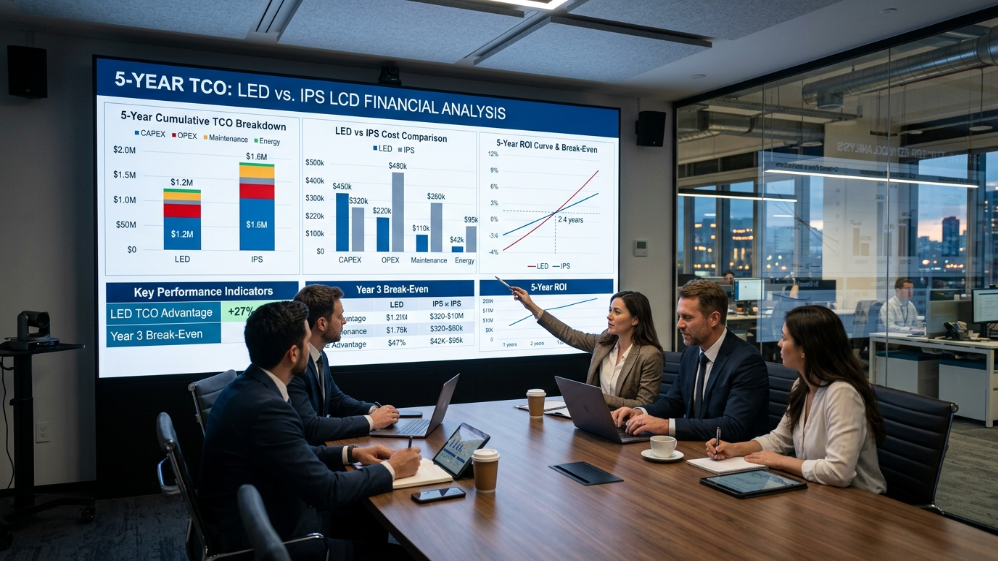
Purchase price is the wrong number to anchor a commercial display procurement decision. The right number is total cost of ownership (TCO) over the operational lifespan—typically 5 to 7 years for commercial LED installations.
| Cost Category | IPS LCD Video Wall | Direct View LED (Indoor P2.5) | Direct View LED (Outdoor P6) |
| Hardware CapEx (per m²) | $800–1,500 | $1,500–3,000 | $2,000–4,500 |
| Structural support (% of project) | 8–12% | 10–20% | 15–25% |
| Annual power cost (per m², 12hr/day) | $180–260 | $120–180 | $200–350 |
| Module replacement (Year 3–5 estimate) | Full panel swap required | Individual module replacement | Individual module replacement |
| Maintenance access model | Rear access or full removal | Front-access magnetic modules | Rear or front-access depending on cabinet |
| Typical operational lifespan | 5–7 years | 7–10 years (100,000hr rated) | 7–10 years (IP65 rated) |
| Scalability for expansion | Fixed; requires new panels | Add cabinets to existing system | Add cabinets to existing system |
Two cost lines in that table catch first-time buyers off guard. Structural steel support frames—the mounting infrastructure required for large-format installations—routinely represent 10 to 20 percent of total project budget. This is not a display cost, but it is a display decision cost: heavier cabinet systems require more substantial framing, which increases both material and installation labor. The other overlooked line is maintenance access architecture. Front-access dvLED systems using magnetic module technology eliminate the need for rear-maintenance corridors. In commercial real estate environments where every square meter of floor space carries a monthly rental value, eliminating a 600mm service corridor behind a video wall is not an aesthetic preference. It is a measurable operating cost reduction over the lease term.
For event rental operators, the ownership economics are distinct. Quality rental-grade LED inventory—P3.91 aluminum-frame cabinets with GOB protection and quick-lock hardware—typically costs $1,500 to $4,000 per m² at purchase. At consistent booking utilization, that inventory pays for itself within 18 to 24 months. During peak seasons, some operators reach full ROI in 14 months. The model only works with volume. Idle inventory depreciates in storage while incurring maintenance, insurance, and facility costs.
Frequently Asked Questions
Is Direct View LED better than IPS LCD for outdoor advertising?
Yes, categorically. IPS LCD panels are physically incapable of reaching the 5,000-nit minimum brightness required for outdoor DOOH legibility in direct sunlight. Outdoor dvLED operating at 5,000–10,000 nits with IP65-rated enclosures is the only commercially viable technology for permanent outdoor advertising installations.
What pixel pitch do I need for an indoor LED video wall in a conference center?
For a conference room or convention center with typical viewing distances of 3 to 8 meters, P2.5 to P3.9 delivers clean, sharp visuals at a significantly lower cost than fine-pitch alternatives. Apply the practical rule: minimum viewing distance in meters multiplied by approximately 0.5 gives you a maximum pixel pitch in millimeters without visible pixelation.
Can IPS panels be used for large-format seamless video walls?
Not without visible bezels between panels. Commercial narrow-bezel LCD units reduce joint width to under 2mm, which is acceptable in some corporate environments. For brand-critical, immersive, or large-format applications—retail flagships, broadcast backdrops, event staging—bezel-free dvLED is the correct specification.
How long does a commercial Direct View LED display last compared to an IPS LCD screen?
Reputable commercial dvLED modules are rated for 100,000 hours of operational life—roughly 23 years at 12 hours per day. IPS LCD panels typically rate at 30,000 to 50,000 hours, with full-panel replacement required when backlight or LCD layers degrade. dvLED’s modular repairability means individual failing diodes or modules can be replaced in the field without removing the entire installation.
What refresh rate do I need for a rental LED display used at live concerts and filmed events?
Specify a minimum of 3,840Hz for any rental display that will be filmed by audience smartphones or professional cameras. At 1,920Hz, rolling shutter on standard camera sensors produces moiré banding across the screen in captured footage. At 3,840Hz and above, this artifact disappears entirely—a specification detail with direct, measurable impact on content virality and post-event brand value.
Expert Verdict
Stop asking which technology is better in the abstract. Ask which technology is correctly specified for your deployment environment, your operational model, and your 5-year budget.
If your project involves any outdoor surface, any display above 65 inches requiring seamless tiling, any rental or touring application, or any venue where ambient light is uncontrolled: Direct View LED is not the premium option. It is the technically correct specification. The IPS alternative is not cheaper—it is misspecified, and misspecification has a price.
IPS LCD earns its place on the shortlist for close-range indoor applications under 65 inches where per-pixel color accuracy matters more than scale or brightness. Outside that boundary, the TCO math, the brightness physics, and the durability engineering all point in one direction.
Specify accordingly.
B2B Procurement Notice Regarding Pricing: > When evaluating commercial procurement options, please note that Direct View LED involves a higher initial CapEx (ranging from $1,500 to $4,500 per m²) compared to standard IPS LCD video walls ($800 to $1,500 per m²). However, when factoring in long-term structural framing costs, annual power consumption, maintenance models, and a 100,000-hour operational lifespan, Direct View LED delivers a significantly lower 5-year Total Cost of Ownership (TCO) and a superior Return on Investment (ROI) for scaled deployments. Always request a comprehensive, multi-year TCO quote from your system integrator rather than relying solely on upfront hardware costs.
References:
Society for Information Display – Display Technology Research & Standards
Video Electronics Standards Association (VESA) – DisplayHDR Certification Standards