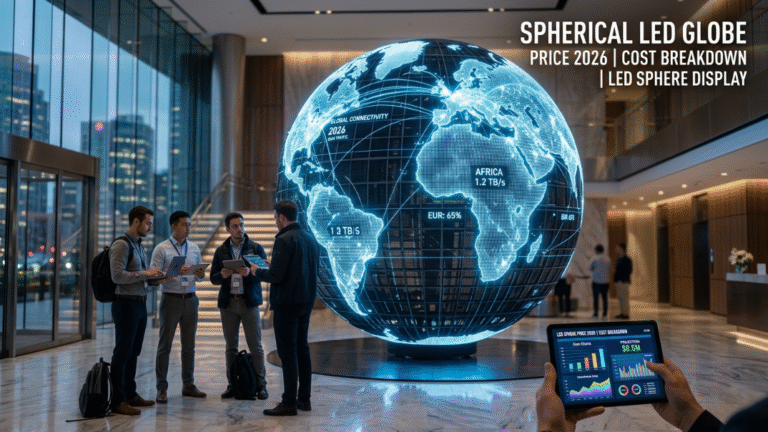
Is an LED Spherical Screen Right for Your Project?
Before going deep into the technology, here is the answer most buyers actually need first:
Buy a spherical LED display if: your goal is a permanent or semi-permanent landmark installation where maximum visual impact, social media shareability, and 360° audience engagement justify a 30–50% premium over equivalent flat LED area — and you have budget allocated for custom 3D content creation.
Don’t buy one if: your primary need is to display standard advertising content to a directional audience, you’re working with a fixed flat-wall installation space, or your budget and timeline don’t accommodate the longer lead times (typically 45–90 days for custom fabrication) and content production investment spherical displays require.
This distinction matters because the LED sphere market attracts significant interest from buyers who are drawn to the visual concept but whose actual use case — a lobby display, a retail screen, an outdoor ad panel — would be better and more economically served by a flat or slightly curved LED wall. A sphere is a landmark, not a versatile display format. Once that’s clear, the rest of this guide will be highly actionable.
What Is an LED Spherical Screen?
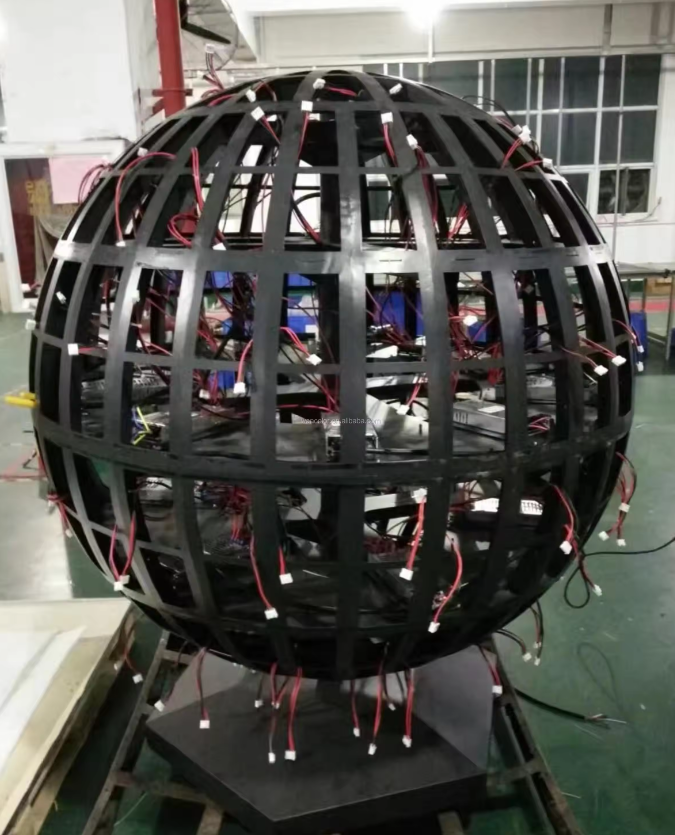
An LED spherical screen is constructed by assembling thousands of custom-curved LED modules over a precision-engineered steel framework to create a seamless 360° display surface with no blind spots or dead angles.
This is not a bent LED panel. It is a purpose-engineered display system where virtually every component — the module geometry, the structural framework, the control signal routing, and the content pipeline — is specifically designed for spherical geometry.
How It Differs from Flat LED Walls
| Feature | Flat LED Wall | LED Spherical Screen |
|---|---|---|
| Viewing Angle | 120°–140° | 360° (full sphere) |
| Panel Shape | Rectangular modules | Hexagonal, pentagonal, or triangular modules |
| Structure | 2D mounting frame | 3D precision steel sphere framework |
| Image Source | Standard flat video | Equirectangular / spherical projection mapped content |
| Control System | Standard multi-output | Multi-channel sync with real-time geometric correction |
| Fabrication | Standard production | Custom-engineered per diameter and pixel pitch |
| Content Production | Standard video/graphics | 3D spherical content required |
| Cost vs. Flat Equivalent | Baseline | 30–50% premium |
Sphere Variations: Not All Spheres Are the Same
- Full sphere: Complete 360° enclosure — the classic globe form. Maximum visual impact, highest cost and structural complexity.
- Half sphere (dome): Floor-mounted or ceiling-mounted hemisphere — lower structural complexity, suitable for permanent architectural integration.
- Oblate sphere / ellipsoid: Flattened globe shape — used where ceiling height limits full sphere installation.
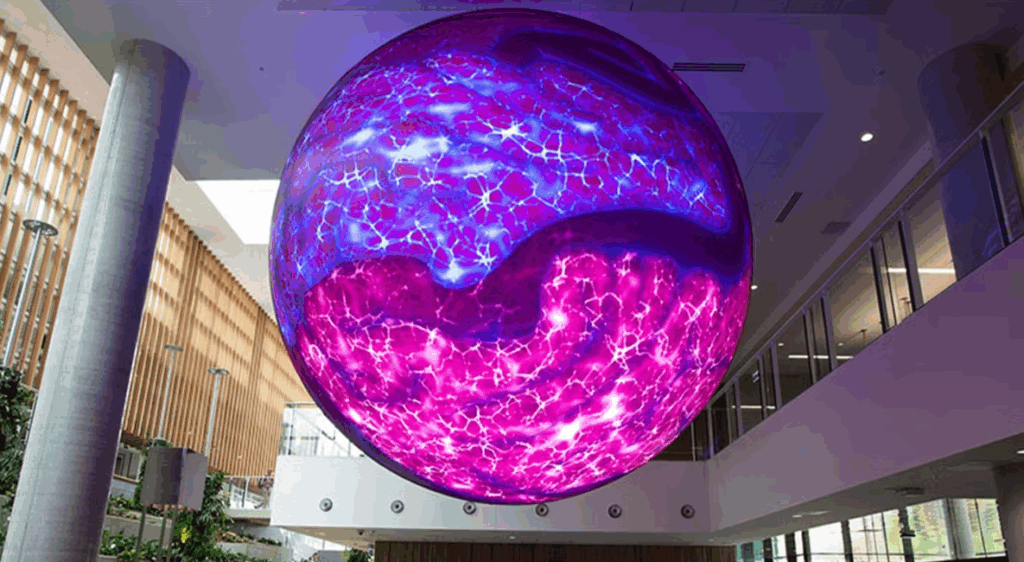
- Hanging sphere: Suspended from ceiling structure — the most dramatic presentation format for atrium and exhibition environments.
- Floor sphere: Ground-mounted on a base — simpler structural requirements, easier maintenance access.
Core Technology: How a Sphere Is Built
a. Curved Module Assembly
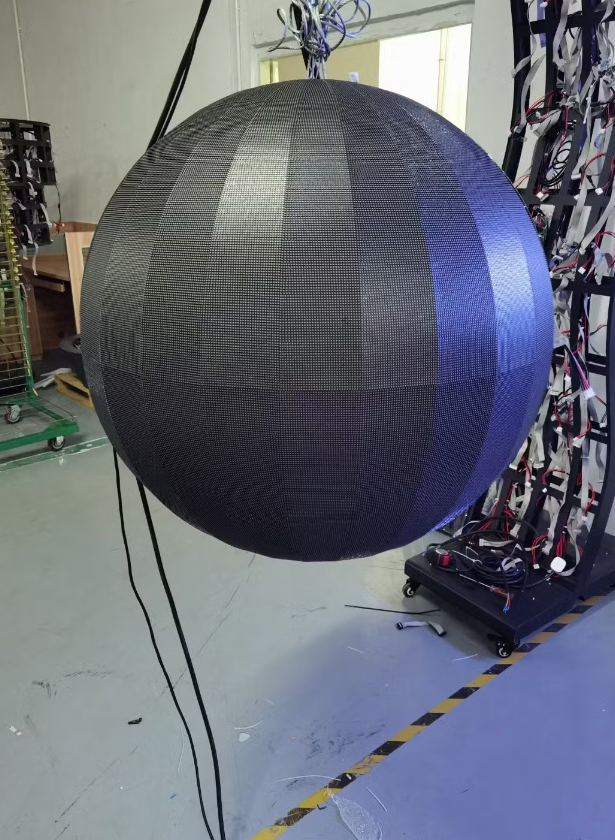
The visual surface of an LED sphere is composed of specially engineered LED modules whose geometry matches the sphere’s curvature radius. Unlike flat panels, which are assembled from identical rectangular modules, a sphere requires multiple module shapes — typically hexagons and pentagons (mirroring the geometry of a soccer ball / truncated icosahedron) — each precision-manufactured to the exact curvature of the target sphere diameter.
Key manufacturing parameters:
- Curvature radius: Current production capability reaches as small as R300mm — enabling spheres as compact as approximately 600mm (2 feet) diameter
- Module tolerances: Gaps between modules must be held under 1mm for seamless visual continuity — requiring CNC-precision bracket systems
- PCB flexibility: Modules use flexible PCB substrates bonded to curved backing plates — a fundamentally different construction from rigid flat panel PCBs
Leading manufacturers including Unilumin, Absen, and specialist sphere fabricators offer pre-engineered spherical module systems for standard diameters (typically 1m, 1.5m, 2m, 3m increments), with fully custom fabrication available for non-standard sizes.
b. Control System and Geometric Correction
This is the most technically demanding aspect of spherical LED displays and the stage where most low-budget projects fail.
The control system must simultaneously:
- Distribute signal to dozens or hundreds of receiving cards across the sphere surface in precise spatial sequence
- Apply real-time geometric correction to map flat video input onto the spherical surface without distortion
- Synchronize refresh across all zones to prevent visible scan artifacts
Industry-standard control platforms — Novastar, Linsn, and Colorlight — all offer spherical mapping modules, but calibration of a large-format sphere is a specialized skill that can require 1–3 days of on-site engineering time. Buyers should budget for professional commissioning as a line item, not assume it’s included in hardware price.
Spherical mapping formats supported:
- Equirectangular (most common — same format as 360° video and Google Street View imagery)
- Cube map projection
- Custom geodesic mapping for non-standard sphere geometries
c. Achieving Seamless 360° Display
True seamlessness is a goal approached asymptotically — physics means there will always be structural joins. Best-practice minimization techniques include:
- Sub-1mm gaps using CNC-precision module bracket systems
- Common-cathode LED design to reduce dark edges between modules
- Pixel-level edge blending in the control system software
- High refresh rate (≥3,840Hz) for smooth appearance in video capture and live broadcast contexts
- Factory pre-calibration — top-tier manufacturers calibrate color and brightness uniformity across all modules before shipping, with calibration data stored in the control system
d. Structural Engineering Requirements
The steel framework is load-bearing, aesthetic (visible through gaps between modules in some designs), and thermal management infrastructure simultaneously. For outdoor spheres, the framework must be engineered for:
- Wind load at the installation height (critical for any sphere above 3m diameter outdoors)
- Seismic compliance in applicable regions
- Thermal expansion — the framework must accommodate differential expansion between steel structure and LED module backing plates across the operating temperature range
- Access provisions for maintenance — internal ladders or platforms for spheres above ~2m diameter
Real-World Case Studies
MSG Sphere, Las Vegas — World’s Largest LED Sphere
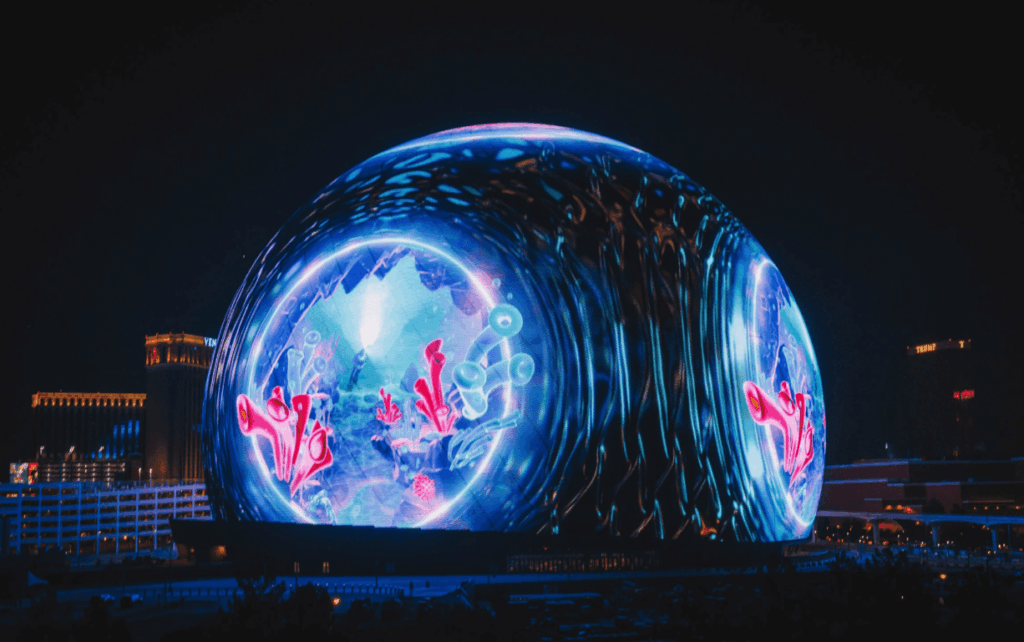
Opened in September 2023, the MSG Sphere stands 366 feet (112m) tall with an exosphere covering over 580,000 sq. ft. (53,900 m²) of LED panels on the exterior surface and an interior immersive display spanning 160,000 sq. ft. The total project cost was approximately $2.3 billion. With over 50 million LED pixels on the exterior alone, it represents the current outer boundary of what LED spherical technology can achieve at architectural scale.
The MSG Sphere established a new benchmark not just for size, but for demonstrating that spherical LED format can function as a venue in itself — not merely a display within a venue.
Tokyo Ginza Luxury Retail Globe
A high-end luxury brand installed a 4-foot (1.2m) diameter LED globe in its Ginza district storefront. The installation generated over 200,000 organic social media shares within the first month — a volume of earned media impressively disproportionate to its physical scale. This case consistently appears in brand experience ROI discussions because it illustrates a core truth about spherical displays: their social media capture rate per square meter of display area is significantly higher than flat LED walls of equivalent area.
Exhibition and Museum Installations
Large-format LED spheres in the 2m–5m diameter range have become a standard feature in science museums, planetariums, and natural history institutions globally, replacing earlier projection-based globe systems. The advantages over projection globes: higher brightness, better daytime visibility, no projector maintenance cycles, and the ability to display real-time data feeds (weather systems, seismic activity, live satellite imagery).
Full Cost Breakdown (2026)
Cost Allocation by Component
| Component | % of Total Cost | Notes |
|---|---|---|
| Custom LED modules | ~40% | Pixel pitch is the primary variable — P1.5 costs ~4× P4 per m² |
| Control system | 20–30% | Includes processors, receivers, cabling, calibration |
| Steel structure | ~15% | Higher for large outdoor spheres with wind-load engineering |
| Installation labor | ~5–10% | Significantly higher for outdoor elevated installations |
| Content creation | 10–15% | 3D spherical content costs 2–3× equivalent flat content |
Price by Size and Pixel Pitch (2026 Reference Pricing)
| Diameter | Pixel Pitch | Surface Area | Estimated Hardware Cost | Installed Cost (Incl. Structure) |
|---|---|---|---|---|
| 1m (3.3 ft) | P3 | ~3.1 m² | $15,000–$28,000 | $22,000–$40,000 |
| 2m (6.6 ft) | P3–P4 | ~12.6 m² | $45,000–$85,000 | $65,000–$120,000 |
| 3m (10 ft) | P4 | ~28.3 m² | $100,000–$180,000 | $145,000–$260,000 |
| 5m (16.4 ft) | P4–P6 | ~78.5 m² | $230,000–$420,000 | $320,000–$600,000 |
| 10m (33 ft) | P6–P8 | ~314 m² | $650,000–$1,200,000 | $900,000–$1,700,000 |
Note: Prices are indicative 2026 market ranges. Final pricing depends on manufacturer, pixel pitch selection, installation complexity, structural engineering requirements, and content production scope.
Cost vs. Flat LED Walls: Honest Comparison
| Metric | Spherical LED | Flat LED Wall |
|---|---|---|
| Hardware cost per m² | $3,500–$12,000 | $800–$4,000 |
| Premium over flat equivalent | +30–50% | Baseline |
| Visual impact per dollar | Extremely high in landmark contexts | Moderate |
| Content production cost | High (3D spherical required) | Standard |
| Installation complexity | High | Standard |
| Maintenance complexity | Moderate–High | Low–Moderate |
| ROI timeline | 2–5 years (landmark/traffic-driven) | 1–3 years |
| Social media capture rate | Very high | Low–Moderate |
Key Factors When Choosing a Spherical LED Display
Pixel Pitch Selection Guide
| Viewing Distance | Recommended Pitch | Application Example |
|---|---|---|
| <2m (close-up touch/kiosk) | P1.5–P2 | Luxury retail, interactive exhibit |
| 2–5m | P2.5–P3 | Lobby centerpiece, showroom |
| 5–15m | P3–P4 | Exhibition hall, event stage |
| 15–30m | P4–P6 | Large atrium, indoor landmark |
| >30m (outdoor) | P6–P10 | Outdoor landmark, building façade |
Size and Venue Constraints
- Ceiling height clearance: Add minimum 500mm above sphere diameter for hanging hardware and cabling
- Floor load capacity: A 3m diameter sphere with steel structure weighs approximately 800–1,500kg — verify structural capacity before finalizing size
- Rigging point capacity: Hanging spheres above 1.5m diameter require dedicated structural rigging points rated for dynamic load (not just static weight)
- Viewing distance optimization: The sphere diameter should be at least 1/15th of the maximum viewing distance for adequate visual impact — a 2m sphere is visually underwhelming in a space where viewers are 40m+ away
Mounting Style Trade-offs
- Hanging (suspended): Maximum visual drama, 360° unobstructed viewing — requires verified structural rigging, most complex installation
- Floor-mounted on base: Easiest installation and maintenance access, partially obscures bottom hemisphere
- Ceiling-embedded (flush): Clean architectural integration, bottom hemisphere only visible — suitable for dome configurations
- Pole-mounted (outdoor): Billboard-style single-pole mounting for outdoor landmark applications
Maintenance Access Planning
This factor is systematically underweighted in the purchasing process and frequently results in high ongoing costs:
- For spheres above 1.5m diameter, internal maintenance access (crawl space or platform within the sphere) dramatically reduces module replacement time and cost
- Magnetic module attachment vs. screw-fixed: magnetic front-access maintenance reduces per-module replacement time from 20–30 minutes to 3–5 minutes
- Spare module inventory: Maintain a minimum 2–3% spare module stock on-site — sourcing replacement modules for custom sphere geometries from overseas carries 15–30 day lead times
How to Plan Your LED Sphere Project: Step-by-Step
Step 1 — Define the Goal and Lifecycle
Is this a permanent landmark (5–10 year installation) or a campaign/event installation (months to 2 years)? This single decision shapes the entire specification:
- Permanent: prioritize Tier-1 manufacturer modules, internal maintenance access, weatherproofing (outdoor), and extended warranty terms
- Campaign/event: rental-grade modular sphere systems from specialist rental companies may be more cost-effective than ownership
Step 2 — Establish Realistic Budget Including Content
The most common budget error: allocating 100% of budget to hardware and discovering content production costs are additive. For a spherical display, content is not optional — standard flat video looks distorted and unprofessional without spherical remapping. Budget allocation recommendation:
- Hardware + installation: 80–85% of total budget
- 3D content creation (launch package): 10–15%
- Annual content refresh: 5–8% of hardware cost per year
Step 3 — 3D Simulation Before Fabrication
Before committing to fabrication, commission a 3D visualization of the sphere in its actual installation environment — showing how it will look from key audience vantage points, how it interacts with ambient lighting, and how the structural mounting will integrate with the architecture. This step costs $2,000–$8,000 and routinely prevents expensive size or positioning errors.
Step 4 — Manufacturer Selection and Sample Validation
Request a physical module sample of your specified pixel pitch and curvature from any manufacturer you’re seriously considering. Evaluate:
- Uniformity of brightness and color across the module surface
- Build quality of the curved PCB substrate and backing plate
- Gap consistency when two modules are placed edge-to-edge
- IP rating verification for outdoor applications
Step 5 — Installation Engineering Review
For spheres above 2m diameter or any outdoor installation, engage a structural engineer to review the mounting design independently — do not rely solely on the manufacturer’s installation guide. This is particularly important for hanging installations and any outdoor installation subject to wind load.
Content Strategy for Spherical Displays
This dimension is almost entirely absent from competitor articles on spherical LED displays — and it’s where many buyers are surprised post-purchase.
Why Standard Content Doesn’t Work
Flat rectangular video stretched onto a sphere surface creates visible distortion — the same effect as projecting a world map onto a globe without cartographic correction. Spherical displays require content in equirectangular format (the standard for 360° video, VR content, and satellite imagery), which is then remapped by the control system onto the sphere geometry.
Content Sources for Spherical Displays
- Custom 3D animation: Highest quality, highest cost — $5,000–$50,000+ per produced piece depending on complexity and duration
- Repurposed 360° video: 360° camera footage (shot in equirectangular format) can be played directly — significantly lower cost than custom animation
- Real-time data visualization: Weather systems, earth imagery, financial data globes — requires software development but creates uniquely compelling live content
- Interactive content: Touch or motion-sensor triggered content is increasingly common in museum and retail sphere installations
Content Management
Ensure your control system includes a content scheduling and remote management capability — for permanent installations, the ability to update content remotely without on-site technical visits is a meaningful operational cost saving over a multi-year deployment.
Manufacturer and Supplier Landscape
Tier-1 Manufacturers with Spherical Product Lines
- Unilumin: Pre-engineered sphere product line with standard diameter options; strong in rental/events sphere formats
- Absen: Custom sphere fabrication capability; strongest international service network for after-sales
- LianTronics: Custom engineering strength for complex curved and shaped installations including spheres
- Leyard: High-end fine-pitch sphere capability; relevant for sub-P2 luxury and mission-critical applications
Specialist Sphere Fabricators
Several manufacturers focus primarily or exclusively on shaped and spherical LED products. These specialists often offer more competitive pricing for standard sphere diameters and deeper application engineering experience than generalist manufacturers who offer spheres as one of many products.
What to Ask Any Sphere Supplier
- How many sphere installations of similar diameter have you completed? Request photo/video documentation and reference contacts.
- What is your module curvature manufacturing tolerance? (Answer should be ±0.5mm or better)
- Is geometric calibration included in the project price, or billed separately?
- What is your spare module availability commitment? For how many years post-delivery?
- What content format does your control system accept natively?
Frequently Asked Questions
Q: How long does an LED spherical screen last?
A: Approximately 50,000 hours of operational life — equivalent to roughly 17 years at 8 hours per day — with proper maintenance. Individual module replacement is expected over this period; plan for 2–5% module replacement per year in high-utilization outdoor installations. The structural framework has an indefinite lifespan with proper corrosion protection.
Q: Are LED spheres hard to maintain?
A: More complex than flat screens due to curved geometry and module variety, but modern designs significantly mitigate this. Spheres with magnetic front-access modules and internal maintenance platforms can have individual modules replaced in under 5 minutes by a single technician. The critical factor is planning maintenance access during the design phase — retrofitting access after installation is expensive.
Q: Where are LED spheres most commonly used?
A: In order of market prevalence: museums and science centers (replacing projection globe systems), shopping mall atriums and retail landmarks, exhibition and trade show installations, theme parks and entertainment venues, luxury hospitality (hotel lobbies, casino floors), and outdoor advertising landmark installations.
Q: What are the installation infrastructure requirements?
A: The four non-negotiable requirements are: a structural mounting system rated for the sphere’s dead load plus dynamic wind load (outdoor); a reliable power supply with appropriate surge protection; adequate ventilation or active cooling for enclosed installation environments; and a data cabling infrastructure supporting the control system’s multi-channel output. Outdoor installations additionally require IP65-rated modules and conformal-coated PCBs.
Q: Can I use regular video content on an LED sphere?
A: Not without remapping. Standard 16:9 video played directly onto a sphere will appear distorted. Content must be in equirectangular format (the standard for 360° video) or remapped through the control system’s geometric correction function. Budget for content conversion or new content production as part of your project.
Q: What is the minimum practical diameter for a spherical LED display?
A: Current manufacturing capability reaches R300mm curvature radius, enabling spheres as small as approximately 600mm (2 feet) diameter. However, the practical minimum for meaningful visual impact in a public space is approximately 1–1.5m diameter. Below that, a high-brightness LED globe lamp or an LCD sphere display may be more cost-effective for decorative applications.
Q: How does the MSG Sphere compare to standard commercial LED sphere installations?
A: The MSG Sphere is in a category of its own — a $2.3 billion architectural project where the sphere format is the venue structure itself, not a display within a venue. Commercial LED sphere installations in the $50,000–$2,000,000 range are fundamentally different in scale, purpose, and engineering. The MSG Sphere is useful as a proof-of-concept for the technology’s limits, but it is not a relevant pricing or specification benchmark for commercial buyers.
Sources:
CNBC – Inside the $2.3B Sphere in Vegas
Novastar