If you are currently budgeting for a 2026 flagship retail installation or a global concert tour, the core question is no longer “can it bend,” but “what is the total cost of ownership.” Currently, the Rolling LED screen price in the global B2B market ranges from $1,400 to $4,800 per square meter for high-performance units.
Below is a direct pricing benchmark based on our 2025-2026 internal manufacturing data for standard vs. premium configurations.
Table 1: 2026 Estimated Rolling LED Screen Price Brackets (FOB)
| Pixel Pitch (PP) | Application Type | Performance Tier | Estimated Price (USD/sqm) | Best For |
| P1.5-P1.9 | Indoor High-Res | Ultra-Premium (GOB/COB) | $3,500-$4,800+ | Luxury Retail, TV Studios, xR |
| P2.6 | Indoor/Events | Professional Grade | $2,200-$3,100 | Concert Backdrops, Auto Shows |
| P3.9 | Indoor/Semi-Outdoor | Standard Commercial | $1,400-$1,900 | Malls, Pillars, Curved Signage |
| P4.8 | Outdoor Rental | High Brightness (IP65) | $1,800-$2,600 | Outdoor Festivals, DOOH |
The “Pain Point” Check: Why Most B2B Buyers Fail at Sourcing
As a lead engineer with over 12 years in the LED space, I’ve seen hundreds of procurement officers prioritize the lowest “sticker price” only to lose 40% of their investment within six months due to FPC (Flexible Printed Circuit) fatigue or SMD drop-off.
In the B2B world, a “cheap” rolling screen is a liability. If the screen fails during a live broadcast, the cost of the downtime and brand damage far outweighs the initial $500/sqm you saved. You aren’t just buying a display; you are buying the reliability of the silicone mask and the integrity of the driving IC.
What is a Rolling LED Screen? (Beyond the Marketing Jargon)
A Rolling LED screen (often categorized under flexible LED displays) is not just a “bendable” panel. Unlike traditional rigid cabinets made of die-cast aluminum, these screens utilize a highly sophisticated FPC (Flexible Printed Circuit) and a soft, reinforced silicone or rubber housing.
Feature to Benefit (FAB) Analysis
-
The Feature: High-tensile FPC with multi-layer copper traces.
-
The Business Benefit: This allows the screen to be rolled and unrolled thousands of times without the circuit breaking. For a rental company, this means your “inventory life” extends from 2 years to 5+ years, significantly increasing your ROI per event.
From an engineering perspective, the 2026 standard for a true “rolling” display requires a bending radius of at least 150mm. This allows you to wrap the screen around pillars, create “S-waves,” or even store 50 square meters of display in a fraction of the space required for traditional panels.
Rolling LED Screen Price: Why the Variance is So High
When you receive three different quotes for a “P2.6 Rolling LED screen,” and they vary by $1,000, you are likely looking at the difference between Tier 1 components and “Ghost Factory” assemblies.
Based on our experience auditing suppliers in the Shenzhen-Huizhou corridor, the price is dictated by three technical pillars:
The Packaging Technology (SMD vs. GOB)
A standard Rolling LED screen uses SMD (Surface Mounted Device). However, because these screens are frequently handled, the LEDs are prone to being knocked off. GOB (Glue on Board) technology adds a transparent epoxy layer over the surface.
-
Price Impact: Adds 15-20% to the cost.
-
Value: It makes the screen “waterproof, dustproof, and anti-collision.” For B2B buyers in the rental sector, GOB is almost mandatory to prevent constant repair costs.
Driving IC and Refresh Rate
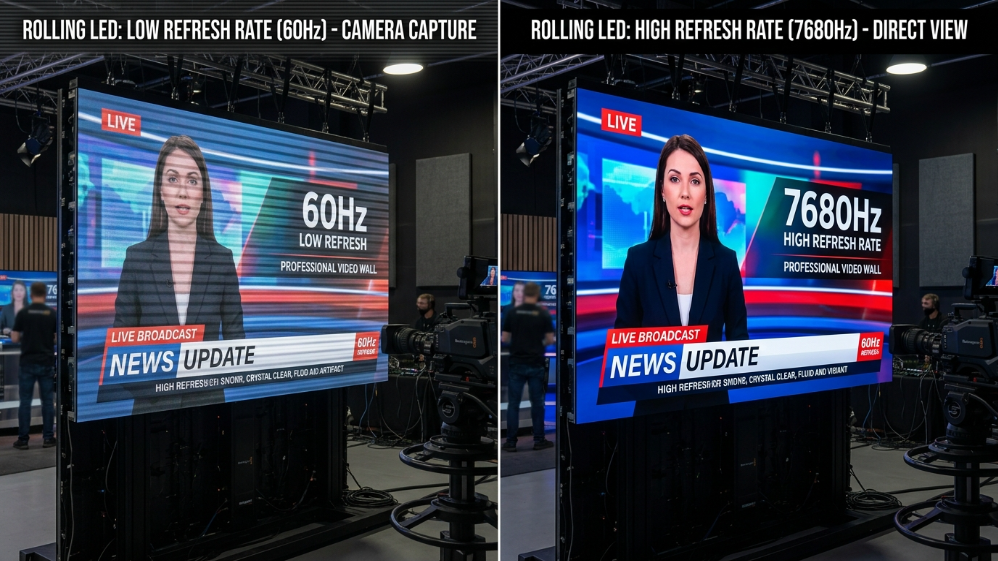
In 2026, the standard for professional events is a 7680Hz refresh rate. This is achieved through high-end driving ICs (like the Macroblock or ICN series).
-
Low Cost: 1920Hz (Causes flickering on smartphone cameras—disastrous for “Instagrammable” retail spaces).
-
Professional: 3840Hz/7680Hz (Smooth as silk on 4K cameras).
Brightness and “Nits”
Standard indoor flexible screens sit at 800-1,000 nits. If you are placing a screen in a sun-drenched mall atrium, you need High-Brightness versions (2,500+ nits). This requires more power-efficient LEDs and better thermal management, which naturally drives the price up.
Table 2: Component Breakdown – Premium vs. Economy Configuration
| Component | Economy Rolling Screen (Cheap) | Premium Rolling Screen (B2B Standard) | Commercial Impact |
| LED Lamp | Copper Wire (Generic) | Gold Wire (Nationstar/Kinglight) | Gold wire lasts 30% longer; less color decay. |
| PCB Type | 2-Layer FPC | 4-Layer or 6-Layer FPC | Better heat dissipation; prevents circuit cracks. |
| Control System | Generic/Non-Synchronous | NovaStar/Colorlight | Industry standard; easier to find technicians worldwide. |
| Power Supply | No-name Brand | MeanWell or G-Energy | Prevents fire hazards and ensures 24/7 stability. |
The Strategic Advantages: Why Pro-AV Integrators are Switching
If you are a system integrator, the Rolling LED screen price is only one part of the equation. You must look at the Logistical Savings.
Ultra-Lightweight Design = Lower Labor Costs
A traditional LED cabinet weighs roughly 7-10kg per panel. A rolling LED curtain or mesh often weighs less than 4kg per square meter.
The Math: For a 100sqm stage backdrop, you are reducing the hanging load by 600kg. This means you can use lighter trusses and, more importantly, fewer riggers. In high-labor markets like the US or EU, this can save $2,000-$5,000 per installation day.
Unprecedented Creative Freedom
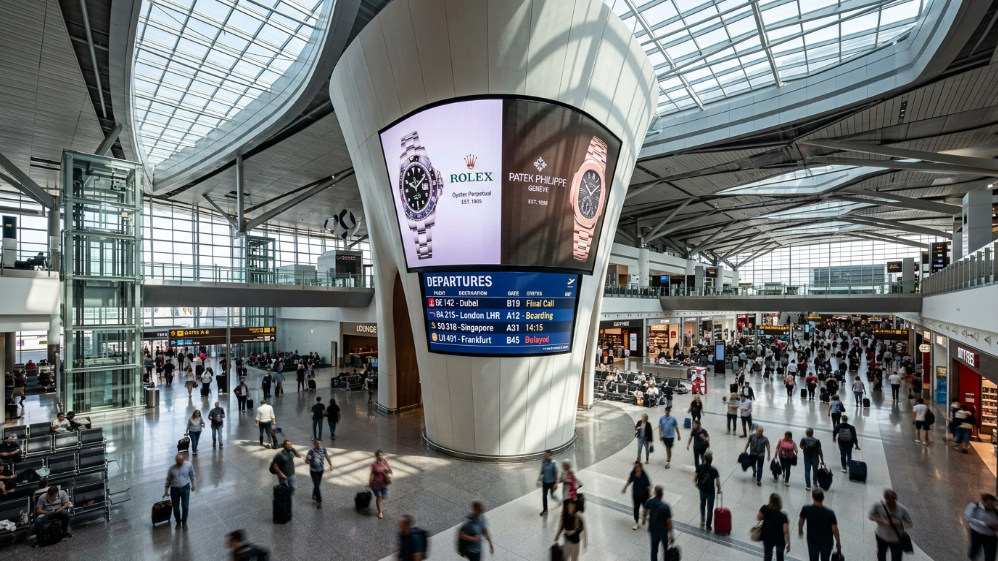
Standard screens are squares. The world is not. B2B buyers in the luxury hospitality sector (hotels, casinos) use rolling screens to turn architectural obstacles—like structural columns—into revenue-generating ad space. By wrapping a P2.5 rolling screen around a pillar, you turn “dead space” into a high-value DOOH (Digital Out-of-Home) asset.
Decoding the Technical Specs: A Checklist for Buyers
Before you sign a Proforma Invoice, you must demand a technical datasheet that goes beyond the basics. According to 2026 industry standards, here is what you should look for:
-
Minimum Bending Radius: Can it handle a diameter of 300mm? If not, it’s not truly “rolling”—it’s just “slightly flexible.”
-
Gray Scale: Look for 14-bit to 16-bit. This ensures that even at low brightness, the colors don’t look “blocky” (contouring).
-
Module Magnet Strength: Most rolling screens are magnetic. If the N52 magnets aren’t strong enough, the screen will “sag” over time on curved steel frames.
-
Serviceability: Is it front-serviceable? In a retail environment, you cannot afford to take down the entire structure to fix one pixel. A front-removable vacuum tool system is the gold standard.
While understanding the hardware specifications and the initial Rolling LED screen price is vital, the true success of a B2B project lies in how these units are integrated into a high-stakes environment. Whether it is a 50-city concert tour or a flagship digital-out-of-home (DOOH) installation, the hardware must survive the rigors of travel and the complexities of 24/7 operation.
Let’s move beyond the spec sheet and look at the operational engineering that separates a profitable installation from a technical nightmare.
Strategic Applications: Where Rolling LED Tech Dominates in 2026
Our engineering team has noticed a significant shift in how Pro-AV integrators utilize flexible tech. It is no longer just for “curved walls”; it is for high-speed deployment and architectural transformation.
Touring and Live Performance: The “Speed-to-Stage” ROI
In the rental world, time is the most expensive commodity. Traditional LED panels require heavy rigging and meticulous alignment. In contrast, rolling screens—specifically those utilizing carbon-fiber reinforced structures—can be unrolled like a carpet from a motorized truss.
The Business Impact: By reducing load-in time from 6 hours to 90 minutes, rental houses can cut their on-site labor overhead by nearly 70%.
High-End Retail: Eliminating Architectural Constraints
Luxury brands in 2026 are moving away from “flat” screens. They want organic shapes that mimic the fluidity of their products. Rolling LED screens allow for seamless concave and convex curves that were previously impossible without visible gaps between cabinets.
Engineering Note: When installing in retail, we recommend a Pixel Pitch of P1.9 or P2.5. This ensures that even when customers are standing 2 meters away, the image remains sharp and the “screen door effect” is nonexistent.
Virtual Production (xR) and Broadcast Studios
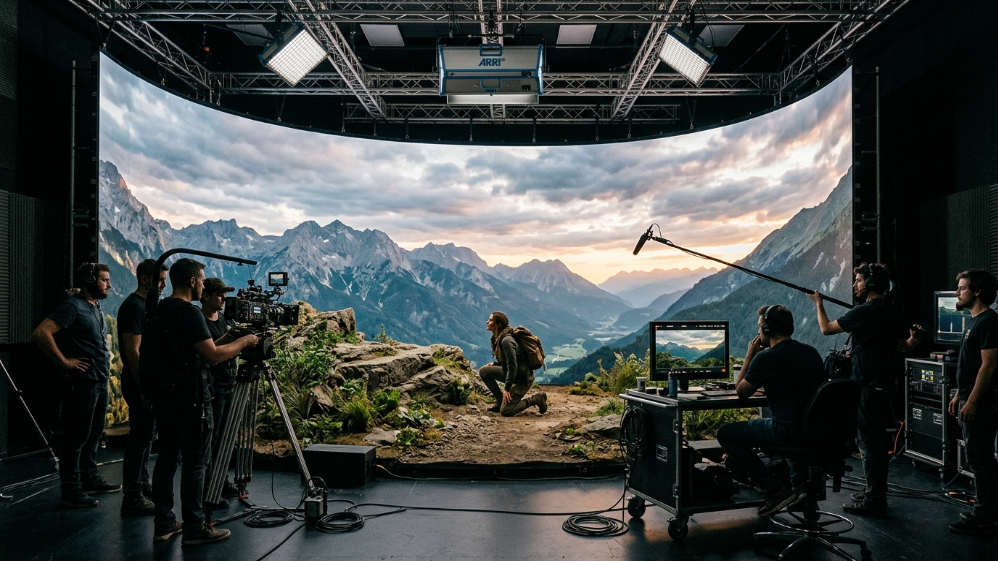
For studios, the rolling screen acts as a “cyclorama” (cyc) wall. Because these screens use high-end FPC (Flexible Printed Circuit) boards that don’t distort when bent, they maintain a uniform color temperature across the curve—a critical requirement for camera sensors to avoid color shifting during a pan.
The Logistical Reality: Shipping, Rigging, and Installation
A common mistake in B2B procurement is ignoring the “hidden” logistics costs. Because rolling screens are thin and lightweight, the shipping math changes entirely.
Table 3: B2B Logistical Comparison – Rolling Screen vs. Standard Die-Cast Cabinets
| Logistical Factor | Traditional Die-Cast Cabinet | Rolling LED Display (Pro-Series) | B2B Cost Savings |
| Weight per m² | 25kg-35kg (with cabling) | 8kg-12kg | ~60% lower rigging costs. |
| Shipping Volume | Large Flight Cases (Bulk) | Compact Rollable Containers | 50% reduction in ocean/air freight. |
| Installation Speed | 10 mins/sqm (2 persons) | 2 mins/sqm (1 person) | Massive reduction in local labor hire. |
| Power Consumption | Higher (standard ICs) | Common Cathode Energy Saving | 30% lower electricity/OPEX. |
Engineering Insight: The Power of Common Cathode Technology
In 2026, we highly recommend buyers specify Common Cathode driving architecture. It reduces heat by 25% by providing precise voltage to the Red, Green, and Blue chips separately. For rolling screens, which often have less airflow than traditional cabinets, this is essential to prevent “thermal expansion” that could cause the flexible mask to bulge or warp.
How to Source Safely: Avoiding the “Race to the Bottom”
If a quote for a Rolling LED screen price looks too good to be true, it’s usually because the manufacturer is using recycled plastic housings or low-tier Nationstar/Kinglight “B-Grade” LEDs.
3 Questions to Ask Your Manufacturer Before Sending a Deposit:
-
“What is the copper thickness of the FPC?” You want at least 2oz or 3oz of copper. Thinner circuits will crack after 500 rolls.
-
“Do you provide a brightness calibration file?” Professional B2B suppliers use NovaStar or Colorlight calibration at the factory. Without this file, if you buy more modules later, the colors will never match.
-
“What is the LED binning strategy?” Ensure all modules come from the same “bin” (batch) to guarantee color uniformity.
B2B FAQ: Addressing Long-Tail Buyer Intent
Can rolling LED screens be used for permanent outdoor installations?
Yes, but you must specify an IP65 or IP66 rating. Outdoor rolling screens use a special UV-resistant silicone that won’t turn yellow or become brittle under direct sunlight. Ensure the nits are above 4,500 for daytime visibility.
How do I repair a dead pixel on a rolling screen?
Unlike traditional cabinets where you swap a module, rolling screens often allow for individual SMD replacement or module-level swaps via a magnetic front-service tool. Because they use GOB (Glue on Board) tech, pixel failures are 80% less likely during transport.
What is the maximum height a rolling screen can be hung?
Engineering-wise, most high-tensile rolling screens can be hung up to 10-15 meters without needing intermediate support, provided the top rigging bar is rated for the total weight.
Does the rolling action affect the refresh rate or latency?
No. The rolling mechanism is purely mechanical (the housing). The refresh rate (typically 3840Hz to 7680Hz) is determined by the Driving IC and the controller (e.g., NovaStar MCTRL4K).
Why is the P2.6 pixel pitch the “Sweet Spot” for B2B events?
P2.6 offers the perfect balance between high resolution for the audience and structural durability. It’s “tough” enough to handle the physical stress of being rolled while providing enough density for 4K video playback on medium-sized stages.
Expert Verdict: The 2026 Buyer’s Strategy
Stop looking at the Rolling LED screen price as a one-time expense and start looking at it as a 5-year ROI engine.
My Engineering Recommendation:
-
If you are a rental house, skip the P3.9 and go straight to P2.6 with GOB protection. The slightly higher upfront cost ($300-$500 extra per sqm) will pay for itself in under 12 months through reduced repair bills and the ability to charge premium “creative” rates to your clients.
-
If you are a retail developer, prioritize Front-Serviceability and Common Cathode tech. Reliability in a 24/7 environment is worth more than a 10% discount from a Tier-3 supplier.
Ready to spec your project? Don’t just ask for a price—ask for a system diagram. A professional partner will provide the power map, signal flow, and structural load calculations before you even place the order.
References:
Sectional Design Standard for Flexible/Rigid-Flexible Printed Boards
Requirements for the Structural Support of Temporary LED Structures