Choosing the right LED screen rental for events in South Africa starts with three decisions: the screen’s physical size, its pixel pitch, and whether it must operate indoors or in direct sunlight. Published rental listings provide useful budget benchmarks: NGS Digital lists a 2.5 × 2 m LED screen package at R9,700 per day, excluding transportation, while Connection House lists a 4 × 2 m P3.9 screen at R19,800 per day, excluding VAT and delivery. These are individual supplier prices, not a national market average. For event planners, AV integrators, concert producers, and rental companies, the real objective is to secure a display that suits the audience, integrates with the production system, and performs reliably within the available budget.
A low rental price can become an expensive mistake if the screen is too small, the image lacks sufficient detail, or the quotation excludes essential installation services. Conversely, specifying an unnecessarily fine pixel pitch can increase costs without delivering a meaningful improvement to the audience. The correct approach is to match the display to the event’s viewing conditions, technical requirements, and operating environment before comparing quotations.
How Much Does LED Screen Rental Cost in South Africa?
The cost of LED screen hire in South Africa depends on screen dimensions, pixel pitch, rental duration, equipment configuration, and the services included in the package. Outdoor concerts, corporate presentations, exhibitions, and sports screenings may require very different specifications, even when the physical screen area appears similar.
According to published supplier listings reviewed in October 2026, advertised daily rates vary with screen size, pixel pitch, and package inclusions. The examples below offer a starting point for budgeting, but they should not be treated as directly interchangeable quotations.
| Supplier and package | Screen dimensions | Pixel pitch | Published daily price | Important exclusions or inclusions |
|---|---|---|---|---|
| NGS Digital Bronze | 2.5 × 2 m | Not specified in the listing | R9,700 | Mounting platform, setup, and technician included; transportation excluded |
| Connection House, indoor screen | 3.5 × 2 m | P2.9 | R16,000 | Controller, platform, setup, cabling, and technician included; delivery excluded; price excludes VAT |
| Connection House, indoor/outdoor screen | 4 × 2 m | P3.9 | R19,800 | Controller, platform, setup, cabling, and technician included; delivery excluded; price excludes VAT |
| Connection House, indoor/outdoor screen | 8 × 3 m | P3.9 | R60,100 | Published daily rental listing; confirm all inclusions and exclusions before booking |
Sources: NGS Digital rental packages and Connection House LED screen rental listings. Prices are published examples and may change; verify availability, VAT treatment, and the complete quotation before purchase.
The table illustrates an important commercial distinction: the advertised screen rental rate is not necessarily the total event display cost. Two suppliers may quote different amounts for apparently similar screens because one includes a video controller, installation platform, cabling, and technician, while another charges separately for some of these services.
Based on our experience with LED display engineering and B2B project requirements, buyers should compare the complete technical scope before comparing prices. The most useful quotation identifies the exact screen configuration, operating environment, installation method, signal requirements, and service responsibilities. A lower headline rate is only an advantage if the equipment meets the event’s actual requirements.
What Extra Costs Can Increase Your Event LED Screen Hire Budget?
The screen itself is only one component of an event’s audiovisual budget. Transport distance, access restrictions, installation complexity, and the need for specialist technicians can materially affect the final cost.
| Cost component | What the buyer should verify | Why it affects the budget |
|---|---|---|
| LED screen rental | Dimensions, pixel pitch, brightness, and rental period | Determines the display configuration and base equipment charge |
| Transportation | Collection, delivery, return, and distance charges | Larger or heavier configurations may require different vehicles and handling arrangements |
| Installation and dismantling | Ground stacking, platform, truss, rigging, and labor | Complex installations require additional equipment, planning, and working time |
| Video processing | Controller, input connections, scaling, and signal distribution | Ensures the display can accept the event’s actual content sources |
| Technical support | Setup technician, event operator, and emergency response | Reduces the risk of prolonged disruption during live presentations |
| Electrical supply | Distribution, cables, generator, and backup arrangements | Helps ensure that the complete display system can operate within the available power capacity |
| Content preparation | Resolution, aspect ratio, playback, and media conversion | Prevents distorted images, unexpected cropping, and incompatible files |
| Additional rental time | Early access, rehearsals, overnight operation, and overtime | Extends the period for which equipment and staff are required |
| Taxes and insurance | VAT treatment, damage liability, and insurance conditions | Clarifies the amount payable and the financial responsibilities of each party |
Not every event will incur every cost. Some rental packages bundle equipment and labor, while others price them separately. Request an itemized quotation rather than relying on an informal price per square meter.
How Do Screen Size, Pixel Pitch, and Rental Duration Affect the Quote?
Three variables deserve particular attention during procurement.
Screen size determines the display area and how effectively content can reach the intended audience. A larger wall may improve visibility at a large outdoor venue, but it also requires more modules, a suitable structure, additional transport capacity, and sufficient power.
Pixel pitch describes the distance between adjacent pixel centers, measured in millimeters. A P2.9 display has a smaller pixel pitch than a P3.9 display and can provide greater pixel density for a comparable screen area. This can improve the appearance of text, graphics, and close-up camera images. However, the commercial benefit depends on viewing distance and content: a finer pitch may add cost without producing a noticeable improvement for spectators watching from far away.
Rental duration affects the commercial terms of the booking. Daily pricing, multi-day discounts, rehearsal periods, overnight operation, and extended installation windows vary by supplier. Ask whether the quoted period covers delivery, setup, the live event, and dismantling, or whether separate charges apply.
What Should an Itemized LED Screen Rental Quote Include?
Before approving a quotation, ask the supplier to document the following:
- Exact screen dimensions and total display area.
- Pixel pitch, brightness specification, and indoor or outdoor suitability.
- Video processor, input connections, and required signal cables.
- Installation method, support structure, and responsible installation contractor.
- Delivery, collection, setup, dismantling, and labor charges.
- Power requirements and responsibility for electrical distribution.
- Technician attendance, operating hours, and emergency support arrangements.
- Rental dates, payment terms, cancellation conditions, and VAT.
- Spare modules or other agreed contingency equipment, where applicable.
A detailed quotation gives the buyer a defensible basis for comparing suppliers and reduces the likelihood of last-minute charges. It also provides a practical starting point for technical coordination between the LED screen provider, venue, production manager, and audiovisual team.
Which LED Screen Size Is Best for Your Event?
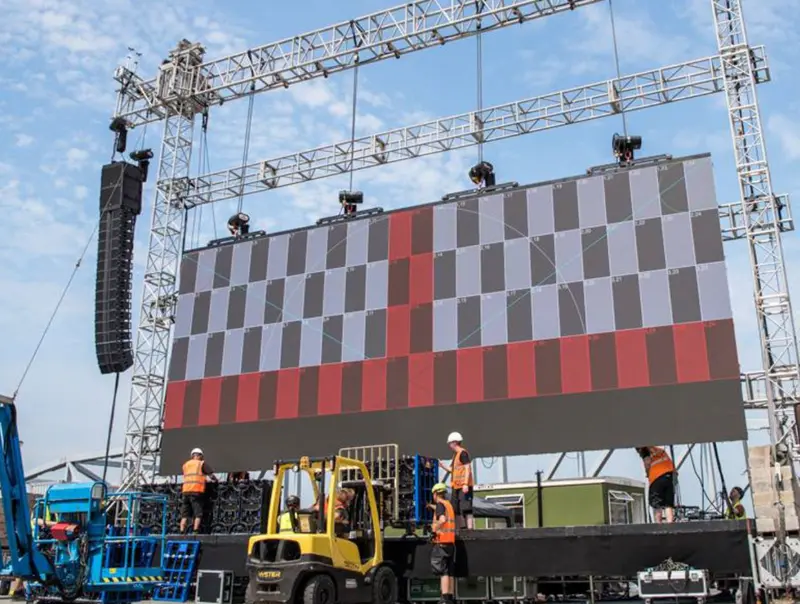
The best LED screen size is determined by audience distribution, viewing distance, content layout, and the physical limitations of the venue. A conference presentation viewed from the back of a hotel ballroom has different requirements from a concert screen designed to remain visible across an outdoor festival ground.
Screen dimensions should therefore be selected before finalizing the pixel pitch. Otherwise, buyers risk paying for a high-resolution display that is physically too small for the audience, or renting an oversized screen that creates unnecessary structural and transportation costs.
What Screen Dimensions Work for Conferences and Corporate Presentations?
Corporate conferences, award ceremonies, and product launches often require a screen that can display presentation slides, speaker images, charts, and video content without sacrificing readability.
The first step is to establish the maximum audience viewing distance and the width of the usable stage. The screen should be large enough for people at the back of the room to read essential content, while remaining proportionate to the stage and surrounding set.
A modular LED wall also allows the production team to select a suitable aspect ratio. For example, a 4 × 2 m screen has a 2:1 aspect ratio, whereas a 4 × 3 m screen has a 4:3 aspect ratio. Neither configuration is universally superior; the choice depends on the content, viewing layout, and desired stage design.
For presentations using standard widescreen 16:9 content, the production team should check how the source image will map onto the physical LED canvas. An incompatible aspect ratio can result in unused display areas, cropping, or image distortion if the content and processor are not configured correctly.
Based on our experience with LED display engineering and system selection, buyers should confirm the screen’s native pixel resolution and intended content format before approving a design. Physical dimensions alone do not guarantee that slides, fine text, or high-resolution product imagery will look sharp.
How Large Should an LED Wall Be for Concerts and Festivals?
Concerts and festivals introduce additional constraints: long viewing distances, large audience areas, stage architecture, changing ambient light, and live camera feeds.
A main stage screen may need to be complemented by side screens or supplementary displays so that spectators outside the central viewing area can follow the performance. The correct arrangement depends on the audience layout and the intended viewing angles, not simply on the number of square meters available.
Outdoor concert buyers should evaluate:
- Display area: Does the screen provide sufficient visibility for the expected audience distribution?
- Brightness: Can the display remain legible under the actual daylight or nighttime lighting conditions?
- Pixel pitch: Is the pixel density appropriate for the closest intended viewers and camera shots?
- Refresh and grayscale performance: Can the display reproduce motion and tonal detail appropriately for live content?
- Structure: Can the proposed support system accommodate the screen configuration and applicable environmental loads?
- Redundancy: Are spare modules, backup signal paths, and suitable troubleshooting arrangements available?
These specifications have practical commercial consequences. A properly matched display can improve the viewing experience without overspending on unnecessary resolution, while appropriate structural and technical planning can reduce the risk of event delays and costly interruptions.
Should You Rent a Modular LED Wall or a Mobile LED Screen Trailer?
Modular LED walls and mobile LED screen trailers address different deployment requirements. Buyers should compare the installation environment and logistics before choosing between them.
| Decision factor | Modular LED wall | Mobile LED screen trailer |
|---|---|---|
| Screen configuration | Can be assembled into different widths, heights, and layouts, subject to compatible equipment and engineering | Generally constrained by the trailer’s installed screen configuration and mechanical design |
| Installation | Requires assembly, signal connections, and an appropriate support system | May reduce screen assembly requirements, depending on the model and site |
| Venue access | Requires suitable access for cabinets, structures, and installation equipment | Requires vehicle access, adequate turning space, and a suitable parking position |
| Best-fit applications | Concert stages, exhibition structures, corporate events, and custom display layouts | Outdoor activations, public screenings, and sites where the trailer configuration is appropriate |
| Structural considerations | Requires assessment of the selected ground support, truss, or flown arrangement | Requires confirmation of the trailer’s stability, deployment conditions, and operating limitations |
| Transport | Depends on cabinet quantity, structures, and equipment volume | Depends on trailer dimensions, towing or transport arrangements, and site access |
A modular configuration is often useful when the project requires a specific screen shape or stage integration. A mobile trailer may be suitable when rapid deployment and a self-contained transport format are priorities. Neither option eliminates the need for a site assessment, electrical planning, or appropriate safety controls.
Before selecting a trailer, confirm that the venue can accommodate the vehicle and deployed screen, including access restrictions, ground conditions, overhead obstructions, and the required viewing orientation. For modular walls, verify the installation footprint, support design, and equipment handling arrangements.
How Do You Estimate Screen Dimensions and Native Resolution?
Screen dimensions describe the physical width and height of the display. Native resolution describes the number of pixels available to reproduce the image.
For a modular LED display, the approximate horizontal pixel count can be calculated by dividing the physical width in millimeters by the pixel pitch in millimeters. The vertical pixel count is calculated in the same way using the screen height.
For example, consider a hypothetical 4,000 × 2,000 mm LED wall using a nominal 4 mm pixel pitch:
- Horizontal pixel count: 4,000 ÷ 4 = 1,000 pixels.
- Vertical pixel count: 2,000 ÷ 4 = 500 pixels.
- Approximate native resolution: 1,000 × 500 pixels.
This is an illustrative calculation, not a specification for a particular rental product. Actual dimensions and pixel counts depend on the cabinet and module design.
The result matters commercially because a screen’s physical size does not automatically determine how much detail it can reproduce. Buyers should match the content output to the display’s actual pixel matrix and the processor’s capabilities. If the event relies on small text, detailed charts, or close-up product imagery, resolution and viewing distance should be reviewed together before the equipment is booked.
What Pixel Pitch Should You Choose for an Event LED Screen?
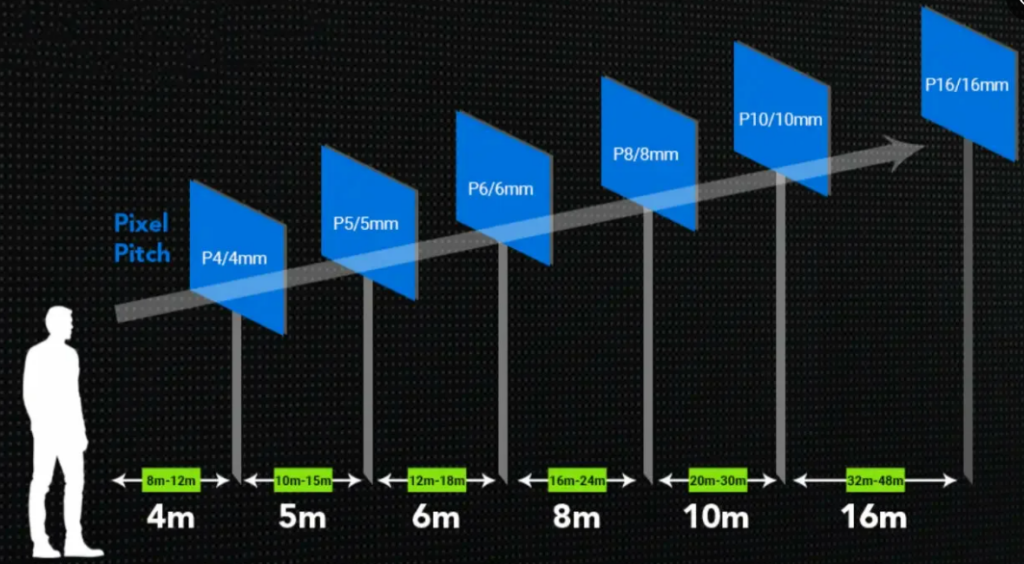
Pixel pitch is one of the most important technical considerations when comparing LED screen rental packages. It affects image detail, viewing distance, and the amount of LED hardware required for a given display area.
A smaller pixel pitch increases pixel density and can improve close-range image quality. A larger pitch can be a sensible choice when the audience is farther away and the additional detail of a finer-pitch display would offer limited practical value.
For B2B buyers, the goal is not to choose the smallest available pitch. It is to select a configuration that delivers the required visual quality at a commercially sensible cost.
P2.9 vs. P3.9 vs. P4.8 vs. P6: Which Is Right for Your Event?
The following comparison describes typical selection considerations rather than fixed viewing-distance limits. Actual suitability depends on display design, content, ambient conditions, audience layout, and camera requirements.
| Pixel pitch | Typical selection considerations | Potential benefit | Commercial trade-off |
|---|---|---|---|
| P2.9 | Close viewing and presentations where detail is important | Greater pixel density can improve the appearance of fine text and graphics | May increase rental cost without a meaningful benefit at long viewing distances |
| P3.9 | General event applications, including many concerts and corporate events | Offers a balance between image detail and practical screen sizing for suitable viewing conditions | Must still be evaluated against audience distance and content requirements |
| P4.8 | Applications where viewers are generally farther from the screen | Can provide adequate image detail without paying for unnecessarily high pixel density | May be less suitable for very close viewing or fine-detail content |
| P6 | Large displays viewed from relatively long distances, subject to content requirements | Can reduce the need to specify a finer-pitch display when close-up detail is not essential | Individual pixels are more apparent at close range |
These are selection guidelines, not guarantees of performance. The same P3.9 screen can be appropriate for one event and unsuitable for another if the viewing distances, content, or camera conditions differ.
How Does Viewing Distance Affect LED Screen Resolution?
Viewing distance influences whether the audience can distinguish individual pixels and how clearly the display reproduces text, graphics, and moving images.
A useful starting point is to identify the closest intended viewer, the typical viewing distance, and the farthest audience area where content must remain legible. Then assess whether the selected pixel pitch provides the necessary image quality across those positions.
For example, an exhibition screen may be viewed from only a few meters away, making fine text and product details important. An outdoor festival screen may be viewed from much farther away, where screen area, brightness, and audience coverage may be more important than extremely fine pixel pitch.
The viewing-distance decision also affects budget allocation. Choosing a finer pitch than the event requires can increase equipment costs, while choosing a pitch that is too coarse can undermine the visual quality expected by the client.
For critical projects, request the actual screen resolution and a proposed viewing-distance assessment from the supplier. If camera-based content is involved, include camera tests in the evaluation rather than relying on viewing distance alone.
When Is a Fine-Pitch Indoor LED Display Worth the Extra Cost?
Fine-pitch indoor LED displays are particularly relevant to corporate presentations, exhibitions, premium showrooms, and events where viewers may stand close to the screen.
A smaller pixel pitch can help render fine typography, product details, and high-resolution graphics more clearly at short distances. This may improve presentation quality when the display is used as a central visual element rather than as a distant background screen.
However, fine pitch does not compensate for poor source content, incorrect scaling, or an unsuitable display layout. Buyers should check the screen’s native resolution, source resolution, content aspect ratio, and expected viewing positions together.
A practical procurement rule is to prioritize the smallest pitch only when the visual benefit can be justified by the event’s requirements. For a large audience watching from a distance, allocating more budget to screen coverage, installation quality, and reliable signal delivery may provide greater overall value.
What Refresh Rate and Grayscale Performance Do Camera-Based Events Need?
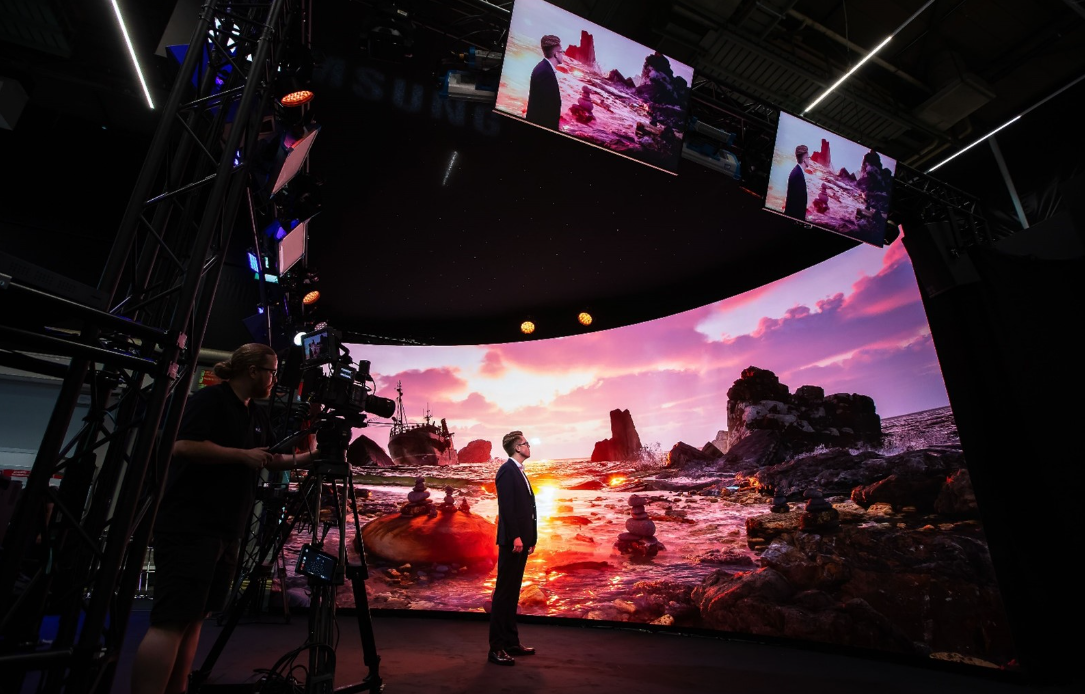
- Camera Flicker: Visible black bars (rolling shutter effect) when filmed.
- Content Loss: Fast-moving content may appear blurry or tearing.
- Not Broadcast Ready: Unsuitable for professional live streaming or TV.
- Flicker-Free: Crystal clear image on all cameras (1/2000s+ shutter speed).
- Smooth Motion: Perfect for fast video playback and sports.
- XR Ready (7680Hz): Essential for virtual production and XR studios.
Live events, broadcasts, and livestreams require more than a display that looks good to the naked eye. Camera shutter settings, frame rates, LED scan behavior, processing, and exposure can affect the recorded image.
Refresh rate describes how frequently the display updates its image, while grayscale performance relates to how effectively it reproduces gradations between darker and brighter tones. These are different characteristics, and a high refresh-rate figure alone does not guarantee clean camera footage.
For events involving LED screens on camera, buyers should:
- Request the manufacturer’s verified refresh-rate and grayscale specifications.
- Confirm the display’s scan configuration and controller compatibility.
- Test the intended camera, shutter settings, frame rate, and exposure against the actual display.
- Check for visible flicker, scan lines, moiré patterns, and uneven tonal reproduction.
- Confirm that the content processor can handle the required input resolution and frame rate.
These checks can reduce the risk of discovering camera artifacts during a live broadcast, when changing the display configuration may be difficult. The commercial benefit is straightforward: fewer production compromises, less emergency troubleshooting, and a more predictable visual result.
Indoor vs. Outdoor LED Screen Rental: Which Should You Choose?
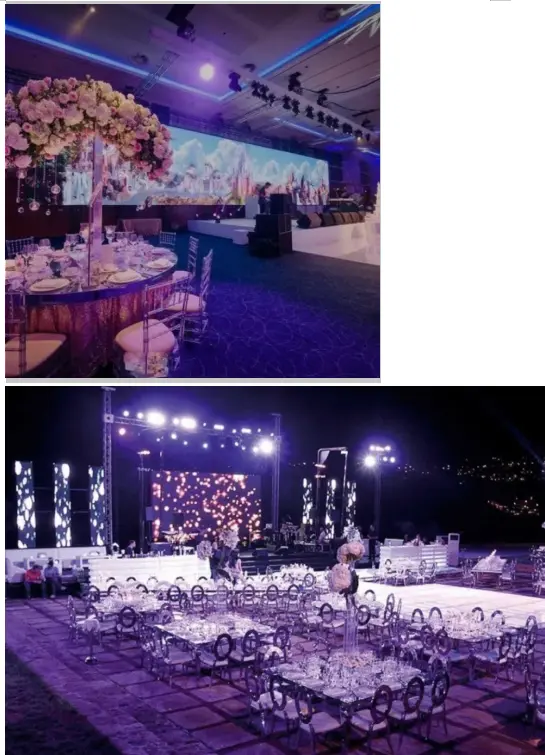
The choice between indoor and outdoor LED screen rental depends on ambient light, weather exposure, viewing distance, and installation conditions. A display designed for a dark conference room may struggle in direct sunlight, while a high-brightness outdoor screen may be unnecessarily bright for close viewing in a hotel ballroom.
For event planners and AV integrators, the right specification balances image quality, equipment cost, environmental protection, and the practical demands of the venue.
| Selection factor | Indoor LED display | Outdoor LED display | Business benefit |
|---|---|---|---|
| Brightness | Often lower, depending on ambient lighting | Generally higher for daylight visibility | Matches the screen to the viewing environment without unnecessary operating brightness |
| Pixel pitch | Fine pitch may be valuable for close viewing | Selected according to audience distance and content | Balances image detail with rental cost |
| Environmental protection | Depends on venue and exposure | Requires suitable protection for expected weather and dust | Reduces environmental risks when the equipment is correctly specified |
| Viewing conditions | Controlled lighting is more common | Sunlight, changing daylight, and wider viewing areas may be factors | Helps maintain content legibility |
| Installation | May use indoor ground support, staging, or approved rigging | May require outdoor-rated structures and additional weather planning | Supports safer installation and more predictable deployment |
| Power planning | Depends on screen configuration and operating conditions | Depends on display size, brightness settings, and equipment configuration | Helps determine electrical distribution and backup requirements |
| Typical applications | Conferences, exhibitions, showrooms, and corporate launches | Festivals, sports screenings, outdoor activations, and concerts | Aligns equipment selection with the event’s purpose |
How Much Brightness Does an Outdoor Event LED Screen Need?
Brightness is measured in nits, equivalent to candelas per square meter. Higher brightness can improve visibility in bright surroundings, but the required output depends on direct sunlight, screen orientation, viewing angle, content, and ambient lighting.
For example, an outdoor display facing strong daylight may require substantially more brightness than an LED wall operating beneath a covered stage. The specification should therefore be based on the actual site conditions rather than a generic maximum-brightness claim.
Ask the supplier to confirm the display’s rated brightness, the measurement conditions, and whether brightness can be adjusted for different operating environments. Excessive brightness is not automatically better: it can be uncomfortable for nearby viewers and may consume more power when the display is operated at higher output.
The commercial objective is sufficient visibility at the intended viewing distance, not the highest number on the datasheet.
Which IP Rating and Weather Protection Should You Specify?
An IP rating describes protection against the ingress of solids and water under specified test conditions. It does not establish that an entire LED screen installation is safe under every combination of wind, rain, temperature, standing water, and electrical exposure.
Before hiring an outdoor LED screen, confirm:
- The documented IP rating for the relevant front and rear surfaces.
- Whether connectors, power distribution, and signal connections are protected appropriately.
- The manufacturer’s permitted operating and storage conditions.
- Whether rainwater can drain away without accumulating around equipment.
- The protection required for the support structure and associated electrical equipment.
These checks help buyers avoid assuming that a weather-resistant display makes the complete installation weatherproof. Site preparation and operating procedures remain essential.
Can Outdoor LED Screens Operate Safely in Rain and Wind?
Outdoor operation requires an assessment of both the display equipment and the installed structure. Wind loading, exposed surface area, mounting configuration, ground conditions, and the location’s weather exposure can affect structural stability.
For a large modular LED wall, the installer should establish the appropriate support arrangement and obtain the necessary engineering assessment and approvals. A mobile trailer also has deployment limits that must be respected.
In South Africa, temporary event structures may be subject to local permitting and safety requirements. The City of Cape Town, for example, identifies temporary structure approval as part of event safety planning. Requirements vary by location and event, so organizers should confirm the applicable rules with the relevant municipality and venue.
Do not rely on the LED cabinet’s IP rating as evidence of structural wind safety. If conditions exceed the manufacturer’s or structural designer’s permitted limits, the appropriate response is to follow the documented operating and shutdown procedures.
When Is an Indoor LED Screen Better for a Corporate Event?
Indoor LED displays are often suitable for conferences, product launches, exhibitions, and presentations where the audience sits relatively close to the screen.
A fine-pitch LED wall can improve the readability of small text and detailed graphics. Its brightness can also be selected for the venue’s lighting conditions, helping presenters avoid excessive glare while maintaining a clear image.
Before confirming a rental package, check the screen’s pixel pitch, native resolution, aspect ratio, viewing distance, and camera requirements. For events using live cameras, request a test with the intended camera settings.
A screen that looks impressive in a supplier’s showroom is not automatically the right display for a specific stage. The content, audience layout, and room lighting determine whether the configuration will deliver the expected result.
What Technical Requirements Must You Check Before Renting?
A reliable LED screen rental involves more than choosing a screen size and paying a daily rate. The display must integrate with the event’s video equipment, electrical supply, support structure, content workflow, and operating schedule.
For B2B buyers, these technical checks should be completed before the supplier confirms the final configuration.
How Do You Calculate LED Screen Power Requirements?
LED display power consumption varies with screen dimensions, pixel pitch, brightness settings, displayed content, and the design of the LED modules and power supplies. Maximum rated consumption and typical operating consumption are not interchangeable.
A practical starting point is to request both figures from the supplier:
- Maximum power consumption: Helps establish the potential electrical demand under the manufacturer’s specified conditions.
- Typical power consumption: Helps estimate likely operating demand under stated conditions, but should not replace maximum-demand planning.
- System-level power demand: Accounts for relevant processing equipment and other components that draw power from the same supply.
For an illustrative calculation, a screen rated at a maximum of 800 W per square meter with a total area of 20 m² would have a nominal maximum display load of 16 kW. This is a hypothetical example, not a Sostron product specification or a recommended generator size.
The final electrical design must account for the actual equipment, voltage, current, circuit capacity, distribution, cable ratings, starting and transient conditions where relevant, and other connected loads. A qualified professional should determine the appropriate supply arrangement.
This matters commercially because an undersized supply can disrupt the event, while an unnecessarily oversized arrangement can increase rental and fuel costs. Accurate equipment data gives the production team a better basis for planning.
What Video Processor and Signal Connections Does Your Event Need?
An LED video processor scales and maps the incoming image to the display’s pixel layout. Depending on the configuration, the system may also require sender equipment, receiving cards, signal distribution, and additional processing for multiple screens.
Before confirming a rental, document the content sources and signal paths.
| Technical requirement | What to confirm | Why it matters |
|---|---|---|
| Source equipment | Laptop, playback server, camera, switcher, or other source | Prevents input incompatibility |
| Signal interfaces | HDMI, SDI, or other supported interfaces | Ensures the source can connect to the processing system |
| Resolution and frame rate | Source output and processor capabilities | Reduces scaling problems and unsupported input modes |
| Screen mapping | Physical screen dimensions and native pixel resolution | Helps prevent cropping, stretching, and incorrect image placement |
| Multiple displays | Independent content, mirrored feeds, or extended canvases | Determines processing and output requirements |
| Backup signal path | Available alternate sources or redundant equipment | Can reduce the impact of a single equipment failure |
| Camera integration | Camera frame rate, shutter settings, and image processing | Helps identify flicker and other recording artifacts before the event |
A written signal-flow diagram is particularly useful for concerts, corporate conferences, and broadcast productions. It identifies who supplies each device and who is responsible for configuring and testing the complete system.
What Rigging and Structural Support Does an LED Wall Require?
The support system must be appropriate for the display’s total weight, dimensions, mounting method, and site conditions. Ground-stacked walls, flown displays, and trailer-mounted screens have different structural requirements.
For suspended installations, confirm the permitted loads for the venue’s rigging points and the equipment attached to them. For ground-supported walls, check the stability of the base structure, floor capacity, access restrictions, and any additional bracing required by the design.
The Entertainment Services and Technology Association’s temporary display support standard addresses planning, site preparation, assembly, suspension, use, and dismantling of temporary large-format display systems. Buyers should confirm the current applicable edition and any requirements imposed by local authorities or the venue.
The commercial value of proper structural planning is not limited to compliance. It can reduce installation delays, clarify contractor responsibilities, and help avoid expensive changes after equipment arrives on site.
How Can You Reduce the Risk of Display Failure During a Live Event?
No display system can be guaranteed to operate without failure, but a well-planned commissioning and contingency process can reduce operational risk.
Before the audience arrives, the production team should verify:
- All modules illuminate correctly and the display has been checked for abnormal pixels.
- Brightness and color uniformity are acceptable across the assembled wall.
- The video processor receives and outputs the required signal formats.
- The intended content plays correctly at the selected resolution and aspect ratio.
- Camera feeds have been tested under the expected operating settings.
- Power distribution and cable connections have been inspected.
- Agreed spare modules, backup sources, and escalation contacts are available.
These checks should be completed during the scheduled test period, not immediately before the first presentation or performance.
A supplier’s spare-parts policy should also be explicit. Confirm whether replacement modules are physically available at the venue, can be delivered quickly, or are only available from a remote warehouse. The difference can determine how long an interruption lasts.
What Power Backup Should You Plan for South African Events?
Power planning should begin with the venue’s available supply and the complete electrical load of the event. Where the event depends on a generator or backup source, the technical team should verify that it can support the required equipment and that the transition between sources is handled appropriately.
The plan should identify which systems need backup, including the LED display, video processor, playback equipment, signal distribution, and any other essential production equipment. Backup duration and fuel arrangements should reflect the event’s operational requirements.
South African event safety requirements are not identical across all venues and municipalities. Organizers should check the applicable event permit, electrical compliance, temporary distribution, and backup-power requirements with the relevant authority and venue. The South African government’s published electrical installation regulations provide a starting point for reviewing applicable electrical safety obligations.
The key procurement question is simple: what happens to the display and the event if the primary power source fails? A written contingency plan is more useful than an unsupported promise that the equipment is reliable.
How Do You Choose an LED Screen Rental Company in South Africa?
Selecting an LED screen rental company requires more than comparing advertised prices. Event organizers need a supplier that can provide the correct display configuration, deliver it on schedule, coordinate installation, and support the equipment throughout the event.
For international B2B buyers, there is an additional distinction: a local rental company supplies equipment and event services, while an LED display manufacturer typically supplies hardware, technical documentation, and product support. Some businesses provide both, but their responsibilities should be confirmed before a contract is signed.
What Equipment Specifications and Technical Documents Should You Request?
Ask every shortlisted supplier for a consistent set of technical information. This makes it easier to compare equipment on equivalent terms rather than relying on marketing descriptions such as premium, high-resolution, or professional-grade.
The specification sheet should identify the exact LED display model, pixel pitch, rated brightness, refresh rate, native resolution, power consumption, and applicable environmental protection rating. For structural installations, request the relevant load information and engineering documentation.
For equipment imported into South Africa, verify whether any applicable regulatory approvals are required. ICASA explains that certain electronic communications equipment must undergo type approval unless an applicable exemption applies; this requirement should be assessed against the actual equipment and its regulatory classification rather than assumed to apply identically to every LED display.
A credible supplier should be able to explain the specifications, identify their limitations, and provide supporting documentation where applicable.
Does the Rental Package Include Delivery, Setup, and an On-Site Technician?
The rental agreement should define the boundary between equipment supply and event production services.
Some packages include delivery, installation, a video processor, cables, and an operator. Others provide the display hardware only or charge separately for transport, structural support, commissioning, and event-day technical attendance.
Ask the supplier to confirm who is responsible for each stage:
- Transporting the equipment to and from the venue.
- Assembling and installing the display.
- Providing and approving the support structure.
- Connecting the electrical supply and signal equipment.
- Testing the display and configuring content.
- Operating the system during the event.
- Dismantling the installation and removing the equipment.
- Responding to technical faults and arranging replacement parts.
This responsibility matrix prevents gaps between the LED rental provider, the AV contractor, the venue, and the event organizer. It is especially important for large installations where several contractors work on the same stage.
How Should You Compare LED Screen Rental Quotes Fairly?
Use the same specification when requesting quotations from multiple suppliers. If one supplier prices a 4 × 2 m P2.9 display and another quotes a 4 × 2 m P3.9 display, the prices do not represent an equivalent comparison.
| Comparison criterion | Questions to ask | Evidence to request |
|---|---|---|
| Display specification | Are the screen dimensions, pixel pitch, and brightness comparable? | Product datasheet and written quotation |
| Processing equipment | Is the required processor and signal distribution included? | Equipment list and signal-flow plan |
| Installation | Are labor, structure, rigging, and dismantling included? | Installation scope and responsibility matrix |
| Operating support | Is a technician available during rehearsals and the live event? | Staffing schedule and support terms |
| Logistics | Are transport, collection, and access costs included? | Itemized delivery charges |
| Electrical requirements | What is the maximum power demand and who provides distribution? | Manufacturer power data and electrical plan |
| Contingencies | What happens if a module, processor, or signal source fails? | Spare-parts policy and response procedure |
| Contract terms | What are the payment, cancellation, overtime, and damage provisions? | Written rental agreement |
A well-structured quotation is a procurement tool, not merely a price list. It lets the buyer identify missing services before they become urgent problems on the event day.
What Questions Should You Ask Before Confirming an Event Booking?
Before paying a deposit, confirm equipment availability for the exact dates, the delivery window, access restrictions, installation time, rehearsal requirements, and dismantling schedule.
Also ask whether the quoted configuration can be changed if the venue layout changes. Clarify the procedure for weather-related interruptions, technical failures, and cancellation or postponement.
For outdoor events, make sure the supplier’s operating limits and shutdown procedures are documented. For indoor venues, confirm ceiling heights, loading access, rigging restrictions, and permitted electrical arrangements.
These details are often more valuable than a small discount. A screen that arrives late or cannot be installed as planned has little value, regardless of how competitive its daily rental rate appears.
What LED Screen Solutions Work Best for Different Event Types?
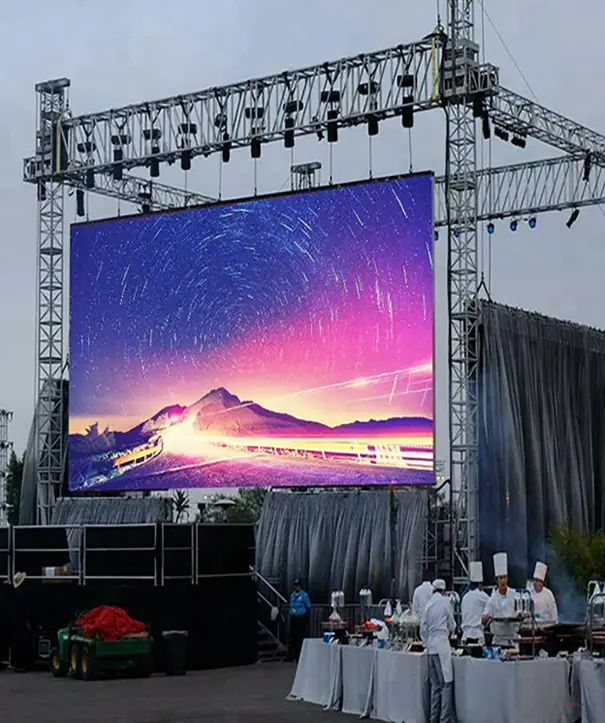
The right LED display configuration depends on how the screen will be used, where the audience will stand or sit, and whether the content consists primarily of presentations, video, live camera feeds, or advertising.
Which LED Screens Work Best for Concerts, Festivals, and Live Performances?
Concerts and festivals often require large modular LED walls that can be integrated into stage designs and configured for main-stage content, live camera feeds, and supplementary audience screens.
Outdoor configurations need sufficient brightness for the operating conditions, suitable environmental protection, and a structurally appropriate support system. Pixel pitch should be selected according to audience distance and the level of detail required.
For rental companies and production contractors, lightweight cabinets and compatible connection systems can improve transport and assembly efficiency. The practical benefit depends on the specific cabinet design, handling arrangements, and installation method; lightweight hardware does not remove the need for safe rigging or structural assessment.
Before booking, confirm the number of display surfaces, the content layout, the required video processing, and the time available for assembly and testing.
What LED Display Specifications Suit Corporate Events and Product Launches?
Corporate events place particular emphasis on presentation clarity, visual consistency, and integration with cameras and presentation systems.
Fine-pitch indoor LED displays may be suitable for product launches, keynote presentations, executive meetings, and premium exhibitions where viewers are relatively close to the screen. Their higher pixel density can help reproduce small text and detailed product imagery.
The screen should also be matched to the content format. A presentation designed for a conventional 16:9 display may require scaling or layout adjustments when used on a wider LED canvas.
For camera-based productions, verify refresh-rate and grayscale specifications and test the actual camera configuration. These measures help protect the quality of the recorded event rather than relying on specifications alone.
How Should You Specify LED Screens for Exhibitions and Trade Shows?
Exhibitions often involve restricted booth dimensions, limited installation windows, close viewing, and strict venue requirements.
A suitable display may be a compact fine-pitch LED wall, a freestanding modular configuration, or a larger screen integrated into a custom booth structure. The decision depends on the booth layout, viewing direction, content, and budget.
Buyers should establish the screen’s footprint, support method, electrical requirements, cable routing, and installation schedule before confirming the exhibition design. They should also check whether the venue imposes specific requirements for rigging, temporary structures, and electrical equipment.
The benefit of early coordination is straightforward: fewer last-minute design changes and a lower risk of delays during the limited trade-show setup period.
What Should You Consider for Sports Screenings and Outdoor Activations?
Outdoor sports screenings and promotional activations need displays that remain legible across the intended viewing area.
The selection should consider daylight exposure, viewing angles, audience density, screen orientation, content resolution, and environmental conditions. A mobile LED trailer may be appropriate where its configuration, access requirements, and deployed position suit the site. A modular wall may be preferable when the event requires a different aspect ratio or a larger custom display surface.
For live sports content, verify that the playback system can deliver the required frame rate and resolution. If multiple sources or camera feeds are involved, confirm how the video processor and switching equipment will handle them.
The objective is a display arrangement that fits the actual audience and venue, rather than one selected solely on screen area.
Is Renting or Buying LED Screens Better for Event Businesses?
For a one-off event, renting equipment can avoid the capital investment and ongoing responsibilities associated with ownership. For a company that deploys LED screens frequently, purchasing may offer greater control over availability, configuration, and equipment utilization.
Neither option is automatically cheaper. The right decision depends on event frequency, annual utilization, equipment specifications, storage, transport, maintenance, and the cost of capital.
When Does Short-Term LED Screen Rental Make More Financial Sense?
Rental is often worth considering when an event company needs equipment for occasional projects, unusual screen dimensions, or a temporary increase in capacity.
It can also provide access to specialized displays without requiring the company to maintain a large inventory. This is useful when customer requirements vary between indoor conferences, outdoor concerts, exhibitions, and broadcast productions.
However, repeated rental charges can accumulate. Buyers should compare the total cost across the expected project period rather than evaluating each event in isolation.
When Should an Event Company Invest in Its Own LED Screen Inventory?
Ownership becomes worth evaluating when demand is recurring, equipment configurations are relatively predictable, and the business can manage storage, transport, maintenance, and technical support.
An owned inventory may give a rental operator greater control over scheduling and enable the company to develop its own equipment packages. The trade-off is the need to finance the purchase and manage equipment that may remain idle between projects.
Before investing, estimate annual billable utilization and consider how quickly the equipment may become commercially outdated or unsuitable for changing customer requirements.
How Do You Compare Rental Costs with the Total Cost of Ownership?
A meaningful comparison includes all major costs over the same period and uses realistic utilization assumptions.
| Cost factor | Rental model | Ownership model |
|---|---|---|
| Initial capital | Generally lower initial commitment | Purchase price or financing commitment |
| Event availability | Depends on supplier inventory and booking dates | Depends on owned inventory, maintenance, and staffing |
| Maintenance | Often included or allocated according to the rental agreement | Owner is responsible for maintenance and repair costs |
| Storage | Usually handled by the rental provider | Owner must arrange appropriate storage |
| Transport | Depends on the package and delivery arrangements | Owner or contractor arranges transport |
| Equipment utilization | Cost is tied to booked rental periods | Revenue depends on utilization and the ability to secure projects |
| Spare parts | Availability depends on the supplier | Owner must plan inventory and replacement procurement |
| Residual value | No owned equipment to resell | Resale value may offset some costs, but is uncertain |
| Flexibility | Equipment can be selected for individual events | Flexibility depends on the range of owned configurations |
A simple ownership model is:
Annual ownership cost = annualized purchase cost + financing + storage + maintenance + transport + staffing + other operating costs.
Compare this with the annual cost of renting equivalent equipment for the same number of events and operating days. Include any realistic residual value and avoid assuming that the equipment will be fully utilized.
For a rental business, the most useful figure is the cost per billable operating day under realistic utilization scenarios. An LED wall that generates revenue throughout the year presents a different financial case from one that is booked only occasionally.
What Should B2B Buyers Evaluate When Sourcing Rental-Grade LED Displays Directly from a Manufacturer?
Companies considering direct procurement should assess the complete equipment lifecycle rather than focusing exclusively on the factory price.
A manufacturer should be able to explain the cabinet architecture, module replacement procedure, power and receiving-card configuration, compatible control systems, and availability of spare parts. Buyers should also establish warranty conditions, technical support arrangements, documentation, production lead times, and shipping terms.
For international buyers, the delivered cost may include freight, insurance, import duties, taxes, customs clearance, local handling, and installation expenses. These costs should be checked against the destination country’s requirements rather than estimated from the factory quotation alone.
Sostron’s relevant product categories include rental LED displays, outdoor LED displays, and fine-pitch indoor displays. The appropriate model should be selected using verified product specifications and the buyer’s application requirements.
For event rental operators, standardization also matters. Compatible cabinets, processing arrangements, and serviceable components can simplify inventory management, but compatibility should be verified at the model and system level before placing an order.
How Do You Prepare for LED Screen Delivery, Installation, and Testing?
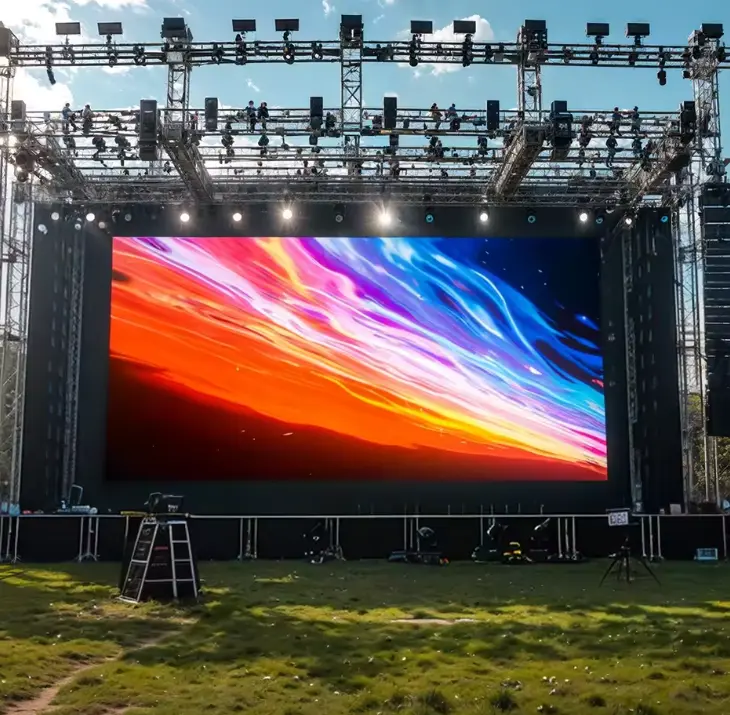
Successful event deployment starts well before the equipment reaches the venue. A clear specification, site assessment, delivery schedule, and technical test plan help the production team identify problems while there is still time to resolve them.
What Information Should You Provide When Requesting an LED Screen Quote?
A complete enquiry enables suppliers to recommend a configuration that meets the actual event requirements.
Provide the event date and location, venue type, intended screen dimensions, approximate audience size, viewing distances, indoor or outdoor conditions, content sources, and available installation space.
Also specify whether the display is needed for presentations, live camera feeds, playback, advertising, or a combination of these uses. If the event requires a particular pixel pitch, brightness level, or camera performance, include those requirements and explain why they matter.
For larger projects, attach a stage drawing, site plan, or proposed screen layout where available. These documents can help suppliers assess access, structural constraints, and installation complexity before preparing a quotation.
What Should Happen During Site Inspection and Pre-Event Planning?
The site inspection should confirm the practical conditions under which the screen will be installed and operated.
The production team should review loading access, delivery routes, floor conditions, ceiling heights, rigging points, electrical supply, cable routes, ambient lighting, and audience sightlines. Outdoor installations require additional assessment of weather exposure, ground conditions, structural stability, and the approved operating limits.
The event organizer should also confirm who is responsible for permits, temporary structure approvals, electrical compliance, and other applicable safety documentation. Requirements depend on the municipality, venue, event classification, and installation design.
The benefit is not paperwork for its own sake. It is the early identification of constraints that could otherwise cause a failed installation, an unexpected cost, or a delay to the event.
Which Tests Should Be Completed Before the Audience Arrives?
Testing should cover the assembled display and the complete signal and power chain.
Confirm that all modules operate correctly, colors are reasonably uniform, brightness settings are appropriate, and the processor maps the source content to the display correctly. Test all required inputs, playback files, live camera feeds, and any planned backup sources.
Where the event is recorded or livestreamed, inspect the image through the actual camera system. Where backup equipment is part of the agreed scope, verify that the team understands how to activate it.
Allow enough time for troubleshooting and retesting before the audience enters. A successful power-on test alone is not evidence that every input, content format, or operating scenario has been checked.
What Should Your Event-Day Contingency Plan Include?
A practical contingency plan identifies the person responsible for each technical decision and the steps to take if the display or its supporting systems fail.
Document the supplier’s emergency contact, the location of agreed spare modules, the backup playback arrangement, and the escalation procedure for processor, power, or signal faults. Establish who can authorize a temporary interruption or shutdown if environmental or structural conditions become unsafe.
For outdoor events, define how weather conditions will be monitored and who has authority to suspend operations under the agreed safety procedures.
The plan should be proportionate to the event. A small corporate presentation may require a spare signal source and a clear technical contact, while a major live production may need more extensive redundancy and onsite engineering support.
Frequently Asked Questions About LED Screen Rental for Events in South Africa
How much does it cost to rent an LED screen in South Africa?
LED screen rental prices vary according to screen size, pixel pitch, rental duration, equipment, and service inclusions. Published supplier listings provide useful starting points, but a daily rate may exclude transport, VAT, structural installation, or technical support. Request itemized quotations for the same display dimensions and specifications, then compare the total event cost rather than the headline price alone.
What is the best pixel pitch for a concert LED screen?
The best pixel pitch depends on the closest viewing distance, audience layout, content detail, and camera requirements. P3.9 or P4.8 may be suitable for some concert configurations, while a different pitch may be appropriate for close-up viewing or larger audience distances. Confirm the actual native resolution and test camera performance where necessary. There is no single pixel pitch that is optimal for every concert.
Does LED screen rental include installation and a technician?
Some LED screen rental packages include delivery, installation, cabling, video processing, and an onsite technician, while others charge separately for these services. The contract should specify who provides the support structure, connects the signal and power systems, operates the display, and handles dismantling. Confirm working hours, overtime charges, and emergency support arrangements before approving the quotation.
Can an outdoor LED screen be used indoors?
An outdoor LED screen may be usable indoors if its brightness, viewing distance, dimensions, and other specifications suit the venue. However, a high-brightness display may be uncomfortable for close viewing if it cannot be adjusted appropriately. Buyers should also consider pixel pitch, content detail, camera performance, and physical installation requirements. Confirm the manufacturer’s operating guidance and test the actual configuration where possible.
Is it cheaper to rent or buy LED screens for recurring events?
Renting may be more economical when demand is occasional or equipment requirements change significantly between events. Buying may be financially attractive when a business can maintain consistent utilization and manage storage, maintenance, transport, and staffing. Compare the total cost over the same period, including financing, repairs, spare parts, and residual value. The decision should be based on realistic billable utilization, not the purchase price alone.
Expert Verdict: Choose the Display Around the Event, Not the Price Tag
For LED screen rental for events in South Africa, start with audience distance, content requirements, venue conditions, and the complete installation scope. Then compare itemized quotations and verify the display’s specifications, structural requirements, power demand, and technical support arrangements.
For event organizers, a well-specified rental package reduces avoidable surprises. For AV integrators and rental operators handling recurring projects, direct manufacturer procurement may also deserve consideration when equipment utilization and lifecycle costs justify ownership.
The professional recommendation is straightforward: specify first, compare second, and confirm the installation and contingency plan before committing to the booking. A display is only as valuable as its performance in the environment where it must work.
Price Disclaimer
The prices in this article are published supplier examples reviewed in October 2026, not guaranteed offers or a national market average. Rental rates may change and may exclude VAT, delivery, installation, power distribution, structural support, or technical services. Confirm availability, the full itemized quotation, and all applicable charges directly with the supplier before booking.
References:
South African Government — Electrical Installation Regulations
City of Cape Town — Temporary Structures at Events