The most costly mistake stadium procurement managers make is optimizing purely for the lowest price per square meter. A $400/m² display that fails within 18 months will ultimately cost far more than an $800/m² system designed for five years or more of stable operation. The real issue is not upfront cost—it’s lifecycle value.
This guide provides a practical technical framework, cost benchmarks, and a procurement checklist to help decision-makers get it right the first time.
Based on more than 20 years of supply chain experience reviewing thousands of Bills of Materials (BOMs) for stadium projects worldwide, the true performance gap between budget and premium LED displays rarely comes down to brightness or pixel pitch. Instead, it is driven by hidden manufacturing factors behind the PCB—such as LED wire bonding quality, signal topology design, potting processes, and thermal management systems—that ultimately determine whether a display survives a single season or delivers reliable performance for a decade of continuous operation.
What Is a Stadium LED Display? (And Why It Is Not Just a Big TV)
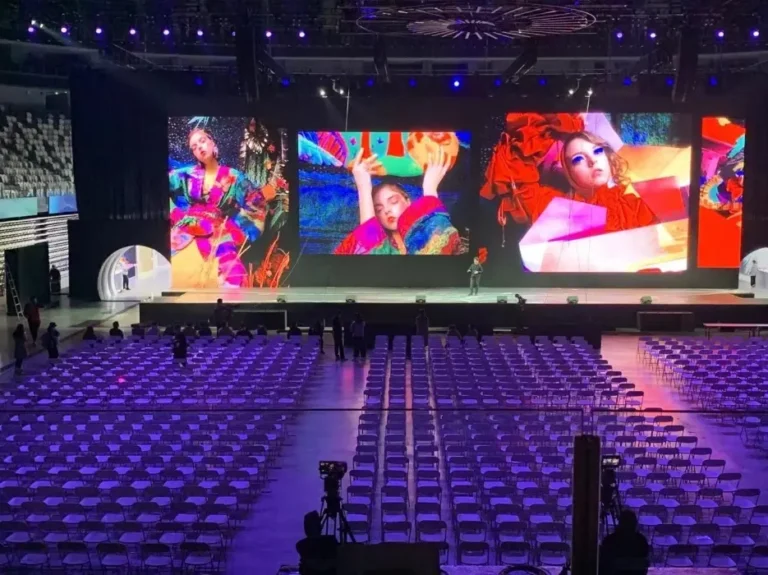
A stadium LED display is a broadcast-grade visual system engineered specifically for sports and entertainment venues. The requirements are fundamentally different from standard outdoor advertising billboards:
- Ultra-high refresh rate (≥3840Hz) to support HD and slow-motion broadcast cameras without scan line artifacts
- Soft masks and anti-collision padding to protect athletes from impact injuries
- Dual power and dual signal redundancy to guarantee uninterrupted live broadcasts
- IP65+ weatherproofing with full module potting, not just surface coating
- Structural wind load certification based on local historical wind speed data
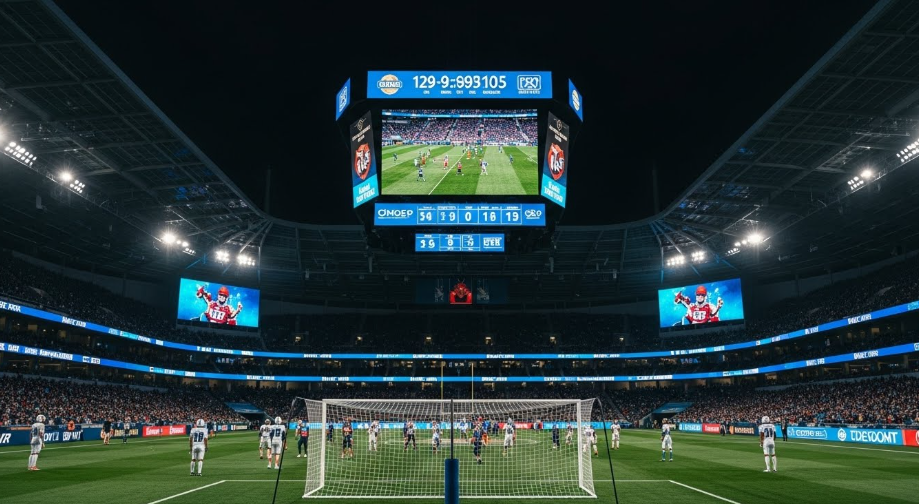
Common stadium display applications include perimeter LED boards, center-hung scoreboards, ribbon boards, and tunnel/concourse displays. Each application has distinct technical requirements that a single product specification cannot satisfy.
Stadium LED Display Types: Technical Requirements by Application
| Application | Pixel Pitch | Brightness | Key Technical Requirements | Viewing Distance |
|---|---|---|---|---|
| Perimeter Boards | P8 / P10 | >6,500 nits | IP65 dual-side, soft mask, adjustable brackets, ≥3840Hz | 10–50m |
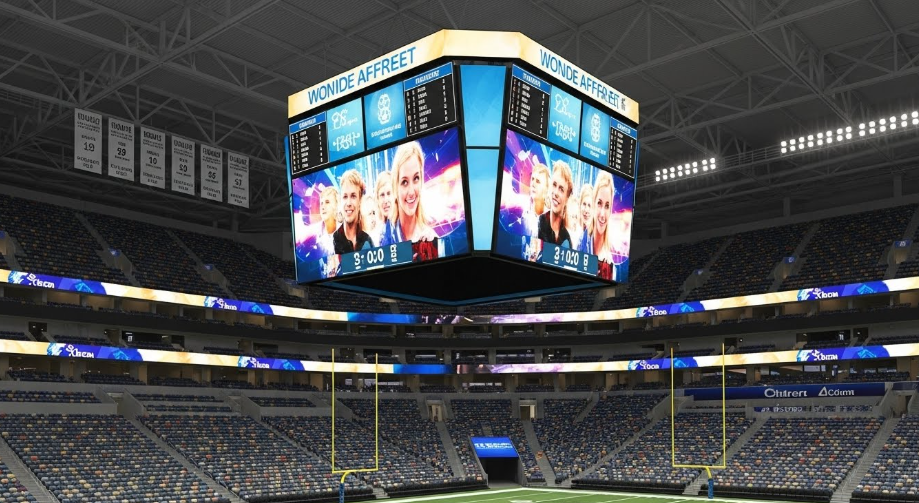
| Center-Hung Scoreboard | P2.5 / P3.91 | >1,200 nits | Lightweight die-cast cabinet, 360° curved assembly, front access | 20–80m |
| Ribbon Boards | P10 | >7,000 nits | Narrow maintenance space, full front access, common-cathode | 15–60m |
| Tunnel / Concourse | P2.5 / P4 | >800 nits | Indoor-rated, high contrast, wide viewing angle | 3–15m |
| Broadcast Backdrop | P2.5 / P3 | >1,500 nits | ≥7680Hz refresh, 4K-ready, zero moiré | 5–20m |
Engineering Deep Dive: Three Critical Application Scenarios
1. Perimeter LED Displays: The Most Physically Demanding Application
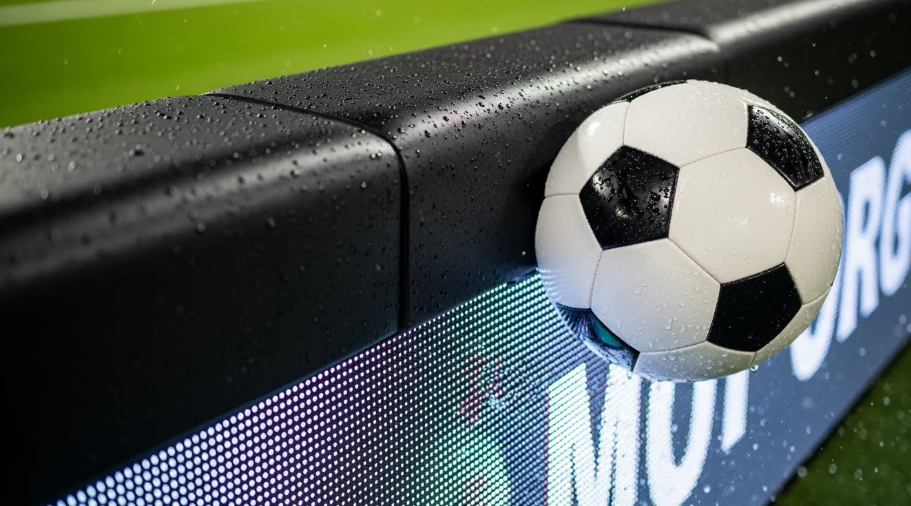
Perimeter boards face conditions no other display type encounters. Soccer balls can exceed 100 km/h on impact. Players collide with boards at full sprint. Maintenance access is often restricted to brief windows between matches.
What separates reliable perimeter boards from failures:
- Custom rubber louvers and soft top-edge impact cushions (FIFA safety standard compliance)
- 60°–90° adjustable rear support brackets for optimal camera and audience sightlines
- Dual-side IP65 potting — not just front-face coating
- Hot-swap module replacement in under 10 seconds without display shutdown
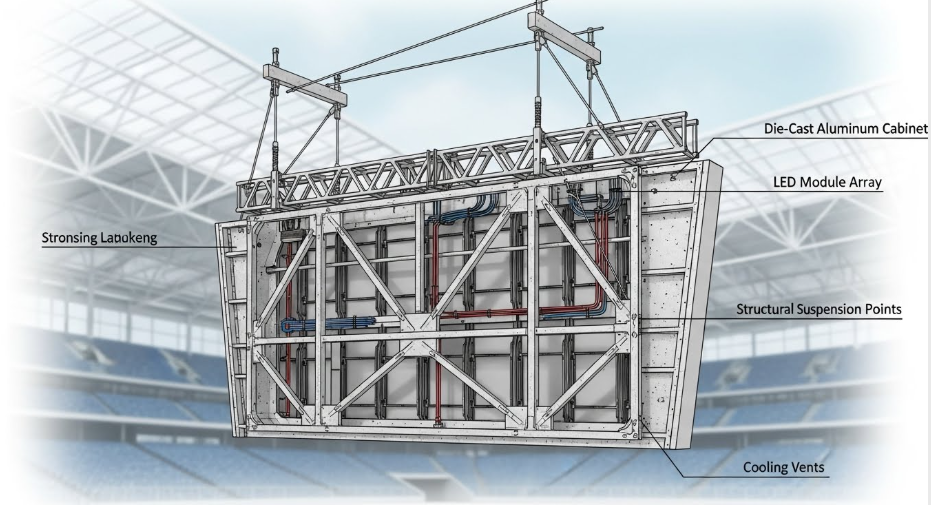
2. Center-Hung Scoreboards: Weight Is the Hidden Cost Driver
Every additional metric ton of scoreboard weight can increase roof steel structure costs by tens of thousands of dollars. This is a cost that never appears on the display spec sheet but directly impacts total project budget.
Engineering priorities for center-hung installations:
- Die-cast magnesium alloy cabinets reduce weight by over 40% compared to traditional steel
- Structural load calculations must be provided by the supplier, not estimated
- Suspension system certification to local building codes is non-negotiable
- Fine-pitch panels (P2.5–P3.91) for high-detail scoring and statistics zones
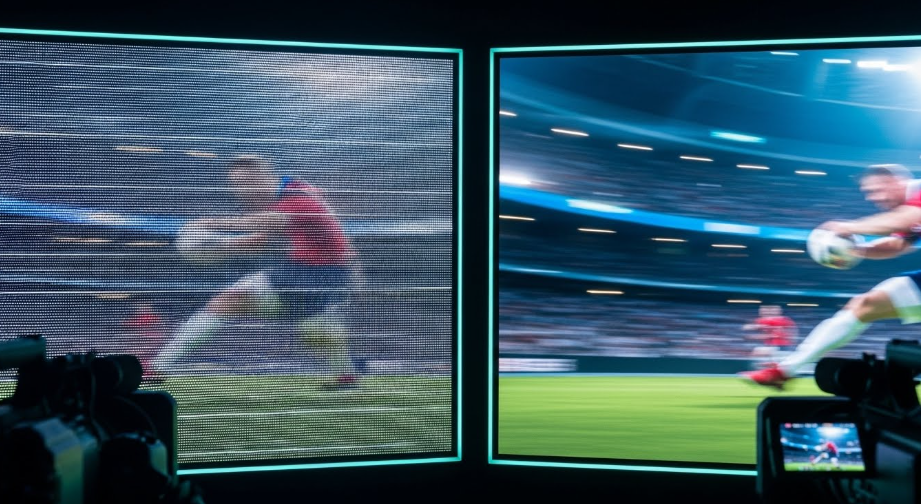
3. Broadcast Refresh Rate: The Specification Buyers Are Most Often Misled On
This is where budget displays consistently fail in real-world deployment.
- 1920Hz looks acceptable to the human eye in the stands
- At 1000fps slow-motion replay, low-refresh displays produce visible black scan lines that are broadcast-disqualifying
- Minimum 3840Hz is the industry standard for sports broadcast compatibility in 2026
- 7680Hz is required for 4K broadcast production and high-speed camera coverage
Always request a camera test with the supplier’s actual production panels — not a demo unit — before finalizing specifications.
Supply Chain Reality: The Hidden Costs Behind the Spec Sheet
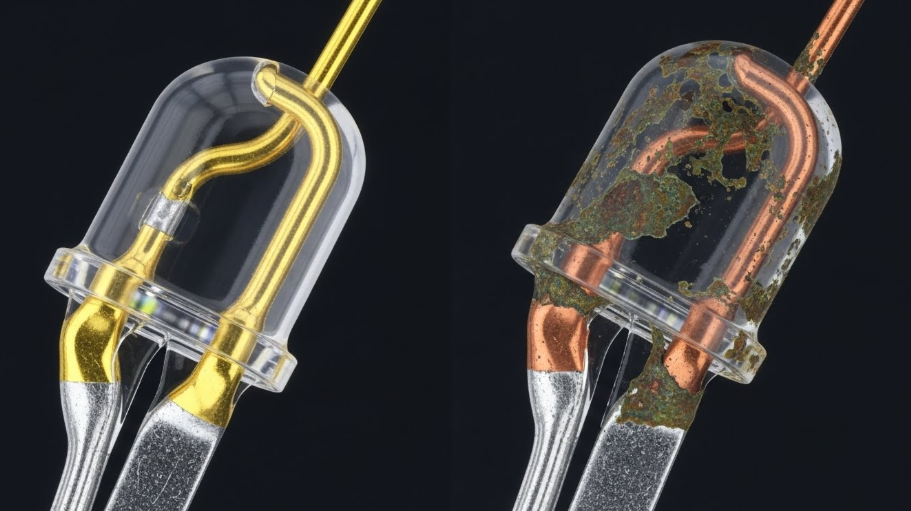
LED Wire Bonding: Gold Wire vs. Copper Wire
This is the LED industry’s most consequential unspoken shortcut.
| Factor | Gold Wire LEDs | Copper Wire LEDs |
|---|---|---|
| Material cost | Higher | Lower (~30% cheaper) |
| Oxidation resistance | Excellent | Poor in humid/coastal environments |
| Electrochemical corrosion | Minimal | High risk after 12–18 months |
| Failure mode | Gradual brightness decline | Dead pixels, “caterpillar” defects |
| Recommended for outdoor stadiums | Yes | No |
| Lifespan in coastal environments | 8–10 years | 2–3 years |
For any outdoor stadium installation within 50km of a coastline or in a high-humidity climate, copper wire LEDs are a procurement risk that will surface after the warranty expires.
Signal Topology: Loop vs. Daisy-Chain
Standard daisy-chain signal wiring means a single failed module can black out every display downstream — a catastrophic failure mode during a live broadcast.
Loop signal topology detects cable damage within 0.5 microseconds and automatically reroutes the signal in reverse. For viewers and broadcast cameras, the failure is completely invisible.
This is not a premium feature. It is a baseline requirement for any broadcast-critical stadium installation.
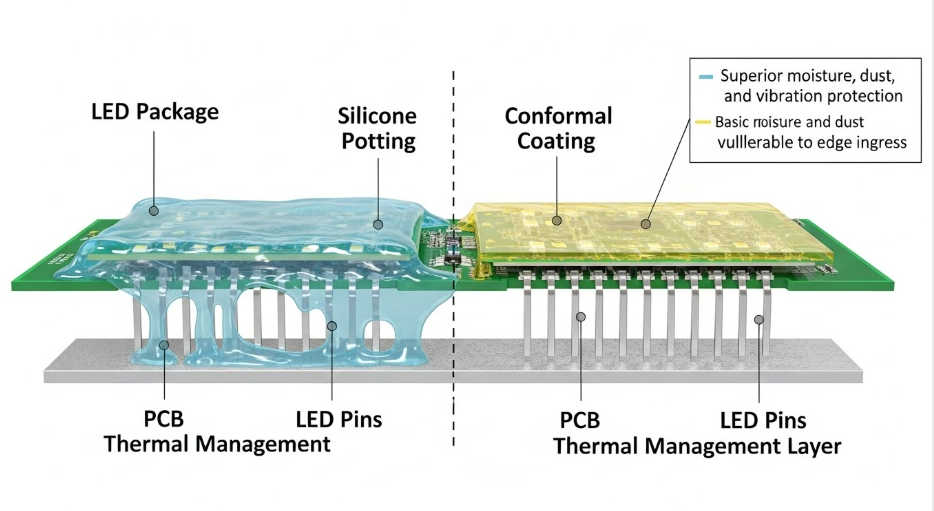
IP65 Reality: Potting Process Determines True Protection
Many displays claim IP65 certification but apply only surface conformal coating to modules. True IP65 protection requires full pin-level silicone potting of every module.
Benefits of full potting:
- Genuine waterproofing under sustained pressure
- Rapid heat transfer from driver ICs to the aluminum base
- Significantly higher Mean Time Between Failures (MTBF)
- Extended component lifespan in temperature-cycling environments
Request the potting process documentation, not just the IP rating certificate.
Cost Analysis: Total Cost of Ownership Over 5 Years
Energy Consumption: The Silent Budget Drain
A 300 m² P10 outdoor display using traditional voltage drive technology can incur up to $50,000 per year in electricity costs. Over five years, energy is often the largest single cost component — larger than the initial hardware purchase.
Common-cathode technology addresses this directly by delivering precise voltage to each LED color channel:
- Red LEDs: 2.8V (vs. standard 5V)
- Green/Blue LEDs: 3.8V (vs. standard 5V)
Results: 30–50% energy savings, surface temperature reduced by 10–15°C, and significantly extended LED lifespan through reduced thermal stress.
5-Year TCO Comparison: 300 m² Outdoor Stadium Display
Assumptions: 12 hours/day operation, average commercial electricity rate
| Cost Component | Generic Market Display | Premium Common-Cathode Display | Difference |
|---|---|---|---|
| Initial CapEx | $180,000 | $210,000 | +$30,000 |
| 5-Year Power Cost | $250,000 | $150,000 | -$100,000 |
| Cooling Infrastructure | High (AC required) | Low (natural convection) | -$15,000 |
| Maintenance & Spare Parts | $20,000 | $5,000 | -$15,000 |
| Unplanned Downtime Costs | $15,000 | $3,000 | -$12,000 |
| Total 5-Year TCO | $465,000 | $368,000 | $97,000 saved |
The premium display costs 16% more upfront and saves over $97,000 over five years. This is the calculation that procurement decisions should be based on — not initial CapEx alone.
Content Gaps: What Most Stadium LED Guides Miss in 2026
Installation and Commissioning Standards
Installation quality directly determines display lifespan. Key requirements that should be contractually specified:
- 72-hour full-white aging test before shipment
- Vibration testing to simulate transport and structural movement
- High-pressure water spray testing for IP rating verification
- On-site calibration using pixel-level uniformity correction software
- Structural calculation report based on local historical wind speed data
AI-Driven Content Management Systems (CMS) in 2026
Modern stadium LED deployments in 2026 increasingly integrate AI-powered CMS platforms that enable:
- Automated content scheduling based on match calendar and broadcast windows
- Real-time brightness adjustment using ambient light sensors and camera feedback
- Predictive maintenance alerts based on pixel failure pattern analysis
- Programmatic DOOH integration for commercial advertising revenue optimization between events
Confirm whether your supplier’s CMS supports API integration with your venue management and broadcast systems before procurement.
Sustainability and Energy Certification
ESG requirements are now standard in stadium procurement specifications across Europe, North America, and increasingly Asia-Pacific. In 2026, buyers should request:
- Energy consumption per square meter at 50% and 100% brightness
- Carbon footprint documentation for manufacturing and logistics
- RoHS and REACH compliance certificates for all components
- End-of-life recycling program documentation
Spare Parts and Long-Term Support Commitment
A display that cannot be maintained is a liability. Before signing any contract, confirm:
- Minimum spare parts availability commitment (industry standard: 10 years)
- Same-batch module availability for color-consistent replacements
- Pixel-level calibration data storage and transfer to replacement modules
- Local or regional service center presence and response time SLA
Procurement Pitfalls: 3 Practical Warnings
1. The Sample Panel Trap
The pristine 0.5 m² sample panel shown during evaluation is handpicked from the best-performing units in the factory. It is not representative of mass production quality.
What to do instead: Request a factory audit. Ask to see the aging room, the SMT production line, and the quality control rejection rate data. A reputable manufacturer will welcome this request.
2. Batch Consistency Failures
Three years after installation, you replace damaged modules — and the new panels are visibly brighter or have a different color temperature than the surrounding display. This is a batch consistency failure that is entirely preventable.
Solution: Specify 3–5% same-batch spare modules at delivery. Ensure the supplier stores pixel-level calibration data so replacement modules can inherit the original calibration profile instantly.
3. Structural Safety Is Non-Negotiable
Outdoor displays do not fail from rain. They fail from wind. A display that is not engineered for local wind load conditions is a structural safety risk, not just a performance risk.
Require: Structural calculation reports based on local historical wind speed data, vented cabinet designs to reduce wind resistance, and high-strength die-cast aluminum construction with certified load ratings.
Frequently Asked Questions
Q: What does a stadium LED display cost per square meter in 2026?
Entry-level P10 outdoor steel cabinet systems: 500–700/m². High-specification systems with die-cast cabinets, gold-wire LEDs, common-cathode energy saving, and high-refresh ICs: 900–1,500/m². The price gap reflects genuine engineering differences, not margin.
Q: What happens if the display goes black during a live broadcast?
A properly engineered system uses dual power supply hot backup and loop signal topology. If one power module fails, the second takes over instantly. If the main signal cable is damaged, the system reroutes in reverse within 0.5 microseconds. For viewers and cameras, the failure is invisible.
Q: How do I verify refresh rate claims before purchase?
Request a live camera test using a high-speed camera (minimum 500fps) pointed at the actual production panel, not a demo unit. Visible scan lines at any frame rate indicate the refresh rate specification is not being met.
Q: What pixel pitch is right for a perimeter board?
P8 or P10 is standard for perimeter applications with viewing distances of 10–50 meters. Finer pitch below P8 provides no visible quality improvement at perimeter viewing distances and increases cost and maintenance complexity unnecessarily.
Q: How long should a quality stadium LED display last?
Quality outdoor LED panels are rated for 100,000+ hours. With proper installation, climate-appropriate specifications, and structured maintenance, operational lifespans of 10–15 years are achievable. Budget displays in demanding environments typically require major component replacement within 3–5 years.
Stadium LED Display Procurement Checklist
Before finalizing any stadium LED display contract, verify the following:
- Refresh rate ≥3840Hz confirmed via camera test on production panels
- LED wire bonding type documented (gold wire for outdoor/coastal)
- Signal topology confirmed as loop (not daisy-chain)
- IP65 achieved via full module potting (not surface coating only)
- Structural wind load calculation report provided
- 72-hour aging test and factory QC process documented
- 3–5% same-batch spare modules included in delivery
- Pixel-level calibration data storage confirmed
- 10-year spare parts availability commitment in contract
- Energy consumption per m² at 50% and 100% brightness specified
- CMS API integration capability confirmed
- CE, ETL, FCC, or relevant regional certifications provided