The Short Answer (For Skimmers)
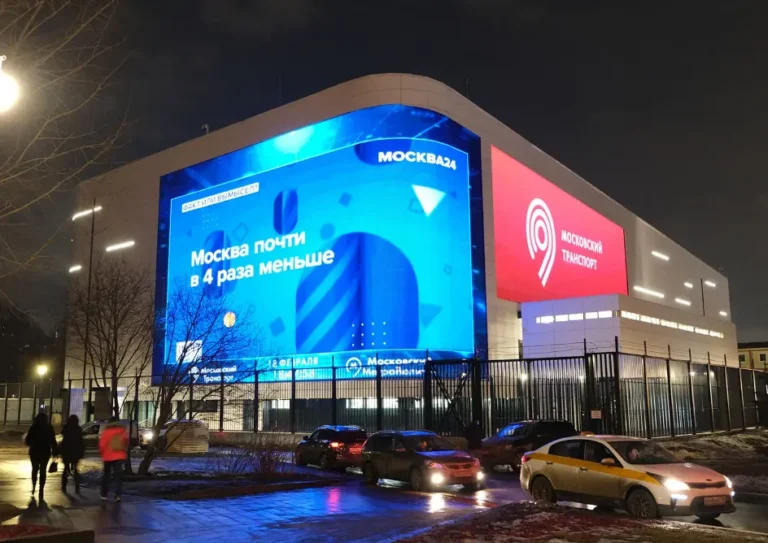
If you’re deciding whether a transparent LED shop window display is worth the investment in 2026, here’s the verdict upfront: yes, for the right context. In high-footfall retail environments — fashion, luxury, automotive, or any brand that depends on storefront visibility — a properly spec’d transparent LED display delivers measurable ROI. Retailers report 30–50% increases in foot traffic over static displays and up to 25% longer customer dwell time.
The critical variables are pixel pitch, brightness (nits), transparency rate, and total cost of ownership (TCO) — not just the purchase price. I’ve evaluated and deployed these systems across multiple commercial projects, and this guide covers what I actually learned, not just what vendors say on their spec sheets.
Does Higher Transparency Hurt Display Performance?
Short answer: Only if the screen is poorly engineered.
This is the question I get most often — and the misconception most vendors either don’t address or actively obscure. Here’s how it actually works.
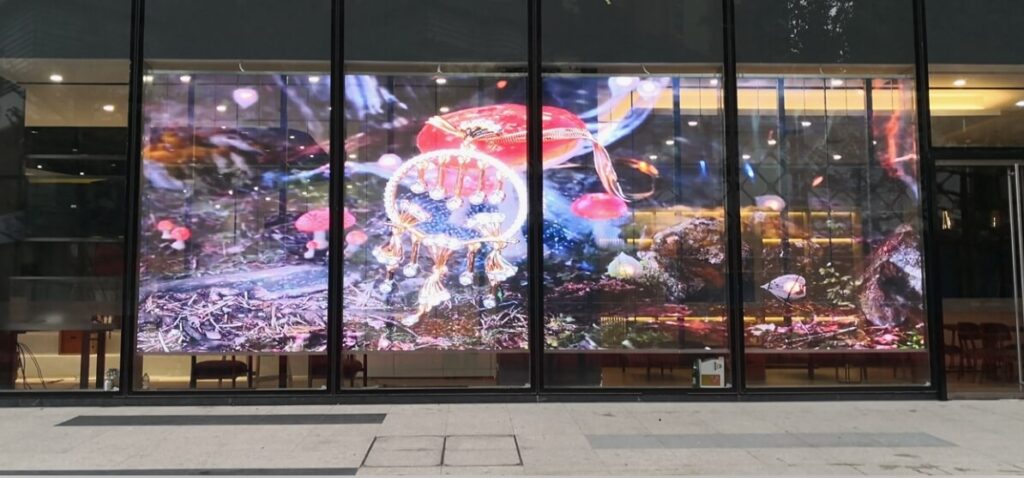
Transparency in an LED panel is created by increasing the gap between individual LED modules. More gap = more light passes through = higher transparency. The trade-off is fewer LEDs per square meter, which directly affects brightness and color density.
The Transparency vs. Performance Matrix
| Transparency Rate | Pixel Pitch Range | Brightness (Typical) | Best Use Case |
|---|---|---|---|
| 50–60% | P4–P5 | 4,000–6,000 nits | High-impact retail, events |
| 70–80% | P5–P7 | 3,500–5,000 nits | Fashion, luxury, automotive |
| 85–95% | P8–P10 | 2,500–4,000 nits | Architecture, minimalist retail |
What to look for in practice:
- Transparency of 70%+ is the baseline for premium retail — it lets customers see merchandise and interior displays through the screen, which is the entire value proposition of this format.
- Brightness below 3,500 nits in a south-facing window will look washed out during peak daylight hours.
- Panels using MIP (Micro LED in Package) technology achieve higher brightness-to-transparency ratios than older COB (Chip-on-Board) designs, with some 2025–2026 models reaching 4,000+ nits at 70% transparency.
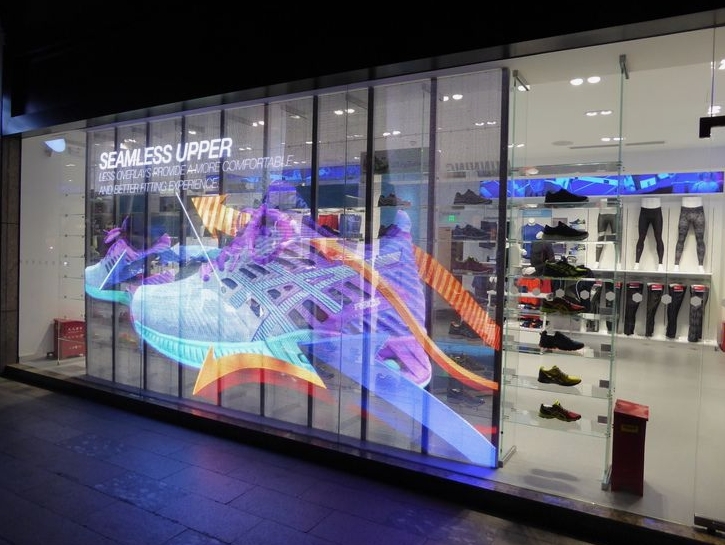
My field observation: A P5 transparent panel at 75% transparency, running 4,500 nits, remains clearly visible in direct sunlight. The content looks best with high-contrast graphics and bold motion — dense text and small fonts disappear at normal pedestrian viewing distance.
How Much Power Does a Transparent LED Window Display Actually Consume?
Short answer: 120–300W per square meter, depending on brightness settings and panel design.
Power consumption is one area where transparent LED has a genuine advantage over traditional backlighted signage — but the numbers require context.
Power Consumption by Panel Type (2026 Standards)
| Display Type | Avg. Power Draw (W/m²) | Annual Cost (/m2,at0.12/kWh, 12h/day) |
|---|---|---|
| Traditional backlit signage | 400–600 | 210–315 |
| Standard transparent LED (older) | 200–350 | 105–184 |
| Modern transparent LED (MIP/2025+) | 120–250 | 63–132 |
| Static vinyl window graphics | ~0 | $0 |
Key savings levers:
- Automatic brightness adjustment — Modern controllers sense ambient light and reduce output after sunset or during overcast conditions. In practice, this cuts average daily consumption by 25–40% compared to fixed-brightness operation.
- Content-aware dimming — Some cloud management platforms now adjust brightness per-zone based on content luminosity, reducing unnecessary power draw from dark scene segments.
- Operational scheduling — Setting the display to run only during peak footfall hours (typically 9am–9pm) rather than 24/7 further reduces annual energy spend.
Real number from a deployment I reviewed: A 4m² transparent LED installation (P5, 75% transparency) in a fashion retailer consumed approximately 820 kWh annually with smart scheduling — roughly equivalent to running a standard laptop continuously for the year.
What Is the Real Lifespan — and What Affects It?
Short answer: 50,000–100,000 hours is the rated spec; 6–10 years is realistic in commercial operation.
LED chip lifespan is rated at the point where brightness drops to 70% of original output (L70 standard). At 12 operating hours per day, 50,000 hours equals approximately 11 years — but real-world lifespan depends on factors vendors often understate.
Lifespan Impact Factors
| Factor | Impact on Lifespan | What to Check |
|---|---|---|
| Operating temperature | High heat accelerates LED degradation | Ensure adequate ventilation; avoid enclosed glass cavities |
| Average brightness level | Higher sustained brightness shortens chip life | Use adaptive dimming to reduce average output |
| LED chip grade | Tier 1 (Nichia, Cree, NATIONSTAR) vs. generic | Ask for chip brand in specs — it’s a meaningful differentiator |
| Driver IC quality | Poor drivers cause uneven aging and flicker | Brands using ICLED, Macroblock, or equivalent ICs show more stable aging curves |
| Humidity and IP rating | Moisture ingress causes premature failure | IP65 minimum for any installation near window condensation zones |
What I’ve seen in the field: Generic-chip panels installed in high-humidity environments (humid subtropical climates, uninsulated glass walls) showed significant brightness inconsistency within 3–4 years. Panels using Tier 1 LEDs with proper thermal management were still performing within spec at the 7-year mark.
What Are the True Maintenance Costs?
Short answer: Budget 300–800 per year per installation for the first five years, plus any modular panel replacements.
Transparent LED is often marketed as “low maintenance,” and by digital signage standards, that’s accurate — but it’s not zero. Here’s the honest breakdown.
Annual Maintenance Cost Breakdown
| Item | Estimated Annual Cost | Notes |
|---|---|---|
| Cleaning (glass surface + LED modules) | 100–200 | Quarterly recommended; avoid abrasive materials |
| Software/cloud CMS subscription | 150–500 | Varies by vendor; some include lifetime licenses |
| Electrical inspection | 80–150 | Annual; required by some commercial leases |
| Module replacement (pixels out) | 0–400 | Dependent on build quality; modular design = lower cost |
| Controller/driver board replacement | 0–300 | Every 3–5 years on average |
| Total (Year 1–5 average) | 330–1,550 | Per installation |
Critical buying point: Prioritize suppliers who offer modular, front-serviceable panels. If a pixel cluster fails, front-service means a technician replaces only that module from the storefront side — no need to remove the entire installation. Rear-service designs require structural access behind the glass and can mean full removal, costing 3–5× more per incident.
How Do Content Updating and Remote Control Work?
Short answer: Via cloud CMS — modern systems support real-time remote updates, scheduling, and multi-location management from any browser.
Content management has been the most improved aspect of transparent LED systems over the past two years. Here’s the current state:
Content Delivery Options in 2026
| Method | Use Case | Update Speed | Cost |
|---|---|---|---|
| Cloud CMS (web-based) | Multi-location brands, franchise operations | Real-time to 5 min | SaaS subscription |
| Local Wi-Fi (LAN) | Single-location, budget installs | 1–5 minutes | One-time setup |
| USB media upload | Backup / offline operations | Manual, on-site | Free |
| 4G/5G cellular module | Remote locations without fixed internet | Real-time | SIM + data plan |
What works best in practice:
- Cloud CMS platforms (such as those offered by Unilumin, Novastar, or third-party systems like Scala or Signagelive) allow scheduling campaigns days or weeks ahead, auto-adjusting content by time-of-day or even local weather conditions via API integration.
- For a multi-location retailer, centralized cloud control means one content designer can push updated promotions to 50 storefronts simultaneously — replacing what previously required physical USB rounds.
Practical integration tip: The most effective retail deployments I’ve reviewed sync LED content scheduling directly with their POS or e-commerce promotion calendar. When an online sale goes live at midnight, the window display triggers automatically — no manual coordination needed.
How Customizable Are Transparent LED Window Displays?
Short answer: Highly customizable — size, pixel pitch, shape, transparency level, and even curved formats are all achievable, though custom orders affect pricing and lead times.
Customization Dimensions
| Parameter | Available Range | Notes |
|---|---|---|
| Transparency | 50%–95% | Higher transparency = lower brightness ceiling |
| Pixel pitch | P2.5–P10+ | P4–P6 is the sweet spot for retail window use |
| Panel size | From 0.5m² to full storefront | Modular tiling — any size is technically achievable |
| Shape | Rectangular, L-shaped, curved, custom-cut | Non-standard shapes require custom manufacturing |
| Mounting method | Frame-mount, adhesive film, hanging | Adhesive transparent film variants available for no-drill installs |
| Indoor vs. outdoor rating | IP20 (indoor) to IP65+ (outdoor-facing) | Specify outdoor rating for any glass facing direct weather |
Standard lead times:
- Standard sizes from stock: 2–4 weeks
- Custom sizes and shapes: 6–12 weeks
- Full storefront bespoke builds: 12–20 weeks
My advice: If you have a standard rectangular window, buy from stock spec — you’ll save 20–35% over custom pricing. Custom work is worth it for flagship stores with architectural glass or unusual window configurations.
What Does a Transparent LED Window Display Cost in 2026?
Short answer: 1,500–4,500+ per square meter all-in, depending on spec and supplier. Total cost of ownership over 5 years is the correct frame — not unit price alone.
Price Range by Tier
| Tier | Hardware Cost ($/m²) | Target Buyer | Typical Pixel Pitch |
|---|---|---|---|
| Entry-level (China OEM) | 1,500–2,200 | Budget, single-location | P7.8–P10 |
| Mid-range | 2,200–3,500 | SMB retail, franchise | P5–P7 |
| Premium (Tier 1 brands) | 3,500–5,500+ | Luxury, flagship stores | P3.9–P5 |
Total Cost of Ownership (TCO) — 5-Year Model for a 4m² Installation
| Cost Category | Entry-level ($) | Mid-range ($) | Premium ($) |
|---|---|---|---|
| Hardware | 6,000–8,800 | 8,800–14,000 | 14,000–22,000 |
| Installation | 1,500–3,000 | 2,000–4,000 | 3,000–6,000 |
| CMS software (5yr) | 0–2,500 | 750–2,500 | 1,500–4,000 |
| Maintenance (5yr) | 1,650–7,750 | 1,650–7,750 | 1,650–7,750 |
| Energy (5yr, 4m²) | 1,500–3,600 | 1,250–3,000 | 900–2,500 |
| 5-Year TCO | ~10,650–25,650 | ~14,450–31,250 | ~21,050–42,250 |
The ROI reality check:
Retailers who deployed transparent LED window displays in high-footfall locations report:
- 30–50% increase in foot traffic vs. static window graphics (vendor-reported; verify with your own location metrics)
- 25% longer customer dwell time at the storefront
- Up to 35% increase in impulse purchases when AI-personalized content is used
For a retailer generating 500,000inannualstorefront−attributablerevenue,evena525,000/year — covering a mid-range 4m² installation’s 5-year TCO in roughly two years.
Are They Actually Effective at Attracting Customers?
Short answer: Yes — but content quality and placement matter as much as the hardware.
The hardware gets attention. The content gets people through the door. Both are required.
What Makes Transparent LED Displays Effective
- Motion contrast — A moving display in a row of static storefronts captures peripheral vision. Studies in retail environments consistently show 3–5× higher attention rates for dynamic vs. static displays.
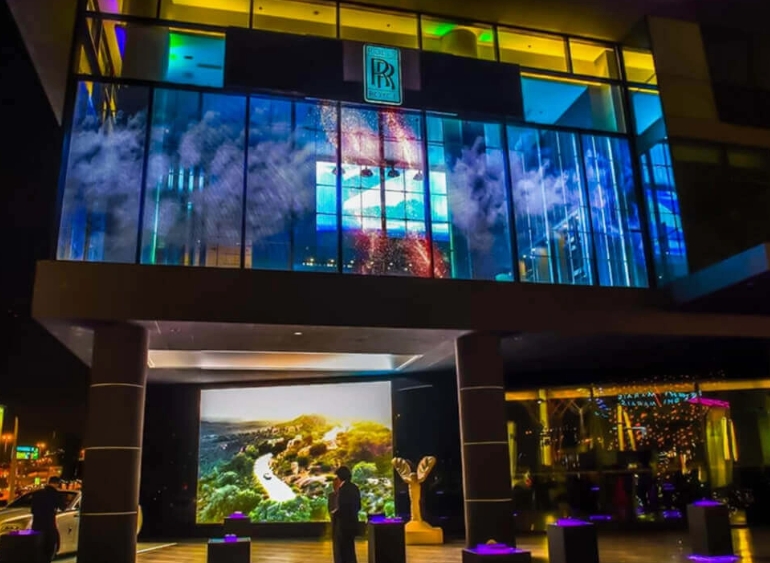
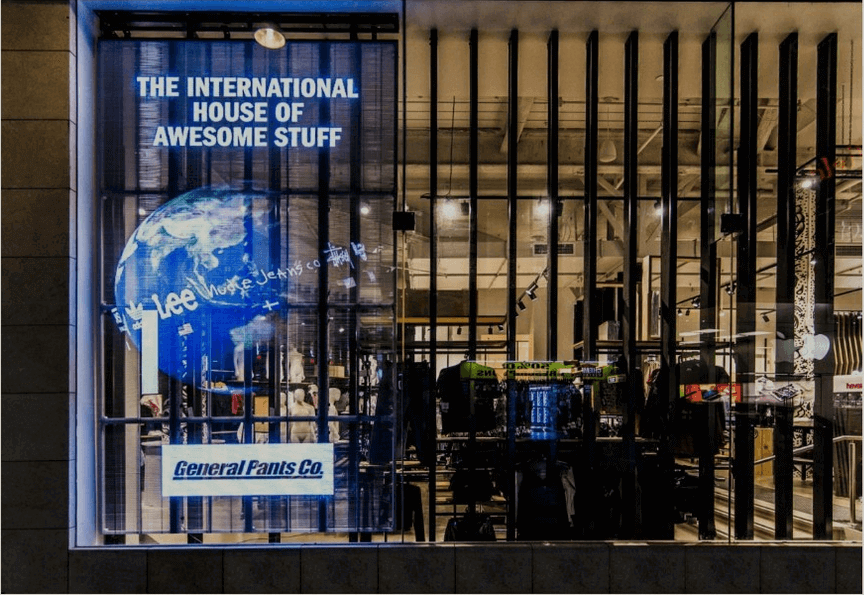
- The “floating image” effect — Modern MIP-based transparent panels create a holographic illusion where content appears to float in mid-air in front of merchandise. This effect is the single biggest differentiator for luxury and flagship applications.
- Day-part relevance — Scheduling different content for morning commuters vs. evening shoppers dramatically outperforms a single static campaign running on a loop.
Content Best Practices
| Content Type | Effectiveness | Recommended Format |
|---|---|---|
| Short brand videos (10–15s) | High | Portrait orientation, 1080×1920 |
| Product spotlights with pricing | High | Bold text, minimal elements |
| Social proof / UGC content | Medium-high | Real photos, authentic testimonials |
| Ambient brand loops | Medium | For brand reinforcement, not conversion |
| Dense promotional text | Low | Too much reading required at distance |
Common mistake I see: Retailers repurpose Instagram Stories or TV commercials directly to the window display. Content designed for a 5-inch phone screen or a living room TV does not translate to a 2m × 1m outdoor window at 3-meter viewing distance. Commission storefront-specific content from day one.
Can Transparent LED Window Displays Handle Outdoor Environments?
Short answer: Yes — if you specify the correct IP rating, brightness, and thermal management from the outset.
“Outdoor” covers a wide range of conditions. Here’s the breakdown:
Environmental Suitability Matrix
| Environment | Required Spec | Notes |
|---|---|---|
| Indoor window facing outward | IP20–IP40, 3,500+ nits | Most common retail use case |
| Covered outdoor (arcade, canopy) | IP54, 4,000+ nits | Some weather exposure but not full elements |
| Full outdoor exposed | IP65+, 5,000+ nits | Rain, dust, temperature extremes |
| Coastal / high humidity | IP65+, corrosion-resistant PCB | Salt air accelerates component degradation |
| Extreme temperature range | IP65+, extended temp rating (-30°C to +60°C) | Required in northern/alpine climates |
Key Outdoor Spec Checklist
- IP65 or higher — Protects against dust ingress and low-pressure water jets (rain, cleaning)
- Operating temperature range — Verify the panel’s rated range matches your climate; cheap panels rated to 0°C will fail in cold climates
- Brightness auto-adjustment — Essential for outdoor; manually fixed brightness either wastes power at night or becomes invisible during peak sun
- Anti-glare coating — Some glass-facing panels require anti-reflective treatment to reduce hotspot glare at certain sun angles
- Ventilation clearance — Enclosed glass cavities trap heat; ensure 10–15cm minimum airflow gap behind the panel
How to Integrate Transparent LED Into Your Marketing Strategy?
Short answer: Treat the window display as a dynamic digital channel — integrate it into your campaign calendar, CMS workflow, and if possible, your real-time data stack.
This is where most retailers underinvest. The hardware is the easy part. The strategy is where ROI is actually won or lost.
Integration Framework
Level 1 — Basic (most retailers today)
- Weekly or monthly content updates tied to promotions
- Same campaign as in-store signage and social media
- Manual scheduling via CMS
Level 2 — Connected (best practice in 2026)
- Content calendar synced with e-commerce promotions and inventory
- Time-of-day scheduling (different content for morning/midday/evening)
- QR codes on-screen linking to product pages or campaign landing pages
Level 3 — Intelligent (early adopters)
- Real-time content adaptation using footfall sensors and weather API
- A/B content testing with conversion tracking (door sensor + POS correlation)
- AI-generated content variants for seasonal campaigns
- Audience demographic sensing to serve relevant content segments
Platform Integration Options
| Platform Type | Integration Method | Benefit |
|---|---|---|
| E-commerce (Shopify, WooCommerce) | API → CMS trigger | Auto-update display when sale goes live |
| Social media | Content repurposing pipeline | Storefront becomes an extension of digital brand |
| Google Analytics / GA4 | Foot traffic correlation | Measure display ROI via in-store visit lift |
| CRM / loyalty program | Personalized campaign triggers | Show offers relevant to local customer base |
Frequently Asked Questions
Can transparent LED displays run 24/7?
Yes, they are rated for continuous operation. However, running them during off-hours (3am–6am in most retail locations) adds operational cost with near-zero return. Use scheduling to run during business hours plus evening peak traffic windows only.
What pixel pitch should I choose for a shop window?
P4.8–P6 covers most retail window applications well. Choose P3.9 or lower only if viewing distance is under 2 meters and content detail (fine text, intricate graphics) is critical. At normal pedestrian viewing distances of 3–5 meters, P6 is indistinguishable from P3.9 in practice.
Do I need structural modifications to install one?
Most modern transparent LED systems mount directly onto existing glass using frames or brackets — no structural modification required. Confirm your glass spec (thickness, load rating) with the supplier before ordering, particularly for large installations.
Which brands are most reliable in 2026?
For Tier 1 reliability, Unilumin, Absen, Leyard, and LG Business Solutions are the established names with documented after-sales support networks. For cost-competitive mid-tier options, GLDLED, Unilumin’s OEM partners, and several Shenzhen-based manufacturers (with verifiable warranty terms) are viable. Always request a physical sample panel before committing to a large order.
What warranty should I expect?
Industry standard is 2–3 years for hardware, 1 year for LED modules from budget suppliers. Premium brands offer 3–5 years with on-site service SLAs. Negotiate for at least 3 years on any installation above $10,000 total value.
Can I use these displays for interior installations only?
Absolutely — glass partitions, showroom walls, meeting room dividers, and retail interior feature walls are all valid use cases. Interior installs require lower IP ratings (IP20–IP40), lower brightness (1,500–3,000 nits), and benefit from tighter pixel pitches since viewing distances are typically shorter.
Quick Reference: Key Specifications at a Glance
| Specification | Typical Range | Recommended Minimum |
|---|---|---|
| Transparency rate | 50–95% | 70% (retail window) |
| Pixel pitch | P2.5–P10 | P5 (standard retail) |
| Brightness (indoor facing out) | 2,500–6,000 nits | 3,500 nits |
| Brightness (full outdoor) | 4,000–8,000 nits | 5,000 nits |
| Lifespan (L70 rating) | 50,000–100,000 hrs | 50,000 hrs |
| IP rating (outdoor) | IP54–IP67 | IP65 |
| Operating temperature | -10°C to +50°C | Verify for your climate |
| Power consumption | 120–300 W/m² | N/A — lower is better |
| Warranty | 1–5 years | 3 years minimum |
Final Verdict
Transparent LED window displays in 2026 are no longer a novelty — they are a mature, measurable retail technology. The market is projected to reach $8.1 billion in 2026 (TrendForce), driven by Mini/Micro LED adoption, cloud-based management maturity, and proven foot traffic ROI.
The investment is justified when:
- Your location has high pedestrian footfall
- Your brand relies on visual differentiation at the storefront
- You have the operational capacity to keep content fresh (stale content wastes the hardware investment)
- You can commit to a 3–5 year ROI window
The investment is not justified when:
- You’re in a low-footfall location (parking lot facing, industrial zone)
- Your budget constrains content production to a one-time design
- You need a solution operational in under 4 weeks (lead times for quality units don’t support this)