A procurement manager we spoke with last quarter put it bluntly: “Every folding LED poster we’d tried before this one either shipped with a wobble in the frame or died at the hinge within a year.” That complaint is more common than most suppliers admit.
A foldable LED advertising screen is a modular LED display built into a hinged cabinet frame, collapsing to roughly one-third of its deployed volume for shipping and expanding into a seamless video wall in under 15 minutes on site.
For a standard 640×1920mm unit, that means a P1.5–P2.5 panel delivering 600–1,000 nits indoors at a fraction of the freight and labor cost of a rigid LED cabinet.
| Buyer Priority | Foldable LED Screen | Traditional Rigid LED Cabinet |
|---|---|---|
| Setup Time | 10–15 min, 1–2 technicians | 2–6 hours, rigging crew required |
| Shipping Volume | Folds to a compact flat profile | Full cabinet depth, stacked crates |
| Best Use Case | Rental, retail rotation, events | Permanent installation |
If that’s the answer you came here for, you already know foldable LED technology solves a logistics problem.
What most sourcing managers don’t discover until it’s too late is which technical specs actually determine whether that screen survives repeated fold cycles without dead pixels, seam misalignment, or a warped hinge after six months of touring.
Based on our experience manufacturing and deploying folding LED posters for retail chains, airport concessionaires, and rental fleets across Europe and the Middle East, the failure point is almost never the LED chip itself—it’s the folding mechanism and the module bonding technology behind it.
This guide walks through the engineering decisions, not just the marketing pitch, so you can spec a foldable LED advertising screen that actually survives your deployment cycle.
Inside the Cabinet: What’s Actually Holding This Screen Together
Before comparing brightness numbers, it helps to open the case and look at what you’re really buying.
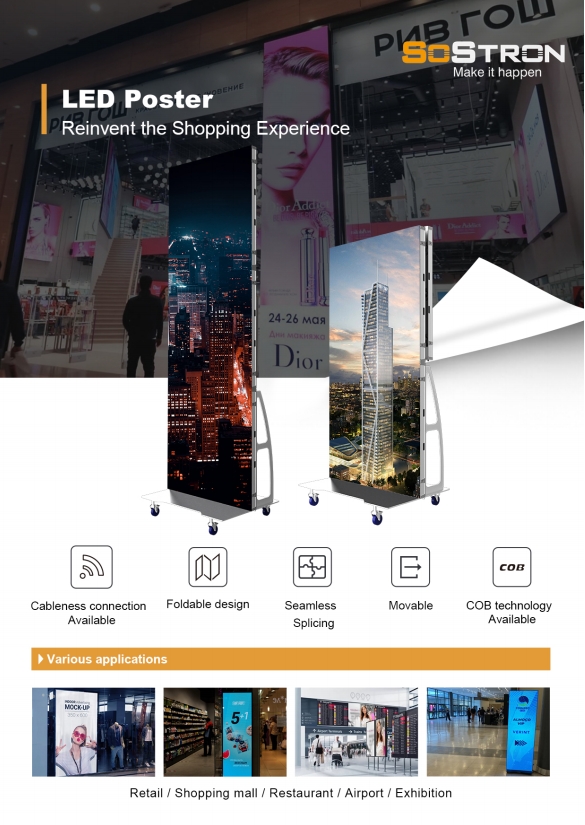
A well-engineered foldable unit isn’t a flat panel with a hinge bolted on—it’s a die-cast aluminum frame designed from the outset to absorb repeated mechanical stress.
The base typically sits on locking casters for single-person mobility, while an internal cross-brace structure (visible as the diagonal steel bracing inside the lower cabinet) keeps the frame rigid once unfolded, preventing the slow frame creep that eventually throws off panel alignment on cheaper units.
Cable routing is built into the frame rather than left exposed, which matters more than it sounds: exposed cabling is the single most common cause of on-site downtime during rapid setup and teardown.
According to AVIXA (the audiovisual industry’s global trade association), equipment reliability during rapid deployment cycles remains one of the top three purchasing criteria for rental and staging companies—ahead of raw image quality in many cases.
Why Work With a Manufacturer Instead of a Reseller?
Why work with a manufacturer instead of a reseller?
Because the engineering decisions above aren’t visible in a product photo, and they’re exactly the details a trading company can’t explain when you ask.
We design and cast our own cabinet frames rather than sourcing generic housings, which means when a client asks us why the hinge is rated for a specific number of cycles, we can answer with test data—not a guess.
That distinction has mattered most on projects where the screen wasn’t going to sit still: retail rotation programs, touring exhibitions, and rental inventory that gets loaded and unloaded every week for a full season.
How Does a Foldable LED Screen Actually Save You Time and Money? (ROI & TCO Breakdown)
Ask any operations manager running a multi-city retail campaign what keeps them up at night, and freight and labor come up before content quality almost every time.
That’s not a coincidence—it’s where the real budget leakage happens.
Here’s where the feature-to-benefit math actually matters to a procurement team.
A folded panel isn’t just “more convenient”—it changes three cost lines directly.
Freight Cost
A rigid LED cabinet ships in its full assembled depth, which means a shipping container holds fewer units and freight is billed largely on volume, not weight.
A foldable cabinet compresses dramatically, so the same container can carry two to three times the number of units.
For a company running 20+ events a year, that difference alone often recovers the price premium of the folding hardware within the first 12 months.
Labor Cost
Rigging a traditional LED wall typically requires a trained crew, a truss or bracket structure, and several hours of cable management and alignment before content can run.
A foldable screen is pre-wired and pre-calibrated at the factory—unfold, lock the frame, power on.
Based on our experience with clients running back-to-back trade show circuits, this cuts a two-person, half-day install down to a 15-minute single-technician task.
Downtime and Damage Risk
Every additional hour of manual assembly is an hour of exposure to cabling errors, misalignment, and physical damage during handling.
Fewer touchpoints during setup translates directly into fewer service calls.
| Cost Factor (3-Year Estimate, 20 events/year) | Foldable LED Screen | Rigid LED Wall (Rental) | LCD Digital Signage |
|---|---|---|---|
| Freight per deployment | Low (compact volume) | High (crated cabinets) | Medium |
| Labor per setup | 1 tech, ~15 min | 2–3 techs, 2–6 hrs | 1 tech, ~20 min |
| Brightness ceiling | Up to 1,000+ nits (indoor), higher outdoor-rated | Up to 5,000 nits | ~700–1,200 nits max |
| Seamless scalability | Yes, modular linking | Yes | No, bezel gaps |
| Typical lifespan | 100,000 hrs LED | 100,000 hrs LED | 30,000–50,000 hrs backlight |
LCD signage still wins on raw unit price for a single, permanently mounted screen.
But it loses badly on brightness ceiling, on seamless multi-unit scaling, and on outdoor viability—three things a DOOH or event-driven business can’t compromise on.
Reading a Pixel Pitch Spec Sheet Without Getting Oversold
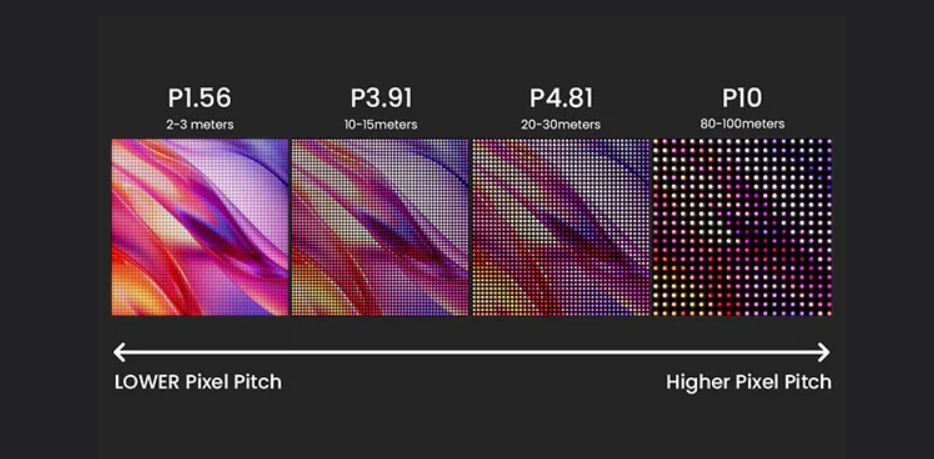
Pixel pitch—the distance in millimeters between LED clusters—is the single spec buyers get wrong most often, usually by over-specifying.
A finer pitch (smaller number) costs more per square meter and doesn’t add visible value if your audience never gets close to the screen.
We’ve had clients arrive requesting P1.25 for a lobby poster viewed from four meters away, when a P1.8 panel would have delivered an identical visual result at a noticeably lower price point.
The engineering rule of thumb we use when advising clients: multiply the pixel pitch number by roughly 2.5–3 to get the minimum comfortable viewing distance in meters.
A P2.5 panel needs about 6–7.5 meters of distance before the image looks fully smooth up close; inside that range, the individual LEDs become visible and the investment in a finer pitch was wasted.
| Pixel Pitch | Minimum Viewing Distance | Best-Fit Application |
|---|---|---|
| P1.5–P1.8 | 3–5 m | Retail counters, close-up showroom displays |
| P1.8–P2.5 | 5–7.5 m | Trade show booths, conference stages |
| P2.5–P3 | 7.5–9 m | Mid-size events, exhibition halls |
| P3–P4 | 9–12+m | Large venues, outdoor advertising |
A well-calibrated indoor foldable poster typically runs 600–1,000 nits, which reads comfortably under standard mall or airport lighting without overwhelming a room or draining unnecessary power.
Outdoor units need substantially higher output with proper waterproof protection to remain legible against direct sunlight—a spec that also demands better thermal management in the cabinet design, since folding mechanisms have less surface area for heat dissipation than a fixed wall.
One spec buyers frequently overlook until it costs them a shoot day: refresh rate.
If your foldable LED advertising screen will ever appear on camera—a product launch livestream, a broadcast backdrop, a virtual production set—a low refresh rate will visibly flicker or band on video.
Our current sPoster line runs at 7680Hz,a rate high enough that even slow-motion camera capture shows no visible banding, which has made it a repeat choice for clients doing in-store video content shoots rather than static display only.
Is a Foldable Screen Durable Enough for Repeated Commercial Use? (The Question Most Spec Sheets Won’t Answer)
This is the question most product pages sidestep, and it’s the one that actually determines your total cost of ownership.
A folded LED panel isn’t judged by its resolution alone—it’s judged by how many open-close cycles the hinge assembly survives before alignment drifts or a connector fatigues.
Ask any supplier for their rated fold-cycle count.
A screen built for occasional retail use might be tested to a few hundred cycles; a screen built for a touring rental fleet needs to survive several thousand without measurable pixel dropout or seam misalignment.
Based on our experience running touring inventory through weekly load-in/load-out cycles, this single spec—rarely listed on a spec sheet—predicts field failure far better than pixel pitch or brightness ever will.
The Bonding Technology Behind the LED Modules Matters Just as Much
| Technology | Impact Resistance | Dust/Moisture Protection | Best For |
|---|---|---|---|
| SMD (standard) | Moderate | Basic, exposed chip edges | Fixed indoor installs, lower handling frequency |
| GOB (Glue on Board) | High—epoxy layer absorbs shock | Strong, near-seamless surface | Foldable, rental, and touring screens |
| COB (Chip on Board) | Highest—chips embedded flush | Excellent, best for close-range viewing | Command centers, premium foldable units |
For a screen that gets folded, crated, trucked, and unfolded dozens of times a year, GOB or COB bonding isn’t a premium upsell—it’s the difference between a three-year asset and a one-season write-off.
SMD modules expose the chip edges directly to the mechanical stress of folding, which is exactly where dead pixels tend to originate after repeated handling.
Our sPoster series offers both SMD and COB module options on the same P1.5 and P1.8 cabinets specifically so clients with heavier rotation schedules can step up to COB without switching product lines.
Environmental protection rounds out the reliability picture.
Indoor foldable units are commonly rated IP43—enough to resist dust ingress and light splashing in a mall or airport environment—while any unit destined for uncovered outdoor staging needs a considerably higher rating.
A screen without a clearly stated IP rating should be assumed indoor-only, regardless of what the marketing copy implies.
Foldable, Rollable, or Fixed: Matching the Format to the Deployment, Not the Trend
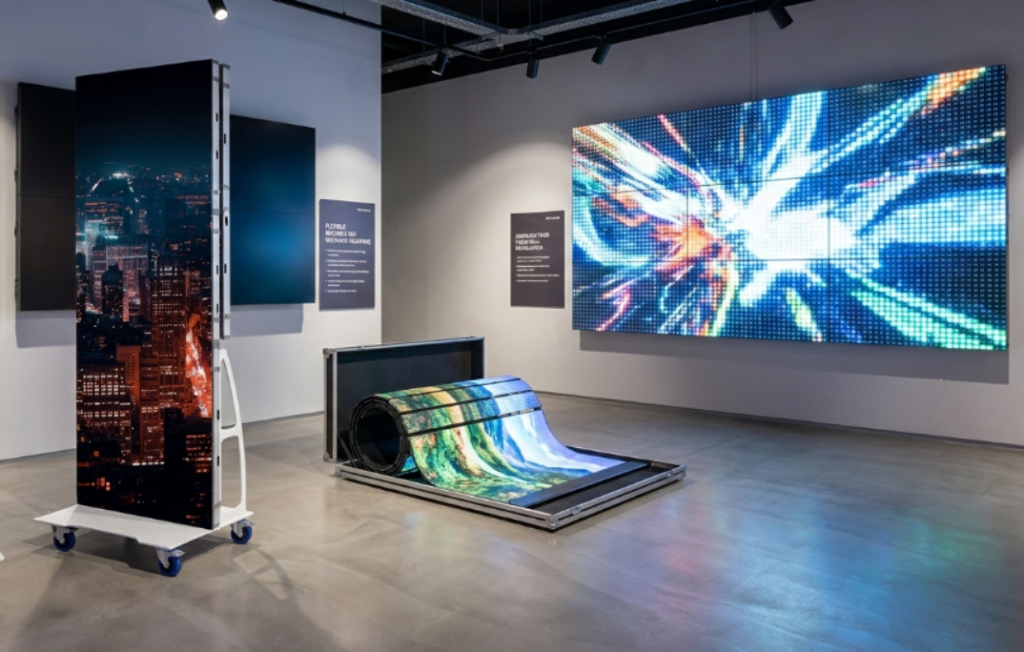
Buyers frequently conflate foldable, rollable, and fixed LED formats, and the wrong choice here is expensive to reverse.
A rollable screen trades folding hinges for a flexible mesh substrate that coils into a case—lighter, but generally limited to finer pixel pitches and lower brightness ceilings, making it better suited to indoor backdrop use than outdoor advertising.
A fixed LED wall still wins on raw structural rigidity for a permanent installation where the screen never moves once mounted.
LCD digital signage remains the lowest upfront cost for a single static screen, but it cannot scale seamlessly across multiple units and tops out well below LED brightness for daylight-facing placements.
The deciding factor isn’t which format is “better”—it’s deployment frequency.
A screen that moves more than a handful of times a year justifies the foldable premium through freight and labor savings alone; a screen that’s installed once and never touched again doesn’t need that engineering at all.
Where the Format Earns Its Keep: Retail, Transit, and Beyond
The application range explains why this category has grown fastest across specific verticals rather than uniformly:
Retail and Pop-Up Campaigns
Window displays and seasonal promotions that need to change layout without a construction crew.
Shopping Mall and Department Store Advertising
Cosmetics and fashion brands running short-cycle visual campaigns in high-footfall corridors.
Trade Show and Exhibition Rental
Booth backdrops that must ship efficiently and set up within a venue’s tight load-in window.
Airports and Transit Hubs
Wayfinding and advertising units that need to be repositioned as terminal layouts and gate configurations change.
Corporate Events and Broadcast / Virtual Production
Where a high refresh rate foldable screen doubles as both a stage visual and a camera-facing backdrop.
A recent deployment worth mentioning:
One European fashion retailer approached us ahead of a multi-city seasonal campaign, needing double-sided visuals for storefront windows that could be swapped between locations without hiring local installation crews at each stop.
We specified P1.8 sPoster units with COB bonding for the added durability across a dozen relocations, paired with cableless module connections so store staff—not AV technicians—could complete setup themselves.
The campaign ran across five cities on the same physical units without a single panel replacement, which is exactly the kind of quiet, unremarkable reliability that a folding hinge is supposed to deliver.
What International Certifications Should You Verify Before Buying?
For any B2B import into North America or the EU, CE, FCC, and RoHS documentation isn’t optional paperwork—it’s what clears customs and passes a corporate procurement compliance review without delay.
Beyond certification, ask your supplier directly about their aging test protocol before shipment:
A legitimate manufacturer burns in every module specifically to catch dead pixels, brightness inconsistency, and early component failure before it becomes your problem on-site.
Suppliers who can’t describe this process in specific terms—test duration, failure criteria, sample rate—are usually reselling someone else’s production run without direct quality oversight.
Vetting a Supplier: The Questions That Separate a Factory from a Middleman
Before issuing a purchase order, verify:
| Verification Item | What Buyers Should Confirm |
|---|---|
| Fold-cycle count | Rated fold-cycle count in writing, not just “durable” in marketing copy |
| Bonding technology | GOB or COB bonding specification, not assumed |
| Protection rating | IP rating with a test standard cited |
| Warranty | Warranty length and what it explicitly excludes |
| Technical support | Spare parts and remote technical support available in your region |
A manufacturer who answers these without hesitation is sourcing engineering data, not sales copy.
Frequently Asked Questions
Can a Foldable LED Advertising Screen Be Used Outdoors?
Only if it carries an outdoor-rated IP protection level and sufficient brightness for direct sunlight.
Standard indoor units, typically IP43, should stay under cover or semi-outdoor at most.
How Many Fold/Unfold Cycles Can the Hinge System Withstand?
This varies significantly by build quality—ask for the manufacturer’s rated cycle count in writing rather than accepting a general durability claim.
What’s the Real Difference Between a Foldable and a Rollable LED Screen?
Foldable screens use rigid hinged panels and generally support finer pixel pitches and higher brightness; rollable screens use a flexible substrate that’s lighter but typically limited to indoor, lower-brightness applications.
Do Foldable LED Screens Need a High Refresh Rate Like 7680Hz?
Only if the screen will appear on camera.
For static advertising or in-person viewing, a lower refresh rate is sufficient and costs less; for livestreamed or broadcast content, higher refresh rates prevent visible flicker.
How Long Does a Foldable LED Screen Typically Last?
The LED chips themselves are commonly rated for 100,000 hours, but real-world lifespan is limited by hinge fatigue and module bonding quality far more often than by LED degradation.
Why Global Buyers Keep Coming Back to Sostron
We’re not the newest name in this industry, and we don’t try to sound like it.
Sostron designs, casts, and assembles our foldable LED posters—including the sPoster series referenced throughout this guide—at our own production facility in Shenzhen, which means the engineering answers in this article aren’t borrowed from a datasheet; they’re pulled from our own test logs and field reports.
When a client asks about fold-cycle ratings, aging test results, or which bonding technology fits a touring schedule, that conversation happens with our engineers directly, not through a reseller relaying secondhand specs.
For B2B buyers weighing freight cost, hinge reliability, and compliance documentation against a shipping deadline, that direct line to the factory floor tends to matter more than any single spec on the sheet.
If you’re comparing formats before committing to a foldable unit, our outdoor LED display guide walks through brightness and IP-rating requirements for screens that never come indoors.
And if your project needs full venue planning rather than a single poster unit, our LED display solutions overview covers how our engineering team scopes projects from initial site assessment through installation support.
Price Note: Foldable LED Advertising Screen Cost Considerations
The price of a foldable LED advertising screen depends on multiple factors, including pixel pitch, screen size, LED module technology, brightness level, protection rating, cabinet design, control system configuration, and order quantity.
A finer pixel pitch such as P1.5 or P1.8, COB/GOB bonding technology, higher refresh rates, and enhanced durability testing requirements may increase the initial investment, but these features can significantly reduce maintenance costs and downtime for frequent-use commercial applications.
For accurate pricing, buyers should provide project details such as application environment, required screen dimensions, viewing distance, indoor or outdoor installation conditions, expected usage frequency, and technical requirements.
Because foldable LED screens are customized products rather than standard consumer displays, the final quotation may vary between projects. We recommend comparing not only the initial purchase price but also shipping efficiency, installation labor savings, service life, and total cost of ownership when evaluating suppliers.
References:
AVIXA – Audiovisual Technology Standards and Best Practices
IES – The Lighting Society: Recommended Practices for LED Lighting and Display Applications