Quick Decision Reference: Core Selection Matrix for Swimming Pool LED Displays
Before you read any details, start with this table. It tells you within 60 seconds what level of screen your project needs.
| Application Scenario | Recommended Pixel Pitch | Minimum IP Rating | Brightness Requirement | Typical Buyers |
|---|---|---|---|---|
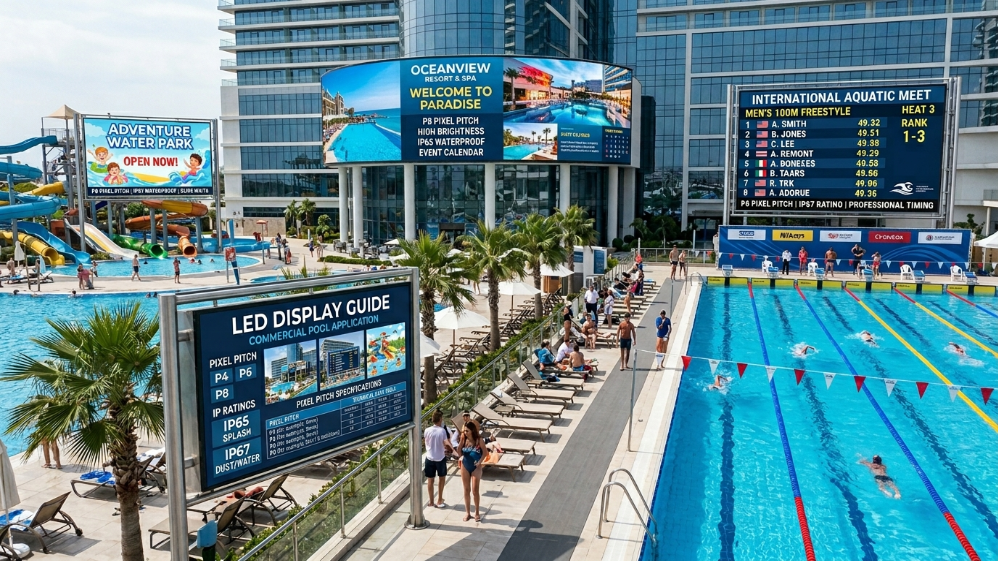
| Resort / hotel pool advertising screen | P4–P6 | IP65 | ≥7,000 nits | System integrators, hotel groups |
| Outdoor water park entertainment large screen | P6–P10 | IP65 | ≥8,000 nits | Event planners, operators |
| International competition pool scoreboard | P3–P4 | IP67 | ≥6,000 nits | Sports venues, event organizers |
| Coastal / seawater pool outdoor advertising | P5–P8 | IP67+ anti-salt-spray coating | ≥8,000 nits | DOOH advertisers |
| Underwater immersive experience screen | P2.5–P4 | IP68 (full immersion) | Custom evaluation | Luxury spas, theme parks |
This table is the conclusion, not the opening statement. The following content is the engineering logic behind these conclusions.
Why a Standard Outdoor LED Screen Won’t Survive a Single Rainy Season by the Pool
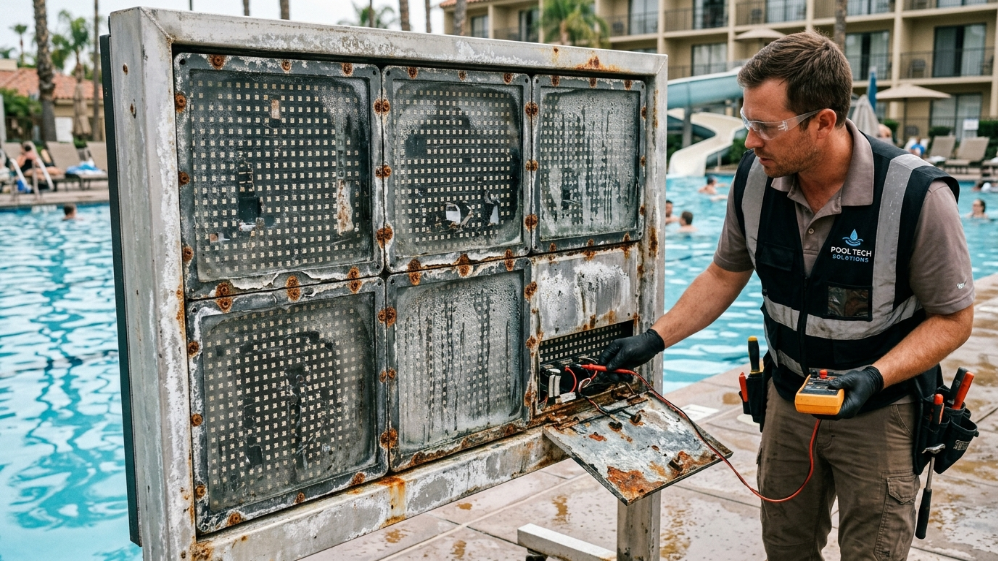
Over the past decade, we have participated in or evaluated more than 200 water-related LED installation projects. The conclusion is straightforward: using standard outdoor LED screens in swimming pool environments is one of the fastest ways to waste procurement budgets.
Swimming pool environments contain four overlapping destructive forces that standard outdoor LED designs do not account for:
① Chloride Corrosion
Chlorine used for pool disinfection reacts electrochemically with copper PCB traces and aluminum cabinets, accelerating oxidation. This is not a “humidity” issue—it is active corrosion. Standard outdoor screen enclosures typically use surface coating treatments, and in chlorine environments, coatings begin to bubble and peel within 18 months.
② High-Humidity Condensation
Indoor pool facilities maintain relative humidity levels of 85%–93% year-round. Internal condensation caused by temperature differences accumulates at the base of LED beads. SMD packaging solder joints are the weak point—once water ingress occurs, it leads to dead pixels at best and short circuits at worst.
③ UV Radiation Degradation
UV exposure in outdoor pool environments, combined with water surface reflection, is significantly stronger than typical outdoor conditions. Low-quality plastic covers may yellow and become brittle within 12–18 months, directly affecting brightness and color uniformity.
④ Vibration and Mechanical Shock
Anti-slip flooring treatments, large equipment operation, and water flow impact transmit continuous low-frequency vibration through the mounting structure to the display. Loose module connectors are the most common field maintenance failure.
The correct solution is GOB packaging technology (Glue-On-Board). Unlike traditional SMD packaging, GOB encapsulates LED beads in transparent epoxy resin, forming a seamless protective layer across the entire emitting surface. This not only improves waterproof performance but also achieves IK07 or higher impact resistance certification—this is the minimum acceptable standard for pool environments.
Four Types of Swimming Pool LED Displays: Precisely Matching Your Project Needs
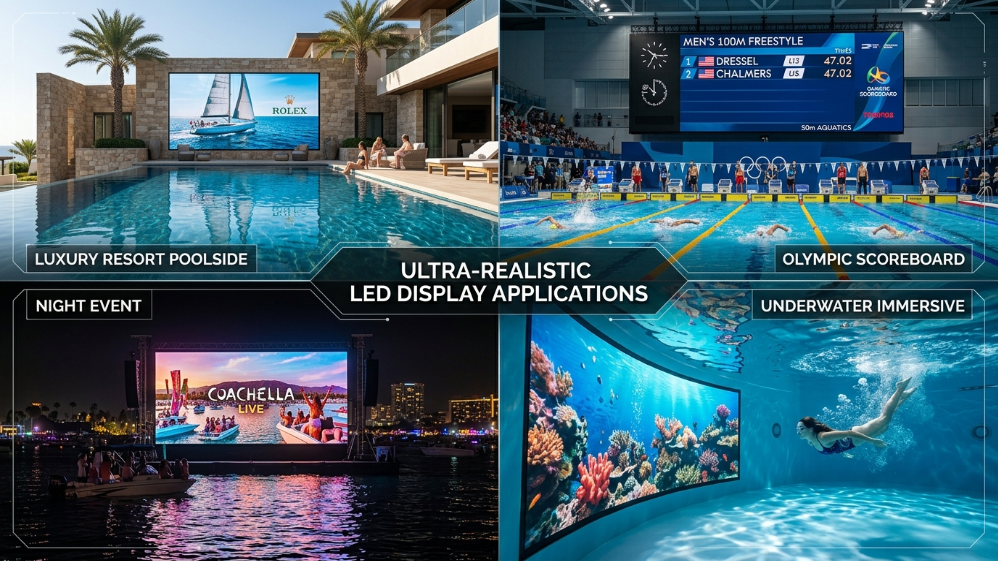
Classification is not for show—it exists because choosing the wrong type leads directly to functional failure or overspending.
Type 1: Poolside Perimeter Advertising Display
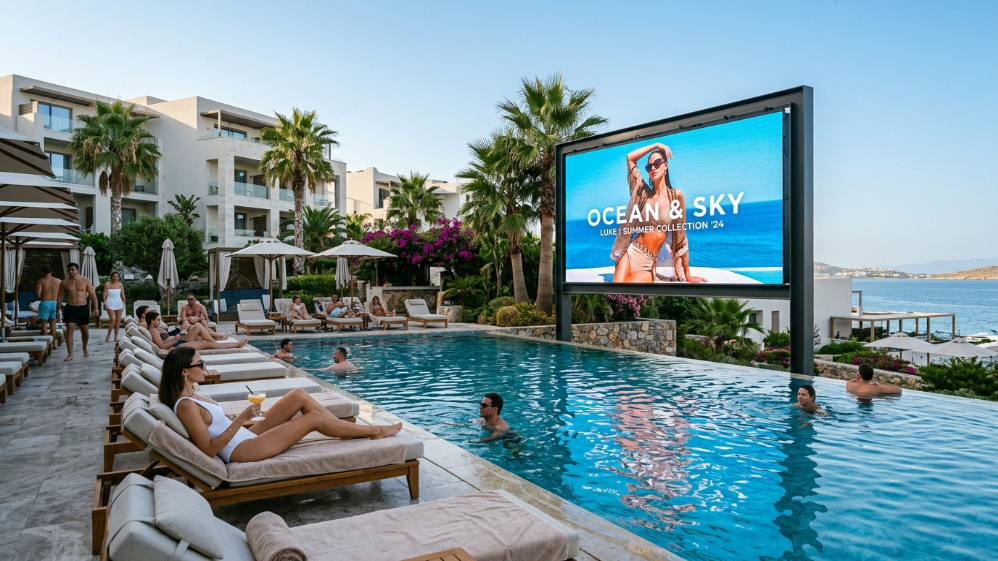
This is the most commercially deployed form. Installed on pool fences, building facades, or dedicated brackets, its core value is both brand communication and advertising monetization.
Based on our experience with resort and water park deployments across Southeast Asia and the Middle East, the key configuration principles are as follows:
A pixel pitch of P4 to P6 is optimal in most commercial scenarios. For example, for a screen viewed from 12 meters, P6 resolution is fully sufficient to display clear branding visuals and promotional content; blindly pursuing P3 significantly increases cost without improving visual performance.
Brightness must reach at least 7,000 nits—this is not a recommendation, but an engineering threshold for readability under direct midday sunlight.
Control systems are recommended to use NovaStar or Linsn solutions, both supporting cloud-based CMS remote content management, allowing operators to update advertising materials in real time without on-site personnel. This is critical for operational efficiency in multi-venue DOOH networks.
Type 2: Competition Pool Scoreboard System
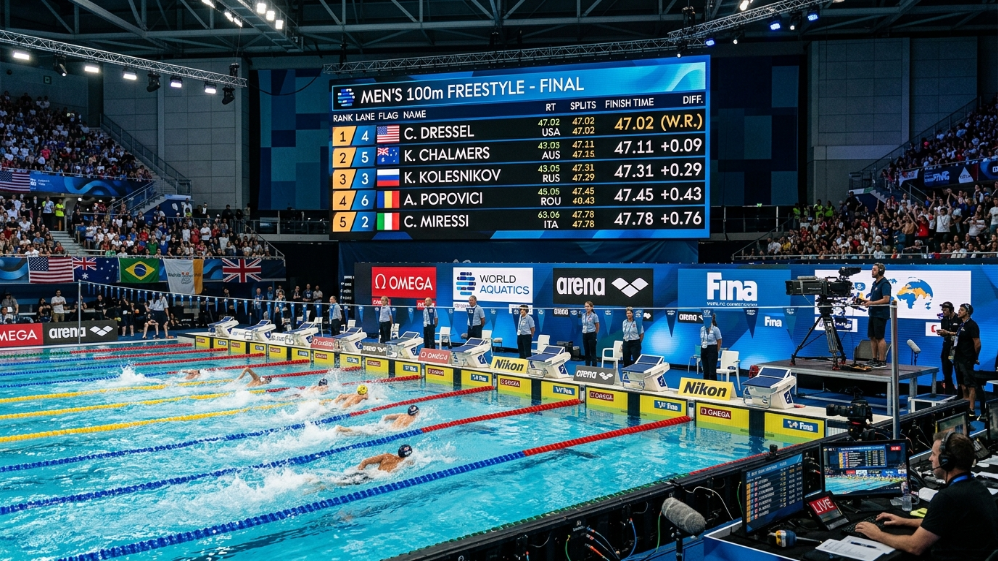
This is the most technically demanding segment. According to World Aquatics (formerly FINA) technical regulations, LED systems used in official international competitions must meet the following:
Refresh rate ≥ 3,840Hz: Ensures no flicker under high-speed cameras, a mandatory requirement for broadcast coverage.
Real-time data integration with timing hardware: Including millisecond-level synchronization with touchpad sensor signals.
MTBF (Mean Time Between Failures) ≥ 100,000 hours: Any failure during competition is an unacceptable commercial risk.
| Technical Parameter | Standard Commercial Screen | Professional Competition Screen | Business Impact |
|---|---|---|---|
| Refresh Rate | 1,920Hz | ≥3,840Hz | Eliminates broadcast flicker, meets broadcast standards |
| Color Uniformity | ≤25% deviation | ≤15% deviation | Ensures consistent multi-module color rendering |
| MTBF | 50,000–80,000 hours | ≥100,000 hours | Reduces downtime risk during events |
| Front Maintenance Structure | Optional | Mandatory | Essential due to limited poolside space |
| Timing System Interface | None | RS-232 / Ethernet standard | Direct integration with Omega, Daktronics systems |
According to data from major aquatics infrastructure procurement in 2024–2025, venues using native timing system integration achieved approximately 37% higher operational satisfaction scores than those using independent signal conversion solutions. Integration is not an add-on—it is a rigid requirement for competitive venues.
Type 3: Floating & Rental LED Display
This is the fastest-growing procurement category for DOOH advertisers and event planners. Lightweight aluminum cabinets (single panel weight controlled within 8kg) combined with IP66 quick-release structures enable frequent deployment across different venues.
The key procurement decision lies in choosing between synchronous and asynchronous control modes.
Live event scenarios requiring real-time signal transmission use synchronous systems. Hotel pool advertising installations with looped static content should use asynchronous controllers, which are lower cost and easier to maintain. Do not pay a premium for unnecessary functionality.
Type 4: Underwater Immersive LED Display
A commercial reality must be acknowledged: this is a niche market, not a mainstream procurement category. It is primarily required by ultra-luxury hotels and theme parks at the level of Dubai Tower developments, where the core value is creating “unreplicable visual memory points.”
Technical barriers are extremely high:
IP68 certification means the screen must withstand continuous immersion at 1.5 meters underwater for 30 minutes without water ingress. To ensure electrical safety underwater, the system must use 12V DC low-voltage power supply and comply with SELV (Safety Extra Low Voltage) certification. For such projects, suppliers must provide third-party test reports—not just specification sheets.
Key Procurement Parameters: 6 Core Indicators You Must Verify
Parameters are not just numbers on a spec sheet—each one is tied to real commercial risk.
| Technical Parameter | Industry Standard Requirement | Business Risk if Not Met | Verification Method |
|---|---|---|---|
| IP Rating | Poolside ≥ IP65, Competition pool ≥ IP67 | Chlorine corrosion leads to hardware failure within 12–18 months | IEC 60529 third-party report |
| Peak Brightness | Outdoor ≥ 7,000 nits | Screen unreadable in daylight, ad value lost | Brightness decay curve test |
| Refresh Rate | Commercial ≥ 1,920Hz, Events ≥ 3,840Hz | Flicker in broadcast footage | Smartphone slow-motion test |
| Color Uniformity | ≤15% (adjacent modules) | Branding visual inconsistency | Full-screen calibration report |
| MTBF | ≥100,000 hours | Frequent downtime, uncontrolled maintenance cost | Internal reliability data |
| Salt Spray Resistance | Coastal projects must pass GB/T 2423.17 | Cabinet corrosion within 1–2 years | ≥500h salt spray test report |
Based on our experience evaluating suppliers across Shenzhen, Taiwan, and South Korea, over 60% of low-cost suppliers cannot provide genuine third-party data for MTBF and salt spray testing. These two factors determine the true 5-year total cost of ownership.
TCO Model: Don’t Look at Purchase Price—5-Year Total Cost Is the Truth
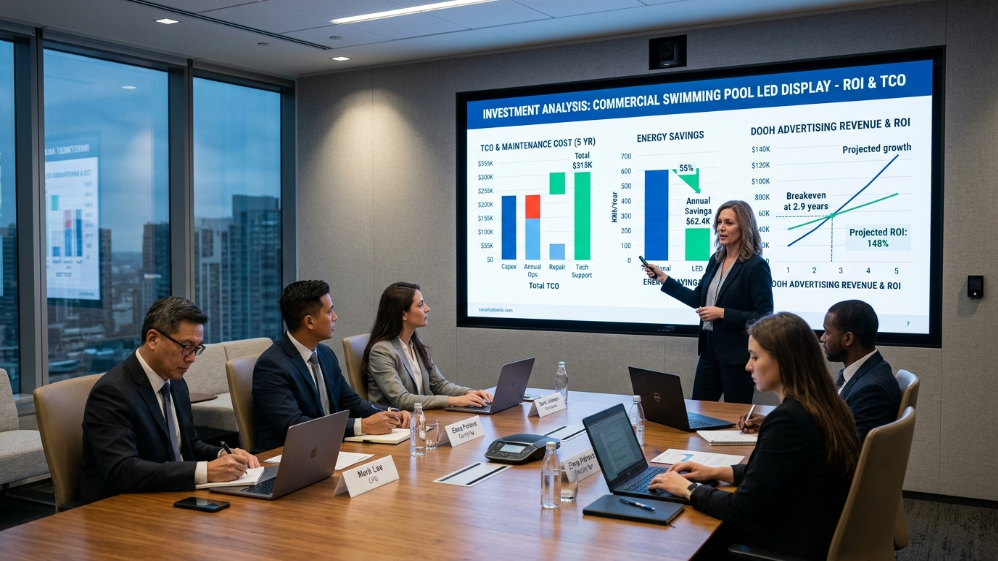
A swimming pool LED screen quoted at “$80/m²” may require two partial module replacements per year due to waterproof failure. Including downtime advertising loss, the actual 5-year cost can be 1.6× higher than a high-quality $200/m² screen.
Breakdown of real TCO:
- Hardware procurement: ~45%
- Installation & commissioning: ~15%
- 5-year electricity cost: ~25%
- Maintenance & spare parts: ~15%
Advanced thermal management designs can improve energy efficiency by up to 40% compared to older solutions. For a 50m² pool advertising screen, this translates to $3,200–$4,800 electricity savings over 5 years. Energy savings are part of ROI.
For DOOH operators, the advertising monetization cycle is more important: a 12m² screen installed in a five-star resort pool area, with conservative estimates of 8 hours daily exposure and $800–$1,200 monthly rental, typically achieves payback within 18–28 months.
FAQ: Top 5 Questions Buyers Ask Before Contacting Suppliers
Q1: Is IP65 sufficient for poolside LED installation?
It depends on the exact location. If the screen is more than 3 meters from the water surface with no direct water impact, IP65 is acceptable. However, for competition pools, water parks, and any high-pressure cleaning environment, IP67 is mandatory—the difference is between “water jet resistance” and “temporary immersion” under IEC 60529.
Q2: P4 or P6 for outdoor swimming pool LED screens?
First calculate viewing distance. Experience formula:
Minimum viewing distance (meters) ≈ pixel pitch (mm) × 1000 ÷ 1000
For distances above 6 meters, P6 is sufficient. Below 4 meters, P4 is required. In pool environments, P6 is the most cost-effective option; P4 is suitable for detailed text display such as menus or schedules.
Q3: How to evaluate whether an LED supplier is reliable?
Check four key indicators:
- ISO 9001 manufacturing certification
- CE/FCC export compliance
- Independent third-party waterproof testing report (not internal testing)
- Verifiable completed pool project cases (with client contact references)
Suppliers meeting all four account for less than 20% of the market.
Q4: How to choose a content management system for pool LED advertising?
NovaStar VNNOX cloud CMS is currently the most integrated solution, supporting multi-screen scheduling and remote diagnostics, suitable for multi-site DOOH operators.
For single-site small-scale deployments, Colorlight asynchronous systems offer lower initial cost. Regardless of choice, ensure HDMI and network input support for future integration of live or streaming content.
Q5: How long does a swimming pool LED screen last?
High-quality commercial pool LED screens have a theoretical LED lifespan of 100,000 hours (about 11 years at 24 hours/day). However, actual lifespan depends on waterproof design and maintenance quality.
Quarterly cleaning inspections and annual sealing checks are the key to achieving 8–10 years of real service life—not just relying on specifications.
Expert Verdict
The swimming pool LED display market is experiencing clear segmentation: suppliers who truly understand aquatic engineering, and manufacturers who simply add “waterproof” to outdoor screen specifications. The price gap is narrowing, but the quality gap is widening dramatically.
Final advice for B2B buyers:
Use MTBF data and salt spray test reports to eliminate 60% of suppliers first, then negotiate price with the remaining qualified candidates.
Purchase price is never the real cost—downtime loss is.
References:
IEC 60529: Degrees of Protection Provided by Enclosures
World Aquatics Competition Regulations & Swimming Facilities Rules