If you need one answer before reading further, here it is: the deciding factor is not brightness or price—it’s cabinet architecture. A fixed LED billboard box and a rental LED cabinet can run the exact same driver IC and share a similar pixel pitch, yet still be engineered for completely opposite mechanical lives.
Fixed Billboard Box vs. Rental LED Cabinet: Core Differences
| Decision Factor | Fixed Billboard Box | Rental LED Cabinet |
|---|---|---|
| Primary design goal | 24/7 structural permanence | Repeated assembly/disassembly |
| Typical cabinet weight | 20–38 kg/m² | 5–18 kg/m² |
| Cabinet material | Aluminum or steel/aluminum hybrid | Die-cast aluminum, magnesium, or carbon fiber |
| Ingress protection | IP65–IP67 | IP30–IP54 (event-grade) |
| Install method | Welded/bolted structural frame | Quick-lock plates, flight cases |
| Best fit | DOOH billboards, arenas, facades | Touring, festivals, virtual production |
That table is the short version. The long version—the one that actually protects your capital budget—requires understanding why these numbers exist, because getting this decision wrong doesn’t show up on day one. It shows up eighteen months later, as dead pixels, warped panels, or a crew standing on a lift for six extra hours.
We’ve spent years on both sides of this argument—specifying steel-and-aluminum billboard frames for street-facing DOOH networks, and building carbon-fiber touring walls that get boxed and shipped every weekend. Based on our experience with system integrators across North America, Africa, and Southeast Asia, the single most common procurement mistake is treating “fixed vs. rental” as a budget question when it’s actually a duty-cycle engineering question.
According to industry field data compiled by outdoor display manufacturers, cabinets deployed outside their intended duty cycle show a 30–40% reduction in service life—aluminum event cabinets pushed into permanent outdoor duty age faster than steel-reinforced billboard boxes, precisely because they were never engineered to absorb constant thermal expansion and contraction.
Cabinet Construction Compared: Steel, Aluminum, and Carbon Fiber Side-by-Side
Strip away the marketing language and every LED billboard box reduces to three engineering choices: what it’s made of, how much it weighs, and how it survives its environment.
Fixed Billboard Box Construction
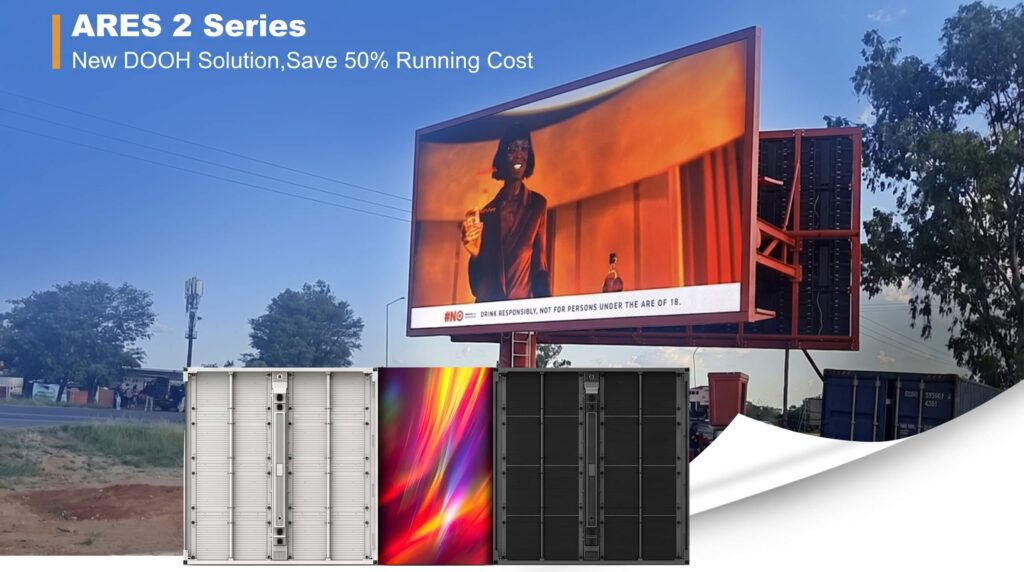
Fixed billboard boxes are typically built from an all-aluminum or aluminum-and-steel structure with reinforced back casing.
That extra structural mass isn’t wasted material—it’s the feature that lets a panel survive a decade of wind load, thermal cycling, and unattended outdoor exposure without warping out of plane.
The business benefit for the buyer: fewer service truck rolls, and a display that stays flat and color-consistent across a 1000 m² billboard face for years, not months.
Rental LED Cabinet Construction
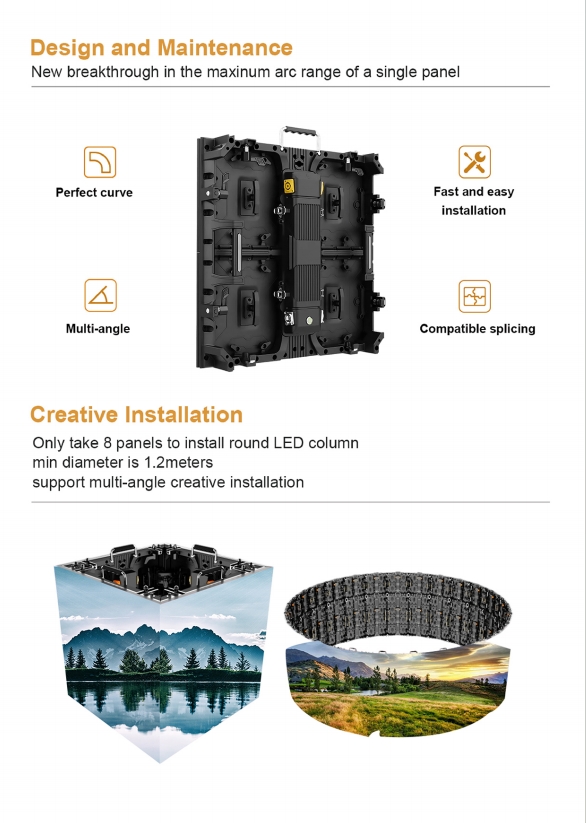
Rental cabinets flip the priority.
Die-cast aluminum or magnesium housings cut weight to 10–18 kg/m², which sounds like a spec-sheet number until you calculate labor.
A four-person rigging crew can hang a 100-panel wall in a single shift with sub-18kg cabinets; the same crew handling 35kg fixed-grade boxes needs additional lift equipment and nearly doubles install time.
That weight number is the ROI on a touring schedule.
Carbon Fiber LED Cabinet Construction
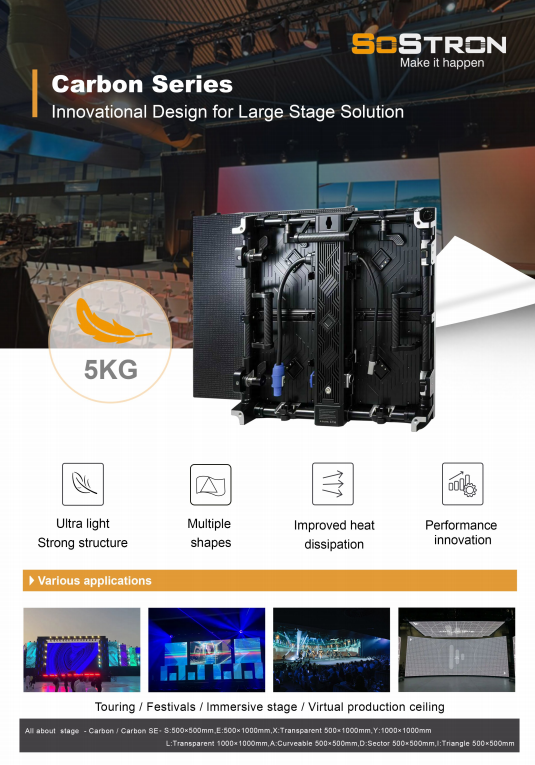
Carbon fiber cabinets sit at the sharpest end of this trade-off.
A carbon-panel design can shave roughly 30% off a comparable aluminum rental cabinet—down to around 5kg per panel—without sacrificing rigidity, because carbon fiber’s strength-to-weight ratio outperforms aluminum at equivalent wall thickness.
The commercial payoff: lower shipping cube weight, faster single-technician servicing, and—critically for creative stage design—enough structural rigidity to support curved, sector, and triangular panel shapes that a heavier aluminum cabinet can’t achieve without added bracing.
Fixed vs. Rental vs. Carbon Fiber Cabinet Comparison
| Attribute | Fixed Aluminum/Steel Box | Rental Die-Cast Aluminum | Carbon Fiber Rental Panel |
|---|---|---|---|
| Weight per panel/m² | 20–38 kg | 10–18 kg | ~5 kg |
| Weight reduction vs. traditional | Baseline | ~40% lighter | ~30% lighter than standard aluminum rental |
| Structural rigidity | Highest (permanent load) | Moderate | High-strength-to-weight |
| Shape flexibility | Flat/slight curve only | Flat, curved | Flat, curved, sector, triangle |
| Typical duty cycle | Years, continuous | Weekly/monthly cycles | Weekly/monthly cycles, frequent handling |
Installation Structure: How the Two Are Actually Mounted
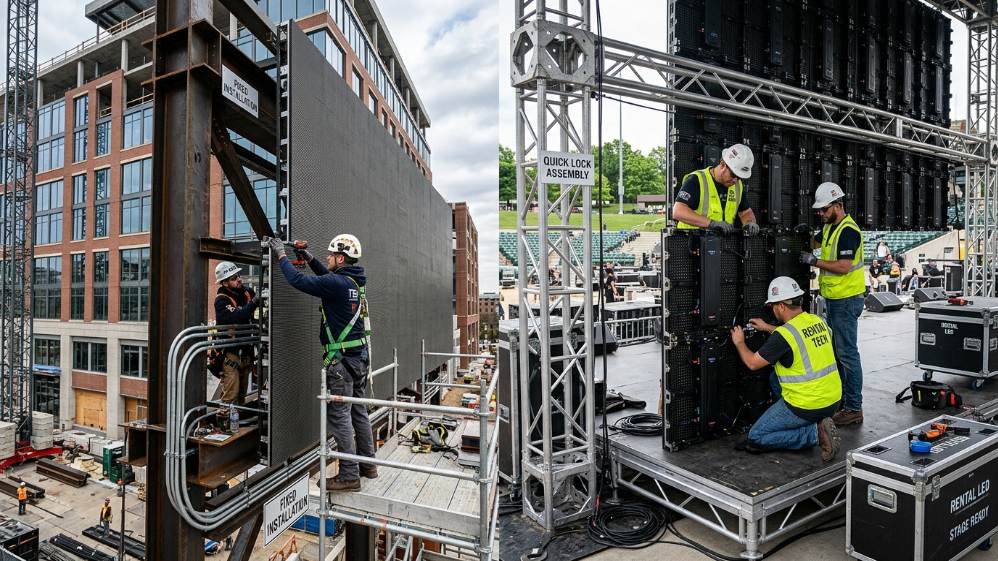
This is the part most comparison guides skip entirely, and it’s the part that determines your actual project timeline.
Fixed Outdoor Billboard Installation Structure
A fixed outdoor billboard box is mounted through a self-developed installation structure—a purpose-built steel or aluminum frame fixed to the wall or steel tower first, independent of the display panels themselves.
Only once that frame is leveled and anchored do technicians hang the LED panels directly onto it, aligning them into a single rigid plane.
A final edge-covering trim closes out exposed edges for weatherproofing and aesthetics.
The sequence matters because it decouples structural tolerance from panel tolerance: if the wall isn’t perfectly flat, the frame absorbs that variance, not the display face.
Rental LED Cabinet Installation Structure
Rental cabinets use an entirely different logic: quick-lock plates and cam-lever fasteners that let adjacent panels clamp directly to each other, tool-free, in seconds.
A well-designed lock plate allows every panel to sit on the same level plane without shimming, and—just as importantly—lets a technician pull a single panel from the middle of an assembled wall for mid-show maintenance without dismantling the surrounding structure.
Can you use a rental cabinet permanently, or a fixed box for a one-off event?
Technically yes, but it’s rarely a good decision.
Rental cabinets lack the continuous thermal-cycling tolerance and static-load engineering that permanent installations demand, while fixed cabinets’ weight and welded-frame install process make them commercially impractical for a three-day event.
IP Rating, Waterproofing, and Thermal Management by Use Case
Weight and lock mechanisms get most of the attention, but ingress protection is where cheap engineering shortcuts actually kill a billboard box.
A permanent outdoor DOOH installation running unattended for years needs IP65 at minimum, and IP67 where dust ingress or standing water is a realistic risk—think coastal billboards, highway medians, or rooftop installations exposed to driving rain.
That rating isn’t achieved by a rubber gasket alone; the panels that actually hold up in the field use double-sided potting glue sealing the LED module from both front and rear, which does two things simultaneously:
- It blocks moisture ingress at the diode level.
- It still allows a technician to disassemble the module for component-level repair rather than scrapping the whole panel.
Rental Cabinet Waterproofing Design
Rental cabinets deliberately under-spec this.
An IP30–IP54 rating is standard for indoor and short-duration outdoor event use, and that’s a rational engineering choice, not a corner cut—full IP67 sealing adds weight and cost that a cabinet only deployed for a weekend doesn’t need.
The problem only surfaces when a rental house gets pressured into leaving a screen up outdoors for a “temporary” three-week retail campaign that quietly becomes six months.
According to field reports from outdoor display integrators, that’s precisely the scenario producing the accelerated component failure rates seen when event-grade cabinets get pushed into permanent duty.
Thermal Management and Driving Technology
Thermal management follows the same logic.
Fixed billboard boxes generally use common cathode driving technology, which delivers independent, optimized voltage to red, green, and blue channels rather than a single shared voltage across all three.
The direct commercial benefit: power consumption can drop by roughly 40% compared to conventional common-anode designs, and because less energy is wasted as heat, the panel runs cooler—which matters enormously when a billboard is expected to operate continuously for a decade with minimal fan maintenance.
The Hybrid Category: Lightweight Fixed Cabinets for Modern DOOH
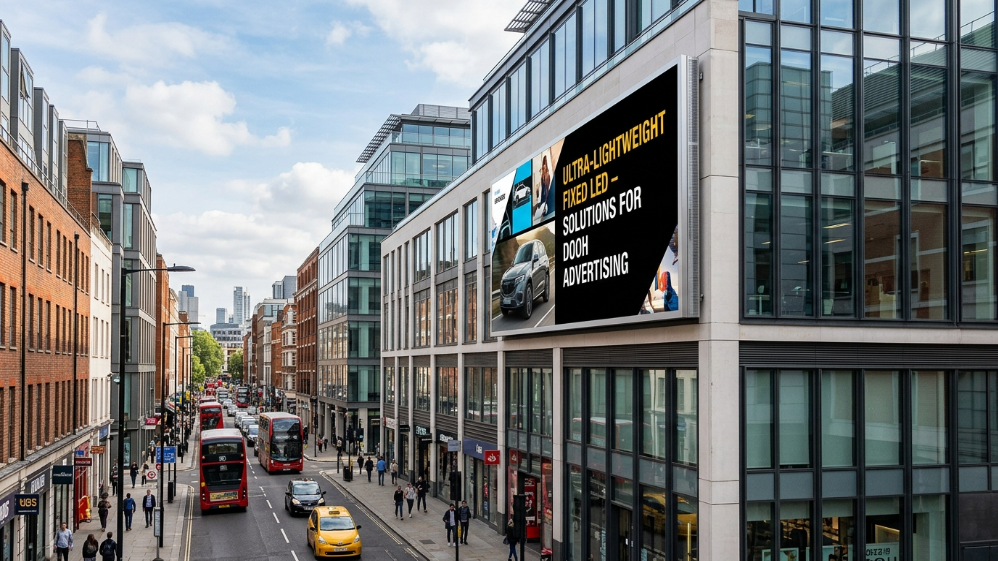
This is the segment most comparison articles miss entirely, and it’s increasingly where the smartest DOOH buyers are moving budget.
A new generation of fixed outdoor cabinets has closed much of the weight gap with rental hardware—modern all-aluminum billboard boxes now land around 20 kg/m², roughly half the mass of legacy steel-cased fixed screens, while still holding a full IP67 rating and structural-grade rigidity.
The FAB case here is direct: lighter fixed panels mean lower steel-structure and shipping costs at deployment, faster crane-and-crew installation on a billboard tower, and—because there’s less thermal mass fighting the sun—better heat dissipation through the all-aluminum back casing.
Panel Size Standardization Advantage
The second underrated advantage is panel-size standardization.
Rather than sourcing a different cabinet mold for every pixel pitch, a single 1000×1000mm (or 1000×750mm/1000×500mm) panel footprint can house pixel pitches from roughly P2.9 down to P10.4 by swapping the internal module density.
For a system integrator managing multiple billboard sites with different viewing distances, that means one spare-parts inventory, one installation-crew training process, and one structural mounting design across an entire portfolio—a procurement simplification that a fragmented product line can’t match.
Fixed, Hybrid, and Rental Cabinet Performance Comparison
| Cabinet Class | Weight | IP Rating | Power Efficiency | Best Fit |
|---|---|---|---|---|
| Legacy steel fixed box | 35–38 kg/m² | IP65 | Standard driving | Long-span structural billboards |
| Modern lightweight fixed (aluminum, common cathode) | ~20 kg/m² | IP67 | ~40% lower consumption | Street-level DOOH, retrofits, tower-mounted displays |
| Standard rental aluminum | 10–18 kg/m² | IP30–IP54 | Standard driving | Touring, festivals, corporate events |
| Carbon fiber rental | ~5 kg/panel | IP21 (indoor) / IP67 front-rear (outdoor rated variants) | Standard–high refresh | Curved stages, virtual production, premium touring |
Application Scenarios: Matching Structure to Use Case
The structural conversation only matters if it maps back to where the screen actually lives:
Permanent DOOH Billboards and Street Displays
Permanent DOOH billboards, street displays, arena signage—lightweight fixed IP67 cabinets with self-developed hanging structures win here, balancing install speed with decade-long durability.
Touring, Festivals, and Virtual Production
Touring, festivals, immersive studios, virtual production ceilings—carbon fiber or standard rental aluminum cabinets dominate, where quick-lock assembly and sub-10kg panel weight directly reduce labor spend per show.
Retail Landmark and Traffic Billboard Sites
Retail landmark and traffic billboard sites—the hybrid lightweight-fixed category is increasingly the default, since these sites need billboard-grade durability but often sit on structures that can’t support legacy steel-cabinet dead loads.
Cabinet Selection Checklist
A simple checklist before specifying either category:
- How many install/strike cycles per year does this screen see?
- What is the unattended exposure duration?
- What is the load-bearing capacity of the mounting structure already on site?
Four or more deployment cycles a year points toward rental-grade hardware regardless of budget; a fixed multi-year site with structural steel already in place points toward the lightweight-fixed hybrid class.
Total Cost of Ownership: Structure-Driven Cost Breakdown
Panel price is the smallest line item in most billboard box deployments once you account for structure.
A heavier legacy fixed cabinet at 35kg/m² typically demands a larger install crew, additional lift or crane time, and a longer engineering-approval cycle for the mounting structure—costs that a 20kg/m² lightweight-fixed cabinet with a pre-engineered hanging frame can cut meaningfully on install day alone.
On the rental side, the ROI math is different: a carbon fiber panel’s weight reduction pays back through faster load-in/load-out on a touring schedule, where labor hours, not material cost, dominate the show budget.
Buyer’s Decision Framework
Before signing off on a cabinet spec, ask your supplier for the structural drawing of the mounting frame, not just the panel datasheet.
A professional manufacturer should be able to show you the installation sequence:
- Frame anchoring.
- Panel hanging.
- Edge covering.
Request the actual IP test basis, not just the rating number, and confirm whether the driving technology is common cathode or common anode, since that single spec swings your annual power bill materially on a large-format billboard.
FAQ
Is a rental LED cabinet strong enough for a permanent outdoor billboard?
Generally no—rental cabinets are engineered for episodic duty cycles and IP30–IP54 protection, not continuous thermal cycling and multi-year unattended outdoor exposure.
How much lighter is a carbon fiber LED panel compared to standard aluminum?
Roughly 30% lighter than a comparable aluminum rental cabinet, often landing near 5kg per panel while maintaining structural rigidity for curved and shaped configurations.
What IP rating does a fixed DOOH billboard actually need?
IP65 as a baseline for standard outdoor exposure, with IP67 recommended for coastal, high-rainfall, or dust-heavy sites.
Can one LED cabinet size support multiple pixel pitches?
Yes—modern fixed cabinets in a standardized 1000×1000mm footprint can house pixel pitches from roughly P2.9 to P10.4 by changing the internal module, simplifying multi-site procurement.
What’s the biggest hidden cost difference between fixed and rental LED structures?
Installation labor tied to cabinet weight and structural complexity—not the panel price—typically drives the largest cost variance between the two categories.
Expert Verdict
If your project involves four or more install/strike cycles a year, specify rental-grade aluminum or carbon fiber hardware and don’t compromise on quick-lock structural design.
If you’re deploying a permanent DOOH billboard, the lightweight-fixed hybrid category—sub-20kg/m², IP67, common cathode—now beats legacy steel cabinets on nearly every metric that matters to your P&L.
The one mistake we’d flag above all others: never let install-day convenience talk you into using event-grade hardware on a site you’ll still be servicing three years from now.
LED Billboard Boxes Price Summary Prompt
For B2B buyers planning LED billboard projects, the total investment should be evaluated based on cabinet structure, installation requirements, environmental protection level, and long-term operating costs rather than only the initial panel price. Fixed outdoor LED billboard boxes with IP65/IP67 protection, lightweight aluminum structures, and energy-saving common cathode technology usually represent a higher upfront investment but deliver better ROI through reduced maintenance, lower power consumption, and longer service life. Rental LED cabinets and carbon fiber solutions are more cost-effective for frequent installation cycles because their lightweight design reduces labor and transportation costs. When requesting a quotation from LED display manufacturers, buyers should provide project size, pixel pitch, installation environment, cabinet type, quantity, and duty cycle requirements to receive an accurate factory pricing proposal.
References:
IEC 60529: Degrees of Protection Provided by Enclosures (IP Code)
NEMA 250: Enclosures for Electrical Equipment (1000 Volts Maximum)