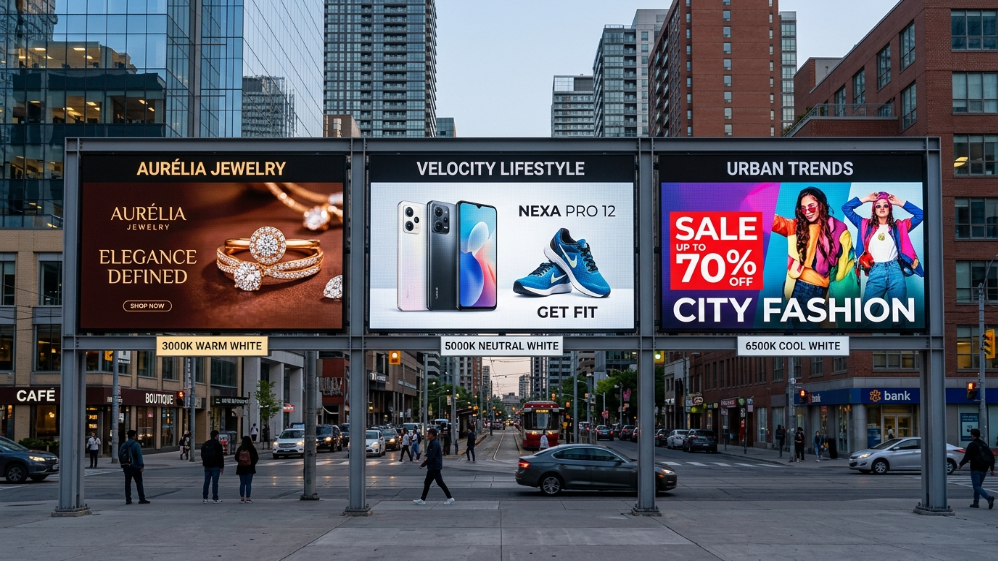
If you need the short answer before we get into the engineering: 6500K delivers maximum daytime visibility for high-traffic promotional content, 5000K is the safest choice for color-accurate product advertising, and 3000K is reserved almost exclusively for luxury, hospitality, and lifestyle brand placements where warmth matters more than punch. There is no universal “correct” CCT for an LED billboard — there is only the correct CCT for the content sitting on top of it.
| Priority | Recommended CCT | Best For | Trade-off |
|---|---|---|---|
| Visibility & impulse attention | 6500K | Retail promos, FMCG, fast food, flash sales | Can distort warm brand colors, higher perceived glare at night |
| Color-accurate reproduction | 5000K | Product shots, tech/automotive, mixed content networks | Slightly less “pop” than 6500K in bright daylight |
| Brand warmth & premium feel | 3000K | Luxury, hospitality, jewelry, real estate | Loses contrast in direct sunlight, weaker cut-through |
Here’s the part most spec sheets don’t tell you: two billboards built with identical pixel pitch, identical brightness rating, and identical driver ICs can still make the same 30-second ad look completely different — one crisp and true-to-brand, the other washed out or clinically cold — purely because of a CCT mismatch against the content and the installation environment. That’s not a design opinion. It’s measurable in Delta E color deviation, and it shows up in client complaint tickets faster than almost any other spec on the RFQ.
We’ve spent the better part of the last decade specifying, calibrating, and troubleshooting outdoor and indoor LED advertising networks for system integrators and DOOH operators across markets with wildly different sunlight conditions — from glass-heavy CBD towers in the Gulf to overcast transit corridors in Northern Europe. Based on our experience with post-installation color disputes, roughly seven in ten “the screen looks wrong” service calls trace back not to a defective panel, but to a CCT that was never matched to the advertising content it was meant to carry. This guide is written from that vantage point: as a decision framework for the people who spec, sell, and stand behind these installations — not a consumer lighting primer repurposed for billboards.
Why Color Temperature Is a Silent Deal-Breaker for Advertising ROI
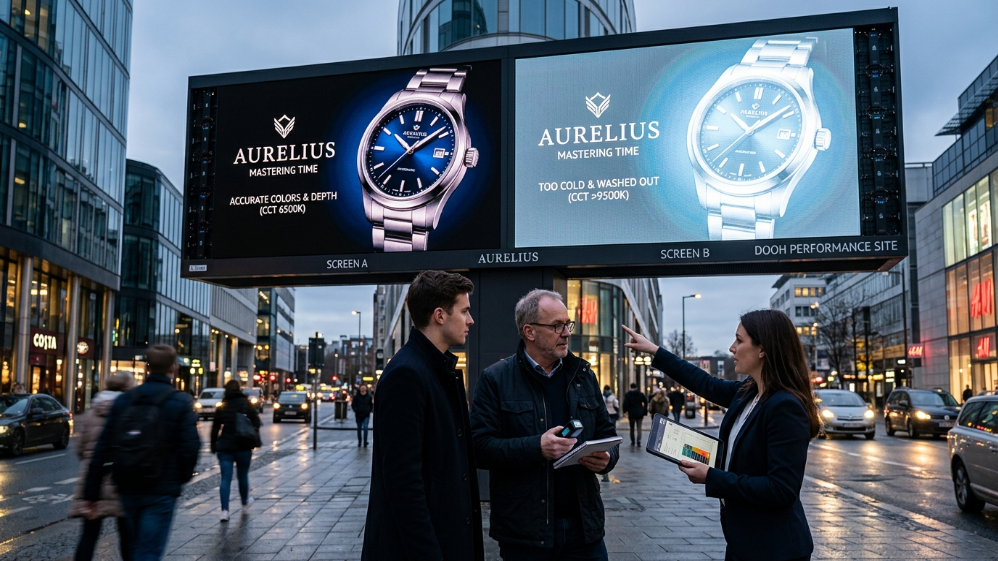
Color temperature rarely appears as a line item in a client’s creative brief, yet it dictates whether that brief actually lands on screen the way it was designed. A cosmetics brand that approved a warm, flattering campaign visual on a calibrated studio monitor will notice immediately if the same asset renders two shades cooler on a 6500K billboard — the skin tones shift, the product packaging looks slightly off-brand, and the client questions the integrator’s competence, not the content.
The Real Cost of Getting CCT Wrong — Client Complaints, Rework, and Lost Contracts
In our field experience, CCT-related disputes are disproportionately expensive to fix compared to almost any other post-installation issue. Brightness can often be adjusted in software. Pixel pitch and resolution are locked in at manufacturing. But color temperature complaints frequently require driver-level recalibration, on-site color matching with a spectrophotometer, or — in the worst cases — panel replacement, because the original CCT bin was baked into the LED chip selection at the factory.
For a rooftop billboard, that means crane access, downtime, and a contract margin that evaporates. According to industry field-service data commonly cited among LED display integrators, color and white-balance complaints remain among the top three post-handover service tickets for outdoor advertising displays, trailing only brightness uniformity and pixel failure.
What Buyers Actually Ask: “Will This Screen Make My Content Look Right?”
Strip away the technical framing and every DOOH operator, activation agency, and integrator is really asking one commercial question: will the content we’re paid to display look the way the brand intended?
That’s a content-and-CCT question disguised as a hardware question, and it’s exactly why color temperature deserves the same line-item attention in a proposal as brightness (nits) or pixel pitch.
The Kelvin Scale Decoded — What 3000K, 5000K, and 6500K Actually Mean for On-Screen Advertising Content
Correlated Color Temperature (CCT) describes the white-point bias baked into the LED’s RGB chip calibration — not brightness, and not color accuracy on its own.
Two panels can share an identical CCT rating and still render content differently if their Delta E (color deviation from true reference) isn’t controlled during binning. That distinction matters enormously for advertising, where brand color fidelity is often contractually specified.
3000K (Warm White): How It Renders Luxury, Hospitality, and Lifestyle Ad Content
A 3000K white point pulls the entire image toward amber.
Feature: warmer white balance shifts reds and golds forward while muting blues.
Benefit for the buyer: hospitality, jewelry, and real estate advertisers get a screen that flatters skin tones, gold tones, and warm interiors — content that would otherwise look sterile under a cooler white point instead reads as inviting and premium, which is precisely the brand register those verticals are selling.
5000K (Neutral Daylight): The “Safe Middle Ground” for Accurate Product Color Reproduction
5000K sits close to natural daylight and is the CCT most spec sheets treat as neutral.
Feature: minimal color bias in either direction.
Benefit for the buyer: for mixed-content advertising networks running rotating creative from multiple clients — automotive, consumer electronics, packaged goods — 5000K reduces the risk that any single brand’s palette is systematically distorted, which is exactly why many multi-tenant DOOH networks standardize on it as a default rather than negotiating CCT per advertiser.
6500K (Cool White): Why It Maximizes Visibility — and Where It Distorts Brand Colors
6500K biases toward blue and reads as “brighter” to the human eye even at equivalent luminance.
Feature: higher perceived contrast against ambient daylight and urban clutter.
Benefit for the buyer: for high-traffic retail promotions and fast-turnover FMCG campaigns, that perceived sharpness translates into faster message capture in a three-second glance — the exact window most roadside and transit advertising has to work with.
The trade-off: warm brand palettes (reds, skin tones, wood textures, gold packaging) desaturate and cool under 6500K, which is why luxury and hospitality clients routinely reject it during creative approval.
Matching Color Temperature to Your Advertising Content Category
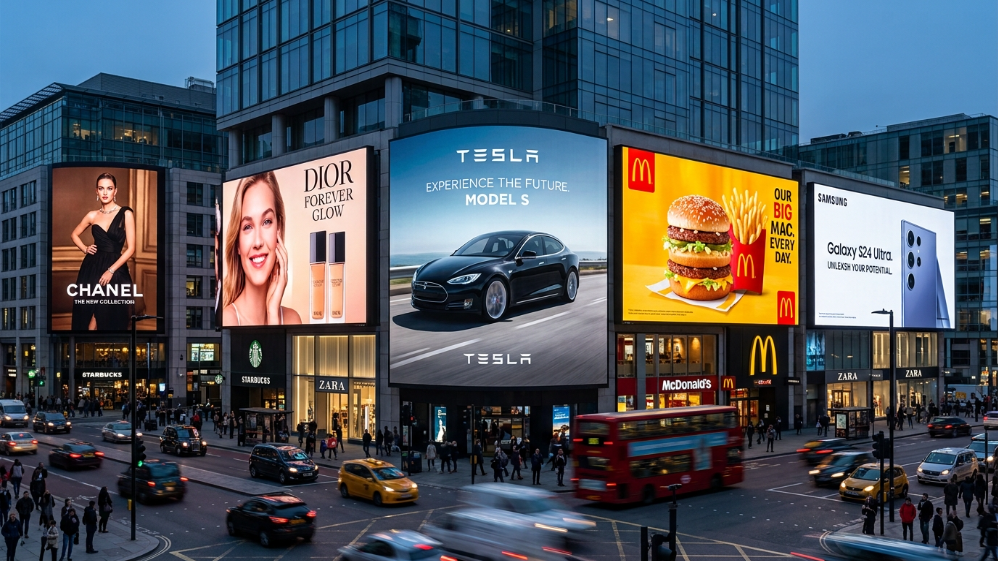
None of this matters in the abstract — it matters against the specific creative rotating on your network. A screen calibrated in isolation, without reference to the content mix it will carry, is a screen you’ll be recalibrating within six months of go-live.
Beauty, Fashion & Jewelry Ads — Why Color Accuracy Beats Brightness
For these verticals, Delta E control matters more than raw nits.
Feature: low Delta E deviation at 5000K-3000K binning.
Benefit: the advertiser’s actual SKU color reaches the pavement intact, which is the difference between a screen that sells and one that gets pulled from the media plan after the first campaign review.
Retail Promotions, Fast Food & FMCG — Why 6500K Drives Impulse Attention
Discount pricing, limited-time offers, and packaged goods thrive on contrast and speed of recognition, not subtlety.
6500K’s blue-shifted white point sharpens edges and numerals against daylight glare, which is precisely why quick-service and big-box retail media buyers request it by name in RFPs.
Automotive, Tech & Corporate Branding — Balancing Modernity with Color Fidelity
These campaigns want to look contemporary without sacrificing the metallic paint finish or product-render accuracy their creative teams spent weeks perfecting.
5000K, occasionally nudged toward 5700K, is the compromise we specify most often for this segment.
Static Image vs. Video/Motion Content
Motion content is more forgiving of CCT drift than static hero shots, because the eye is tracking movement rather than scrutinizing a fixed color swatch.
If your network runs a mixed static/video schedule, bias your default CCT toward whatever your highest-value static creative demands — video will still read acceptably.
Environmental & Technical Factors That Change Your Ideal CCT Choice
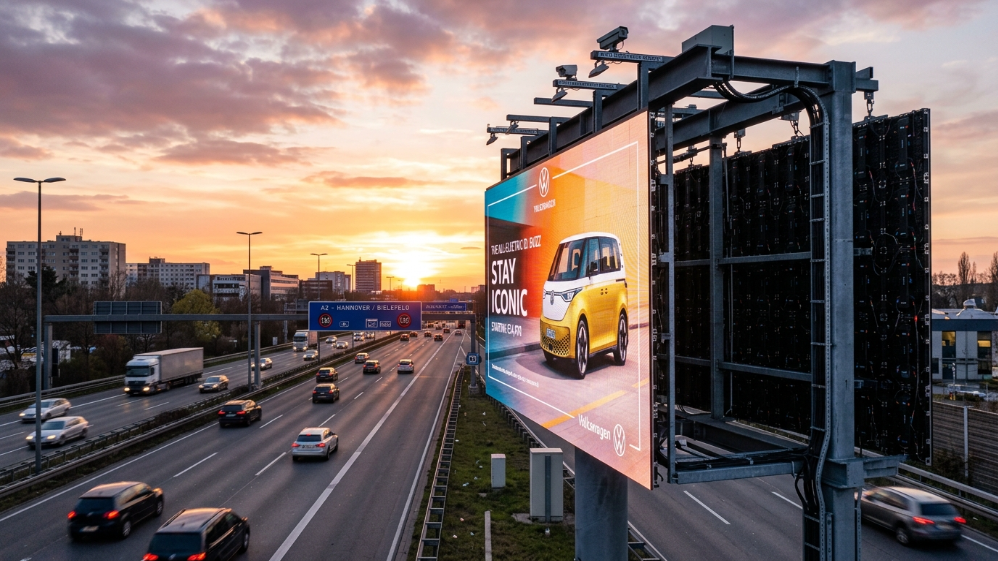
Spec sheets are written in a lab. Billboards live on rooftops, highways, and glass-clad plazas, and the surrounding light does as much work on perceived color as the panel itself.
Ambient sunlight washes out warm tones first, which is why 3000K installations in direct-sun, high-glare locations frequently get re-specified within a year.
Viewing distance compounds the effect: at long throw distances typical of highway billboards, cooler CCTs read as sharper simply because the eye resolves contrast before it resolves hue.
And for any DOOH placement near broadcast cameras or livestream backdrops — stadium perimeter boards, event activations — 6500K has a well-documented tendency to introduce color distortion and glare under camera sensors, which is why several professional venues have quietly standardized closer to the 5000K–5700K band instead of pushing brightness alone.
The Hidden Technical Risk: Color Consistency Across Multi-Screen LED Networks
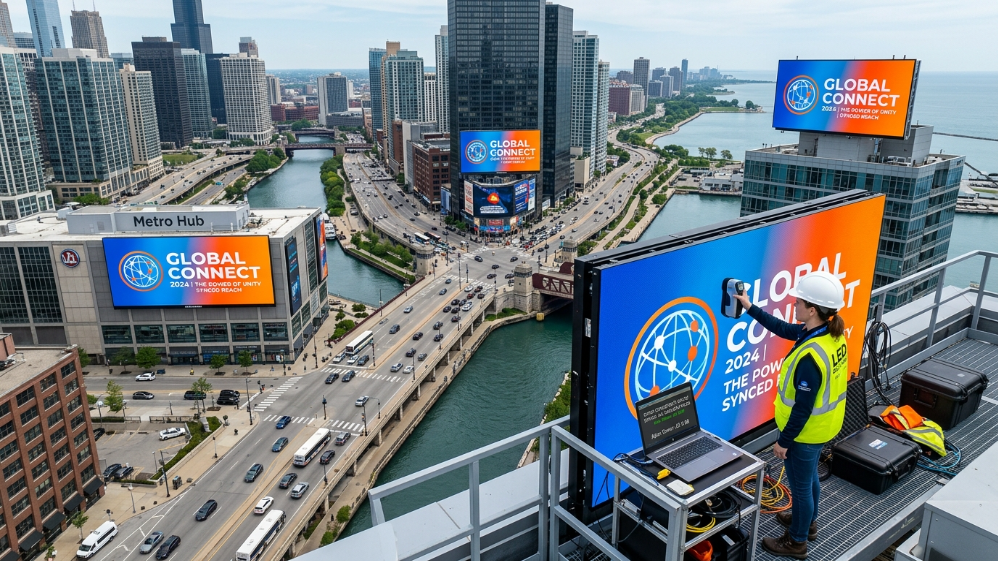
This is the section most vendor brochures skip, and it’s the one that determines whether your client’s brand looks identical across five city billboards or looks like five different companies.
What Is Binning, and Why It Determines Uniformity
LED chips are sorted, or “binned,” by wavelength and luminous output during manufacturing.
Two panels from the same product line can carry different bins if quality control is loose.
Feature: tight binning tolerance across a batch.
Benefit: a national campaign creative renders with the same white balance whether it’s on a screen in the airport or one three states away — which is the uniformity clause most enterprise DOOH contracts now write in explicitly.
| Evaluation Point | Ask the Supplier | Red Flag Answer |
|---|---|---|
| Binning tolerance | What CCT/luminance tolerance range is guaranteed across panels in one order? | “Standard industry tolerance,” no numeric spec |
| Delta E rating | What is the Delta E deviation at your default CCT setting? | Supplier doesn’t measure or report Delta E |
| CCT adjustability | Can CCT be recalibrated on-site post-installation, or is it fixed at the chip level? | Fixed at chip level, no field calibration tool |
| Ambient light response | Does the display include an ambient light sensor for auto brightness/CCT adjustment? | Manual-only, fixed preset regardless of daylight |
| Multi-screen consistency | Is there a color-matching/calibration process across networked displays? | No cross-panel calibration procedure documented |
How to Evaluate a Supplier’s Color Consistency Specs Before You Sign
Ask for the Delta E figure in writing, not a marketing claim of “true color” or “vivid color.”
If a supplier can’t produce a number, they haven’t measured it — and you’re the one who inherits the color-matching dispute after handover, not them.
Smart Adjustment: Should Your LED Billboard Have Auto CCT/Brightness Control?
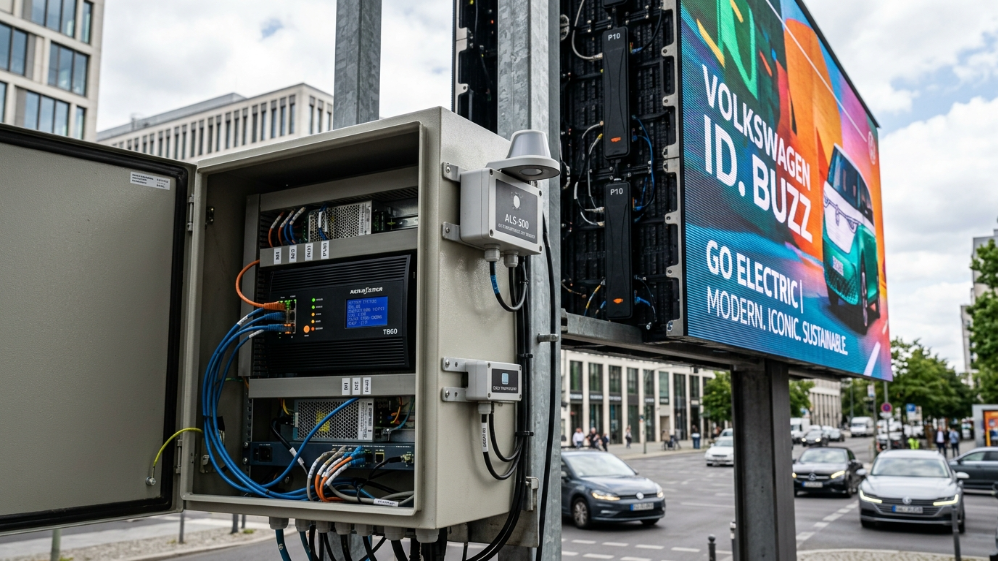
Ambient light sensors that pair brightness and white-balance adjustment do genuinely reduce daytime-to-nighttime color complaints, particularly on installations facing east-west sun exposure.
For single-tenant, single-brand screens, a manual preset tuned once to the brand’s content is often more predictable and cheaper to maintain than an adaptive system, which introduces one more variable to troubleshoot when something looks “off.”
For multi-tenant DOOH networks running dozens of advertisers’ creative, adaptive CCT is worth the premium — it protects the median advertiser’s color accuracy across a full day-night cycle without per-client manual tuning.
Frequently Asked Questions
Can I adjust the color temperature of an LED billboard after installation?
On most modern outdoor displays, CCT can be adjusted at the controller/driver level within a limited range without touching the panel hardware.
A shift outside that range typically requires factory recalibration or a different chip bin.
Does a higher CCT mean a brighter LED display?
No. CCT and luminance (nits) are separate specifications.
A 6500K panel is not inherently brighter than a 5000K panel of the same nit rating — it simply reads as visually cooler and, to some viewers, subjectively sharper.
What color temperature do most outdoor advertising billboards default to?
5000K is the most common factory default for mixed-content DOOH networks, precisely because it minimizes color bias across the broadest range of advertiser creative.
How does color temperature affect LED display power consumption?
Chip-level CCT selection has minimal direct impact on power draw; brightness (nits) and ambient-light-driven auto-dimming are the dominant energy variables, not CCT itself.
Is 6500K suitable for a luxury brand’s flagship LED billboard?
Generally not recommended.
Luxury creative depends on warm-tone fidelity — 6500K’s blue shift tends to desaturate gold, skin, and wood tones that these campaigns are built around; 3000K–4000K performs better for this segment.
Expert Verdict
Stop treating color temperature as a manufacturing afterthought and start treating it as a media-planning spec, on par with pixel pitch and nits.
Our rule of thumb after years of post-installation service calls: default to 5000K unless the content mix gives you a clear reason not to, demand a written Delta E figure before signing any multi-panel order, and never let a supplier quote CCT without also quoting binning tolerance.
That single line item prevents more client disputes than any warranty clause ever will.
LED Billboard Pricing Consideration for B2B Buyers
For commercial LED billboard projects, color temperature selection should be evaluated together with pixel pitch, brightness level, cabinet structure, calibration system, and installation environment rather than as an isolated specification. Entry-level outdoor LED billboards with standard SMD technology typically start from several hundred dollars per square meter, while premium solutions featuring high brightness, fine pixel pitch, advanced color calibration, smart monitoring, and long-term outdoor protection can reach several thousand dollars per square meter.
When preparing an RFQ, B2B buyers should request a complete quotation including LED module quality, CCT range, Delta E calibration data, brightness (nits), refresh rate, IP rating, spare parts ratio, control system, installation accessories, and after-sales support. A lower initial price without guaranteed color consistency may create higher operational costs through recalibration, content complaints, and brand dissatisfaction after deployment.
References:
CIE 015:2018 Colorimetry — International Commission on Illumination (CIE)
IEC 62717:2014 LED Modules for General Lighting — Performance Requirements