What Is a Basketball LED Scoreboard?
A basketball LED scoreboard is a digital display system powered by Light Emitting Diode (LED) technology, purpose-built to communicate real-time game data to players, coaches, referees, and spectators. Unlike legacy flip-score or incandescent boards, modern LED scoreboards update instantaneously, support wireless operation, and — at the professional tier — integrate full-motion video and sponsor content.
Having tested and evaluated LED scoring systems across school gyms, semi-pro clubs, and arena-level installations, the single biggest mistake buyers make is purchasing on screen size alone, while ignoring pixel pitch (the distance between LED clusters) and nit rating (brightness). Both directly determine whether your scoreboard is actually readable from the seats that matter.
A fully featured basketball LED scoreboard displays:
| Data Field | Purpose |
|---|---|
| Home / Away Score | Core real-time scoring |
| Game Clock | Countdown per quarter/half |
| Shot Clock | 24-sec (NBA) / 30-sec (NCAA) compliance |
| Period / Quarter Indicator | Game progression tracking |
| Team Fouls | Bonus foul entry tracking |
| Timeouts Remaining | Per-team timeout management |
| Player Fouls (optional) | Individual foul tracking |
| Possession Arrow | Alternating possession indicator |
Four Types of Basketball LED Scoreboards {#types}
Type 1 — Fixed Wall-Mounted Scoreboard
The most common installation for school gyms and community arenas. Fixed scoreboards bolt to the end wall or the steel structure above the backboard. They offer the best long-term cost efficiency, lowest maintenance burden, and the most visible sightlines for spectators. Typical size range: 6ft × 3ft to 12ft × 5ft.
Best for: High schools, universities, community recreation centers, and club arenas with a permanent court.
Type 2 — Portable LED Scoreboard
Mounted on a wheeled stand, portable scoreboards serve venues that host multiple sports or share facilities. They fold down for transport and require no structural installation. The trade-off is lower brightness and smaller display area, which limits readability beyond roughly 50 feet.
Best for: Multi-use gyms, church leagues, mobile tournament setups, smaller venues with tight budgets.
Type 3 — Center-Hung (Scorers’ Table + Overhead) System
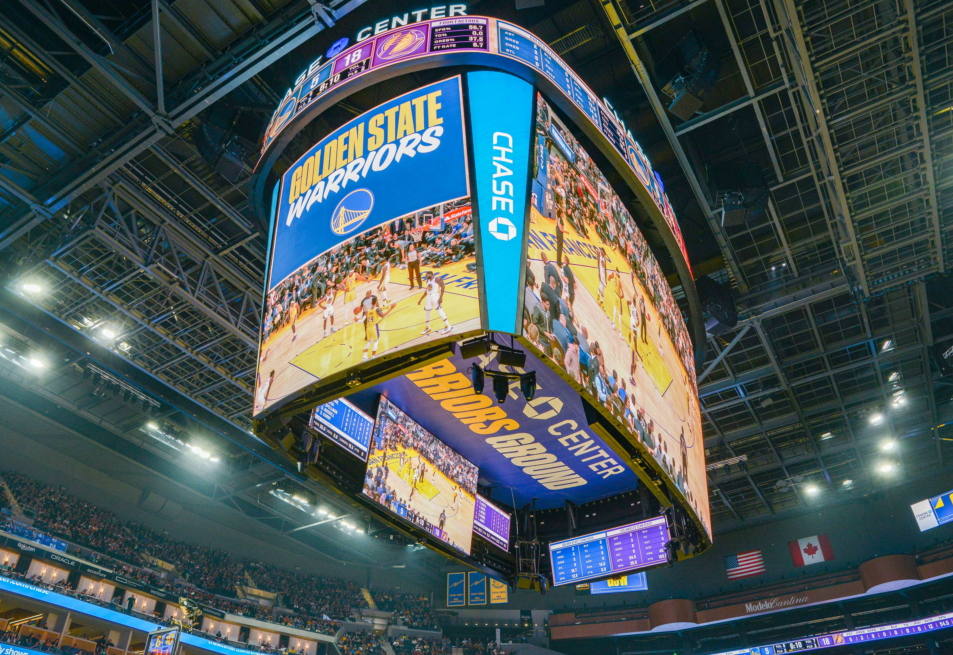
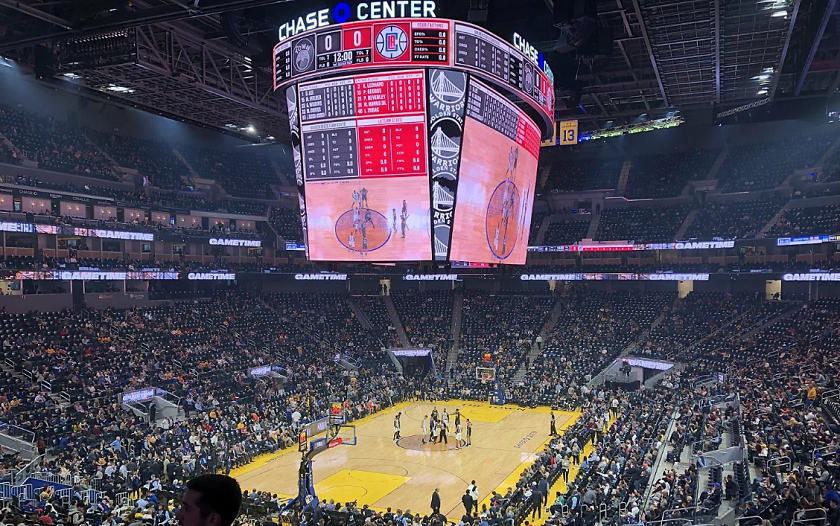
Commonly seen in Division I college and professional arenas, center-hung systems suspend four-sided LED displays above center court, giving 360-degree scoreboard visibility regardless of seating position. These are typically combined with LED scorer’s tables and ribbon boards to create a fully integrated game-day experience.
Best for: Mid-to-large arenas, NBA G-League venues, D1 college programs, and professional facilities.
Type 4 — Full-Video LED Scoreboard
The premium tier. Full-video boards use high-density LED panels (pixel pitch P2.5–P4) capable of displaying live broadcast feeds, instant replays, animated graphics, and real-time sponsor advertisements. These systems can generate advertising and sponsorship revenue that offsets the capital investment over time. Nevco
Best for: Professional venues, large university arenas, entertainment-focused sports facilities.
Key Display Specs You Must Understand
Before requesting a quote, understand these five technical specifications — most suppliers will not volunteer this information unless pressed.
| Specification | What It Means | Recommended Minimum |
|---|---|---|
| Pixel Pitch (P-value) | Distance (mm) between LED clusters. Lower = sharper image | P4 for ≥30ft viewing distance |
| Brightness (nits) | Luminous intensity. Higher = readable in bright light | 4,000+ nits for indoor; 8,000+ for outdoor |
| Refresh Rate | Times per second screen refreshes. Prevents flickering in video | 1,920Hz+ for broadcast quality |
| IP Rating | Dust/water resistance. Outdoor boards need IP65 minimum | IP43 indoor / IP65 outdoor |
| Viewing Angle | How wide the display remains readable | 140° horizontal minimum |
How to Choose the Right Basketball LED Scoreboard
Step 1: Define Your Venue Type and Viewing Distance
The single most important factor is the maximum viewing distance from the scoreboard to the farthest seat. A P6 display is perfectly sharp at 20 feet; at 80 feet it looks grainy. Use this rule of thumb: multiply the pixel pitch by 1,000 for the minimum comfortable viewing distance in millimeters (e.g., P4 = 4,000mm = ~13 feet minimum; readable to ~130 feet).
Step 2: Identify Required Game-Specific Features
Basketball has sport-specific mandatory requirements that generic scoreboards miss:
- Shot clock compliance (24-second NBA / 30-second NCAA rules)
- Bonus foul indicator (5-foul team bonus threshold)
- Possession arrow display
- Period vs. half-time configuration (high school vs. NBA format)
Step 3: Evaluate the Control System
In 2026, many scoreboards come with mobile app integration and cloud-based control systems, allowing operators to manage displays and schedule advertising content remotely. Look for systems with: Breaking AC
- Wireless tablet/phone control for the scorer’s table
- Backup wired control (redundancy for live games)
- Multi-sport software presets if the court hosts volleyball, wrestling, or other sports
Step 4: Calculate Total Cost of Ownership (TCO)
The purchase price is not the full cost. A full TCO analysis should include:
- Hardware purchase price
- Installation labor ($2,000–$10,000)
- Electrical infrastructure upgrades (if needed)
- Annual maintenance contract ($300–$1,500/year)
- Software licensing (some brands charge annual fees)
- Warranty terms (industry standard: 3–5 years)
Step 5: Check Indoor vs. Outdoor Requirements
Outdoor scoreboards cost 50–100% more than equivalent indoor models because they require weatherproofing, UV-resistant panels, higher brightness for direct sunlight readability, and anti-corrosion enclosures. KeepTheScore
Basketball LED Scoreboard Price Breakdown (2026)
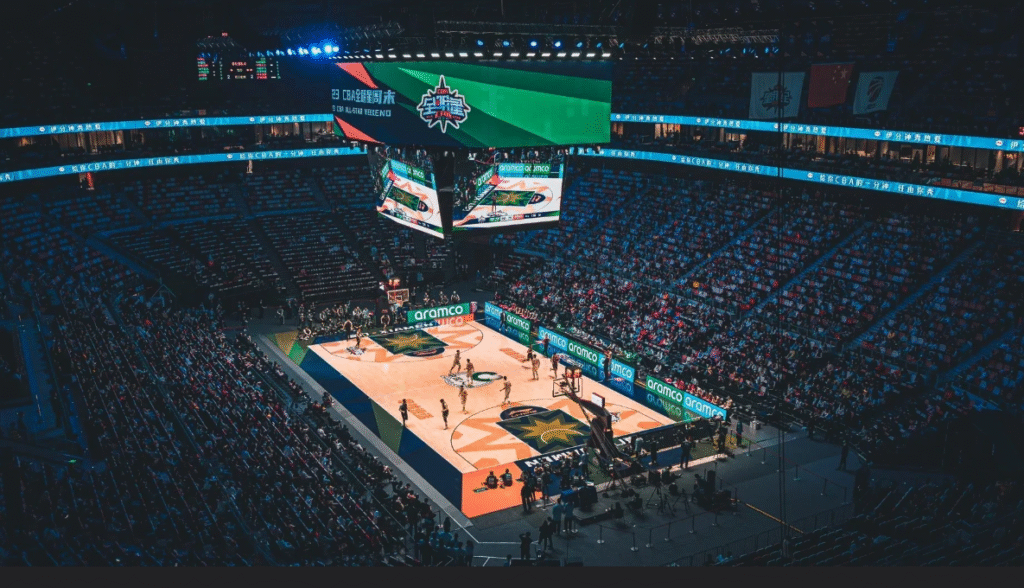
Basic scoreboards can start from $1,000, mid-range digital ones typically fall between $5,000 and $15,000, and high-end LED or video scoreboards can exceed $100,000. Breaking AC
| Tier | Price Range | Best Suited For | Key Features |
|---|---|---|---|
| Entry-Level | $1,000–$5,000 | Elementary schools, church leagues, community centers | Score + clock display, basic LED digits, wired control |
| Mid-Range | $5,000–$15,000 | High schools, semi-pro clubs, recreation centers | Full basketball feature set, wireless control, team logo display |
| Professional | $15,000–$50,000 | Universities, D2/D3 arenas, large clubs | Video capability, shot clock integration, multi-sport, sponsor panels |
| Arena-Grade | $50,000–$100,000+ | NBA G-League, D1 college, pro facilities | Full-motion video, center-hung 4-sided, broadcast-quality refresh rate |
Additional Costs to Budget:
- Installation: $2,000–$10,000 depending on mounting complexity and electrical work
- Customization (logos, school colors, sponsor branding): $500–$3,000
- Annual Maintenance: $300–$1,500
- Replacement LED modules (after 7–10 years): 15–25% of original hardware cost
Pro Tip: Always request an itemized quote that separates hardware, installation, software licensing, and warranty costs. Bundled “all-in” quotes often obscure inflated installation margins.
Software Scoreboards vs. Hardware Scoreboards
A competitor content gap the original article missed entirely: software-based scoreboard systems are now a legitimate alternative for budget-constrained venues.
If a gym already has an LED wall, large TV, or projector, web-based scoreboard software running in a browser — controlled via tablet or phone — can deliver functional game-day scoring for as little as $14/month, versus $15,000–$50,000 for dedicated hardware. KeepTheScore
| Software Scoreboard | Dedicated LED Hardware | |
|---|---|---|
| Upfront Cost | $0–$500 | $1,000–$100,000+ |
| Monthly Cost | $14–$100/month | $0 after purchase |
| Display Quality | Depends on existing screen | Dedicated, optimized |
| Durability | Limited by existing display | 10–15 year lifespan |
| Outdoor Use | No | Yes (with right unit) |
| Best For | Small gyms, tight budgets | Permanent professional venues |
Verdict: For school gyms under 200 seats with an existing large display, start with software. For venues investing in a long-term facility upgrade, dedicated hardware delivers better ROI, fan experience, and sponsorship revenue potential.
Top Basketball LED Scoreboard Brands (2026)
| Brand | Origin | Known For | Best Fit |
|---|---|---|---|
| Daktronics | USA | Broadcast-quality video boards | Professional & D1 College |
| Nevco | USA | Full-service school solutions | K-12 and small colleges |
| Varsity Scoreboards | USA | Fast lead times, affordable pricing | High school programs |
| Olympian LED | USA | Custom video + scoring integration | Mid-tier arenas |
| SRYLED / SoStron | China | Cost-effective, export-focused | International clubs, budget-conscious buyers |
FAQ
Q: How long does a basketball LED scoreboard last?
A: Well-maintained dedicated hardware scoreboards have a functional lifespan of 10–15 years. Individual LED modules may need replacement after 7–10 years of heavy use.
Q: What is pixel pitch and why does it matter for a basketball scoreboard?
A: Pixel pitch measures the distance in millimeters between LED clusters. A lower pixel pitch (e.g., P2.5) produces a sharper image suited for close-range viewing. For most high school gyms, P5–P8 provides the right balance of quality and cost-efficiency.
Q: Do I need a separate shot clock for my basketball scoreboard?
A: Some integrated systems include the shot clock within the main scoreboard display. However, for FIBA, NBA, or NCAA compliance, a dedicated shot clock unit mounted above the backboard is typically required. Budget $500–$3,000 for a compliant shot clock pair.
Q: Can a basketball LED scoreboard be used for other sports?
A: Yes. Most mid-range and above scoreboards include multi-sport software presets for volleyball, wrestling, football, and soccer. Confirm this capability with the supplier before purchasing.
Q: What is the difference between a synchronous and asynchronous LED scoreboard?
A: A synchronous scoreboard requires a real-time connection to a control computer to display content. An asynchronous scoreboard stores content on an internal card and can run independently — better for reliability during live games.
Q: How much does it cost to install a basketball scoreboard?
A: Installation costs typically add $2,000–$10,000 depending on electrical work, mounting complexity, and whether outdoor-rated equipment is needed. KeepTheScore
Q: Is a software scoreboard good enough for a competitive basketball league?
A: For recreational leagues and small tournaments, yes. For schools hosting NFHS-sanctioned games or higher, a dedicated hardware unit that meets official timing standards is recommended.