A 2×1 LED screen is a modular LED display with a 2:1 width-to-height aspect ratio—most commonly configured as a 2-meter-wide by 1-meter-tall panel assembly. Built from standard die-cast aluminum cabinets (typically 500×500mm or 1000×500mm units), this format has quietly become one of the most commercially versatile sizes in the global B2B display market. Before you issue a single RFQ, here is what every system integrator, DOOH operator, and event production company needs to know at a glance:
| Specification | Typical Range for a 2×1 LED Screen |
| Physical Dimensions | 2000mm (W) × 1000mm (H) |
| Cabinet Configuration | 4 × 500×500mm or 2 × 1000×500mm cabinets |
| Pixel Pitch Options | P2.6 / P2.9 / P3.91 / P4.81 |
| Resolution (P3.91) | approx. 512×256 pixels |
| Brightness (Indoor) | 800–1,500 nits |
| Brightness (Outdoor) | 4,500–6,500 nits |
| Refresh Rate | 1,920Hz–3,840Hz |
| Cabinet Weight (per 500×500mm) | 7–9 kg |
| Aspect Ratio | 2:1 (non-standard—content must be purpose-built) |
This is not a generic LED wall article. If you are comparing quotes from three Chinese manufacturers and cannot figure out why their specs look identical but their prices differ by 40%, or if your client just asked you to spec a 2×1 format screen for a DOOH site and you are not sure which pixel pitch survives a five-year outdoor deployment—this guide addresses both problems directly.
What Is a 2×1 LED Screen? Dimensions, Format, and Why It Matters
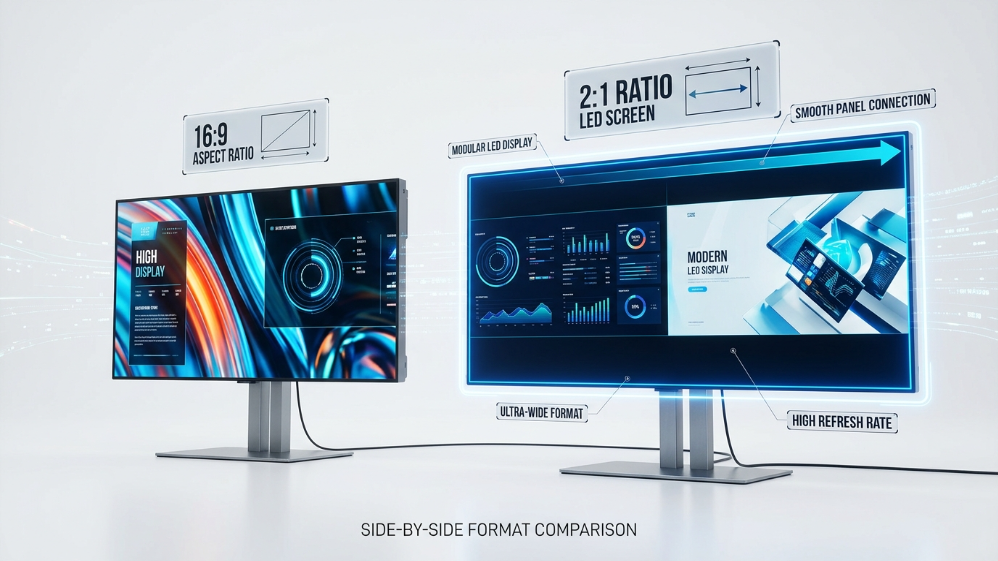
The 2:1 Aspect Ratio Explained: How It Differs from 16:9 and 4:3 Standard Displays
Most of the LED industry defaults to 16:9—it aligns with broadcast video, PowerPoint decks, and standard advertising creative. The 2:1 ratio (sometimes written as 18:9 or expressed as a 2000×1000mm physical build) deliberately breaks from that convention, and for good reason.
A 16:9 screen at 2-meter width gives you a height of 1.125 meters. A 2:1 screen at the same width gives you exactly 1 meter. That 12.5cm difference matters enormously in three real-world scenarios: retail window installations with strict height clearances, tradeshow booth headers with 1-meter vertical limits, and DOOH sites where the landlord has fixed the fascia dimensions. Trying to squeeze a 16:9 format into a 2:1 physical space means either cropping your content or living with black bars—neither is acceptable when the screen is a revenue asset.
Based on our experience deploying 2:1 format screens across DOOH networks in Southeast Asia and Europe, this ratio also performs exceptionally well as a corporate lobby ticker, a DJ booth backdrop, and a multi-panel tile unit in command center builds. The format is not exotic. It is underspecified in most buyer guides, which is why procurement teams frequently order the wrong cabinet configuration on their first attempt.
Physical Dimensions Demystified—Is It 2m×1m, 2ft×1ft, or a Cabinet Count?
Here is where terminology creates real sourcing mistakes. “2×1 LED screen” can mean three different things depending on who is using the term:
-
2 meters wide × 1 meter tall — The most common B2B interpretation. This is the physical build specification.
-
2 feet × 1 foot — Occasionally used in North American AV rental contexts for small monitor-grade panels. Entirely different product.
-
2 cabinets wide × 1 cabinet tall — A cabinet-count notation that defines the assembly grid, not the physical size. If each cabinet is 500×500mm, this gives you a 1m×0.5m screen—half the size most buyers expect.
Always confirm with your supplier which convention they are using. A reputable manufacturer will immediately provide the specification in millimeters alongside the cabinet grid notation. If they cannot, that is itself a qualification signal.
The Cabinet Math Behind a 2×1 Screen: How Many 500mm Panels Do You Actually Need?
This is the single most frequently botched calculation in the procurement process.
For a 2000mm×1000mm screen using standard 500×500mm die-cast aluminum cabinets:
-
Width: 2000mm ÷ 500mm = 4 cabinets across
-
Height: 1000mm ÷ 500mm = 2 cabinets tall
-
Total cabinet count: 8 panels
If your supplier offers 1000×500mm cabinets (a common rental format used for faster installation), the count becomes 4 panels in a 2×2 grid. The physical result is identical—the assembly method and rigging weight distribution differ.
Weight matters for site approval. At 7–9 kg per 500×500mm cabinet, an 8-cabinet 2×1 screen carries a gross weight of 56–72 kg before rigging hardware, cabling, and the video processor enclosure. For a hanging installation, that load must be engineered into the truss specification. A Novastar or Colorlight video processor adds another 3–6 kg to the system weight depending on the unit. Factor this into your structural engineer’s sign-off—especially for permanent DOOH installations where local building codes govern suspended display loads.
5 High-ROI Applications Where a 2×1 LED Screen Outperforms Standard Formats
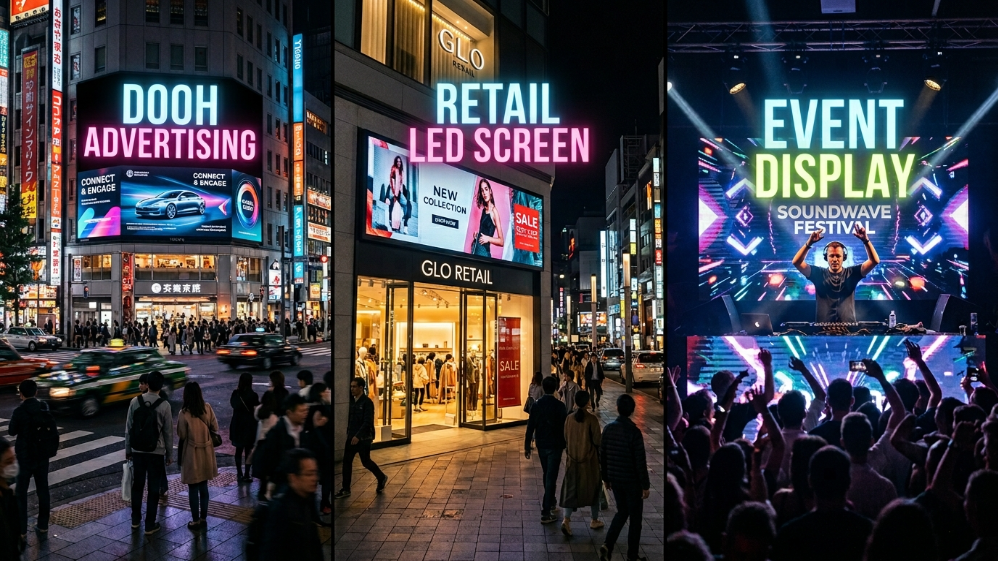
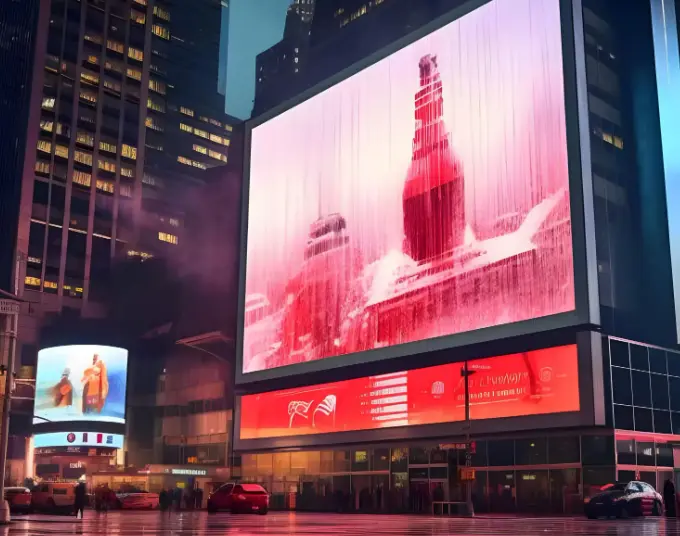
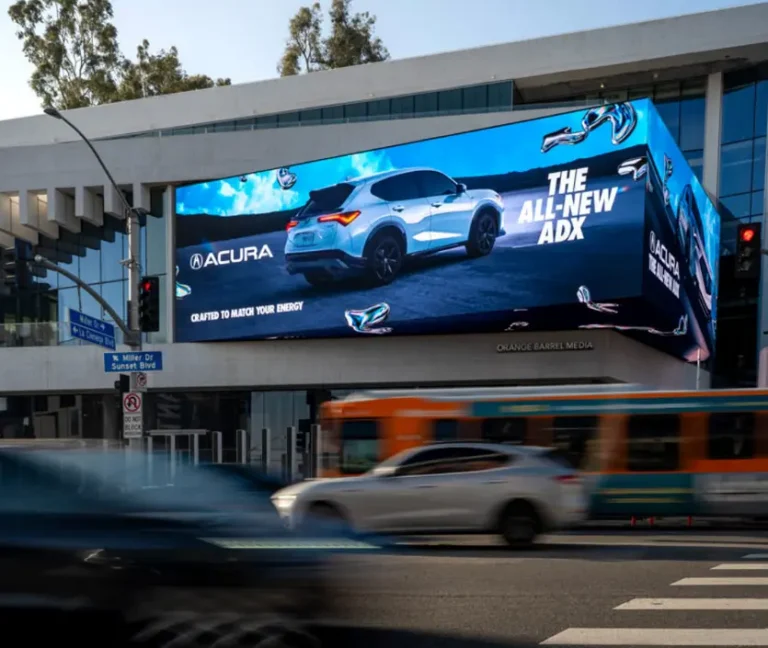
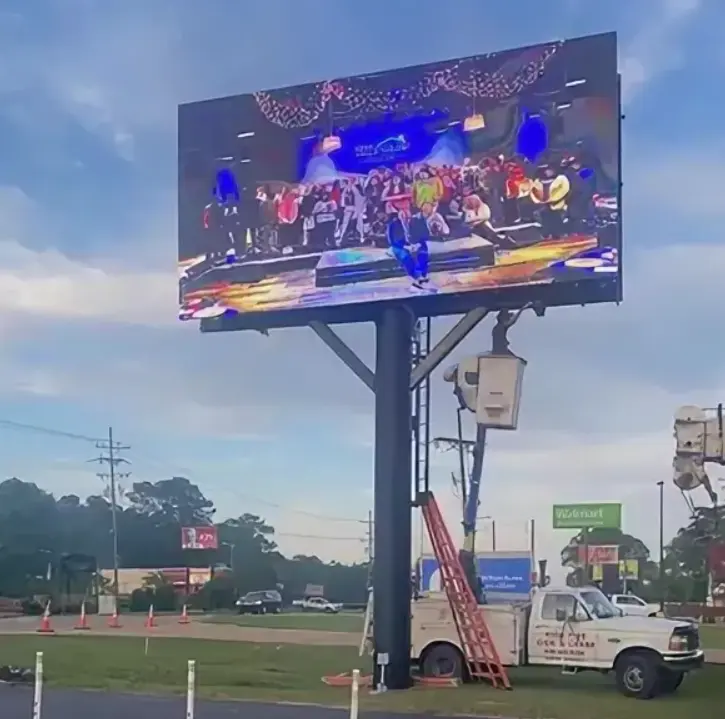
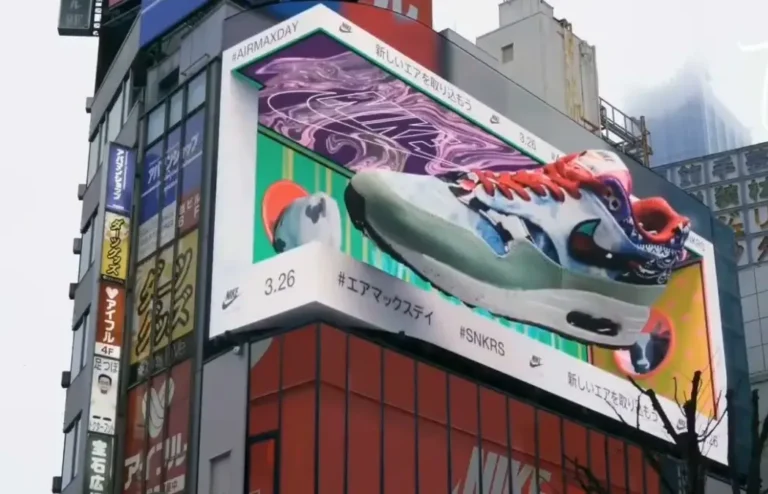
DOOH Advertising: Why the 2:1 Ratio Maximizes Programmatic Ad Fill Rates on Narrow Site Footprints
According to industry data from the Digital Out-of-Home industry, a significant share of urban DOOH inventory exists in sites with a width-to-height ratio between 1.8:1 and 2.2:1—storefront lintels, transportation corridor headers, and retail mall fascia panels. Standard 16:9 screens leave dead space or require creative reformatting at these sites. A 2×1 screen fits natively, which translates directly to higher programmatic fill rates because the screen accepts standard 2:1 creative without any transcoding overhead.
For DOOH network operators building inventory at scale, this matters financially. Every percentage point of fill rate improvement on a screen that runs 16 hours per day over a five-year asset life represents meaningful revenue. The 2×1 format is not a compromise—it is a deliberate site-format match.
Outdoor 2×1 deployments require a minimum brightness rating of 4,500 nits for adequate daylight visibility, with premium high-traffic sites specifying 5,500–6,000 nits. For programmatic DOOH applications that may include motion video, a refresh rate of 3,840Hz is the professional baseline—it eliminates moiré artifacts in camera footage when a passer-by photographs the screen, which protects brand reputation for your advertising clients.
Event Production & Rental: The 2×1 as a Side-Screen, Confidence Monitor, and DJ Booth Display
The 2×1 format has become the de facto standard for DJ booth backdrops and side-screen IMAG (image magnification) panels in mid-size event productions. The reason is purely geometric: most DJ booth structures and side-stage rigs are engineered for a display that is wide but not tall. A 16:9 panel at the same width exceeds the rig’s vertical clearance; a 2×1 fits without modification.
| Event Application | Recommended Pixel Pitch | Min. Brightness | Refresh Rate | Notes |
| DJ Booth Backdrop (indoor) | P2.9 | 800 nits | 3,840Hz | Camera-ready for broadcast/social content capture |
| Side-screen IMAG (mid-size venue) | P3.91 | 1,000 nits | 3,840Hz | Balance of resolution and cost at 5–10m viewing distance |
| Conference Stage Header | P2.6 | 800 nits | 1,920Hz | Fine pitch for close viewing from front rows (3–6m) |
| Outdoor Festival Side-Screen | P3.91 / P4.81 | 4,500 nits | 1,920Hz | Cost-optimized; audience at 15m+ cannot resolve finer pitch |
| Retail Pop-Up Activation | P2.9 | 1,200 nits | 3,840Hz | High ambient light compensation; social media filming likely |
Based on our experience with rental fleet operators in Europe and North America, a 2×1 screen built with P3.91 cabinets on a 500×500mm die-cast aluminum chassis delivers the optimal balance of image quality, deployment speed, and total cost of ownership for event production applications. The 500×500mm cabinet format allows a two-person crew to assemble a complete 2×1 screen in under 20 minutes—a critical operational factor when your venue access window is 90 minutes.
How to Choose the Right Pixel Pitch for Your 2×1 LED Screen Project
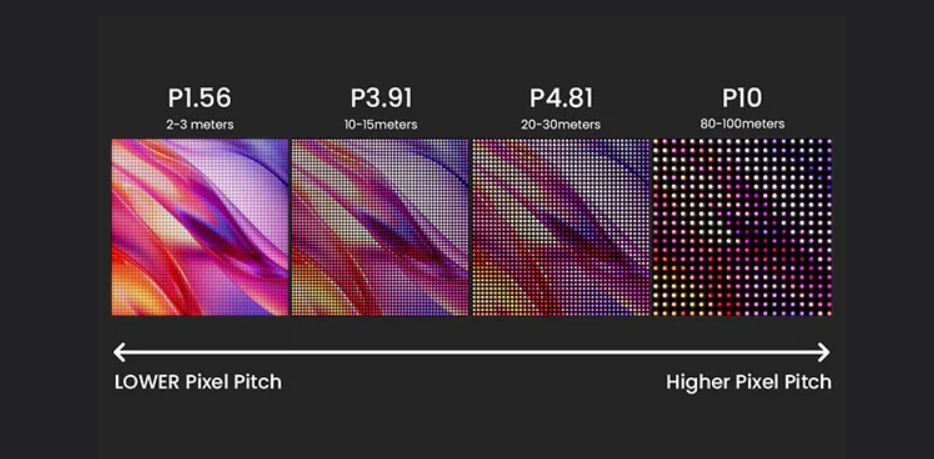
Pixel pitch is the single most consequential specification decision you will make. Get it wrong and you either overspend on resolution your audience cannot physically perceive, or you deliver a visible pixel grid that undermines the visual impact you were hired to create.
The Viewing Distance Rule: Matching P2.6, P3.91, and P4.81 to Your Venue or Installation
The industry-standard formula is straightforward: minimum viewing distance (in meters) ≈ pixel pitch (in mm). A P3.91 screen should not be viewed from closer than approximately 4 meters. A P2.6 screen is legible from 2.5 meters. Applied to a 2×1 format:
-
P2.6 — Corporate AV, conference stages, broadcast studios. Viewing distances of 2.5–8 meters. The higher pixel density (approx. 148,000 pixels/m²) justifies the cost premium when your audience sits in the front three rows or when the screen appears in broadcast-quality video production.
-
P3.91 — The B2B workhorse for events and DOOH. Viewing distances of 4–12 meters. At 65,400 pixels/m², this pitch delivers excellent visual quality at the distances where most event audiences and DOOH pedestrian traffic actually stand. It is also the most liquid product in the global rental and used-equipment market—critical for resale value calculation.
-
P4.81 — Outdoor large-venue and cost-sensitive deployments. Viewing distances of 5–15 meters. When your audience is beyond 10 meters, the human eye cannot distinguish P3.91 from P4.81. Choosing P4.81 at the right application reduces hardware cost by 25–35% with zero perceptible quality trade-off for the end viewer.
Pixel pitch selection is not about buying the best specification—it is about matching the specification to the physics of human vision at your specific site.
Indoor vs. Outdoor Brightness Requirements—What Nit Rating Does a 2×1 Screen Need?
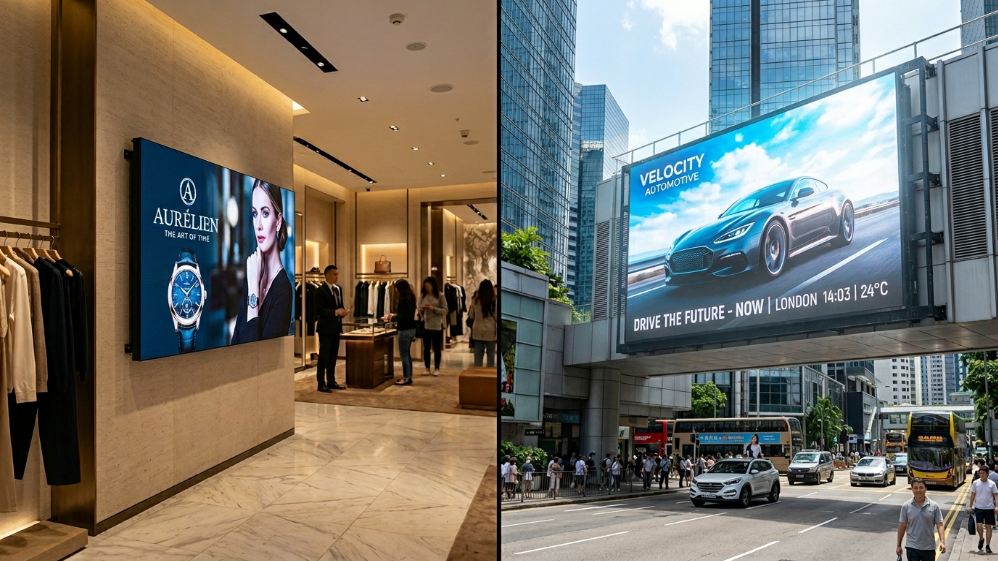
Brightness is where B2B buyers most consistently under-specify. The instinct is to match the minimum published requirement and call it done. That approach works until the screen is installed and the client calls to say it looks washed out at noon.
For an indoor 2×1 LED screen in a controlled-light environment—conference stage, corporate lobby, broadcast studio—800 to 1,200 nits is sufficient. For retail environments with floor-to-ceiling windows and direct sunlight ingress, that number climbs to 1,500–2,500 nits. Outdoor installations are a different category entirely: 4,500 nits is the floor, not the target. Premium outdoor DOOH sites in high-ambient-light conditions—south-facing urban facades, transit hubs with glass canopy structures—routinely specify 5,500–6,000 nits to guarantee contrast ratios that make content legible from 20 meters in full daylight.
One practical note on power: high-brightness outdoor panels consume significantly more electricity. A 2×1 screen at P3.91 running at 6,000 nits will draw approximately 600–720W at peak load. That is a circuit planning consideration,not a footnote.
2×1 LED Screen Technical Specifications: A Complete Reference Table
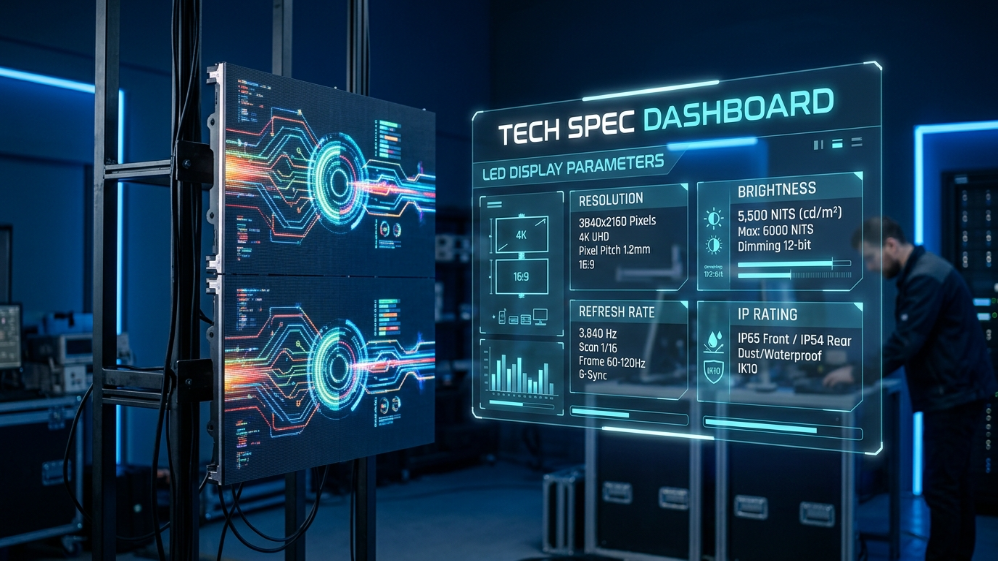
The table below consolidates the key engineering parameters B2B buyers and their technical teams need when preparing specifications for an RFQ, a structural engineer’s brief, or an AV system design document. All figures represent industry-standard die-cast aluminum cabinet products from tier-one manufacturers.
| Parameter | P2.6 (Indoor) | P3.91 (Indoor/Rental) | P3.91 (Outdoor) | P4.81 (Outdoor) |
| Screen Resolution (2×1m) | ~769×384 px | ~512×256 px | ~512×256 px | ~416×208 px |
| Pixel Density | ~148,000 px/m² | ~65,400 px/m² | ~65,400 px/m² | ~43,300 px/m² |
| Peak Brightness | 800–1,200 nits | 800–1,500 nits | 4,500–6,000 nits | 5,000–6,500 nits |
| Refresh Rate | 3,840Hz | 1,920–3,840Hz | 1,920–3,840Hz | 1,920Hz |
| IP Rating | IP30–IP50 | IP30–IP50 | IP65–IP67 | IP65–IP67 |
| Cabinet Weight (500×500mm) | 7–8 kg | 7.5–9 kg | 9–12 kg | 10–14 kg |
| Total Screen Weight (8 cabs) | 56–64 kg | 60–72 kg | 72–96 kg | 80–112 kg |
| Peak Power (full screen) | ~480W | ~480–600W | ~600–800W | ~640–960W |
| Typical Warranty | 2–3 years | 2–3 years | 3–5 years | 3–5 years |
| Recommended Signal Processor | Novastar VX4S / MX40 Pro | Novastar VX4S | Colorlight X8 / Novastar MCTRL660 | Colorlight X8 |
Signal processor compatibility is a non-negotiable due diligence item. A 2×1 screen running P3.91 at 512×256 pixels is well within the single-output capacity of a Novastar VX4S or equivalent Colorlight unit. If your project involves tiling multiple 2×1 screens into a larger video wall—common in command center and broadcast studio builds—you will need to map your total pixel load against the processor’s maximum output resolution before finalising hardware specifications.
How to Sourcing a 2×1 LED Screen: OEM, Wholesale, and Custom Manufacturing
What to Evaluate Before Issuing an RFQ
The LED display manufacturing landscape is stratified. Tier-one suppliers (Leyard, Absen, Unilumin) carry premium pricing and enterprise-grade after-sales infrastructure. Tier-two OEM factories in Shenzhen and Guangzhou offer equivalent core panel quality at 25–45% lower cost but require more rigorous pre-qualification on the buyer’s side.
Before contacting any supplier, assemble the following specification document:
-
Physical dimensions (confirm 2000mm×1000mm, not cabinet-count notation)
-
Pixel pitch and LED chip brand (Nationstar, San’an, and Kinglight are the industry-standard tier-one LED die suppliers—insist on written confirmation)
-
Cabinet material (die-cast aluminum, not extruded—die-cast provides superior thermal management and dimensional precision for seamless tiling)
-
Refresh rate minimum (state 3,840Hz if content will be filmed)
-
IP rating matching deployment environment
-
Certifications required for your market (CE for Europe, FCC for North America, RoHS for both)
-
Warranty terms and in-country service coverage
The single most common procurement failure we encounter is buyers accepting a quote that specifies “SMD LED” without confirming the LED die brand and the driver IC. A P3.91 screen using generic driver ICs will develop grayscale uniformity issues within 18 months of operation. Insisting on ICN2053, ICN2153, or MBI5153 driver ICs in your RFQ specification costs you nothing and eliminates an entire category of field failure.
Total Cost of Ownership vs. Purchase Price
Purchase price is the least useful number in a 2×1 LED screen procurement decision. The relevant metric is cost per operational hour over the asset’s service life—typically 5 years for rental inventory and 7–10 years for permanent DOOH or architectural installations.
A P3.91 rental screen priced at $180/m² with a 2-year warranty and no local service network will cost more over five years than a $240/m² equivalent with a 3-year warranty, accessible spare modules, and a manufacturer-certified repair centre within your operating region. Factor in the cost of one complete screen replacement versus one service contract, and the arithmetic becomes straightforward.
Frequently Asked Questions About 2×1 LED Screens
Q1: What resolution does a 2×1 LED screen have at P3.91 pixel pitch?
At P3.91, a 2000×1000mm screen delivers approximately 512 pixels wide by 256 pixels tall—a total of 131,072 pixels. This is sufficient for full-motion video, live feed display, and branded content playback at viewing distances of 4 meters and beyond. For 4K source content, the signal processor will downscale the feed to match the screen’s native resolution; confirm your processor supports seamless scaling without frame-rate penalty.
Q2: Can a 2×1 LED screen be used outdoors permanently?
Yes, with the correct product specification. Outdoor permanent installations require a minimum IP65 rating (dust-tight and water jet-resistant), die-cast aluminum cabinets with sealed module connections, and a brightness rating of at least 4,500 nits. Front-access service design is strongly recommended for permanent wall-mount builds where rear access is physically impossible after installation.
Q3: How many 500×500mm cabinets make up a 2×1 meter LED screen?
Eight cabinets arranged in a 4-wide×2-tall grid. If using 1000×500mm cabinets, four panels in a 2-wide×2-tall grid produce the same 2000×1000mm physical output. Confirm the cabinet format with your supplier before issuing a purchase order—the assembly method and cabling topology differ between the two configurations.
Q4: What content aspect ratio should I produce for a 2×1 LED screen?
2:1 (sometimes listed as 18:9). Standard 16:9 video will display with black bars on the left and right edges, or be stretched to fill the screen with visible distortion. All creative assets—video, static graphics, and data visualisations—must be purpose-built at the screen’s native resolution (e.g. 512×256 for P3.91). Brief your content team before production begins; retrofitting 16:9 creative for a 2:1 screen mid-campaign is an avoidable cost.
Q5: Is a 2×1 LED screen compatible with standard video processors like Novastar and Colorlight?
Yes. The 2×1 format’s pixel count falls comfortably within the output capacity of mid-range units from both ecosystems. A Novastar VX4S handles up to 1,300,000 pixels per output card—a P3.91 2×1 screen’s 131,072 pixels represents roughly 10% of that capacity, leaving substantial headroom for scaling to larger configurations or adding a secondary screen to the same processor output.
Expert Verdict
The 2×1 LED screen is one of the most underspecified formats in the B2B display market—which is precisely why the buyers who understand it hold a commercial advantage over those who default to 16:9 for every project.
Three decisions will determine whether your investment performs over its operational life: pixel pitch matched to actual viewing distance (not aspirational resolution), LED die and driver IC specification confirmed in writing before purchase, and brightness rated for the installation environment with a 15–20% operational headroom above the minimum published requirement.
For rental fleet operators, P3.91 on a 500×500mm die-cast aluminum cabinet is the correct starting point. For permanent DOOH or architectural installations, P3.91 outdoor with IP65, front-access service, and a supplier-backed 3-year warranty is the specification that holds up under financial scrutiny. Everything else is a variable you adjust to budget—but those three anchor points are non-negotiable.
Get those right, and a 2×1 LED screen is not a compromise format. It is a precision tool.
References:
AVIXA DISCAS Standard (Display Image Size for 2D Content in Audiovisual Systems)
OAAA Digital Out-of-Home (DOOH) Digital Billboard Recommended Standards & Creative Guidelines