Based on 2026 market testing, the procurement cost for a standard DJ LED screen (4m × 3m, P3.9 indoor rental grade, 3840Hz high refresh rate, aluminum alloy cabinet) is approximately $600 – $950 per square meter, with the total system price ranging from $15,000 to $30,000. High-end P2.5 configurations or custom DJ booths can reach $1,000 – $1,500 per square meter, with total prices exceeding $30,000 – $50,000. The final price depends on pixel pitch, screen scale, refresh rate, and cabinet portability—this article will break them down one by one to prevent you from overspending by 30% to 50%.
As an engineer with 10 years of experience as an LED display product manager, I have seen too many DJ nightclubs and touring teams look only at the “unit price” during the budget phase, only to see their TCO (Total Cost of Ownership) double later on. This article is not a sales pitch; it is about the real cost logic to help you spend every dollar where it counts.
How Does Pixel Pitch Dictate 80% of the Price Ceiling for DJ LED Screens?
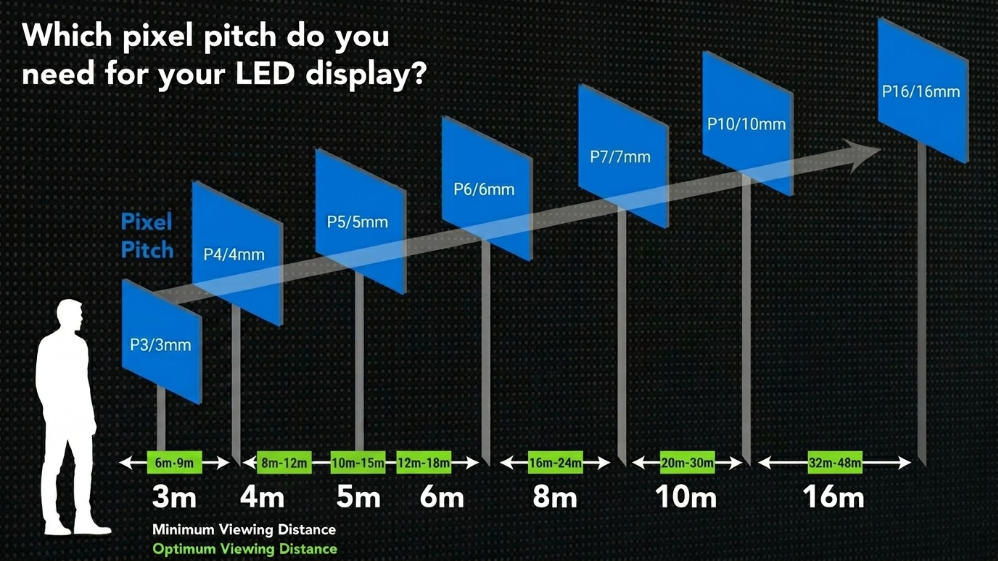
In DJ scenarios, the audience is often only 2–5 meters away from the screen, sometimes even leaning against the DJ booth. This directly determines that Pixel Pitch is the core variable of price—it is not just “clarity,” but a comprehensive reflection of the number of LED lamps, driver IC precision, and SMT (Surface Mount Technology) processes.
Why is fine pitch 80% more expensive or higher?
-
Exponential Increase in Lamp Density: P3.9 has about 65,000 lamps per square meter; P2.5 jumps directly to 160,000 lamps, and P1.8 exceeds 300,000. Lamp beads account for 40%–55% of the cost; when the quantity doubles, the unit price naturally doubles.
-
Packaging Process Premium: Standard SMD2121 is sufficient for some uses, but for close-range DJ setups, anti-collision and moisture-proofing require GOB (Glue On Board) or COB packaging. These processes are complex with lower yields, adding 20%–35% to the cost.
-
Driver and Cooling Chain Upgrades: Fine pitch requires higher grayscale (above 16-bit) and precision constant-current driver ICs. Heat dissipation design must also upgrade from passive fans to aluminum alloy thermal conductivity, indirectly pushing up BOM costs by 20%.
2026 Mainstream Pixel Pitch DJ Application Estimated Quote Comparison Table
(Procurement price, including NovaStar controller basic configuration, excluding installation and shipping)
| Pixel Pitch | Suitable DJ Viewing Distance | Estimated Price/sqm (USD) | Typical DJ Scenario | Why this price? |
| P4.0 | 4–10 meters | $500 – $700 | Small nightclub background wall | Fewer lamps, simple process; suitable for long distances/low budgets. |
| P3.9 | 3–8 meters | $600 – $950 | Standard DJ booth / Medium stage | Best cost-performance ratio; most commonly used in clubs. |
| P2.5 | 2–6 meters | $1,000 – $1,500 | High-end club / Touring main screen | No graininess at close range; strong high-refresh support. |
| P1.8 | 1.5–4 meters | $1,800 – $2,500 | Custom 270° immersive DJ booth | Extreme density + GOB; highest cost. |
Key Conclusion: If your DJ booth audience stands <3 meters away but you choose P4.0, no amount of money can save your reputation from “pixelated” visuals. Conversely, forcing P2.5 in a long-distance nightclub is equivalent to paying 50% more for an effect no one will see.
How Do DJ Stage Configuration Scale and Modular Design Directly Push Total Costs Up or Down?
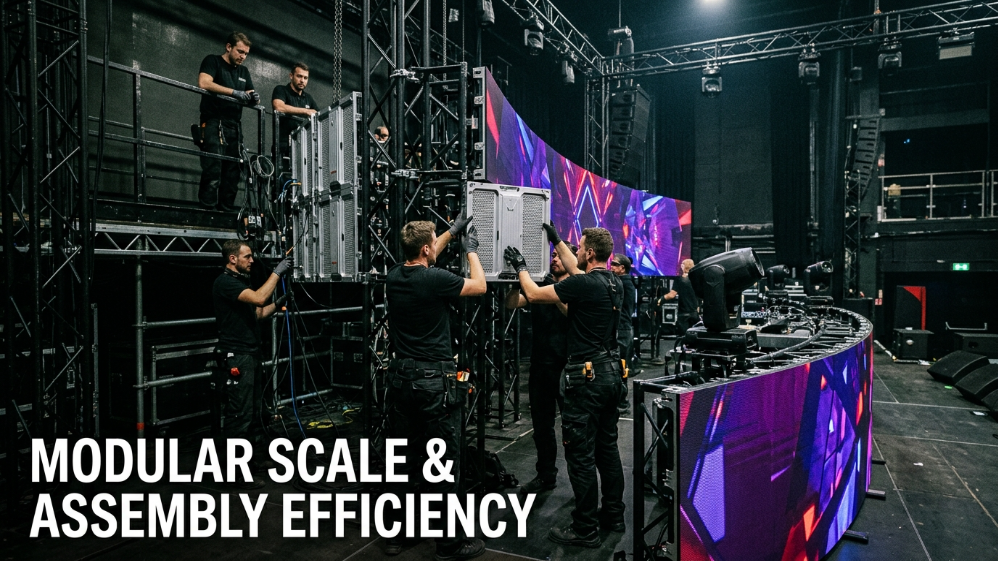
Many people assume “the larger the area, the cheaper it is,” but the DJ scene is often the opposite—small-scale customization often has a higher unit price, while large-scale standard modules benefit from economies of scale.
Real Logic Breakdown:
-
Square Footage is Linear but Not Absolute: A 4m × 3m (12㎡) standard DJ booth has the lowest procurement unit price. However, an ultra-small 2m × 1m booth, due to non-standard cutting and extra frame reinforcement, can have a unit price 15%–25% higher.
-
Cabinet Module Size Determines Setup Efficiency: Comparing 500 × 500mm vs. 640 × 640mm die-cast aluminum cabinets: the former has denser locks and faster assembly (a 5-minute setup for DJ tours), but mold and CNC precision costs are higher, making each cabinet about $30–$50 more expensive.
-
Curved/270° Immersive Premium: Nightclubs seek wraparound visuals. Curved screens require special arc cabinets + precision calibration, increasing the unit price by 40%–60% because yield rates and testing man-hours multiply.
Typical DJ Configuration Scale Cost Comparison Table
(2026 Estimated Total Procurement Price, including basic controller)
| Configuration Scale | Screen Area | Recommended Pitch | Total Procurement Cost (USD) | Price per sqm | Application |
| Small DJ Booth | 2m × 1.5m | P3.9 | $9,000 – $13,000 | $600 – $850 | Small clubs, mobile DJs |
| Standard Stage Wall | 4m × 3m | P3.9 | $15,000 – $28,000 | $600 – $950 | Main screen for med-sized clubs |
| Medium Touring Screen | 5m × 4m | P2.5 | $30,000 – $45,000 | $1,000 – $1,500 | Festivals, tours |
| Custom Immersive Booth | 3m × 2.5m Curved | P1.8 | $35,000 – $55,000 | $1,800 – $2,500 | High-end clubs |
Engineer’s Tip: Touring teams are most likely to fall into a trap here—choosing the wrong cabinet size. The labor costs and damage rates from frequent assembly and disassembly will eventually eat up all the money saved initially.
Refresh Rate and A/V Sync Technology: The “Invisible Killer” Cost Driver for DJ LED Screens
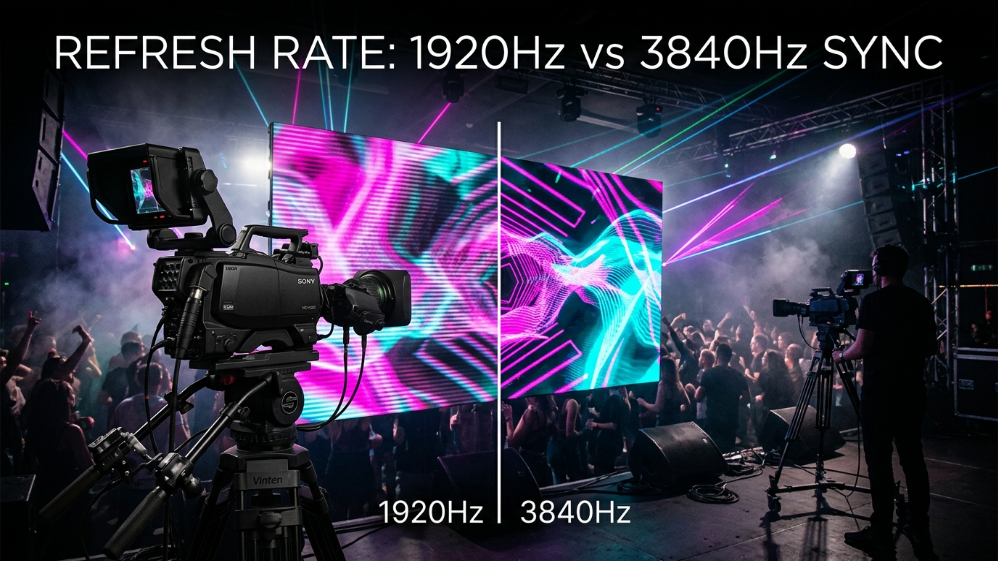
DJ performances fear “flicker” and “ghosting” the most. Refresh Rate directly affects camera filming and lighting synchronization. A low refresh rate under music beats and lasers creates moiré patterns, which can ruin the live effect.
Why is high refresh rate expensive?
-
3840Hz vs. 1920Hz: The former requires higher-frequency driver ICs and stronger power management. Chip and PCB layers increase, raising costs by 25%–40%.
-
7680Hz Top Configuration: Only used for professional touring + multi-camera live streaming. Includes 16-bit grayscale + low-latency processors, adding another 30% to the price.
-
NovaStar Controller Matching: VX4S/VX1000/MCTRL660 series support high refresh + DMX/Resolume synchronization. The controller itself costs an additional $2,000–$5,000, and firmware debugging hours are expensive.
The Truth About High Refresh Rate Costs:
-
1920Hz: Sufficient for daily nightclubs, but cameras easily catch ghosting; suitable for budget-conscious projects.
-
3840Hz: The DJ standard; no flicker + music sync; best cost-performance ratio.
-
7680Hz: Essential for high-end music festivals, but TCO for power consumption and cooling will also rise.
Cabinet Portability and Touring Durability Design—The Most Easily Ignored but Expensive Cost Black Hole for Mobile DJs
Mobile DJs and touring teams prioritize “5-minute setup and quick teardown,” but this makes cabinet design the most underestimated cost black hole. Why is lightweight durability expensive? It involves material science, mechanical precision, and long-term impact resistance.
-
Die-cast Aluminum vs. Iron Cabinet: An aluminum cabinet weighs only 15kg (vs. 25kg for iron). Touring logistics save 30% in fees, but CNC precision machining and mold amortization make the cabinet $30–$50 more expensive.
-
Fast Locking System: High-precision mechanical locks support over 5,000 repeated assemblies. Standard screw structures cannot keep up with DJ touring rhythms, adding $60–$80 per cabinet.
-
IP40/IP54 Protection + Anti-vibration Design: Humid nightclub environments and stage vibrations require sealing strips and reinforced ribs. This complexity adds a 15%–25% cost premium.
-
Rental Grade vs. Fixed Installation Grade: Rental cabinets require higher-strength aluminum and buffering designs. They are 20% more expensive initially, but damage rates decrease by 40% over a five-year lifecycle.
Engineer’s Tip: Many teams choose iron cabinets to save a few thousand dollars initially, only to find they deform after one tour transport. Repair fees quickly consume the “saved” budget.
DJ LED Screen TCO Lifecycle: 7 Hidden Costs No One Else Writes About
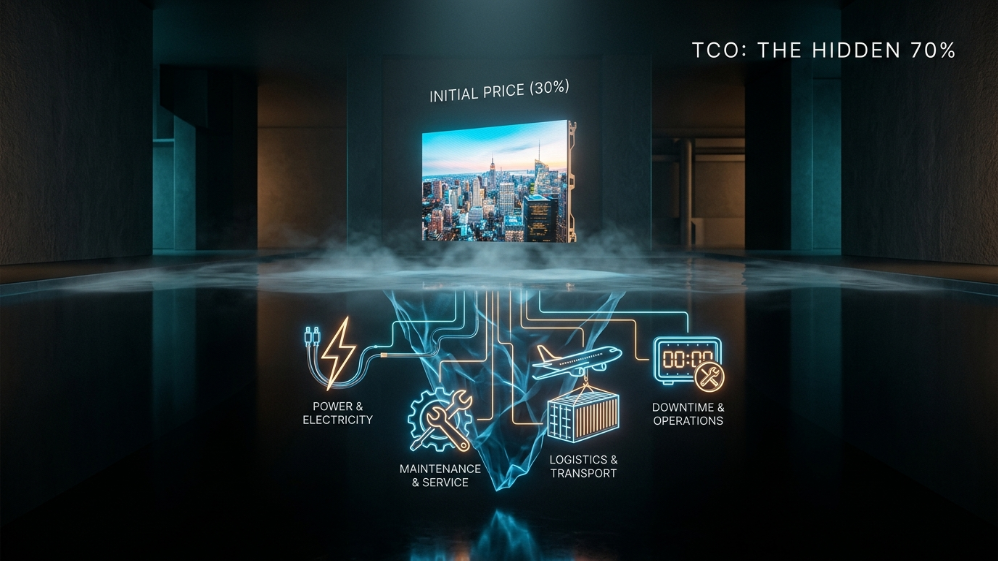
The purchase price is just the starting point. In DJ scenarios, the TCO (Total Cost of Ownership) is often 1.5 to 2 times the initial price. The following 7 hidden costs are completely ignored by most buyers when budgeting:
-
Transport and Frequent Assembly Wear: For 10–15 shows a year, with a 0.5%–2% panel damage rate per show, cumulative repairs and labor can reach 15%–25% of the initial price.
-
Power Consumption: 3840Hz high refresh + nightclub high-brightness mode can cost an extra $0.5–$1 per sqm per hour in electricity, easily totaling thousands of dollars annually.
-
Content Production Software Licensing: Resolume Arena + DMX sync licenses cost $2,000–$5,000 per year; without them, precise music-beat mapping is impossible.
-
Operational Training and Tech Support: On-site training for a DJ team for 1–2 days costs $2,000, with remote troubleshooting adding $1,500 annually.
-
Spare Parts Inventory and Mid-show Failures: Critical driver IC spare parts inventory + the loss of one hour of showtime (ticket/drink revenue) can reach $3,000–$8,000 per occurrence.
-
Insurance and Claims: Professional performance insurance covering LED screens costs $500–$1,500 annually. Long claim cycles can also affect the next show.
-
Tech Obsolescence and Storage: With Mini-LED becoming popular in 2–3 years, old screens depreciate by 30%. Professional flight case storage fees add another $2,000+ per year.
These costs are magnified in high-frequency DJ touring and nightclub usage scenarios, far exceeding ordinary fixed installation projects. Teach you how to choose a DJ display that’s right for you.
Simulated Scenario Case Study—24-Month TCO and ROI for a 4m × 3m P3.9 DJ Screen in a Medium Nightclub
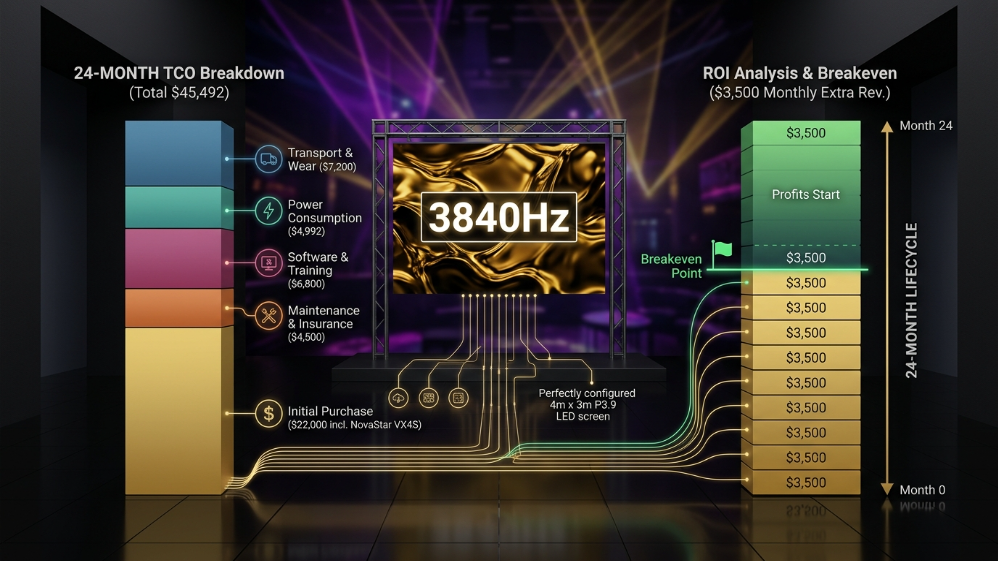
Assume a medium-sized nightclub in Los Angeles purchases a standard 4m × 3m P3.9 set (3840Hz, aluminum rental cabinets):
Initial Purchase Cost: $22,000 (including NovaStar VX4S controller).
24-Month TCO Full Breakdown (Unit: USD)
| Item | Cost Detail | 24-Month Total |
| Initial Purchase | $22,000 | $22,000 |
| Transport + Wear | 3 events per year × $1,200 | $7,200 |
| Power Consumption | $0.8/hr × 20 hrs/week | $4,992 |
| Software + Training | Resolume License + Training | $6,800 |
| Maintenance + Insurance | Spare parts + Premiums | $4,500 |
| TCO Total | – | $45,492 |
ROI Analysis: This screen brings in approximately $3,500 in additional monthly event revenue (tickets + drinks). It breaks even in 18 months, and by the 24th month, it earns a net profit of approximately $38,500. If a P2.5 immersive setup were chosen (50% more expensive initially), the TCO would be higher, but a high-end club could break even in 14 months through VIP area premiums.
FAQ
Q1: Is P3.9 or P2.5 better for a nightclub DJ LED screen?
P3.9 offers the best cost-performance for 3–8 meter viewing distances, fitting most clubs. P2.5 is only worth it if the audience is <3 meters away; it costs 50%–60% more but provides much better clarity at close range. Choosing the wrong pitch affects your reputation; measure your actual distance before deciding.
Q2: Is it better to rent or buy a DJ LED screen?
Touring teams are advised to rent ($80–$150/sqm per day), as it is flexible and includes maintenance. For fixed nightclubs with frequent events, buying yields a lower TCO within 24 months. However, factor in storage and depreciation; most medium clubs break even in 18–24 months.
Q3: Is there a big difference between 3840Hz and 1920Hz refresh rates for DJ sets?
The difference is massive. 1920Hz easily causes moiré patterns and camera ghosting under music and lasers, ruining livestreams. 3840Hz is the DJ standard, perfectly syncing with beats and avoiding flicker. It costs only 25% more and is highly recommended for touring and streaming.
Q4: Why is custom small DJ booth pricing higher than a standard stage wall?
Small 2m × 1.5m booths use non-standard cutting, reinforced frames, and curved processes, making the unit price 15%–30% higher. A standard 4m × 3m setup has better economies of scale and modularity. Confirm viewing distances early, as later modifications are even more expensive.
Looking only at the initial unit price is a major trap—the real cost of a DJ screen lies in subsequent frequent use, synchronization technology, and durable design, with TCO often far exceeding the purchase price. Since installation environments and viewing distances vary greatly, please contact our engineering team for a precise, free custom quote.
References:
AVIXA IOTA (Industry Outlook and Trends Analysis) Report
Journal of the Society for Information Display – Emissive Display Cost Metrics