If you’re sourcing LED screens in Miami for a trade show, a permanent DOOH installation, or a corporate lobby—the decision tree matters more than the product catalog. Here’s the condensed answer before we go deep:
| Your Situation | Recommended Path | Key Spec Priority |
|---|---|---|
| One-time or infrequent events | Short-term rental | Brightness ≥3,500 nits (indoor), pixel pitch P2.9–P3.91 |
| Recurring events (6+/year) | Lease or purchase | TCO analysis + warranty SLA |
| Outdoor DOOH/billboard | Permanent purchase | ≥5,500 nits, IP65, P6–P10 |
| Corporate lobby/boardroom | Permanent installation | Fine pitch P1.2–P1.8, high refresh rate ≥3,840 Hz |
| Retail/hospitality façade | Purchase or long-term lease | UV-resistant cabinet, remote CMS integration |
Miami is not a forgiving market for underpowered LED technology. The combination of intense subtropical UV radiation, ambient temperatures regularly above 90°F, hurricane-season humidity, and one of the highest concentrations of competing visual stimuli in the United States means that a screen spec that performs flawlessly in Chicago will fail—visually and mechanically—within 18 months on Biscayne Boulevard.
Why Miami Is One of the Most Demanding Markets for LED Screen Performance
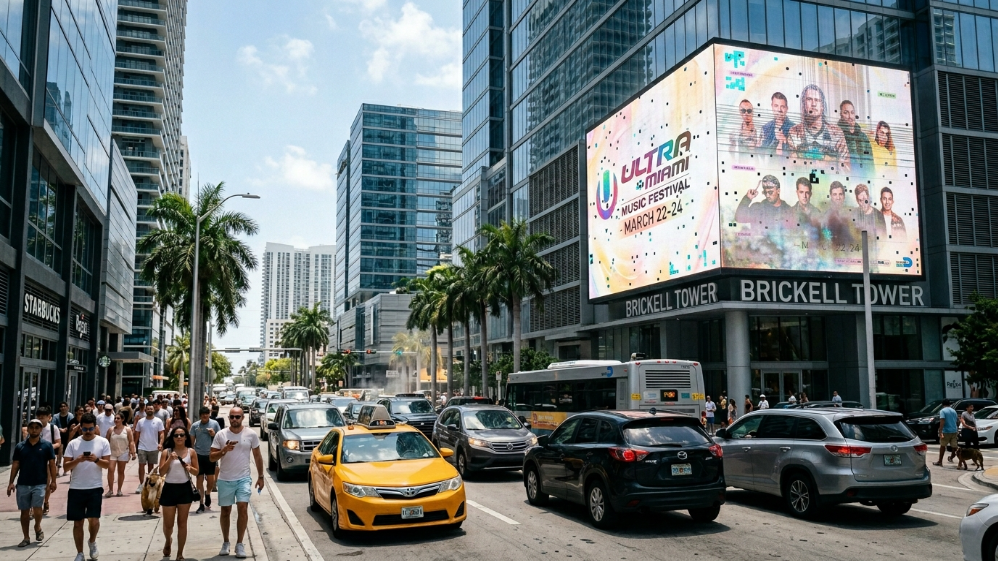
Most procurement teams learn this the hard way. Based on field deployments across South Florida, the single most common mistake B2B buyers make is importing a spec sheet designed for a northern U.S. or European climate and applying it directly to a Miami installation. The consequences range from washed-out images under direct afternoon sun, to cabinet corrosion from salt air exposure within 24 months, to thermal throttling that cuts screen brightness by 30–40% during peak afternoon hours—precisely when foot traffic and advertising impressions are highest.
Miami’s event economy compounds this. The city hosts over 300 major conventions, trade shows, and corporate events annually, with venues including the Miami Beach Convention Center, Mana Wynwood, and the James L. Knight Center driving consistent, high-volume demand for LED screens across both permanent and temporary deployments. For system integrators and event production companies operating in this market, equipment failure is not an inconvenience—it’s a contract-ending liability.
How Miami’s Climate Shapes Your LED Screen Specification
The engineering baseline for any outdoor LED screen in Miami starts with brightness. A screen rated at 3,500 nits—adequate for overcast northern climates—will appear noticeably dim in direct Florida sunlight. The practical minimum for outdoor-facing installations in Miami is 5,000 nits, with premium DOOH deployments (roadside billboards, building façades on high-traffic corridors) specifying 5,500–6,000 nits to maintain contrast and color accuracy across all daylight conditions.
Weatherproofing Requirements
Weatherproofing is equally non-negotiable. The IP (Ingress Protection) rating defines how well a screen’s cabinet resists moisture and particulate intrusion. An IP54-rated panel—common in budget-tier outdoor screens—offers splash resistance. It is insufficient for Miami.
Any outdoor deployment in South Florida should require a minimum IP65 rating on both the front and rear panels, providing full dust-tight protection and resistance to direct water jets. During hurricane season, this distinction is the difference between a functioning asset and a $40,000 insurance claim.
Thermal Management Considerations
Thermal management deserves equal attention. LED screens generate substantial internal heat, and Miami’s ambient temperatures accelerate LED junction degradation. Screens without active cooling systems or intelligent thermal throttling will experience accelerated lumen depreciation—the gradual reduction in brightness over the panel’s lifetime.
High-quality commercial-grade panels designed for tropical climates typically use aluminum die-cast cabinets with internal fan arrays and thermal sensors, maintaining stable brightness output even at sustained ambient temperatures of 95°F+.
How to Choose the Right Pixel Pitch for Your Miami Application
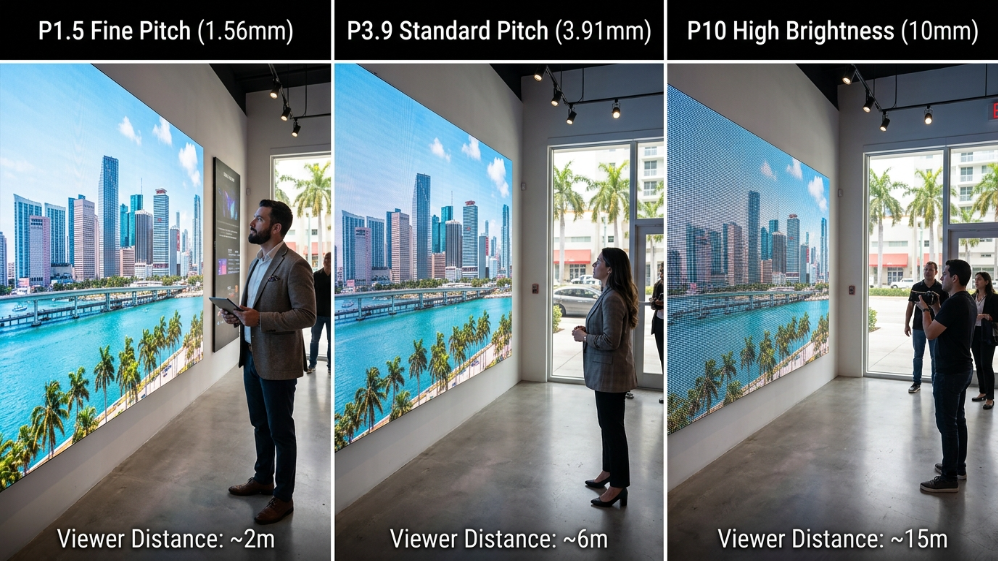
Pixel pitch is the specification that determines everything—resolution, viewing distance, cost, and the physical scale of your installation. It is expressed in millimeters and represents the distance between the center of one LED cluster and the next.
Smaller pitch = higher resolution = higher cost per square meter.
The practical rule: your minimum viewing distance in feet roughly equals your pixel pitch in millimeters multiplied by 10. A P3.91 screen delivers acceptable resolution from approximately 13 feet and beyond. A P1.5 fine-pitch screen is designed for viewing at 5 feet or closer—ideal for control rooms, broadcast studios, and executive boardrooms.
| Application Type | Recommended Pixel Pitch | Typical Miami Use Case | Min. Brightness |
|---|---|---|---|
| Outdoor Billboard/DOOH | P8–P16 | I-195 corridor, SR-112 Airport Expressway | 5,500 nits |
| Outdoor Event Stage | P3.91–P6 | Ultra Music, Art Basel activations | 4,500 nits |
| Trade Show Booth (under 400 sqft) | P2.5–P3.91 | Miami Beach Convention Center exhibitor floor | 1,000–1,500 nits |
| Corporate Lobby/Reception | P1.8–P2.5 | Brickell financial district offices | 800–1,200 nits |
| Broadcast/Virtual Production | P1.2–P1.5 | Miami film studios, live event backdrops | 600–1,000 nits |
| Retail Storefront (window-facing) | P2.5–P4 | Wynwood, Lincoln Road, Design District | 2,500–4,000 nits |
The Cost of Choosing the Wrong Pixel Pitch
The commercial implication of getting pixel pitch wrong runs in both directions.
Over-Specifying
Over-specify—purchasing P1.5 fine-pitch panels for a tradeshow backdrop viewed from 20 feet—and you’ve spent 60–80% more than necessary with zero visible quality gain to your audience.
Under-Specifying
Under-specify—deploying P10 panels for an indoor corporate event at 15-foot viewing distances—and your brand presentation will look pixelated, undermining the investment entirely.
According to data from the Direct View LED industry (InfoComm/AVIXA market reports), mismatched pixel pitch is cited as the primary cause of dissatisfaction in over 35% of first-time commercial LED screen purchases. For B2B buyers in Miami’s competitive event and advertising landscape, that number carries real reputational and financial weight.
Rent vs. Buy vs. Lease—Which LED Screen Model Makes Financial Sense in Miami?
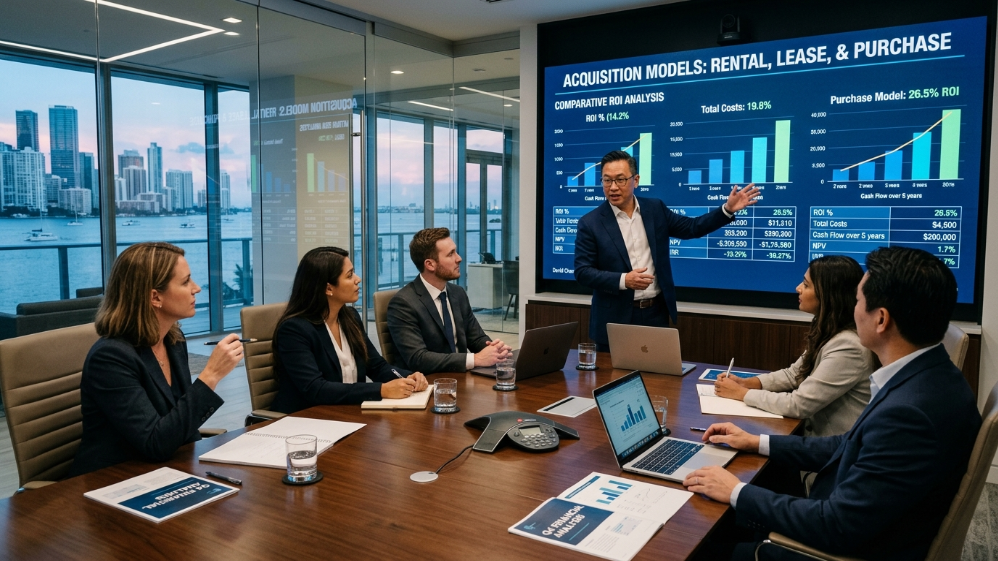
This is where most B2B procurement decisions stall. The rental vs. purchase debate is rarely about upfront cost—it’s about utilization rate and risk tolerance.
A useful threshold from field experience: if your organization deploys LED screens in Miami six or more times per year, the annualized cost of rentals almost always exceeds the TCO of ownership within 24–30 months. Below that frequency, rental keeps capital free and eliminates maintenance liability—a legitimate strategic choice, not a compromise.
Permanent Installations
For permanent DOOH operators and multi-venue integrators, the calculus shifts entirely toward purchase. A high-quality outdoor LED billboard panel—IP65-rated, 5,500 nits, P8 pitch—carries a lifespan of 7–10 years with routine maintenance.
Amortized against rental rates for equivalent screen area in the Miami market, ownership generates positive ROI typically within 18–24 months of continuous deployment.
Leasing Programs
Leasing programs occupy a strategically underutilized middle ground. Several Miami-based LED suppliers and national AV distributors now offer operating leases on LED video wall systems, allowing businesses to deploy permanent-grade equipment with predictable monthly payments, technology refresh clauses at end-of-term, and maintenance bundled into the contract.
For hospitality groups, retail chains, and corporate real estate developers fitting out multiple Miami properties simultaneously, this structure preserves credit lines while delivering owned-quality performance.
| Procurement Model | Best For | Cost Profile | Risk Profile |
|---|---|---|---|
| Short-term Rental | 1–5 events/year, no storage | Higher per-use cost, zero capex | Vendor-managed risk |
| Long-term Rental (12+ months) | Seasonal campaigns, pop-ups | Mid-range, flexible exit | Moderate |
| Operating Lease | Multi-site rollouts, hospitality | Fixed monthly, capex-light | Low—refresh clause protects against obsolescence |
| Outright Purchase | DOOH, permanent installs, high-frequency events | High upfront, lowest long-term TCO | Owner bears maintenance |
| Purchase + Managed Services | Integrators, enterprises | Capex + flat monthly SLA fee | Near-zero operational risk |
Hidden Operational Costs
One cost line that consistently surprises first-time buyers: content management infrastructure. A LED screen without a reliable CMS (Content Management System) integration is a very expensive static display.
Budget for software licensing, network connectivity (especially for remote DOOH sites along Miami’s expressway corridors), and—for multi-screen networks—a NovaStar or Brompton video processing stack. These operational costs typically add 8–15% to annual TCO and are absent from most vendor quotes.
How to Evaluate an LED Screen Supplier in Miami—7 Questions Every B2B Buyer Must Ask
Miami’s LED market ranges from world-class integrators serving Fortune 500 clients to importers reselling uncertified panels with no local support structure. The price gap between them can be 40%. The reliability gap is far larger.
Ask every shortlisted vendor these questions before issuing an RFQ:
1. What Certifications Do Your Panels Carry?
Minimum requirements for commercial deployment in the U.S.: UL listing, CE marking, RoHS compliance, and FCC Part 15.
For outdoor installations, confirm IP65 on both front and rear independently—some vendors rate only the front panel.
2. Where Is Your Local Technical Support Team Based?
A vendor headquartered in Shenzhen with no Miami or South Florida field engineers is not a viable partner for time-critical event production or DOOH operations.
On-site response SLA should be contractually defined—4-hour response for live events, next-business-day for permanent installs is a reasonable baseline.
3. What Is the Actual Warranty Structure?
A headline “5-year warranty” frequently excludes LEDs, power supplies, and receiving cards—the three components most likely to fail.
Require a line-item warranty breakdown. Best-in-class suppliers warrant LED chips for 5 years, power supply for 3 years, and cabinet/structure for 10 years separately.
4. Can You Provide References From Permanent Miami Installations?
Request site visits or video documentation of operational deployments—specifically outdoor screens that have survived at least one South Florida hurricane season.
This is a non-negotiable qualification filter.
5. Do You Handle Miami-Dade Permitting?
Outdoor LED signage in Miami requires municipal permits covering sign dimensions, brightness limits (typically capped at 0.3 footcandles above ambient for residential-adjacent zones), and electrical inspection.
A supplier who leaves permitting entirely to the client is adding hidden project cost and timeline risk.
6. What Video Processing Hardware Do You Supply?
Panel quality and processor quality are inseparable. Confirm compatibility between LED receiving cards and your preferred video processing stack—mismatched hardware is a common source of refresh rate artifacts and color banding that no amount of panel-level quality compensates for.
7. What Are Your Lead Times and Inventory Depth for Miami Projects?
Custom configurations for large permanent installations carry 8–14 week manufacturing lead times from Asian fabricators.
Suppliers with local warehouse inventory in South Florida can support event deployments on 48–72 hour notice—a material operational advantage for production companies.
FAQ: What Miami B2B Buyers Are Actually Searching For
Q1: How much does it cost to rent an LED screen in Miami?
Rental pricing for LED screens in Miami varies by screen size, pixel pitch, and duration.
A standard P3.91 indoor LED wall at 10×6 feet for a one-day event typically ranges from $800–$2,500, inclusive of delivery and basic setup.
Larger configurations (20×12 feet+) for trade shows or concerts run $4,000–$15,000+ per day depending on pixel pitch and technical support requirements.
Always request all-in quotes—rigging, processing, and operator fees are frequently itemized separately.
Q2: What pixel pitch do I need for an outdoor LED billboard in Miami?
For roadside DOOH applications—highways, arterial roads, high-traffic commercial corridors—P8 to P10 pixel pitch delivers the correct resolution-to-viewing-distance ratio at the lowest cost per square meter.
Viewing distances on Miami’s expressways typically exceed 50 feet, making finer pitches an unnecessary expenditure.
Confirm minimum brightness of 5,500 nits and IP65 weatherproofing for any permanent outdoor installation.
Q3: Do I need a permit for an outdoor LED sign in Miami?
Yes. Miami-Dade County and the City of Miami both regulate outdoor digital signage under their respective sign ordinance codes.
Requirements cover maximum sign dimensions, setback distances from roadways, maximum luminance levels, and animation/transition speed restrictions.
Permitting timelines typically run 6–12 weeks. Engage a local signage consultant or work with a supplier who provides permit management as part of their turnkey service.
Q4: How long do commercial LED screens last in Florida’s climate?
A properly specified, well-maintained commercial LED screen—IP65-rated, with active thermal management—should deliver 7–10 years of operational life in South Florida conditions.
The critical variables are panel quality (L70 lumen maintenance rating, indicating the hours to 70% original brightness), installation quality, and preventive maintenance cadence.
Budget for annual cleaning and bi-annual electronics inspection as standard operating costs.
Q5: What’s the difference between an LED video wall and an LED billboard for Miami outdoor advertising?
Functionally, both use LED panel technology—the difference is scale, pixel pitch, and structural mounting.
LED video walls (typically P2.5–P4, modular, mounted on truss or wall structures) are designed for close-range viewing in event and retail contexts.
LED billboards (P6–P16, large-format, permanent structural mounts) are engineered for vehicular traffic viewing at 50–300 feet.
For DOOH advertising along Miami’s highway corridors, billboard-grade panels with high-brightness ratings and robust steel subframes are the appropriate specification.
Expert Verdict
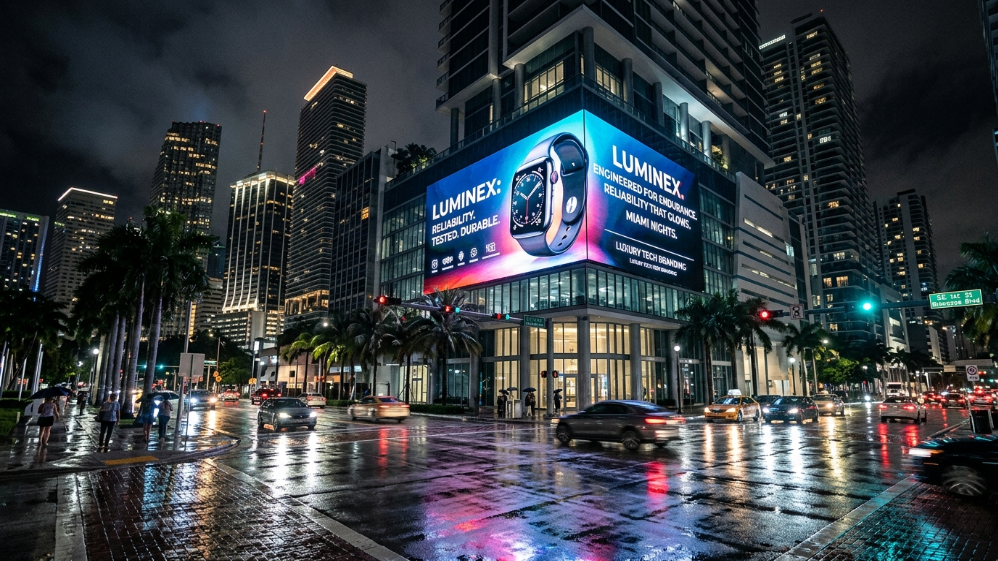
Miami rewards over-specification and punishes budget shortcuts—more than almost any other U.S. market. The climate is unforgiving, the competition for visual attention is extreme, and the cost of a failed screen during Art Basel or a major trade show cannot be recovered with a refund.
If you’re a system integrator or DOOH operator entering this market: anchor your spec to IP65, 5,500 nits outdoor minimum, and a verified local support SLA before price-shopping anything else.
If you’re an event producer: calculate your annual rental spend honestly—the crossover to ownership economics arrives faster than most budgets assume.
The right LED screen for Miami isn’t the cheapest panel that passes the spec sheet. It’s the one still running at full brightness in August, two years after installation, without a single service call.
References:
AVIXA – Audiovisual Systems Standards & Display Guidelines
UL Solutions – Safety Certification for LED Displays