Key Takeaways
- COB (Chip on Board) is an LED packaging method where bare LED chips are bonded directly onto the PCB and sealed under a single epoxy/resin layer — no individual SMD lamp housings.
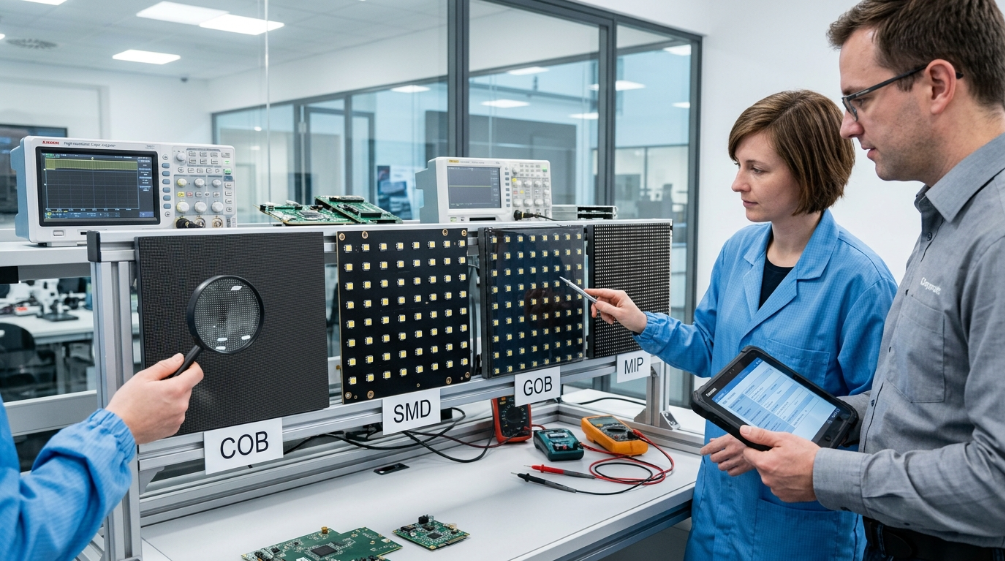
- COB is not the same technology as GOB or MIP: GOB adds a glue/resin coating over existing SMD lamps, while MIP pre-packages micro-LEDs into modular units before mounting. COB bonds bare chips directly.
- Typical COB pixel pitches run from P0.6 to P1.8mm, making it the go-to choice for control rooms, broadcast studios, and XR virtual production stages where viewers sit close to the screen.
- COB costs more per square meter than SMD at wider pitches, but the price gap narrows — and can even reverse — below P1.2, where COB’s manufacturing yield economics improve.
- Choosing COB vs. SMD vs. GOB vs. MIP depends on three variables: viewing distance, ambient environment (indoor/outdoor, impact risk), and budget — not brightness alone.
What Is a COB LED Display?

A COB (Chip on Board) LED display is an LED screen built by mounting bare LED chips directly onto the printed circuit board and encapsulating them under a single protective layer, instead of packaging each chip into an individual SMD (Surface Mount Device) lamp first.
COB ≠ SMD. In SMD packaging, each LED chip is first packaged into a small plastic lamp with its own leads, then that lamp is soldered onto the board. COB + fine pixel pitch = the current standard for premium close-viewing applications such as control rooms and broadcast sets, because removing the individual lamp housing lets chips sit much closer together, raising pixel density and eliminating the visible gaps (“screen door effect”) between pixels.
This is a different question from asking what a GOB LED screen is — GOB is a coating applied on top of standard SMD lamps, not a chip-mounting method. The two are often confused because both aim to improve durability, but they solve the problem in different ways (see the comparison table below).
How COB LED Screens Are Manufactured
Understanding the manufacturing process explains why COB behaves differently from SMD in the field:
- Chip bonding: Bare red, green, and blue LED die (often flip-chip type, mounted face-down for direct electrical contact) are bonded straight onto the PCB substrate using die-bonding equipment — no intermediate lamp package.
- Wire or flip-chip connection: Depending on the chip type, connections are made either through microscopic wire bonding or, in more advanced flip-chip COB, without wires at all — reducing failure points and improving light output.
- Common cathode / driver IC design: Many COB modules use common-cathode circuitry paired with high-refresh driver ICs, which reduces the heat generated per pixel and supports the very high refresh rates (up to 7,680Hz) required for flicker-free camera capture.
- Encapsulation: A black epoxy or resin layer is applied over the entire chip array, sealing it as a single unit. This single-surface encapsulation is what gives COB its IP54-level dust/moisture resistance and impact tolerance — but it’s also why individual pixel-level repair is harder than on SMD boards.
- Whole-panel calibration: Because COB chips can’t be pre-sorted for brightness/color consistency the way individual SMD lamps can, each finished COB module typically goes through full-panel optical calibration before shipping to guarantee uniformity.
COB vs SMD vs GOB vs MIP vs COG: Technical Comparison
LED packaging technology is not a two-way choice between COB and SMD — the market now includes GOB, MIP, and emerging COG. Here’s how they compare across the dimensions that actually affect a purchase decision:
| Dimension | SMD | GOB | COB | MIP | COG |
|---|---|---|---|---|---|
| Chip mounting | Individually packaged lamp, then soldered | SMD lamps + protective glue coating | Bare chips bonded directly to PCB | Micro-LEDs pre-packaged in modular units, then surface-mounted | Bare chips bonded to a glass substrate (not PCB) |
| Typical pixel pitch | P1.2 – P10+ | P1.2 – P10 | P0.6 – P1.8 | P0.4 – P1.0 | Below P0.1 (Micro LED territory) |
| Viewing angle | Wide, but with visible gaps up close | Wide, improved uniformity vs. SMD | Wide (up to ~160°), seamless surface | Wide, excellent color uniformity | Widest; enables transparent panels |
| Impact/moisture resistance | Lower (individual lamps exposed) | High (glue-sealed) | Highest among PCB-based options (IP54 typical) | High (sealed micro-packages) | High, but still maturing for mass production |
| Ideal viewing distance | Medium to long range | Medium range, touch-enabled displays | Short range (close-up) | Short range, premium indoor | Ultra-short range, architectural/transparent |
| Repair/maintenance | Individual lamp replacement possible | Module-level replacement | Requires specialized tools; harder pixel-level repair | Module-level, more serviceable than COB | Still limited field-repair data |
| Relative cost (per m², equal pitch) | Lowest, mature supply chain | Low-to-moderate | Higher, narrows below P1.2 | Higher, premium positioning | Highest, limited volume production |
| Best-fit application | Large-format billboards, stadium screens | Rental/touring, touch kiosks | Control rooms, broadcast/XR stages, boardrooms | Premium TVs, AR/VR, high-end conference rooms | Transparent facades, ultra-fine architectural displays |
Note: figures above are typical industry ranges, not fixed specifications — always confirm exact values against a manufacturer’s datasheet for your target pixel pitch.
Advantages and Disadvantages of COB LED Screens
Advantages
- Higher brightness uniformity: With chips mounted closer together and no individual lamp casing to diffract light unevenly, COB panels produce a more consistent surface brightness.
- Better thermal management: Direct chip-to-PCB soldering improves heat dissipation, which helps preserve LED lifespan and color stability over time.
- Smaller, more compact modules: Integrating chips onto a single board without separate brackets reduces module footprint and simplifies large-wall assembly.
- Higher IP protection: The sealed encapsulation typically achieves IP54-class dust and moisture resistance on the front surface, making COB more forgiving in touch-heavy or high-traffic environments than exposed SMD.
- Easier path to ultra-fine pixel pitch: COB is currently one of the most cost-effective ways to reach sub-P1.5 resolutions at production scale.
Disadvantages
- Lower first-pass yield: Because a single COB module can contain many thousands of chips, ensuring every one is defect-free during die-bonding is difficult, which increases manufacturing cost.
- Harder maintenance: The sealed, one-piece surface means faulty modules generally need specialized tools or full replacement rather than individual lamp swaps.
- Higher unit price at wider pitches: COB’s complex process typically costs more than SMD above roughly P1.5–P1.8, though this gap shrinks in fine-pitch segments.
Where COB LED Displays Are Used
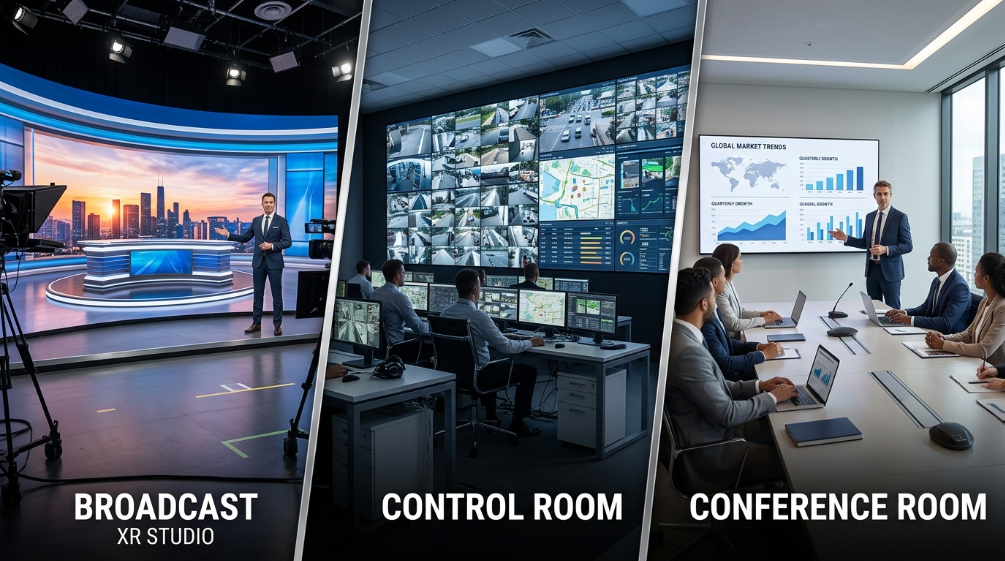
Control rooms and command centers. Long operating hours and close viewing distances make COB’s uniformity and low failure rate valuable where 24/7 reliability matters more than upfront cost.
Broadcast studios and XR / virtual production stages. This is currently COB’s fastest-growing application. Flip-chip COB panels support the very high refresh rates (commonly 3,840Hz, with premium lines up to 7,680Hz) and fine pixel pitches (typically P1.2–P2.9 depending on camera distance) needed to avoid moiré and flicker on camera. For close-up dialogue or newsroom sets, P1.2–P1.5 COB is generally recommended; for larger cinematic volumes shot from 15–30 feet away, P2.3–P2.8 is a common sweet spot.
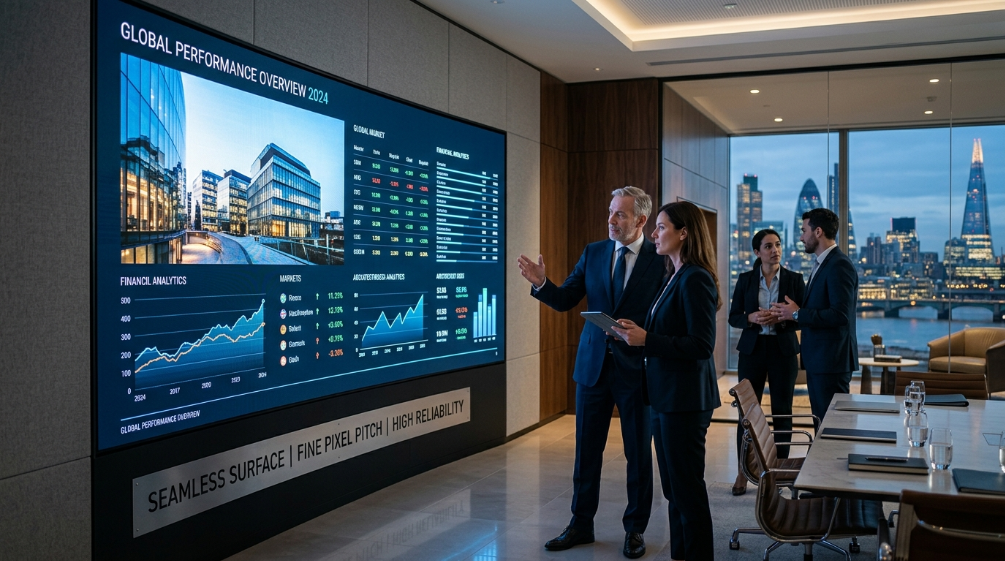
Boardrooms and premium conference rooms. Sub-P1.5 COB delivers 4K-class clarity at short viewing distances without the seams visible on wider-pitch SMD.
High-end retail and showroom displays. Uniform brightness and a seamless black surface make COB attractive for flagship brand environments where image quality drives purchase decisions.
Indoor advertising, commercial exhibitions, and stage backdrops. COB is increasingly used where budgets support fine-pitch resolution and screens are viewed from a few meters away rather than across a stadium.
What COB is generally not the best fit for: very large outdoor billboards viewed from long distances, where wider-pitch SMD or DIP remains more cost-effective, and repair simplicity matters more than pixel density.
Typical Technical Specifications
| Parameter | Typical Range |
|---|---|
| Pixel pitch | P0.6 – P1.8mm (fine-pitch); some flexible COB down to P0.93 |
| Refresh rate | 3,840Hz standard; up to 7,680Hz for broadcast/XR-grade panels |
| Grayscale | 14-bit to 22-bit, depending on driver IC |
| Brightness (indoor) | 600 – 1,200 nits typical |
| IP rating (front) | IP54 common for sealed COB surfaces |
| Viewing angle | Up to ~160° horizontal |
| Operating temperature | Approximately -20°C to 40°C |
These are typical industry figures compiled from multiple manufacturer datasheets; always request the specific spec sheet for the model and pixel pitch you’re evaluating, since values vary by supplier and driver IC generation.
How to Choose Between COB, SMD, GOB, and MIP: A Decision Checklist
Work through these questions in order — each one narrows the field:
- What’s your minimum viewing distance?
- Under 2m → COB or MIP (P0.6–P1.5)
- 2–5m → COB or SMD (P1.5–P2.6)
- Over 5m → SMD or DIP (P2.6+)
- Will the screen be touched, bumped, or exposed to dust/moisture?
- Frequently → prioritize COB or GOB for their sealed surfaces
- Rarely, controlled environment → SMD is often sufficient
- Is the display going in front of a broadcast or cinema camera?
- Yes → confirm refresh rate (3,840Hz minimum, 7,680Hz preferred) and low-latency processing regardless of packaging type
- No → refresh rate above 1,920Hz is generally unnecessary
- What’s your maintenance capability on-site?
- Limited/remote → factor in COB’s harder pixel-level repair vs. SMD’s simpler lamp swaps
- In-house technical team → COB’s maintenance complexity is a smaller concern
- What’s the budget ceiling per square meter?
- Tight budget, pitch above P2.5 → SMD is usually the most economical
- Budget flexible, pitch below P1.2 → COB pricing becomes competitive with, or cheaper than, SMD at equivalent resolution
COB LED Display Cost Considerations
Pricing varies widely by pixel pitch, brightness, refresh rate, and cabinet size, so treat any number as a starting reference rather than a quote. As a general rule, COB carries a price premium over SMD at wider pitches (above P1.8), but that gap narrows — and in some fine-pitch segments (around P1.2 and below) COB can be priced at or below comparable SMD — as manufacturing yields improve industry-wide. For large-scale projects such as virtual production volumes, total system cost also depends heavily on the control system, processor, rigging, and calibration software, not packaging technology alone. Request itemized quotes broken down by module, cabinet, control system, and installation to compare suppliers accurately.
COB LED Display FAQ
Is COB LED display better than SMD?
Neither is universally “better” — COB generally offers finer pixel pitch, better uniformity, and higher impact resistance, while SMD remains more cost-effective and easier to repair at wider pitches. The right choice depends on viewing distance and budget.
Is a COB LED screen waterproof?
COB’s sealed encapsulation typically achieves an IP54-class rating on the front surface, meaning it resists dust and splashing water, but it is not fully submersible. Confirm the exact IP rating with your supplier for outdoor or wet-environment use.
How long does a COB LED display last?
With proper thermal management, COB LEDs commonly carry rated lifespans in the range of 100,000 hours, similar to or slightly better than well-made SMD, largely due to improved heat dissipation from direct chip-to-board mounting.
Can COB LED displays be repaired on-site?
Repair is possible but more involved than SMD, since faulty chips are sealed under a single encapsulation layer. Most suppliers recommend module-level replacement rather than individual chip repair.
What pixel pitch is best for a virtual production LED wall?
For close-up shots (a few feet from camera), P1.2–P1.5 COB is common; for larger volumes shot from 15–30 feet, P2.3–P2.8 is a typical range. Exact choice also depends on camera lens and shooting distance.
Is COB LED display suitable for outdoor use?
COB is primarily designed and marketed for indoor, close-viewing applications. For outdoor installations, wider-pitch SMD with appropriate IP65-rated housing is generally the more established, cost-effective standard.
A Note on Choosing a Supplier
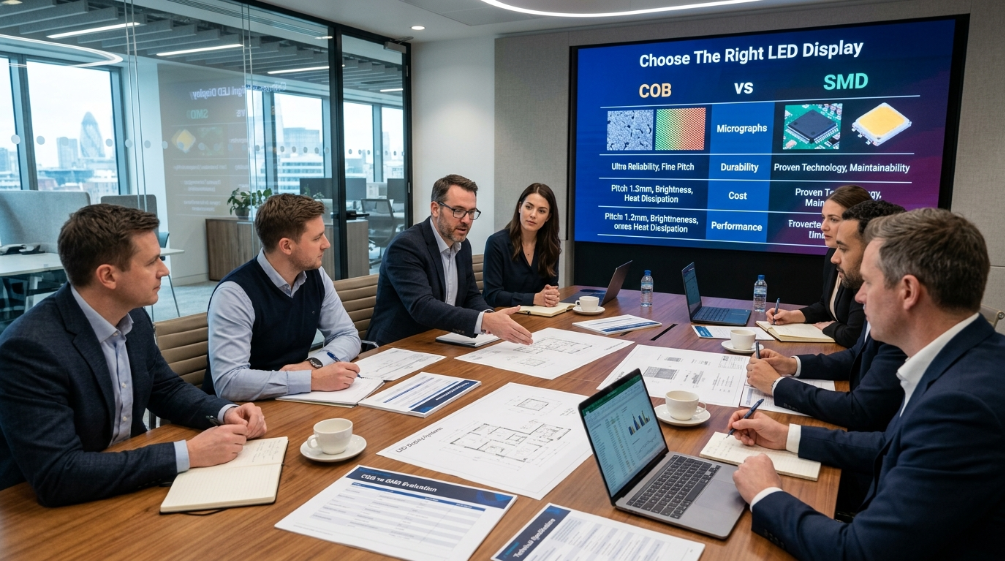
Pixel pitch and packaging type are only part of the specification. Ask any COB LED display supplier for documentation on their LED chip source, driver IC, and control system compatibility (e.g., NovaStar or equivalent), since these components — not the packaging method alone — determine real-world color consistency and long-term reliability.
Get a COB LED Display Quote
If you’re evaluating COB LED screens for a control room, broadcast studio, or premium indoor installation, our team can help match pixel pitch and specifications to your viewing distance and budget.
[Request a Quote] or [Download the COB LED Display Spec Sheet] to compare pixel pitch options against your project requirements.
References:
Investigation of the Long-Term Aging Characteristics of Chip-On-Board LEDs: Operating Lifetime Study