Quick Summary
- For outdoor use, direct-view LED displays outperform LCD in every critical performance category — brightness, viewing angle, weather resistance, and operational lifespan.
- Outdoor LED displays typically achieve 5,000–10,000+ nits of peak brightness; outdoor LCD panels top out at 1,000–2,500 nits, making them unreadable in direct sunlight without additional anti-glare engineering.
- LCD remains the cost-effective choice for semi-outdoor and indoor-facing applications — transit stations, covered walkways, retail window displays — where direct sunlight exposure is limited.
- The IP rating is the single most important specification for any outdoor display: outdoor LED panels are commonly rated IP65–IP68; standard LCD panels are rated IP54 or lower.
- In 2026, Mini LED-backlit outdoor LCD panels have narrowed the brightness gap somewhat, but cannot match direct-view LED in pixel pitch flexibility, seamless tiling, or sustained high-brightness longevity.
- Total cost of ownership over five years typically favors LED for high-brightness outdoor installations once maintenance, replacement frequency, and energy costs are factored in — despite higher upfront capital cost.
The Direct Answer: LED or LCD for Outdoor?
If you’re evaluating displays for a genuinely outdoor installation — exposed to sunlight, rain, temperature swings, and continuous operation — direct-view LED is the correct technology in the vast majority of cases.
Having reviewed specifications and performance data across hundreds of commercial outdoor display installations, the pattern is consistent: LCD panels that appear to be outdoor-rated frequently fail the real-world sunlight readability test at brightness levels below 2,500 nits, while direct-view LED panels operating at 6,000–8,000 nits remain clearly visible at midday in summer conditions.
The more nuanced question is: what counts as “outdoor”? A covered transit station concourse, a north-facing retail window, or a partially shaded venue entrance have meaningfully different requirements than a south-facing highway billboard or an open-air stadium scoreboard. That distinction determines whether LED’s higher cost is justified — or whether a well-specified LCD panel is the smarter investment.
This guide gives you the data to make that call precisely.
Understanding the Technology: What LED and LCD Actually Are
Before comparing performance, it’s worth clarifying a terminology trap that misleads many buyers.
Direct-View LED (What This Article Discusses for Outdoors)
A direct-view LED display uses individual LED clusters as the actual pixels — each point of light on the screen is an LED emitting directly toward the viewer. There is no liquid crystal layer, no backlight, no diffuser. This is the technology used in:
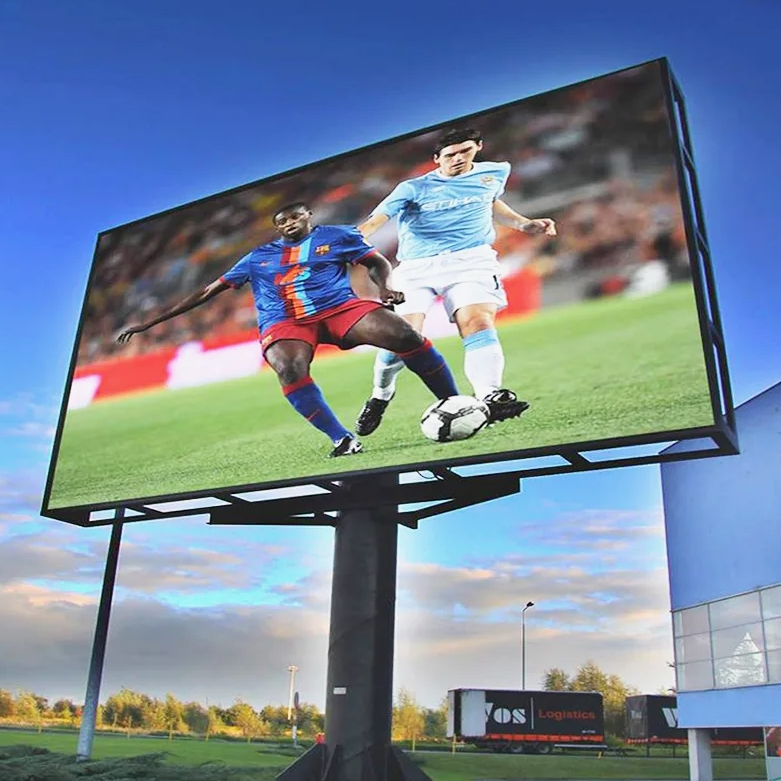
- Large outdoor billboards and building facades
- Stadium scoreboards and video walls
- Concert and event LED walls
- Highway variable message signs
Pixel pitch — the distance between LED clusters — ranges from P0.9mm (ultra-fine indoor use) to P16mm or larger (far-distance outdoor viewing). Most outdoor installations use P4mm–P10mm pitch.
LCD (Liquid Crystal Display)
An LCD display uses liquid crystal molecules sandwiched between glass layers. The crystals do not emit light — they are illuminated by a backlight (which itself uses LEDs in virtually all modern panels). The distinction matters because:
- LCD brightness is limited by how much light the backlight can push through the liquid crystal and polarizer stack
- LCD panels have fixed aspect ratios and cannot be tiled seamlessly at large sizes without visible bezels
- LCD panels require sealed enclosures for genuine outdoor use, adding complexity and cost
Modern outdoor LCD panels use high-brightness LED backlights and anti-reflective glass coatings, but they remain fundamentally limited by the LCD optical stack compared to direct-view LED.
Head-to-Head: LED vs. LCD in Outdoor Conditions
Brightness: The Make-or-Break Factor
Sunlight readability is the defining challenge for any outdoor display. The ambient illuminance of direct sunlight ranges from 10,000 to 100,000 lux. To overcome this and remain readable, display brightness must be substantial.
Direct-view LED:
- Typical outdoor brightness range: 5,000–10,000 nits
- High-brightness specialist installations: up to 15,000+ nits
- Brightness is dynamically adjustable based on ambient light sensors
- No optical stack loss — LED output goes directly to the viewer
Outdoor LCD:
- Standard outdoor-rated panels: 1,000–2,500 nits
- High-brightness specialty LCD: up to 3,500–5,000 nits (with significant heat management requirements)
- Anti-reflective coatings help but do not compensate for brightness deficit
- Optical stack (polarizers, diffusers, LC layer) absorbs approximately 60–70% of backlight output
Verdict: For open-sky outdoor environments with direct sun exposure, LED’s brightness advantage is decisive. At 2,500 nits, an LCD panel in direct afternoon sunlight in summer will produce a washed-out, low-contrast image that fails its core communication purpose.
Viewing Angle: Who Sees What and From Where
Direct-view LED:
- Horizontal viewing angle: typically 140°–160°
- Vertical viewing angle: 120°–140°
- Color and brightness are highly consistent across the full viewing cone
- No angular color shift — critical for large audiences spread across wide locations
Outdoor LCD:
- IPS-panel LCD: 170°–178° (specification), but with brightness rolloff at extreme angles
- VA-panel LCD: narrower effective viewing angle with noticeable color shift
- Anti-reflective coating helps but reflective glare at off-angles remains an issue outdoors
- Consistent brightness across wide angles is difficult to achieve without significant optical engineering
Verdict: LED maintains more consistent brightness and color across wide angles under outdoor conditions. IPS LCD matches LED on paper but underperforms in direct sunlight conditions where glare compounds angle-dependent brightness loss.
Weather Resistance: IP Ratings, Temperature Range & Structural Durability
Direct-view LED:
- Standard outdoor LED cabinets: IP65–IP66 (dust-tight, water jet resistant)
- Premium weatherproof configurations: IP67–IP68 (submersion-rated)
- Operating temperature range: typically -20°C to +60°C
- Aluminum or steel cabinets with positive pressure ventilation prevent moisture ingress
- No glass panel to crack under thermal shock or physical impact
Outdoor LCD:
- Sealed outdoor LCD enclosures: IP54–IP65
- Operating temperature range: -10°C to +50°C (tighter range due to LC fluid behavior)
- Glass front panel is a vulnerability point — thermal shock, vandalism, and debris impact risk
- Humidity and condensation management requires active climate control in many configurations
- Liquid crystal response time degrades significantly at temperatures below 0°C
Verdict: Direct-view LED is structurally more robust for genuinely harsh outdoor conditions — extreme temperature ranges, heavy rainfall, coastal humidity, and high-traffic locations where physical impact is a risk.
Energy Efficiency and Operational Lifespan
Direct-view LED:
- Power consumption: varies significantly by pixel pitch and brightness — P6 outdoor panels typically consume 400–800W per m² at full brightness
- Brightness dimming at night reduces consumption by 50–70%
- LED lifespan: 80,000–100,000 hours (approximately 9–11 years at 24/7 operation)
- Individual module replacement extends effective panel life significantly
Outdoor LCD:
- Outdoor high-brightness LCD power consumption: 300–600W per m² at rated brightness
- Backlight degradation accelerates at sustained high brightness — 50% brightness loss can occur within 3–5 years of outdoor operation
- Full panel replacement is typically required when backlights degrade, as individual backlight servicing is uneconomical
- LCD lifespan at rated outdoor brightness: 30,000–50,000 hours before significant degradation
Verdict: Modern direct-view LED and high-brightness LCD are comparable in power consumption per unit area, but LED’s dramatically longer operational lifespan before brightness degradation makes it the lower total-cost option over a 5–10 year horizon for continuous outdoor use.
Full Specification Comparison Table
| Specification | Direct-View LED (Outdoor) | Outdoor LCD |
|---|---|---|
| Peak brightness | 5,000–15,000 nits | 1,000–5,000 nits |
| Sunlight readability | Excellent (direct sun) | Moderate to poor (direct sun) |
| Viewing angle (H/V) | 140°–160° / 120°–140° | 170°–178° (spec) / effective less |
| IP rating | IP65–IP68 | IP54–IP65 |
| Operating temp | -20°C to +60°C | -10°C to +50°C |
| LED/backlight lifespan | 80,000–100,000 hrs | 30,000–50,000 hrs |
| Seamless tiling | ✅ Yes (bezel-free) | ❌ No (bezels visible) |
| Custom sizes/shapes | ✅ Modular, any dimension | ❌ Fixed aspect ratios |
| Image quality (indoors) | Good | Excellent (higher PPI) |
| Power per m² (full brightness) | 400–800W | 300–600W |
| Upfront cost per m² | Higher | Lower |
| 5-year TCO (outdoor, 12hr/day) | Lower | Higher |
| Maintenance complexity | Module-level swap | Sealed unit service |
| Content update flexibility | High | High |
| Minimum pixel pitch | P0.9mm (indoor) / P3mm (outdoor) | N/A (fixed resolution) |
Where LCD Still Wins Outdoors
LED does not win in every scenario. There are genuine outdoor and semi-outdoor use cases where LCD is the superior or more economical choice.
Covered and Semi-Outdoor Environments
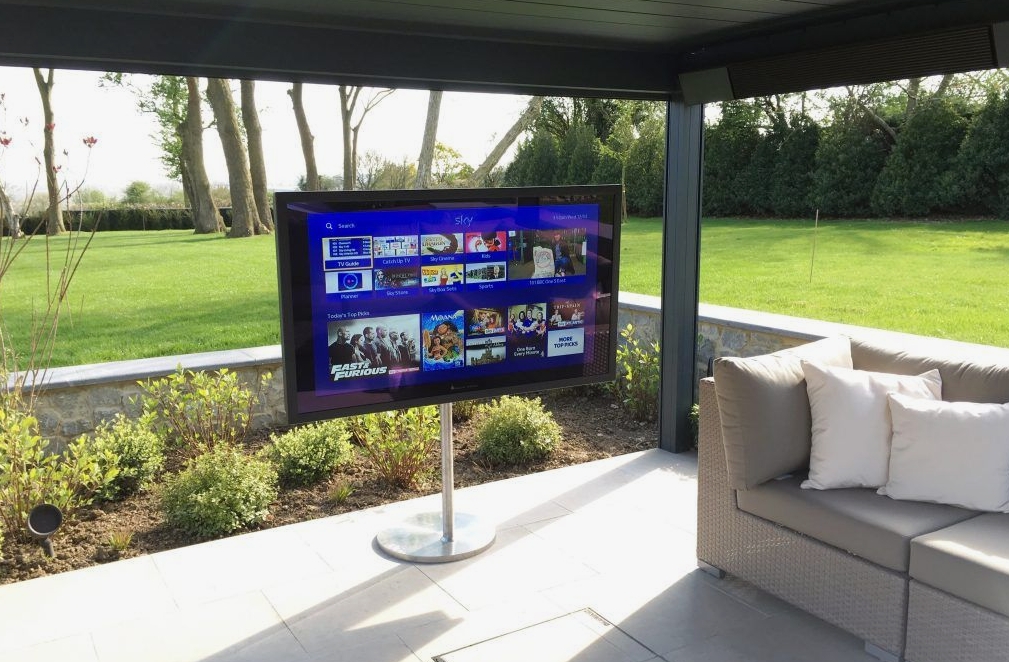
Transit station concourses, covered shopping arcades, stadium concession areas, and airport terminals are technically “outdoor” or semi-outdoor but are shielded from direct sunlight. In these environments, 1,500–2,500 nit LCD panels perform adequately and cost significantly less than equivalent direct-view LED.
Retail Window Displays
North-facing or partially shaded retail windows benefit from high-resolution LCD displays, which offer superior pixel density (PPI) at typical close-range viewing distances. An LCD display at 2–3 meter viewing distance provides sharper text and graphic detail than an equivalent-cost LED panel at the same distance.
Information Kiosks and Wayfinding
Interactive kiosks with touchscreen capability, wayfinding signage, and information terminals benefit from LCD’s superior resolution and touch overlay compatibility. Direct-view LED does not support conventional capacitive touch overlays at outdoor pixel pitches.
Budget-Constrained Short-Term Installations
For temporary outdoor installations with a deployment period under 12 months — events, pop-up retail, seasonal promotions — the lower upfront cost of outdoor-rated LCD may deliver better ROI than direct-view LED’s higher capital expenditure, even accounting for performance differences.

Real-World Applications: Which Technology Fits Your Project
LED Is the Standard Choice For:
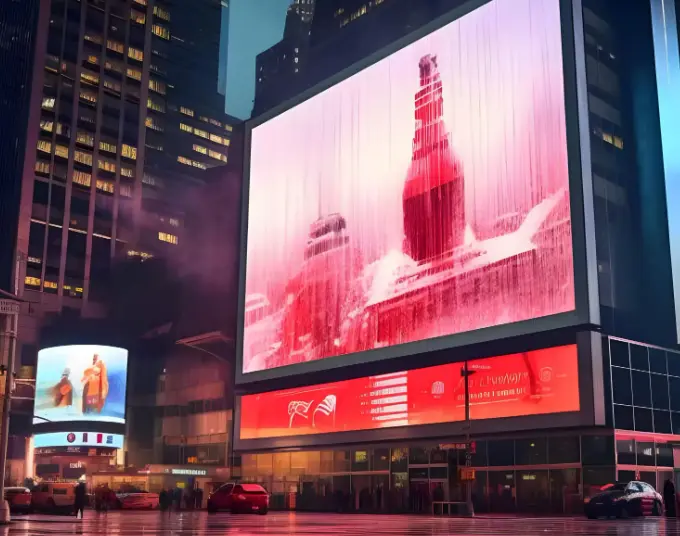
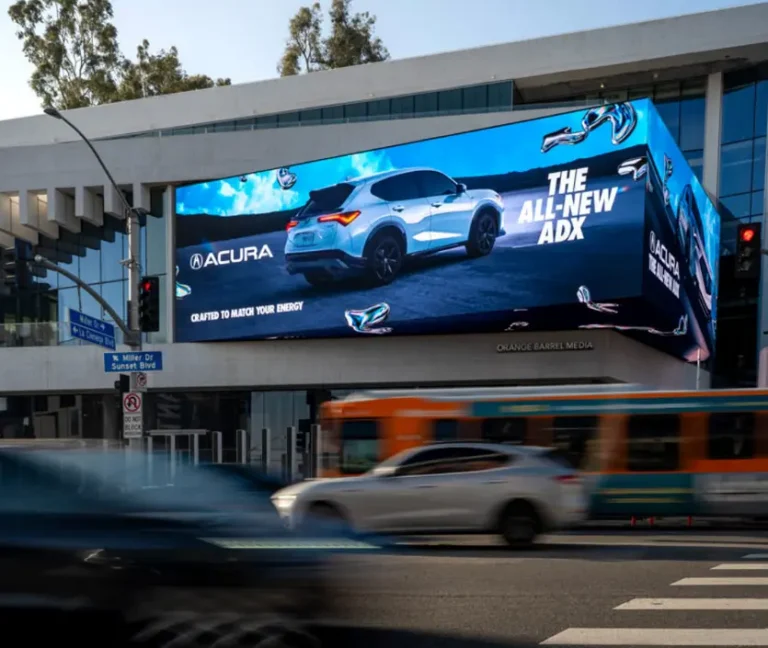
Large-Scale Outdoor Advertising Billboards High-traffic locations like Times Square, Piccadilly Circus, and Shibuya Crossing use direct-view LED exclusively. The combination of sustained high brightness (8,000+ nits), continuous 24/7 operation, and large custom sizes (often exceeding 500m²) makes LED the only viable technology. Modular cabinet construction allows maintenance of individual sections without taking the entire display offline.
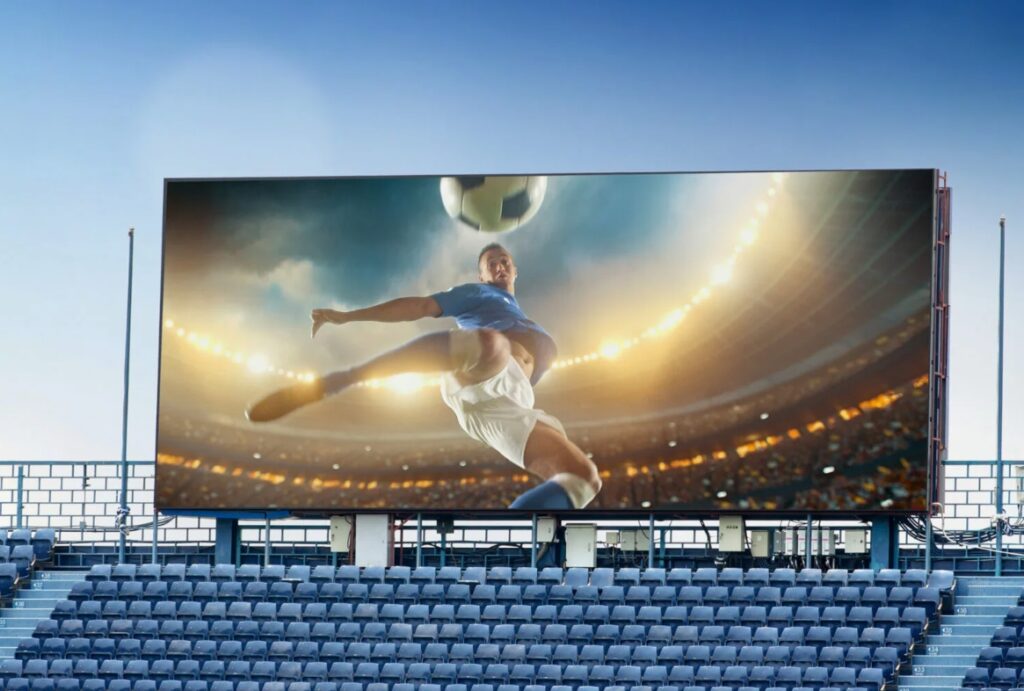
Stadium and Sports Venue Displays Scoreboards, perimeter LED ribbon boards, and video replay screens in stadiums require wide viewing angles across audiences distributed across large seating areas. LED’s 140°+ horizontal viewing angle ensures consistent image quality from every seat. High refresh rates (typically 3,840Hz or above) eliminate flicker artifacts in broadcast camera capture.
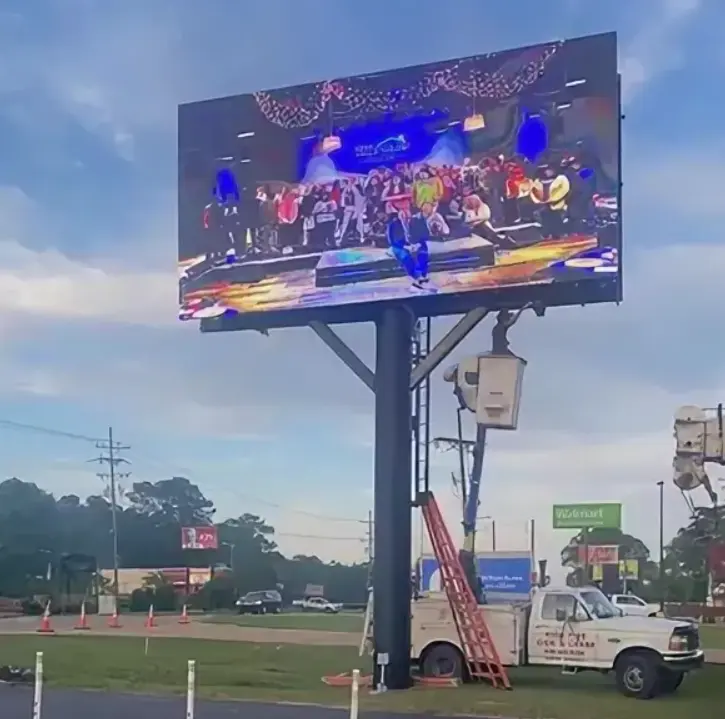
Highway Variable Message Signs and Traffic Systems Road-facing outdoor LED displays must remain readable at distances of 100–500 meters in all weather conditions. High brightness (8,000–10,000 nits), high contrast, and wide operating temperature ranges (-30°C to +65°C for specialist highway installations) are requirements that only direct-view LED meets reliably.
Concert and Live Event LED Walls Outdoor festival and concert stages use modular LED panels for their flexibility — curved configurations, rapid deployment and strike, and high brightness for daytime performances. Rental LED panels in the P3.9–P5.9 range are the industry standard for outdoor live events.
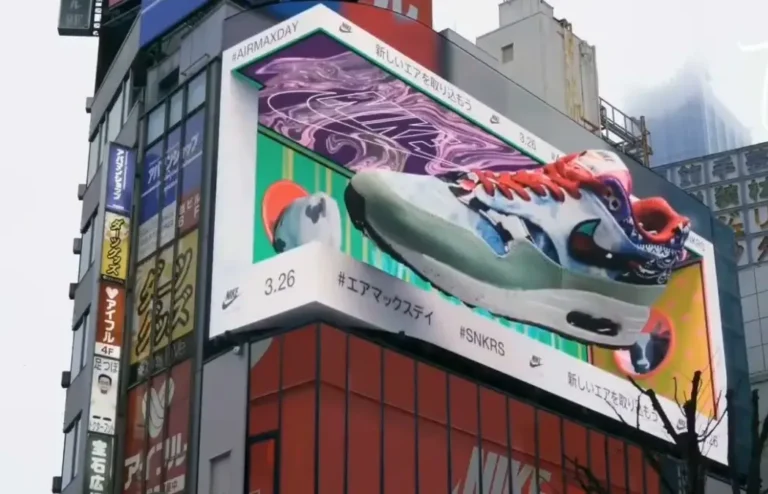
Building-Integrated and Architectural Displays Transparent LED mesh screens, curved building facades, and architectural feature lighting are exclusive to LED technology. These applications require custom form factors that LCD cannot accommodate.
LCD Is Appropriate For:
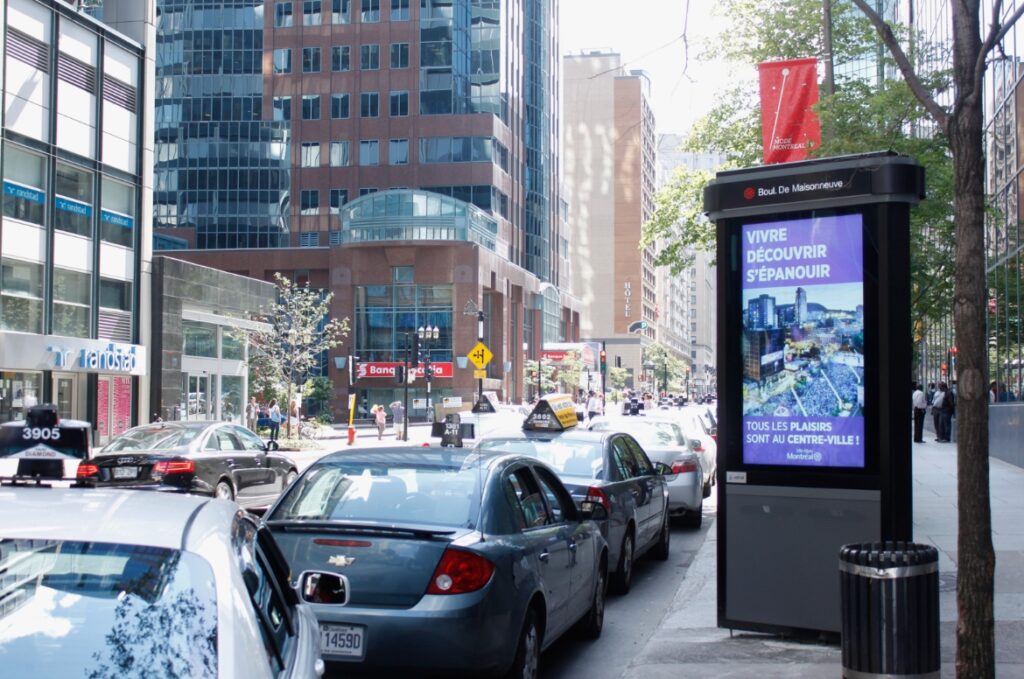
Transit Station Advertising (Covered Locations) Shanghai Metro, London Underground, and similar systems use outdoor-rated LCD panels in station environments protected from direct rainfall and sunlight. Viewing distances of 2–5 meters and controlled lighting conditions make high-resolution LCD cost-effective for advertising and information content.
Retail Window and Storefront Displays (Shaded) For brands seeking high-resolution product imagery in retail windows without direct sun exposure, outdoor-rated 55″–86″ LCD panels offer superior pixel density and color accuracy at lower cost than small-pitch LED.
Interactive Kiosks and Wayfinding Any outdoor application requiring touch interaction, QR code integration, or close-up information display benefits from LCD’s higher PPI and touchscreen compatibility.
2026 Cost & ROI Analysis
The upfront cost gap between outdoor LED and outdoor LCD has narrowed since 2022, but remains significant. The more important metric for most commercial buyers is total cost of ownership (TCO) over the installation’s operating life.
Upfront Capital Cost (Approximate, 2026 Market Rates)
| Configuration | Cost per m² (USD) |
|---|---|
| Outdoor LCD (1,500–2,500 nits, 55″) | $800 – $2,500 |
| Outdoor LCD (3,000–5,000 nits, high-brightness) | $3,000 – $8,000 |
| Outdoor direct-view LED (P6–P8, standard) | $2,500 – $5,000 |
| Outdoor direct-view LED (P4–P5, fine pitch) | $5,000 – $12,000 |
| Outdoor direct-view LED (P10+, budget) | $800 – $2,000 |
5-Year Total Cost of Ownership Comparison (Per 10m² Installation, 12 hrs/day)
| Cost Component | Outdoor LCD | Direct-View LED (P6) |
|---|---|---|
| Hardware (upfront) | $25,000 | $35,000 |
| Installation | $8,000 | $10,000 |
| Energy (5yr, $0.15/kWh) | $16,000 | $18,000 |
| Maintenance & repairs | $12,000 | $6,000 |
| Panel replacement (if needed) | $15,000 | $4,000 (module swap) |
| 5-Year TCO | ~$76,000 | ~$73,000 |
Note: These are indicative estimates for typical commercial installations. Actual costs vary by location, vendor, installation complexity, and operating hours. The LED advantage increases significantly at 18hr/day or 24/7 operation cycles.
Emerging Technologies Changing the Equation
Mini LED Outdoor LCD: Closing the Brightness Gap
Mini LED backlighting — using thousands of small LED zones for local dimming — has pushed outdoor LCD brightness into the 3,000–5,000 nit range in 2025–2026 product generations. This meaningfully improves outdoor readability in partially shaded environments, though it still does not match direct-view LED in full direct-sunlight conditions.
Samsung, LG, and AUO Optronics are the leading suppliers of high-brightness Mini LED outdoor LCD panels in 2026. These panels offer an intermediate option for buyers who need better outdoor performance than standard LCD but cannot justify direct-view LED’s capital cost.
Micro LED: The Future Convergence Point
Micro LED technology — self-emissive pixels at micron-scale, fabricated in arrays — theoretically delivers both the resolution advantage of LCD and the brightness and weather resistance of direct-view LED. Commercial outdoor Micro LED installations remain limited to flagship projects in 2026 due to manufacturing yield constraints and cost, but the technology roadmap points toward Micro LED becoming the dominant outdoor display technology by the early 2030s.
AI-Driven Adaptive Brightness
Both LED and LCD outdoor display controllers now incorporate ambient light sensors coupled with AI-driven brightness adjustment algorithms. These systems modulate output based on real-time sunlight intensity, time of day, and weather conditions — reducing energy consumption by 20–40% compared to fixed-brightness operation while maintaining readability standards. This feature is now standard in premium outdoor installations of both technologies.
Buyer’s Decision Framework
Use this decision tree before committing to either technology:
Step 1: Assess Sunlight Exposure
- Direct sun, south/west facing, minimal shade: → Direct-view LED (8,000+ nits mandatory)
- Partial shade, east/north facing, or covered: → High-brightness LCD is viable if budget-constrained
- Fully covered, indoor-facing window: → Standard outdoor-rated LCD
Step 2: Evaluate Scale and Form Factor
- Over 20m² total display area: → Direct-view LED (seamless tiling, no bezels)
- Custom shape (curved, non-rectangular): → Direct-view LED only
- Under 10m², standard rectangle: → Either technology viable based on brightness assessment
- Interactive/touch required: → Outdoor LCD (touch overlay compatible)
Step 3: Calculate Operating Hours and Horizon
- 24/7 or 18hr/day operation, 5+ year horizon: → LED TCO advantage is significant
- 12hr/day, 3-year horizon: → Cost comparison is closer; evaluate carefully
- Seasonal or short-term (<18 months): → Outdoor LCD likely offers better upfront ROI
Step 4: Check the IP Rating Against Your Environment
| Environment | Minimum IP Rating Required |
|---|---|
| Sheltered (no direct rain) | IP54 |
| Exposed to rain, standard outdoor | IP65 |
| High-pressure wash required | IP66 |
| Coastal (salt spray, high humidity) | IP67 |
| Extreme weather, flood risk | IP68 |
Verify that your chosen panel’s tested IP rating matches your environment. Manufacturer-claimed ratings versus independently tested ratings sometimes differ — request third-party IP certification documentation for high-value installations.
FAQ
Q: Can LCD screens be used outdoors at all? Yes — outdoor-rated LCD panels with high-brightness backlights and sealed IP65 enclosures are used in many semi-outdoor environments. They perform well in covered or shaded locations. They struggle in direct sunlight at brightness levels below 2,500 nits.
Q: What brightness (nits) do I need for an outdoor display? A minimum of 2,500 nits is required for partial-shade outdoor environments. Direct sunlight applications need 5,000 nits minimum — ideally 7,000–10,000 nits for south-facing installations in sunny climates. Direct-view LED panels reach these levels; most outdoor LCD panels do not.
Q: What is the IP rating and why does it matter for outdoor displays? IP (Ingress Protection) rating indicates resistance to dust and water. The first digit (6 in IP65) rates dust protection (6 = dust-tight). The second digit rates water resistance (5 = water jet resistant, 8 = submersion rated). For outdoor displays exposed to rain, a minimum of IP65 is required. Below IP65, moisture ingress will cause premature failure.
Q: Is direct-view LED more expensive than outdoor LCD? Upfront, yes — typically by 30–80% per square meter depending on pixel pitch and brightness specifications. However, over a 5+ year operating period, lower maintenance costs, longer operational lifespan, and module-level repairability make LED’s total cost of ownership competitive with or lower than outdoor LCD for high-utilization installations.
Q: What pixel pitch should I choose for an outdoor LED display? As a general rule: minimum viewing distance (in meters) × 0.5–1 = appropriate pixel pitch in mm. For a billboard viewed from 30 meters minimum distance, P10–P16 is appropriate. For a stadium video wall viewed from 10–15 meters, P6–P8 is standard. For a storefront display viewed from 5 meters, P4–P5 is recommended.
Q: How do I prevent my outdoor display from overheating? Direct-view LED panels use passive aluminum heat dissipation or active fans in high-brightness configurations. Ensure adequate cabinet ventilation clearance and avoid installations that trap heat (enclosed niches without airflow). Outdoor LCD panels require active thermal management (fans, sometimes air conditioning) in high-ambient-temperature environments. Operating beyond the rated temperature range accelerates degradation significantly.
Q: Will Micro LED replace both LED and LCD for outdoor use? Micro LED is positioned as the long-term successor to both technologies — combining direct-view LED’s brightness and durability with superior pixel density. Commercial outdoor Micro LED at scale remains expensive in 2026, but falling manufacturing costs suggest Micro LED will be the dominant premium outdoor display technology by 2030–2032.
Conclusion
For the majority of outdoor display applications — anything exposed to direct sunlight, harsh weather, or requiring continuous high-brightness operation — direct-view LED is the correct choice in 2026. Its advantages in brightness, weather resistance, lifespan, and modular scalability are not incremental differences; they are fundamental performance gaps that determine whether your display actually communicates its intended message under real outdoor conditions.
LCD remains valuable for semi-outdoor, covered, and budget-constrained applications where direct sunlight is not a primary factor. The emerging Mini LED outdoor LCD category has meaningfully narrowed the brightness gap, creating a viable middle ground for buyers who need better-than-standard outdoor LCD performance without direct-view LED’s capital investment.
When making your final specification decision, match the technology to three concrete requirements: the actual peak ambient light in your installation location, your required operating hours over the planned deployment period, and your environment’s IP rating demand. Everything else follows from those three parameters.
References:
- Omdia Global Digital Signage & Display Market Report, Q1 2026
- IEC 60529: Degrees of Protection Provided by Enclosures (IP Code)